
 Submit an article

Search
- Page Path
- HOME > Search
Research Papers
- Illness experience of head and neck cancer patients: an interpretative phenomenological analysis
- Min Ryu, Suhye Kwon
- J Korean Acad Nurs 2026;56(3):408-420. Published online August 18, 2026
- DOI: https://doi.org/10.4040/jkan.26027
-
 Abstract
 PDF
PDF ePub
ePub - Purpose
Head and neck cancer is frequently diagnosed at an advanced stage and is associated with substantial mortality. Patients also experience major physical limitations and psychosocial distress. This study explored the subjective meaning of illness experiences among patients with head and neck cancer using interpretative phenomenological analysis (IPA).
Methods
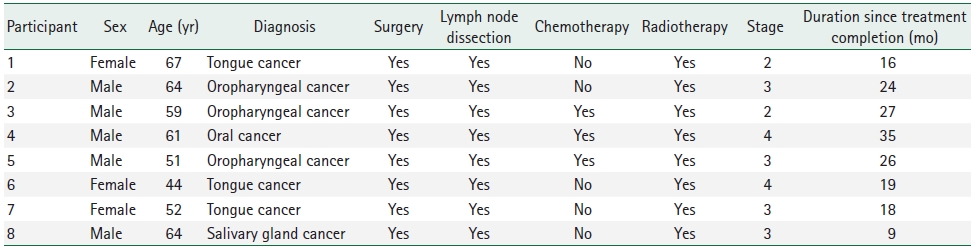
This qualitative study used IPA to examine the experiences of eight adults with stage II–IV head and neck cancer recruited from two university hospitals. All participants had undergone surgery followed by radiotherapy or chemoradiotherapy at least 6 months before data collection. Data were collected through in-depth interviews conducted from February to June 2022 and were analyzed using the cyclical IPA procedure.
Results
Four superordinate themes were identified: (1) being overwhelmed by lamentation and fear when confronting a late-diagnosed illness; (2) confronting human limitations during treatment undertaken for survival; (3) losing daily life and selfhood while living in a body that had not recovered; and (4) reconstructing life beyond the fear of recurrence. Participants experienced diagnosis and treatment as traumatic and described persistent functional impairments and painful sequelae.
Conclusion
These findings provide an in-depth understanding of the illness experiences of patients with head and neck cancer and offer evidence to inform nursing interventions that support adaptation and quality of life.
- 423 View
- 24 Download

- Lived experiences of correctional officers in treating drug offenders: a hermeneutic phenomenological approach
- Hyun-Ok Jung
- J Korean Acad Nurs 2026;56(2):233-246. Published online May 26, 2026
- DOI: https://doi.org/10.4040/jkan.25166
-
Abstract
PDFePub
- Purpose
This study explored the lived experiences of correctional officers working with individuals convicted of drug offenses.
Methods
Data were collected through individual in-depth interviews and observations with 10 correctional officers who had experience working with individuals convicted of drug offenses. Data were collected from September 15 to November 2, 2025, and analyzed using van Manen’s hermeneutic phenomenological approach to identify essential themes.
Results
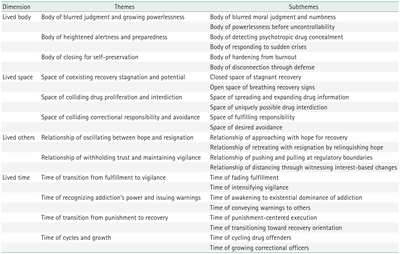
The themes were interpreted within four existential grounds: body, space, other, and time. The lived body was experienced as a body of blurred judgment and growing powerlessness, a body of heightened alertness and preparedness, and a body that closes itself off for self-preservation. The lived space was experienced as a space in which recovery stagnation and potential coexist, a space in which drug proliferation and interdiction collide, and a space in which correctional responsibility and avoidance conflict. The lived other was experienced as a relationship oscillating between hope and resignation and as a relationship characterized by withheld trust and sustained vigilance. The lived time was experienced as a transition from fulfillment to vigilance, a time of recognizing the power of addiction and issuing warnings, a transition from punishment to recovery, and a time of cycles and growth.
Conclusion
This study shows that working with individuals convicted of drug offenses is not merely the execution of regulation and control, but an existential practice of care in which correctional officers continually attune themselves to sensing risk, negotiating relationships, and sustaining the possibility of recovery.
- 963 View
- 105 Download
- Perspectives of parents, teachers, and community leaders on adolescent sexual behavior across ecological contexts in Cambodia: a qualitative study
- Youngran Yang, Gloria Park
- J Korean Acad Nurs 2026;56(1):108-122. Published online February 25, 2026
- DOI: https://doi.org/10.4040/jkan.25146
-
Abstract
PDFePub
- Purpose
This study investigated the perspectives of parents, teachers, and community leaders regarding adolescents’ sexual behavior in Cambodia.
Methods
Grounded in the ‘ecological framework of adolescent health,’ this study employed a descriptive qualitative approach to explore the perspectives of key stakeholders, including 12 parents, eight teachers, and four community leaders. Drawing on in-depth, semi-structured individual and focus group interviews, the study examined risk and protective factors related to risky sexual behavior across family, school, community, social, cultural, and policy contexts. Data collection was conducted from December 5, 2022 to January 31, 2023.
Results
The integrated thematic analysis revealed six main themes. Parents positioned themselves as anxious protectors but struggled with limited opportunities for open conversation; teachers acted as observe-and-warn mediators, constrained by institutional authority, curricular boundaries, and rapidly shifting youth culture; and community leaders interpreted emerging trends through the lens of social change, eroding traditions, and weakening collective governance. Across groups, participants acknowledged the limitations of unilateral action and advocated for multilevel, collaborative solutions that bridge families, schools, and broader communities.
Conclusion
The study concluded that adolescent sexual behaviors should be understood from diverse perspectives. This finding highlights the need for culturally appropriate and sensitive measures supported by multisectoral systems operating at the family, school, community, civil society (e.g., non-governmental organizations), and national levels.
- 1,423 View
- 109 Download
- Experiences of work performance among physician assistant nurses during the period of healthcare disruption in South Korea: a qualitative content analysis
- Juyoung Ha, Minji Kim
- J Korean Acad Nurs 2026;56(1):98-107. Published online February 24, 2026
- DOI: https://doi.org/10.4040/jkan.25133
-
Abstract
PDFePub
- Purpose
This study aimed to explore the work experiences of physician assistant (dedicated nurses in Korea) during the medical service gap caused by physician–government conflicts.
Methods
A qualitative design employing individual in-depth interviews was used. Data were collected from July 18 to August 13, 2025. Fifteen nurses who worked as physician assistant 5 during the healthcare service gap participated in the study. Participants were categorized as follows: (1) nurses in the role before the period of healthcare disruption, (2) those who voluntarily applied after the period of healthcare disruption, and (3) those involuntarily assigned during the period of healthcare disruption. Data were analyzed using conventional content analysis.
Results
Three categories with six subcategories were identified: (1) reconstructing inner experience within an expanded role (unprepared responsibility and burden, inner fulfillment discovered through continuity of care); (2) reconfiguring relationships from a boundary position (feeling distant as “the same yet different” nurses, expansion of mutual understanding in a crisis context); and (3) precarious positioning within an unestablished system (uncertain standing after residents’ return, episodic implementation of non-standardized training).
Conclusion
This study showed that physician assistant who filled residents’ gaps in an incomplete system experienced heavier role burdens, blurred job identity, unequal conditions, and unstable affiliation, while some also found renewed meaning and fulfillment through continuity of care and closer collaboration. With structured education, clearly defined scopes of practice after residents’ return, and stable legal and organizational support, these nurses can function as more than temporary substitutes and help sustain continuity and quality of patient care. -
Citations
Citations to this article as recorded by
- The Tertiary Hospital Restructuring Project in South Korea: A Reflexive Thematic Analysis of Hospital Directors’ Perspectives on Barriers and Policy Recommendations
Hooyeon Lee, Ji Eun Kim, Kyungin Lee, Dong Jun Kim, Kwangmo Yang, Kyounga Lee, Myung-Il Hahm
Healthcare.2026; 14(16): 2469. CrossRef
- The Tertiary Hospital Restructuring Project in South Korea: A Reflexive Thematic Analysis of Hospital Directors’ Perspectives on Barriers and Policy Recommendations
- 2,218 View
- 326 Download
- 1 Web of Science
- 1 Crossref
- A qualitative exploration of acute stroke patients’ experiences with aphasia in Korea
- Jiyeon Kang, Hyunyoung Heo
- J Korean Acad Nurs 2025;55(4):621-633. Published online November 25, 2025
- DOI: https://doi.org/10.4040/jkan.25132
-
Abstract
PDFePub
- Purpose
This study aimed to explore the lived experiences of patients with acute stroke-related aphasia within the Korean healthcare context.
Methods
A qualitative research design using inductive content analysis was employed, following the Consolidated Criteria for Reporting Qualitative Research guidelines. Fourteen adults with acute stroke-related aphasia participated in one-on-one, in-depth interviews conducted between January and May 2025. Participants were recruited through purposive sampling until theoretical saturation was reached. Data were analyzed using an inductive qualitative content analysis approach.
Results
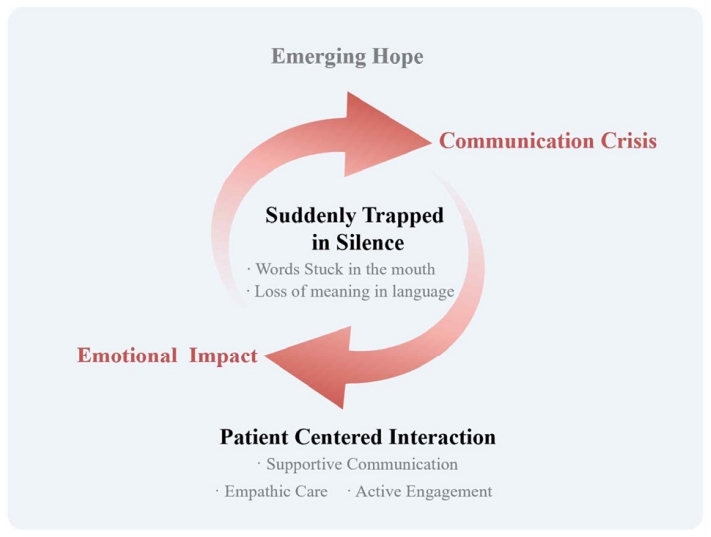
Five main categories emerged: “suddenly trapped in silence” described the abrupt loss of language, including the inability to articulate intended words and understand others; “emotional impact” captured psychological shock and feelings of loss; “communication crisis” encompassed expressive difficulties, exclusion from decision-making, and social withdrawal; “patient-centered interaction” highlighted supportive communication, empathic care, and active engagement by others; and “emerging hope” reflected signs of recovery, self-directed efforts, and anticipation of improvement. These categories converged into the overarching theme, “communication beyond language,” illustrating how patients sought meaningful interaction despite linguistic limitations.
Conclusion
Acute aphasia extends beyond a language disorder to encompass profound emotional and social experiences. Although communication barriers exist, meaningful interaction remains possible through empathetic, person-centered approaches. Healthcare professionals should recognize that patients with aphasia retain cognitive competence despite expressive limitations. These findings underscore the need to integrate emotional sensitivity into clinical care and to develop training programs that enhance person-centered communication skills in stroke rehabilitation settings.
- 2,622 View
- 221 Download
- The experiences of infertile women discontinuing in vitro fertilization treatment: a grounded theory approach
- Eunmi Park, Yeoungsuk Song
- J Korean Acad Nurs 2025;55(3):440-453. Published online August 11, 2025
- DOI: https://doi.org/10.4040/jkan.25048
-
Abstract
PDFePub
- Purpose
This study aimed to develop a situation-specific theory by gaining an in-depth understanding of the deterrent processes experienced by infertile women who have discontinued in vitro fertilization (IVF) procedures, within the socio-cultural context of South Korea.
Methods
The participants were 16 infertile women who discontinued IVF procedures. Data were collected through individual in-depth interviews from February to December 2023. Theoretical sampling was conducted, and the transcribed interview contents were analyzed using Strauss and Corbin’s grounded theory method.
Results
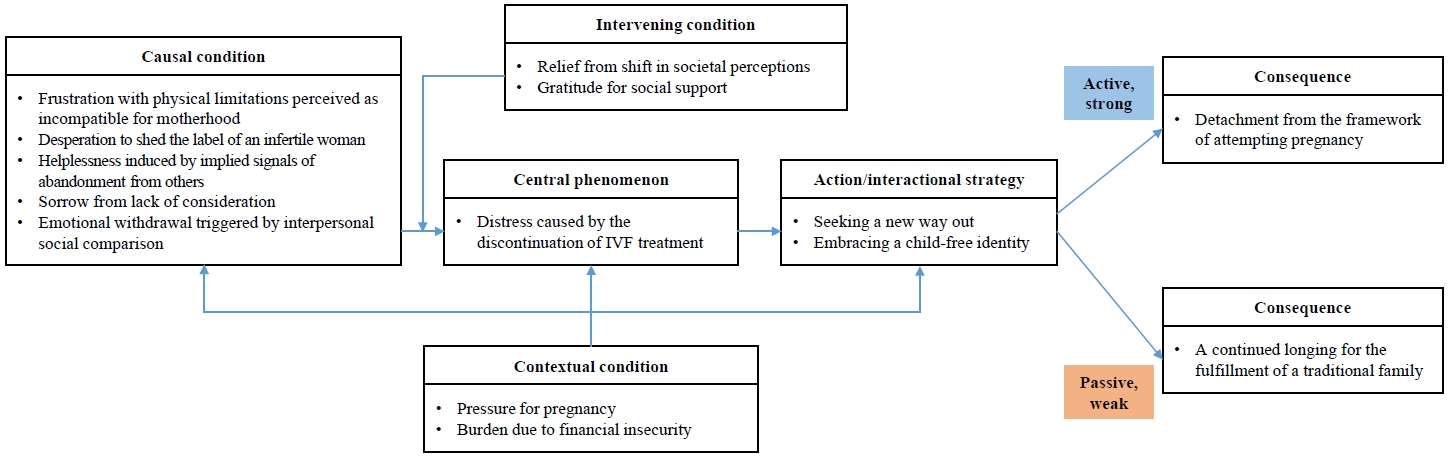
In total, 37 concepts and 14 categories were extracted through the open coding process. The central phenomenon in axial coding was “Distress caused by the discontinuation of IVF treatment.” The core category was “A journey to break free from the identity of infertility toward self-determined womanhood.” The results were categorized into two types: “Detachment from the framework of attempting pregnancy” and “A continued longing for the fulfillment of a traditional family.” The situation-specific theory was the “Theory of reconstructing subjective identity through the acceptance of childfree life,” which illustrates how infertile women actively redefine their life trajectories after discontinuing IVF treatment.
Conclusion
This study highlights the importance of public perceptions about infertile women who discontinue IVF procedures, which are seen as the last resort of assisted reproductive technology, because positive perceptions assists women in living a self-governing life. It may be necessary to develop educational and promotional programs to change negative social perceptions and to establish a psycho-social support system for infertile women who have been deterred from IVF procedures.
- 2,764 View
- 217 Download
- Life changes following trauma in female burn survivors: a narrative inquiry
- Riah Kim, Inyoung Choe, Ji-Su Yun, Heeseung Choi
- J Korean Acad Nurs 2025;55(3):425-439. Published online August 1, 2025
- DOI: https://doi.org/10.4040/jkan.25003
-
Abstract
PDFePub
- Purpose
Burn survivors endure repeated exposure to intense pain and face recurring trauma throughout social adaptation. This study explored how female burn survivors construct the meaning of their traumatic experience of a burn accident and the subsequent changes in their lives.
Methods
A qualitative study was conducted using narrative inquiry. Participants were recruited through purposive sampling, and each engaged in three in-depth interviews, resulting in a total of 21 interviews between April 18, 2024, and August 1, 2024. Each interview lasted 90 minutes on average and was conducted in a comfortable location preferred by the participants. The collected data were analyzed through Connelly and Clandinin’s approach.
Results
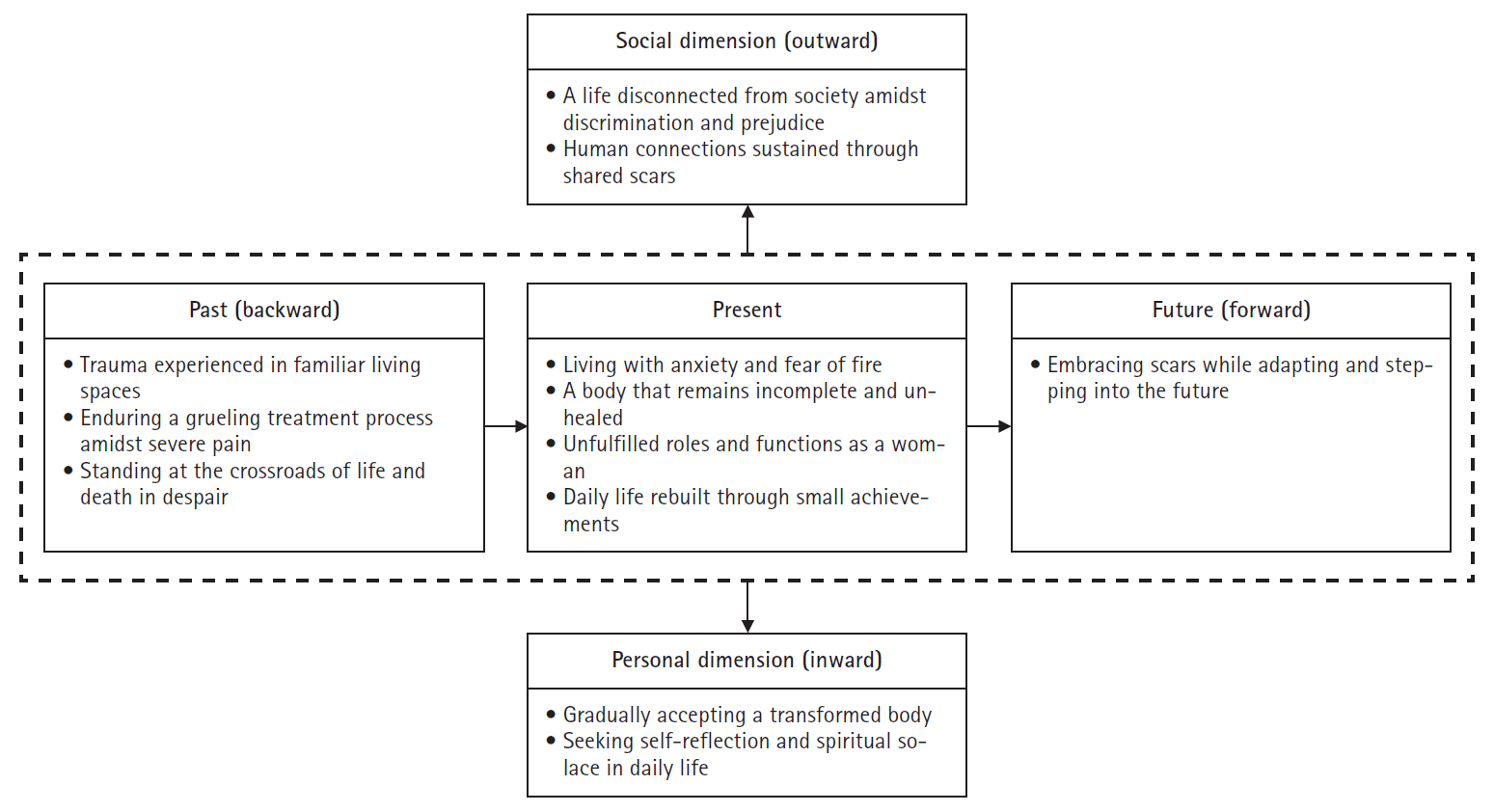
The participants were seven women with burns on the full body, face-upper limbs, or face-torso. All burns were third- to fourth-degree, and most participants had lived with these injuries for over 10 years. From the significant statements, five themes and 12 subthemes were extracted. The five themes were “unforeseen catastrophe,” “burn scars encroaching upon daily life,” “navigating life as an incomplete woman,” “exclusion from social integration,” and “the meaning of life deepened by suppressed pain.”
Conclusion
Female burn survivors experienced immense hardships following their accidents. However, through their recovery efforts, they found new meaning in life, experienced a renewed sense of being alive, and achieved inner growth and maturity. This study highlights the need for social support and underscores the importance of providing various opportunities and policy assistance for female burn survivors dealing with trauma.
- 3,386 View
- 168 Download
- Successful aging among the elderly with mild cognitive impairment facing the crisis of old age: a grounded theory study
- Haeyun Shin, Suhye Kwon
- J Korean Acad Nurs 2025;55(2):301-316. Published online May 27, 2025
- DOI: https://doi.org/10.4040/jkan.24114
-
Abstract
PDFePub
- Purpose
The purpose of this study was to understand experiences of successful aging experience in older adults with mild cognitive impairment.
Methods
The participants were 15 older adults with mild cognitive impairment who had experienced successful aging. Data were collected from January to October 2021 through individual deep, unstructured interviews. Data analysis was performed using Charmaz’s grounded theory method. In addition, the consolidated criteria for reporting qualitative research checklist was used to ensure the quality of the study.
Results
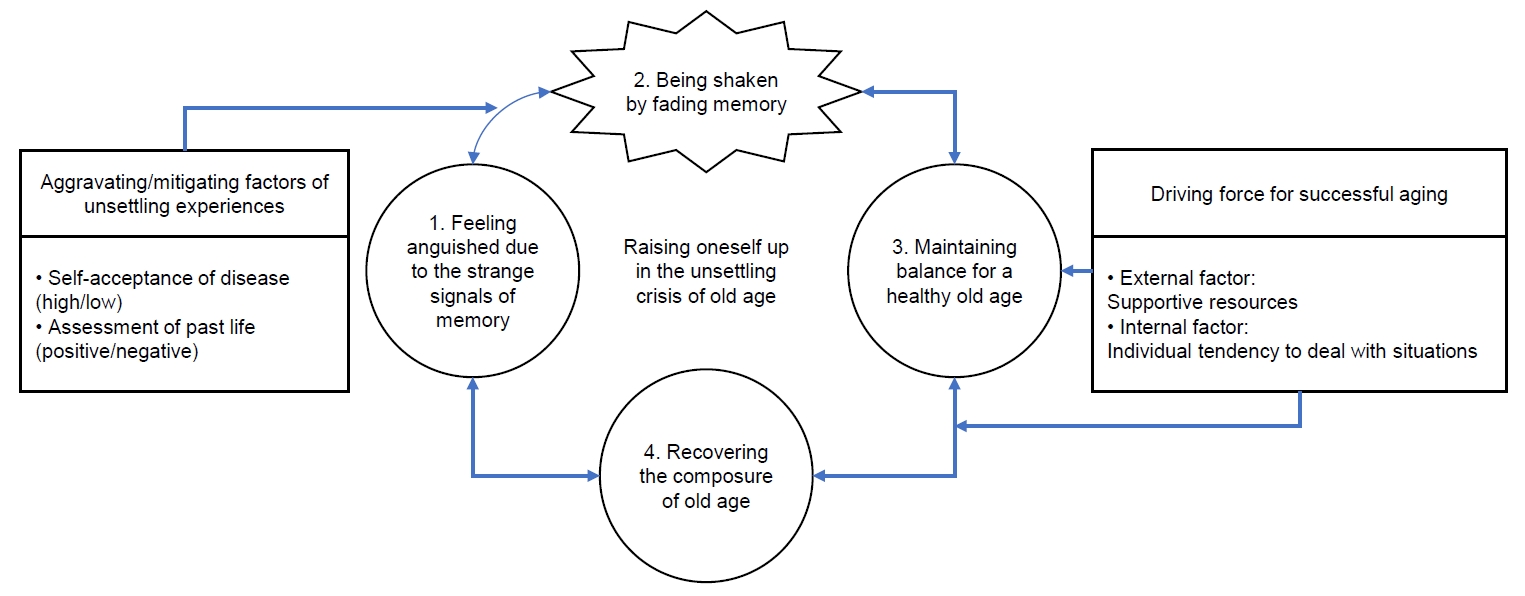
The key category representing experiences of successful aging experience in older adults with mild cognitive impairment was “raising oneself up in the unsettling crisis of old age.” Four stages were derived: “feeling anguished due to the strange signals of memory,” “being shaken by fading memory,” “maintaining balance for a healthy old age,” and “recovering the composure of old age.”
Conclusion
Participants tried to successfully achieve aging while implementing their own plans and strategies in the midst of the challenges of old age, when the mind and body were unsettled by mild cognitive impairment. The results of this study provide a deep understanding of experiences of successful aging in older adults with mild cognitive impairment, potentially contributing to the development and implement of nursing intervention programs to promote the successful pursuit of aging in this population.
- 3,418 View
- 169 Download
- A qualitative meta-synthesis of the essence of patient experiences of dialysis
- Soyoung Jang, Eunyoung E. Suh, Yoonhee Seok
- J Korean Acad Nurs 2025;55(1):119-136. Published online February 19, 2025
- DOI: https://doi.org/10.4040/jkan.24102
-
Abstract
PDFePub
- Purpose
This study aimed to understand the experiences of dialysis and their meaning among patients with chronic kidney disease through a meta-synthesis of the existing literature. Since 2010, the prevalence of end-stage renal disease has doubled in South Korea, which has the sixth-highest incidence worldwide. Although most kidney disease patients undergo dialysis to attenuate disease-related symptoms and prolong their lives, the implications of dialysis on their lives, together with the role played by patients’ significant others, remain underexplored. Similarly, existing research has not considered both patients with hemodialysis and peritoneal dialysis.
Methods
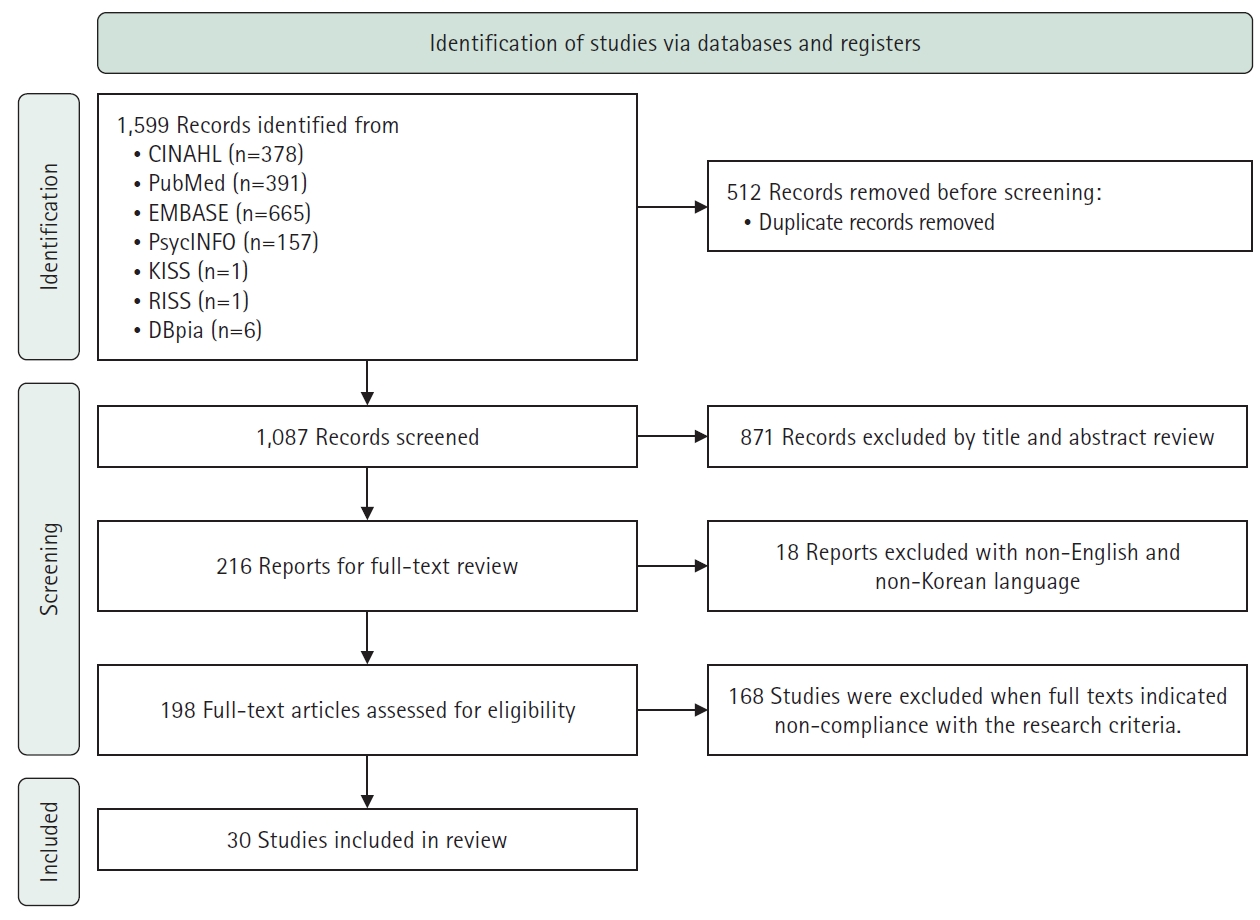
In this meta-synthesis, seven electronic databases (PubMed, CINAHL, EMBASE, PsycINFO, DBpia, KISS, and RISS) were searched for the terms “dialysis” and “qualitative.” Thirty qualitative studies were selected for examination.
Results
The overriding theme observed in the studies was “I do not have much time left.”–navigating the dual realities of one’s limited existence, while other key themes were: (1) the inevitable experience of the troubles of dialysis, (2) life is extended, but deteriorating in every aspect, (3) accepting dialysis with a positive outlook for life, and (4) essential support experienced in an exhausting life.
Conclusion
These findings are important for the design and delivery of practical and tailored nursing interventions to help patients overcome the various challenges related to dialysis treatment, and improve their quality of life.
- 5,011 View
- 221 Download
- Experiences of Unmarried Women Undergoing Planned Oocyte Cryopreservation
- Miok Kim, Kim Mingyoung
- J Korean Acad Nurs 2024;54(4):577-593. Published online November 30, 2024
- DOI: https://doi.org/10.4040/jkan.24064
-
Abstract
PDFePub
Purpose The present study investigated the experiences of unmarried women undergoing planned oocyte cryopreservation (OC).
Methods Data were collected from August 2022 to February 2023 through individual in-depth interviews with thirteen unmarried women undergoing planned OC. Data were analyzed using Colazzi’s phenomenological method.
Results The findings revealed four distinct clusters. The first cluster, “Safeguards against Future Uncertainty,” examined experiences associated with uncertainties in several aspects of reproductive health threats and decision-making regarding planned OC. The second cluster, “Indescribable Pain and Chaos,” explored the psychological and physical pain, complications, concerns about repeat procedures, and uncertainties about the use of frozen oocytes experienced during the planned OC process and afterward. The third cluster, “Motivation to Rebuild Resilience,” explored participants’ resilience in overcoming difficulties and shocks during the planned OC process and regaining their inner strength through the support of family and friends. The fourth cluster, “Finally Freeing the Mind,” focused on the sense of liberation from the pressure of marriage and childbirth, which enabled participants to engage in their present self and concentrate on self-stability and growth in preparation for the future.
Conclusion The present study enhances our understanding of the emotional difficulties and distress experienced by women considering OC, thereby assisting in improving approaches for psychological support and clinical management. Furthermore, providing insights into these first-hand experiences to women considering planned OC, healthcare professionals, and policymakers could help establish systems to support the decision-making process.
-
Citations
Citations to this article as recorded by- Informed opinion: the mating gap
Marcia C. Inhorn
Reproductive BioMedicine Online.2026; 53(1): 105732. CrossRef - The Experiences of Female Cancer Patients Undergoing Fertility Preservation: A Qualitative Study
Menekşe Nazlı Aker, Neslihan Yılmaz Sezer, Melek Hava Köprülü, Gülşah Kaya, Batuhan Özmen, Wenjun Mao
European Journal of Cancer Care.2025;[Epub] CrossRef
- Informed opinion: the mating gap
- 4,738 View
- 160 Download
- 2 Web of Science
- 2 Crossref
- Experiences of Patients and Their Families Receiving Medical Services Provided by Advanced Practice Nurses at Tertiary General Hospitals
- Mi-Kyeong Jeon, Su Jung Choi, Ji Eun Han, Eun Kyung Kwon, Jeong Hee Park, Jeong Hye Kim
- J Korean Acad Nurs 2024;54(4):594-606. Published online November 4, 2024
- DOI: https://doi.org/10.4040/jkan.24069
-
Abstract
PDFePub
Purpose This study aimed to understand and describe the experiences of patients and their families who have received medical services from advanced practice nurses in tertiary general hospitals in Korea.
Methods Data were collected through four focus group interviews with 20 patients and their families who had received medical services from advanced practice nurses for more than six months at four tertiary hospitals from November 29 to December 28, 2023. Verbatim transcripts were analyzed using qualitative content analysis.
Results The four themes extracted from the experiences of patients and their families were as follows: unfamiliar medical personnel encountered during the treatment process, healthcare professionals who exhibited excellence, companions to light my way through the tunnel of illness, and an advanced practice nurse system that must be activated urgently.
Conclusion The study’s findings indicate that patients and their families view the care provided by advanced practice nurses as excellent, reliable, and holistic. Research suggests that advanced practice nurses are valuable healthcare professionals in team-based care. The findings suggest that hospitals should utilize an advanced practice nurse system to improve patient outcomes and ensure the quality of care.
-
Citations
Citations to this article as recorded by- Legislation of Medical Support Tasks in the Nursing Act as a Foundation for Nursing Professionalism and Role Expansion
Su Jung Choi
Korean Journal of Adult Nursing.2025; 37(2): 69. CrossRef - Strategies for expanding the role of advanced practice providers in the Korean nursing workforce: a mixed-methods approach
Jeong Hye Kim, Mi-Kyeong Jeon, Suyoung Choi, Mimi Lee, Su Jung Choi
Journal of Korean Academy of Nursing.2025; 55(4): 568. CrossRef - Nurses' Patient Care Experiences in a Changing Healthcare Environment Following One Year of Healthcare Policy Conflict - A Focus Group Interview
Eun Hee Kang, Yunhyung Kim, Jeong Hye Kim
Journal of Korean Association for Qualitative Research.2025; 10(3): 280. CrossRef
- Legislation of Medical Support Tasks in the Nursing Act as a Foundation for Nursing Professionalism and Role Expansion
- 6,157 View
- 326 Download
- 1 Web of Science
- 3 Crossref
- An Exploratory Study on Non-Contact Nursing Experiences of Clinical Nurses during the COVID-19 Pandemic
- Hye Min Byun, Eun Kyoung Yun
- J Korean Acad Nurs 2024;54(3):446-458. Published online August 31, 2024
- DOI: https://doi.org/10.4040/jkan.24045
-
Abstract
PDF
- Purpose
This study aimed to understand the non-contact nursing experiences of clinical nurses during the COVID-19 pandemic.
Methods
A qualitative research design applying thematic analysis was used. The participants were purposive sampled from three institutes: a tertiary hospital, a general hospital, and a residential treatment center in Seoul. Data were collected between December 2021 and January 2022 through individual in-depth interviews with 12 clinical nurses. The data were analyzed using Braun and Clarke’s method to identify the meaning of the participants’ experiences.
Results
During the COVID-19 pandemic, the fields where the participants performed non-contact nursing included intensive care units and isolation wards of hospitals, a residential treatment center, and home cares. Their tasks in non-contact nursing commonly involved remote monitoring using digital devices or equipment, consultation and education. From their experiences performing tasks in these fields, the four theme clusters and nine themes were derived. The four theme clusters are as follows: (1) Confusion of nursing role; (2) Conflict due to insufficient support system; (3) Concern about the quality of nursing; (4) Reflection on the establishment of nursing professionalism.
Conclusion
This study highlights the necessity for institutionalizing professional nursing areas, nursing education, and practical support by clarifying the purpose and goals of non-contact nursing and developing nursing knowledge through frameworks. -
Citations
Citations to this article as recorded by- Telecare legislation priorities: A Delphi study grounded in ethical challenges
Seongyu Han, Eun Kyoung Yun
Nursing Ethics.2026; 33(2): 488. CrossRef - A systematic review of pulmonary rehabilitation nursing interventions for patients with chronic obstructive pulmonary disease
Da-Jung Kim
Journal of Exercise Rehabilitation.2025; 21(5): 234. CrossRef
- Telecare legislation priorities: A Delphi study grounded in ethical challenges
- 2,981 View
- 111 Download
- 2 Web of Science
- 2 Crossref
- How Do We Approach Quality Care for Patients from Middle Eastern Countries? A Phenomenological Study of Korean Nurses’ Experiences
- Dael Jang, Seonhwa Choi, Gahui Hwang, Sanghee Kim
- J Korean Acad Nurs 2024;54(3):372-385. Published online August 31, 2024
- DOI: https://doi.org/10.4040/jkan.24036
-
Abstract
PDF
- Purpose
Although more people from Middle Eastern countries are visiting South Korea for medical treatment, Korean nurses lack experience in treating them. Understanding and describing Korean nurses’ experiences can help them provide quality care to these patients by enhancing their competency in culturally appropriate care. This study described the experiences of nurses who provide care to Middle Eastern patients in clinical settings in South Korea.
Methods
We conducted a phenomenological study to describe nurses’ experience of caring for patients from Middle Eastern countries. Ten nurses with prior experience in caring for these patients were recruited from a university-affiliated tertiary hospital. Semi-structured face-to-face interviews were conducted between May 1 and June 4, 2020. The transcribed data were analyzed using Giorgi’s phenomenological method to identify the primary and minor categories representing nurses’ experiences.
Results
Four major categories (new experiences in caring for culturally diverse patients, challenges in caring for patients in a culturally appropriate manner, nursing journey of mutual agreement with culturally diverse patients, and being and becoming more culturally competent) and 11 subcategories were identified.
Conclusion
Nurses experience various challenges when caring for Middle Eastern patients with diverse language and cultural needs. However, nurses strive to provide high-quality care using various approaches and experience positive emotions through this process. To provide quality care to these patients, hospital environments and educational programs must be developed that center on field nurses and students and support them in delivering quality care while utilizing their cultural capabilities. -
Citations
Citations to this article as recorded by- The roles of nurses employed as medical tourism facilitators in Taiwan: A qualitative study
Eimi Nakada, Keiko Sugimoto, Rieko K. Fukuzawa, Thomas Mayers, Yi-Chuan Chen, Judith S. C. Shiao
International Journal of Healthcare Management.2026; : 1. CrossRef
- The roles of nurses employed as medical tourism facilitators in Taiwan: A qualitative study
- 3,649 View
- 96 Download
- 1 Web of Science
- 1 Crossref
- Lived Experience of Kidney Transplant Recipients with Kidney Graft Failure
- Younghui Hwang, Kyoungok Min, Haeng-Mi Son
- J Korean Acad Nurs 2024;54(1):93-105. Published online February 29, 2024
- DOI: https://doi.org/10.4040/jkan.23113
-
Abstract
PDF
- Purpose
The study aimed to understand the semantic structure and nature of the disease experience of kidney transplant recipients with kidney graft failure by applying phenomenological research methods.
Methods
Data were collected between February and September 2021 through individual in-depth interviews with 12 kidney transplant recipients with kidney graft failure. Colaizzi’s phenomenological analysis was used to analyze the meaning of the participants’ illness experiences.
Results
5 theme clusters and 15 themes were derived. The five theme clusters are as follows: (1) First transplant giving me a second life; (2) Body and mind becoming sick again; (3) Waiting for a re-transplant with hope and worry; (4) Life supported by gratefulness; (5) Having control over my own life.
Conclusion
This study shows that kidney transplant recipients with kidney graft failure experience physical and psychological difficulties during the long disease period and require help from many people, including family members, friends, colleagues, and health care providers, to overcome their difficulties. -
Citations
Citations to this article as recorded by- Perceived Threat of the Risk for Graft Rejection and Its Related Factors in Kidney Transplant Recipients: A Cross- Sectional Study
Seolhwa Baek, Sung Reul Kim, Kyounghae Kim, Yusun Park
Korean Journal of Adult Nursing.2026; 38(1): 81. CrossRef
- Perceived Threat of the Risk for Graft Rejection and Its Related Factors in Kidney Transplant Recipients: A Cross- Sectional Study
- 2,466 View
- 87 Download
- 1 Crossref
- Perspectives of Frontline Nurses Working in South Korea during the COVID-19 Pandemic: A Combined Method of Text Network Analysis and Summative Content Analysis
- SangA Lee, Tae Wha Lee, Seung Eun Lee
- J Korean Acad Nurs 2023;53(6):584-596. Published online December 31, 2023
- DOI: https://doi.org/10.4040/jkan.23048
-
Abstract
PDF
- Purpose
This study aimed to explore the perspectives of frontline nurses working during the novel coronavirus disease 2019 (COVID-19) pandemic.
Methods
An online qualitative study was conducted using a pragmatic approach. The data were collected in August 2021. Registered Korean nurses who provided direct nursing care to patients with confirmed COVID-19 were eligible for this study. An online survey was used to gather free-text data, which were then analyzed using machine-based network analysis and summative content analysis.
Results
The analysis examined the responses of 126 participants and led to the identification of six prominent themes. These themes were further classified into three distinct levels: personal, task, and organizational. The identified themes are as follows: “collapse of personal life,” “being overwhelmed by the numerous roles required,” “personal protective equipment was sufficiently provided, but that is not enough,” “changes in interprofessional collaboration,” “inappropriate workforce management,” and “diverted allocation of healthcare services and resources.” Conclusion: Our findings highlight areas for improvement in resources, systems, and policies to enhance preparedness for future pandemics. -
Citations
Citations to this article as recorded by- Skill mix changes in healthcare professions during the COVID-19 pandemic: a scoping review
Natalia Petka-Nosal, Iwona A Bielska, Katarzyna Badora-Musiał, Katarzyna Nowak-Zając, Alicja Domagała, Małgorzata Gałązka-Sobotka, Iwona Kowalska-Bobko
BMJ Open.2025; 15(10): e100024. CrossRef
- Skill mix changes in healthcare professions during the COVID-19 pandemic: a scoping review
- 3,700 View
- 52 Download
- 1 Web of Science
- 1 Crossref
- Nursing Students’ Experiences of Observing the Use of Physical Restraints: A Qualitative Study
- Sun Mi Ha
- J Korean Acad Nurs 2023;53(6):610-621. Published online December 31, 2023
- DOI: https://doi.org/10.4040/jkan.23032
-
Abstract
PDF
- Purpose
The purpose of this study was to understand the experiences of final-year undergraduate nursing students in observing the use of physical restraints on patients in the course of clinical practice.
Methods
Three focus group interviews were conducted with 12 Korean nursing students who could provide sufficient information about their observation of physical restraints. The collected data was analyzed through conventional content analysis.
Results
The data were classified into four theme clusters, and nine themes. The four theme clusters included ‘recognized as an unavoidable means,’ ‘experienced problems with the use of physical restraints,’ ‘realized the importance of the nurse's role and efforts,’ and ‘aspire to learn about correct use of physical restraints.’ While nursing students recognized the necessities and problems of using physical restraints in clinical practice, and the importance of nurses’ role and effort, the results found that education related to the use of physical restraints should be more systematic within the nursing curriculum.
Conclusion
This study highlights the necessity of educating nursing students to ensure they acquire accurate knowledge and awareness regarding the use of physical restraints, and suggests the inclusion of systematic guidelines through simulation or extracurricular activities. -
Citations
Citations to this article as recorded by- Exploring Nurses’ and Nursing Students’ Attitudes Toward Coercive and Technological Measures in Mental Health: A Conceptual Framework and Study Protocol
Giuliano Anastasi, Roberto Latina, Yari Longobucco, Alessandro Stievano, Stefano Bambi
Nursing Reports.2024; 14(4): 4129. CrossRef
- Exploring Nurses’ and Nursing Students’ Attitudes Toward Coercive and Technological Measures in Mental Health: A Conceptual Framework and Study Protocol
- 5,289 View
- 138 Download
- 1 Web of Science
- 1 Crossref
- Adolescents’ Experiences of Non-Suicidal Self-Injury: An Interpretative Phenomenological Analysis Study
- Jung A Ko, Ji Young Kim
- J Korean Acad Nurs 2023;53(5):538-555. Published online October 31, 2023
- DOI: https://doi.org/10.4040/jkan.23075
-
Abstract
PDF
- Purpose
This qualitative study used interpretative phenomenological analysis and photovoice methods to explore the meaning of non-suicidal self-injury experienced by adolescents.
Methods
Participants were adolescents enrolled in middle and high schools in Gyeonggi-do and Jeollabuk-do who were selected through snowball sampling. Six participants had repeatedly engaged in self-injurious behavior for over a year. Data were collected through in-depth interviews and the photovoice method between November 2020 and July 2021. The collected data were analyzed using six steps of interpretative phenomenological analysis.
Results
The results yielded 5 main themes and 18 subthemes. The main themes were ‘a silent cry to an indifferent world’, ‘a heartache that one endures with scars’, ‘an inescapable cycle’, ‘filling the space in one’s heart’, and ‘healing the wounds’. The study findings revealed that the self-injurious behavior of adolescents began as a consequence of feeling lost and struggling with conflicts at home and school, which helped them relieve tension and pain. Nonetheless, inflicting self-injury only left signs of regret and remorse, which became a trace that the participants wanted to hide. However, the wounds healed after receiving attention and support from others. They were determined to stop engaging in repeated self-injurious behaviors and made efforts to do so.
Conclusion
This study can be used as a basis for the development of educational programs to prevent non-suicidal self-injury in adolescents. Additionally, it can inform nursing interventions that focus on building support systems to help adolescents who attempt self-injury. -
Citations
Citations to this article as recorded by- Collaborative Immersive Virtual Environments in Geography Education on Climate Zones: A UX Case Study
Martina Střechová, Michal Černý, Čeněk Šašinka, Zdeněk Stachoň, Alžběta Šašinková, František Holubec, Hana Švédová
ISPRS International Journal of Geo-Information.2025; 14(12): 455. CrossRef - Experiences of Male Nursing Students in Women's Health Nursing Practicum: A Mixed-Methods Study Using Photovoice
Na Won An, Na Kyoung Lee
Journal of Korean Association for Qualitative Research.2024; 9(2): 104. CrossRef
- Collaborative Immersive Virtual Environments in Geography Education on Climate Zones: A UX Case Study
- 8,935 View
- 176 Download
- 1 Web of Science
- 2 Crossref
- Experiences of Transitional Care for Medicaid Case Managers
- Yunhee Hwang, Gaeon Lee
- J Korean Acad Nurs 2023;53(5):556-569. Published online October 31, 2023
- DOI: https://doi.org/10.4040/jkan.23031
-
Abstract
PDF
- Purpose
This phenomenological study tried to understand the essence of the transitional care experience of medicaid case managers and its structural meaning. In addition, it was attempted to establish a system of transitional care and seek support measures for medicaid case managers.
Methods
The participants of this study were 7 medicaid case managers who had spent more than 1 year and 6 months in medicaid pilot project. Data were collected with individual in-depth interviews from June to December 2021. The data were analyzed by Giorgi's phenomenological analysis method.
Results
The seven constituents derived from the results of this study were 'struggle to establish a living environment', 'dedication to supporting independent living', 'anxiety about safety', 'pressure on care responsibilities', ‘distress in building the pilot project’, 'pride in role', and 'expectation for improvement'.
Conclusion
The study results provide a comprehensive understanding of the transition care reality for medicaid case managers. They also shed light on managers’ perceptions and attitudes. These findings can serve as fundamental information for establishing support measures for medicaid case managers and transitional care systems.
- 2,597 View
- 47 Download
- Weight Loss Experience of Highly Obese Young Adult Who Underwent Bariatric Surgery
- Hoim Lee, Hyoju Jeong, Suhye Kwon
- J Korean Acad Nurs 2023;53(2):260-273. Published online April 30, 2023
- DOI: https://doi.org/10.4040/jkan.23004
-
Abstract
PDF
- Purpose
This study aimed to explore the weight loss experience of highly obese young people who underwent bariatric surgery.
Methods
Data were collected, from October 2021 to April 2022, through individual in-depth interviews with eight highly obese young adults who underwent bariatric surgery and analyzed using Colaizzi’s phenomenological method.
Results
The following four theme clusters were extracted. First, ‘The unbearable sorrow of obese people’ explains the process of choosing bariatric surgery after fluctuations and frustration despite countless repeated weight loss attempts. Second, ‘The impact aftermath of bariatric surgery’ revealed participants struggling in the face of unexpected changes due to bariatric surgery. Third, ‘Efforts to rebuild a healthy myself’ demonstrated the struggle to regain health by using the surrounding support system to overcome the difficulties of this surgical procedure. Lastly, ‘Facing life by getting rid of the yoke of obesity’ displayed the experiences of the participants who felt ambivalent about their changed appearance, but coping positively with the new life.
Conclusion
This study provides an in-depth understanding of the weight loss experiences of highly obese adolescents who underwent bariatric surgery and presents a new perspective on clinical practice. The results of this study are expected to be useful in developing and applying systematic and customized nursing interventions before and after bariatric surgery.
- 2,600 View
- 36 Download
- The Experience of Gynecologic Cancer in Young Women: A Qualitative Study
- Sung-Jin Kim, Hyunjeong Shin
- J Korean Acad Nurs 2023;53(1):115-128. Published online February 28, 2023
- DOI: https://doi.org/10.4040/jkan.22119
-
Abstract
PDF
- Purpose
This study aimed to understand the experiences of women under 40 years of age with gynecologic cancer.
Methods
Semi-structured individual in-depth interviews were conducted with 14 Korean female patients aged 21~39 years with gynecologic cancer. The data were analyzed using Corbin and Strauss' grounded theory approach, including open coding, context analysis, and integrating categories.
Results
Grounded theory analysis revealed nine categories and a core category of ‘the journey to find my life after losing the life as a typical woman.’ The categories that emerged as the conditions are ‘Unwelcomed guest, cancer,’ ‘Completely devastated life as an ordinary woman,’ ‘Uncertain future,’ ‘Losing my physical characteristics as a woman,’ and ‘Life tied with treatments.’ The actions/interactions were ‘Decrease of interpersonal relationships,’ ‘A lonely battle to overcome alone,’ and ‘The power to overcome hardships.’ The consequence was ‘Live my own life.’ Conclusion: This study contributes to the development of a substantive theory of the experience of gynecologic cancer in young women, which has been on the rise in recent years. The study’s results are expected to be used as a basis for providing nursing care to help young women with gynecologic cancer adapt to their disease. -
Citations
Citations to this article as recorded by- The Mediating Effects of Negative Affect and Cancer Coping in the Relationship between Perceived Stress and Health-Related Quality of Life among Gynecological Cancer Survivors: A Cross-Sectional Study
Yeon-woo Kim, Sunki Kim, Hye-Ja Park
Korean Journal of Adult Nursing.2025; 37(3): 266. CrossRef - Exploring the Disease Experience in Women with PCOS: A Qualitative Content Analysis
Miok Kim, Su Jeong Yi
Healthcare.2025; 13(24): 3243. CrossRef - ORGAN LOSS AS A TRIGGER OF IDENTITY CRISIS IN WOMEN WITH MALIGNANT TUMORS OF THE REPRODUCTIVE SYSTEM (literature review)
Valentyn BELYAK, Rostyslav BILOBRYVKA
Ukrains kyi Visnyk Psykhonevrolohii.2025; : 123. CrossRef - Illness Experiences of Young Adult Thyroid Cancer Patients Receiving Radioactive Iodine Treatment
Hyeon Ae Lee, Sue Kyung Sohn
Asian Oncology Nursing.2025; 25(4): 195. CrossRef - Factors Influencing Oncofertility in Gynecological Cancer Patients: Application of Mixed Methods Study
Minji Kim, Juyoung Ha
Journal of Korean Academy of Nursing.2024; 54(3): 418. CrossRef
- The Mediating Effects of Negative Affect and Cancer Coping in the Relationship between Perceived Stress and Health-Related Quality of Life among Gynecological Cancer Survivors: A Cross-Sectional Study
- 2,536 View
- 108 Download
- 3 Web of Science
- 5 Crossref
- Lived Experience of Middle-Aged Patients with Complex Regional Pain Syndrome
- Young-suk Seo, Sunhee Lee
- J Korean Acad Nurs 2022;52(6):598-607. Published online December 31, 2022
- DOI: https://doi.org/10.4040/jkan.22086
-
Abstract
PDF
- Purpose
This qualitative study aimed to explore the lived and true meaning of experiences of middle-aged patients with complex regional pain syndrome.
Methods
The participants were 10 men and women aged 40 to 60 years who received outpatient treatment at a university hospital, could communicate, and agreed to participate in the study. Data were collected through individual interviews using open and semi-structured questions from September 2019 to July 2021 and were analyzed using the content analysis method suggested by Hsieh and Shannon (2005).
Results
As a result of this study, 42 summarized semantic units related to life experience, 15 subthemes, and seven themes were derived. The seven themes were “pressed by severe pain,” “frustrated because I cannot be part of the community,” “distressed because people do not recognize my disease,” “sad about conflicts with family,” “unmotivated because of desperate life,” “appreciating for support,” and “putting oneself together and living daily life.” Conclusion: The vivid experiences of the participants derived in this study are the basic data for developing treatment guidelines. In the future, we propose a study on life and family care experiences according to the developmental characteristics of the life cycle of patients with complex regional pain syndrome and develop and apply programs to support patients and their families. -
Citations
Citations to this article as recorded by- Experiences of diagnosis and treatment for upper limb Complex Regional Pain Syndrome: a qualitative analysis
Grace S Griffiths, Bronwyn L Thompson, Deborah L Snell, Jennifer A Dunn
Pain Medicine.2023; 24(12): 1355. CrossRef
- Experiences of diagnosis and treatment for upper limb Complex Regional Pain Syndrome: a qualitative analysis
- 2,697 View
- 59 Download
- 1 Web of Science
- 1 Crossref
- The Caring Experience of Family Caregivers for Patients of Living Donor Liver Transplantation from the Family Members
- Miseon Bang, Suhye Kwon
- J Korean Acad Nurs 2022;52(4):435-450. Published online August 31, 2022
- DOI: https://doi.org/10.4040/jkan.22043
-
Abstract
PDF
- Purpose
The purpose of the study was to understand the care experiences of the family of living donor liver transplantation (LDLT) patients where the donation had occurred within the family.
Methods
Participants were eight family caregivers who cared for recipients and donors of LDLT. Data were collected through individual in-depth interviews from November, 2020 to April, 2021. Data analysis was performed through a cyclical process of data collection and analysis by applying Giorgi’s phenomenological research method.
Results
The five main components extracted from the experiences of the family caregivers were: "A double-edged choice to save the family", "The harsh daily life of liver transplantation care", "The yoke of double care on both shoulders", "The power to withstand the adversity of caring", and "The recovery and growth of life pursued by trusting each other".
Conclusion
The participants tried to do their best in their daily lives, while providing reassurance and care to the LDLT patients in the family; however, they expressed some worry and hardship while doing so. The results of this study provide a deeper understanding of the caring experience of the family caregivers, which may contribute to the development of nursing interventions that will aid these caregivers in providing care to their LDLT family members. Furthermore, the development and application of an integrated management program for LDLT patients in the family is required. -
Citations
Citations to this article as recorded by- Adaptation of living donors after liver transplantation in South Korea: an integrative review
Gyeong-Ju An
Journal of Korean Biological Nursing Science.2026; 28(2): 231. CrossRef - Challenges and support needs among family caregivers involved in solid organ transplant care process: a scoping review protocol
Shi He, Ningbin Huang, Meiqi Lai, Wenwen Li, Siting Chen, Guolong Zhang, Danxia Huang, Guilin Peng, Ying Huang, Liang Ruan
BMJ Open.2025; 15(3): e086771. CrossRef
- Adaptation of living donors after liver transplantation in South Korea: an integrative review
- 3,269 View
- 66 Download
- 2 Web of Science
- 2 Crossref
- Delirium Experience of the Intensive Care Unit Patients
- Jaeyeon Jung, Sujin Jang, Seonmi Jo, Sunhee Lee
- J Korean Acad Nurs 2022;52(2):134-143. Published online April 30, 2022
- DOI: https://doi.org/10.4040/jkan.21240
-
Abstract
PDF
- Purpose
The study aimed to understand the delirium experience of intensive care unit (ICU) patients.
Methods
We performed a qualitative study using Colaizzi’s phenomenological method. Eleven patients, who experienced delirium according to the Confusion Assessment Method for ICU, participated after transferring to general wards from the ICU. Individual in-depth semi-structured interviews ranging from 30 minutes to 2 hours in length were conducted between November 2018 and August 2019.
Results
Nine themes and four theme clusters emerged. The four theme clusters were: 1) “Overwhelmed by fear,” which describes the experience of a patient close to death and the feeling of difficulty in understanding disorganized thinking; 2) “Anxious about not understanding the situation,” which means that patients’ sense of time and space were disordered in the ICU; 3) “Being deserted,” which indicates the feeling of being separated from others and yourself; and 4) “Resistance to protect my dignity,” which indicates that the dignity and autonomy of an individual in the patient’s position at the ICU, are ignored.
Conclusion
Nursing interventions are needed that would enable patients to maintain orientation and self-esteem in the ICU. In addition, healthcare providers need to provide information about the unfamiliar environment in the ICU in advance. -
Citations
Citations to this article as recorded by- Patients' and family members' dyadic experience of post‐operative delirium in the intensive care unit: A qualitative study
Jing Dong, Weijing Sui, Yiyu Zhuang
Nursing in Critical Care.2025;[Epub] CrossRef - Association Between Person-centered Care, Intensive Care Experience, and Post-intensive Care Syndrome in Critical Care Survivors: A Multi-center Prospective Cohort Study
Jiyeon Kang, Seonyoung Yun
Asian Nursing Research.2025; 19(3): 274. CrossRef - Factors Influencing Intensive Care Unit Nurses’ Competency in Delirium Care in A Tertiary General Hospital
Mi Ran Lim, Gyoo Yeong Cho
Journal of Korean Critical Care Nursing.2024; 17(3): 37. CrossRef - Exploring patients’ and families’ preferences for auditory stimulation in ICU delirium prevention: A qualitative study
Yajun Ma, Nianqi Cui, Zhiting Guo, Yuping Zhang, Jingfen Jin
Intensive and Critical Care Nursing.2024; 82: 103629. CrossRef - The Influence of Ethical Nursing Competence and Positive Nursing Organizational Culture on Person-Centered Care in Intensive Care Unit Nurses: A Cross-Sectional Survey
Jae Eun Lee, Hye-Young Jang
Journal of Korean Academy of Fundamentals of Nursing.2024; 31(3): 304. CrossRef - A Study on Nurses' Communication Experiences with Intubation Patients
Ye Rim Kim, Hye Ree Park, Mee Kyung Shin
The Korean Journal of Rehabilitation Nursing.2023; 26(1): 28. CrossRef - Intensive Care Experience of Critical Care Patients and Its Related Factors : A Secondary Analysis Study
Jiyeon Kang, Hyojeong Woo
Journal of Korean Critical Care Nursing.2023; 16(3): 11. CrossRef - Item analysis of the Korean version of the Intensive Care Experience Questionnaire: Using the Rasch Model based on Item Response Theory
Jiyeon Kang, Minhui Kim
Journal of Korean Critical Care Nursing.2022; 15(3): 37. CrossRef
- Patients' and family members' dyadic experience of post‐operative delirium in the intensive care unit: A qualitative study
- 3,960 View
- 222 Download
- 3 Web of Science
- 8 Crossref
- Experience of Peer Support Work among People with Mental Illness in the Community: A Grounded Theory Approach
- Myung Sun Hyun, Hyunlye Kim, Kyoung A Nam, Su Young Kim
- J Korean Acad Nurs 2022;52(2):187-201. Published online April 30, 2022
- DOI: https://doi.org/10.4040/jkan.21208
-
Abstract
PDF
- Purpose
This study discovered a substantive theory of the experience and process of peer support work among people with mental illness.
Methods
The participants were members of community-based mental health facilities and had been working as peer supporters for more than six months. The data were collected through in-depth interviews with twelve participants and analyzed using Corbin and Strauss’s grounded theory approach.
Results
The core category was “becoming a healer going with patients in the journey of recovery,” and the core phenomenon was “identity confusion as a peer supporter.” The causal conditions were “starting peer support work without certainty” and “standing at the boundary between the therapist and patient.” The intervening conditions were “willingness to become a successful peer supporter,” “feeling a sense of homogeneity with the patient,” “accepting the mental illness,” and “support from people around.” The action and interaction strategies were “letting go of greed,” “being open about oneself,” “developing professional skills,” “maintaining wellness in the body and mind,” and “being with the patient.” The consequences were “becoming a useful person,” “changing attitude toward life,” “expansion of the sense of self-existence,” “recovering from mental illness,” and “discovering a role as peer supporter.” Finally, the substantive theory of “becoming a healer going with patients in the journey of recovery” was derived.
Conclusion
This study provides a holistic understanding of peer support work and the implications of interventions to help people with mental illness in a person-centered recovery process. -
Citations
Citations to this article as recorded by- Community Program Participation Experience of Peer Recovery Coaches for Substance Use Disorders Based on a Caring Perspective: A Qualitative Study
Kyung Im Kang, Chan Mi Kang
Nursing Open.2026;[Epub] CrossRef - Recovery Identity Formation among Peer Supporters: A Qualitative Meta-Synthesis
Kuem Sun Han, Jihye Shin, Miran Jung, Soo Yeon Lee, Hee Jin Moon
Journal of Korean Academy of psychiatric and Mental Health Nursing.2025; 34(4): 370. CrossRef - A model for the involvement of service users as instructors into the psychiatric nursing curriculum in Korea: A qualitative study on participation experience
Suyoun Ahn, Soyoung Shin, Jaewon Joung
International Journal of Mental Health Nursing.2024; 33(4): 917. CrossRef - Experience of Mental Health Professionals Collaborating with Peer Supporters in a Community Mental Health Service Team
Sowon Lee, Boyoung Kim, Chung Kil Park
International Journal of Mental Health Promotion.2024; 26(4): 251. CrossRef - Experience of Peer Supporters for Patients with Schizophrenia
Hae Kyung Jo, Se Na Ryu
Journal of Korean Academy of psychiatric and Mental Health Nursing.2023; 32(3): 280. CrossRef
- Community Program Participation Experience of Peer Recovery Coaches for Substance Use Disorders Based on a Caring Perspective: A Qualitative Study
- 3,508 View
- 79 Download
- 3 Web of Science
- 5 Crossref
- Experience of Nurses in Charge of COVID-19 Screening at General Hospitals in Korea
- Boo Young Ha, Yun-Sook Bae, Han Sol Ryu, Mi-Kyeong Jeon
- J Korean Acad Nurs 2022;52(1):66-79. Published online February 28, 2022
- DOI: https://doi.org/10.4040/jkan.21166
-
Abstract
PDF
- Purpose
The purpose of this study was to understand and describe the experiences of nurses in charge of COVID-19 screening at general hospitals in South Korea.
Methods
Data were collected through individual in-depth interviews with 14 nurses who had been working for more than a month at a screening clinic operated by two general hospitals from May 11 to July 20, 2021. Verbatim transcripts were analyzed using Colaizzi’s phenomenological analysis.
Results
As a result of analysis, four theme clusters were extracted from nurses’ experiences, as follow: the role of the hospital gatekeeper entrusted with managing the COVID-19 pandemic, struggling to maintain the protective barrier, boundlessness like a Mobius strip, and driving force to endure as a nurse in charge of COVID-19 screening.
Conclusion
The results of this study provide a deeper understanding of the lives of screening clinic nurses who are struggling with the COVID-19 situation. The results are expected to be useful in providing basic data for improving the infection control system and response strategies that can be applied to nursing practice in other pandemic situations. -
Citations
Citations to this article as recorded by- The Moderating Effect of Calling in the Relationship between Post-Traumatic Stress and Turnover Intention of Nurses Who Cared for COVID-19 Patients
Min Ju Woo, Bu Kyung Park
Journal of Korean Academy of Nursing Administration.2025; 31(1): 75. CrossRef - Nurses’ Experience of Caring for Patients with COVID-19 in Residential Treatment Centers: A Qualitative Study
Jung Hwan Heo, Heeje Yun, Yeong Hun Park
Journal of Korean Association for Qualitative Research.2025; 10(3): 226. CrossRef - Improving Emerging Infectious Disease Control Based on the Experiences of South Korean Nurses During the COVID-19 Pandemic: A Qualitative Systematic Review
Ha-Young Park, In-Sun Yeom
Journal of Korean Academy of Fundamentals of Nursing.2024; 31(1): 1. CrossRef - The impact of nurse’s sense of calling, organizational commitment, job stress, and nursing work environment on patient safety management activities in comprehensive nursing care service units during the covid-19 pandemic
YeJi Lee, Won Ju Hwang
BMC Nursing.2024;[Epub] CrossRef - Nurses’ intention to care of COVID-19 patients in hospitals dedicated to infectious disease in South Korea: application of the theory of planned behavior and verification of the moderating effect of ethical nursing competence
Mira Mo, Seongmi Moon, Eun Kyeung Song
BMC Nursing.2024;[Epub] CrossRef - Perspectives of Frontline Nurses Working in South Korea during the COVID-19 Pandemic: A Combined Method of Text Network Analysis and Summative Content Analysis
SangA Lee, Tae Wha Lee, Seung Eun Lee
Journal of Korean Academy of Nursing.2023; 53(6): 584. CrossRef - Influence of Job Stress and Resilience on Burnout of Clinical Nurses Working in Small and Medium-Sized Hospital: Focusing on Comparing National Safety Hospital and COVID-19 Dedicated Hospital
Su-Young Jang, Young Ko
Korean Journal of Health Promotion.2023; 23(2): 65. CrossRef
- The Moderating Effect of Calling in the Relationship between Post-Traumatic Stress and Turnover Intention of Nurses Who Cared for COVID-19 Patients
- 2,424 View
- 25 Download
- 3 Web of Science
- 7 Crossref
- Nurses’ Experiences of the COVID-19 Crisis
- Jung-Hoon Lee, Yeoungsuk Song
- J Korean Acad Nurs 2021;51(6):689-702. Published online December 31, 2021
- DOI: https://doi.org/10.4040/jkan.21160
-
Abstract
PDF
- Purpose
This study aimed to develop a situation-specific theory to explain nurses’ experiences of the COVID-19 crisis.
Methods
The participants were 16 hospital nurses who experienced the COVID-19 crisis. Data were collected through in-depth individual interviews from September 2, 2020 to January 20, 2021. Transcribed interview contents were analyzed using Corbin and Strauss’s grounded theory method.
Results
A total of 38 concepts and 13 categories were identified through an open coding process. The core category found was becoming a pioneering nurse who turns crises into opportunities. The causal conditions were the chaos of being exposed defenselessly to an unexpected pandemic, fear caused by a nursing care field reminiscent of a battlefield, and moral distress from failing to protect patients’ human dignity. The contextual conditions were feeling like the scapegoat of the hospital organization, increasing uncertainty due to the unpredictable state of COVID-19, and relative deprivation due to inappropriate treatment. The central phenomenon was suffering alone while experiencing the dedication of the COVID-19 hero image. The action/interactional strategy were efforts to find a breakthrough and getting the nurse’s mind right, and the intervening conditions were gratitude for those who care for broken hearts and getting used to myself with repetitive work. The Consequences were becoming an independent nurse and frustration with the unchanging reality.
Conclusion
This study provides the foundation for the nurse's situation-specific theory of the COVID-19 crisis by defining the crisis perceived by nurses who cared for COVID-19 patients and suggesting types of coping with the crisis. -
Citations
Citations to this article as recorded by- Updates of the Status Quo of Situation‐Specific Theories (2015–2025)
Dongmi Kim, Eun‐Ok Im
Journal of Nursing Scholarship.2026;[Epub] CrossRef - Hemşirelerde Göreli Yoksunluk ve Algılanan Yoksunluk Üzerine Yapılmış Çalışmaların Kapsam Analizi ile İncelenmesi
Nurşah Tatoğlu, Serap Altuntaş
Balkan Sağlık Bilimleri Dergisi.2026; 5(2): 160. CrossRef - The Moderating Effect of Calling in the Relationship between Post-Traumatic Stress and Turnover Intention of Nurses Who Cared for COVID-19 Patients
Min Ju Woo, Bu Kyung Park
Journal of Korean Academy of Nursing Administration.2025; 31(1): 75. CrossRef - Experiences of Person‐Centred Care Among Nurses in COVID‐19 Wards: A Qualitative Study
Myoungsuk Kim, Yongmi Lee, Hyun‐Ju Kang
Nursing Open.2025;[Epub] CrossRef - The mediating and moderating role of recovery experience between occupational stress and turnover intention in nurses caring for patients with COVID‐19
Junghoon Lee, Junekyu Kim, Hong‐A Lim, Yeoungsuk Song
Journal of Clinical Nursing.2024; 33(4): 1470. CrossRef - Improving Emerging Infectious Disease Control Based on the Experiences of South Korean Nurses During the COVID-19 Pandemic: A Qualitative Systematic Review
Ha-Young Park, In-Sun Yeom
Journal of Korean Academy of Fundamentals of Nursing.2024; 31(1): 1. CrossRef - Factors Influencing Depression Among Nurses in General Hospitals During the COVID-19 Pandemic: Focus on Job Demands, Post-traumatic Stress, and Social and Organizational Support
Si Hyun Baek, Jeong-Hee Kim
Journal of Korean Academy of Nursing Administration.2024; 30(3): 306. CrossRef - An Integrated Review of Difficulties and Response Strategies
Experienced by Korean Nurses during the COVID-19 Outbreak: Based on
Qualitative Research
Jayoung YOU, Dan Bi CHO
Korean Journal of Medical Ethics.2024; 27(1): 27. CrossRef - Experience of Clinical Adaptation among Nurses in Intensive Care Unit
Jin Young Hong, Sue Kyung Sohn
Journal of Korean Critical Care Nursing.2024; 17(1): 1. CrossRef - Nurses’ intention to care of COVID-19 patients in hospitals dedicated to infectious disease in South Korea: application of the theory of planned behavior and verification of the moderating effect of ethical nursing competence
Mira Mo, Seongmi Moon, Eun Kyeung Song
BMC Nursing.2024;[Epub] CrossRef - Factors Influencing Person-Centered Care among Nurses in COVID-19 Special Care Units at Tertiary General Hospitals: A Cross-Sectional Descriptive Study
Kisook Kim, Sunmi Kwon
Korean Journal of Adult Nursing.2023; 35(2): 127. CrossRef - Perceptions of Healthcare Safety Nets among Tertiary Hospital and Long-Term Care Hospital Nurses during the COVID-19 Pandemic: A Q-Methodological Approach
Bom-Mi Park, Mi Young Chon, Hyun-Jung Lee
Healthcare.2023; 11(20): 2732. CrossRef - Burnout and Its Associated Factors Among COVID-19 Frontline Healthcare Workers
Hyeonseok Oh, Euihyun Kwak, So Yeon Hyun, Songeun Lee, Suk-Hyun Lee, In Mok Oh, Minyoung Sim
Journal of Korean Neuropsychiatric Association.2023; 62(4): 199. CrossRef - Experiences of Psychiatric Nurses Working in a Closed Psychiatric Unit during the COVID-19 Pandemic
Ji Young Kim, Hyun Kyung Kim
Journal of Korean Academy of psychiatric and Mental Health Nursing.2023; 32(4): 374. CrossRef - Parenting Experience of Shift Nurses With Elementary School-Aged Children During the COVID-19 Pandemic: A Phenomenological Study
Jeung-Im Kim, Mi-Youn Jang, A-Ri Song, Jung-Eun Yu, Myung-Sook Baik
Journal of The Korean Society of Maternal and Child Health.2023; 27(3): 154. CrossRef - Influence of COVID 19 on Nursing Students’ Career Identity: A Cross-sectional Study
Na-geong Kim, Hye-Ryeon Park
The Open Nursing Journal.2023;[Epub] CrossRef - Effects of Job Stress, Social Support, and Infection Control Fatigue on Professional Quality of Life among Nurses in Designated COVID-19 Hospitals
Minyoung Shin, Woojoung Joung
Journal of Korean Academy of Nursing Administration.2023; 29(5): 603. CrossRef - Burnout among Nurses in COVID-19 Designated Units Compared with Those in General Units Caring for Both COVID-19 and Non-COVID-19 Patients
Kyung Ah Woo, Eun Kyoung Yun, JiSun Choi, Hye Min Byun
Journal of Korean Academy of Nursing Administration.2023; 29(4): 374. CrossRef - Effect of Anxiety and Calling on Professional Quality of Life in COVID-19 Dedicated Nurses in Korea
Minjung Moon, Kyoungsan Seo
Healthcare.2022; 10(9): 1797. CrossRef - An Exploratory Study on Current Nursing Issues in the COVID-19 era through Newspaper Articles: The Application of Text Network Analysis
Young Joo Lee
Journal of Korean Academy of Nursing Administration.2022; 28(3): 307. CrossRef - Exploring the Experiences of Nurse Managers during the COVID-19 Pandemic
Hyunjin Jang, Eun-Mi An, Ki-Eun Kim, Yoounjoong Jung, Youjung Choi, Sue Kim
Journal of Korean Academy of Nursing Administration.2022; 28(4): 460. CrossRef - An Analysis of Tasks of Nurses Caring for Patients with COVID-19 in a Nationally-Designated Inpatient Treatment Unit
Minho Jung, Moon-Sook Kim, Joo-Yeon Lee, Kyung Yi Lee, Yeon-Hwan Park
Journal of Korean Academy of Nursing.2022; 52(4): 391. CrossRef - Factors Influencing Post-traumatic Growth of Nurses at Nationally Designated Infectious Disease Hospital
Ji Eun Oh, Ju Young Park
Journal of Korean Academy of Nursing Administration.2022; 28(5): 499. CrossRef
- Updates of the Status Quo of Situation‐Specific Theories (2015–2025)
- 3,805 View
- 67 Download
- 7 Web of Science
- 23 Crossref
- Nurses’ Experience with Caring for COVID-19 Patients in a Negative Pressure Room Amid the Pandemic Situation
- Eun-Young Noh, Young Jun Chai, Hyun Jeong Kim, Eunjin Kim, Yeon-Hwan Park
- J Korean Acad Nurs 2021;51(5):585-596. Published online October 31, 2021
- DOI: https://doi.org/10.4040/jkan.21148
-
Abstract
PDF
- Purpose
The purpose of this study was to explore nurses’ experience with caring for COVID-19 patients in a negative pressure room amid the spread of the pandemic.
Methods
This study was a qualitative research, and focus group interviews were used to collect data. Three focus groups comprising 19 nurses were interviewed from February 17 to 25, 2021. All interviews were recorded and transcribed verbatim with the consent of the participants. The verbatim transcripts were scrutinized using thematic analysis.
Results
Two main themes emerged from the analysis: ‘Struggling in an isolated space’ and ’Limitations of nursing infrastructure and system’. The nurses caring for COVID-19 patients experienced anxiety and fear about the infection, physical exhaustion, emotional burnout, and a sense of duty as a nurse. They also acknowledged the lack of guidelines, increased task and burden, limitations of nursing care, and the demand for improving the limitations of the nursing system.
Conclusion
The results of this study demonstrate that nurses caring for COVID-19 patients encounter physical and emotional problems within the limited healthcare system. The study suggests that comprehensive interventions are needed for nurses. Furthermore, detailed guidelines, strengthening of nursing personnel, and improvements to the nursing system are vital to effectively cope with the pandemic. The government and medical institutions should be aware of the needs of nurses and what they are going through, and make efforts to improve the quality of life of healthcare workers and create a safe healthcare environment. -
Citations
Citations to this article as recorded by- Improving safety and efficiency in isolation rooms using an Internet of Things remote control system for infusion pumps: Usability test
Jeongok Park, Junghyen Lim, Youngkyung Kim
DIGITAL HEALTH.2026;[Epub] CrossRef - Factors Influencing Posttraumatic Growth among Nurses in COVID-19 Isolation Wards in Tertiary Hospitals
Ye Seul Im, Hyun Kyung Kim
Journal of Korean Academy of Fundamentals of Nursing.2025; 32(2): 233. CrossRef - Experiences of Person‐Centred Care Among Nurses in COVID‐19 Wards: A Qualitative Study
Myoungsuk Kim, Yongmi Lee, Hyun‐Ju Kang
Nursing Open.2025;[Epub] CrossRef - An Exploratory Study on Non-Contact Nursing Experiences of Clinical Nurses during the COVID-19 Pandemic
Hye Min Byun, Eun Kyoung Yun
Journal of Korean Academy of Nursing.2024; 54(3): 446. CrossRef - Nurses’ intention to care of COVID-19 patients in hospitals dedicated to infectious disease in South Korea: application of the theory of planned behavior and verification of the moderating effect of ethical nursing competence
Mira Mo, Seongmi Moon, Eun Kyeung Song
BMC Nursing.2024;[Epub] CrossRef - Nurses' perceptions of medical service robots in negative‐pressure isolated wards and in general wards: A cross‐sectional survey
Jung Hwan Lee, In Ho Han, Jong Hwan Park, Kye‐Hyung Kim, Jaehyun Hwang, Dong Hwan Kim, Jae Il Lee, Kyoung Hyup Nam
Nursing Open.2024;[Epub] CrossRef - Korean Hospital Nurses’ Experiences with COVID-19: A Meta-Synthesis of Qualitative Findings
Suk-Jung Han, Hee-Jung Hong, Bok-Soon Shin
Healthcare.2024; 12(9): 903. CrossRef - Improving Emerging Infectious Disease Control Based on the Experiences of South Korean Nurses During the COVID-19 Pandemic: A Qualitative Systematic Review
Ha-Young Park, In-Sun Yeom
Journal of Korean Academy of Fundamentals of Nursing.2024; 31(1): 1. CrossRef - Need for Information and Communication Technology during COVID-19: An Exploratory Study Using Nurses’ Activity Diaries
Hyeongsuk Lee, Dongmin Lee, Seungmin Lee
Healthcare Informatics Research.2023; 29(3): 256. CrossRef - Factors Influencing SARS-CoV-2 Infection Control Practices of Nurses Caring for COVID-19 Patients in South Korea: Based on Health Belief Model
Dain Jeong, Young Eun
International Journal of Environmental Research and Public Health.2023; 20(4): 3223. CrossRef - Perspectives of Frontline Nurses Working in South Korea during the COVID-19 Pandemic: A Combined Method of Text Network Analysis and Summative Content Analysis
SangA Lee, Tae Wha Lee, Seung Eun Lee
Journal of Korean Academy of Nursing.2023; 53(6): 584. CrossRef - Experiences of Psychiatric Nurses Working in a Closed Psychiatric Unit during the COVID-19 Pandemic
Ji Young Kim, Hyun Kyung Kim
Journal of Korean Academy of psychiatric and Mental Health Nursing.2023; 32(4): 374. CrossRef - Experiences of Caring for Cohort-Isolated Patients among Nurses in Locked Psychiatric Units
Hyeran An, Kyungmi Kim, Jongeun Lee, Sunhwa Won
Healthcare.2023; 11(19): 2650. CrossRef - Effect of Anxiety and Calling on Professional Quality of Life in COVID-19 Dedicated Nurses in Korea
Minjung Moon, Kyoungsan Seo
Healthcare.2022; 10(9): 1797. CrossRef - Critical role of information and communication technology in nursing during the COVID‐19 pandemic: A qualitative study
Hye Jin Yoo, Hyeongsuk Lee
Journal of Nursing Management.2022; 30(8): 3677. CrossRef - Correlation between COVID-19 and Nurses’ Job Stress and Burnout
Seyoung Yun, Song Vogue Ahn
Health Insurance Review & Assessment Service Research.2022; 2(2): 202. CrossRef - Experience of Nurses in Charge of COVID-19 Screening at General Hospitals in Korea
Boo Young Ha, Yun-Sook Bae, Han Sol Ryu, Mi-Kyeong Jeon
Journal of Korean Academy of Nursing.2022; 52(1): 66. CrossRef - Frontline nurses' burnout and its associated factors during the COVID-19 pandemic in South Korea
Eun-Young Noh, Yeon-Hwan Park, Young Jun Chai, Hyun Jeong Kim, Eunjin Kim
Applied Nursing Research.2022; 67: 151622. CrossRef - Emergency nurses' attitudes, perceptions about personal protective equipment and willingness to care for COVID‐19 patients: A descriptive, cross‐sectional study
Ha‐Ra Jang, Ji‐Soo Kim
Journal of Nursing Management.2022; 30(7): 2514. CrossRef - Clinical Field and Alternative Clinical Practice Experience in a Pandemic Situation of Nursing Students Who Have Experienced Clinical Practice before COVID-19
Hyeran An, Sunnam Park, Jongeun Lee
International Journal of Environmental Research and Public Health.2022; 19(20): 13372. CrossRef - Fourth Industrial Revolution and Nursing Research
Young Whee Lee
Journal of Korean Academy of Nursing.2022; 52(1): 1. CrossRef - Nurses’ Experience in COVID-19 Patient Care
Soojin Chung, Mihyeon Seong, Ju-young Park
Journal of Korean Academy of Nursing Administration.2022; 28(2): 142. CrossRef
- Improving safety and efficiency in isolation rooms using an Internet of Things remote control system for infusion pumps: Usability test
- 3,182 View
- 33 Download
- 17 Web of Science
- 22 Crossref
- A Phenomenological Study of the Lived Experience of Nurses Caring for Patients with COVID-19 in Korea
- Hee Oh, Na Kyoung Lee
- J Korean Acad Nurs 2021;51(5):561-572. Published online October 31, 2021
- DOI: https://doi.org/10.4040/jkan.21112
-
Abstract
PDF
- Purpose
This study aimed to understand nurses’ lived experiences of caring for patients with COVID-19.
Methods
The phenomenological research method was used. The study participants were 16 Korean nurses who had experiences in caring for patients with COVID-19 in clinical settings. Data was collected using one-on-one in-depth interviews, from June 30 to September 30, 2020. During the interview, the quarantine rules were observed.
Results
The study derived four themes clusters and thirty-eight sub themes. Four theme clusters were identified, i.e., ‘a repetitive sense of crisis’, ‘enduring a drastic change,’ ‘sacrifice of personal life,’ and ‘pride in nursing’. The nurses’ experiences of caring for patients with COVID-19 were an uneasy, unfamiliar, and threatening experiences for an individual, but it is an opportunity for a nursing organization to renew. Accordingly, it was found that nurses faithfully fulfill their individual roles with a vocation and responsibility.
Conclusion
The study provides an in-depth understanding of the situational, psychological, and environmental aspects of challenges facing nurses in the pandemic situation. Based on the findings, institutional follow-up measures should be provided to establish support systems for better nursing care. In addition, studies are needed to track nurses' experiences in the prolonged COVID-19 situation. -
Citations
Citations to this article as recorded by- The Lived Experiences of Frontline Nurses Who Contracted COVID‐19: Does Gender Matter?
Ruqayya Zeilani, Maysoon S. Abdalrahim, Ahmad Alqunneh, Elham H. Othman
International Journal of Nursing Practice.2026;[Epub] CrossRef - Multiomics approaches to cardiovascular disease: technological innovations and clinical translation
Binte Zehra, Nidhina Vinod, Shuhd BinEshaq, Inna Aleksandrova, Richa Tambi, Muhammad Faizan, Samah Alasrawi, Mohamed Almarri, Martina Brueckner, Wolfgang M. Kuebler, Wendy K. Chung, Sumaya Almansoori, Roberto M. Di Donato, Mohammed Uddin, Stefan S. Du Ple
American Journal of Physiology-Heart and Circulatory Physiology.2026; 330(6): H1752. CrossRef - Effects of Death Attitude, Self-esteem, and Perceived Risk of Respiratory Infectious Diseases on Death Anxiety among Nurses in COVID-19 Wards
Yeon Hee Jeong, Hun Ha Cho
Journal of Korean Academy of psychiatric and Mental Health Nursing.2025; 34(1): 5. CrossRef - Analysis of the relative importance of key factors in nursing workforce management for pandemic response in general hospitals and long-term care hospitals
Jeong Eun Cha, Eun Kyoung Yun
Journal of Korean Academy of Nursing.2025; 55(2): 236. CrossRef - Development of Standard Operating Procedures for Infectious Disease Disaster Response in Healthcare Institutions
Kyungah Woo, Sungmo Jung, HyeMin Byun, Keunhee Yoo, Eunkyoung Yun
Quality Improvement in Health Care.2025; 31(1): 46. CrossRef - Experiences of Person‐Centred Care Among Nurses in COVID‐19 Wards: A Qualitative Study
Myoungsuk Kim, Yongmi Lee, Hyun‐Ju Kang
Nursing Open.2025;[Epub] CrossRef - Nurses’ Experience of Caring for Patients with COVID-19 in Residential Treatment Centers: A Qualitative Study
Jung Hwan Heo, Heeje Yun, Yeong Hun Park
Journal of Korean Association for Qualitative Research.2025; 10(3): 226. CrossRef - Terminal Care Performance of Nurses Caring for COVID‐19 Patients: A Cross‐Sectional Descriptive Study
Juyeon Oh, Dong‐Hee Kim, Yujin Kim
Nursing Open.2024;[Epub] CrossRef - Experiences of Nurses Working as Helpers in a Dedicated COVID-19 Ward of a Certified Tertiary Hospital
Eun Hyang Park, Hee Kyung Chang
Journal of Korean Association for Qualitative Research.2024; 9(2): 93. CrossRef - An Exploratory Study on Non-Contact Nursing Experiences of Clinical Nurses during the COVID-19 Pandemic
Hye Min Byun, Eun Kyoung Yun
Journal of Korean Academy of Nursing.2024; 54(3): 446. CrossRef - The lived experiences of operating room nurses from the surgery on COVID-19 patients: a phenomenological study
Behzad Imani, Mehrnush Mostafayi, Shirdel Zandi
Perioperative Medicine.2024;[Epub] CrossRef - A Delphi Study on the Changes in Work, Organizational Culture, and Health Issues of Nurses at Tertiary Hospitals in South Korea during the COVID‐19 Pandemic
MiRa Yun, WonJong Kim, Boas Yu, Eun-Hi Choi, Paolo C. Colet
Journal of Nursing Management.2024;[Epub] CrossRef - Nurses’ Experiences with the Use of Electronic Nursing Record: A Qualitative Study
Yul Hee LEE, Min Sun KIM, Hee Jung KIM
Korean Journal of Health Promotion.2024; 24(3): 110. CrossRef - Nurses’ healthy behaviors during the COVID-19 pandemic and related factors
Eun-Kyoung Lee, Ji-Soo Kim
The Journal of Korean Academic Society of Nursing Education.2024; 30(1): 39. CrossRef - Nurses’ intention to care of COVID-19 patients in hospitals dedicated to infectious disease in South Korea: application of the theory of planned behavior and verification of the moderating effect of ethical nursing competence
Mira Mo, Seongmi Moon, Eun Kyeung Song
BMC Nursing.2024;[Epub] CrossRef - Anxiety among nurses in caring for COVID-19 patients: a qualitative study
Sri Eka Wahyuni, Budi Anna Keliat, Herni Susanti, Besral Besral
Healthcare in Low-resource Settings.2024;[Epub] CrossRef - Improving Emerging Infectious Disease Control Based on the Experiences of South Korean Nurses During the COVID-19 Pandemic: A Qualitative Systematic Review
Ha-Young Park, In-Sun Yeom
Journal of Korean Academy of Fundamentals of Nursing.2024; 31(1): 1. CrossRef - Influences of Organizational Culture, Nursing Workplace Spirituality, and Nurses’ Perceived Health Status on Quality of Nursing Work Life according to Nursing Clinical Ladder
Hyun Sook Lee, Ju Hyun Jin, Ju Ri Lee, Hye Jin Kim, Yeon Jae Jung
Journal of Korean Academy of Nursing Administration.2024; 30(1): 31. CrossRef - The COVID-19 Pandemic Experience of A Cohort of Quarantined University Hospital Nurse Managers
Soon-Youl Lee, Suk Jung Han, Hee Jung Hong
Journal of Korean Public Health Nursing.2024; 38(2): 205. CrossRef - Parenting Experience of Shift Nurses With Elementary School-Aged Children During the COVID-19 Pandemic: A Phenomenological Study
Jeung-Im Kim, Mi-Youn Jang, A-Ri Song, Jung-Eun Yu, Myung-Sook Baik
Journal of The Korean Society of Maternal and Child Health.2023; 27(3): 154. CrossRef - Development of a Reward Scale for Hospital Nurses
Sun Hee Kim, Eun-Young Kim
Journal of Korean Academy of Nursing.2023; 53(5): 525. CrossRef - Treatment of patients with coronavirus disease 2019 and cross‐infection in dental clinics in Korea
Na‐Young Lee, Han‐Na Kim
International Journal of Dental Hygiene.2023; 21(2): 438. CrossRef - Influence of Job Stress and Resilience on Burnout of Clinical Nurses Working in Small and Medium-Sized Hospital: Focusing on Comparing National Safety Hospital and COVID-19 Dedicated Hospital
Su-Young Jang, Young Ko
Korean Journal of Health Promotion.2023; 23(2): 65. CrossRef - Beyond the case numbers: Social determinants and contextual factors in patient narratives of recovery from COVID-19
Danielle Hitch, Elle Deféin, Melanie Lloyd, Bodil Rasmussen, Kimberley Haines, Eleanor Garnys
Australian and New Zealand Journal of Public Health.2023; 47(1): 100002. CrossRef - Experiences of Caring for Cohort-Isolated Patients among Nurses in Locked Psychiatric Units
Hyeran An, Kyungmi Kim, Jongeun Lee, Sunhwa Won
Healthcare.2023; 11(19): 2650. CrossRef - Perspectives of Frontline Nurses Working in South Korea during the COVID-19 Pandemic: A Combined Method of Text Network Analysis and Summative Content Analysis
SangA Lee, Tae Wha Lee, Seung Eun Lee
Journal of Korean Academy of Nursing.2023; 53(6): 584. CrossRef - Experiences of Psychiatric Nurses Working in a Closed Psychiatric Unit during the COVID-19 Pandemic
Ji Young Kim, Hyun Kyung Kim
Journal of Korean Academy of psychiatric and Mental Health Nursing.2023; 32(4): 374. CrossRef - Burnout among Nurses in COVID-19 Designated Units Compared with Those in General Units Caring for Both COVID-19 and Non-COVID-19 Patients
Kyung Ah Woo, Eun Kyoung Yun, JiSun Choi, Hye Min Byun
Journal of Korean Academy of Nursing Administration.2023; 29(4): 374. CrossRef - An Exploratory Study on Current Nursing Issues in the COVID-19 era through Newspaper Articles: The Application of Text Network Analysis
Young Joo Lee
Journal of Korean Academy of Nursing Administration.2022; 28(3): 307. CrossRef - Factors Influencing Organizational Commitment of Nurses at an Infectious Disease Hospital of COVID-19
Su Hee Moon, Min Hye Kim, Doo Young Kim, Yoon Ji Ryu, Soo Joung Lee, Jin Nyoung Jang, Mi Yeoul Jung, Yoon Ju Cho, Hyo Jeong Choi
Journal of Korean Critical Care Nursing.2022; 15(2): 39. CrossRef - The COVID-19 Correspondence Work Experience of Community Health Practitioners
Jae-Hyun Ha, Hyun-Ju Lee
Journal of Korean Academy of Community Health Nursing.2022; 33(2): 139. CrossRef - Exploring the Experiences of Nurse Managers during the COVID-19 Pandemic
Hyunjin Jang, Eun-Mi An, Ki-Eun Kim, Yoounjoong Jung, Youjung Choi, Sue Kim
Journal of Korean Academy of Nursing Administration.2022; 28(4): 460. CrossRef - Factors Affecting Nursing Intention for Patients with Emerging Infectious Diseases among Nurses in Hospitals Dedicated to COVID-19: A Focus on the Mediating Effects of Job Crafting
Yu Na Lim, Ju Young Park
Journal of Korean Academy of Fundamentals of Nursing.2022; 29(1): 105. CrossRef - Nurses’ Experiences of Care for Patients in Coronavirus Disease 2019 Infection Wards during the Early Stages of the Pandemic
Nanhui Kim, Youngran Yang, Junhee Ahn
Korean Journal of Adult Nursing.2022; 34(1): 109. CrossRef - Factors Influencing the Educational Needs and Nursing Intention Regarding COVID-19 Patient Care among Undergraduate Nursing Students
Eun-Joo Ji, Eun-Kyung Lee
International Journal of Environmental Research and Public Health.2022; 19(23): 15671. CrossRef - Factors Influencing Post-traumatic Growth of Nurses at Nationally Designated Infectious Disease Hospital
Ji Eun Oh, Ju Young Park
Journal of Korean Academy of Nursing Administration.2022; 28(5): 499. CrossRef
- The Lived Experiences of Frontline Nurses Who Contracted COVID‐19: Does Gender Matter?
- 4,769 View
- 126 Download
- 15 Web of Science
- 36 Crossref
- Job Retention Process among Working People with Mental Illness: A Grounded Theory Approach
- Myung Sun Hyun, Kyoung A Nam, Hyunlye Kim, Su Young Kim
- J Korean Acad Nurs 2021;51(3):320-333. Published online June 30, 2021
- DOI: https://doi.org/10.4040/jkan.21016
-
Abstract
PDF
- Purpose
The study was conducted to explore the experiences of job retention among working people with mental illness.
Methods
The participants were members with mental illness at the S Community Mental Health Center in Gyeonggi Province and who had been working for more than six months. The data were collected through in-depth interviews with 11 participants between June 27 and August 20, 2018. The data were analyzed through Corbin and Strauss’s grounded theory method.
Results
The core category was struggling to take root in the community as a productive member. The core phenomenon was the desire to be a productive person, and the causal condition was the willingness to change for a purposeful life. The action and interaction strategies included maintaining regular living patterns, maintaining medication, developing one’s tips for self-management, and self-approval. The intervening conditions were difficulties in forming social relationships, presence of symptoms, social resources, and acceptance of one’s mental illness. The consequences were restoration of family relationships, healthy pleasure through work, social inclusion, development of self-worth, and transition to an independent person.
Conclusion
Working people with mental illness are struggling to take root in the community as a productive member. This study suggests that a holistic understanding of the job retention experience among people with mental illness is required. The findings will provide the basis for developing interventions that can improve job retention among working people with mental illness.
- 1,947 View
- 50 Download
- The Lived Experience of Body Alteration and Body Image with Regard to Immediate Breast Reconstruction among Women with Breast Cancer
- Jeonghee Ahn, Eunyoung E. Suh
- J Korean Acad Nurs 2021;51(2):245-259. Published online April 30, 2021
- DOI: https://doi.org/10.4040/jkan.21028
-
Abstract
PDF
- Purpose
The purpose of this study was to explore the lived experience of body alteration and body image with regard to immediate breast reconstruction among women with breast cancer.
Methods
Data were collected from July to December 2020 through individual in-depth interviews with 15 women who had undergone immediate breast reconstruction due to breast cancer. Verbatim transcripts were analyzed using Colaizzi’s phenomenological analysis.
Results
The following four theme clusters emerged. First, “revalued meaning of breasts due to cancer” illustrated the fact that cancer removal surgery brought the participants to reconsider the meaning of their breasts. Second, “had no choice but breast reconstruction” demonstrated the participants’ decision-making process of not wanting to lose breasts. Third, “unsatisfied breasts despite reconstruction” portrayed the distress due to the unexpected surgical outcomes. Finally, “restarted everyday routines with the altered body” described the healing process of the participants by accepting their changed body.
Conclusion
In Korea, where family-centeredness and fidelity are highly valued, women perceived their breasts not only as a symbol of femininity but as the mediator connecting the self to family. Despite the distress related to imperfect breasts, the participants were thankful for their reconstructed breasts. Breast reconstruction helped them return to daily life as the psychological trauma of breast cancer was healed. The participants rebuilt their body image by accepting their scarred new body. This may allow health professionals to provide constructive and culturally appropriate counseling in advance by providing insight into women’s perception of their body image with regard to breast reconstruction. -
Citations
Citations to this article as recorded by- A systematic review and meta−analysis on the prepectoral and partial subpectoral immediate single−stage Implant-Based Breast Reconstruction Using ADM
Tingjian Zhang, Yuyao Liu, Liang Huang, Qiang Zhang, Ying Li, Lingyan Du, Xueyun Zhao
Frontiers in Oncology.2026;[Epub] CrossRef - The Efficacy of Self‐Management Interventions Based on E‐Health in Quality of Life in Patients With Cancer: A Meta‐Analysis of Randomized Controlled Trials
Jialin Zhang, Shu Zhang, Linna Li, Liyang Duan, Xiaolin Hu
Worldviews on Evidence-Based Nursing.2026;[Epub] CrossRef - Factors influencing decision regret regarding contralateral prophylactic mastectomy in women at high risk of hereditary breast cancer: a cross-sectional study
Sun-Young Park, Youlim Kim
Supportive Care in Cancer.2026;[Epub] CrossRef - Mental health in female breast cancer survivors post-mastectomy: A structural model based on Roy's adaptation model
Hyeng Sook Yoon, Eunjung Ryu
Asia-Pacific Journal of Oncology Nursing.2025; 12: 100820. CrossRef - Categorising Subjective Perceptions of Middle-Aged Breast Cancer Patients Using Q Methodology
Min-Jeung Shim, Song-Yi Lee, Oh-Sun Ha
Healthcare.2024; 12(18): 1873. CrossRef - Body Acceptance Scale for Women with Breast Cancer: Development and Validation of a Measurement
Jeonghee Ahn, Eunyoung E. Suh
Seminars in Oncology Nursing.2023; 39(5): 151486. CrossRef - Influence of body image on quality of life in breast cancer patients undergoing breast reconstruction: Mediating of self‐esteem
Yunhee Jang, Mihyeon Seong, Sohyune Sok
Journal of Clinical Nursing.2023; 32(17-18): 6366. CrossRef - Body acceptance in women with breast cancer: A concept analysis using a hybrid model
Jeonghee Ahn, Eunyoung E. Suh
European Journal of Oncology Nursing.2023; 62: 102269. CrossRef - A systematic review and meta-analysis on the prepectoral single-stage breast reconstruction
Jiameng Liu, Xiaobin Zheng, Shunguo Lin, Hui Han, Chunsen Xu
Supportive Care in Cancer.2022; 30(7): 5659. CrossRef
- A systematic review and meta−analysis on the prepectoral and partial subpectoral immediate single−stage Implant-Based Breast Reconstruction Using ADM
- 4,204 View
- 127 Download
- 10 Web of Science
- 9 Crossref
- Young Adult Donor’s Experiences of Living Donor Liver Transplantation
- Miseon Bang, Haeyun Shin, Min Ryu, Suhye Kwon
- J Korean Acad Nurs 2021;51(1):105-118. Published online February 28, 2021
- DOI: https://doi.org/10.4040/jkan.20235
-
Abstract
PDF
- Purpose
This study aimed to explore young adult donors’ experiences of living donor liver transplantation.
Methods
A phenomenological research method was used. The participants were two women and six men. Data were collected through individual in-depth interviews from November 25th, 2019 to June 10th, 2020 and analyzed using Colaizzi’s phenomenological method.
Results
Five theme clusters extracted from the young adult donors’ experiences were painful decision of a liver donation, the agony of both mind and body that overpowers youth, the bitter and bare face of reality that a young donor encounters, feeling the power of love that fills up the space of the organ removed, and liver donation becoming priming water for maturity.
Conclusion
The results of this study provide a deeper understanding of the lives of young adult donors who have experienced unexpected difficulties as well as self growth from the donation. It is expected that the results can be of use for developing and applying customized nursing interventions for management before and after liver donation among young adult donors. -
Citations
Citations to this article as recorded by- Adaptation of living donors after liver transplantation in South Korea: an integrative review
Gyeong-Ju An
Journal of Korean Biological Nursing Science.2026; 28(2): 231. CrossRef - Giving as repaying: towards an embodied ethics of living donor liver transplantation
Ya-Ping Lin, Huei-Ya Chen
Medicine, Health Care and Philosophy.2025; 28(3): 517. CrossRef - Research Trends on Living Donors for Liver Transplantation: A Text Network Analysis and Topic Modeling
Seongmi Choi, Mihui Kim, Won Jin Seo
Journal of Korean Academy of Fundamentals of Nursing.2024; 31(2): 157. CrossRef - Living well or not? Quality of life of parental living liver donors: A cross‐sectional study
Xiaxin Wu, Jing Chen, Yaru Fan, Yuexian Shi, Wei Gao
Journal of Clinical Nursing.2023; 32(15-16): 5113. CrossRef - The Caring Experience of Family Caregivers for Patients of Living Donor Liver Transplantation from the Family Members
Miseon Bang, Suhye Kwon
Journal of Korean Academy of Nursing.2022; 52(4): 435. CrossRef - The life experiences of living liver donors: A qualitative meta‐synthesis
Hye‐Young Jang, Hyei Yeon Im, Hye Jin Nam
Research in Nursing & Health.2022; 45(6): 693. CrossRef
- Adaptation of living donors after liver transplantation in South Korea: an integrative review
- 2,835 View
- 26 Download
- 6 Web of Science
- 6 Crossref
- Diabetes Self-Management Experience of Patients with Diabetes: Focused on the Visually Impaired
- Sun Ju Chang, Kyoung-eun Lee, Eunjin Yang, Hee Jung Kim
- J Korean Acad Nurs 2021;51(1):92-104. Published online February 28, 2021
- DOI: https://doi.org/10.4040/jkan.20231
-
Abstract
PDF
- Purpose
This study aimed to understand and describe the diabetes self-management experience of visually impaired people with diabetes.
Methods
Ten participants were recruited through a website used by the visually impaired from February to March 2020. Data were collected through two focus group interviews conducted in June 2020; each group consisted of five participants. All interviews were recorded with the consent of the participants and transcribed verbatim. The transcribed data were analyzed using qualitative content analysis.
Results
Seven categories were as follows; a two-faced, lifelong companion, an unprepared encounter, struggle to live, love-hate relationship with family, strategies to adapt, lessening attention to self-management, the desire to learn properly.
Conclusion
It can be concluded that the visually impaired have fewer opportunities for receiving diabetes self-management education than general diabetic patients. Consequently, plans to improve the education available to such patients are required. Additionally, psychological counseling and diabetes education for patients’ families are necessary, and improving the perception of medical workers regarding the visually impaired will be prove useful. -
Citations
Citations to this article as recorded by- Diabetes care for people experiencing homelessness in the UK: insights from a national survey of frontline professionals and the development of an integrated care model
Daniela Oehring, Martha Paisi, Mona Nasser, Theo Jackson, Ryan Young, Lynne Wooff, Helen Partridge, Jacqueline Conaty, Samantha Dorney-Smith
Frontiers in Public Health.2025;[Epub] CrossRef - Widening disparities in the national prevalence of diabetes mellitus for people with disabilities in South Korea
I. Hwang, S.Y. Kim, Y.Y. Kim, J.H. Park
Public Health.2024; 226: 173. CrossRef - A Tailored Intervention for Improving Diabetes Self-care Among Adults With Visual Impairment: A Pilot Study
Hee Jung Kim, Kyoung-eun Lee, Eunjin Yang, Sun Ju Chang
Canadian Journal of Diabetes.2024; 48(6): 394. CrossRef - The Impact of Visual Impairment on Healthcare Use among Four Medical Institution Types: A Nationwide Retrospective Cohort Study in Korea
Boyoung Jeon, Heejo Koo, Hee Kyoung Choi, Euna Han
Yonsei Medical Journal.2023; 64(7): 455. CrossRef - Association between Visual Impairment and Nutritional Risk among Older Adults with Diabetes: A Population-Based Cross-Sectional Study
Eunjin Yang, Kyung Hee Lee
Journal of Korean Academy of Nursing.2023; 53(2): 167. CrossRef - Who are the most vulnerable populations for primary care? Avoidable hospitalizations across individuals with different types of disabilities in South Korea
S. Kim, B. Jeon
Public Health.2023; 217: 138. CrossRef - Factors Associated With Diabetes Self-Care Behaviors of People With Visual Impairment: A Cross-Sectional Study
Sun Ju Chang, Hee Jung Kim, Kyoung-eun Lee, Eunjin Yang
The Science of Diabetes Self-Management and Care.2022; 48(5): 324. CrossRef
- Diabetes care for people experiencing homelessness in the UK: insights from a national survey of frontline professionals and the development of an integrated care model
- 3,649 View
- 77 Download
- 7 Web of Science
- 7 Crossref
- Motives for Empathy among Clinical Nurses in China: A Qualitative Study
- Yu Zhu, Ming-Mei He, Ji-Min Zhu, Li Huang, Bai-Kun Li
- J Korean Acad Nurs 2020;50(6):778-786. Published online December 31, 2020
- DOI: https://doi.org/10.4040/jkan.20123
-
Abstract
PDF
- Purpose
This study aimed to explore the motives of clinical nurses for experiencing empathy with patients and their families based on a self-determination theory framework.
Methods
Semi-structured face-to-face interviews with twenty-one nurses at four tertiary hospitals in Anhui, China, were conducted, recorded and transcribed. A content analysis with a directed approach was performed.
Results
An analysis of the interview transcripts revealed three categories of empathy motivation: autonomous motivation, controlled motivation and a lack of empathy motivation. Autonomous motivation included personal interests, enjoyment and a sense of value, pure altruism, assimilation, and recognition of the importance of empathy. Controlled motivation highlighted pressures from oneself and others, the possibility of tangible or intangible rewards, and avoidance of adverse effects. Finally, a lack of empathy motivation referred to a lack of intention for empathy and denial of the value of empathy.
Conclusion
This study provides a deep understanding of the motives underlying empathy in nurses. The results reveal the reasons for empathy and may support the development of effective strategies to foster and promote empathy in nurses. -
Citations
Citations to this article as recorded by- From the goodness of our hearts: a scoping review of qualitative literature on altruism as a reward mechanism for nursing
Jacqueline Christianson, Madaline McCarthy, Bonnie Sommers-Olson, Emily Horner, Norah Johnson
BMC Nursing.2026;[Epub] CrossRef - Reframing Burnout: Measuring “Altruistic Execution” to Understand Nurse Burnout
Jacqueline Christianson, Abir Bekhet, Jill Guttormson, Maharaj Singh, Norah L. Johnson
Western Journal of Nursing Research.2024; 46(11): 941. CrossRef - Perception and experience of altruism in graduate nursing students
Xinyu Gu, Yanxia Yang, Hao Gong, Luojing Zhou
Nursing Ethics.2023; 30(7-8): 1125. CrossRef
- From the goodness of our hearts: a scoping review of qualitative literature on altruism as a reward mechanism for nursing
- 2,226 View
- 16 Download
- 3 Web of Science
- 3 Crossref
Original Articles
- The Disease Management Experience of Patients with Asthma: Grounded Theory Approach
- Bohye Kim, Oksoo Kim
- J Korean Acad Nurs 2020;50(5):714-727. Published online October 31, 2020
- DOI: https://doi.org/10.4040/jkan.20139
-
Abstract
PDF
- Purpose
The aim of this study was to develop a situation-specific theory to explain the disease management experience of patients with asthma.
Methods
Twenty participants with asthma were selected using the theoretical sampling method. The data were acquired through in-depth interviews conducted from June to October 2018 and analyzed using the grounded theory approach of Strauss and Corbin.
Results
In total, 69 concepts, 30 subcategories, and 13 categories were generated to explain the disease management experience of patients with asthma. The core category of the disease management experience of patients with asthma was ‘management of the disease to prevent aggravation of symptoms over the lifetime’. The disease management process of asthma patients included three steps: the ‘cognition phase’, the ‘adjustment phase’, and the ‘maintenance phase’. However, some patients remained in the ‘stagnation phase’ of disease management, which represents the result of the continual pursuit of risky health behavior. There were three types of disease management experiences among patients with asthma: ‘self-managing’, ‘partially self-managing’, and ‘avoidant’.
Conclusion
This study shows that patients with asthma must lead their disease management process to prevent exacerbation of their symptoms. It is imperative to develop nursing strategies and establish policies for effective disease management of patients with asthma based on their individual disease management processes and types. -
Citations
Citations to this article as recorded by- Updates of the Status Quo of Situation‐Specific Theories (2015–2025)
Dongmi Kim, Eun‐Ok Im
Journal of Nursing Scholarship.2026;[Epub] CrossRef - Qualitative Research in Healthcare: Data Analysis
Dasom Im, Jeehye Pyo, Haneul Lee, Hyeran Jung, Minsu Ock
Journal of Preventive Medicine and Public Health.2023; 56(2): 100. CrossRef
- Updates of the Status Quo of Situation‐Specific Theories (2015–2025)
- 2,589 View
- 62 Download
- 2 Web of Science
- 2 Crossref
- Qualitative Study on the Experience of Patients with Meniere Disease
- Woo Joung Joung
- J Korean Acad Nurs 2020;50(5):699-713. Published online October 31, 2020
- DOI: https://doi.org/10.4040/jkan.20115
-
Abstract
PDF
- Purpose
The purpose of this study was to understand and describe the experiences of patients with Meniere disease.
Methods
Data were collected from February 19, 2019, to February 5, 2020, through individual in-depth interviews with 13 Meniere patients. Verbatim transcripts were analyzed using Colaizzi’s phenomenological analysis.
Results
The experiences of patients with Meniere disease were clustered into the following four themes from 22 meaning units: 1) Complex unfamiliar symptoms that shatter both balance of the body and peace of the heart; 2) A disease that medical treatment and health professionals cannot cure; 3) Suffering hardships that cannot be understood by non-Meniere sufferers; and 4) Making daily efforts to become healthier. Symptoms of Meniere disease are life-shattering and depressing because they are neither visible nor easily curable. Over time, as they accepted the reality of living with the disease, the participants would shift their focus from complete symptomatic cure to leading a healthy and more balanced life.
Conclusion
This study shows that Meniere disease has a pervasive impact on all aspects of the patients’ lives. Patients are prone to experiencing restrictions in their social functioning and activities. They also experience psychosocial problems due to the unseen nature of their symptoms. This study elucidates the experiences of Meniere patients and the need for nursing intervention to help improve their quality of life and ability to self-manage. Lastly, this study shows the need for a coordinated interdisciplinary approach to raising public awareness of the disease.
- 4,554 View
- 45 Download
- Hermeneutic Phenomenological Study on the Experiences of Employment of Married North Korean Women Defectors Rearing Children
- Hyun Mee Cho, Eun Joung Choi
- J Korean Acad Nurs 2020;50(1):39-51. Published online January 31, 2020
- DOI: https://doi.org/10.4040/jkan.2020.50.1.39
-
Abstract
PDF
Abstract Purpose: This study aimed to understand the experiences of married North Korean women’s child-rearing, working lives, and their home and work environment in depth.
Methods: This study adopted van Manen’s hermeneutic phenomenological method to qualitatively analyze data. The participants were 8 married North Korean women defectors. Data were collected through in-depth interviews and observations from July 4 to August 20, 2018.
Results: Nine essential themes emerged: more personal challenges after overcoming a life-threatening crisis; hopes of firmly settling in this land; the wound from the north, which chased them here; a body that becomes stronger through hardship; being stuck in a past full of anxiety and pain; the present is full of hope; hope for the future; sense of alienation from coworkers that cannot be overcome; and sense of power to endure an exhausting work life.
Conclusion This study provided a broader understanding of the life and experiences of married women from North Korea. It highlights the need for nurses to recognize their importance in nursing care. The study also suggests that academic and practical approaches for nursing, and basic data for a nursing intervention for married women from North Korea be provided. The study findings can be used as a basis for preparing a national policy that will help North Korean defectors to find employment and gain stability.
- 1,458 View
- 24 Download
- Adaptation to Motherhood in Central Asian-Korean Immigrants to Korea: A Grounded Theory Study
- Su Hyun Kim, Hyang-In Cho Chung
- J Korean Acad Nurs 2019;49(6):677-689. Published online December 30, 2019
- DOI: https://doi.org/10.4040/jkan.2019.49.6.677
-
Abstract
PDF
Purpose This qualitative study aimed to develop a substantive theory of the process of adaptation to motherhood in Central Asian-Korean immigrants to Korea.
Methods Individual, in-depth interviews were conducted from July to September 2017, with 18 women who emigrated of Korean ethnicity from Central Asia to Korea, and took care of their baby for at least a year after their first delivery in Korea. The interviews were audio-recorded and transcribed verbatim. Data from the transcriptions were analyzed through Strauss and Corbin's grounded theory method, and data analysis was conducted simultaneously with data collection.
Results As a result of categorizing the interview data through the process of open coding, 10 categories, with 31 subcategories and 102 concepts were drawn, and “growth as a Central Asian-Korean mother in an unfamiliar, historical hometown” was found to be the core category of the process of adaptation to motherhood in Central Asian-Korean immigrants to Korea.
Conclusion A characteristic of the process of adaptation to motherhood in Central Asian-Korean immigrants to Korea, drawn from this study, is that it differs according to the level of initiative to carry out interaction strategies, and the use of various supportive social resources. The findings indicate the need for Medicare eligibility adjustment for antenatal care, the extension of the visa renewal period during childbirth, the development of web- or mobile application-based educational programs in Russian language, and the establishment of integrated visiting healthcare services, community service resources, and policy support to enable these women to utilize various supportive social resources.
-
Citations
Citations to this article as recorded by- Web-based program for sexual and reproductive health education of immigrant women: A scoping review protocol
Suhyun Kim, Aeri Jang, Ileana B. Heredia-Pi
PLOS ONE.2024; 19(5): e0298551. CrossRef - Effects of Maternal Adjustment Enhancement Program Using Mobile-Based Education for Chinese Immigrant Women in Korea: A Quasi-Experimental Study
Ju-Eun Song, Eun Ha Roh, Youn-Jeong Kim, Jeong-Ah Ahn
Journal of Transcultural Nursing.2022; 33(6): 685. CrossRef - Adaptation in pregnant women: a descriptive phenomenological study using Giorgi’s approach
Minseon Koh, Jisoon Kim, Sukhee Ahn
Korean Journal of Women Health Nursing.2020; 26(4): 346. CrossRef - Influence of Stress and Anxiety on Depression in Central Asian Koreans in Korea
Hyun-Bok Lee, Myeong-Suk Cho, Hyo-Ja An, Jeong-A Ko
Journal of Korean Academy of psychiatric and Mental Health Nursing.2020; 29(4): 339. CrossRef
- Web-based program for sexual and reproductive health education of immigrant women: A scoping review protocol
- 2,243 View
- 33 Download
- 3 Web of Science
- 4 Crossref
- Experiencing Coercive Control in Female Victims of Dating Violence
- Jinsook Kwon, Sihyun Park
- J Korean Acad Nurs 2019;49(1):46-58. Published online February 28, 2019
- DOI: https://doi.org/10.4040/jkan.2019.49.1.46
-
Abstract
PDF
Background Dating violence refers to violence occurring between people in an intimate relationship. Forms of dating violence are often categorized into physical, psychological, and sexual violence, and most existing literature has followed this frame. However, few studies have focused on the phenomenon of living under the perpetrator's coercive control in victims of dating violence, although those experiences are known to be signs of severe forms of violence later on.
Purpose The purpose of this study was to explore the experiences of being coercively controlled in female victims who had experienced dating violence.
Methods For this study, in-depth interviews were conducted with a total of 14 female victims, and all interviews were audio-recorded and transcribed. The data were analyzed using the phenomenological analysis method suggested by Colaizzi.
Results Three themes were derived in chronological order: idealizing the relationship (period of potential control), facing severer tyranny (period of coercive control), and escaping from the unending trap (period of post-control). The results showed that the victims experienced perpetrators' control with specific patterns. The perpetrators' controlling behaviors were invisible, literally benevolent, at the beginning; however, severe forms of violence seemed to appear as their relationship deepened and the perpetrators failed to control the victims.
Conclusion Findings from this study presented vivid experiences of female victims who needed help and care. Hopefully, the results can benefit in terms of developing evidence-based prevention strategies for victims as well as assessing the risks of severe forms of dating violence, such as physical attack or murder.
-
Citations
Citations to this article as recorded by- Emerging Adults’ Experiences of Dating Violence: A Qualitative Exploration
Beatriz Víllora, María Jesús Cava, Sofía Buelga, Raúl Navarro
Victims & Offenders.2025; 20(1): 65. CrossRef - Implementing expressive writing therapy in a virtual setting: A feasibility trial for survivors of intimate partner violence
Sihyun Park, Yejung Ko
The Arts in Psychotherapy.2024; 90: 102197. CrossRef - Development and Validation of the Bystander Engagement Scale for Witnessed Intimate Partner Violence: A South Korean Version
Sihyun Park, Yejung Ko
Journal of Interpersonal Violence.2024; 39(13-14): 2959. CrossRef - Development and Initial Validation of a Scale to Measure Social Abuse in Intimate Partner Relationships
Sihyun Park, Hyunji Woo, Kader Tekkas-Kerman
Journal of Interpersonal Violence.2024;[Epub] CrossRef - Social marketing program for dating violence bystander intervention on university campus: analyzing its effectiveness and sociocultural feasibility
Sihyun Park, Yejung Ko
Journal of American College Health.2023; 71(8): 2319. CrossRef - A Systematic Review and Meta-Analysis of Randomized Controlled Trials for Intimate Partner Violence: The Effects of the Programs Based on Their Purposes
Sihyun Park, Sin-Hyang Kim
Trauma, Violence, & Abuse.2023; 24(4): 2115. CrossRef - Social Abuse in Intimate Partner Relationships: A Hybrid Concept Analysis
Sihyun Park, Jaehee Jeon
Trauma, Violence, & Abuse.2022; 23(5): 1599. CrossRef - Factors Associated with Coping Behaviors of Abused Women: Findings from the 2016 Domestic Violence Survey
Youngran Han, Heejung Kim, Nawon An
Healthcare.2022; 10(4): 622. CrossRef - A mixed‐method pilot study to test a program for friend‐supporters of victims of dating violence
Sihyun Park, Sin‐Hyang Kim
Journal of Community Psychology.2021; 49(5): 1153. CrossRef - “This Society Ignores Our Victimization”: Understanding the Experiences of Korean Male Victims of Intimate Partner Violence
Sihyun Park, Su-Hyang Bang, Jaehee Jeon
Journal of Interpersonal Violence.2021; 36(23-24): 11658. CrossRef - Victims of Intimate Partner Violence in South Korea: Experiences in Seeking Help Based on Support Selection
Sihyun Park, Yejung Ko
Violence Against Women.2021; 27(3-4): 320. CrossRef - An integrative literature review on intimate partner violence against women in South Korea
Hye Young Min, Jung Min Lee, Yoonjung Kim
Korean Journal of Women Health Nursing.2020; 26(4): 260. CrossRef
- Emerging Adults’ Experiences of Dating Violence: A Qualitative Exploration
- 3,517 View
- 71 Download
- 17 Web of Science
- 12 Crossref
- Person-Centered Relational Care Experienced by Critical Care Nurses: An Interpretative Phenomenological Analysis Study
- Myoung Sun Jang, Sungjae Kim
- J Korean Acad Nurs 2019;49(4):423-436. Published online January 15, 2019
- DOI: https://doi.org/10.4040/jkan.2019.49.4.423
-
Abstract
PDF
Abstract Purpose The aim of the study was to explore nurses’ experience of person-centered relational care in the context of critical care.
Methods Key interview questions were developed based on the human-to-human relationship model suggested by Travelbee. Data were collected through in-depth interviews with a purposive sample of 11 nurses having more than 2 years of working experience in intensive care units. An interpretative phenomenological analysis was conducted to analyze the data.
Results Four super-ordinate and nine sub-ordinate themes were identified. Emerged super-ordinate themes were as follows: (1) encountering a live person via patient monitoring systems; (2) deep empathic connection; (3) humanistic and compassionate care, and (4) accompanying the journey to the end. Study findings revealed that nurses in intensive care units experienced ‘balancing emotions’ and ‘authenticity’ in caring when entering human-to-human relationships with dying patients. The phenomenon of person-centered relational care in intensive care units was found to subsume intrinsic attributes of empathy, compassion, and trust, similar to the central concepts of Travelbee's theory.
Conclusion The interpretative findings in this study provide deeper understanding of Travelbee's human-to-human relationship model. The technological environment in intensive care units did not hinder experienced nurses from forming human-to-human relationships. These themes need to be emphasized in critical care nursing education as well as in nursing management. The results of this study will contribute to understanding nurse-patient caring relationships in depth, and help improve the quality of nursing care in intensive care units.
-
Citations
Citations to this article as recorded by- Professional Identity Formation in Nursing: The Role of Travelbee's Human-to-Human Relationship Model
İnci İnceleme, Satı Demir
Journal of Gazi University Health Sciences Institute.2025; 7(1): 28. CrossRef - Concept Analysis of Warmth in Nursing
Jee-Won Kim, Mina Park
Journal of Korean Academy of Fundamentals of Nursing.2025; 32(2): 197. CrossRef - Workload, Teamwork, Compassion Competence, and Person-centered Critical Care Nursing among Critical Care Nurses
Hyun A Lee, Myung Sun Hyun, Jin-Hee Park, Eun Ji Seo
Journal of Korean Critical Care Nursing.2025; 18(2): 14. CrossRef - Listening to the voices of healthcare providers involved in the design of a new birthing room: an interpretative phenomenological analysis
Anwar Nader AlKhunaizi, Areej Ghalib Al-Otaibi
BMC Health Services Research.2025;[Epub] CrossRef - Framework of humanistic care for patients in theICU: A preliminary study
Yuchen Zhang, Li Zhao, Meng Zhang, Xiaojing Guo, Chen Xin, Yubiao Gai
Nursing in Critical Care.2024; 29(1): 125. CrossRef - Exploring Healthcare Providers’ and Women’s Perspectives of Labor Companionship during Childbirth: An Interpretative Phenomenological Analysis Study
Anwar Nader AlKhunaizi, Areej Ghalib Al-Otaibi, Manal F. Alharbi, Ghareeb Bahari
Healthcare.2024; 12(9): 869. CrossRef - Experience of Clinical Adaptation among Nurses in Intensive Care Unit
Jin Young Hong, Sue Kyung Sohn
Journal of Korean Critical Care Nursing.2024; 17(1): 1. CrossRef - Self-reflection of a General Ward Nurses on the Experience of End-of-Life Care for a Patient who Decided to Suspend Life-sustaining Treatment: van Manen's Hermeneutic Phenomenological Approach
Hee Jung Hong
Korean Journal of Adult Nursing.2023; 35(3): 273. CrossRef - The impact of family care visitation programme on patients and caregivers in the intensive care unit: A mixed methods study
Hye Jin Yoo, JaeLan Shim
Journal of Clinical Nursing.2023; 32(13-14): 3797. CrossRef - Effective Teaching Behaviors of Clinical Nursing Teachers: A Qualitative Meta-Synthesis
Jian Zhang, Fenhua Zhou, Jinxia Jiang, Xia Duan, Xin Yang
Frontiers in Public Health.2022;[Epub] CrossRef - Nurse Spiritual Care Therapeutics Scale
Kyung-Ah Kang, Elizabeth Johnston Taylor, Jiyoung Chun
Journal of Hospice & Palliative Nursing.2022; 24(6): E250. CrossRef - Person-centred care among intensive care unit nurses: A cross-sectional study
Hyuna Youn, Miyoung Lee, Sun Joo Jang
Intensive and Critical Care Nursing.2022; 73: 103293. CrossRef - The Effect of a Multifaceted Family Participation Program in an Adult Cardiovascular Surgery ICU*
Hye Jin Yoo, JaeLan Shim
Critical Care Medicine.2021; 49(1): 38. CrossRef - Conceptualization of Person-Centered Care in Korean Nursing Literature: A Scoping Review
Ji Yea Lee, Sewon Lee, Eui Geum Oh
Korean Journal of Adult Nursing.2020; 32(4): 354. CrossRef - Critical care nurses’ communication experiences with patients and families in an intensive care unit: A qualitative study
Hye Jin Yoo, Oak Bun Lim, Jae Lan Shim, Liza Heslop
PLOS ONE.2020; 15(7): e0235694. CrossRef
- Professional Identity Formation in Nursing: The Role of Travelbee's Human-to-Human Relationship Model
- 3,967 View
- 125 Download
- 9 Web of Science
- 15 Crossref
- Experiences of Ego Integrity Recovery in Elderly Cancer Patients: Grounded Theory Approach
- Han-Gyo Choi, Hye-Ah Yeom
- J Korean Acad Nurs 2019;49(3):349-360. Published online January 15, 2019
- DOI: https://doi.org/10.4040/jkan.2019.49.3.349
-
Abstract
PDF
Abstract Purpose This study was conducted to derive a substantive theory on lived experiences of elderly cancer patients.
Methods The data were collected from February to March 2018 through in-depth personal interviews with 14 elderly cancer patients. The collected data were analyzed based on Corbin and Strauss's grounded theory.
Results The core category was “the journey to find balance in daily lives as a cancer patient by recovering disturbed ego integrity.” The core phenomenon was “shattered by suffering from cancer,” and the causal conditions were “physical change” and “limitations in daily life.” The contextual conditions were “decreased self-esteem,” “feelings of guilt toward the family,” and the sense of “economic burden.” The participants’ action and interaction strategies were “maintaining or avoiding social relations,” “seeking meaning of the illness,” “falling into despair,” and “strengthening the willingness to battle the cancer.” The intervening conditions were “support from health care providers and family,” “dissatisfaction with health care providers,” “spiritual help from religion,” and “the improvement or worsening of health conditions.” The consequences were “having a new insight for life,” “living positively along with cancer illness,” and “the loss of willingness to live.” A summary of the series of processes includes the “crisis stage,” “reorganizing stage,” and the “ego integration stage.”
Conclusion This study explored the holistic process of ego integrity impairment and the recovery experience of elderly cancer patients. This study is expected to be used as a basis for the development of nursing interventions that can support patients when coping with all stages of their cancer illness trajectory.
-
Citations
Citations to this article as recorded by- Decision-making experiences regarding kidney transplant among older adults in South Korea: A qualitative descriptive study
Hye Jin Chong, Min Kyeong Jang, Hyun Kyung Kim
Patient Education and Counseling.2024; 119: 108044. CrossRef - Living experiences of older patients with cancer amid the COVID-19 pandemic: A phenomenological study
Yong Hwan Hyeon, Kyoung Ja Moon
Journal of Korean Gerontological Nursing.2024; 26(1): 54. CrossRef - Relationship between Communication Competence, Empathy and Geriatric Nursing Practice of Nurses Caring for Elderly Cancer Patients at a General Hospital: Focusing on Veterans Hospital
Eun Sil Park, Jeong Hye Kim
Asian Oncology Nursing.2024; 24(2): 94. CrossRef - Qualitative Research in Healthcare: Data Analysis
Dasom Im, Jeehye Pyo, Haneul Lee, Hyeran Jung, Minsu Ock
Journal of Preventive Medicine and Public Health.2023; 56(2): 100. CrossRef - Decision-Making Experience of Older Patients with Cancer in Choosing Treatment: A Qualitative Meta-Synthesis Study
Eun Young Kim, Se Jin Hong
Journal of Korean Gerontological Nursing.2021; 23(4): 418. CrossRef - Identifying optimal care coordination strategies for older adults with cancer
Han-Gyo Choi, Hye-Ah Yeom
Geriatric Nursing.2021; 42(6): 1349. CrossRef - Hermeneutic Phenomenological Study on the Lived Experience of Illness among Older Females with Cancer in South Korea
Miseon Bang, Suhye Kwon, Seonnyeo Kim, Haeyun Shin, Eunyoung Seo
Asian Oncology Nursing.2020; 20(2): 110. CrossRef - Experiences of Inpatients Living with Lung Cancer in South Korea
Hae Ok Kim, Hyeon Jeong Kim
Asian Oncology Nursing.2020; 20(1): 28. CrossRef - Good Nursing Experience of Patients with Cancer in a Korean Cancer Hospital
Eunyoung E. Suh, Hye Jin Yoo, Jeong Hee Hong, In Gak Kwon, Hyunju Song
Journal of Korean Critical Care Nursing.2020; 13(3): 51. CrossRef
- Decision-making experiences regarding kidney transplant among older adults in South Korea: A qualitative descriptive study
- 2,404 View
- 33 Download
- 6 Web of Science
- 9 Crossref
- A Qualitative Study on Interpersonal Relationships of Patients with Facial Burn Injuries: Phenomenological Study
- Myungsook Kil, Yongmi Lee
- J Korean Acad Nurs 2019;49(3):263-273. Published online January 15, 2019
- DOI: https://doi.org/10.4040/jkan.2019.49.3.263
-
Abstract
PDF
Abstract Purpose The purpose of the study was to explore the experience of patients with facial burn injuries regarding their interpersonal relationships.
Methods The phenomenological research method was used. Participants of the study consisted of five males and three females. Data were collected through individual in-depth interviews from November, 2014 to February, 2015 and analyzed using Colaizzi's method.
Results Five theme clusters were extracted that described patients’ experiences. They are “being a lonely foreigner,” “closing my mind toward the world,” “hiding hurt feelings,” “companion of my face,” and “communicating with the world”.
Conclusion The results of this study provide a deep understanding and insight into the experience of interpersonal relationships among facial burn patients. The development of a comprehensive program including physical, psychological, and social aspects is recommended to address the problems facial burn patients encounter in interpersonal relationships and to facilitate interaction.
-
Citations
Citations to this article as recorded by- Development and application of a storytelling-based burn care education program for nursing students
Daehee Lee, Eunyoung E. Suh
Nurse Education Today.2025; 153: 106787. CrossRef - Life changes following trauma in female burn survivors: a narrative inquiry
Riah Kim, Inyoung Choe, Ji-Su Yun, Heeseung Choi
Journal of Korean Academy of Nursing.2025; 55(3): 425. CrossRef - Stigma and self-esteem in facial burn patients: A correlation study
Xiaoxue Wu, Yueyun Hu, Yanyan Li, Siqing Li, Haiyan Li, Xuemei Ye, Ailing Hu
Burns.2024; 50(5): 1341. CrossRef - Examining the perceived stress and body image in burn patients: A cross‐sectional study
Betul Uyar, Mehmet Fatih Akkoç, Semra Bulbuloglu, Resul Yilmaz
International Wound Journal.2023; 20(5): 1369. CrossRef - Living With Stigma and Low Self-esteem Among Individuals With Burn Injuries: A Cross-sectional Study
Xiaoxue Wu, Yueyun Hu, Ailing Hu
Journal of Burn Care & Research.2023; 44(3): 573. CrossRef - Factors associated with posttraumatic growth in patients with severe burns by treatment phase
Sun‐mi Hwang, Eun Ju Lim
Nursing Open.2020; 7(6): 1920. CrossRef
- Development and application of a storytelling-based burn care education program for nursing students
- 2,221 View
- 15 Download
- 6 Web of Science
- 6 Crossref
- Chronically Ill Patients' Perception of Hospital Nurses
- Byoung-Sook Lee, Mi-Aie Lee, Yong-Sook Eo
- J Korean Acad Nurs 2018;48(3):311-322. Published online June 30, 2018
- DOI: https://doi.org/10.4040/jkan.2018.48.3.311
-
Abstract
PDF
Purpose The purpose of this qualitative research was to investigate chronically ill patients' perception of hospital nurses.
Methods Individual in-depth interviews and qualitative content analysis were used for data collection and analysis respectively. Participants were 13 chronically ill hospitalized patients or outpatients in three universities hospitals. All interviews were recorded and transcribed verbatim. Data were analyzed using the qualitative content analysis suggested by Graneheim and Lundman (2004).
Results Three themes emerged from the 10 sub-themes, which were categorized from the 21 condensed meaning units by interpreting the underlying meanings. The three themes were “person giving comfort and support by caring”, “person facilitating the process of healing”, and “person taking the initiative in power relations”. Two themes involved positive experiences of patients and the other included negative ones.
Conclusion The results showed that the participants perceived the hospital nurses as devoted to caring for patients and facilitating treatments, but authoritative in performing their duty. Based on these results, it is recommended that hospital nurses improve their nursing knowledge, skills and humanistic attitude.
-
Citations
Citations to this article as recorded by- Significado de la cronicidad para el cuidador y la persona cuidada: una revisión integrativa
Claudia Andrea Ramírez-Perdomo, Claudia Patricia Cantillo-Medina, Alix Yaneth Perdomo-Romero , María Elena Rodríguez-Vélez, Lili Andrea Buitrago Malaver, Ana Ligia Escobar Tobón
Avances en Enfermería.2023;[Epub] CrossRef - Person-Centered Care Experience of Nursing Home Workers: A Qualitative Meta-Synthesis Study
Eun Young Kim, Sung Ok Chang
Journal of Korean Gerontological Nursing.2022; 24(1): 33. CrossRef - The Effect of Nursing Competence on Patient-Centered Care among Nurses Caring for Patients with Chronic Disease: The Mediating Effect of Burnout and the Moderating Effect of Nursing Work Environment
Jin-Yeong Ahn, Young Eun
Korean Journal of Adult Nursing.2021; 33(2): 134. CrossRef - Perceptions Related to Nursing and Nursing Staff in Long-Term Care Settings during the COVID-19 Pandemic Era: Using Social Networking Service
Juhhyun Shin, Sunok Jung, Hyeonyoung Park, Yaena Lee, Yukyeong Son
International Journal of Environmental Research and Public Health.2021; 18(14): 7398. CrossRef
- Significado de la cronicidad para el cuidador y la persona cuidada: una revisión integrativa
- 2,233 View
- 21 Download
- 4 Crossref
- Shifting of Centricity: Qualitative Meta Synthetic Approach on Caring Experience of Family Members of Patients with Dementia
- Young Mi Ryu, Mi Yu, Seieun Oh, Haeyoung Lee, Haejin Kim
- J Korean Acad Nurs 2018;48(5):601-621. Published online January 15, 2018
- DOI: https://doi.org/10.4040/jkan.2018.48.5.601
-
Abstract
PDF
Abstract Purpose This study aimed to synthesize the caring experiences of Korean family members of patients with dementia through a qualitative meta-synthesis method.
Methods By searching through nine Korean and English databases, we compared 37 qualitative studies on caring experiences of family members of patients with dementia. The selected studies were synthesized through meta-synthesis, proposed by Sandelowski and Barroso (2007).
Results The meta-synthesis elicited four themes: tough life due to care for patients, changes in relationships, adaptation to caregiver's roles, and new perspectives of life through personal growth. Caregivers were shocked when a sudden diagnosis of dementia was made prior to any preparation on their part. They were tied to their patients all the time and their mind and body got exhausted. Their relationship with patients began to change and they looked at them differently. They experienced conflicts with the other non-caring family members and were alienated from them. They were also socially isolated. However, by building their own care strategies and utilizing social resources, they gradually adapted to their caregiver roles. Finally, they experienced personal growth and acquired a new perspective toward life by accepting their roles and finding meaning in their lives. Shifting the caregiver's centricity from themselves to the patient was the process of becoming human beings who actively constructed their realities while giving meaning to their painful lives and interacting with the environment.
Conclusion The results of the study can be useful for nurses in understanding the experiences of caregivers of the patients with dementia and in providing them with practical interventions.
-
Citations
Citations to this article as recorded by- Distinct trajectories of emotional distress and physical health among informal dementia caregivers surrounding bereavement: a systematic review
Ji-Won Kim, Ji-Won Oh, Bo-Min Kim, Ji-Eun Choi, Chan-Young Kwon
BMC Psychology.2026;[Epub] CrossRef - Caregiver burden in informal caregivers of cardiac patients: a mixed-methods systematic review
Fateme Beheshtaeen, Zahra Molazem, Majid Najafi Kalyani, Zinat Mohebbi, Reza Moshfeghinia, Mohammad Goudarzi Rad
BMC Psychology.2026;[Epub] CrossRef - A qualitative meta-synthesis of the essence of patient experiences of dialysis
Soyoung Jang, Eunyoung E. Suh, Yoonhee Seok
Journal of Korean Academy of Nursing.2025; 55(1): 119. CrossRef - Self-care experiences of male spouses of people with dementia: a descriptive phenomenological study
Sua Jung, Jun-Ah Song
Aging & Mental Health.2025; 29(7): 1329. CrossRef - Time Usage and Satisfaction Based on Occupational Area Between Weekdays and Weekends of Family Caregivers and Non-family Caregivers of Dementia Patients
Woo-Hyuk Jang, Jong-Hwi Park
Annals of Indian Academy of Neurology.2024; 27(5): 543. CrossRef - Health and medical experience of migrant workers: qualitative meta-synthesis
Hyun-Jin Cho, Kyoungrim Kang, Kyo-Yeon Park
Archives of Public Health.2024;[Epub] CrossRef - Time usage analysis according to occupational area and satisfaction level in family caregivers of dementia patients
Woo-Hyuk Jang, Jong-Sik Jang, Jong-Hwi Park
PeerJ.2023; 11: e15178. CrossRef - Factors related to depression in primary caregivers of older adults with dementia in the COVID-19 pandemic era: A cross-sectional descriptive study
Su-In Kim, Gwi-Ryung Son Hong
Journal of Korean Gerontological Nursing.2023; 25(4): 420. CrossRef - Partners' Experience of Informal Caregiving for Patients With Heart Failure
Zequan Wang, Christine Tocchi
Journal of Cardiovascular Nursing.2023; 38(2): E40. CrossRef - Caring Experience of Spouse Caregivers of Persons with Alzheimer's Disease: A Qualitative Study
Jin-Hee Lee, Gwi-Ryung Son Hong
Journal of Korean Gerontological Nursing.2022; 24(3): 257. CrossRef - Korean Family Caregivers' Experiences With Managing Behavioral and Psychological Symptoms of Dementia: Keeping Harmony in Daily Life
Jiyeon Kim, Jun-Ah Song, Sua Jung, Hongjin Cheon, Jiyeon Kim
Research in Gerontological Nursing.2022; 15(3): 141. CrossRef - Family Caregiver Suffering in Caring for Patients with Amyotrophic Lateral Sclerosis in Korea
Juyeon Oh, Jung-A Kim, Min Sun Chu
International Journal of Environmental Research and Public Health.2021; 18(9): 4937. CrossRef - Relationship between Caring Burden and Caring Behavior among Family Caregivers of Elderly with Dementia in Community-Dwelling: Mediating Effects of Caring Self-Efficacy and Social Support
Young Ju Oh, Myung Ha Lee, Hee Sun Kim
Korean Journal of Adult Nursing.2020; 32(2): 186. CrossRef - Family Members’ Experience in Caring for Elderly with Dementia in Long-Term Care Hospitals
Eun Kyoung Suh, Hye Ryoung Kim
Journal of Korean Gerontological Nursing.2020; 22(4): 335. CrossRef - Caring experiences of family caregivers of patients with heart failure: A meta-ethnographic review of the past 10 years
Eun Young Kim, Seieun Oh, Youn-Jung Son
European Journal of Cardiovascular Nursing.2020; 19(6): 473. CrossRef - Influencing Factors on Care Burden among Family Caregivers for Elders with Dementia: Focusing on Family Caregivers using a Support Center for Dementia
Kyung Choon Lim
Journal of Korean Academic Society of Nursing Education.2019; 25(1): 136. CrossRef
- Distinct trajectories of emotional distress and physical health among informal dementia caregivers surrounding bereavement: a systematic review
- 3,519 View
- 178 Download
- 16 Crossref
- An Ethnography on the Healthy Life of the Aged Women Participating the Senior Centers
- Eunha Kim, Jinhyang Yang
- J Korean Acad Nurs 2018;48(3):349-361. Published online January 15, 2018
- DOI: https://doi.org/10.4040/jkan.2018.48.3.349
-
Abstract
PDF
Abstract Purpose This ethnography was performed to explore patterns and meanings of healthy life among aged women using senior centers.
Methods The informants were 21 individuals aged 65 years and older at 2 community-based senior centers. Data were collected from iterative fieldwork through in-depth interviews and participant observations and analyzed using text analysis and taxonomic methods developed by Spradley. Field notes were used with follow-up interviews and dialogue between authors to enhance interpretation.
Results Patterns of healthy life among aged women using senior centers were categorized by age groups within the context of the four cultural elements of taking care of the body, relationality, temporality, and spatiality: active and passive control, maintenance of interdependence and individuality, expansion and maintenance of the daily routine, unity of peer relations and sustenance of family relations, spending time productively and tediously, and complementary and alternative space of the family relations.
Conclusion The informants in this study demonstrated healthy life by maintaining and strengthening continuous relationships developed in the senior centers without being isolated from the family and society. Patterns of their healthy life differed across age groups within the socio-cultural context. Therefore, interventions should be tailored to address age groups and community needs.
-
Citations
Citations to this article as recorded by- Qualitative Study on the Exercise Experiences and Health Perceptions of Older Women
Young Hye Jeong
The Korean Journal of Community Living Science.2025; 36(4): 645. CrossRef
- Qualitative Study on the Exercise Experiences and Health Perceptions of Older Women
- 2,143 View
- 12 Download
- 1 Crossref
- Threats to Identity: A Grounded Theory Approach on Student Nurses’ Experience of Incivility during Clinical Placement
- Jiyeon Kang, Yeon Jin Jeong, Kyoung Ran Kong
- J Korean Acad Nurs 2018;48(1):85-95. Published online January 15, 2018
- DOI: https://doi.org/10.4040/jkan.2018.48.1.85
-
Abstract
PDF
Abstract Purpose This qualitative study aimed to explore the experience of incivility among nursing students.
Methods Sixteen nursing students who had experienced incivility during their clinical placement were invited for one-on-one interviews until the point of theoretical saturation. The grounded theory approach of Corbin and Strauss was adopted to analyze transcribed interview contents.
Results Incivility occurred in the context of a hierarchical organizational culture, due to nursing students’ position as outsiders, non-systematic clinical education, and poor nursing work environment. The experience of incivility was identified as “being mistreated as a marginal person,” and nursing students responded to this phenomenon in the following three steps: reality shock, passive action, and submissive acceptance. This process caused students to lose self-esteem and undergo role conflict. Furthermore, nursing students’ experience of incivility could eventually lead to workplace bullying in nurses.
Conclusion The results of this study suggest that nursing students’ experience of incivility can be a process that threatens their identity. It is necessary to develop educational programs and provide appropriate counseling services so that nursing students can actively cope with the incivility. In addition, institutional plans are needed to ensure safe and supportive clinical learning environments.
-
Citations
Citations to this article as recorded by- Task-oriented incivility and its impact on nursing students' safety behaviors in intensive care units: A qualitative study
Suwen Li, Fenghua Zhu, Chenxin Ye, Xing Xin, Luyin Cheng, Yuting Wu, Gendi Lu
Nurse Education Today.2026; 166: 107178. CrossRef - Turkish Validity and Reliability of the Nursing Students' Rights Awareness Scale in Clinical Practice
Elif Sözeri Öztürk, Tuğba Karataş
Journal of Nursology.2025; 28(1): 20. CrossRef - Exploring relationships among workplace incivility, organizational commitment, work engagement and job burnout in Vietnamese primary schools
Quan H.N. Tran
Industrial and Commercial Training.2025; 57(4): 345. CrossRef - Systemic antecedents of academic incivility in nursing: An integrative review
Justin Fontenot, Michael Hebert, Robbie Stefanski, Dawn Morris
Teaching and Learning in Nursing.2024; 19(2): 192. CrossRef - Nursing Students’ Perception of Injustice in Clinical Practice
Hye Young Cho, Kyoung Ah Kang
Journal of Korean Academy of Nursing Administration.2023; 29(4): 433. CrossRef - A structural model of nursing students’ performing communication skills
Cho Rong Gil, Kyung Mi Sung
The Journal of Korean Academic Society of Nursing Education.2023; 29(2): 148. CrossRef - The effect of verbal violence, clinical practice stress, and coping with stress on nursing students’ major satisfaction during clinical practice
Heejung Heo, Yeoungsuk Song
The Journal of Korean Academic Society of Nursing Education.2023; 29(2): 190. CrossRef - Nursing students' rights in clinical practice in South Korea: a hybrid concept-analysis study
Sunghee Park, Mi-Young Choi
Child Health Nursing Research.2023; 29(4): 260. CrossRef - Effects of a Nonviolent Communication-Based Empathy Education Program for Nursing Students: A Quasi-Experimental Pilot Study
Jieun Sung, Youngran Kweon
Nursing Reports.2022; 12(4): 824. CrossRef - Impact of incivility and psychological capital on nursing students’ transition shock
Chung Hee Woo, Chanhee Kim
Collegian.2022; 29(5): 621. CrossRef - The influence of nursing students’ perfectionism tendency and perception of instructor caring on incivility experienced by nursing students
Eun Nam Lee, Na Geong Kim
The Journal of Korean Academic Society of Nursing Education.2021; 27(4): 436. CrossRef - The influence of experienced violence and the clinical learning environment on vocational identity in nursing students
Mira Lee, Hee Ok Park, Insook Lee
The Journal of Korean Academic Society of Nursing Education.2021; 27(3): 321. CrossRef - Development and Validation of the Nursing Students’ Rights Awareness Scale in Clinical Practice: A Scale Development Study
Sung-Hee Park, Mi-Young Choi
Healthcare.2021; 9(10): 1323. CrossRef - Effects of clinical practice stress and moral sensitivity on clinical competency in nursing students
Yeoungsuk Song, Joon-Young Lee
The Journal of Korean Academic Society of Nursing Education.2020; 26(2): 157. CrossRef - Radiotherapy students’ perceptions of support provided by clinical supervisors
L. Armstrong-James, R. N. M. Khine, R. J. Thorne, M. J. E. Tuckey, C. Bennett
Journal of Radiotherapy in Practice.2020; 19(1): 15. CrossRef - Experiences of Perception of Nursing Students' Rights in Clinical Practice
Sunghee Park, Hyeyoung Cho
Journal of Korean Academic Society of Nursing Education.2019; 25(4): 471. CrossRef - Interventions for coping with bullying need further investigation and should be built into nursing curricula
Jiyeon Kang
Evidence Based Nursing.2018; 21(3): 70. CrossRef - Educating our future generation-The role of nurse managers in encouraging civility
Annamaria Bagnasco, Giuseppe Aleo, Fiona Timmins, Gianluca Catania, Milko Zanini, Loredana Sasso
Journal of Nursing Management.2018; 26(8): 899. CrossRef - “Loving Nursing” and “Taking Responsibility”: Strategies for Transitioning to Practice in Lebanon
Michael Clinton, Sawsan Ezzeddine, Myrna Doumit, Ursula Rizk, Murielle Madi
Sage Open.2018;[Epub] CrossRef
- Task-oriented incivility and its impact on nursing students' safety behaviors in intensive care units: A qualitative study
- 2,937 View
- 69 Download
- 11 Web of Science
- 19 Crossref
- Life Experiences of Uninfected Women Living with HIV-Infected Husbands: A Phenomenological Study
- Myoung Hee Seo, Seok Hee Jeong
- J Korean Acad Nurs 2017;47(6):781-793. Published online December 29, 2017
- DOI: https://doi.org/10.4040/jkan.2017.47.6.781
-
Abstract
PDF
Purpose This study aimed to understand the meaning and essence of the life experiences of uninfected women living with HIV-infected husbands.
Methods This qualitative study adopted van Manen's hermeneutic phenomenological method. Study participants were 8 females whose husband had been diagnosed with HIV for longer than 6 months, who had known about their husband's infection for more than 6 months, who were in a legal or common-law marriage and were living with their husbands at the time of interview for this study, and whose HIV antibody test results were negative. Data were collected from in-depth individual interviews with the participants from May to August 2016, and from related idiomatic expressions, literature, artwork, and phenomenological references.
Results The following essential themes were identified regarding the life experiences of uninfected women living with HIV-infected husbands: ‘experiencing an abrupt change that came out of the blue and caused confusion’, ‘accepting one's fate and making desperate efforts to maintain one's family’, ‘dealing with a heavy burden alone’, ‘experiencing the harsh reality and fearful future’, and ‘finding consolation in the ordeal’.
Conclusion This study provided a holistic and in-depth understanding of the meaning and essence of the life experiences of uninfected women living with HIV-infected husbands. Thus, this study recognizes these unnoticed women as new nursing subjects. Further, the present findings can be used as important basic data for the development of nursing interventions and national policy guidelines for uninfected women living with HIV-infected husbands.
-
Citations
Citations to this article as recorded by- Using decision tree analysis to understand the influence of social networks on disclosure of HIV infection status
Gwang Suk Kim, Mi-So Shim, Jeongmin Yi
AIDS Care.2022; 34(1): 118. CrossRef - Factors Influencing the Initiation of Treatment after the Diagnosis of Korean Patients with HIV
Mi-So Shim, Gwang Suk Kim, Chang Gi Park
Journal of Korean Academy of Community Health Nursing.2018; 29(3): 279. CrossRef
- Using decision tree analysis to understand the influence of social networks on disclosure of HIV infection status
- 1,910 View
- 15 Download
- 2 Crossref
- Experience of Becoming a Father of a High Risk Premature Infant
- Jeong Eon Park, Byoung Sook Lee
- J Korean Acad Nurs 2017;47(2):277-288. Published online April 28, 2017
- DOI: https://doi.org/10.4040/jkan.2017.47.2.277
-
Abstract
PDF
Purpose This study was performed to identify the experience of becoming a father of a high risk premature infant.
Methods Grounded theory was used for this research. The participants were 12 fathers who had premature infants lighter than 2,500g of birth weight, less than 37 weeks of gestational age and having stayed 2 weeks or longer in a NICU right after birth. Theoretical sampling was done to identify participants and indepth interviews were done for the data collection. For data analysis, the process suggested by Corbin and Strauss was used.
Results For these participants the core phenomenon of the experience of becoming a father of a high risk premature infant was ‘striving through with belief and patience’. The phenomenon was ‘being frustrated in an unrealistic shock’. Contextual conditions were ‘uncertainty in the health status of the premature baby’ and ‘no one to ask for help’ and intervening conditions were ‘possibility in the health recovery of the premature baby’ and ‘assistance from significant others’. Action/interaction strategies were ‘withstanding with belief in the baby’ and ‘enduring with willpower as head of the family’ and the consequence was ‘becoming a guardian of the family’.
Conclusion For the participants, the process of becoming the father of a high risk premature infant was striving through the situation with belief in their babies' ability to overcome the crisis and waiting for the babies' recovery with patience.
-
Citations
Citations to this article as recorded by- Topics and Trends in Neonatal Family-Centered Care
In Young Cho, Cho Hee Kim
CIN: Computers, Informatics, Nursing.2025;[Epub] CrossRef - An Integrated Review of Transitional Care for Families of Pre-Term Infants
Jeong Soon Kim, Hae Ran Kim
Healthcare.2024; 12(22): 2287. CrossRef - The experience of fathers whose infants were hospitalized in Neonatal Intensive Care Unit in South Korea: A scoping review
Jiyeon Lee, Sunyeob Choi
Journal of Pediatric Nursing.2023; 72: 36. CrossRef - Perceptions of fatherhood and confidence regarding neonatal care among fathers of high-risk neonates in South Korea: a descriptive study
Jin Won Lee, Sunhee Lee
Child Health Nursing Research.2023; 29(3): 229. CrossRef - Changes in Strauss & Corbin's Grounded Theory
Ji Eun Kim
Journal of Korean Academy of Nursing.2019; 49(5): 505. CrossRef - Parenting Experience of Prematurity Parents Based on Grounded Theory
Jeong Soon Kim
Journal of The Korean Society of Maternal and Child Health.2019; 23(4): 232. CrossRef - Experiences of Mothers of Premature Infants Receiving Rehabilitation Therapy
Hyun-Ju Kang
Child Health Nursing Research.2018; 24(3): 298. CrossRef
- Topics and Trends in Neonatal Family-Centered Care
- 2,025 View
- 25 Download
- 7 Crossref
- The Recovery Process of Alcohol Dependent Men Living in a Therapeutic Community
- Sungye Kang
- J Korean Acad Nurs 2017;47(2):267-276. Published online April 28, 2017
- DOI: https://doi.org/10.4040/jkan.2017.47.2.267
-
Abstract
PDF
Purpose The purpose of this study was to explore the recovering process of men who had abused alcohol and has lived in a therapeutic community.
Methods Individual in-depth interviews were used to collect data from 10 of these men who has lived in the therapeutic community for more than one year. Qualitative data from field notes and transcribed notes were analyzed using the grounded theory methodology developed by Strauss and Corbin.
Results The core category about the recovering process of the men who had abused alcohol and are now in the therapeutic community was identified as “reconstructing a broken life”. The recovering process of these men in the therapeutic community consisted of four phases; ‘self-awareness stage’, ‘unfreezing stage’, ‘readjustment stage’, and ‘challenging stage’.
Conclusion In this study “reconstructing a broken life”, as the core category vividly showed joys and sorrows of men who had abused alcohol and has lived in the recovering process of managing the yoke of life-long disease. In this process of recovery from alcoholic dependence the men gradually adjusted themselves to their given condition. Also they gained coping strategies to care for, and protect themselves. Therefore health care providers can establish supportive programs in the clinical field to empower these men by reflecting their proactive coping strategies.
-
Citations
Citations to this article as recorded by- Experience of the Therapeutic Community Regarding Individuals With Alcohol Use Disorder: Phenomenological Study
Mira Han, Hee Kyung Kim, Mihyong Lee
Journal of Addictions Nursing.2025; 36(3): 164. CrossRef - Life transformation: a meta-synthesis of recovery from alcohol addiction
Jandi Kim, Youjin Shin, Byunghee Kim, Sungjae Kim
Addiction Research & Theory.2021; 29(5): 372. CrossRef - Stress and Coping of Recovering Alcoholics in Communities
Jaewon Joung, KyungIm Kang
Stress.2019; 27(3): 277. CrossRef
- Experience of the Therapeutic Community Regarding Individuals With Alcohol Use Disorder: Phenomenological Study
- 1,761 View
- 7 Download
- 3 Crossref
- A study on the Experience of the Life of Caregivers with Mentally Ill Children
- Kyoung Soon Lee
- Journal of Nurses Academic Society 1997;27(4):953-960. Published online March 30, 2017
- DOI: https://doi.org/10.4040/jnas.1997.27.4.953
-
Abstract
The purpose of this study was to explore and describe the experience of caregivers with mentally ill children. The sample consists of 4 participants who care for their children with mentally ill. They were asked open-ended questions in order for them to talk about their experiences. With permission of the subjects, the interviews were recorded and transcribed. The methodology utilized was the Colaizzi's phonomenological approach. The interview data was organized by themes into 5 categories : anguish, positive emotion, maturation, acceptance of the disease, and seeking information. These 5 themes were further categorized into 4 main groups : emotional impact, spiritual maturation, adapting to the illness, and seeking support needs. The results of this study have clinical and theoretical implications not only for psychiatric nursing in Korea but also for all clinicians working with the families of the mentally ill.
- 606 View
- 0 Download
- Criteria for Critique of Qualitative Nursing Research
- Kyung Rim Shin
- Journal of Nurses Academic Society 1996;26(2):497-506. Published online March 30, 2017
- DOI: https://doi.org/10.4040/jnas.1996.26.2.497
-
Abstract
PDF
Gradually, there has been increase in the use of qualitative research methods in nursing research. Nursing scholars are using qualitative research methods to explore the essence of nursing and discover its meaning. However, there has been lack of standards for evaluating qualitative nursing research. Often nursing researchers are applying quantitative research evaluation standards to qualitative nursing research. Thus, there has not been any notable qualitative research done to date. In order to improve the quality of nursing research done to discover new knowledge for the nursing, and for development of nursing theory, criteria for critiquing qualitative research should be established. Therefore, this researcher introduced standards as criteria for critiquing qualitative research which are based on literature reviews and research experiences. The suggested criteria are developed several question's as follows: 1) description of the research phenomena, 2) significance, 3) research purpose, 4) research question, 5) assumptions, 6) researcher's abilities, 7) selection of research samples, 8) data collection, 9) human subjects, 10) data analysis, 11) description of researcher's results, 12) literature review. Follow-up of concrete questions for each of the criterias have been developed.
-
Citations
Citations to this article as recorded by- “This is Not Smoking”: A Phenomenological Study on the Experiences of Flavored Tobacco Use Among Women in Their 20s
Kwanwook Kim
Journal of the Korean Society for Research on Nicotine and Tobacco.2024; 15(4): 135. CrossRef - A Study on the Operational Status of NCS-based Curriculum in Refrigeration Area of Fisheries & Maritime High School
Haeun KIM, Beodeul KANG
JOURNAL OF FISHRIES AND MARINE SCIENCES EDUCATION.2020; 32(1): 99. CrossRef
- “This is Not Smoking”: A Phenomenological Study on the Experiences of Flavored Tobacco Use Among Women in Their 20s
- 1,392 View
- 16 Download
- 2 Crossref
 First
First Prev
Prev


