
 Submit an article

Search
- Page Path
- HOME > Search
Research Papers
- Development of a nurses’ situation awareness scale for clinical deterioration: a methodological study
- Hye Jin Kang, Yi Kyung Ha
- J Korean Acad Nurs 2026;56(3):370-381. Published online August 5, 2026
- DOI: https://doi.org/10.4040/jkan.26039
-
 Abstract
 PDF
PDF ePub
ePub - Purpose
This study aimed to develop a scale for assessing nurses’ situation awareness of clinical deterioration and to evaluate its validity and reliability.
Methods
This methodological study followed the scale-development guidelines of DeVellis and Thorpe. Item generation began with 44 items derived from 17 attributes identified through a hybrid-model concept analysis, which included a literature review and focus group interviews with 13 nursing experts. After content validity was evaluated by seven experts, 30 items were retained. A pilot test was then conducted with 20 hospital nurses to assess item comprehensibility. From August 30 to October 6, 2025, a total of 446 hospital nurses participated in the survey, and data from 440 respondents were analyzed. Construct validity was examined using exploratory and confirmatory factor analyses, along with convergent and discriminant validity testing. Internal consistency was evaluated using Cronbach’s α and McDonald’s ω.
Results
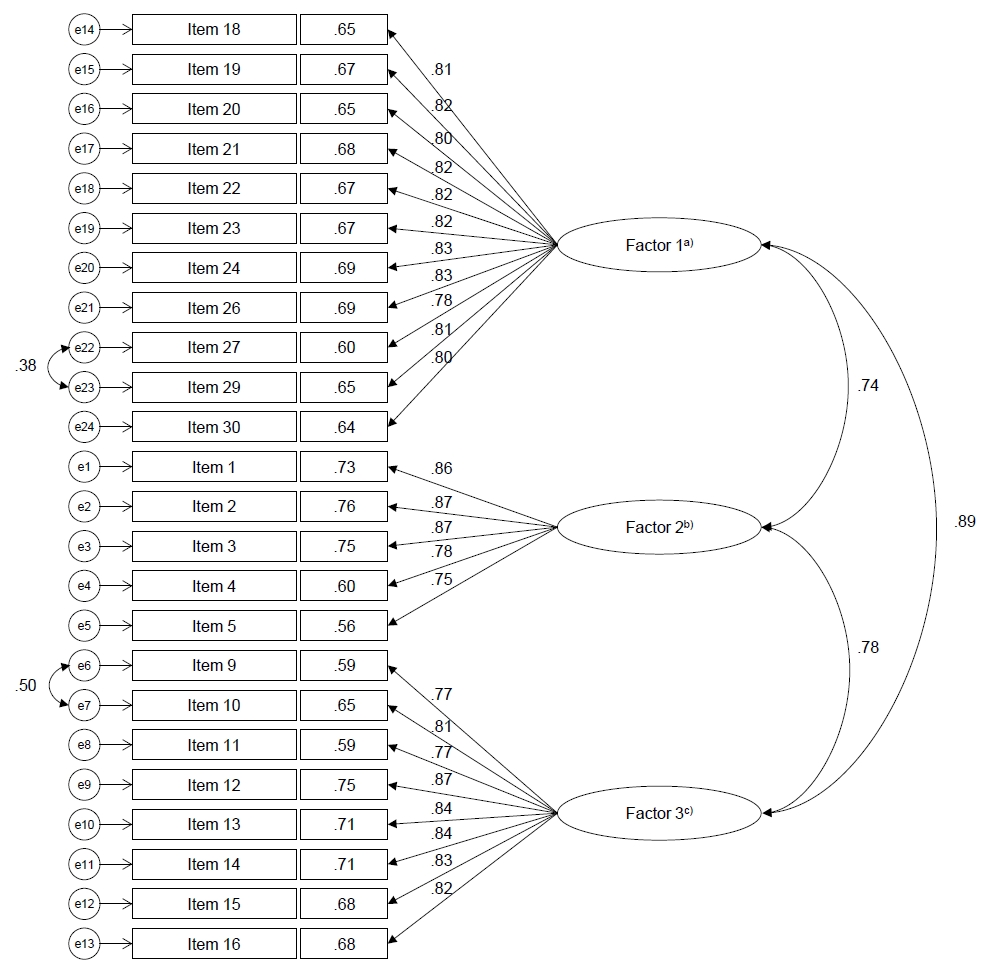
Exploratory factor analysis yielded a three-factor model, which showed acceptable fit in confirmatory factor analysis. The final instrument comprised 24 items across three factors, was scored on a 5-point Likert scale, and was named the Nurses’ Situation Awareness Scale for Clinical Deterioration (NSAS-CD). The scale showed high internal consistency, with Cronbach’s α of .98 and McDonald’s ω of .98.
Conclusion
The NSAS-CD demonstrated acceptable validity and reliability for assessing nurses’ situation awareness of clinical deterioration. Further research is needed to evaluate its generalizability across diverse clinical settings and to establish standardized criteria for clinical deterioration.
- 635 View
- 59 Download

- Job analysis of nurses in acute psychiatric intensive care units using the DACUM method: a cross-sectional study
- Yun Ju Lee, Hee Kyung Kim, Jinhee Yoo, Sukja Kim, Jungeun Shin, Kyoungduck Park, Bunsun Cho
- J Korean Acad Nurs 2026;56(3):382-392. Published online August 3, 2026
- DOI: https://doi.org/10.4040/jkan.26037
-
Abstract
PDFePub
- Purpose
This study systematically analyzed the job duties of nurses in acute psychiatric intensive care units using the Developing A Curriculum (DACUM) technique and identified the core job structure that reflects the characteristics of acute mental health nursing.
Methods
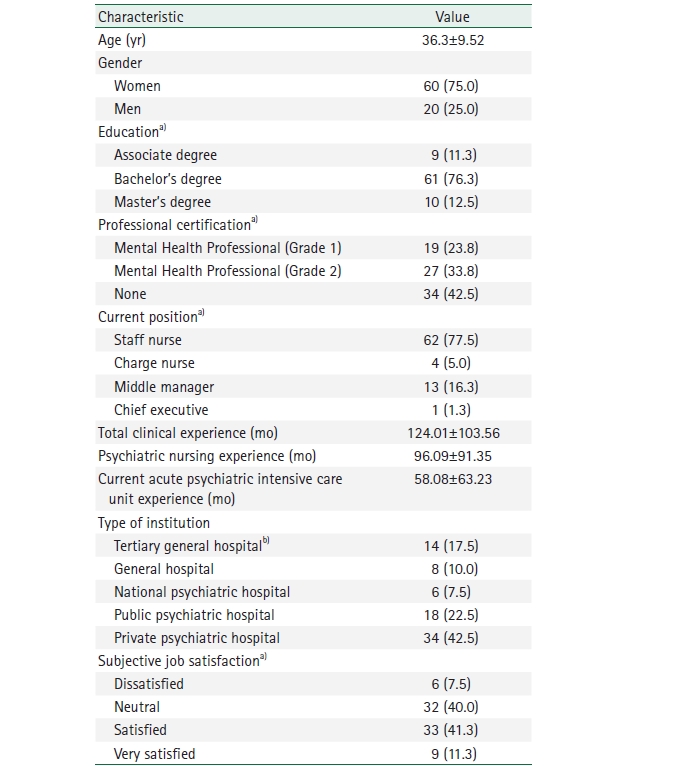
This descriptive cross-sectional study used a DACUM workshop conducted in 2025 to identify job duties. The DACUM committee included one job analysis expert, one coordinator, and eight acute psychiatric nurses. Content validity was verified by eight experts using an item-level content validity index of ≥0.78. A total of 80 nurses assessed task importance, difficulty, and frequency. Data were analyzed using descriptive statistics and the determinant coefficient.
Results
The DACUM analysis identified a structured framework consisting of 10 duties and 39 tasks. “Emergency and crisis management” had the highest determinant coefficient, followed by “therapeutic milieu management,” “psychosocial interventions,” and “education and professional development.” At the task level, crisis intervention and response, physical emergency nursing care, and management of safety incident recurrence were prioritized.
Conclusion
DACUM-based job analysis clarified the structured roles of nurses in acute psychiatric intensive care units and highlighted job characteristics centered on emergency management and safety. These findings provide foundational data for standardizing nursing roles, establishing staffing strategies, and developing specialized clinical education programs for acute psychiatric care.
- 480 View
- 52 Download
- Effects of a hybrid delirium nursing competency enhancement program using the metaverse and standardized patients for intensive care unit nurses: a quasi-experimental study
- Juwon Yun, Mi Yang Jeon
- J Korean Acad Nurs 2026;56(3):331-343. Published online July 27, 2026
- DOI: https://doi.org/10.4040/jkan.26013
-
Abstract
PDFePub
- Purpose
This study evaluated the effects of a hybrid simulation program using the metaverse and standardized patients to enhance delirium nursing competency among intensive care unit (ICU) nurses. Outcomes included delirium nursing knowledge, attitudes, and performance confidence.
Methods
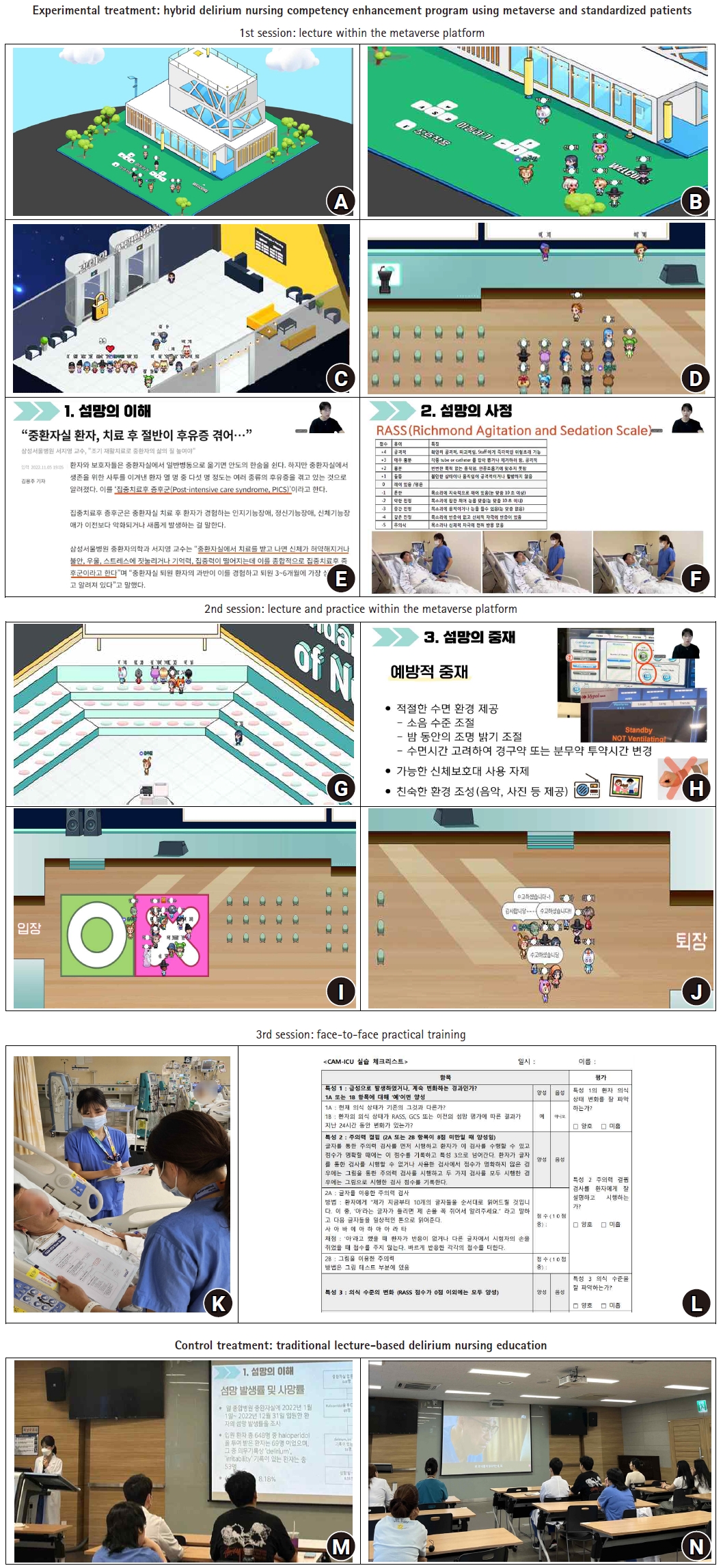
A quasi-experimental study with cluster allocation was conducted among 52 ICU nurses, including 28 in the experimental group and 24 in the control group. Data were collected from July 8 to August 28, 2024. The experimental group participated in a hybrid delirium nursing competency simulation program comprising two metaverse-based sessions (lectures, quizzes, discussions, and practice) followed by a face-to-face standardized patient simulation session. The control group received a conventional face-to-face lecture on delirium nursing. Data were analyzed using the chi-square test, the Fisher exact test, the independent t-test, and the paired t-test with IBM SPSS Statistics ver. 27.0.
Results
After the intervention, the experimental group demonstrated significantly greater improvement in delirium nursing attitude (t=2.05, p=.046) and performance confidence (t=3.35, p=.002) compared with the control group. However, the change in delirium nursing knowledge did not differ significantly between groups (t=0.71, p=.483).
Conclusion
The hybrid delirium nursing competency program using the metaverse and standardized patients was associated with greater positive changes in ICU nurses’ delirium nursing attitudes and performance confidence than conventional lecture-based education. This immersive and interactive hybrid simulation approach may be a sustainable continuing education strategy for strengthening delirium nursing competency among ICU nurses.
- 626 View
- 54 Download
- Latent profile analysis of health and fatigue recovery among shift work nurses and differential associations with participation in a shift work improvement pilot project: a descriptive cross-sectional study
- Eunhee Jung, Eunhye Kim, Suryang Seo, Sunyoung Lee, Sora An, Hyejin Kim, Ye Seul Kim, Youjin Kim, Mijeong Park, Hyoun-Joong Kong, Saram Lee, Yeong Joo Hong, Minho Jung
- J Korean Acad Nurs 2026;56(3):358-369. Published online July 23, 2026
- DOI: https://doi.org/10.4040/jkan.26006
-
Abstract
PDFePub
- Purpose
This study aimed to identify latent profiles of shift-work nurses according to perceived health, fatigue, and recovery levels and to examine differences across profiles in work-related outcomes, including sleep quality, work-life balance, job satisfaction, and turnover intention. It also examined whether patterns associated with participation in a shift-work improvement pilot project differed by latent profile.
Methods
This descriptive cross-sectional study included 120 shift-work nurses working in pediatric wards at a tertiary hospital in South Korea. Data were collected from January 14 to 24, 2025. Latent profile analysis was performed using the 36-Item Short Form Health Survey and the Occupational Fatigue Exhaustion Recovery Scale. Differences in outcomes by latent profile membership and pilot-project participation status at the time of data collection were examined using two-way analysis of covariance, with age included as a covariate.
Results
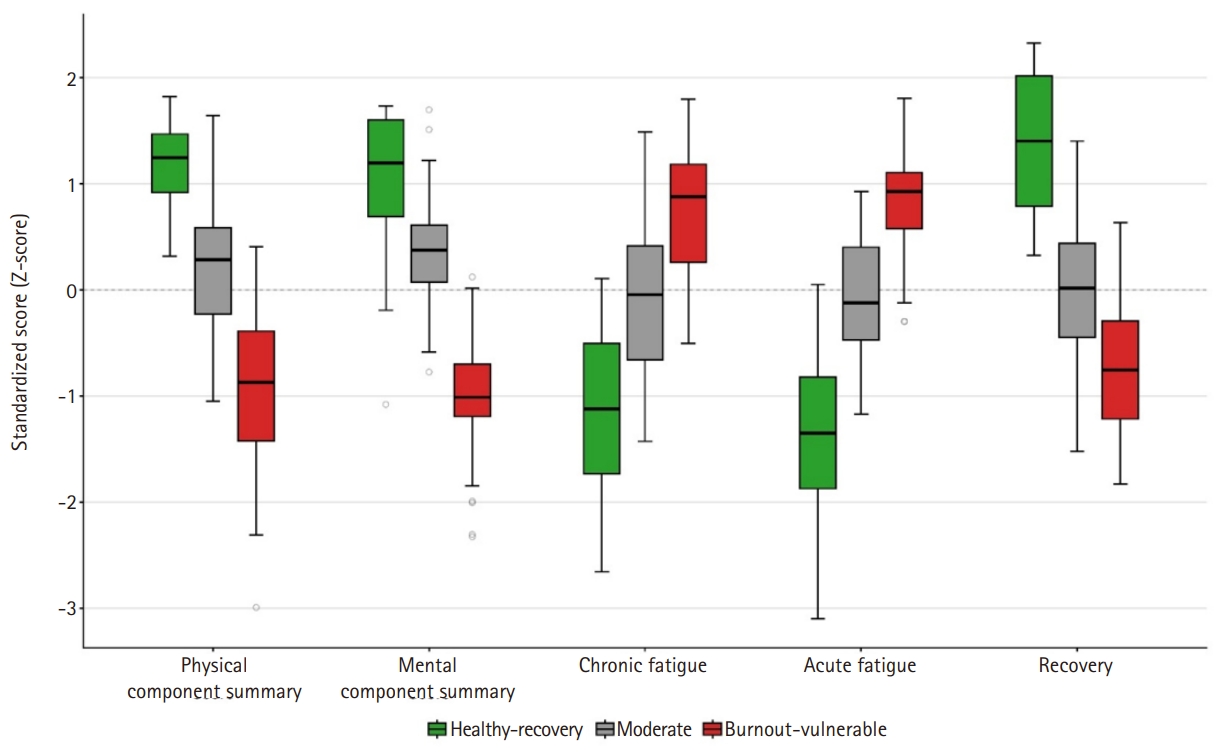
Three latent profiles were identified: Healthy-Recovery (20.8%), Moderate (41.7%), and Burnout-Vulnerable (37.5%). Significant differences among profiles were observed in sleep quality (F=37.37, p<.001), work-life balance (F=50.86, p<.001), job satisfaction (F=12.29, p<.001), and turnover intention (F=12.11, p<.001). A significant interaction between latent profile membership and pilot-project participation was observed for job satisfaction (F=4.77, p=.010, partial η²=.078). Pilot-project participation was associated with significantly higher job satisfaction only in the Healthy-Recovery profile (p=.005).
Conclusion
Associations between pilot-project participation and work-related outcomes differed according to nurses’ health, fatigue, and recovery profiles. These findings indicate that heterogeneity among shift-work nurses should be considered when interpreting work-related outcomes and designing tailored support strategies.
- 542 View
- 59 Download
- Nursing management competencies among nurses in national specialized hospitals in Korea: a mixed-methods study
- Jiyoung Choi, Jee-In Hwang
- J Korean Acad Nurs 2026;56(2):190-205. Published online May 22, 2026
- DOI: https://doi.org/10.4040/jkan.25175
-
Abstract
PDFePub
- Purpose
This study aimed to examine nursing management competencies among nurses working in national specialized hospitals, to identify competency development needs and influencing factors, and to provide foundational data for the development of educational and competency-enhancement programs.
Methods
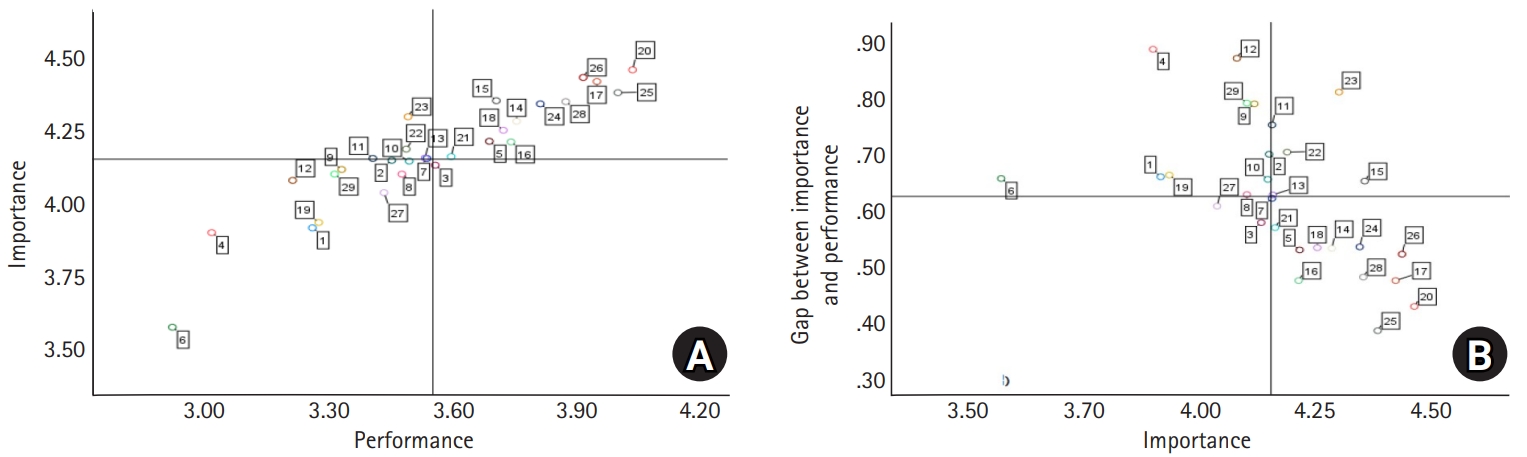
A mixed-methods design was employed. Quantitative data were collected via an online survey of 162 nurses from five national specialized hospitals from January 10 to February 10, 2025, and qualitative data were obtained through in-depth interviews with 20 participants from March 7 to April 16, 2025. Quantitative data were analyzed using descriptive statistics, independent t-tests, analysis of variance, importance–performance analysis, the Borich Needs Assessment, the Locus for Focus model, and multiple regression analysis. Qualitative data were analyzed using content analysis with ATLAS.ti.
Results
The mean performance score for nursing management competencies was 3.56±0.71 on a 5-point scale. Customer orientation received the highest score (4.03±0.78), whereas business and marketing received the lowest score (2.92±1.03). Across needs-assessment models, leadership, nursing ethics and law, quality improvement, and standard development consistently emerged as high-priority areas. In multiple regression analysis, the nursing work environment was the only factor significantly associated with nursing management competency performance (β=.33, p<.001). Qualitative content analysis corroborated these findings and identified three facilitator themes and three barrier themes.
Conclusion
Nursing management competency performance among nurses in national specialized hospitals was associated with the nursing work environment, including organizational conditions. These findings underscore the importance of organizational support and suggest that competency-based education should be redesigned to prioritize high-need competency areas. This study provides a foundation for developing educational interventions and programs to enhance nursing management capacity.
- 1,352 View
- 169 Download
- Nurse retention discourse in YouTube comments: a structural topic modeling analysis
- Taewha Lee, JooHyun Lee
- J Korean Acad Nurs 2026;56(2):206-219. Published online May 18, 2026
- DOI: https://doi.org/10.4040/jkan.25172
-
Abstract
PDFePub
- Purpose
This study analyzed public discourse on nurse retention through YouTube comments posted between 2018 and 2024 to examine how retention issues are collectively framed in online public spheres, thereby extending individual-level retention research to societal-level discourse analysis.
Methods
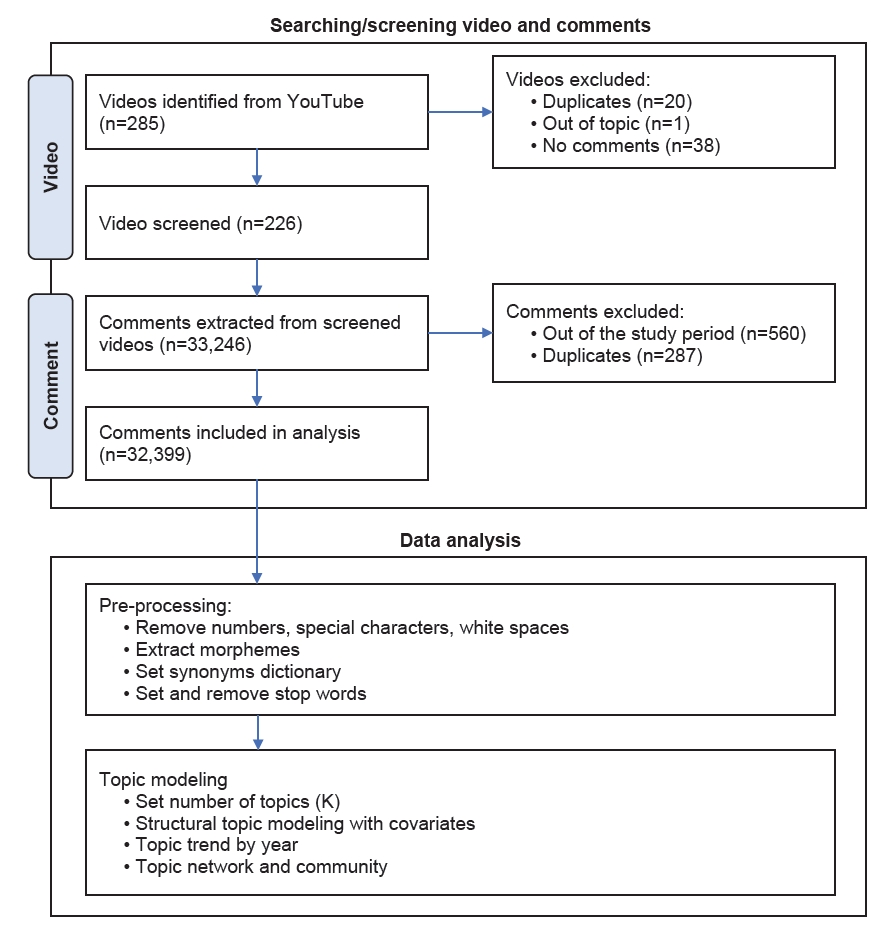
Comments were collected from 226 YouTube videos uploaded between January 2015 and December 2024, identified using search terms that combined “nurse” with retention-related keywords. After duplicates and comments posted outside the study period were removed, 32,399 comments were analyzed using structural topic modeling with year and number of likes as covariates. Topic correlation network analysis with community detection was used to identify discourse coalitions.
Results
Fourteen substantive topics and one noninterpretive topic emerged, spanning individual coping strategies, organizational workplace issues, and systemic policy structures. “International nursing migration and career pathways” (12.8%) and “Disputes regarding the scope of practice among professionals” (11.4%) were the most prevalent topics. Temporal analysis revealed discourse shifts consistent with focusing events theory: COVID-19 (coronavirus disease 2019) activated structural critique frames while suppressing career mobility discourse; the 2022 Nursing Law followed an issue-attention cycle pattern; and the 2024 medical school quota expansion embedded retention discourse within broader healthcare policy debates. Network analysis identified two discourse communities, professional identity and structural exploitation, with international migration serving as a bridging frame across both.
Conclusion
Public discourse framed nurse retention as a systemic and structural issue rather than as an expression of individual professional rejection. These collective framing patterns complement traditional survey-based research and may inform policy design by identifying which frames achieve public resonance and where discourse fragmentation may challenge policy implementation.
- 1,234 View
- 124 Download
- Experiences of nurses working as physician assistants under the expanded scope-of-practice policy following the 2024 resignation of medical residents in South Korea: a phenomenological study
- Tae Yeong Yang, Myung Jin Jang, NaHyun Lee
- J Korean Acad Nurs 2026;56(2):220-232. Published online May 14, 2026
- DOI: https://doi.org/10.4040/jkan.26001
-
Abstract
PDFePub
- Purpose
This study aimed to explore the lived experiences of clinical support nurses under the expanded scope-of-practice policy implemented after the mass resignation of medical residents in Korea in 2024. In Korea, these nurses are often referred to as physician assistant (PA) nurses, although they differ from licensed physician assistants or nurse practitioners in the United States. The study sought to understand how the policy was perceived, implemented, and interpreted by nurses who played a key role in maintaining clinical services during a healthcare workforce crisis.
Methods
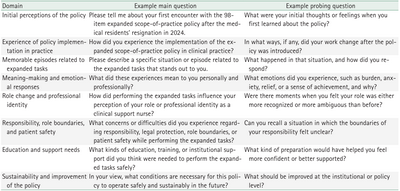
A qualitative phenomenological design based on Colaizzi’s method was used. Fourteen clinical support nurses from a tertiary hospital in Seoul participated in in-depth, semi-structured interviews conducted between August and December 2025. The interviews were transcribed verbatim and analyzed through iterative reading, extraction of significant statements, formulation of meanings, and thematic integration. Trustworthiness was established using the criteria of credibility, dependability, transferability, and confirmability.
Results
Four essential themes were identified: (1) multifaceted perceptions of the 98-item expanded scope-of-practice policy; (2) gaps in the current education system and demands for structured training; (3) ambivalent experiences during policy implementation; and (4) conditional acceptance of the policy’s sustainability and calls for improvement. Participants reported increased professional recognition and autonomy while also experiencing ambiguity in role boundaries, concerns about legal accountability, and emotional burden related to insufficient preparation and protection.
Conclusion
The expanded scope-of-practice policy both strengthens professional competence and creates role instability among clinical support nurses. Its sustainable implementation requires clear legal protection, standardized education and certification systems, appropriate compensation, and the active involvement of frontline nurses in policy development. -
Citations
Citations to this article as recorded by
- The Tertiary Hospital Restructuring Project in South Korea: A Reflexive Thematic Analysis of Hospital Directors’ Perspectives on Barriers and Policy Recommendations
Hooyeon Lee, Ji Eun Kim, Kyungin Lee, Dong Jun Kim, Kwangmo Yang, Kyounga Lee, Myung-Il Hahm
Healthcare.2026; 14(16): 2469. CrossRef
- The Tertiary Hospital Restructuring Project in South Korea: A Reflexive Thematic Analysis of Hospital Directors’ Perspectives on Barriers and Policy Recommendations
- 1,481 View
- 176 Download
- 1 Web of Science
- 1 Crossref
Review Paper
- Variables associated with compliance with standard precautions among hospital nurses: a systematic review and meta-analysis
- Song Hee Park, Seok Hee Jeong, Chang Seop Lee, Young Man Kim
- J Korean Acad Nurs 2026;56(1):1-26. Published online February 27, 2026
- DOI: https://doi.org/10.4040/jkan.25114
-
Abstract
PDF
- Purpose
This study aimed to conduct a systematic review and meta-analysis to identify variables associated with standard precautions compliance among hospital nurses and to comprehensively examine their effect sizes.
Methods
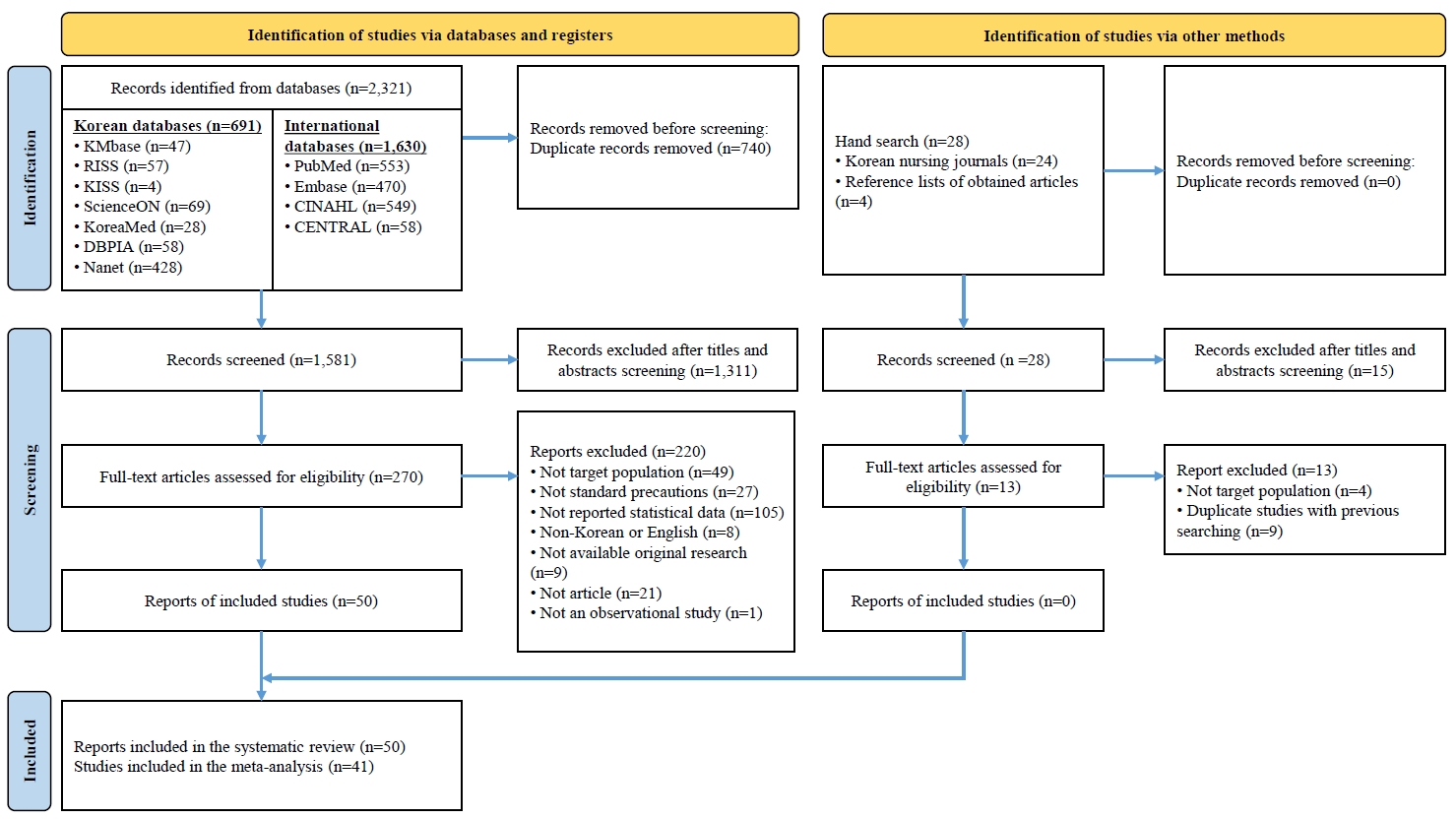
A systematic review and meta-analysis were reported in accordance with the PRISMA and MOOSE guidelines. Studies published in English or Korean were retrieved from KMbase, KoreaMed, KISS, ScienceON, RISS, Nanet, DBpia, PubMed, Embase, CINAHL, and CENTRAL. Data collection was conducted from July 6 to July 16, 2024. To ensure a comprehensive search, no restrictions were placed on the publication period, and studies published up to June 2024 were included in the literature search. Analyses were performed using R ver. 4.4.1.
Results
Of the 2,321 studies screened, 50 were included in the systematic review and 41 were included in the meta-analysis. Variables were categorized according to the ecological model. Among individual-level factors, variables with medium correlation effect sizes (ESr ≥.30) included self-efficacy (ESr=.41; 95% confidence interval [CI], 0.24 to 0.56), perceived barriers (ESr=−.35; 95% CI, −0.59 to −0.05), cues to action (ESr=.34; 95% CI, 0.07 to 0.57), and perceived benefits (ESr=.30; 95% CI, 0.13 to 0.46). Among organizational factors, organizational culture for infection control (ESr=.47; 95% CI, 0.39 to 0.54) and patient safety culture (ESr=.44; 95% CI, 0.35 to 0.53) demonstrated medium effect sizes. Other statistically significant variables with small effect sizes were also identified. No variables were identified within the interpersonal, community, or public policy domains.
Conclusion
This study identified self-efficacy and organizational culture for infection control as key determinants of compliance with standard precautions. Strengthening these factors may reduce healthcare-associated infections and promote safer nursing care (PROSPERO registration number: CRD42024566518). -
Citations
Citations to this article as recorded by- Factors influencing intensive care unit nurses’ performance of standard precautions in South Korea: a descriptive correlational study
Hana Seo, Nahyun Kim
Journal of Korean Biological Nursing Science.2026; 28(2): 300. CrossRef
- Factors influencing intensive care unit nurses’ performance of standard precautions in South Korea: a descriptive correlational study
- 3,037 View
- 366 Download
- 1 Crossref
Research Papers
- Experiences of work performance among physician assistant nurses during the period of healthcare disruption in South Korea: a qualitative content analysis
- Juyoung Ha, Minji Kim
- J Korean Acad Nurs 2026;56(1):98-107. Published online February 24, 2026
- DOI: https://doi.org/10.4040/jkan.25133
-
Abstract
PDFePub
- Purpose
This study aimed to explore the work experiences of physician assistant (dedicated nurses in Korea) during the medical service gap caused by physician–government conflicts.
Methods
A qualitative design employing individual in-depth interviews was used. Data were collected from July 18 to August 13, 2025. Fifteen nurses who worked as physician assistant 5 during the healthcare service gap participated in the study. Participants were categorized as follows: (1) nurses in the role before the period of healthcare disruption, (2) those who voluntarily applied after the period of healthcare disruption, and (3) those involuntarily assigned during the period of healthcare disruption. Data were analyzed using conventional content analysis.
Results
Three categories with six subcategories were identified: (1) reconstructing inner experience within an expanded role (unprepared responsibility and burden, inner fulfillment discovered through continuity of care); (2) reconfiguring relationships from a boundary position (feeling distant as “the same yet different” nurses, expansion of mutual understanding in a crisis context); and (3) precarious positioning within an unestablished system (uncertain standing after residents’ return, episodic implementation of non-standardized training).
Conclusion
This study showed that physician assistant who filled residents’ gaps in an incomplete system experienced heavier role burdens, blurred job identity, unequal conditions, and unstable affiliation, while some also found renewed meaning and fulfillment through continuity of care and closer collaboration. With structured education, clearly defined scopes of practice after residents’ return, and stable legal and organizational support, these nurses can function as more than temporary substitutes and help sustain continuity and quality of patient care. -
Citations
Citations to this article as recorded by- The Tertiary Hospital Restructuring Project in South Korea: A Reflexive Thematic Analysis of Hospital Directors’ Perspectives on Barriers and Policy Recommendations
Hooyeon Lee, Ji Eun Kim, Kyungin Lee, Dong Jun Kim, Kwangmo Yang, Kyounga Lee, Myung-Il Hahm
Healthcare.2026; 14(16): 2469. CrossRef
- The Tertiary Hospital Restructuring Project in South Korea: A Reflexive Thematic Analysis of Hospital Directors’ Perspectives on Barriers and Policy Recommendations
- 2,281 View
- 330 Download
- 1 Web of Science
- 1 Crossref
- Development of an end-of-life care competency scale for nurses in long-term care hospitals: a psychometric validation study
- Sookyeon Son, Mi-Kyeong Jeon
- J Korean Acad Nurs 2025;55(4):598-612. Published online November 27, 2025
- DOI: https://doi.org/10.4040/jkan.25113
-
Abstract
PDFePub
- Purpose
This study aimed to develop a scale to measure end-of-life care (EOLC) competency among nurses working in long-term care hospitals and to evaluate its validity and reliability.
Methods
Preliminary items were developed based on attributes and indicators identified through a conceptual analysis of EOLC competency. The initial version of the scale was refined through expert content validity assessment, item revision, and a pilot test. The main survey was conducted among 460 nurses in long-term care hospitals, and 409 valid responses were analyzed after excluding 51 incomplete or invalid cases. Data were analyzed using software-assisted item analysis, exploratory and confirmatory factor analyses, and assessments of convergent, discriminant, and criterion-related validity, as well as reliability testing.
Results
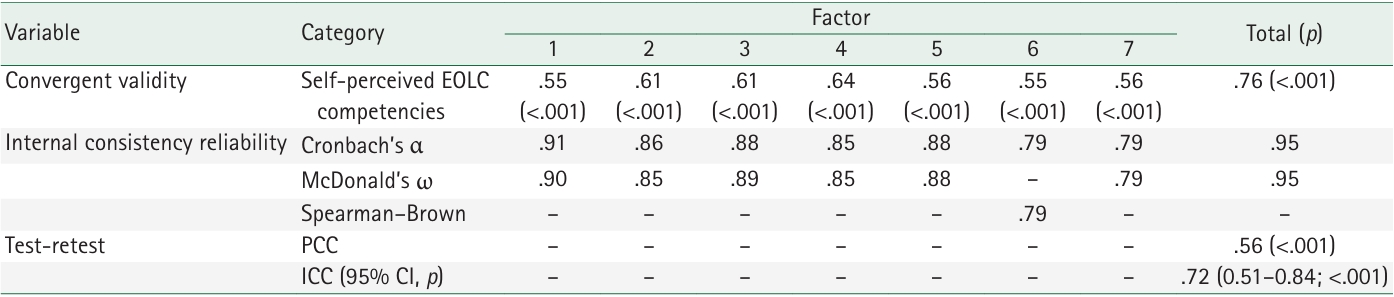
The initial 55 items were reduced to a final set of 30 items across seven dimensions. Model fit indices indicated good construct validity (χ²/degrees of freedom=1.91, standardized root mean square residual=.06, root mean square error of approximation=.07, Tucker-Lewis index=.90, comparative fit index=.91), with a total explained variance of 70.2%. The scale demonstrated strong criterion-related validity (r=.76, p<.001), high internal consistency (Cronbach’s α=.95; McDonald’s ω=.95), acceptable test–retest reliability (r=.56, p<.001), and an intraclass correlation coefficient of .72 (95% confidence interval, .51–.84; p<.001).
Conclusion
The developed scale is a valid and reliable instrument for assessing EOLC competency among nurses in long-term care hospitals. It can be effectively utilized for educational assessment, training evaluation, and the measurement of program effectiveness in end-of-life care.
- 2,790 View
- 223 Download
- Effects of presenteeism on turnover intention in clinical nurses through the serial mediating roles of missed nursing care and job satisfaction: a cross-sectional predictive correlational study
- Hyeonseon Cheon, Seok Hee Jeong, Hyun Kyung Kim, Hyoung Eun Chang
- J Korean Acad Nurs 2025;55(4):584-597. Published online November 10, 2025
- DOI: https://doi.org/10.4040/jkan.25015
-
Abstract
PDFePub
- Purpose
This study aimed to investigate the two-mediator serial mediation effect of missed nursing care and job satisfaction on the relationship between presenteeism and turnover intention in clinical nurses.
Methods
A cross-sectional predictive correlational study was conducted, and the participants were 208 clinical nurses working in advanced general hospitals in South Korea. Data were collected from October 6 to November 7, 2023 using self-reported questionnaires, including general characteristics, presenteeism, missed nursing care, job satisfaction, and turnover intention. Data were analyzed using IBM SPSS/WIN ver. 29.0 and PROCESS macro ver. 4.2.
Results
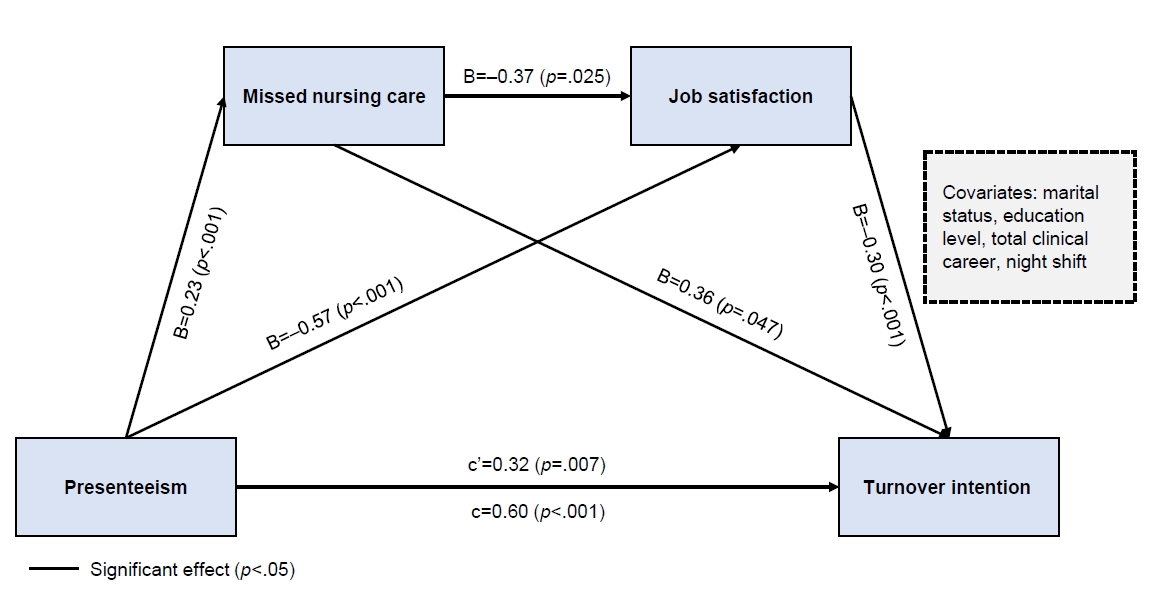
Missed nursing care and job satisfaction exhibited a double mediating effect on the relationship between presenteeism and clinical nurses’ turnover intention. In addition, missed nursing care showed a mediating effect on the relationship between presenteeism and clinical nurses’ turnover intention. Job satisfaction had a mediating effect on the relationship between presenteeism and clinical nurses’ turnover intention. Presenteeism had a direct effect on missed nursing care, job satisfaction, and turnover intention. Missed nursing care exerted a direct effect on job satisfaction and turnover intention among clinical nurses. Job satisfaction had a direct effect on turnover intention.
Conclusion
To reduce nurses’ turnover intention, it is essential to develop and implement programs focused on preventing presenteeism. Additionally, organizational initiatives should prioritize active support for nurses’ health management, alleviating the shortage of nursing staff, augmenting job satisfaction, and improving the overall working environment. -
Citations
Citations to this article as recorded by- The Effects of Perceived Time Pressure, Presenteeism, and Patient Safety Culture of General Hospital Nurses on Patient Safety Management Activities
Young Suk Yoo, Ju Young Park
Journal of Korean Public Health Nursing.2026; 40(1): 63. CrossRef - The Effects of Nurses' Job Stress and Presenteeism on Turnover Intention: Moderated Mediating Effect of Nursing Work Environment
Yu Seung Ban, Youngran Yang, Seok Hee Jeong, Hyoung Eun Chang
Journal of Korean Academy of Nursing Administration.2026; 32(3): 187. CrossRef - Post-Traumatic Stress Symptoms, Occupational Stress, Emotional Exhaustion, and Quiet Quitting in Workplace-Violence-Exposed Turkish Prehospital Emergency Workers: A Cross-Sectional Study
Mehmet Tatlı, Ramazan Güven, Habip Balsak, Mehmet Özel, İsmail Altıntop
Healthcare.2026; 14(15): 2244. CrossRef - Portuguese Version of the MISSCARE Survey-Patient: A Cross-Cultural Validation Study
Paulo Cruchinho, Gisela Teixeira, Pedro Lucas, Filomena Gaspar, María Dolores López-Franco
Nursing Reports.2026; 16(9): 312. CrossRef
- The Effects of Perceived Time Pressure, Presenteeism, and Patient Safety Culture of General Hospital Nurses on Patient Safety Management Activities
- 3,364 View
- 418 Download
- 1 Web of Science
- 4 Crossref
- Job stress levels and coping among hospital nurses: a latent profile analysis
- Myungji Kim, Hyunkyung Choi
- J Korean Acad Nurs 2025;55(3):377-387. Published online August 22, 2025
- DOI: https://doi.org/10.4040/jkan.25061
-
Abstract
PDFePub
- Purpose
This study aimed to identify job stress levels and coping profiles among hospital nurses, explore the factors influencing profile classification, and determine whether levels of job embeddedness and happiness varied among the profiles.
Methods
Data were collected through an online survey of 325 hospital nurses, and latent profiles were identified via latent profile analysis. The R3STEP (three-step auxiliary variable approach) method was used to examine the factors influencing the latent profiles, and one-way analysis of variance was conducted to analyze differences in levels of job embeddedness and happiness.
Results
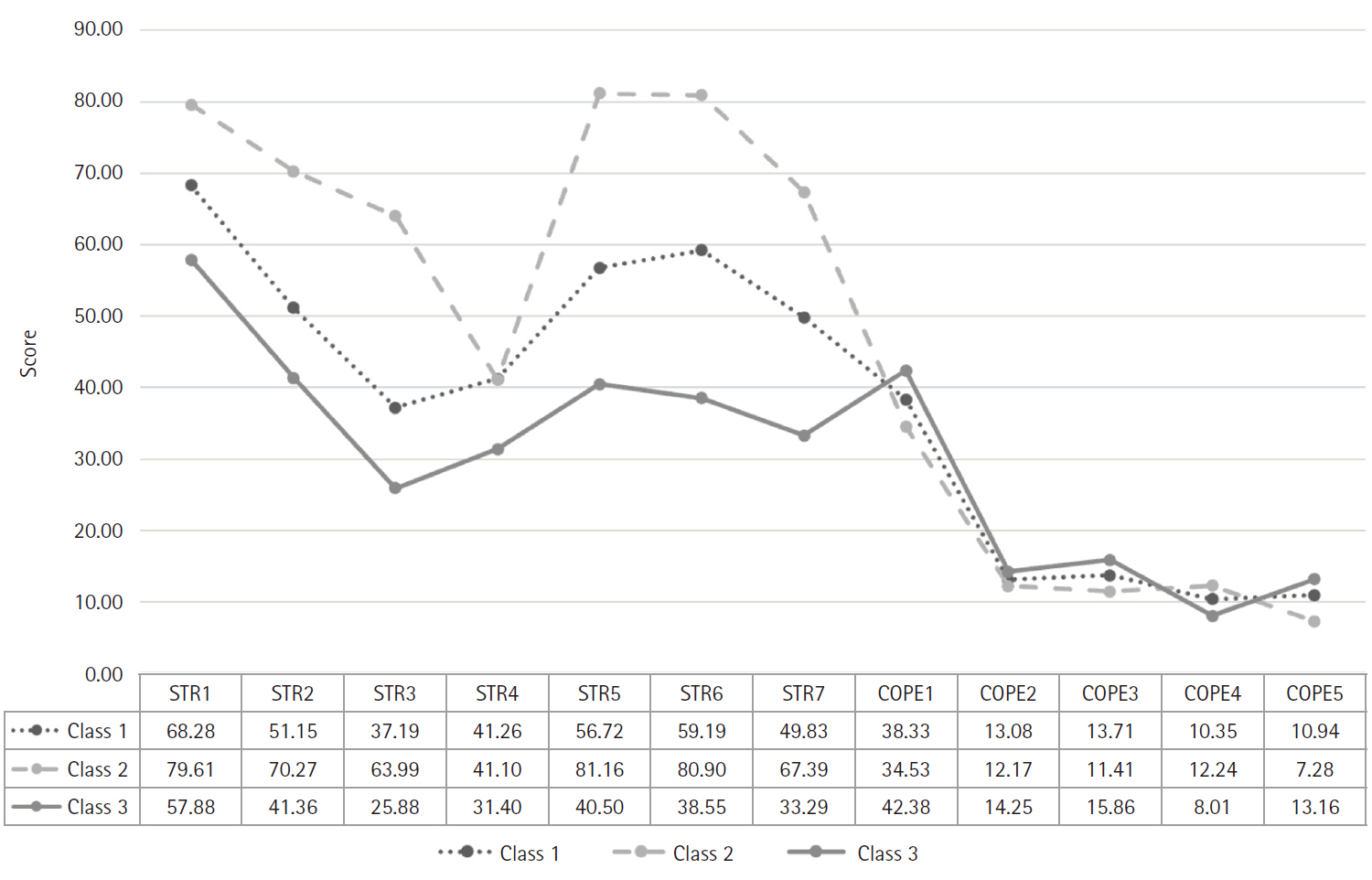
Three job stress and coping profiles were identified: (1) the “moderate stress-balanced coping group”, characterized by moderate levels of job stress and moderate use of all coping strategies; (2) the “high stress-emotional coping group”, with high job stress and primary use of emotional display strategies; and (3) the “low stress-adaptive coping group, with low job stress and the utilization of a variety of coping strategies. Workplace location and monthly income influenced the classification of latent profiles. Nurses working in metropolitan areas and those with lower monthly incomes were more likely to be classified into the high stress-emotional coping group than other groups. The levels of job embeddedness and happiness were highest in the low stress-adaptive coping group and lowest in the high stress-emotional coping group.
Conclusion
The results of this study indicate the need to develop strategies that offer diverse stress-coping programs and support nurses in effectively utilizing coping methods that best suit their individual needs.
- 3,703 View
- 314 Download
- Comparison of educational needs and priorities for work-related laws between hospital and community-based nurses
- Jeonghyun Kim, Min Kyoung Han, Minjae Lee, Sujin Shin
- J Korean Acad Nurs 2025;55(3):400-412. Published online August 21, 2025
- DOI: https://doi.org/10.4040/jkan.25049
-
Abstract
PDFePub
- Purpose
This study aimed to examine the practical utilization of work-related laws in nursing practice and to prioritize educational needs to provide foundational data for improving nurses’ legal competencies.
Methods
A descriptive survey was employed using an online self-reported questionnaire. Participants included 275 nurses with over 3 years of clinical experience, categorized into hospital and community-based. Convenience sampling was used, and data were collected between January 9 and February 3, 2025. Descriptive statistics and the paired t-test were conducted using IBM SPSS 26.0. Educational needs were analyzed using the Borich Needs Assessment and the Locus for Focus model.
Results
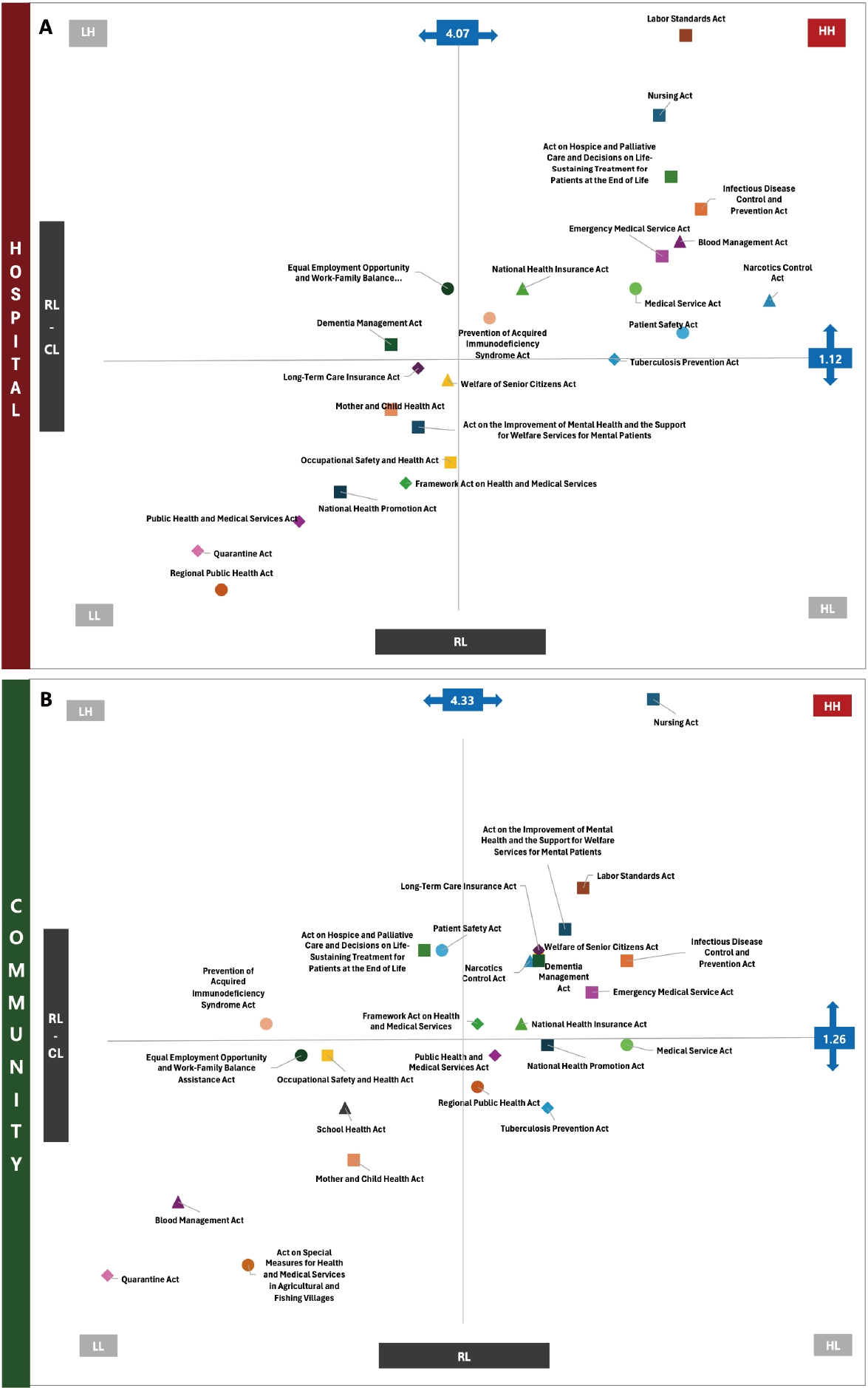
Among participants, 75.6% had received education on work-related laws, and 79.3% of those participants received related education during their undergraduate studies. However, 32.4% of nurses reported experiencing practice related difficulties due to insufficient legal knowledge, particularly related to unclear legal responsibilities and ambiguity in the scope of practice. High educational needs were identified for the Nursing Act and the Labor Standards Act across all workplaces. Hospital nurses emphasized the Hospice and Palliative Care Act and Emergency Medical Services Act, while community-based nurses prioritized the Mental Health Welfare Act, Elderly Welfare Act, and Dementia Management Act.
Conclusion
Nurses’ legal education needs are related to practical applications and their capability to respond appropriately to legal requirements, and these needs vary depending on their work environment and social changes. These findings underscore the necessity of restructuring legal education curricula to improve practical relevance and support nurses’ rights, providing a basis for developing workplace-specific legal education programs. -
Citations
Citations to this article as recorded by- Legal Literacy in Clinical Nursing Practice: A Walker and Avant Concept Analysis
Yufei Xing, Xiaolong Wang, Enming Zhang, Jiajia Yu, Qiong Fang
Nursing Reports.2026; 16(6): 200. CrossRef
- Legal Literacy in Clinical Nursing Practice: A Walker and Avant Concept Analysis
- 2,984 View
- 201 Download
- 1 Web of Science
- 1 Crossref
- Effects of social support on organizational commitment among experienced nurses experiencing department rotation: the mediating effect of organizational socialization
- Young Jun Jang, Jeong A Jeong, Yu Seung Ban, Seon Hwa Park, Eun Jee Lee
- J Korean Acad Nurs 2025;55(3):364-376. Published online August 18, 2025
- DOI: https://doi.org/10.4040/jkan.25042
-
Abstract
PDFePub
- Purpose
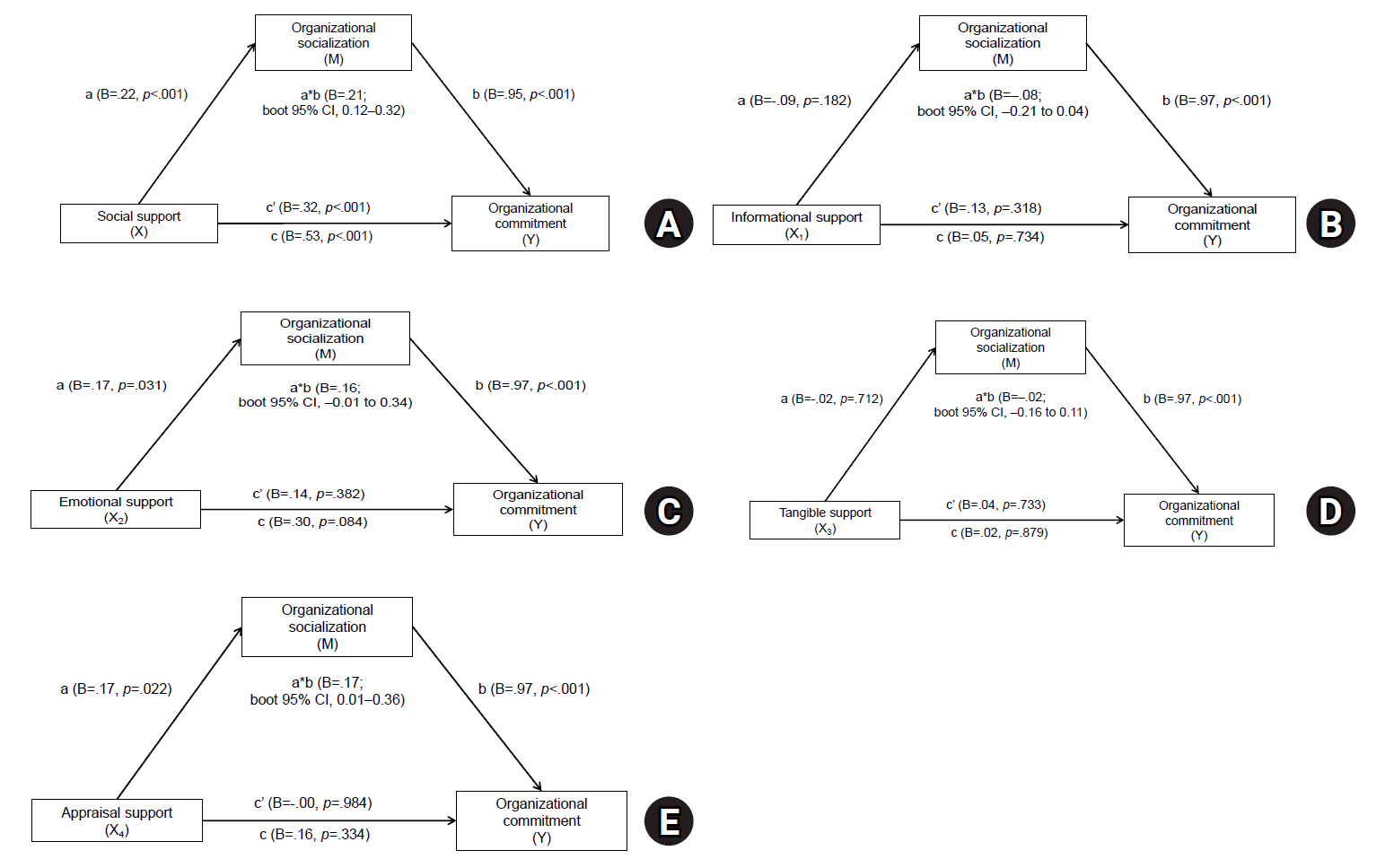
This study explored the mediating role of organizational socialization in the relationship between social support and organizational commitment among nurses in hospitals who had experienced department rotation.
Methods
A descriptive survey design was used with 202 nurses from a tertiary hospital who had experienced department rotation within the past 12 months. Data were collected via an online questionnaire from August 1 to August 30, 2024. Analyses included frequency analysis, descriptive statistics, Pearson correlation, and multiple regression. The mediating effect was tested using IBM SPSS WIN ver. 23.0 and the PROCESS macro (model 4) with 10,000 bootstrap resamples.
Results
Organizational socialization partially mediated the relationship between social support and organizational commitment (B=.21; bootstrapped 95% confidence interval, 0.12–0.32).
Conclusion
The findings suggest that both social support and organizational socialization play essential roles in improving nurses’ organizational commitment following department rotation. Thus, practical programs, such as mentoring systems, should be implemented that both enhance social support and actively promote organizational socialization. These efforts have the potential to help nurses adjust more effectively to new units and ultimately improve retention and performance within healthcare organizations. -
Citations
Citations to this article as recorded by- Why Self‐Leadership Alone Is Not Enough: How Professional Self‐Concept and Organizational Commitment Shape Male Nurses’ Intention to Stay
Donghyeok Lee, Mihwa Shim, Jungmin Lee, Matthew Vandermeulen
Journal of Nursing Management.2026;[Epub] CrossRef - The Effects of Nurses’ Dispatch Work Characteristics on Job Embeddedness, Organizational Commitment, and Turnover Intention
Eejee Jung, Gunjeong Lee
Journal of Korean Academy of Nursing Administration.2025; 31(5): 560. CrossRef - Nurses' Experience Working with Substitute Nurses
Hye Mi Kim, Yeon Hee Kim, Jeong Hye Kim
Journal of Korean Association for Qualitative Research.2025; 10(3): 208. CrossRef
- Why Self‐Leadership Alone Is Not Enough: How Professional Self‐Concept and Organizational Commitment Shape Male Nurses’ Intention to Stay
- 3,388 View
- 374 Download
- 1 Web of Science
- 3 Crossref
Review Paper
- Research trends in generative artificial intelligence in nursing: a scoping review
- Myung Jin Choi, Myoung Hee Seo, Jihun Kim, Sunmi Kim, Seok Hee Jeong
- J Korean Acad Nurs 2025;55(3):468-487. Published online August 5, 2025
- DOI: https://doi.org/10.4040/jkan.25006
-
Abstract
PDFePub
- Purpose
Generative artificial intelligence (AI) has yet to be comprehensively analyzed in the nursing literature. This study aimed to identify research trends in generative AI within the nursing field through a scoping review and propose strategies for its effective utilization in nursing.
Methods
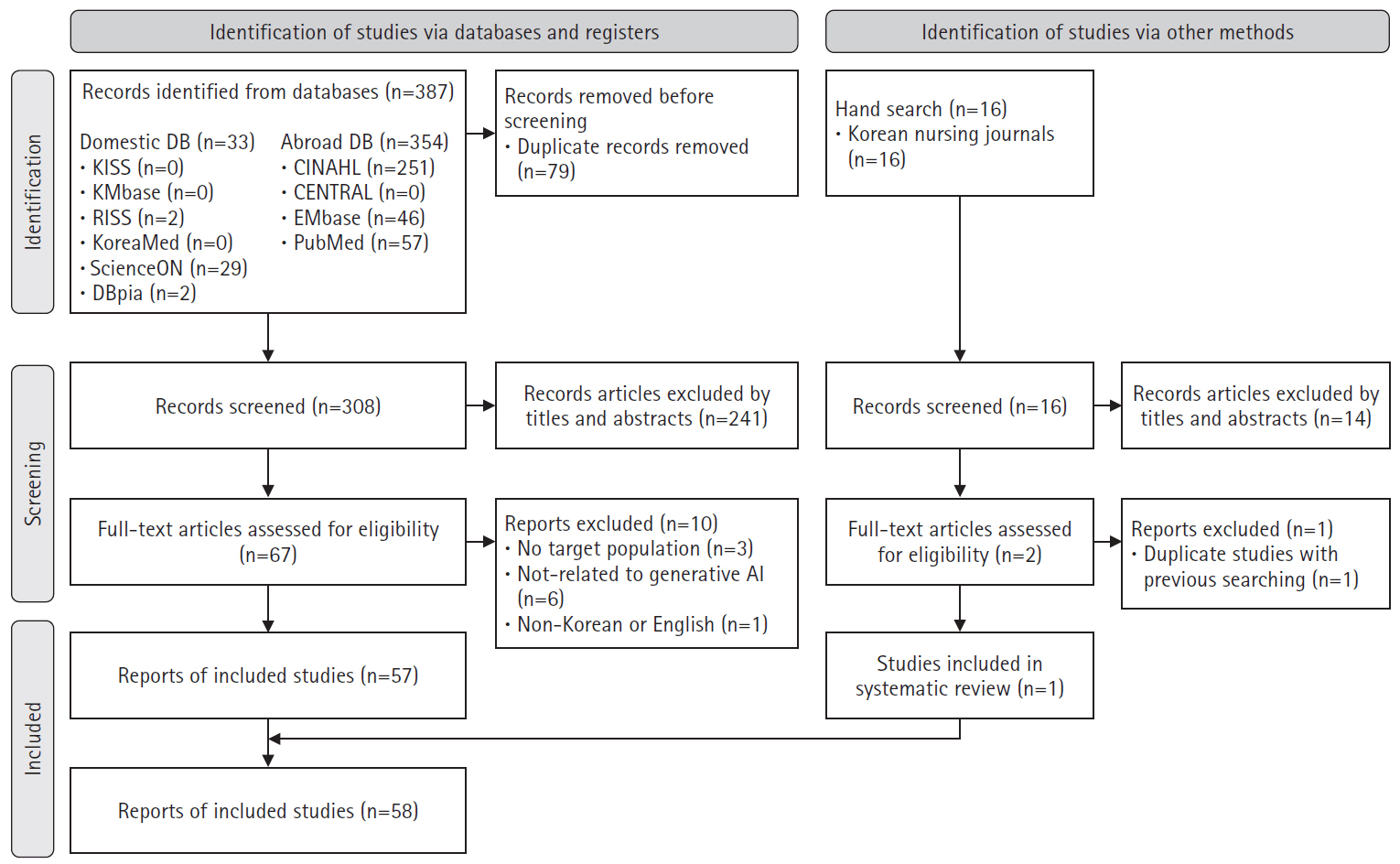
A scoping review was conducted following Arksey and O’Malley’s six-stage framework. The inclusion criteria included: (1) studies conducted in nursing; (2) research related to generative AI; and (3) original research articles, theses, communications, editorials, letters, or commentaries published in academic journals. Database used PubMed, Embase, CENTRAL, CINAHL, KMbase, KoreaMed, KISS, ScienceON, RISS, DBpia, and 27 nursing-specific journals.
Results
In total, 403 studies were initially identified, and 58 were included in the final analysis. In the care domain, strengths included rapid information retrieval and improved nurse-patient communication, while limitations included the irreplaceable human element and low reliability. The administration domain had no relevant studies. In the research domain, generative AI exhibited strengths such as enhanced efficiency in the paper writing process and improved dissemination speed, but its weaknesses included lack of ethical and legal accountability and a risk of inaccurate or biased information. In the education domain, generative AI was effective in saving time in educational design and implementation, as well as supporting content creation, but challenges included algorithmic bias and risks of plagiarism.
Conclusion
This study identified potential benefits and limitations of generative AI across nursing domains. For effective application, it is essential to develop comprehensive guidelines and policies, provide user education and support, and create opportunities for nurses, educators, and students to learn about strengths and risks of generative AI. -
Citations
Citations to this article as recorded by- Generative AI use in instructor-assigned learning activities among nursing students: A cross-sectional survey of perceptions, ethical awareness, faculty restrictions, and continuance intention
Yun-Ting Huang, Hsiao-Fang Hsiung, Hui-Ling Lin, Li-Chun Chang, Li-Ling Liao
Nurse Education Today.2026; 165: 107162. CrossRef - Toward an end-to-end K-AI nursing ecosystem: digital twins across the care continuum
Jeung-Im Kim, Jiyeon Kang, YeoJin Im, Sung Reul Kim, Sun Ju Chang
Journal of Korean Academy of Nursing.2026; 56(2): 123. CrossRef - A concept analysis of generative artificial intelligence-based learning support in nursing education
Hyo Hoon Ku
The Journal of Korean Academic Society of Nursing Education.2026; 32(3): 393. CrossRef - Nursing Students' Perspectives on the Use of Artificial Intelligence in Psychiatric Nursing Education: A Qualitative Meta-Synthesis
Sukyung Son, Eunyoung Park
Journal of Korean Academy of psychiatric and Mental Health Nursing.2025; 34(Special Is): 9. CrossRef
- Generative AI use in instructor-assigned learning activities among nursing students: A cross-sectional survey of perceptions, ethical awareness, faculty restrictions, and continuance intention
- 13,273 View
- 1,038 Download
- 2 Web of Science
- 4 Crossref
Research Papers
- Media discourse on physician assistant nurses in South Korea: a text network and topic modeling approach
- Young Gyu Kwon, Daun Jeong, Song Hee Park, Mi Kyung Kim, Chan Woong Kim
- J Korean Acad Nurs 2025;55(3):388-399. Published online July 30, 2025
- DOI: https://doi.org/10.4040/jkan.25038
-
Abstract
PDFePub
- Purpose
This study quantitatively examined the portrayal of physician assistant (PA) nurses in Korean media by integrating text network analysis with latent Dirichlet allocation (LDA) topic modeling.
Methods
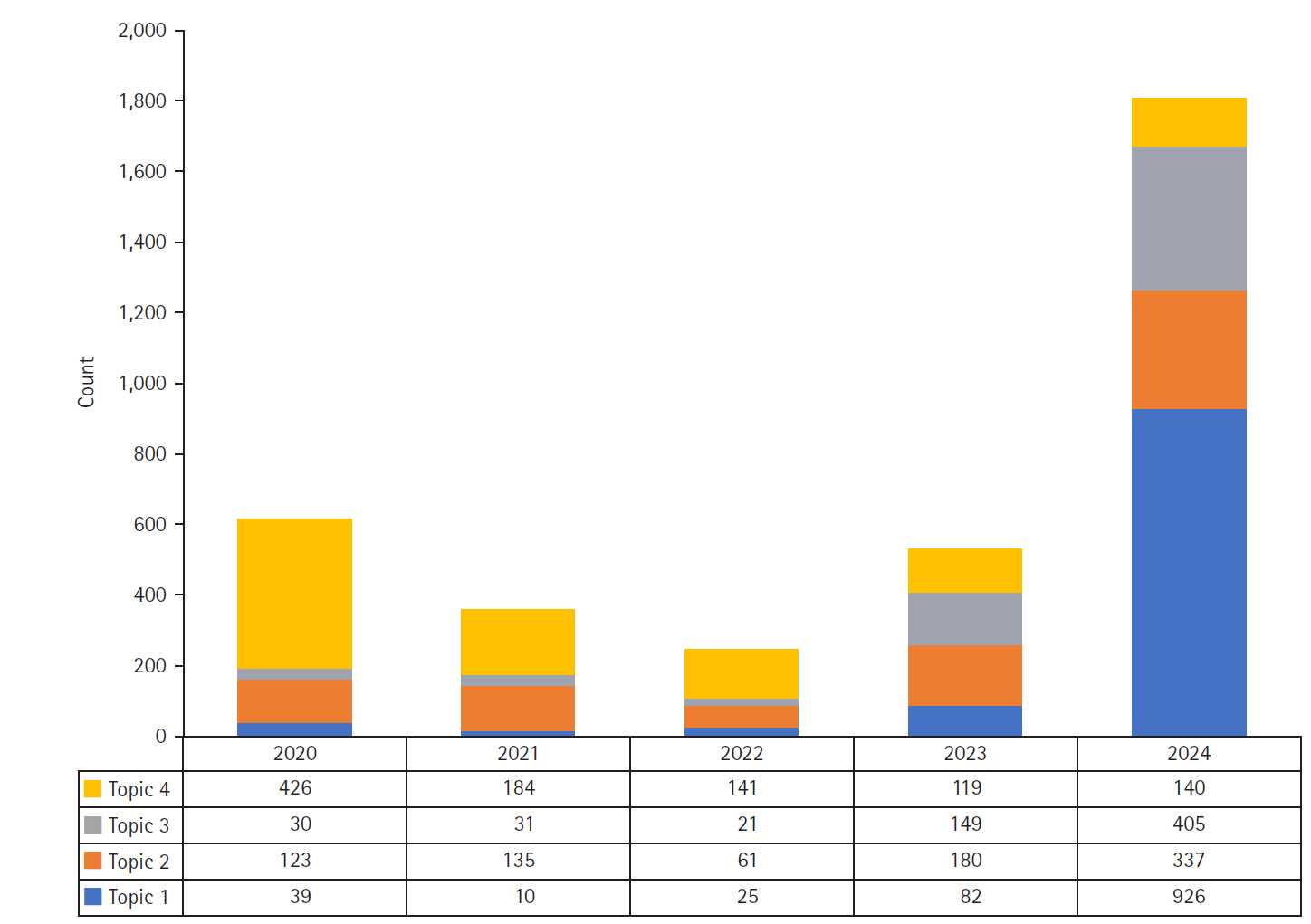
A total of 3,564 news articles published by nine major Korean media outlets between 2020 and 2024 were analyzed. Content analysis was conducted using term frequency-inverse document frequency calculations, network centrality analysis, and LDA topic modeling to extract key terms, map discourse structures, and identify latent topics.
Results
The analysis identified four primary topics in Korean media discourse: “healthcare workforce expansion policies” (30.4%), “hospital clinical practice and operational management” (23.5%), “institutionalization of the PA nursing role” (17.8%), and “COVID-19 response and public health crisis management” (28.3%). High-centrality keywords included “hospital,” “medical,” “patient,” “physician,” “government,” and “nurse,” indicating that the discourse primarily focused on clinical settings. Topic modeling revealed a major shift from pandemic-centered coverage in 2020 to a focus on healthcare workforce policy and PA nurse institutionalization in 2024, coinciding with the passage of the Nursing Act.
Conclusion
This study provides empirical evidence suggesting that the portrayal of PA nurses in Korean media discourse evolved from a peripheral regulatory issue to a central healthcare delivery solution, particularly in the contexts of workforce management, clinical practice, and crisis response. Our findings suggest that PA nurse institutionalization received broader attention when positioned as part of systemic healthcare improvements addressing concrete clinical needs. These results offer valuable insights for policymakers and administrators in framing and implementing workforce policy reforms. -
Citations
Citations to this article as recorded by- Impact of role conflict and job stress on turnover intention among Korean physician assistant nurses: A cross-sectional study
Jin-Won Lee, Eun-Hi Choi, Ji-Sun Back
International Journal of Nursing Sciences.2026; 13(2): 172. CrossRef
- Impact of role conflict and job stress on turnover intention among Korean physician assistant nurses: A cross-sectional study
- 4,463 View
- 152 Download
- 1 Web of Science
- 1 Crossref
- Development of a communication self-efficacy scale for nurses: a psychometric validation study
- Kuem Sun Han, Jihye Shin, Soo Yeon Lee
- J Korean Acad Nurs 2025;55(2):269-284. Published online May 27, 2025
- DOI: https://doi.org/10.4040/jkan.24129
-
Abstract
PDFePub
- Purpose
This methodological study was conducted to develop a scale to measure communication self-efficacy in nurses and examine its validity and reliability.
Methods
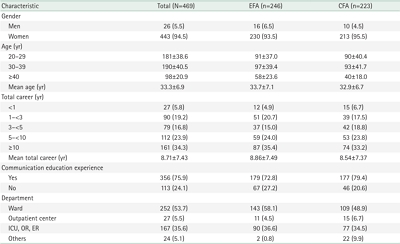
We selected 54 initial items from literature reviews and interviews with 10 clinical nurses. Thirty-two preliminary items were derived from consultations with 10 experts. To verify the scale’s factor structure, we conducted exploratory factor analysis (EFA), and confirmatory factor analysis (CFA) among 469 nurses. Data were analyzed using item analysis, EFA, CFA, discriminant validity, convergent validity, and internal consistency using IBM SPSS Statistics ver. 29.0 (IBM Corp.) and IBM SPSS AMOS ver. 20.0 (IBM Corp.).
Results
The scale consisted of 18 items with three factors (ability to apply therapeutic communication skills, crisis management capabilities, and communication competence), which explained 46.1% of the total variance. Convergent validity and discriminant validity were confirmed for the factors. CFA supported the fit of the measurement model comprising three factors (standardized root mean square residual=.04, root mean square error of approximation=.03, goodness of fit index=.92, Tucker-Lewis index=.97, comparative fit index=.98, normed fit index=.89, critical N=216). Internal consistency was confirmed by a Cronbach’s α coefficient of .91.
Conclusion
The communication self-efficacy scale for nurses is expected to measure communication self-efficacy among nurses. It will be useful for improving nurses’ professional communication abilities. -
Citations
Citations to this article as recorded by- Factors Influencing Psychiatric Nursing Competency among Emergency Nurses: The Mediating Effect of Psychological Safety in a Cross-Sectional Study
Yu Jin Lee, Chung Hee Woo
Journal of Korean Academy of psychiatric and Mental Health Nursing.2026; 35(1): 53. CrossRef - Development and Validation of a Multidimensional Nursing Empowerment Scale (NES)
Fatma Cerit Soydan, Ayşe Nefise Bahçecik
Journal of Nursing Management.2026;[Epub] CrossRef
- Factors Influencing Psychiatric Nursing Competency among Emergency Nurses: The Mediating Effect of Psychological Safety in a Cross-Sectional Study
- 5,410 View
- 404 Download
- 1 Web of Science
- 2 Crossref
- Analysis of the relative importance of key factors in nursing workforce management for pandemic response in general hospitals and long-term care hospitals
- Jeong Eun Cha, Eun Kyoung Yun
- J Korean Acad Nurs 2025;55(2):236-248. Published online May 14, 2025
- DOI: https://doi.org/10.4040/jkan.24112
-
Abstract
PDFePub
- Purpose
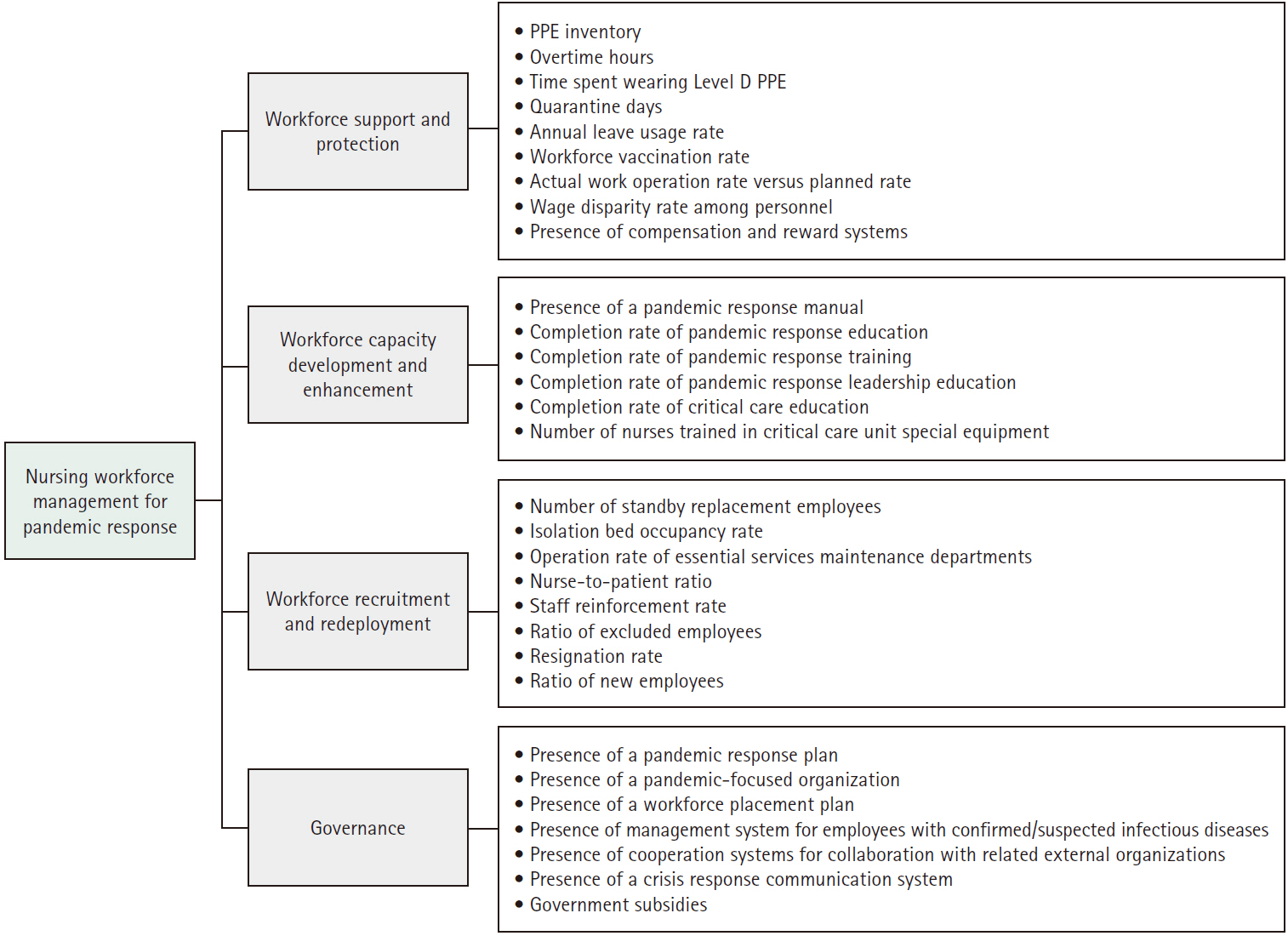
This study aimed to identify the key factors in nursing workforce management for pandemic response in general hospitals and long-term care hospitals and to analyze the relative importance of these factors.
Methods
A validity test was conducted with experts to select four categories and 30 key factors related to nursing workforce management for pandemic response. Surveys were collected from 25 nursing managers in general hospitals and 21 nursing managers in long-term care hospitals, and the relative importance of the key factors was analyzed using the analytic hierarchy process method.
Results
Differences were found between the two groups in the relative importance of nursing workforce management for pandemic response. Specifically, the highest-ranking category was “workforce recruitment and redeployment” for general hospitals, but “workforce support and protection” for long-term care hospitals. The most important factor regarding nursing workforce management was the “nurse-to-patient ratio” for both general and long-term care hospitals.
Conclusion
General and long-term care hospitals need to establish nursing workforce management strategies to effectively respond to pandemics with appropriate consideration of the relative importance and prioritization of key factors based on hospital characteristics.
- 3,080 View
- 110 Download
- Reliability and validity of the Korean version of the Nurses Professional Values Scale-3 for nursing students: a methodological study
- Eun Hee Yang, Mi Yu
- J Korean Acad Nurs 2025;55(1):93-106. Published online February 20, 2025
- DOI: https://doi.org/10.4040/jkan.24113
-
Abstract
PDFePub
- Purpose
This study aimed to adapt the Nurses Professional Values Scale-3 (NPVS-3) for Korean nursing students and assess its reliability and validity.
Methods
The NPVS-3 was translated into Korean using forward and back translation with expert review. Data from 206 nursing students at four universities were analyzed to assess content, construct, discriminant, and criterion validity, as well as internal consistency.
Results
The Korean version (NPVS-3K) consisted of 21 items in three subscales: caring (eight items), activism (eight items), and professionalism (five items), explaining 60.9% of the total variance. For convergent validity, standardized coefficients for the items ranged from .56 to .81, construct reliability ranged from .89 to .95, and the average variance extracted ranged from .61 to .72. The model was validated by confirmatory factor analysis (χ2=526.00 [p<.001], χ2/degrees of freedom=2.83, standardized root mean residual=.03, goodness of fit index=.81, comparative fit index=.87, Turker Lewis index=.85). Discriminant validity was confirmed using a multi-trait and multi-item matrix. Criterion validity showed positive correlations between the three NPVS-3K factors and professional identity (factor 1: r=.40, p<.001; factor 2: r=.55, p<.001; factor 3: r=.43, p<.001). Internal consistency, as measured by Cronbach’s α, was .94 overall, with subscale values of .90 for caring, .92 for activism, and .78 for professionalism.
Conclusion
The NPVS-3K demonstrated satisfactory validity and reliability, establishing it as a valuable tool for assessing the professional values of Korean nursing students. Additionally, it can aid in developing educational strategies to strengthen these values, although further research is required to confirm its broader applicability. -
Citations
Citations to this article as recorded by- The mediating effect of nursing professional values on the relationship between ethical values and ethical decision-making confidence in nursing students approaching graduation
Seang Ryu, Kyungja Kang
The Journal of Korean Academic Society of Nursing Education.2026; 32(2): 198. CrossRef - Translation, Cultural Adaptation and Validation of a Korean Version of the Digital Professionalism Self‐Assessment Instrument for Nurses
Suyeon Ban, Ja-Yeoung Lee, GyeongAe Seomun, Matthew Vandermeulen
Journal of Nursing Management.2026;[Epub] CrossRef
- The mediating effect of nursing professional values on the relationship between ethical values and ethical decision-making confidence in nursing students approaching graduation
- 6,966 View
- 521 Download
- 1 Web of Science
- 2 Crossref
- Mediating effect of grit on the influence of nurses’ silence behavior on medication safety competence: a cross-sectional study
- Haengsuk Kim, Wanju Park
- J Korean Acad Nurs 2025;55(1):81-92. Published online February 20, 2025
- DOI: https://doi.org/10.4040/jkan.24088
-
Abstract
PDFePub
- Purpose
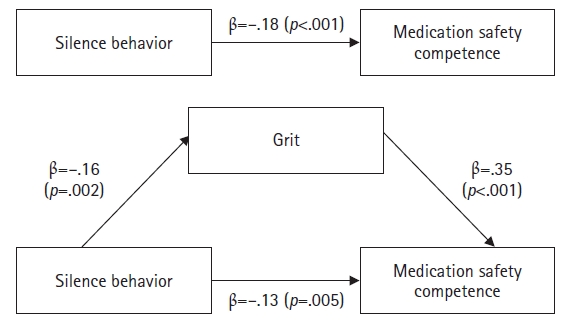
This study investigated the mediating effect of grit in the relationship between silence behavior and medication safety competence among nurses.
Methods
The study included 166 nurses from four university hospitals and general hospitals in Seoul and Gyeonggi-do, South Korea. Data were collected from March 1 to 10, 2024, using self-report questionnaires. Data were analyzed using the t-test, analysis of variance, Scheffé’s test, and Pearson’s correlation coefficients with IBM SPSS Statistics ver. 23.0 (IBM Corp.). A mediation analysis was performed using Hayes’s PROCESS macro model 4 and the bootstrapping method.
Results
Medication safety competence showed significant correlations with silence behavior (r=–.21, p=.008) and grit (r=.43, p<.001). Furthermore, grit partially mediated the relationship between silence behavior and medication safety competence.
Conclusion
This study indicates that grit is a significant mediator in the relationship between silence behavior and medication safety competence. Therefore, an integrated approach that reduces silence behavior and promotes grit is essential for strengthening nurses’ medication safety competence. Ultimately, these strategies will help ensure patient safety by improving medication safety competence.
- 7,847 View
- 603 Download
- A qualitative meta-synthesis of the essence of patient experiences of dialysis
- Soyoung Jang, Eunyoung E. Suh, Yoonhee Seok
- J Korean Acad Nurs 2025;55(1):119-136. Published online February 19, 2025
- DOI: https://doi.org/10.4040/jkan.24102
-
Abstract
PDFePub
- Purpose
This study aimed to understand the experiences of dialysis and their meaning among patients with chronic kidney disease through a meta-synthesis of the existing literature. Since 2010, the prevalence of end-stage renal disease has doubled in South Korea, which has the sixth-highest incidence worldwide. Although most kidney disease patients undergo dialysis to attenuate disease-related symptoms and prolong their lives, the implications of dialysis on their lives, together with the role played by patients’ significant others, remain underexplored. Similarly, existing research has not considered both patients with hemodialysis and peritoneal dialysis.
Methods
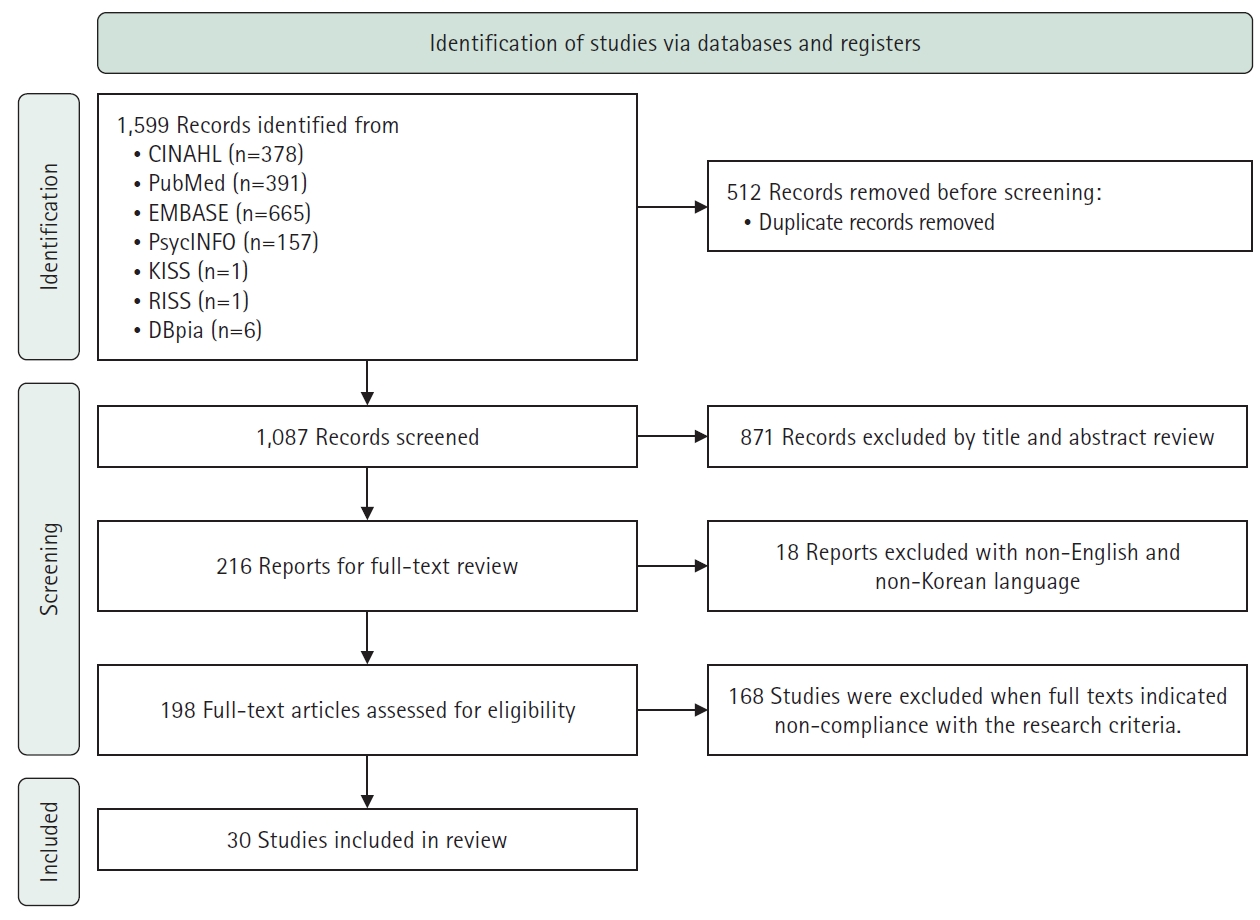
In this meta-synthesis, seven electronic databases (PubMed, CINAHL, EMBASE, PsycINFO, DBpia, KISS, and RISS) were searched for the terms “dialysis” and “qualitative.” Thirty qualitative studies were selected for examination.
Results
The overriding theme observed in the studies was “I do not have much time left.”–navigating the dual realities of one’s limited existence, while other key themes were: (1) the inevitable experience of the troubles of dialysis, (2) life is extended, but deteriorating in every aspect, (3) accepting dialysis with a positive outlook for life, and (4) essential support experienced in an exhausting life.
Conclusion
These findings are important for the design and delivery of practical and tailored nursing interventions to help patients overcome the various challenges related to dialysis treatment, and improve their quality of life.
- 5,057 View
- 223 Download
- Validity and Reliability of the Korean Version of the Occupational Coping Self-Efficacy Scale for Nurses
- Youngrye Park, Sunah Park, Hee Ran Kang
- J Korean Acad Nurs 2024;54(4):633-644. Published online November 30, 2024
- DOI: https://doi.org/10.4040/jkan.24094
-
Abstract
PDFePub
Purpose This study aimed to evaluate the validity and reliability of the Korean version of the occupational coping self-efficacy for nurses (K-OCSE-N) scale.
Methods The English version of the OCSE-N scale was translated into Korean using a translation and back-translation process. Data were gathered from 213 nurses employed in a general hospital in South Korea. The content validity was assessed using the content validity index. The construct validity was verified through exploratory and confirmatory factor analyses. Criterion validity was assessed using Pearson’s correlation coefficients with the job stress coping and general self-efficacy scales. Reliability was examined using item-total score correlation and Cronbach’s α coefficient for internal consistency.
Results The exploratory factor analysis identified two factors that explained 61.8% of the cumulative variance: occupational burden and relational difficulty. In confirmatory factor analysis, the model exhibited adequate fit (
χ 2/df = 2.07, GFI = .95, SRMR = .04, RMSEA = .07, CFI = .97, and TLI = .95), with both convergent and discriminant validity deemed acceptable. The criterion validity presented a positive correlation of the K-OCSE-N with both job stress coping (r = .72,p < .001) and general self-efficacy (r = .72,p < .001). The internal consistency of the scale using Cronbach’s α for the total items was .89.Conclusion The K-OCSE-N scale is a valid and reliable tool for measuring nurses’ occupational coping self-efficacy. This study suggests that various intervention studies can use the scale to assess and strengthen nurses’ occupational coping self-efficacy in nursing practice.
-
Citations
Citations to this article as recorded by- Patient Safety and Quality Improvement in Nursing Practice: Associations Among Workload, Occupational Coping Self-Efficacy and Medical Device-Related Pressure Injury Prevention
Hyun Suk Gwag, Jin Ah Kim
Healthcare.2026; 14(2): 270. CrossRef - Effects of the Nursing Work Environment, Patient-Centered Communication, Occupational Coping Self-Efficacy, and Professional Identity on Missed Nursing Care among General Hospital Nurses
Yuju Kim, Ju-Yeon Uhm
Journal of Fundamental Nursing Science.2026; 33(2): 277. CrossRef
- Patient Safety and Quality Improvement in Nursing Practice: Associations Among Workload, Occupational Coping Self-Efficacy and Medical Device-Related Pressure Injury Prevention
- 10,065 View
- 525 Download
- 1 Web of Science
- 2 Crossref
- Experiences of Patients and Their Families Receiving Medical Services Provided by Advanced Practice Nurses at Tertiary General Hospitals
- Mi-Kyeong Jeon, Su Jung Choi, Ji Eun Han, Eun Kyung Kwon, Jeong Hee Park, Jeong Hye Kim
- J Korean Acad Nurs 2024;54(4):594-606. Published online November 4, 2024
- DOI: https://doi.org/10.4040/jkan.24069
-
Abstract
PDFePub
Purpose This study aimed to understand and describe the experiences of patients and their families who have received medical services from advanced practice nurses in tertiary general hospitals in Korea.
Methods Data were collected through four focus group interviews with 20 patients and their families who had received medical services from advanced practice nurses for more than six months at four tertiary hospitals from November 29 to December 28, 2023. Verbatim transcripts were analyzed using qualitative content analysis.
Results The four themes extracted from the experiences of patients and their families were as follows: unfamiliar medical personnel encountered during the treatment process, healthcare professionals who exhibited excellence, companions to light my way through the tunnel of illness, and an advanced practice nurse system that must be activated urgently.
Conclusion The study’s findings indicate that patients and their families view the care provided by advanced practice nurses as excellent, reliable, and holistic. Research suggests that advanced practice nurses are valuable healthcare professionals in team-based care. The findings suggest that hospitals should utilize an advanced practice nurse system to improve patient outcomes and ensure the quality of care.
-
Citations
Citations to this article as recorded by- Legislation of Medical Support Tasks in the Nursing Act as a Foundation for Nursing Professionalism and Role Expansion
Su Jung Choi
Korean Journal of Adult Nursing.2025; 37(2): 69. CrossRef - Strategies for expanding the role of advanced practice providers in the Korean nursing workforce: a mixed-methods approach
Jeong Hye Kim, Mi-Kyeong Jeon, Suyoung Choi, Mimi Lee, Su Jung Choi
Journal of Korean Academy of Nursing.2025; 55(4): 568. CrossRef - Nurses' Patient Care Experiences in a Changing Healthcare Environment Following One Year of Healthcare Policy Conflict - A Focus Group Interview
Eun Hee Kang, Yunhyung Kim, Jeong Hye Kim
Journal of Korean Association for Qualitative Research.2025; 10(3): 280. CrossRef
- Legislation of Medical Support Tasks in the Nursing Act as a Foundation for Nursing Professionalism and Role Expansion
- 6,199 View
- 327 Download
- 1 Web of Science
- 3 Crossref
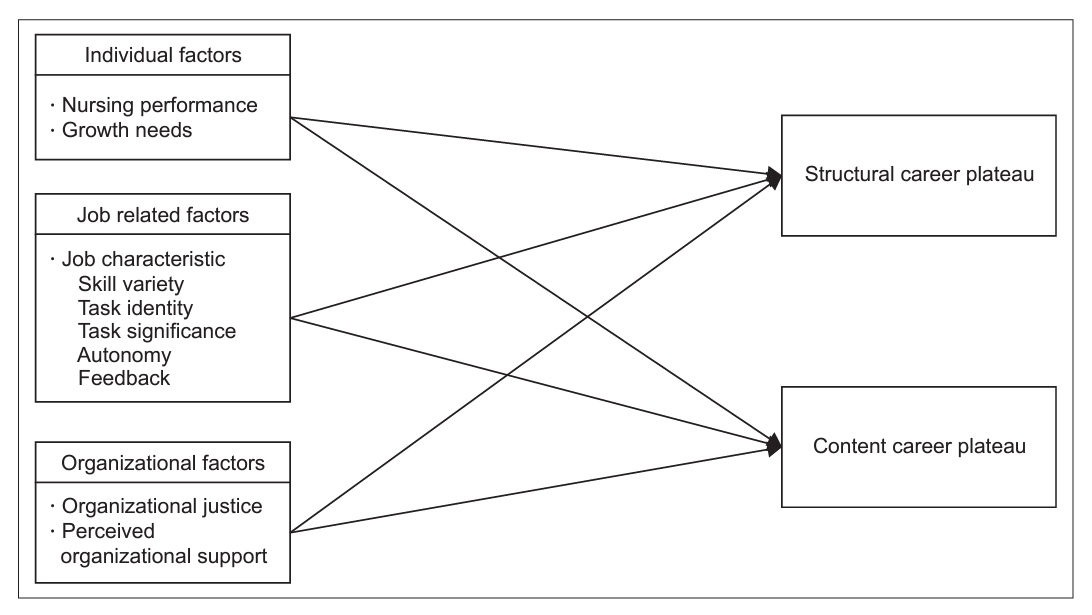
- Factors Influencing Clinical Nurses’ Perception of Structural and Content Career Plateau
- Ji Hye Kim, Ji Yun Lee
- J Korean Acad Nurs 2024;54(4):534-546. Published online October 23, 2024
- DOI: https://doi.org/10.4040/jkan.24002
-
Abstract
PDFePub
Purpose This study was intended to provide basic data for reducing the career plateaus of clinical nurses.
Methods The participants were 288 clinical nurses who worked at five hospitals, general hospitals, and tertiary hospitals in Seoul, Gyeonggi, and Chungcheong provinces and had more than one year of clinical experience. The research data were collected from December 26, 2022, to April 7, 2023, using structured questionnaires and analyzed using SPSS software. The study conducted mean, standard deviation, percentage, t-test, ANOVA, Pearson‘s correlation coefficient, and hierarchical regression analysis.
Results Perceived organizational support was identified as the factor influencing structural career plateaus. Factors influencing content career plateaus included growth needs, skill variety, organizational justice, and perceived organizational support.
Conclusion The above research results suggest that to increase the motivation of clinical nurses and reduce career plateaus, it is necessary to improve awareness and systems of human resource management at the organizational level.
-
Citations
Citations to this article as recorded by- Nursing managers’ perceptions of clinical nurses’ self-management in professional title promotion: a qualitative user persona study
Xiang Gao, Xuemei Wang
BMC Nursing.2026;[Epub] CrossRef - Associations of Nurses’ Career Attitudes, Career Management Behaviors, and Understanding and Expected Outcomes of The Career Ladder System With Intention to Stay and Career Satisfaction: A Cross‐Sectional Study
Ae Ran Kim, Yun Hee Ham, Jeong Hee Hong, Mikyong Kwak, Hye Jin Baek, GeumMoon Lee
Research in Nursing & Health.2026; 49(5): 679. CrossRef - Trapped in position, strong in spirit? Examining career plateau and psychological resilience among nurses
Leyla Afşar, Şehrinaz Polat, Aslı Yeşil
WORK: A Journal of Prevention, Assessment & Rehabilitation.2026;[Epub] CrossRef
- Nursing managers’ perceptions of clinical nurses’ self-management in professional title promotion: a qualitative user persona study
- 3,577 View
- 239 Download
- 3 Web of Science
- 3 Crossref
- How Do We Approach Quality Care for Patients from Middle Eastern Countries? A Phenomenological Study of Korean Nurses’ Experiences
- Dael Jang, Seonhwa Choi, Gahui Hwang, Sanghee Kim
- J Korean Acad Nurs 2024;54(3):372-385. Published online August 31, 2024
- DOI: https://doi.org/10.4040/jkan.24036
-
Abstract
PDF
- Purpose
Although more people from Middle Eastern countries are visiting South Korea for medical treatment, Korean nurses lack experience in treating them. Understanding and describing Korean nurses’ experiences can help them provide quality care to these patients by enhancing their competency in culturally appropriate care. This study described the experiences of nurses who provide care to Middle Eastern patients in clinical settings in South Korea.
Methods
We conducted a phenomenological study to describe nurses’ experience of caring for patients from Middle Eastern countries. Ten nurses with prior experience in caring for these patients were recruited from a university-affiliated tertiary hospital. Semi-structured face-to-face interviews were conducted between May 1 and June 4, 2020. The transcribed data were analyzed using Giorgi’s phenomenological method to identify the primary and minor categories representing nurses’ experiences.
Results
Four major categories (new experiences in caring for culturally diverse patients, challenges in caring for patients in a culturally appropriate manner, nursing journey of mutual agreement with culturally diverse patients, and being and becoming more culturally competent) and 11 subcategories were identified.
Conclusion
Nurses experience various challenges when caring for Middle Eastern patients with diverse language and cultural needs. However, nurses strive to provide high-quality care using various approaches and experience positive emotions through this process. To provide quality care to these patients, hospital environments and educational programs must be developed that center on field nurses and students and support them in delivering quality care while utilizing their cultural capabilities. -
Citations
Citations to this article as recorded by- The roles of nurses employed as medical tourism facilitators in Taiwan: A qualitative study
Eimi Nakada, Keiko Sugimoto, Rieko K. Fukuzawa, Thomas Mayers, Yi-Chuan Chen, Judith S. C. Shiao
International Journal of Healthcare Management.2026; : 1. CrossRef
- The roles of nurses employed as medical tourism facilitators in Taiwan: A qualitative study
- 3,692 View
- 96 Download
- 1 Web of Science
- 1 Crossref
- Temporal Exploration of New Nurses’ Field Adaptation Using Text Network Analysis
- Shin Hye Ahn, Hye Won Jeong, Seong Gyeong Yang, Ue Seok Jung, Myoung Lee Choi, Heui Seon Kim
- J Korean Acad Nurs 2024;54(3):358-371. Published online August 31, 2024
- DOI: https://doi.org/10.4040/jkan.24034
-
Abstract
PDF
- Purpose
This study aimed to analyze the experiences of new nurses during their first year of hospital employment to gather data for the development of an evidence-based new nurse residency program focused on adaptability. Methods: This study was conducted at a tertiary hospital in Korea between March and August 2021 with 80 new nurses who wrote in critical reflective journals during their first year of work. NetMiner 4.5.0 was used to conduct a text network analysis of the critical reflective journals to uncover core keywords and topics across three periods. Results: In the journals, over time, degree centrality emerged as “study” and “patient understanding” for 1 to 3 months, “insufficient” and “stress” for 4 to 6 months, and “handover” and “preparation” for 7 to 12 months. Major sub-themes at 1 to 3 months were: “rounds,” “intravenous-cannulation,” “medical device,” and “patient understanding”; at 4 to 6 months they were “admission,” “discharge,” “oxygen therapy,” and “disease”; and at 7 to 12 months they were “burden,” “independence,” and “solution.” Conclusion: These results provide valuable insights into the challenges and experiences encountered by new nurses during different stages of their field adaptation process. This information may highlight the best nurse leadership methods for improving institutional education and supporting new nurses’ transitions to the hospital work environment. -
Citations
Citations to this article as recorded by- A Text Network Analysis of Nurse Managers’ Feedback Journals
Naru Kang, Shinhye Ahn, Hye Won Jeong
CIN: Computers, Informatics, Nursing.2026;[Epub] CrossRef - Development and evaluation of a stepwise clinical competency development program for new nurses: A single-group repeated-measures quasi-experimental study
Shinhye Ahn, Hye Won Jeong, Joyce Jebet Cheptum
PLOS One.2026; 21(2): e0342464. CrossRef - Analysis of clinical nurse educators’ mentoring feedback on new nurse journals at a tertiary hospital in South Korea: utilizing text network analysis
Shinhye Ahn, Hye Won Jeong
BMC Nursing.2025;[Epub] CrossRef - A Kirkpatrick Model Evaluation of the Development and Assessment of an Integrated, Adaptation Support Program for New Nurses Led by Clinical Nurse Educators: Using a Single, Group Repeated‐Measures Design
Hye Won Jeong
Nursing & Health Sciences.2025;[Epub] CrossRef
- A Text Network Analysis of Nurse Managers’ Feedback Journals
- 5,382 View
- 119 Download
- 4 Web of Science
- 4 Crossref
- Concept Analysis of Social Intelligence of Nurses Using Hybrid Model
- Kyung Ran Lee, Na Kyoung Lee, Hee Oh, Kyoung Ae Park
- J Korean Acad Nurs 2024;54(3):459-474. Published online August 31, 2024
- DOI: https://doi.org/10.4040/jkan.23121
-
Abstract
PDF
- Purpose
The purpose of this study was to conduct a concept analysis of social intelligence in nurses so that applying social intelligence to the nursing field.
Methods
In this study, we followed the hybrid model procedure, involving the following steps: First, in the theoretical stage, the attributes and definitions of the concept of social intelligence were determined through literature review. Second, the concepts’ reality was confirmed during fieldwork. In the final analysis stage, the results confirmed in the theoretical and fieldwork stages were compared and analyzed to confirm the properties and definition of the concept.
Results
Nurses’ social intelligence consists of three dimensions: social cognitive nursing competency, human-centered social evolution, and skills for solving complex nursing situations. Nurses’ social intelligence is a professional nursing competency that flexibly coordinates complex nursing situations, developed through accumulating experiences of continuous reflection and relationship expansion based on receptive listening and social sensitivity in clinical interpersonal relationships.
Conclusion
Nurses’ social intelligence is widely used in clinical practice and is shown to have a significant direct and indirect impact on clinical nursing. To effectively apply social intelligence in the clinical context, individual and organizational efforts are required to share and transfer knowledge and capacity-building methods through collective intelligence and education. -
Citations
Citations to this article as recorded by- The Predictive Role of Social Intelligence Dimensions on Critical Thinking Dispositions Among Nurses: A Cross‐Sectional Study in Western Iran
Nahid Sourni, Mahvash Kahrizi, Nader salari, Maryam Janatolmakan, Rostam Jalali
Nursing Open.2026;[Epub] CrossRef
- The Predictive Role of Social Intelligence Dimensions on Critical Thinking Dispositions Among Nurses: A Cross‐Sectional Study in Western Iran
- 3,494 View
- 169 Download
- 2 Web of Science
- 1 Crossref
- The Influence of Diversity Management of Nursing Organization on Organizational Commitment: Double Mediating Effect of Diversity Sensitivity Orientation and Positive Nursing Organizational Culture
- Hwi Gon Jeon, Keum Seong Jang, Eun A Kim
- J Korean Acad Nurs 2024;54(3):403-417. Published online August 31, 2024
- DOI: https://doi.org/10.4040/jkan.23120
-
Abstract
PDF
- Purpose
The aim of this study was to identify the double mediating effect of effect of diversity sensitivity orientation and positive nursing organizational culture between diversity management and organizational commitment.
Methods
Participants were 245 nurses working in six tertiary hospitals located in 3 different regions. Data collection was conducted from February 13, 2023 to March 6, 2023 through online self-reported questionnaire. The data were analyzed by IBM SPSS Statistics 27 and SPSS PROCESS Macro 4.2 program.
Results
The direct effect of diversity management on organizational commitment was significant (β = .21, p < .001). The indirect effect of diversity management on organization commitment was .34 (95% confidence interval [CI] = .23~.47). The double mediating effect of diversity sensitivity orientation and positive nursing organizational culture in the relationship between diversity management and organizational commitment was .02 (95% CI = .00~.05).
Conclusion
Diversity sensitivity orientation and positive nursing organizational culture show double mediating effect on the relationship between diversity management and organizational commitment. Education program and human resource management strategy for enhancing diversity management, diversity sensitivity orientation and positive nursing organizational culture should be provided to improve organizational commitment, and which are needed active support of the association and nursing organization. -
Citations
Citations to this article as recorded by- Impact of Resilience, Emotional Exhaustion, and Communication Competency on Organizational Commitment Among Nurses in a Tertiary Hospital Setting in South Korea: A Cross-Sectional Study
Ho Young Kim, Hee Jeong Kim, Eun Ja Yeun
Sage Open.2025;[Epub] CrossRef - Organizational commitment of nursing staff: Definition of the concept and specifics of measurement (review of foreign publications)
K. V. Kuzmin, L. E. Petrova, V. S. Kharchenko
Kuban Scientific Medical Bulletin.2025; 32(5): 96. CrossRef
- Impact of Resilience, Emotional Exhaustion, and Communication Competency on Organizational Commitment Among Nurses in a Tertiary Hospital Setting in South Korea: A Cross-Sectional Study
- 3,135 View
- 210 Download
- 1 Web of Science
- 2 Crossref
- Sleep Deprivation and Fatigue among Nurses Working Consecutive Night Shifts: A Prospective Observational Study
- Ari Min, Jisu Seo, Minkyung Kang, Hye Chong Hong
- J Korean Acad Nurs 2024;54(2):139-150. Published online May 31, 2024
- DOI: https://doi.org/10.4040/jkan.23164
-
Abstract
PDF
- Purpose
This study aimed to identify changes in sleep patterns and fatigue levels during consecutive night shifts among shift nurses and to determine the association between sleep parameters and increased fatigue levels during work.
Methods
This prospective observational study employing ecological momentary assessments was conducted using data collected from 98 shift nurses working in Korean hospitals between June 2019 and February 2021. The sleep patterns were recorded using actigraphy. The participants reported their fatigue levels at the beginning and end of each night shift in real time via a mobile link. Linear mixed models were used for the analysis.
Results
Nurses spent significantly less time in bed and had shorter sleep durations during consecutive night shifts than on off-duty days, whereas their wake times after sleep onset were much longer on off-duty days than on on-duty days. Fatigue levels were higher on the second and third night-shift days than on the first night-shift days. A shorter time spent in bed and asleep was associated with a greater increase in fatigue levels at the end of the shift than at the beginning.
Conclusion
Nurses experience significant sleep deprivation during consecutive night shifts compared with off-duty days, and this sleep shortage is associated with a considerable increase in fatigue levels at the end of shifts. Nurse managers and administrators must ensure sufficient intershift recovery time during consecutive night shifts to increase the time spent in bed and sleeping. -
Citations
Citations to this article as recorded by- A Text Network Analysis of Nurse Managers’ Feedback Journals
Naru Kang, Shinhye Ahn, Hye Won Jeong
CIN: Computers, Informatics, Nursing.2026;[Epub] CrossRef - Comparative Effects of Music Therapy Versus White Noise on Sleep Quality and Psychological Resilience of Night-Shift Nurses: Retrospective Cohort Study
WenQing Zhang, Yan Li, Fang Li
Noise and Health.2026; 28(130): 62. CrossRef - Relationship Between Occupational Characteristics and Telomere Length in Female Nurses Aged 20–39 Years: A Cross-Sectional Study
Jeonghye Yun, Hyunjung Lee
Healthcare.2026; 14(12): 1657. CrossRef - Sleep deprivation: a comprehensive review of multisystem impacts, underlying mechanisms, and emerging interventions
Yong-Zheng Fan, Guo-Dong Liu, An-Na Zhang, Yu Wang, Yu-Qing Cheng
Frontiers in Neurology.2026;[Epub] CrossRef - The intervention effect of caffeine oral tablets on mental fatigue induced by nap deprivation: based on assessments of heart rate variability, cognitive performance and subjective fatigue—a pilot study
Yong-Zheng Fan, Shuai-Yi Li, Xiao-Lei Lin, An-Na Zhang, Yu Wang, Ke-Feng Huang, Wen-Xian Song
Frontiers in Public Health.2026;[Epub] CrossRef - Sleep quality, insomnia, chronic fatigue, and work performance in three-shift and fixed-night-shift nurses: a comparative cross-sectional study
Ji Eun Lee, Dong Yeon Kim, Hye Hyeon Shin, Su Hyeon Kim, Hee Young Choi
Journal of Korean Biological Nursing Science.2026; 28(3): 428. CrossRef - Associations of Insomnia, Fatigue, and Overtime Work With Self‐Reported Medication Errors Among Perianesthesia Nurses: A Cross‐Sectional Study
Yulim Kang, Eun Young Choi, Wonhee Baek, Chang Park, Ari Min
International Nursing Review.2026;[Epub] CrossRef - Predictors of osteoporosis self-efficacy among young and middle-aged female nurses based on self-efficacy theory and the health belief model: evidence from a tertiary hospital in Eastern China
Mingyan Xie, Zhanping Jin, Saihong Cai, Qinhong Xu
Frontiers in Public Health.2026;[Epub] CrossRef - Effectiveness of digital cognitive behavioral therapy for insomnia in nurses with shift work sleep disorder: Results of a randomized controlled trial
Hanna A. Brückner, Johanna Ell, Lina Kalon, Jana Strahler, Antje Ducki, Dieter Riemann, Claudia Buntrock, Kai Spiegelhalder, Dirk Lehr
International Journal of Nursing Studies.2025; 169: 105112. CrossRef - Fatigue and coping strategies among Chinese night-shift nurses: a cross-sectional study
Bin He, Yanle Zhang, Shengjun Qian, Qun Ye, Ying Ren, Zhan Wang
BMC Nursing.2025;[Epub] CrossRef - Investigating the associations between weekend catch-up sleep and insulin resistance: NHANES cross-sectional study
Xianling Liu, Aihui Chu, Xiahao Ding
BMC Medicine.2025;[Epub] CrossRef - Sleep Quality in Shift-Working Nurses: Subjective and Objective Evaluation
Željka Dujmić, Štefica Mikšić, Ivana Barać, Josip Samardžić, Lea Maršić, Petar Samardžić, Zvjezdana Gvozdanović, Ivana Jelinčić, Blaženka Kljajić Bukvić, Marija Barišić, Davorka Čavar-Lovrić, Ružica Mrkonjić, Ivica Mihaljević, Nikolina Farčić
International Journal of Environmental Research and Public Health.2025; 23(1): 64. CrossRef
- A Text Network Analysis of Nurse Managers’ Feedback Journals
- 16,659 View
- 608 Download
- 9 Web of Science
- 12 Crossref
- Development of the Hospital Nurses’ Silence Behavior Scale
- Soojin Chung, Jee-In Hwang
- J Korean Acad Nurs 2024;54(2):279-295. Published online May 31, 2024
- DOI: https://doi.org/10.4040/jkan.23138
-
Abstract
PDF
- Purpose
This study aimed to develop a scale to measure hospital nurses’ silence behavior and examine its validity and reliability.
Methods
A total of 52 preliminary items on hospital nurses’ silence behavior were selected using a content validity test by seven experts on 53 candidate items derived from a literature review and in-depth interviews with 14 nurses. A total of 405 hospital nurses participated in a psychometric testing. Data analysis comprised item analysis, exploratory and confirmatory factor analyses, and convergent and discriminant validity tests. Pearson’s correlation coefficient was used for assessing concurrent validity, and Cronbach’s alpha was used for the reliability test.
Results
The final scale consisted of nine factors with 31 items, exhibiting acceptable model fit indices, convergent validity, and discriminant validity. The score of the entire scale was positively correlated with the ‘Organizational Silence Scale (OSS)-the issues on which nurses remain silent’ (r = .60, p < .001) and ‘OSS-the reasons why nurses remain silent’ (r = .68, p < .001). Cronbach’s α of the scale was .92, and α of each subscale ranged from .71 to .90.
Conclusion
The Hospital Nurses’ Silence Behavior Scale is a useful tool for assessing multifaceted silence behavior among nurses. It can provide basic data for developing better communication strategies among nurses and other hospital staff. -
Citations
Citations to this article as recorded by- Mediating Effect of Emotional Labour on the Role Pressure and Silence Behaviour of Nurses
Lianci He, Jianhua Liu, Rong Sun, Yuan Deng, Ling Tang, Shaochuan Chen
Evaluation & the Health Professions.2026; 49(1): 3. CrossRef - The Relationship Between Clinical Nurses’ Perceptions of the Power Used by Nursing Managers and Professional Silence Behaviors: An Example From Türkiye
Şirin Çelikkanat, Ayşe Eminoğlu Güven, Zeynep Güngörmüş, Lori M. Schirle
Journal of Nursing Management.2026;[Epub] CrossRef - Communication skills and organizational silence as predictors of perioperative competence in operating room nurses: a cross-sectional study
Hee Eun Kim, Sangjin Ko
BMC Nursing.2026;[Epub] CrossRef - Mediating effect of grit on the influence of nurses’ silence behavior on medication safety competence: a cross-sectional study
Haengsuk Kim, Wanju Park
Journal of Korean Academy of Nursing.2025; 55(1): 81. CrossRef - Influence of Clinical Nurses’ Organizational Silence on Organizational Citizenship Behavior: Mediating Effect of Organizational Commitment Moderated by Organizational Justice
Shin Ae Hwang, Haeyoung Min
Journal of Korean Academy of Nursing Administration.2024; 30(4): 416. CrossRef - Psychometric evaluation and translation of the Persian version of the Organizational Silence Behavior Scale (OSBS-P) for clinical nurses
Alireza Mirzaei, Mobina Jamshidinia, Mehrzad Aghabarari, Pouya Dolat Abadi, Reza Nemati-Vakilabad, Ehsan Namaziandost
PLOS ONE.2024; 19(12): e0314155. CrossRef
- Mediating Effect of Emotional Labour on the Role Pressure and Silence Behaviour of Nurses
- 7,261 View
- 378 Download
- 5 Web of Science
- 6 Crossref
- National Petition Analysis Related to Nursing: Text Network Analysis and Topic Modeling
- HyunJung Ko, Seok Hee Jeong, Eun Jee Lee, Hee Sun Kim
- J Korean Acad Nurs 2023;53(6):635-651. Published online December 31, 2023
- DOI: https://doi.org/10.4040/jkan.23052
-
Abstract
PDF
- Purpose
This study aimed to identify the main keyword, network structure, and main topics of the national petition related to “nursing” in South Korea.
Methods
Data were gathered from petitions related to the national petition in Korea Blue House related to the topic “nursing” or “nurse” from August 17, 2017, to May 9, 2022. A total of 5,154 petitions were searched, and 995 were selected for the final analysis. Text network analysis and topic modeling were analyzed using the Netminer 4.5.0 program.
Results
Regarding network characteristics, a density of 0.03, an average degree of 144.483, and an average distance of 1.943 were found. Compared to results of degree centrality and betweenness centrality, keywords such as “work environment,” “nursing university,” “license,” and “education” appeared typically in the eigenvector centrality analysis. Topic modeling derived four topics: (1) “Improving the working environment and dealing with nursing professionals,” (2) “requesting investigation and punishment related to medical accidents,” (3) “requiring clear role regulation and legislation of medical and nonmedical professions,” and (4) “demanding improvement of healthcare-related systems and services.” Conclusion: This is the first study to analyze Korea's national petitions in the field of nursing. This study's results confirmed both the internal needs and external demands for nurses in South Korea. Policies and laws that reflect these results should be developed. -
Citations
Citations to this article as recorded by- Voice of Customer Analysis of Nursing Care in a Tertiary Hospital: Text Network Analysis and Topic Modeling
Hyunjung Ko, Nara Han, Seulki Jeong, Jeong A Jeong, Hye Ryoung Yun, Eun Sil Kim, Young Jun Jang, Eun Ju Choi, Chun Hoe Lim, Min Hee Jung, Jung Hee Kim, Dong Hyu Cho, Seok Hee Jeong
Journal of Korean Academy of Nursing Administration.2024; 30(5): 529. CrossRef - A Study on Internet News for Patient Safety Campaigns: Focusing on Text Network Analysis and Topic Modeling
Sun-Hwa Shin, On-Jeon Baek
Healthcare.2024; 12(19): 1914. CrossRef
- Voice of Customer Analysis of Nursing Care in a Tertiary Hospital: Text Network Analysis and Topic Modeling
- 3,860 View
- 66 Download
- 1 Web of Science
- 2 Crossref
- Perspectives of Frontline Nurses Working in South Korea during the COVID-19 Pandemic: A Combined Method of Text Network Analysis and Summative Content Analysis
- SangA Lee, Tae Wha Lee, Seung Eun Lee
- J Korean Acad Nurs 2023;53(6):584-596. Published online December 31, 2023
- DOI: https://doi.org/10.4040/jkan.23048
-
Abstract
PDF
- Purpose
This study aimed to explore the perspectives of frontline nurses working during the novel coronavirus disease 2019 (COVID-19) pandemic.
Methods
An online qualitative study was conducted using a pragmatic approach. The data were collected in August 2021. Registered Korean nurses who provided direct nursing care to patients with confirmed COVID-19 were eligible for this study. An online survey was used to gather free-text data, which were then analyzed using machine-based network analysis and summative content analysis.
Results
The analysis examined the responses of 126 participants and led to the identification of six prominent themes. These themes were further classified into three distinct levels: personal, task, and organizational. The identified themes are as follows: “collapse of personal life,” “being overwhelmed by the numerous roles required,” “personal protective equipment was sufficiently provided, but that is not enough,” “changes in interprofessional collaboration,” “inappropriate workforce management,” and “diverted allocation of healthcare services and resources.” Conclusion: Our findings highlight areas for improvement in resources, systems, and policies to enhance preparedness for future pandemics. -
Citations
Citations to this article as recorded by- Skill mix changes in healthcare professions during the COVID-19 pandemic: a scoping review
Natalia Petka-Nosal, Iwona A Bielska, Katarzyna Badora-Musiał, Katarzyna Nowak-Zając, Alicja Domagała, Małgorzata Gałązka-Sobotka, Iwona Kowalska-Bobko
BMJ Open.2025; 15(10): e100024. CrossRef
- Skill mix changes in healthcare professions during the COVID-19 pandemic: a scoping review
- 3,738 View
- 53 Download
- 1 Web of Science
- 1 Crossref
- Effects of Nursing Work Environment on Intention to Stay of Hospital Nurses: A Two-Mediator Serial Mediation Effect of Career Motivation and Job-Esteem
- Yu Na Lee, Eungyung Kim
- J Korean Acad Nurs 2023;53(6):622-634. Published online December 31, 2023
- DOI: https://doi.org/10.4040/jkan.23038
-
Abstract
PDF
- Purpose
This study aimed to identify the mediating effects of career motivation and job-esteem and the effect of the nursing work environment on intention to stay among hospital nurses.
Methods
Data were collected from 289 nurses working at an advanced general hospital. The research model design was based on the PROCESS macro proposed by Hayes and analyzed using SPSS 24.0 program.
Results
The results showed a positive correlation between intention to stay and nursing work environment (r = .19, p = .001), career motivation (r = .34, p < .001), and job-esteem (r = .37, p < .001). Nursing work environment (B = 0.34 [.09~.59]) and job-esteem (B = 0.27 [.04~.49]) had a direct effect on intention to stay. There was a two-mediator sereal mediation effect of career motivation and job-esteem. The nursing work environment showed a significant effect on the intention to stay among hospital nurses through career motivation and job-esteem.
Conclusion
In order to increase the retention rate of hospital nurses, it is suggested that government and medical institutions provide multifaceted support that can increase nurses’ motivation for career development and recognition of the nursing profession through improvement of the nursing work environment. -
Citations
Citations to this article as recorded by- Weight analysis of Chinese nurses' behaviors to maintain patient dignity and its relationship with job-esteem: a cross-sectional study controlling for agreeableness
Cong Guo, Chunlin Zhang, Cuizhu Zhou, Mengqi Zhu, Lingling Chen, Youran Liu, Yequn Zhang, Jie Wang, Tengfei Liang
Frontiers in Psychology.2026;[Epub] CrossRef - Quality of the Healthy Work Environment and Retention Intention among Nurses in Tertiary Hospitals: Mediating Roles of Need Satisfaction and Work-Life Balance
Da-Young Lee, Hyeon-Young Kim
Journal of Fundamental Nursing Science.2026; 33(3): 406. CrossRef - Effects of Grit and Nursing Work Environment on Work Engagement in Clinical Nurses
Young Ju Kim, Hye Young Cho
Journal of Korean Academy of Nursing Administration.2025; 31(3): 312. CrossRef - The Effects of Emotional Intelligence and the Practice Environment on the Job-Esteem of Physician Assistant Nurses in University Hospitals
Yoonjung Cho, Yeoungsuk Song
Journal of Korean Academy of Fundamentals of Nursing.2025; 32(4): 488. CrossRef - The Korean Version of Health Work Environment Assessment Tool for Clinical Nurses: A Validation and Reliability Study
Im Sun Seo, Mihyun Park
Journal of Korean Academy of Nursing Administration.2025; 31(5): 483. CrossRef
- Weight analysis of Chinese nurses' behaviors to maintain patient dignity and its relationship with job-esteem: a cross-sectional study controlling for agreeableness
- 3,762 View
- 241 Download
- 1 Web of Science
- 5 Crossref
- Development of a Reward Scale for Hospital Nurses
- Sun Hee Kim, Eun-Young Kim
- J Korean Acad Nurs 2023;53(5):525-537. Published online October 31, 2023
- DOI: https://doi.org/10.4040/jkan.23057
-
Abstract
PDF
- Purpose
This study aimed to develop and test a reward scale for hospital nurses.
Methods
The initial items were identified through a literature review and focus group interviews with ten hospital nurses. The content validity of the items was evaluated by ten experts. Fifty-one items were derived from the pilot survey. Four hundred eighty-eight nurses participated in the study: 248 for exploratory factor analysis (EFA) and 240 confirmatory factor analysis (CFA). Data were analyzed using item analysis, EFA, CFA, convergent validity, known-group validity, and internal consistency using IBM SPSS Statistics 29.0 and IBM SPSS AMOS 29.0.
Results
The final scale consisted of 31 items and eight factors (decent wage, opportunity to grow and develop, support for special situations, various benefits, flexibility of work, job-related achievement, reflecting career and performance, and recognition), which explained 67.3% of the total variance. The eight-subscale model was validated by CFA. Convergent validity was evaluated by analyzing correlation with intention to leave (r = - .63, p < .001) and job satisfaction (r = .54, p < .001). The known-group validity was evaluated by comparing the reward scales according to age, clinical career, income level and hospital type. The scale was found to be reliable with a Cronbach’s α of .89.
Conclusion
Both the validity and reliability of the reward scale for hospital nurses are verified, which can enhance the understanding of the range of rewards and may assist nurse managers in establishing an effective reward system. -
Citations
Citations to this article as recorded by- KEBIJAKAN WORK-LIFE BALANCE DAN DAMPAKNYA TERHADAP BURNOUT SERTA KINERJA PERAWAT DI RUMAH SAKIT
Sania Nur Azizah, Nur Sabrina Azzahrah, Aep Saefullah
Cakrawala : Jurnal Penelitian Mahasiswa.2026; 1(2): 154. CrossRef - Optimized nursing management in the Central Sterile Supply Department and Gastroenterology Department: a retrospective controlled study
Dali Wang
American Journal of Translational Research.2024; 16(12): 7480. CrossRef - The Impact of Fixed Shift Work of Fixed Night Shift Nurses on Job Engagement and Satisfaction
Jeong-A Bang, HyunSuk Joung, DonHee Lee
Journal of Korean Society for Quality Management.2024; 52(4): 745. CrossRef
- KEBIJAKAN WORK-LIFE BALANCE DAN DAMPAKNYA TERHADAP BURNOUT SERTA KINERJA PERAWAT DI RUMAH SAKIT
- 5,535 View
- 210 Download
- 1 Web of Science
- 3 Crossref
- Effects of Emotional Intelligence on Job Satisfaction of Pediatric Nurses: The Mediating Effect of Communication Skills and Pediatric Nurse-Parent Partnership
- Da Gyeon Lee, Mi-Young Choi
- J Korean Acad Nurs 2023;53(5):514-524. Published online October 31, 2023
- DOI: https://doi.org/10.4040/jkan.23044
-
Abstract
PDF
- Purpose
This study aimed to identify the mediating effects of communication skills and pediatric nurse-parent partnership on the relationship between emotional intelligence and job satisfaction among pediatric nurses.
Methods
A survey was administered to 205 pediatric nurses working in children’s, general, and tertiary hospitals situated in Chungcheong province and Seoul. Data were collected in August and September 2022. The collected data were analyzed using SPSS Statistics version 26.0 along with the PROCESS macro program.
Results
Emotional intelligence had a significant effect, and was a critical factor affecting the job satisfaction of pediatric nurses. Furthermore, communication skills and nurse-parent partnership had a serial double mediating effect.
Conclusion
These findings underscore the significance of conducting job satisfaction improvement programs, including strategies for augmenting emotional intelligence, bolstering communication skills, and fostering nurse-parent partnership. -
Citations
Citations to this article as recorded by- Psychosocial Predictors of Developmentally Supportive Care Competency Among NICU Nurses in South Korea: Self-Leadership, Emotional Intelligence, and Nursing Professionalism
So Jin Lee, Haeryun Cho
Advances in Neonatal Care.2026;[Epub] CrossRef - Nurse–Parent Partnership in Pediatric Settings: A Scoping Review
Hye-yoon Bae, Haeryun Cho
Journal of Korean Maternal and Child Health.2026; 30(3): 121. CrossRef - Factors influencing partnerships between care workers and families in nursing homes in South Korea
Eun-Yeong Jung, Hye-Young Jang
Scientific Reports.2025;[Epub] CrossRef
- Psychosocial Predictors of Developmentally Supportive Care Competency Among NICU Nurses in South Korea: Self-Leadership, Emotional Intelligence, and Nursing Professionalism
- 3,821 View
- 188 Download
- 1 Web of Science
- 3 Crossref
- Analysis of Media Trends and Social Perceptions on Nursing Law Legislation
- Seung-Hee Lee, Min-Ho Joo
- J Korean Acad Nurs 2023;53(4):439-452. Published online August 31, 2023
- DOI: https://doi.org/10.4040/jkan.23030
-
Abstract
PDF
- Purpose
This study aimed to derive considerations for the enactment of nursing law by analyzing the trends and social perceptions of nursing law mentioned in major daily newspapers, cafes, and blogs.
Methods
Main texts and comments that included nursing law as a keyword were collected from major daily news and online postings from January 2021 to August 2022. The data collected through web crawling were analyzed using a TousFlux program used for big data analysis.
Results
During the period of study, the awareness level around nursing law enactment increased. In particular, public concern over nursing law enactment intensified due to the two political parties' policy pledges related to nursing law in January 2022 and the failure to introduce the nursing law to the national assembly judiciary committee in May 2022. Except in December 2021, public perception of nursing law enactment was generally favorable, with public opinion tilting more in favor of than against enactment.
Conclusion
Public opinion should be considered when drafting and implementing the nursing law to make it easier for the people to understand what the law constitutes. In addition, it is necessary to pay attention to and continuously promote the relationship between medical care and nursing in the nursing law system of developed nations. Lastly, nursing law enactment can enhance nurses' retention intention and provide a sense of efficacy to medical services. -
Citations
Citations to this article as recorded by- Nurse retention discourse in YouTube comments: a structural topic modeling analysis
Taewha Lee, JooHyun Lee
Journal of Korean Academy of Nursing.2026; 56(2): 206. CrossRef - The Legislative Trajectory of Korea’s Nursing Act: Insights From the Multiple Streams Framework
Donguk Lee, Justin Fontenot, Ph.D., RN, NEA-BC
Journal of Nursing Management.2026;[Epub] CrossRef - ‘Holding the line for patients’—Emergency nurses' experiences during a prolonged physician shortage crisis: A qualitative study
Mi Hyun Kim, Hye Jin Yoo
International Emergency Nursing.2026; 87: 101866. CrossRef - General Nurses’ Experience of Passing and Repealing the Nurses Act in Parliament
Yeon Hee Kim, Bo Kyung Kim, Su Jin Lee, Ha Young Lim, Hyang Ju Jung, Ju Song Cha
Journal of Korean Association for Qualitative Research.2024; 9(1): 65. CrossRef
- Nurse retention discourse in YouTube comments: a structural topic modeling analysis
- 4,547 View
- 131 Download
- 3 Web of Science
- 4 Crossref
- Development and Validation of a Dignity in Care Scale of Terminally Ill Patients for Nurses
- Yun Sil Ahn, Pok Ja Oh
- J Korean Acad Nurs 2023;53(3):340-358. Published online June 30, 2023
- DOI: https://doi.org/10.4040/jkan.23039
-
Abstract
PDF
- Purpose
This study aimed to develop an instrument to showcase Dignity in Care of Terminally Ill Patients for Nurses and to examine its validity and reliability.
Methods
A total of 58 preliminary items on dignity in care of terminally ill patients for nurses were selected using content validity analysis and expert opinions on 97 candidate items derived through a literature review and qualitative focus group interviews. Questionnaires were administered to 502 nurses caring for terminally ill cancer patients at hospice and palliative care institutions. The data were analyzed using item analysis, exploratory and confirmatory factor analysis, convergent and discriminant validity, and Pearson correlation for criterion validity, reliability was tested using Cronbach’s alpha.
Results
The final instrument consisted of 25 items, with four factors identified through confirmatory factor analysis. Four factors-ethical values and moral attitudes, interaction-based communication, main-taining comfort, professional insight and competence–accounted for 61.8% of the total variance. Cronbach’s ⍺ for total items was .96, and test-retest reliability of intraclass correlation coefficient was .90.
Conclusion
Since its validity and reliability have been verified through various methods, the Dignity in Care Scale of Terminally Ill Patients for Nurses can be used for develop nursing interventions and improve dignity in care of terminally ill patients. -
Citations
Citations to this article as recorded by- Cultural adaptation and psychometric validation of the Korean version of the Intensive care unit Dignified Care Questionnaire (IDCQ)
Sejin Kang, So Hyun Park, Youn-Jung Son
BMC Nursing.2026;[Epub] CrossRef - Hemşirelerde Mesleki Onur Ölçeğinin Türkçe Geçerlik ve Güvenirlik Çalışması
Sinem Öcalan, Mustafa Sabri Kovancı
Sağlık Bilimleri Üniversitesi Hemşirelik Dergisi.2026; 8(1): 61. CrossRef - Development and Psychometric Testing of the Nurses’ Professional Dignity Scale
Michela Piredda, Maddalena De Maria, Rosario Caruso, Anna Marchetti, Giorgia Petrucci, Anna Cerra, Joyce J. Fitzpatrick, Alessandro Stievano
Nursing Reports.2025; 15(4): 127. CrossRef - Concept Analysis of Compassionate Care among Nurses: A Hybrid Model
Ae Kyung Chang, Jin Ah Kim, Yu Kyung Jin, Woo Jung Hong, Yeon Kyung Cho, Ah Young Kim
Journal of Korean Academy of Fundamentals of Nursing.2025; 32(2): 275. CrossRef - Dignity in Care of Older Patients with Cancer in Korea: A Hybrid Model Concept Analysis
Yun Sil Ahn, Pok-Ja Oh, Gye Jeong Yeom
Healthcare.2025; 13(22): 2935. CrossRef - Development and Validation of a Dignity in Care Scale of Terminally Ill Patients for Nurses
Yun Sil Ahn, Pok Ja Oh
Journal of Korean Academy of Nursing.2023; 53(3): 340. CrossRef
- Cultural adaptation and psychometric validation of the Korean version of the Intensive care unit Dignified Care Questionnaire (IDCQ)
- 4,740 View
- 146 Download
- 3 Web of Science
- 6 Crossref
- Effects of Clinical Nurses’ Job Crafting on Organizational Effectiveness Based on Job DemandsResource Model
- Eun Young Lee, Eungyung Kim
- J Korean Acad Nurs 2023;53(1):129-143. Published online February 28, 2023
- DOI: https://doi.org/10.4040/jkan.22138
-
Abstract
PDF
- Purpose
This study aimed to examine the mediating effects of clinical nurses’ job crafting on organizational effectiveness based on the job demands-resources model proposed by Bakker and Demerouti (2017).
Methods
The participants consisted of 393 nurses working in nursing units of a tertiary general hospital located in Cheongju region. The data, collected using questionnaire from August 9 to August 20, 2021, were analyzed using SPSS 23.0 and AMOS 27.0.
Results
The goodness-of-fit (GoF) test results on the modified model (χ 2 = 2.7, GFI = .94, SRMR = .03, RMSEA = .06, NFI = .92, CFI = .94, TLI = .92, AGFI = .90), indicated that the GoF index satisfied the recommended level. Regarding the effects of each variable on organizational effectiveness, job crafting showed statistically significant direct (β = .48, p < .001), indirect (β = .23, p < .001), and total effects (β = .71, p < .001). Burnout showed statistically significant direct effect (β = - .17, p < .001). Work engagement showed statistically significant direct (β = .41, p < .001) and total effects (β = .41, p < .001). The factors explaining organizational effectiveness were job crafting, burnout, and work engagement, which had an explanatory power of 76.7%.
Conclusion
Nurses’ job crafting is an important mediating factor for enhancing the organizational effectiveness of nursing organizations. Hospitals should develop job-crafting success cases and related education and training programs as a strategy for enhancing the job crafting of nurses and, consequently organizational effectiveness. -
Citations
Citations to this article as recorded by- Examining the status quo and related factors of clinical nurses’ spare-time planning
Nana Liang, Xiaoyan Wang, Jishun Ren, Yajun Zhang, Xiaohui Liu, Lihong Ka, Juan Zhao, HongXia Tao
Frontiers in Public Health.2026;[Epub] CrossRef - Regulatory Focus Mediates the Relationship Between Psychological Capital and Team Job Crafting: A Cross-Sectional Study
Shuo Wang, Jie Yuan, Xiaojie Fang, Yulian Wei, Junjie Ma, Xuebing Jing
Sage Open Nursing.2026;[Epub] CrossRef - Job crafting as an ex-ante burnout management strategy in healthcare organisations: an emerging market perspective
Poonam Pal, Rahul Bodhi, Shatrughan Yadav
Journal of Health Organization and Management.2026; : 1. CrossRef - Hospital Nurses’ Professional Quality of Life Model: A Cross‐Sectional Study Based on the Expanded Job Demands‐Resources Model
Younghee Kim, Mi Yu, Jacopo Fiorini
Journal of Nursing Management.2025;[Epub] CrossRef - The impact of grit and job crafting on organizational commitment and job satisfaction among hospital nurses in Korea
Mi-Suk Hyun
Medicine.2025; 104(45): e45890. CrossRef - Effects of Attitude Toward Interdepartmental Transfer, Career Growth Opportunity, and Role Breadth Self-Efficacy on Job Crafting among Nurses with Transfer Experience
Yu Jin Lee, Chung Hee Woo
Journal of Korean Academy of Fundamentals of Nursing.2025; 32(4): 497. CrossRef - Job Crafting as the Missing Link: Understanding Its Role in Nurses’ Work Engagement
Kyungjin Lee, Ja Kyung Seo, Seung Eun Lee, Yunhong Liu
Journal of Nursing Management.2025;[Epub] CrossRef - Commitment to Organizational Change in Clinical Nurses: A Structural Model Applying Lewin's Change Theory
Mihwa Hong, Sujeong Han
Journal of Korean Academy of Fundamentals of Nursing.2024; 31(1): 38. CrossRef
- Examining the status quo and related factors of clinical nurses’ spare-time planning
- 5,357 View
- 226 Download
- 6 Web of Science
- 8 Crossref
- Conceptual Analysis of Career Anchors of Nurses
- Jae Woo Oh, Mi Ran Kim
- J Korean Acad Nurs 2023;53(1):28-38. Published online February 28, 2023
- DOI: https://doi.org/10.4040/jkan.22091
-
Abstract
PDF
- Purpose
This study aimed to provide a theoretical basis for career anchors of nurses by defining and organizing its concept.
Methods
Using the Walker and Avant concept analysis, a total of 29 articles were analyzed through a literature search in this study.
Results
The career anchors of nurses are individual career choice motives, a self-concept where in competency and values are harmonized, which act as a desire for growth and development in nursing, and are actions that maintain careers. Additionally, they indicate the direction for achieving individual career goals and act as a core value expected of nurses by nursing organizations, indicating continuous and integrated professional growth and development of the nursing profession.
Conclusion
The career anchors of nurses identified in the results contribute to securing patient safety, providing quality care through policies, institutionalizing bases for career development, preventing nurse turnover, and retaining skilled nurses. -
Citations
Citations to this article as recorded by- Developing a tailored retention model for healthcare professionals: A mixed-methods study in South African pathology laboratories
Shiksha Gallow, Ravinder Rena, Manjeet Kharub
International Journal of Healthcare Management.2026; 19(3): 488. CrossRef - Effects of Career Anchors on Nursing Students’ Professional Self-concept and Work Values
Jae Woo Oh, Ji Ah Song
Journal of Korean Academy of Fundamentals of Nursing.2024; 31(4): 435. CrossRef
- Developing a tailored retention model for healthcare professionals: A mixed-methods study in South African pathology laboratories
- 3,218 View
- 116 Download
- 1 Web of Science
- 2 Crossref
- The Moderating Effect of Organizational Justice on the Relationship between Self-Efficacy and Nursing Performance in Clinical Nurses
- Ju-Ra Kim, Yukyung Ko, Youngjin Lee, Chun-Ja Kim
- J Korean Acad Nurs 2022;52(5):511-521. Published online October 31, 2022
- DOI: https://doi.org/10.4040/jkan.22076
-
Abstract
PDF
- Purpose
This study aimed to examine the moderating effect of organizational justice on the relationship between self-efficacy and nursing performance among clinical nurses.
Methods
In January 2021, a cross-sectional survey was conducted with 224 clinical nurses recruited from a university-affiliated hospital in Suwon, South Korea. Participants completed online-based, self-report structured questionnaires. Collected data were analyzed using multiple regression and a simple model of PROCESS macro with a 95% bias-corrected bootstrap confidence interval.
Results
Self-efficacy and organizational justice were found to be significant predictors of nursing performance. These two predictors explained the additional 34.8% variance of nursing performance in the hierarchical regression model, after adjusting the other covariates. In addition, organizational justice moderated the relationship between self-efficacy and nursing performance among the clinical nurses. In particular, at low self-efficacy level, participants with high organizational justice had higher nursing performance compared to those with low organizational justice.
Conclusion
Enhancing organizational justice can be used as an organizational strategy for improving the organizational culture in terms of distribution, procedure, and interaction. Ultimately, these efforts will contribute to the improvement of nursing performance through a synergistic effect on organizational justice beyond nurses’ individual competency and self-efficacy. -
Citations
Citations to this article as recorded by- Workplace spirituality and well-being: roles of organizational justice and thriving at work
Arjun Kumar Shrestha, Bhawana Tamrakar
Management Decision.2026; : 1. CrossRef - Transformational Leadership and Nurse Job Performance Through Self‐Efficacy in Chinese Tertiary Hospitals
Yuan Jiang
Nursing Open.2026;[Epub] CrossRef - Balancing efficiency and fairness in an output-based agency relationship: an empirical investigation of the cognitive factors favouring a win–win situation
Filippo Ferrari
Evidence-based HRM: a Global Forum for Empirical Scholarship.2025; 13(5): 866. CrossRef - Work-family balance mediates self-efficacy and subjective well-being among nurses in Chinese intensive care units: A cross-sectional study
Lating Zhang, Xianzhen Jin, Na Cheng, Ruhua Wang, Xinhui Liang, Haiyan Fan, Xue Jiang
Applied Nursing Research.2025; 82: 151932. CrossRef - Relationship between resilience and self-efficacy among Iranian nurses: a cross-sectional study during the post-Corona era
Saeed Ghasempour, Ali Abbasi, Mohammad Hasan Basirinezhad, Ali Dadgari, Hossein Ebrahimi
BMC Nursing.2024;[Epub] CrossRef - Effects of Nurse-Nurse Collaboration and Nurse-Physician Collaboration on Nursing Performance in Nurses: The Mediating Effect of Patient Safety Management Activities
JaHyun Kim, Seok Hee Jeong, Hee Sun Kim, Sunmi Kim
Journal of Korean Academy of Nursing Administration.2024; 30(4): 343. CrossRef - The Impact of Self-Efficacy on Nurses’ Well-Being: Does Digital Competence Matter?
Yali Li, Qi Jing, Taiwen Feng, Xiaoling Yang
Journal of Korean Academy of Nursing.2023; 53(4): 385. CrossRef
- Workplace spirituality and well-being: roles of organizational justice and thriving at work
- 3,296 View
- 167 Download
- 7 Web of Science
- 7 Crossref
Review Paper
- Effects of Leadership Styles of Nursing Managers on Turnover Intention of Hospital Nurses: A Systematic Review and Meta-Analysis
- Yunjeong Cho, Seok Hee Jeong, Hee Sun Kim, Young Man Kim
- J Korean Acad Nurs 2022;52(5):479-498. Published online October 31, 2022
- DOI: https://doi.org/10.4040/jkan.22039
-
Abstract
PDF
- Purpose
This study aimed to examine effect sizes of leadership styles of nursing managers on turnover intention of hospital nurses.
Methods
A systematic review and meta-analysis were conducted in accordance with the PRISMA and MOOSE guidelines. Participants were nurses working in hospitals. The intervention involved nursing managers’ leadership styles; the outcome assessed was nurses’ turnover intention. This was an observational study design. Eleven databases were searched to obtain articles published in Korean or English. Of the 14,428 articles reviewed, 21 were included in systematic review and meta-analysis. Comprehensive Meta-Analysis and R software programs were used.
Results
The total effect size r (ESr) was - 0.25 (95% confidence interval: - 0.29 to - 0.20). Effect sizes of each leadership style on turnover intention were as follows: ethical leadership (ESr = - 0.34), transformational leadership (ESr = - 0.28), authentic leadership (ESr = - 0.23), transactional leadership (ESr = - 0.21), and passive avoidant leadership (ESr = 0.13). Ethical leadership was the most effective style in decreasing turnover intention of hospital nurses.
Conclusion
Positive leadership styles of nurse managers effectively decrease turnover intention of hospital nurses, and negative leadership styles of nurse managers effectively increase turnover intention of hospital nurses. The ethical leadership style is the most effective in decreasing turnover intention of hospital nurses; however, it requires careful interpretation as its effects are reported by only two studies. This study contributes to addressing the high turnover rate of hospital nurses and developing positive leadership styles of nurse managers in hospital settings. -
Citations
Citations to this article as recorded by- Cultural Differences in the Relationship Between Negative Leadership Behaviours and Nurses’ Emotional Exhaustion: A Systematic Review
Shiyi Chen, Xinze Zhang, Huan Chen, Feng Zhang, Tao-Hsin Tung, Haixiao Chen, Verónica V. Márquez-Hernández
Journal of Nursing Management.2026;[Epub] CrossRef - Factors Influencing Intention to Leave Among Nurse Managers: A Cross‐Sectional Study
Valentina Simonetti, Ilaria Franconi, Natascia Piermattei, Andrea Faragalli, Marco Fioretti, Donatella Rossolini, Giulia Santamaria, Rosaria Gesuita, Giancarlo Cicolini
Worldviews on Evidence-Based Nursing.2026;[Epub] CrossRef - Turnover intention and associated factors among psychiatric nurses: A systematic review and meta-analysis
Maryam Zarei, Abbas Daneshkohan, Ehsan Zarei
Archives of Psychiatric Nursing.2026; 62: 152129. CrossRef - Integral nursing leadership and its association with job satisfaction and turnover intention among nurses: a cross-sectional study
Fatemeh Dadashzadeh, Saeid Mehri, Alireza Mirzaei, Aghil Habibi Soola
Scientific Reports.2026;[Epub] CrossRef - Leadership research in nursing (2000–2024): a bibliometric analysis of global trends and thematic evolution
Ali Kaplan, Damla Gökalp
Leadership in Health Services.2026; : 1. CrossRef - The effect of organizational communication and grit on turnover intention of rehabilitation hospital nurses: A cross-sectional correlation study
Inji Ha, Heeok Park, Ji Hun Joung
Journal of Korean Gerontological Nursing.2025; 27(1): 35. CrossRef - Influence of Leadership Styles on Turnover Intentions in Technology Startups
Sheeza Fayyaz, Saima Majeed
Journal of Professional & Applied Psychology .2025; 6(1): 36. CrossRef - Protecting Workers From Rude Customers to Enhance Organizational Identification in Emotional Labor Environments: A Study With Call Center Agents
Hyojeong Kim, Nagesh N Murthy, Anurag Agarwal, Kwangtae Park
Production and Operations Management.2025; 34(10): 3250. CrossRef - Humanistic nursing care management strategies: from formulation to implementation
Jing Lv, Yajie Su, Hongmei Tang, Xiaolin Jiang, Xiaojuan Chen
Frontiers in Public Health.2025;[Epub] CrossRef - When Leadership Drives Nurses Away: Empirical Research Qualitative on High Turnover Rates Reasons
Saleem Al‐Rjoub
Nursing Open.2025;[Epub] CrossRef - Relationship between different leadership styles of nursing managers and nurses’ turnover intention in hospitals: an integrative review
Alicia Jimenez-Caceres, Anna Agusti-Boada, Conxi Caro-Benito, Olga Monistrol
BMC Nursing.2025;[Epub] CrossRef - Structured Subjective Readiness in Situational Leadership: Validating the 4D Model as an Associative Predictor
Dino Giergia, Nikola Drašković, Mario Fraculj
Administrative Sciences.2025; 15(12): 488. CrossRef - Mediating Effect of Leader-Member Exchange on the Ethical Leadership of Nursing Unit Managers and Turnover Intention of Clinical Nurses: A Nationwide Survey using Proportional Quota Sampling
Jihun Kim, Sunmi Kim, Nara Han, Seok Hee Jeong
Journal of Korean Academy of Nursing Administration.2024; 30(1): 42. CrossRef - Effects of Resilience, Nursing Managers’ Empowering Leadership on Turnover Intention among New Nurses: Mediating role of Transition Shock
Hyun Jin Jung, Hyun Kyung Kim, Seok Hee Jeong
Journal of Korean Academy of Nursing Administration.2024; 30(3): 212. CrossRef - Investigation of the relationship between nurses' perception of toxic leadership and their organizational trust levels and turnover intentions
Sultan Türkmen Keskin, Meltem Özduyan Kiliç
Journal of Advanced Nursing.2024; 80(5): 1859. CrossRef - The structural relationship of job stress, job satisfaction, organizational commitment, and turnover intention among youth sports education leaders in Korea
Myung Kyu Jung, Tae Gyeom Jung, Min Woo Jeon, Ji Hae Lee
Frontiers in Psychology.2024;[Epub] CrossRef - Effects of Patient Safety Management System, Leadership, and Communication Types on Nurse’ Patient Safety Management Activities
Eunji Lee, Haejung Lee
Journal of Korean Academy of Nursing Administration.2024; 30(4): 367. CrossRef - Nursing-sensitive Indicators in East Asian Hospitals: A Scoping Review
Jae Jun Lee, Won Jin Seo, Dong Ah Park, Hwa Yeong Oh, Seung Eun Lee
Quality Improvement in Health Care.2024; 30(2): 88. CrossRef - Factors Influencing Nurses Turnover in Saudi Arabia: A Systematic Review
Abdulmajeed M. Albalawi, Glezzeelyne P. Pascua, Sameer A. Alsaleh, Walaa Sabry, Sitti Nursa Ahajan, Jeseela Abdulla, Amal Abdulalim, Suad S. Salih, Sulaiman Al Sabei
Nursing Forum.2024;[Epub] CrossRef - Effects of Nursing Unit Managers’ Authentic Leadership, Transformational Leadership, and Transactional Leadership on Turnover Intention in Advanced Beginner Nurses: Mediation Effects of Positive Psychological Capital
Eun Jeong Kim, Eungyung Kim, Son Ja Lee
Journal of Korean Academy of Nursing Administration.2023; 29(4): 409. CrossRef - Factors related to the organizational silence of Korean nurses: A systematic review and meta-analysis
Kyungja Kang, Jeong-Hee Kim
The Journal of Korean Academic Society of Nursing Education.2023; 29(3): 302. CrossRef
- Cultural Differences in the Relationship Between Negative Leadership Behaviours and Nurses’ Emotional Exhaustion: A Systematic Review
- 9,966 View
- 693 Download
- 14 Web of Science
- 21 Crossref
Research Paper
- An Analysis of Tasks of Nurses Caring for Patients with COVID-19 in a Nationally-Designated Inpatient Treatment Unit
- Minho Jung, Moon-Sook Kim, Joo-Yeon Lee, Kyung Yi Lee, Yeon-Hwan Park
- J Korean Acad Nurs 2022;52(4):391-406. Published online August 31, 2022
- DOI: https://doi.org/10.4040/jkan.22056
-
Abstract
PDF
- Purpose
The purpose of this study was to provide foundational knowledge on nursing tasks performed on patients with COVID-19 in a nationally-designated inpatient treatment unit.
Methods
This study employs both quantitative and qualitative approaches. The quantitative method investigated the content and frequency of nursing tasks for 460 patients (age ≥ 18y, 57.4% men) from January 20, 2020, to September 30, 2021, by analyzing hospital information system records. Qualitative data were collected via focus group interviews. The study involved interviews with three focus groups comprising 18 nurses overall to assess their experiences and perspectives on nursing care during the pandemic from February 3, 2022, to February 15, 2022. The data were examined with thematic analysis.
Results
Overall, 49 different areas of nursing tasks (n = 130,687) were identified based on the Korean Patient Classification System for nurses during the study period. Among the performed tasks, monitoring of oxygen saturation and measuring of vital signs were considered high-priority. From the focus group interview, three main themes and eleven sub-themes were generated. The three main themes are “Experiencing eventfulness in isolated settings,” “All-around player,” and “Reflections for solutions.” Conclusion: During the COVID-19 pandemic, it is imperative to ensure adequate staffing levels, compensation, and educational support for nurses. The study further propose improving guidelines for emerging infectious diseases and patient classification systems to improve the overall quality of patient care. -
Citations
Citations to this article as recorded by- Exploring Nursing Care for Patients With COVID-19 Using International Classification for Nursing Practice–Based Nursing Records
Sumi Sung, Hyesil Jung, Youlim Kim
CIN: Computers, Informatics, Nursing.2024; 42(2): 127. CrossRef - Burnout among Nurses in COVID-19 Designated Units Compared with Those in General Units Caring for Both COVID-19 and Non-COVID-19 Patients
Kyung Ah Woo, Eun Kyoung Yun, JiSun Choi, Hye Min Byun
Journal of Korean Academy of Nursing Administration.2023; 29(4): 374. CrossRef - A Systematic Review of the Functional Ingredients and Physiological Activities of Taraxacum coreanum Nakai
In-Seo Yoo, Ae-Jung Kim
Asian Journal of Beauty and Cosmetology.2023; 21(4): 719. CrossRef
- Exploring Nursing Care for Patients With COVID-19 Using International Classification for Nursing Practice–Based Nursing Records
- 3,102 View
- 33 Download
- 1 Web of Science
- 3 Crossref
Review Paper
- Patient Safety Management Activities of Korean Nurses: A Meta-Analytic Path Analysis
- Seohee Jeong, Seok Hee Jeong
- J Korean Acad Nurs 2022;52(4):363-377. Published online August 31, 2022
- DOI: https://doi.org/10.4040/jkan.22022
-
Abstract
PDF
- Purpose
This study aimed to test a hypothetical model of Korean nurses’ patient safety management activities using meta-analytic path analysis.
Methods
A systematic review, meta-analysis, and meta-analytic path analysis were conducted following the PRISMA and MOOSE guidelines. Seventy-four studies for the meta-analysis and 92 for the meta-analytic path analysis were included. The R software program (Version 3.6.3) was used for data analysis.
Results
Four variables out of 49 relevant variables were selected in the meta-analysis. These four variables showed large effect sizes (ESr = .54) or median effect sizes (ESr = .33∼.40) with the highest k (number of studies) in the individual, job, and organizational categories. The hypothetical model for the meta-analytic path analysis was established using these variables and patient safety management activities. Twelve hypothetical paths were set and tested. Finally, the perception of the importance of patient safety management and patient safety competency directly affected patient safety management activities. In addition, self-efficacy, the perception of the importance of patient safety management, patient safety competency, and patient safety culture, indirectly affected patient safety management activities.
Conclusion
Self-efficacy, the perception of the importance of patient safety management, patient safety competency, and the organization’s patient safety culture should be enhanced to improve nurses’ patient safety management activities. -
Citations
Citations to this article as recorded by- Variables associated with compliance with standard precautions among hospital nurses: a systematic review and meta-analysis
Song Hee Park, Seok Hee Jeong, Chang Seop Lee, Young Man Kim
Journal of Korean Academy of Nursing.2026; 56(1): 1. CrossRef - Impact of Teamwork, Patient Safety Culture, and Operating Room Distractions on Patient Safety Management Activities among Perioperative Nurses
Eun Yeong Lee, Eun Kyeung Song
Journal of Korean Critical Care Nursing.2026; 19(1): 48. CrossRef - Factors influencing patient safety nursing activities among emergency department nurses in Korea: a cross-sectional descriptive study based on the theory of planned behavior
Sojung Park, Jihyun Kim
Journal of Korean Biological Nursing Science.2026; 28(3): 455. CrossRef - Development and validation of patient safety educational booklet to empower anesthesia process owners to improve safety compliance before, during and after anesthesia
Fatemeh Asadi, Azam Saei, Shanam Sedigh Maroufi, Jamileh Abolghasemi
Journal of Education and Health Promotion.2025;[Epub] CrossRef - Development of a patient safety management protocol for nurses in long-term care hospitals
Soon-Ock Kim
Scientific Reports.2025;[Epub] CrossRef - Impact of Clinical Nurses' Patient Safety Competency, Psychological Safety, and Nursing Unit Manager's Safety-Specific Transformational Leadership on Intention to Report Near Misses
Young hyun Cho, Seung Eun Lee, Mi Jeong Kwak, Hyun Joo Lee
Quality Improvement in Health Care.2025; 31(2): 60. CrossRef - The influencing factors of pediatric nurses’ perception of patient safety culture and partnership with patients’ parents on patient safety nursing activities in South Korea: a descriptive study
Seo Jin Lee, Young Ran Han
Child Health Nursing Research.2024; 30(4): 255. CrossRef - Effects of Nurse-Nurse Collaboration and Nurse-Physician Collaboration on Nursing Performance in Nurses: The Mediating Effect of Patient Safety Management Activities
JaHyun Kim, Seok Hee Jeong, Hee Sun Kim, Sunmi Kim
Journal of Korean Academy of Nursing Administration.2024; 30(4): 343. CrossRef - Mediating Effects of Job Satisfaction between Nurses’ Perceptions of Patient Safety Culture and Their Safety Nursing Activities
I Jung Han, Young Ran Han
Journal of Korean Academy of Fundamentals of Nursing.2023; 30(1): 46. CrossRef - The Effects of Professional Autonomy, Job Satisfaction, and Perceived Patient-Safety Culture on Nurses' Patient-Safety Management Activities: A Cross-Sectional Study
Bokja Koak, Junglim Seo, Eunji Song, Haneul Shin, Jaehee Jeon
Korean Journal of Adult Nursing.2023; 35(2): 117. CrossRef
- Variables associated with compliance with standard precautions among hospital nurses: a systematic review and meta-analysis
- 5,791 View
- 319 Download
- 4 Web of Science
- 10 Crossref
Research Papers
- Effect of Patient Safety Training Program of Nurses in Operating Room
- Peijia Zhang, Xin Liao, Jie Luo
- J Korean Acad Nurs 2022;52(4):378-390. Published online August 31, 2022
- DOI: https://doi.org/10.4040/jkan.22017
-
Abstract
PDF
- Purpose
This study developed an in-service training program for patient safety and aimed to evaluate the impact of the program on nurses in the operating room (OR).
Methods
A pretest–posttest self-controlled survey was conducted on OR nurses from May 6 to June 14, 2020. An in-service training program for patient safety was developed on the basis of the knowledge–attitude–practice (KAP) theory through various teaching methods. The levels of safety attitude, cognition, and attitudes toward the adverse event reporting of nurses were compared to evaluate the effect of the program. Nurses who attended the training were surveyed one week before the training (pretest) and two weeks after the training (posttest).
Results
A total of 84 nurses participated in the study. After the training, the scores of safety attitude, cognition, and attitudes toward adverse event reporting of nurses showed a significant increase relative to the scores before the training (p < .001). The effects of safety training on the total score and the dimensions of safety attitude, cognition, and attitudes toward nurses’ adverse event reporting were above the moderate level.
Conclusion
The proposed patient safety training program based on KAP theory improves the safety attitude of OR nurses. Further studies are required to develop an interprofessional patient safety training program. In addition to strength training, hospital managers need to focus on the aspects of workflow, management system, department culture, and other means to promote safety culture. -
Citations
Citations to this article as recorded by- Implementation strategies by leaders and health professionals to improve the safety climate in the operating room: a scoping review
Rosilene Alves Ferreira, Eduardo José Ferreira Santos, Olga Maria Pimenta Lopes Ribeiro, Danielle Mendonça Henrique, Flavia Giron Camerini, Andressa Aline Bernardo Bueno, Soraia Cristina de Abreu Pereira, Vivian Schutz, Marcia Valeria Rosa Lima, Cintia Si
BMJ Open.2026; 16(1): e109055. CrossRef - Mapping Interventions to Promote Safety Culture in the OR: A Scoping Review
Caroline Pease, Janet A. Curran, Rebekah Bercovici, Caitlin van Bilsen, Alannah Delahunty‐Pike, Christine Pritchett, Leah Boulos, Tanya Vandale
AORN Journal.2026; 123(3): 231. CrossRef - Correlation analysis of satisfaction with subspecialty management model in operating rooms: a cross-sectional survey in China
W. Wang, J. Shen, Y. Ma, Y. Chen, R. Gong, Q. Qian, Y. Sun
BMC Nursing.2025;[Epub] CrossRef - Effect of Counting Error Prevention Training on Operating Room Nurses’ Counting Error Prevention Awareness and Perceptions of Patient Safety
Myung Jin JANG, Mi Kyung HONG, Mi Jeong LEE, Kyung A LEE, Yang Ok KIM, Jin A JEON, Hana KO
Korean Journal of Health Promotion.2024; 24(1): 20. CrossRef
- Implementation strategies by leaders and health professionals to improve the safety climate in the operating room: a scoping review
- 7,663 View
- 287 Download
- 4 Web of Science
- 4 Crossref
- Images of Nurses Appeared in Media Reports Before and After Outbreak of COVID-19: Text Network Analysis and Topic Modeling
- Min Young Park, Seok Hee Jeong, Hee Sun Kim, Eun Jee Lee
- J Korean Acad Nurs 2022;52(3):291-307. Published online June 30, 2022
- DOI: https://doi.org/10.4040/jkan.22002
-
Abstract
PDF
- Purpose
The aims of study were to identify the main keywords, the network structure, and the main topics of press articles related to nurses that have appeared in media reports.
Methods
Data were media articles related to the topic “nurse” reported in 16 central media within a one-year period spanning July 1, 2019 to June 30, 2020. Data were collected from the Big Kinds database. A total of 7,800 articles were searched, and 1,038 were used for the final analysis. Text network analysis and topic modeling were performed using NetMiner 4.4.
Results
The number of media reports related to nurses increased by 3.86 times after the novel coronavirus (COVID-19) outbreak compared to prior. Pre- and post-COVID-19 network characteristics were density 0.002, 0.001; average degree 4.63, 4.92; and average distance 4.25, 4.01, respectively. Four topics were derived before and after the COVID-19 outbreak, respectively. Pre-COVID-19 example topics are “a nurse who committed suicide because she could not withstand the Taewoom at work” andf “a nurse as a perpetrator of a newborn abuse case,” while post-COVID-19 examples are “a nurse as a victim of COVID-19,” “a nurse working with the support of the people,” and “a nurse as a top contributor and a warrior to protect from COVID-19.” Conclusion: Topic modeling shows that topics become more positive after the COVID-19 outbreak. Individual nurses and nursing organizations should continuously monitor and conduct further research on nurses’ image. -
Citations
Citations to this article as recorded by- What do patients value? A retrospective study of compliment letters from a single institution
Young Gyu Kwon, Myeong Namgung, Mi Kyung Kim, Jae Chol Choi, Daun Jeong, Chan Woong Kim
BMJ Open.2026; 16(3): e101505. CrossRef - Influence of Nursing Work Environment and Nursing Professionalism on Medication Safety Competence among Nurses in General Hospitals
Hyeri Kim, Yun-Hee Kim
Journal of Fundamental Nursing Science.2026; 33(1): 72. CrossRef - Nurse retention discourse in YouTube comments: a structural topic modeling analysis
Taewha Lee, JooHyun Lee
Journal of Korean Academy of Nursing.2026; 56(2): 206. CrossRef - Honoring donors: medical students’ reflections on cadaveric dissection
Young Gyu Kwon, Myeong Namgung, Song Hee Park, Mi Kyung Kim, Chan Woong Kim, Hyo Hyun Yoo
BMC Medical Education.2025;[Epub] CrossRef - Analysis of the relative importance of key factors in nursing workforce management for pandemic response in general hospitals and long-term care hospitals
Jeong Eun Cha, Eun Kyoung Yun
Journal of Korean Academy of Nursing.2025; 55(2): 236. CrossRef - Shifting social perceptions of dietitians in Korea after the legislation of nutrition teachers: a keyword network analysis of unstructured data
Yunkyoung Oh, Eunsil Her
Korean Journal of Community Nutrition.2025; 30(3): 214. CrossRef - Media Portrayals of Nurse Retention: A Decade of News With Topic Modeling and Network Analysis
Taewha Lee, JooHyun Lee
International Nursing Review.2025;[Epub] CrossRef - A Text Network Analysis of Research on the Bereaved After Sudden Death Since 2000
Kyung-Ah Kang, Suk-Jung Han, Jiyoung Chun
Journal of Hospice and Palliative Care.2025; 28(4): 160. CrossRef - Voice of Customer Analysis of Nursing Care in a Tertiary Hospital: Text Network Analysis and Topic Modeling
Hyunjung Ko, Nara Han, Seulki Jeong, Jeong A Jeong, Hye Ryoung Yun, Eun Sil Kim, Young Jun Jang, Eun Ju Choi, Chun Hoe Lim, Min Hee Jung, Jung Hee Kim, Dong Hyu Cho, Seok Hee Jeong
Journal of Korean Academy of Nursing Administration.2024; 30(5): 529. CrossRef - Impact of a game-based interprofessional education program on medical students’ perceptions: a text network analysis using essays
Young Gyu Kwon, Myeong Namgung, Song Hee Park, Mi Kyung Kim, Sun Jung Myung, Eun Kyung Eo, Chan Woong Kim
BMC Medical Education.2024;[Epub] CrossRef - Analysis of issues related to nursing law: Examination of news articles using topic modeling
JooHyun Lee, Hyoung Eun Chang, Jaehyuk Cho, Seohyun Yoo, Joonseo Hyeon, Andrea Cioffi
PLOS ONE.2024; 19(8): e0308065. CrossRef - Medical students’ perceptions of improving physician satisfaction and patient care: a text network analysis approach
Young Gyu Kwon, Myeong Namgung, Song Hee Park, Mi Kyung Kim, Hyo Hyun Yoo, Chan Woong Kim
BMC Medical Education.2024;[Epub] CrossRef - Socialisation of children to nurse and nursing images: A Goffman‐inspired thematic analysis of children's picture books in a Swedish context
Stinne Glasdam, Hongxuan Xu, Sigrid Stjernswärd
Nursing Inquiry.2024;[Epub] CrossRef - Agendas on Nursing in South Korea Media: Natural Language Processing and Network Analysis of News From 2005 to 2022
Daemin Park, Dasom Kim, Ah-hyun Park
Journal of Medical Internet Research.2024; 26: e50518. CrossRef - Research trends over 10 years (2010-2021) in infant and toddler rearing behavior by family caregivers in South Korea: text network and topic modeling
In-Hye Song, Kyung-Ah Kang
Child Health Nursing Research.2023; 29(3): 182. CrossRef - The Analysis of Research Trends and Public Awareness of Smart Farms using Text Mining
Sung-Ho Kil, Hye-Mi Park, Eunseok Lee, Jin-Young Kim, Ji-Woo Kim
Journal of People, Plants, and Environment.2023; 26(1): 9. CrossRef - National Petition Analysis Related to Nursing: Text Network Analysis and Topic Modeling
HyunJung Ko, Seok Hee Jeong, Eun Jee Lee, Hee Sun Kim
Journal of Korean Academy of Nursing.2023; 53(6): 635. CrossRef - An analysis of Research Published in the Journal of Korean Academy of Psychiatric and Mental Health Nursing from 2013 to 2022 using Text Network Analysis and Topic Modeling
Eun Jo Kim, Kuem-Sun Han
Journal of Korean Academy of psychiatric and Mental Health Nursing.2023; 32(2): 188. CrossRef - Chronological Changes in the Portrayal of Korean Nurses in TV Documentaries
Eunjin Kim, Gumhee Baek, Aram Cho, Mijin Byun
Journal of Korean Academy of Nursing Administration.2023; 29(4): 341. CrossRef - A topic modeling analysis for Korean online newspapers: Focusing on the social perceptions of nurses during the COVID-19 epidemic period
Soo Jung Chang, Sunah Park, Yedong Son
The Journal of Korean Academic Society of Nursing Education.2022; 28(4): 444. CrossRef
- What do patients value? A retrospective study of compliment letters from a single institution
- 5,485 View
- 92 Download
- 12 Web of Science
- 20 Crossref
- Validity and Reliability of the Korean Version of the Climate, Health, and Nursing Tool
- Da Woon Jeong, Gwang Suk Kim, Min Kyung Park
- J Korean Acad Nurs 2022;52(2):173-186. Published online April 30, 2022
- DOI: https://doi.org/10.4040/jkan.21211
-
Abstract
PDF
- Purpose
Climate change has various negative effects on human health, which has resulted in increased burden on the health care system. Nurses contribute significantly to assessing climate-related health risks and creating a healthy environment. This study aimed to evaluate the reliability and validity of the Korean version of the Climate, Health, and Nursing Tool (K-CHANT) to measure nurses’ awareness, motivation, concern, and behaviors at work and at home regarding climate change and health.
Methods
The 22 items of English CHANT were translated into Korean with forward-backward translation techniques. Internal consistency reliability, test-retest reliability, and construct validity using confirmatory factor analysis were performed using SPSS WIN (25.0) and AMOS (26.0). Survey data were collected from 220 master’s, doctoral, and post-doctoral nursing students.
Results
The K-CHANT consists of 20 items across 5 domains.Two items of the original CHANT were excluded because of low content validity index and standardized regression weights. The internal consistency reliability of the K-CHANT, assessed by Cronbach’s αá was .81, with an intraclass correlation coefficient of .66~.90. The five subscales model was validated by confirmatory factor analysis (SRMR < .08, RMSEA < .08, AGFI > .70, CFI > .70).
Conclusion
The K-CHANT has satisfactory construct validity and reliability to measure nurses’ awareness, motivation, concern, and behaviors at work and at home regarding climate change and health. Future research should examine nurses’ perceptions and behaviors related to the health effects of climate change and develop an action plan to improve it. -
Citations
Citations to this article as recorded by- Factors affecting environmental sustainability attitudes among nurses – Focusing on climate change cognition and behaviours: A cross‐sectional study
Sophia J. Chung, Haeyoung Lee, Sun Joo Jang
Journal of Advanced Nursing.2026; 82(4): 2863. CrossRef - Psychometric Properties of the Turkish Version of the Climate and Health Tool (CHAT) for Health Professionals: A Validity and Reliability Study
Arzu Bulut, Hande Demirtaş
Evaluation & the Health Professions.2026; 49(3): 341. CrossRef - Climate change-related behaviors among hospital nurses in South Korea: a latent profile analysis
Dukhyun Back, Kihye Han, Hyang Baek
BMC Nursing.2026;[Epub] CrossRef - Nurses’ Perceptions and Behaviors Regarding Climate Change and Health: A Correlational Study Aligned With Saudi Vision 2030
Yasir S Alsalamah, Lisa Babkair, Monerh A Alfalaij, Abeer Mohamed Abdelkader, Mona Gamal Mohamed, Mirna Fawaz, Ashraf Jehad Abuejheisheh, Thamer Alslamah, Azza Abdeldayem Ata, Manal Saleh Moustafa Saleh
Public Health Nursing.2026;[Epub] CrossRef - The Effects of Environmental Health Literacy and Climate Change‐Health Perception on Climate Change‐Health Nursing Practice Among Korean Community Health Practitioners: A Descriptive Correlational Study
Ra‐mi Choi, YounKyoung Jang
Public Health Nursing.2026;[Epub] CrossRef - Nurses' Perceptions and Behaviours Regarding Climate Change and Health: A Quantile Regression Analysis
Min Kyung Park, Seoyoung Baek, Da Woon Jeong, Gwang Suk Kim
Journal of Advanced Nursing.2025; 81(12): 8218. CrossRef - Exploring influences of environmental information, beliefs and self‐efficacy on nurses' climate health behaviours and their relationships
Jeongmin Yi, Yeojin Yi
Journal of Advanced Nursing.2025; 81(12): 8160. CrossRef - Climate change perceptions and behaviors among Korean nurses: The role of organizational initiatives
Dukhyun Back, Kihye Han, Jieun Kim, Hyang Baek
Nursing Outlook.2025; 73(3): 102383. CrossRef - Preparedness of nurses for climate change: questionnaire development and preliminary validation
Pui Hing Chau, Tiffany L.T. Yu, Yan Hu, Yasna K. Palmeiro Silva, Eileen Gilder, Michelle Cole, Roinah Ngunyulu, Chia-Chin Lin
International Journal of Nursing Studies Advances.2025; 8: 100337. CrossRef - Nurses' educational needs regarding climate change and health by type of institutions: A descriptive cross-sectional study
Min Kyung Park, Gwang Suk Kim, Da Woon Jeong, Seoyoung Baek
Nurse Education in Practice.2025; 87: 104473. CrossRef - İklim, Sağlık ve Hemşirelik Ölçeğinin Türkçeye Uyarlanması, Geçerlik ve Güvenirliğinin İncelenmesi
Özden Buse Yalçin, Betül Aktaş
Hemşirelik Bilimi Dergisi.2025; 8(2): 231. CrossRef - Evidencia de validez y fiabilidad de la Climate and Health Tool (CHANT): versión en español adaptada a la zona tropical latinoamericana
Ericka Carolina Murillo-Rodríguez, Diego Leal-Chaves
Revista Facultad Nacional de Salud Pública.2025;[Epub] CrossRef - Climate change and nursing research: a scoping review
Claire A Richards, Ann Dyer, Melissa Vera, Julie Postma
Environmental Research: Health.2025; 3(4): 042001. CrossRef - Measuring Nurses’ Knowledge and Awareness of Climate Change and Climate-Associated Diseases: Systematic Review of Existing Instruments
Omar Portela Dos Santos, Élodie Perruchoud, Filipa Pereira, Paulo Alves, Henk Verloo
Nursing Reports.2024; 14(4): 2850. CrossRef - Validation of the Sustainability Attitudes in Nursing Survey-2 for nurses: A cross-sectional study
Sophia J. Chung, Sun Joo Jang, Haeyoung Lee
Nurse Education in Practice.2024; 75: 103898. CrossRef - Factors related to perceptions of climate health impact and climate action: Focusing on the Health Belief Model
Hansol Lee, Jaehee Kim, Yuri Lee
Korean Journal of Health Education and Promotion.2024; 41(2): 31. CrossRef - Climate Change and Nursing
Yoomi Jung
Journal of Korean Academy of Nursing.2024; 54(4): 475. CrossRef - Development and Validation of a Dignity in Care Scale of Terminally Ill Patients for Nurses
Yun Sil Ahn, Pok Ja Oh
Journal of Korean Academy of Nursing.2023; 53(3): 340. CrossRef - Climate, Health, and Nursing Tool (CHANT): A confirmatory factor analysis
Anna Winquist, Elizabeth C. Schenk, Cara Cook, Shanda Demorest, Ekaterina Burduli
Public Health Nursing.2023; 40(2): 306. CrossRef - Factors Influencing Nursing Graduate Students’ Perception and Behavior Related to Climate Change and Health: A Secondary Data Analysis
Min Kyung Park, Seoyoung Baek, Da Woon Jeong, Gwang Suk Kim
Korean Journal of Adult Nursing.2023; 35(1): 71. CrossRef
- Factors affecting environmental sustainability attitudes among nurses – Focusing on climate change cognition and behaviours: A cross‐sectional study
- 3,844 View
- 223 Download
- 17 Web of Science
- 20 Crossref
- Relationships among Knowledge and Skills about Suicide Prevention, Attitudes toward Suicide, and Burnout of Suicide Prevention Work of Nurses at Mental Health Welfare Centers: A Mixed Methods Study
- Hee-Ra Dong, Ji Min Seo
- J Korean Acad Nurs 2022;52(1):92-104. Published online February 28, 2022
- DOI: https://doi.org/10.4040/jkan.21189
-
Abstract
PDF
- Purpose
This study aimed to identify relationships among knowledge and skills about suicide prevention, attitudes toward suicide, and burnout of suicide prevention work of nurses at mental health welfare centers.
Methods
An explanatory sequential mixed-method research was conducted. For the quantitative study, the subjects (nurses) were 133 nurses executing suicide prevention work. The data were analyzed using the SPSS 25.0 program. For the qualitative research, 13 nurses with high burnout scores were interviewed. The data were analyzed using theme analysis method.
Results
Quantitative results showed the average burnout of suicide prevention work was 54.62 ± 12.51. The burnout of suicide prevention work had significant correlations with attitudes toward suicide (r = .30, p < .001) and suicide prevention skills (r = - .18,p = .037). Qualitative results showed six themes related to burnout of suicide prevention work. They were ‘feeling a lack of confidence in one’s suicide counselling skills’, ‘feeling of the limits of one’s ability to cope with a suicide crisis’, ‘feeling regret for not being able to help the clients’, ‘being over-empathetic to the clients’, ‘Not being able to understand the clients because the subjects (nurses) opposes committing suicide’, and ‘thinking that the suicidal thoughts of suicide attempters do not improve’.
Conclusion
To reduce burnout of nurses’ suicide prevention work at mental health welfare centers, there is a need to develop an educational program considering nurses' attitudes toward suicide and one to enhance their confidence in suicide prevention skills. -
Citations
Citations to this article as recorded by- Effects of an online suicide crisis nursing education program on suicide prevention information literacy, attitudes toward suicide, and suicide prevention behaviors among general ward nurses in general hospitals
Ji Yeon Park, Hee Sook Kim
The Journal of Korean Academic Society of Nursing Education.2026; 32(3): 382. CrossRef - Adolescentes con conductas autolesivas en servicios de urgencias: una mirada a la atención integral
Janiely Aparecida Senne de Sousa Leite, Ana Paula Miranda de Araújo Soares, Nathalia Vitória de Carvalho Martinez, Aline Conceição Silva, Angelina Lettiere-Viana, Tauani Zampieri Fermino, Diene Monique Carlos
Revista da Escola de Enfermagem da USP.2025;[Epub] CrossRef - Adolescents with self-injurious behavior in emergency services: a look at comprehensive care
Janiely Aparecida Senne de Sousa Leite, Ana Paula Miranda de Araújo Soares, Nathalia Vitória de Carvalho Martinez, Aline Conceição Silva, Angelina Lettiere-Viana, Tauani Zampieri Fermino, Diene Monique Carlos
Revista da Escola de Enfermagem da USP.2025;[Epub] CrossRef - Adolescentes com comportamentos autolesivos em serviços de urgência e emergência: um olhar pela integralidade do Cuidado
Janiely Aparecida Senne de Sousa Leite, Ana Paula Miranda de Araújo Soares, Nathalia Vitória de Carvalho Martinez, Aline Conceição Silva, Angelina Lettiere-Viana, Tauani Zampieri Fermino, Diene Monique Carlos
Revista da Escola de Enfermagem da USP.2025;[Epub] CrossRef - Influence of Self-leadership, Managers’ Authentic Leadership, and Nurses' Organizational Culture Relationships on Hospital Nurses’ Organizational Silence: A Mixed Method Study
Hyun-Ju Lee, So-Young Kang
Journal of Korean Academy of Nursing Administration.2024; 30(4): 404. CrossRef - Evaluation of Internet-Based Training in Trauma Care for Nurses in Mental Health Welfare Centers: A Cluster Randomized Controlled Trial
Sunah Kim, Go-Un Kim, Jinyoung Park
Journal of Primary Care & Community Health.2023;[Epub] CrossRef
- Effects of an online suicide crisis nursing education program on suicide prevention information literacy, attitudes toward suicide, and suicide prevention behaviors among general ward nurses in general hospitals
- 3,679 View
- 157 Download
- 2 Web of Science
- 6 Crossref
- Experience of Nurses in Charge of COVID-19 Screening at General Hospitals in Korea
- Boo Young Ha, Yun-Sook Bae, Han Sol Ryu, Mi-Kyeong Jeon
- J Korean Acad Nurs 2022;52(1):66-79. Published online February 28, 2022
- DOI: https://doi.org/10.4040/jkan.21166
-
Abstract
PDF
- Purpose
The purpose of this study was to understand and describe the experiences of nurses in charge of COVID-19 screening at general hospitals in South Korea.
Methods
Data were collected through individual in-depth interviews with 14 nurses who had been working for more than a month at a screening clinic operated by two general hospitals from May 11 to July 20, 2021. Verbatim transcripts were analyzed using Colaizzi’s phenomenological analysis.
Results
As a result of analysis, four theme clusters were extracted from nurses’ experiences, as follow: the role of the hospital gatekeeper entrusted with managing the COVID-19 pandemic, struggling to maintain the protective barrier, boundlessness like a Mobius strip, and driving force to endure as a nurse in charge of COVID-19 screening.
Conclusion
The results of this study provide a deeper understanding of the lives of screening clinic nurses who are struggling with the COVID-19 situation. The results are expected to be useful in providing basic data for improving the infection control system and response strategies that can be applied to nursing practice in other pandemic situations. -
Citations
Citations to this article as recorded by- The Moderating Effect of Calling in the Relationship between Post-Traumatic Stress and Turnover Intention of Nurses Who Cared for COVID-19 Patients
Min Ju Woo, Bu Kyung Park
Journal of Korean Academy of Nursing Administration.2025; 31(1): 75. CrossRef - Nurses’ Experience of Caring for Patients with COVID-19 in Residential Treatment Centers: A Qualitative Study
Jung Hwan Heo, Heeje Yun, Yeong Hun Park
Journal of Korean Association for Qualitative Research.2025; 10(3): 226. CrossRef - Improving Emerging Infectious Disease Control Based on the Experiences of South Korean Nurses During the COVID-19 Pandemic: A Qualitative Systematic Review
Ha-Young Park, In-Sun Yeom
Journal of Korean Academy of Fundamentals of Nursing.2024; 31(1): 1. CrossRef - The impact of nurse’s sense of calling, organizational commitment, job stress, and nursing work environment on patient safety management activities in comprehensive nursing care service units during the covid-19 pandemic
YeJi Lee, Won Ju Hwang
BMC Nursing.2024;[Epub] CrossRef - Nurses’ intention to care of COVID-19 patients in hospitals dedicated to infectious disease in South Korea: application of the theory of planned behavior and verification of the moderating effect of ethical nursing competence
Mira Mo, Seongmi Moon, Eun Kyeung Song
BMC Nursing.2024;[Epub] CrossRef - Perspectives of Frontline Nurses Working in South Korea during the COVID-19 Pandemic: A Combined Method of Text Network Analysis and Summative Content Analysis
SangA Lee, Tae Wha Lee, Seung Eun Lee
Journal of Korean Academy of Nursing.2023; 53(6): 584. CrossRef - Influence of Job Stress and Resilience on Burnout of Clinical Nurses Working in Small and Medium-Sized Hospital: Focusing on Comparing National Safety Hospital and COVID-19 Dedicated Hospital
Su-Young Jang, Young Ko
Korean Journal of Health Promotion.2023; 23(2): 65. CrossRef
- The Moderating Effect of Calling in the Relationship between Post-Traumatic Stress and Turnover Intention of Nurses Who Cared for COVID-19 Patients
- 2,449 View
- 25 Download
- 3 Web of Science
- 7 Crossref
- Collaborative Disaster Governance Recognized by Nurses during a Pandemic
- Dahae Rim, Hyunsook Shin, Hyejin Jeon, Jieun Kim, Hyojin Chun, Hee Oh, Soonyoung Shon, Kaka Shim, Kyung Mi Kim
- J Korean Acad Nurs 2021;51(6):703-719. Published online December 31, 2021
- DOI: https://doi.org/10.4040/jkan.21163
-
Abstract
PDF
- Purpose
We aimed to identify collaborative disaster governance through the demand and supply analysis of resources recognized by nurses during the COVID-19 pandemic.
Methods
We used a descriptive study design with an online survey technique for data collection. The survey questions were developed based on focus group interviews with nurses responding to COVID-19 and expert validity testing. A 42-question online survey focusing on disaster governance was sent to nurses working in COVID-19 designated hospitals, public health offices, and schools. A total of 630 nurses participated in the survey. Demand and supply analysis was used to identify the specific components of disaster governance during a pandemic situation and analyze priority areas in disaster governance, as reported by nurses.
Results
Demand and supply analysis showed that supplies procurement, cooperation, education, and environment factors clustered in the high demand and supply quadrant while labor condition, advocacy, emotional support, and workload adjustment factors clustered in the high demand but low supply quadrant, indicating a strong need in those areas of disaster governance among nurses. The nurses practicing at the public health offices and schools showed major components of disaster governance plotted in the second quadrant, indicating weak collaborative disaster governance.
Conclusion
These findings show that there is an unbalanced distribution among nurses, resulting in major challenges in collaborative disaster governance during COVID-19. In the future and current pandemic, collaborative disaster governance, through improved distribution, will be useful for helping nurses to access more required resources and achieve effective pandemic response. -
Citations
Citations to this article as recorded by- Development and Effectiveness of a Basic Epidemiological Investigation Simulation Program of Emerging Respiratory Infectious Diseases for Nursing Students: Application of Standardized Patients
Jiyun Park, Gye Jeong Yeom
Research in Community and Public Health Nursing.2023; 34: 267. CrossRef - An Exploratory Study on Current Nursing Issues in the COVID-19 era through Newspaper Articles: The Application of Text Network Analysis
Young Joo Lee
Journal of Korean Academy of Nursing Administration.2022; 28(3): 307. CrossRef
- Development and Effectiveness of a Basic Epidemiological Investigation Simulation Program of Emerging Respiratory Infectious Diseases for Nursing Students: Application of Standardized Patients
- 2,054 View
- 45 Download
- 2 Crossref
- Nurses’ Experiences of the COVID-19 Crisis
- Jung-Hoon Lee, Yeoungsuk Song
- J Korean Acad Nurs 2021;51(6):689-702. Published online December 31, 2021
- DOI: https://doi.org/10.4040/jkan.21160
-
Abstract
PDF
- Purpose
This study aimed to develop a situation-specific theory to explain nurses’ experiences of the COVID-19 crisis.
Methods
The participants were 16 hospital nurses who experienced the COVID-19 crisis. Data were collected through in-depth individual interviews from September 2, 2020 to January 20, 2021. Transcribed interview contents were analyzed using Corbin and Strauss’s grounded theory method.
Results
A total of 38 concepts and 13 categories were identified through an open coding process. The core category found was becoming a pioneering nurse who turns crises into opportunities. The causal conditions were the chaos of being exposed defenselessly to an unexpected pandemic, fear caused by a nursing care field reminiscent of a battlefield, and moral distress from failing to protect patients’ human dignity. The contextual conditions were feeling like the scapegoat of the hospital organization, increasing uncertainty due to the unpredictable state of COVID-19, and relative deprivation due to inappropriate treatment. The central phenomenon was suffering alone while experiencing the dedication of the COVID-19 hero image. The action/interactional strategy were efforts to find a breakthrough and getting the nurse’s mind right, and the intervening conditions were gratitude for those who care for broken hearts and getting used to myself with repetitive work. The Consequences were becoming an independent nurse and frustration with the unchanging reality.
Conclusion
This study provides the foundation for the nurse's situation-specific theory of the COVID-19 crisis by defining the crisis perceived by nurses who cared for COVID-19 patients and suggesting types of coping with the crisis. -
Citations
Citations to this article as recorded by- Updates of the Status Quo of Situation‐Specific Theories (2015–2025)
Dongmi Kim, Eun‐Ok Im
Journal of Nursing Scholarship.2026;[Epub] CrossRef - Hemşirelerde Göreli Yoksunluk ve Algılanan Yoksunluk Üzerine Yapılmış Çalışmaların Kapsam Analizi ile İncelenmesi
Nurşah Tatoğlu, Serap Altuntaş
Balkan Sağlık Bilimleri Dergisi.2026; 5(2): 160. CrossRef - The Moderating Effect of Calling in the Relationship between Post-Traumatic Stress and Turnover Intention of Nurses Who Cared for COVID-19 Patients
Min Ju Woo, Bu Kyung Park
Journal of Korean Academy of Nursing Administration.2025; 31(1): 75. CrossRef - Experiences of Person‐Centred Care Among Nurses in COVID‐19 Wards: A Qualitative Study
Myoungsuk Kim, Yongmi Lee, Hyun‐Ju Kang
Nursing Open.2025;[Epub] CrossRef - The mediating and moderating role of recovery experience between occupational stress and turnover intention in nurses caring for patients with COVID‐19
Junghoon Lee, Junekyu Kim, Hong‐A Lim, Yeoungsuk Song
Journal of Clinical Nursing.2024; 33(4): 1470. CrossRef - Improving Emerging Infectious Disease Control Based on the Experiences of South Korean Nurses During the COVID-19 Pandemic: A Qualitative Systematic Review
Ha-Young Park, In-Sun Yeom
Journal of Korean Academy of Fundamentals of Nursing.2024; 31(1): 1. CrossRef - Factors Influencing Depression Among Nurses in General Hospitals During the COVID-19 Pandemic: Focus on Job Demands, Post-traumatic Stress, and Social and Organizational Support
Si Hyun Baek, Jeong-Hee Kim
Journal of Korean Academy of Nursing Administration.2024; 30(3): 306. CrossRef - An Integrated Review of Difficulties and Response Strategies
Experienced by Korean Nurses during the COVID-19 Outbreak: Based on
Qualitative Research
Jayoung YOU, Dan Bi CHO
Korean Journal of Medical Ethics.2024; 27(1): 27. CrossRef - Experience of Clinical Adaptation among Nurses in Intensive Care Unit
Jin Young Hong, Sue Kyung Sohn
Journal of Korean Critical Care Nursing.2024; 17(1): 1. CrossRef - Nurses’ intention to care of COVID-19 patients in hospitals dedicated to infectious disease in South Korea: application of the theory of planned behavior and verification of the moderating effect of ethical nursing competence
Mira Mo, Seongmi Moon, Eun Kyeung Song
BMC Nursing.2024;[Epub] CrossRef - Factors Influencing Person-Centered Care among Nurses in COVID-19 Special Care Units at Tertiary General Hospitals: A Cross-Sectional Descriptive Study
Kisook Kim, Sunmi Kwon
Korean Journal of Adult Nursing.2023; 35(2): 127. CrossRef - Perceptions of Healthcare Safety Nets among Tertiary Hospital and Long-Term Care Hospital Nurses during the COVID-19 Pandemic: A Q-Methodological Approach
Bom-Mi Park, Mi Young Chon, Hyun-Jung Lee
Healthcare.2023; 11(20): 2732. CrossRef - Burnout and Its Associated Factors Among COVID-19 Frontline Healthcare Workers
Hyeonseok Oh, Euihyun Kwak, So Yeon Hyun, Songeun Lee, Suk-Hyun Lee, In Mok Oh, Minyoung Sim
Journal of Korean Neuropsychiatric Association.2023; 62(4): 199. CrossRef - Experiences of Psychiatric Nurses Working in a Closed Psychiatric Unit during the COVID-19 Pandemic
Ji Young Kim, Hyun Kyung Kim
Journal of Korean Academy of psychiatric and Mental Health Nursing.2023; 32(4): 374. CrossRef - Parenting Experience of Shift Nurses With Elementary School-Aged Children During the COVID-19 Pandemic: A Phenomenological Study
Jeung-Im Kim, Mi-Youn Jang, A-Ri Song, Jung-Eun Yu, Myung-Sook Baik
Journal of The Korean Society of Maternal and Child Health.2023; 27(3): 154. CrossRef - Influence of COVID 19 on Nursing Students’ Career Identity: A Cross-sectional Study
Na-geong Kim, Hye-Ryeon Park
The Open Nursing Journal.2023;[Epub] CrossRef - Effects of Job Stress, Social Support, and Infection Control Fatigue on Professional Quality of Life among Nurses in Designated COVID-19 Hospitals
Minyoung Shin, Woojoung Joung
Journal of Korean Academy of Nursing Administration.2023; 29(5): 603. CrossRef - Burnout among Nurses in COVID-19 Designated Units Compared with Those in General Units Caring for Both COVID-19 and Non-COVID-19 Patients
Kyung Ah Woo, Eun Kyoung Yun, JiSun Choi, Hye Min Byun
Journal of Korean Academy of Nursing Administration.2023; 29(4): 374. CrossRef - Effect of Anxiety and Calling on Professional Quality of Life in COVID-19 Dedicated Nurses in Korea
Minjung Moon, Kyoungsan Seo
Healthcare.2022; 10(9): 1797. CrossRef - An Exploratory Study on Current Nursing Issues in the COVID-19 era through Newspaper Articles: The Application of Text Network Analysis
Young Joo Lee
Journal of Korean Academy of Nursing Administration.2022; 28(3): 307. CrossRef - Exploring the Experiences of Nurse Managers during the COVID-19 Pandemic
Hyunjin Jang, Eun-Mi An, Ki-Eun Kim, Yoounjoong Jung, Youjung Choi, Sue Kim
Journal of Korean Academy of Nursing Administration.2022; 28(4): 460. CrossRef - An Analysis of Tasks of Nurses Caring for Patients with COVID-19 in a Nationally-Designated Inpatient Treatment Unit
Minho Jung, Moon-Sook Kim, Joo-Yeon Lee, Kyung Yi Lee, Yeon-Hwan Park
Journal of Korean Academy of Nursing.2022; 52(4): 391. CrossRef - Factors Influencing Post-traumatic Growth of Nurses at Nationally Designated Infectious Disease Hospital
Ji Eun Oh, Ju Young Park
Journal of Korean Academy of Nursing Administration.2022; 28(5): 499. CrossRef
- Updates of the Status Quo of Situation‐Specific Theories (2015–2025)
- 3,819 View
- 69 Download
- 7 Web of Science
- 23 Crossref
 First
First Prev
Prev


