
 Submit an article

Search
- Page Path
- HOME > Search
Research Papers
- Development of a nurses’ situation awareness scale for clinical deterioration: a methodological study
- Hye Jin Kang, Yi Kyung Ha
- J Korean Acad Nurs 2026;56(3):370-381. Published online August 5, 2026
- DOI: https://doi.org/10.4040/jkan.26039
-
 Abstract
 PDF
PDF ePub
ePub - Purpose
This study aimed to develop a scale for assessing nurses’ situation awareness of clinical deterioration and to evaluate its validity and reliability.
Methods
This methodological study followed the scale-development guidelines of DeVellis and Thorpe. Item generation began with 44 items derived from 17 attributes identified through a hybrid-model concept analysis, which included a literature review and focus group interviews with 13 nursing experts. After content validity was evaluated by seven experts, 30 items were retained. A pilot test was then conducted with 20 hospital nurses to assess item comprehensibility. From August 30 to October 6, 2025, a total of 446 hospital nurses participated in the survey, and data from 440 respondents were analyzed. Construct validity was examined using exploratory and confirmatory factor analyses, along with convergent and discriminant validity testing. Internal consistency was evaluated using Cronbach’s α and McDonald’s ω.
Results
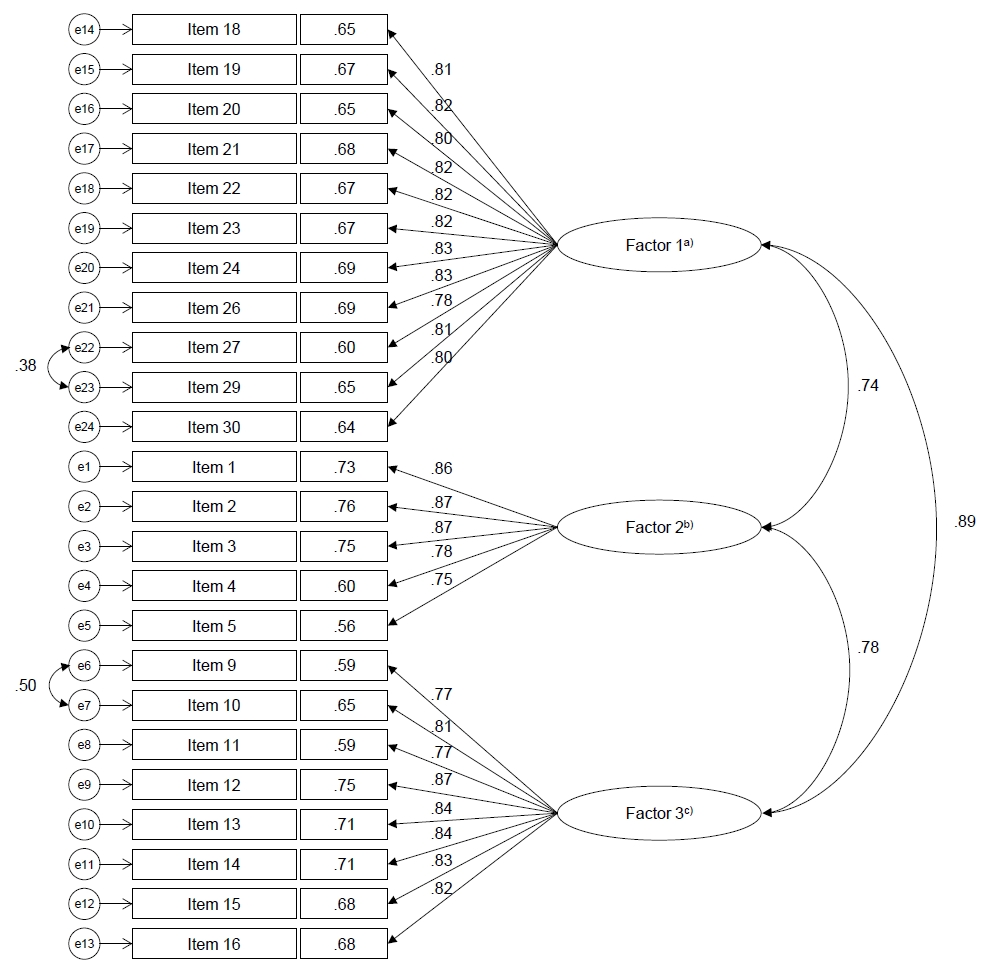
Exploratory factor analysis yielded a three-factor model, which showed acceptable fit in confirmatory factor analysis. The final instrument comprised 24 items across three factors, was scored on a 5-point Likert scale, and was named the Nurses’ Situation Awareness Scale for Clinical Deterioration (NSAS-CD). The scale showed high internal consistency, with Cronbach’s α of .98 and McDonald’s ω of .98.
Conclusion
The NSAS-CD demonstrated acceptable validity and reliability for assessing nurses’ situation awareness of clinical deterioration. Further research is needed to evaluate its generalizability across diverse clinical settings and to establish standardized criteria for clinical deterioration.
- 984 View
- 116 Download

- Nursing management competencies among nurses in national specialized hospitals in Korea: a mixed-methods study
- Jiyoung Choi, Jee-In Hwang
- J Korean Acad Nurs 2026;56(2):190-205. Published online May 22, 2026
- DOI: https://doi.org/10.4040/jkan.25175
-
Abstract
PDFePub
- Purpose
This study aimed to examine nursing management competencies among nurses working in national specialized hospitals, to identify competency development needs and influencing factors, and to provide foundational data for the development of educational and competency-enhancement programs.
Methods
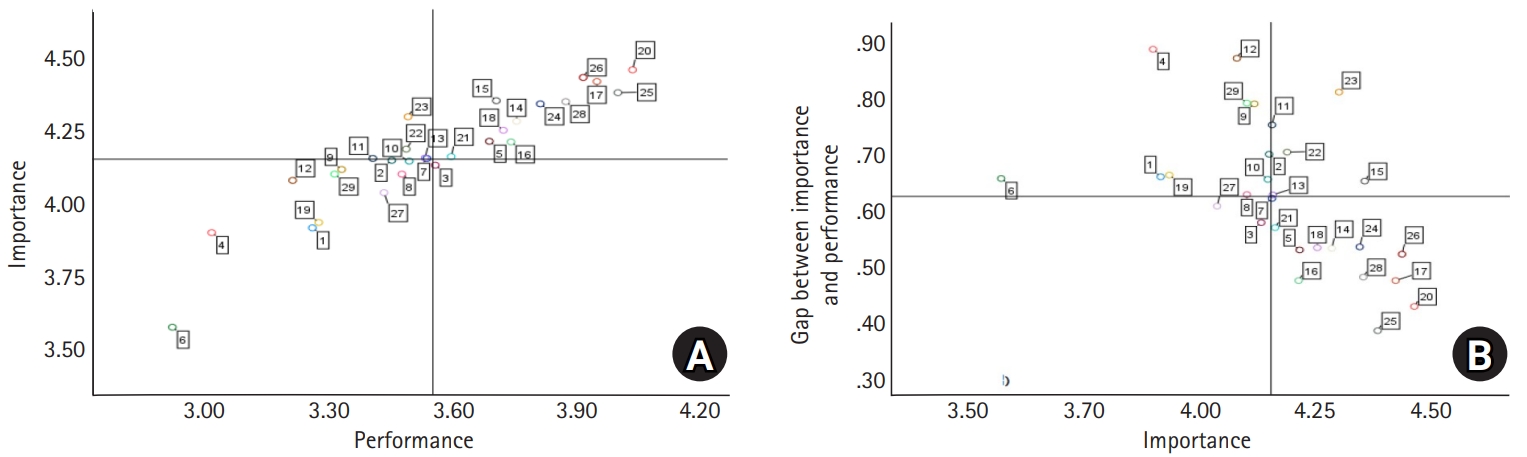
A mixed-methods design was employed. Quantitative data were collected via an online survey of 162 nurses from five national specialized hospitals from January 10 to February 10, 2025, and qualitative data were obtained through in-depth interviews with 20 participants from March 7 to April 16, 2025. Quantitative data were analyzed using descriptive statistics, independent t-tests, analysis of variance, importance–performance analysis, the Borich Needs Assessment, the Locus for Focus model, and multiple regression analysis. Qualitative data were analyzed using content analysis with ATLAS.ti.
Results
The mean performance score for nursing management competencies was 3.56±0.71 on a 5-point scale. Customer orientation received the highest score (4.03±0.78), whereas business and marketing received the lowest score (2.92±1.03). Across needs-assessment models, leadership, nursing ethics and law, quality improvement, and standard development consistently emerged as high-priority areas. In multiple regression analysis, the nursing work environment was the only factor significantly associated with nursing management competency performance (β=.33, p<.001). Qualitative content analysis corroborated these findings and identified three facilitator themes and three barrier themes.
Conclusion
Nursing management competency performance among nurses in national specialized hospitals was associated with the nursing work environment, including organizational conditions. These findings underscore the importance of organizational support and suggest that competency-based education should be redesigned to prioritize high-need competency areas. This study provides a foundation for developing educational interventions and programs to enhance nursing management capacity.
- 1,564 View
- 186 Download
- A structural equation model of respiratory infection prevention behaviors among elementary school teachers in South Korea: a cross-sectional study
- Yoon-Ji Lee, JONG-EUN LEE
- J Korean Acad Nurs 2026;56(2):262-275. Published online May 21, 2026
- DOI: https://doi.org/10.4040/jkan.26010
-
Abstract
PDFePub
- Purpose
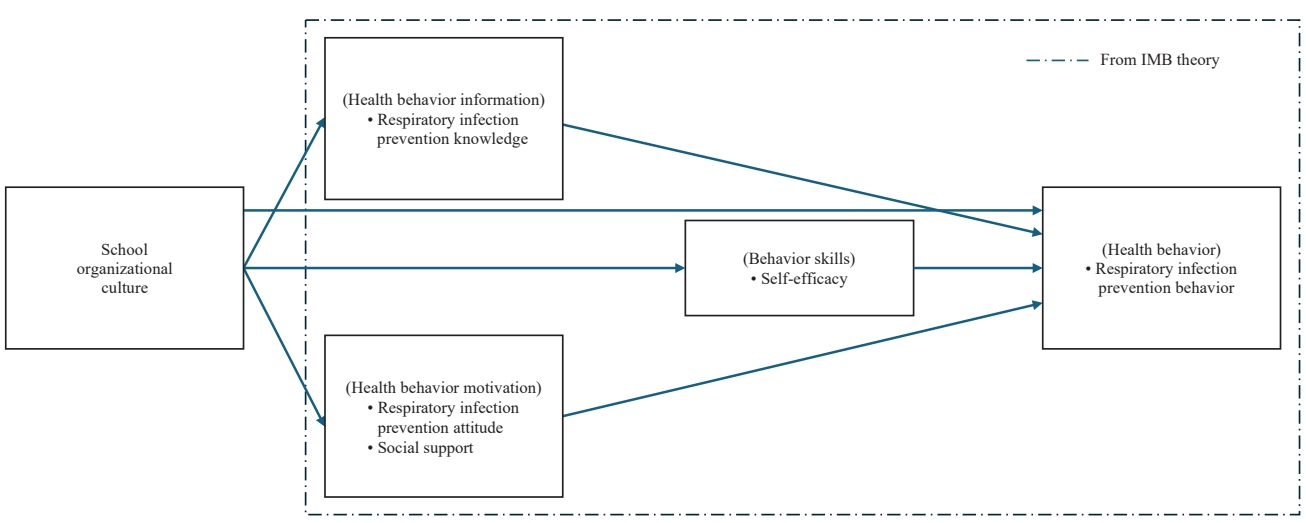
This study aimed to develop and test a structural equation model of respiratory infection prevention behaviors among elementary school teachers based on the Information–Motivation–Behavioral Skills model.
Methods
This study included 250 teachers who were currently working in elementary schools and had experience as homeroom teachers. Data were collected from December 18 to December 31, 2023 using self-reported questionnaires. The proposed model included school organizational culture as the exogenous variable and respiratory infection prevention knowledge, respiratory infection prevention attitude, social support, self-efficacy, and respiratory infection prevention behavior as endogenous variables. Data were analyzed using IBM SPSS for Windows ver. 24.0 and Smart PLS ver. 4.1.
Results
Of the 19 hypothesized paths in the research model, five were statistically significant. School organizational culture had a significant direct effect on respiratory infection prevention knowledge (β=.20, p=.041), social support had a significant direct effect on self-efficacy (β=.33, p=.001), and self-efficacy had a significant direct effect on respiratory infection prevention behaviors (β=.22, p=.021). Respiratory infection prevention attitude (direct: β=.23, p=.029; total: β=.26, p=.008) and school organizational culture (direct: β=.22, p=.017; total: β=.30, p=.002) had significant direct and total effects on respiratory infection prevention behaviors.
Conclusion
To enhance respiratory infection prevention behaviors among elementary school teachers, interventions should focus on strengthening positive attitudes toward infection prevention and improving self-efficacy. Organizational-level strategies, including establishing supportive school organizational cultures, promoting peer support among teachers, and sharing infection prevention practices within schools, are also needed to facilitate and sustain preventive behaviors.
- 1,156 View
- 119 Download
- Development of emergency nursing educational materials in Lao People's Democratic Republic: a methodological study
- Jina Oh, Eunsil Won, Seohyun Won, Sunmi Kim, Seryung Oh, Souksavanh Phanpaseuth, Anousone Sisoulath, Lamngeun Silavong
- J Korean Acad Nurs 2026;56(2):247-261. Published online May 21, 2026
- DOI: https://doi.org/10.4040/jkan.25174
-
Abstract
PDFePub
- Purpose
This study aimed to develop contextualized emergency nursing educational materials tailored to the Lao People’s Democratic Republic (Lao PDR). Emergency nurses in Lao PDR face challenges arising from the lack of standardized, culturally relevant learning resources. Existing materials are often adopted from other countries and do not adequately reflect local needs, contributing to inconsistencies in clinical practice. Developing locally tailored resources, supported by official development assistance, is therefore essential for improving emergency nursing education and practice.
Methods
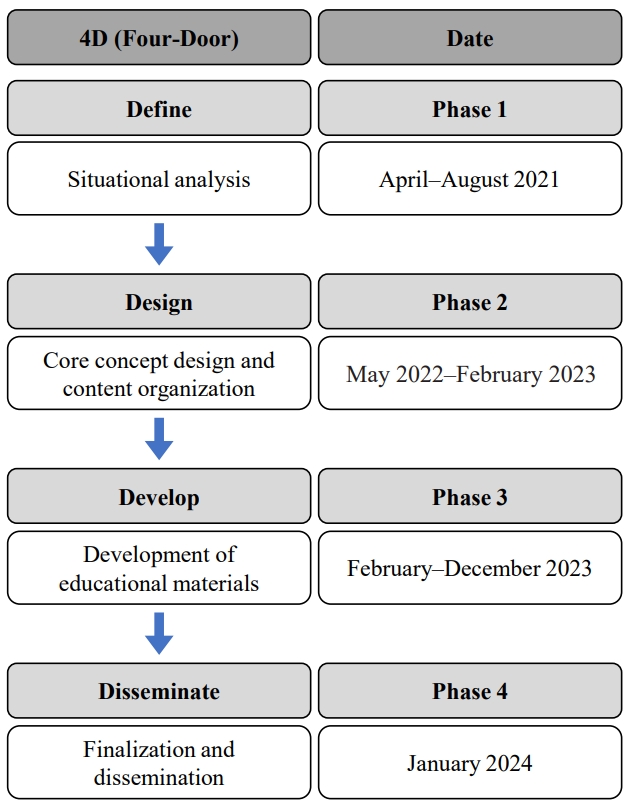
This study used a methodological design based on the Four-Door Model—Define, Design, Develop, and Disseminate—from 2021 to 2024. A situational analysis was conducted using a mixed-methods approach that included a quantitative survey of 70 nursing professionals and qualitative interviews with 52 stakeholders. Content validity and suitability were evaluated by a panel of six local experts using standardized validation forms and the Suitability Assessment of Materials (SAM).
Results
Ten emergency nursing domains were developed to address both universal principles, including triage protocols and life support interventions, and Lao PDR-specific challenges. Validity and suitability were supported by a SAM score of 77.3%, indicating clinical accuracy and cultural appropriateness. The 269-page coursebook was distributed to partner nursing colleges, three central hospitals, and international organizations.
Conclusion
This study developed the first comprehensive emergency nursing educational materials tailored to the Lao PDR context and written in the local language. These materials support continuing professional development and license renewal every 5 years. They also exemplify an international development paradigm that prioritizes recipient-country ownership and sustainable capacity building through collaborative knowledge creation.
- 1,211 View
- 114 Download
Review Paper
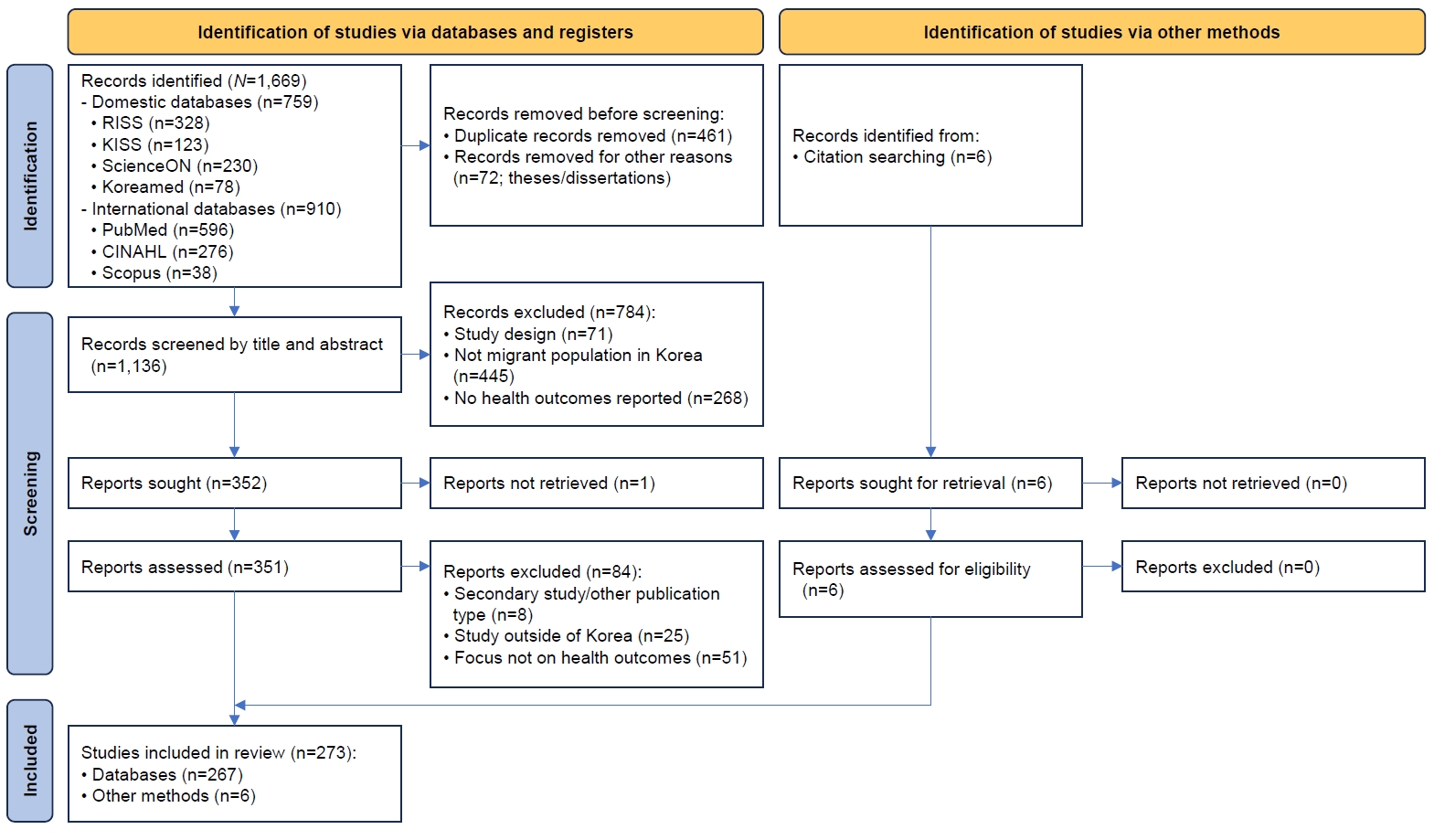
- Migrant health research in South Korea, 2010–2021: a scoping review
- Soo Jin Kang, Bok-Nam Seo
- J Korean Acad Nurs 2026;56(2):126-147. Published online May 19, 2026
- DOI: https://doi.org/10.4040/jkan.25152
-
Abstract
PDFePub
- Purpose
This scoping review mapped research trends in migrant health in Korea and evaluated their alignment with global priorities.
Methods
We conducted a scoping review using the Arksey and O’Malley framework. We searched PubMed, CINAHL, Scopus, KoreaMed, ScienceON, RISS, and KISS for articles published between 2010 and 2021, which defined the review period. The inclusion criteria were studies of adult migrants residing in Korea, primary empirical research, and academic journal articles with full text available in Korean or English. Two reviewers performed inductive coding and assigned each study to one primary subject area for frequency counts.
Results
Of 1,669 records, 273 studies met the inclusion criteria. Marriage-migrant women were the most frequently studied group (56.4%), followed by migrant workers (20.5%) and international students (7.0%). Ten subject areas were identified. Mental health (56/273; 20.5%) and health status and quality of life (47/273; 17.2%) were the most common, whereas infection was the least common (6/273; 2.2%). According to World Health Organization priority areas, P4 (tackling the social determinants of health) was the most common (132/273; 48.4%), followed by P1 (promoting health through public health interventions) (73/273; 26.7%). P3 (mainstreaming health policies and fostering partnerships) and P5 (strengthening health monitoring and information systems) were minimally represented (6/273; 2.2% and 11/273; 4.0%, respectively).
Conclusion
Migrant health research in Korea is heavily concentrated on individual-level topics and marriage-migrant populations, with limited evidence on policies, monitoring systems, and underserved groups (e.g., refugees and diverse populations). Future studies should diversify the populations examined, standardize national monitoring and linked data infrastructure, strengthen the P3 and P5 priority areas, and include more longitudinal, interventional, and policy evaluation research.
- 2,442 View
- 234 Download
Research Papers
- The mediating effects of perceived organizational support and coping strategies on the relationship between job stress and professional quality of life among nurse managers in tertiary and general hospitals
- Seo-In Yang, Min-Jung Choi
- J Korean Acad Nurs 2026;56(2):166-178. Published online April 6, 2026
- DOI: https://doi.org/10.4040/jkan.25099
-
Abstract
PDFePub
- Purpose
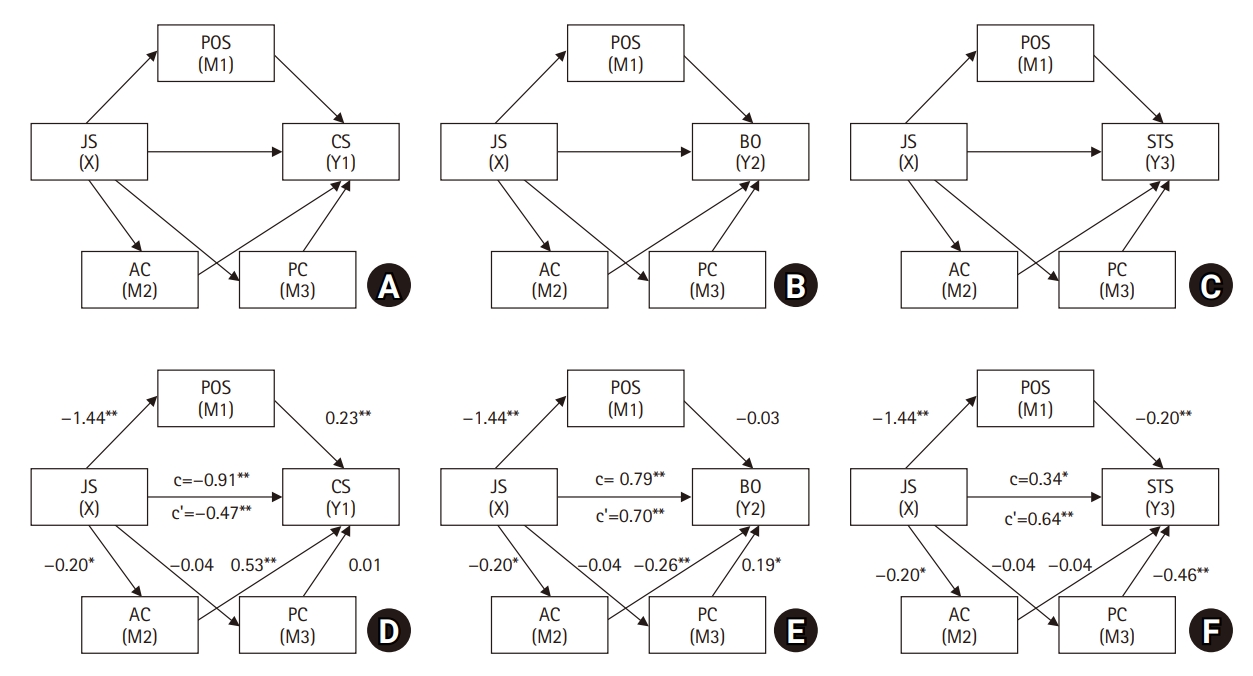
This study aimed to examine the mediating effects of perceived organizational support and coping strategies on the relationship between job stress and professional quality of life among nurse managers working in tertiary and general hospitals.
Methods
The participants were 299 nurse managers employed at tertiary and general hospitals located in Seoul and Gyeonggi Province. Data on job stress, perceived organizational support, coping strategies, and professional quality of life were collected using an online self-report questionnaire between June 28, 2024, and May 31, 2025. The collected data were analyzed using IBM SPSS Statistics ver. 27.0 and the PROCESS Macro ver. 4.0.
Results
Job stress was identified as a significant predictor of professional quality of life among nurse managers. Perceived organizational support and active coping demonstrated significant mediating effects on compassion satisfaction. Active coping showed a significant mediating effect on burnout, whereas perceived organizational support mediated secondary traumatic stress. Passive coping did not demonstrate a significant mediating effect on any of the three subdomains of professional quality of life.
Conclusion
Job stress is closely associated with compassion satisfaction, and this relationship is partially mediated by perceived organizational support and active coping. Accordingly, targeted interventions are required to reduce job stress, strengthen organizational support, and enhance coping competencies among nurse managers. Furthermore, reinforcing institutional- and policy-level support is essential to mitigate secondary traumatic stress and to ensure the sustainability of nurse managers’ professional roles.
- 2,365 View
- 246 Download
- Development and psychometric testing of the Perceived Postoperative Care Competency Scale for Nursing Students: a methodological study
- Perihan Şimşek, Gül Çakir Özmen, Melek Ertürk Yavuz, Sema Koçan, Dilek Çilingir
- J Korean Acad Nurs 2026;56(1):81-97. Published online February 24, 2026
- DOI: https://doi.org/10.4040/jkan.25123
-
Abstract
PDFePub
- Purpose
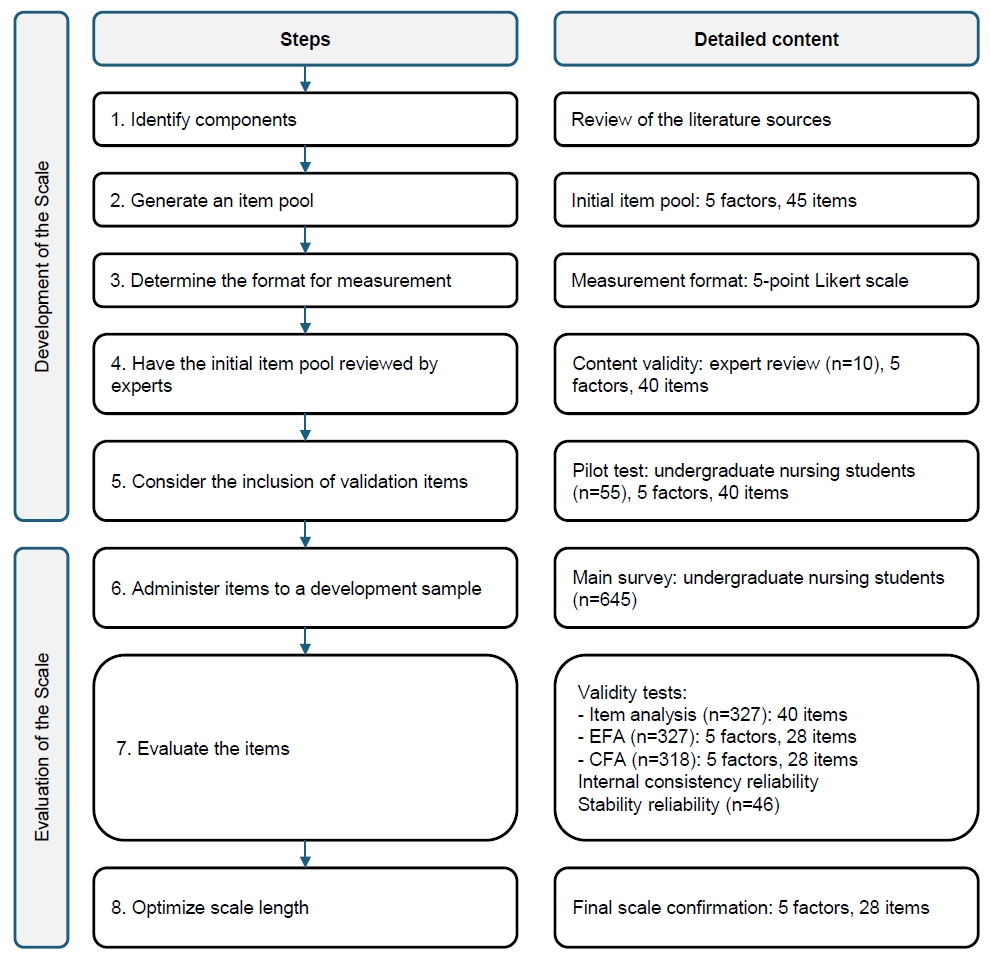
To improve the quality of postoperative care and promote recovery after surgery, it is important that nursing education is competency-based and that competency assessment is an integral part of the educational process. The purpose of this study was to develop a tool to evaluate nursing students’ perceived competence in postoperative care.
Methods
This cross-sectional methodological study followed DeVellis’s scale development steps and was conducted between December 2022 and March 2023. In this study, 892 students were invited and 703 responded. After exclusions, data from 645 students were analyzed to examine the psychometric structure of the scale using exploratory factor analysis (n=327) and confirmatory factor analysis (n=318). Reliability was assessed by calculating Cronbach’s α coefficients and by test–retest measurement (n=46).
Results
The proposed scale was confirmed to consist of five factors and 28 items (χ2/degrees of freedom=2.25, root mean square error of approximation=.06, normed fit index=.90, and goodness-of-fit index=.85). Cronbach’s α was .97 for the total scale. The data demonstrated high test–retest stability (intraclass correlation coefficient=.88). The scale developed and psychometrically tested in this study revealed a five-factor structure: legal responsibilities and ethical principles (seven items), postoperative nursing care (seven items), interpersonal relations and communication (four items), leadership (six items), and education and professional development (four items).
Conclusion
The scale, which demonstrated very good psychometric properties, would be helpful in assessing perceived postoperative nursing competence among nursing students. This may help students graduate with the necessary knowledge and skills required for postoperative care. However, further research involving larger samples and more diverse cultural contexts is needed to enhance the generalizability of the scale.
- 2,792 View
- 191 Download
Review Paper
- Research trends in generative artificial intelligence in nursing: a scoping review
- Myung Jin Choi, Myoung Hee Seo, Jihun Kim, Sunmi Kim, Seok Hee Jeong
- J Korean Acad Nurs 2025;55(3):468-487. Published online August 5, 2025
- DOI: https://doi.org/10.4040/jkan.25006
-
Abstract
PDFePub
- Purpose
Generative artificial intelligence (AI) has yet to be comprehensively analyzed in the nursing literature. This study aimed to identify research trends in generative AI within the nursing field through a scoping review and propose strategies for its effective utilization in nursing.
Methods
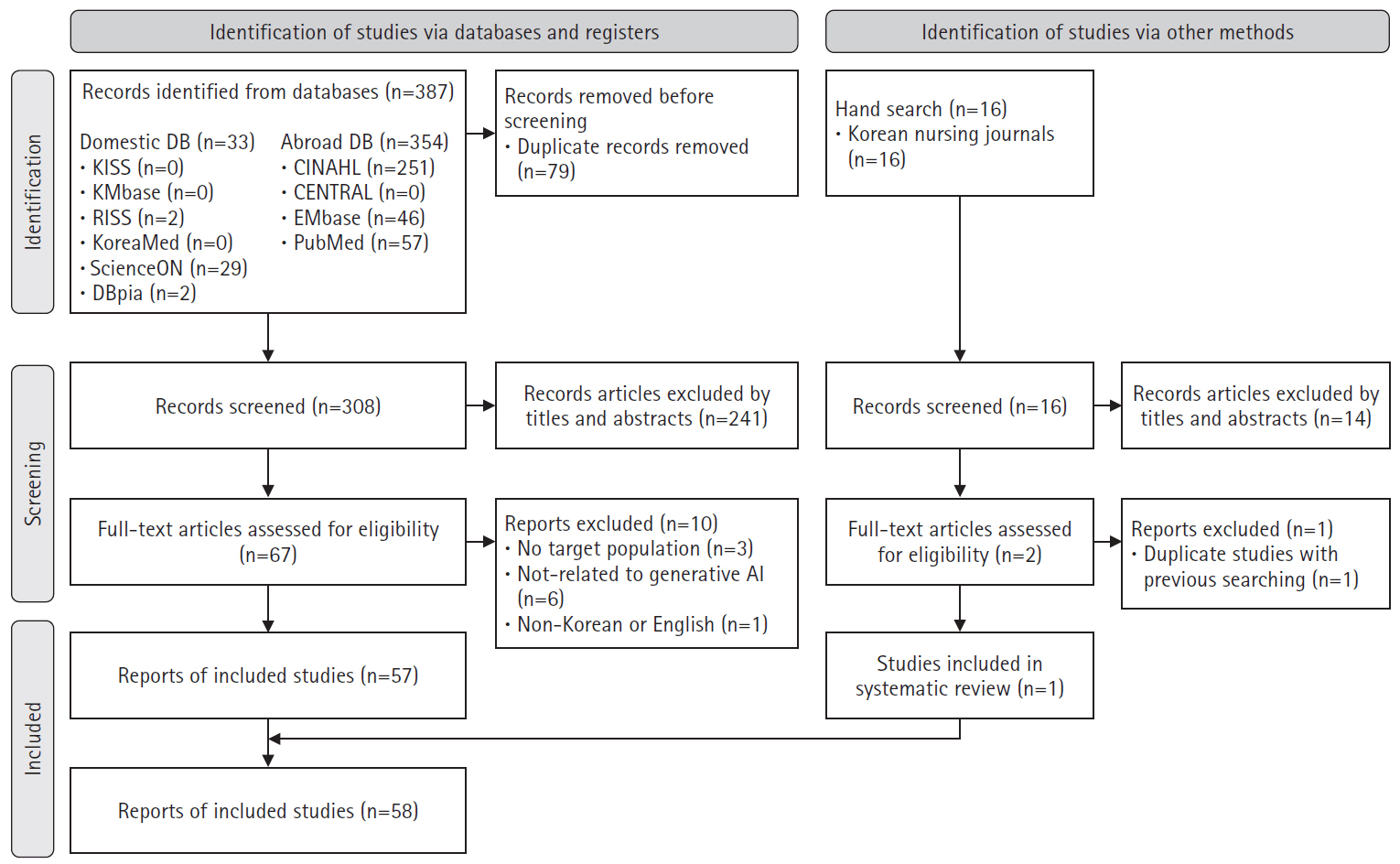
A scoping review was conducted following Arksey and O’Malley’s six-stage framework. The inclusion criteria included: (1) studies conducted in nursing; (2) research related to generative AI; and (3) original research articles, theses, communications, editorials, letters, or commentaries published in academic journals. Database used PubMed, Embase, CENTRAL, CINAHL, KMbase, KoreaMed, KISS, ScienceON, RISS, DBpia, and 27 nursing-specific journals.
Results
In total, 403 studies were initially identified, and 58 were included in the final analysis. In the care domain, strengths included rapid information retrieval and improved nurse-patient communication, while limitations included the irreplaceable human element and low reliability. The administration domain had no relevant studies. In the research domain, generative AI exhibited strengths such as enhanced efficiency in the paper writing process and improved dissemination speed, but its weaknesses included lack of ethical and legal accountability and a risk of inaccurate or biased information. In the education domain, generative AI was effective in saving time in educational design and implementation, as well as supporting content creation, but challenges included algorithmic bias and risks of plagiarism.
Conclusion
This study identified potential benefits and limitations of generative AI across nursing domains. For effective application, it is essential to develop comprehensive guidelines and policies, provide user education and support, and create opportunities for nurses, educators, and students to learn about strengths and risks of generative AI. -
Citations
Citations to this article as recorded by
- Generative AI use in instructor-assigned learning activities among nursing students: A cross-sectional survey of perceptions, ethical awareness, faculty restrictions, and continuance intention
Yun-Ting Huang, Hsiao-Fang Hsiung, Hui-Ling Lin, Li-Chun Chang, Li-Ling Liao
Nurse Education Today.2026; 165: 107162. CrossRef - Toward an end-to-end K-AI nursing ecosystem: digital twins across the care continuum
Jeung-Im Kim, Jiyeon Kang, YeoJin Im, Sung Reul Kim, Sun Ju Chang
Journal of Korean Academy of Nursing.2026; 56(2): 123. CrossRef - A concept analysis of generative artificial intelligence-based learning support in nursing education
Hyo Hoon Ku
The Journal of Korean Academic Society of Nursing Education.2026; 32(3): 393. CrossRef - Leadership Development Needs of Novice and Advanced Beginner Nurses: A Nationwide Cross-sectional Study Using Proportional Quota Sampling
Sunmi Kim, Seok Hee Jeong
Journal of Korean Academy of Nursing Administration.2026; 32(4): 275. CrossRef - Nursing Students' Perspectives on the Use of Artificial Intelligence in Psychiatric Nursing Education: A Qualitative Meta-Synthesis
Sukyung Son, Eunyoung Park
Journal of Korean Academy of psychiatric and Mental Health Nursing.2025; 34(Special Is): 9. CrossRef
- Generative AI use in instructor-assigned learning activities among nursing students: A cross-sectional survey of perceptions, ethical awareness, faculty restrictions, and continuance intention
- 14,207 View
- 1,094 Download
- 2 Web of Science
- 5 Crossref
Research Papers
- The Effects of a Self-Efficacy Theory-Based Exercise Program for Patients Undergoing with Total Knee Arthroplasty
- Kyung-Hye Park, Hee-Young Kang
- J Korean Acad Nurs 2024;54(4):547-562. Published online October 22, 2024
- DOI: https://doi.org/10.4040/jkan.24027
-
Abstract
PDF
 Supplementary MaterialePub
 Purpose This study was performed to develop a self-efficacy theory-based exercise program for total knee arthroplasty (TKA) and to test the program’s efficacy in ameliorating knee pain and restoring function as measured by lower extremity muscle strength, 3 meter walking time, Korean Western Ontario McMaster Index (WOMAC), exercise self-efficacy, and length of hospital stay for TKA patients.
Methods This quasi-experimental study incorporating a non-equivalent control group and pretest-posttest non-synchronized design non-synchronous design was applied to assess self-efficacy reinforcement strategies based on self-efficacy theory. The exercise program consisted of the following steps: TKA, education to prevent postoperative complications, and muscle strength exercises. Respective exercise and control groups included 29 and 27 participants. The experimental group received eight sessions of the program from three weeks before TKA to four weeks after TKA. Collected data were analyzed using the chi-square test, Mann–Whitney U test, and ranked ANCOVA and t-tests using IBM SPSS Statistics 23.
Results Experimental group showed significant improvement in lower extremity muscle strength (F = 8.63,
p = .005), 3 meter walking time (z = - 5.02,p < .001), WOMAC index (z = - 2.22,p = .027), self-efficacy for exercise (z = - 3.29,p = .001), and length of hospital stay (t = - 2.11,p = .040) compared to the control group. No significant differences in knee pain and range of motion were observed.Conclusion These findings indicate that a self-efficacy theory-based exercise program can be an effective exercise strategy that patients undergoing TKA can easily follow at home without assistance. It is thus recommended as an exercise intervention for TKA patients.
-
Citations
Citations to this article as recorded by- Self-efficacy and implementation intentions in home rehabilitation of stroke patients: the parallel mediating role of recurrence risk perception and outcome expectations
Xiaowen Jiang, Qiuxue Sun, Rong Tang, Shuxian Liu, Xi Chen, Yumei Lv
Frontiers in Psychology.2025;[Epub] CrossRef - Factors Influencing Decision-Making and Rehabilitation Among Older Women Who Underwent Total Knee Replacement: A Qualitative Study in Taiwan
Ching Han Huang, Yun Yee Chen, Shu Wen Chen, Chen Ti Wang, Mei Hsiang Lin
Patient Preference and Adherence.2025; Volume 19: 3931. CrossRef
- Self-efficacy and implementation intentions in home rehabilitation of stroke patients: the parallel mediating role of recurrence risk perception and outcome expectations
- 5,409 View
- 398 Download
- 2 Web of Science
- 2 Crossref
- The Influence of Diversity Management of Nursing Organization on Organizational Commitment: Double Mediating Effect of Diversity Sensitivity Orientation and Positive Nursing Organizational Culture
- Hwi Gon Jeon, Keum Seong Jang, Eun A Kim
- J Korean Acad Nurs 2024;54(3):403-417. Published online August 31, 2024
- DOI: https://doi.org/10.4040/jkan.23120
-
Abstract
PDF
- Purpose
The aim of this study was to identify the double mediating effect of effect of diversity sensitivity orientation and positive nursing organizational culture between diversity management and organizational commitment.
Methods
Participants were 245 nurses working in six tertiary hospitals located in 3 different regions. Data collection was conducted from February 13, 2023 to March 6, 2023 through online self-reported questionnaire. The data were analyzed by IBM SPSS Statistics 27 and SPSS PROCESS Macro 4.2 program.
Results
The direct effect of diversity management on organizational commitment was significant (β = .21, p < .001). The indirect effect of diversity management on organization commitment was .34 (95% confidence interval [CI] = .23~.47). The double mediating effect of diversity sensitivity orientation and positive nursing organizational culture in the relationship between diversity management and organizational commitment was .02 (95% CI = .00~.05).
Conclusion
Diversity sensitivity orientation and positive nursing organizational culture show double mediating effect on the relationship between diversity management and organizational commitment. Education program and human resource management strategy for enhancing diversity management, diversity sensitivity orientation and positive nursing organizational culture should be provided to improve organizational commitment, and which are needed active support of the association and nursing organization. -
Citations
Citations to this article as recorded by- Impact of Resilience, Emotional Exhaustion, and Communication Competency on Organizational Commitment Among Nurses in a Tertiary Hospital Setting in South Korea: A Cross-Sectional Study
Ho Young Kim, Hee Jeong Kim, Eun Ja Yeun
Sage Open.2025;[Epub] CrossRef - Organizational commitment of nursing staff: Definition of the concept and specifics of measurement (review of foreign publications)
K. V. Kuzmin, L. E. Petrova, V. S. Kharchenko
Kuban Scientific Medical Bulletin.2025; 32(5): 96. CrossRef
- Impact of Resilience, Emotional Exhaustion, and Communication Competency on Organizational Commitment Among Nurses in a Tertiary Hospital Setting in South Korea: A Cross-Sectional Study
- 3,294 View
- 215 Download
- 1 Web of Science
- 2 Crossref
Review Papers
- Factors Related to Emotional Leadership in Nurses Manager: Systematic Review and Meta-Analysis
- Se Young Jang, Chan Mi Park, Eun Hee Yang
- J Korean Acad Nurs 2024;54(2):119-138. Published online May 31, 2024
- DOI: https://doi.org/10.4040/jkan.24026
-
Abstract
PDF
- Purpose
This study aimed to identify research trends related to emotional leadership among nurse managers by conducting a systematic literature review and meta-analysis. This study sought to derive insights that could contribute to improving emotional leadership in nursing practice.
Methods
A systematic review and meta-analysis were conducted according to the Preferred Reporting Items for Systematic Reviews and Meta-Analysis (PRISMA) and Meta-Analysis Of Observational Studies in Epidemiology (MOOSE) guidelines. Databases including PubMed, Cumulative Index to Nursing and Allied Health Literature, Scopus, Web of Science, Research Information Sharing Service, Koreanstudies Information Service System, Korean Medical Database, KoreaMed, ScienceON, and DBpia were searched to obtain papers published in English and Korean. Literature searches and screenings were conducted for the period December 1, 2023 to December 17, 2023. The effect size correlation (ESr) was calculated for each variable and the meta-analysis was performed using the statistical software SPSS 29.0, R 4.3.1.
Results
Twenty-five (four personal, six job, and fifteen organizational) relevant variables were identified through the systematic review. The results of the meta-analysis showed that the total overall effect size was ESr = .33. Job satisfaction (ESr = .40) and leader-member exchange (ESr = .75) had the largest effect size among the job and organizational-related factors.
Conclusion
Emotional leadership helps promote positive changes within organizations, improves organizational effectiveness, and increases member engagement and satisfaction. Therefore, it is considered an important strategic factor in improving organizational performance. -
Citations
Citations to this article as recorded by- Leadership Development Needs of Novice and Advanced Beginner Nurses: A Nationwide Cross-sectional Study Using Proportional Quota Sampling
Sunmi Kim, Seok Hee Jeong
Journal of Korean Academy of Nursing Administration.2026; 32(4): 275. CrossRef - Emotional leadership in health care: A dire need illuminated by pivotal resource cuts
Jacqueline Hoare
South African Journal of Science.2025;[Epub] CrossRef
- Leadership Development Needs of Novice and Advanced Beginner Nurses: A Nationwide Cross-sectional Study Using Proportional Quota Sampling
- 5,920 View
- 287 Download
- 1 Web of Science
- 2 Crossref
- Descriptive Review of Patents in Healthcare and Nursing: Based on Network Analysis
- Misun Jeon, Nayung Youn, Sanghee Kim
- J Korean Acad Nurs 2024;54(1):1-17. Published online February 29, 2024
- DOI: https://doi.org/10.4040/jkan.23064
-
Abstract
PDF
- Purpose
The significance of the healthcare industry has grown exponentially in recent years due to the impact of the fourth industrial revolution and the ongoing pandemic. Accordingly, this study aimed to examine domestic healthcare-related patents comprehensively. Big data analysis was used to present the trend and status of patents filed in nursing.
Methods
The descriptive review was conducted based on Grant and Booth’s descriptive review framework. Patents related to nursing was searched in the Korea Intellectual Property Rights Information Service between January 2016 to December 2020. Data analysis included descriptive statistics, phi-coefficient for correlations, and network analysis using the R program (version 4.2.2).
Results
Among 37,824 patents initially searched, 1,574 were selected based on the inclusion criteria. Nursing-related patents did not specify subjects, and many patents (41.4%) were related to treatment in the healthcare delivery phase. Furthermore, most patents (56.1%) were designed to increase effectiveness. The words frequently used in the titles of nursing-related patents were, in order, “artificial intelligence,” “health management,” and “medical information,” and the main terms with high connection centrality were “artificial intelligence” and “therapeutic system.” Conclusion: The industrialization of nursing is the best solution for developing the healthcare industry and national health promotion. Collaborations in education, research, and policy will help the nursing industry become a healthcare industry of the future. This will prime the enhancement of the national economy and public health.
- 4,026 View
- 115 Download
Research Papers
- Development of Nursing Clinical Judgment Scale
- Shi Nae Kwon, Hyojung Park
- J Korean Acad Nurs 2023;53(6):652-665. Published online December 31, 2023
- DOI: https://doi.org/10.4040/jkan.23042
-
Abstract
PDF
- Purpose
This study aimed to develop a nursing clinical judgment scale (NCJS) and verify its validity and reliability in assessing the clinical judgment of nurses.
Methods
A preliminary instrument of the NCJS comprising 38 items was first developed from attributes and indicators derived from a literature review and an in-depth/focus interview with 12 clinical nurses. The preliminary tool was finalized after 7 experts conducted a content validity test based on a data from a preliminary survey of 30 hospital nurses in Korea. Data were collected from 443 ward, intensive care unit, emergency room nurses who voluntarily participated in the survey through offline and online for the verification of the construct validity and reliability of the scale.
Results
The final scale comprised 23 items scored on a 5-point Likert scale. Six factors – integrated data analysis, evaluation and reflection on interventions, evidence on interventions, collaboration among health professionals, patient-centered nursing, and collaboration among nurse colleagues – accounted for 64.9% of the total variance. Confirmatory factor analysis supported the fit of the measurement model, comprising six factors (root mean square error of approximation = .07, standardized root mean square residual = .04, comparative fit index = .90). Cronbach’s α for all the items was .92.
Conclusion
The NCJS is a valid and reliable tool that fully reflects the characteristics of clinical practice, and it can be used effectively to evaluate the clinical judgment of Korean nurses. Future research should reflect the variables influencing clinical judgment and develop an action plan to improve it. -
Citations
Citations to this article as recorded by- Functional connectivity theory-based neurophysiological profiles associated with emotional competence and clinical judgment in nursing students: A cluster analysis
Young Kyung Cho
Nurse Education Today.2027; 168: 107421. CrossRef - The role of immersive extended reality for the development and evaluation of clinical reasoning in health professions education: A scoping review
Sophie Lansley, Jared McSweeney, Jasmine Rutere, Harish Thampy
Medical Teacher.2026; : 1. CrossRef - How the nursing work environment moderates the relationship between clinical judgment and person-centered care among intensive care unit nurses
Mi Hwa Seo, Eun A. Kim, Hae Ran Kim, Mohammad Jamil Rababa
PLOS ONE.2025; 20(1): e0316654. CrossRef - Effects of Critical Thinking Disposition, Clinical Judgement, and Nurse–Physician Collaboration on Triage Competency Among Triage Nurses
Ji-Won Song, Hyung-Ran Park
Healthcare.2025; 13(4): 405. CrossRef - Effectiveness of a virtual reality nursing simulation for pediatric pneumonia care: a Korean pilot study using a single-group pre-post test design
Eun Joo Kim, Seong Kwang Kim, Sung Sook Song
Child Health Nursing Research.2025; 31(4): 198. CrossRef - The Influence of Clinical Nurses' Clinical Judgment, Nursing Work Environment and Ethical Nursing Competence on Patient Safety Nursing Activities
Eunseo Hong, Hyojung Park
Journal of Korean Public Health Nursing.2025; 39(3): 368. CrossRef
- Functional connectivity theory-based neurophysiological profiles associated with emotional competence and clinical judgment in nursing students: A cluster analysis
- 9,935 View
- 526 Download
- 4 Web of Science
- 6 Crossref
- Analysis of ROX Index, ROX-HR Index, and SpO 2 /FIO 2 Ratio in Patients Who Received HighFlow Nasal Cannula Oxygen Therapy in Pediatric Intensive Care Unit
- Sun Hee Choi, Dong Yeon Kim, Byung Yun Song, Yang Sook Yoo
- J Korean Acad Nurs 2023;53(4):468-479. Published online August 31, 2023
- DOI: https://doi.org/10.4040/jkan.22152
-
Abstract
PDF
- Purpose
This study aimed to evaluate the use of the respiratory rate oxygenation (ROX) index, ROX-heart rate (ROX-HR) index, and saturation of percutaneous oxygen/fraction of inspired oxygen ratio (SF ratio) to predict weaning from high-flow nasal cannula (HFNC) in patients with respiratory distress in a pediatric intensive care unit.
Methods
A total of 107 children admitted to the pediatric intensive care unit were enrolled in the study between January 1, 2017, and December 31, 2021. Data on clinical and personal information, ROX index, ROX-HR index, and SF ratio were collected from nursing records. The data were analyzed using an independent t-test, χ2 test, Mann–Whitney U test, and area under the curve (AUC).
Results
Seventy-five (70.1%) patients were successfully weaned from HFNC, while 32 (29.9%) failed. Considering specificity and sensitivity, the optimal cut off points for predicting treatment success and failure of HFNC oxygen therapy were 6.88 and 10.16 (ROX index), 5.23 and 8.61 (ROX-HR index), and 198.75 and 353.15 (SF ratio), respectively. The measurement of time showed that the most significant AUC was 1 hour before HFNC interruption.
Conclusion
The ROX index, ROX-HR index, and SF ratio appear to be promising tools for the early prediction of treatment success or failure in patients initiated on HFNC for acute hypoxemic respiratory failure. Nurses caring for critically ill pediatric patients should closely observe and periodically check their breathing patterns. It is important to continuously monitor three indexes to ensure that ventilation assistance therapy is started at the right time. -
Citations
Citations to this article as recorded by- Admission Respiratory Rate-Oxygenation Index and Outcome of Acute Respiratory Illness in a Pediatric Intensive Care Unit
Vijendra Singh, Umesh Pandwar, Navindana ., Manjusha Goel
Cureus.2026;[Epub] CrossRef - Non-invasive SpO2/FiO2 ratio (SFR) as surrogate for PaO2/FiO2 ratio (PFR): A scoping review
Madhura Reddy, Malavika Kulkarni, Sushma Thimmaiah Kanakalakshmi, Laxmi Shenoy, Rama Rani KrishnaBhat
The Journal of Critical Care Medicine.2025; 11(3): 221. CrossRef - Can the ROX index predict high‐flow nasal cannula failure in children under 2 with lower respiratory tract infection?
Pablo Vasquez‐Hoyos, Alvaro L. Jacome‐Orozco, Andrea P. Rodriguez‐Mayorga, Leidy E. Sepulveda‐Forero, Diana P. Escobar‐Serna, Juan S. Barajas, Evelyn Obando‐Belalcazar, Claudia M. Salinas‐Jaimes, Juan J. Peralta‐Palmezano, Alexandra Jimenez‐Chavez, Rafael
Pediatric Pulmonology.2024; 59(5): 1246. CrossRef - Impact of Surgical Mask Placement Over High-Flow Nasal Cannula on Oxygenation Parameters in COVID-19 Patients Experiencing Hypoxemic Respiratory Failure
Aadila Coatwala, Mayank Dhir, Sagar Sinha, Dattatray Bhusare
Cureus.2024;[Epub] CrossRef
- Admission Respiratory Rate-Oxygenation Index and Outcome of Acute Respiratory Illness in a Pediatric Intensive Care Unit
- 8,438 View
- 239 Download
- 2 Web of Science
- 4 Crossref
- Assessment of Risk Factors for Postoperative Delirium in Older Adults Who Underwent Spinal Surgery and Identifying Associated Biomarkers Using Exosomal Protein
- Wonhee Baek, JuHee Lee, Yeonsoo Jang, Jeongmin Kim, Dong Ah Shin, Hyunki Park, Bon-Nyeo Koo, Hyangkyu Lee
- J Korean Acad Nurs 2023;53(4):371-384. Published online August 31, 2023
- DOI: https://doi.org/10.4040/jkan.22146
-
Abstract
PDF
- Purpose
With an increase in the aging population, the number of patients with degenerative spinal diseases undergoing surgery has risen, as has the incidence of postoperative delirium. This study aimed to investigate the risk factors affecting postoperative delirium in older adults who had undergone spine surgery and to identify the associated biomarkers.
Methods
This study is a prospective study. Data of 100 patients aged ≥ 70 years who underwent spinal surgery were analyzed. Demographic data, medical history, clinical characteristics, cognitive function, depression symptoms, functional status, frailty, and nutritional status were investigated to identify the risk factors for delirium. The Confusion Assessment Method, Delirium Rating Scale-R-98, and Nursing Delirium Scale were also used for diagnosing deliri-um. To discover the biomarkers, urine extracellular vesicles (EVs) were analyzed for tau, ubiquitin carboxy-terminal hydrolase L1 (UCH-L1), neurofilament light, and glial fibrillary acidic protein using digital immunoassay technology.
Results
Nine patients were excluded, and data obtained from the remaining 91 were analyzed. Among them, 18 (19.8%) developed delirium. Differences were observed between partici-pants with and without delirium in the contexts of a history of mental disorder and use of benzodiazepines (p = .005 and p = .026, respectively). Tau and UCH-L1—concentrations of urine EVs—were comparatively higher in participants with severe delirium than that in partici-pants without delirium (p = .002 and p = .001, respectively).
Conclusion
These findings can assist clinicians in accurately identifying the risk factors before surgery, classifying high-risk patients, and predicting and detecting delirium in older patients. Moreover, urine EV analysis revealed that postoperative delirium following spinal surgery is most likely associated with brain damage. -
Citations
Citations to this article as recorded by- Psychological factors associated with postoperative cognitive outcomes in older adults: a systematic review and meta-analysis
Anahita Amirpour, Lina Bergman, Jeanette Eckerblad, Gabriela Markovic, Ulrica Nilsson, Anna Falk
British Journal of Anaesthesia.2026; 136(5): 1482. CrossRef - Exosomes as a biomarker in postoperative complications: a literature review
Zhan Huang, Yi Wang, Wei Li, Zhiqiang Gan, Haiqing Yang, Jiayao Li, Yuan Jiang, Yi Yuan
Frontiers in Cell and Developmental Biology.2026;[Epub] CrossRef - Emerging biomarkers of postoperative delirium at the intersection of neuroinflammation and neurodegeneration
Kun Leng, Mervyn Maze, Odmara L. Barreto Chang
Frontiers in Aging Neuroscience.2025;[Epub] CrossRef
- Psychological factors associated with postoperative cognitive outcomes in older adults: a systematic review and meta-analysis
- 3,273 View
- 107 Download
- 3 Web of Science
- 3 Crossref
- Factors Affecting Radiation Protective Behaviors in Perioperative Nurses Applying the Theory of Planned Behavior: Path Analysis
- Se Young Jang, Hee Sun Kim, Seok Hee Jeong, Young Man Kim
- J Korean Acad Nurs 2023;53(2):222-235. Published online April 30, 2023
- DOI: https://doi.org/10.4040/jkan.22099
-
Abstract
PDF
- Purpose
The aim of this study was to identify the factors explaining protective behaviors against radiation exposure in perioperative nurses based on the theory of planned behavior.
Methods
This was a cross-sectional study. A total of 229 perioperative nurses participated between October 3 and October 20, 2021. Data were analyzed using SPSS/WIN 23.0 and AMOS 23.0 software. The three exogenous variables (attitude toward radiation protective behaviors, subjective norm, and perceived behavioral control) and two endogenous variables (radiation protective intention and radiation protective behaviors) were surveyed.
Results
The hypothetical model fit the data (χ2/df = 1.18, SRMR = .02, TLI = .98, CFI = .99, RMSEA = .03). Radiation protective intention (β = .24, p = .001) and attitude toward radiation protective behaviors (β = .32, p = .002) had direct effects on radiation protective behaviors. Subjective norm (β = .43, p = .002) and perceived behavior control (β = .24, p = .003) had direct effects on radiation protective intention, which explained 38.0% of the variance. Subjective norm (β = .10, p = .001) and perceived behavior control (β = .06, p = .002) had indirect effects via radiation protective intention on radiation protective behaviors. Attitude toward radiation protective behaviors, subjective norm, and perceived behavioral control were the significant factors explaining 49.0% of the variance in radiation protective behaviors.
Conclusion
This study shows that the theory of planned behavior can be used to effectively predict radiation protective behaviors in perioperative nurses. Radiation safety guidelines or education programs to enhance perioperative nurses’ protective behaviors should focus on radiation protective intention, attitude toward radiation protective behaviors, subjective norm, and perceived behavioral control. -
Citations
Citations to this article as recorded by- Development and validation of a radiation protection attitude scale for operating room medical staff based on the ABC theory model
Wei Xu, Yingru Dou, Kai Wang
Applied Radiation and Isotopes.2026; 238: 112927. CrossRef - Health Protective Behavior in Occupational Health Practice: A Concept Analysis
Fenggang Liu, Juanjuan Wang, Weeraporn Suthakorn, Li Liao
Health Science Reports.2025;[Epub] CrossRef - Factors related to preventive measures towards PM2.5 exposure: A systematic review
Jeevan Bhatta, Orapin Laosee, Cheerawit Rattanapan
Global Transitions.2024; 6: 212. CrossRef - Factors Influencing Radiation Protection Behavior of Nurses in Intensive Care Units
Seo Jeong Kim, Yun Hee Kim
Journal of Korean Critical Care Nursing.2024; 17(3): 1. CrossRef - A Review of the Relationship between Health Behaviors and Career Adaptability among University Students
Dongming Jia, Xia Yuan
Journal of Medicine and Health Science.2024; 2(4): 43. CrossRef
- Development and validation of a radiation protection attitude scale for operating room medical staff based on the ABC theory model
- 3,914 View
- 128 Download
- 3 Web of Science
- 5 Crossref
- Factors Related to Clinical Competence among Graduating Nursing Students during the COVID-19 Pandemic: A Cross-Sectional Study
- Su Kyoung Chung, Jinsook Kim, Pratibha Bhandari
- J Korean Acad Nurs 2023;53(2):145-154. Published online April 30, 2023
- DOI: https://doi.org/10.4040/jkan.22087
-
Abstract
PDF
- Purpose
This study investigated clinical competency, COVID-19-related anxiety, coping strategies, self-efficacy, and perceived stress among graduating nursing students during the COVID-19 pandemic.
Methods
We conducted a cross-sectional survey. Participants were recruited from universities located in four major cities in South Korea. General demographic information, clinical competency, self-efficacy, perceived stress, COVID-19-related anxiety, and coping strategies were assessed using reliable questionnaires. Descriptive statistics, correlations, and multiple regression tests were used to analyze the data.
Results
The mean clinical competency, self-efficacy, perceived stress, adaptive coping, and maladaptive coping were 138.16 ± 18.34, 83.85 ±14.02, 21.37 ± 5.79, 53.15 ± 4.64, and 30.98 ± 6.73, respectively. COVID-19-related anxiety was reported by 4.3% of participants. Clinical competency was significantly positively correlated with self-efficacy (r = .44, p < .001) and adaptive coping (r = .20, p = .035) and was significantly negatively correlated with maladaptive coping (r = .20, p = .035). The predictors of clinical competency were self-efficacy (β = .434, p < .001) and adaptive coping (β = .173, p < .039), which explained 23% of the variance in clinical competency.
Conclusion
Self-efficacy and adaptive coping strategies are significant predictors of clinical competence during the pandemic. Planning and implementing various curricular and non-curricular activities to increase senior students' self-efficacy and adaptive coping strategies will help prepare competent nursing graduates for the pandemic when they enter the nursing workforce. -
Citations
Citations to this article as recorded by- Exploring Educational Stress and Competence of Intern Nurses' Following Two Years of Online Education: A Cross-Sectional Study
Fatma Dursun Ergezen, Ayşe Yacan Kök, Emine Kol
Ordu Üniversitesi Hemşirelik Çalışmaları Dergisi.2026; 9(1): 83. CrossRef - The Effect of Internship Length on Self‐Efficacy and Clinical Competence: Accelerating Entry Into the Nursing Workforce in Saudi Arabia
Sitah S. Alshutwi, Majed Alamri
Journal of Nursing Management.2025;[Epub] CrossRef
- Exploring Educational Stress and Competence of Intern Nurses' Following Two Years of Online Education: A Cross-Sectional Study
- 4,456 View
- 95 Download
- 2 Web of Science
- 2 Crossref
Review Paper
- Effects of Leadership Styles of Nursing Managers on Turnover Intention of Hospital Nurses: A Systematic Review and Meta-Analysis
- Yunjeong Cho, Seok Hee Jeong, Hee Sun Kim, Young Man Kim
- J Korean Acad Nurs 2022;52(5):479-498. Published online October 31, 2022
- DOI: https://doi.org/10.4040/jkan.22039
-
Abstract
PDF
- Purpose
This study aimed to examine effect sizes of leadership styles of nursing managers on turnover intention of hospital nurses.
Methods
A systematic review and meta-analysis were conducted in accordance with the PRISMA and MOOSE guidelines. Participants were nurses working in hospitals. The intervention involved nursing managers’ leadership styles; the outcome assessed was nurses’ turnover intention. This was an observational study design. Eleven databases were searched to obtain articles published in Korean or English. Of the 14,428 articles reviewed, 21 were included in systematic review and meta-analysis. Comprehensive Meta-Analysis and R software programs were used.
Results
The total effect size r (ESr) was - 0.25 (95% confidence interval: - 0.29 to - 0.20). Effect sizes of each leadership style on turnover intention were as follows: ethical leadership (ESr = - 0.34), transformational leadership (ESr = - 0.28), authentic leadership (ESr = - 0.23), transactional leadership (ESr = - 0.21), and passive avoidant leadership (ESr = 0.13). Ethical leadership was the most effective style in decreasing turnover intention of hospital nurses.
Conclusion
Positive leadership styles of nurse managers effectively decrease turnover intention of hospital nurses, and negative leadership styles of nurse managers effectively increase turnover intention of hospital nurses. The ethical leadership style is the most effective in decreasing turnover intention of hospital nurses; however, it requires careful interpretation as its effects are reported by only two studies. This study contributes to addressing the high turnover rate of hospital nurses and developing positive leadership styles of nurse managers in hospital settings. -
Citations
Citations to this article as recorded by- Cultural Differences in the Relationship Between Negative Leadership Behaviours and Nurses’ Emotional Exhaustion: A Systematic Review
Shiyi Chen, Xinze Zhang, Huan Chen, Feng Zhang, Tao-Hsin Tung, Haixiao Chen, Verónica V. Márquez-Hernández
Journal of Nursing Management.2026;[Epub] CrossRef - Factors Influencing Intention to Leave Among Nurse Managers: A Cross‐Sectional Study
Valentina Simonetti, Ilaria Franconi, Natascia Piermattei, Andrea Faragalli, Marco Fioretti, Donatella Rossolini, Giulia Santamaria, Rosaria Gesuita, Giancarlo Cicolini
Worldviews on Evidence-Based Nursing.2026;[Epub] CrossRef - Turnover intention and associated factors among psychiatric nurses: A systematic review and meta-analysis
Maryam Zarei, Abbas Daneshkohan, Ehsan Zarei
Archives of Psychiatric Nursing.2026; 62: 152129. CrossRef - Integral nursing leadership and its association with job satisfaction and turnover intention among nurses: a cross-sectional study
Fatemeh Dadashzadeh, Saeid Mehri, Alireza Mirzaei, Aghil Habibi Soola
Scientific Reports.2026;[Epub] CrossRef - Leadership research in nursing (2000–2024): a bibliometric analysis of global trends and thematic evolution
Ali Kaplan, Damla Gökalp
Leadership in Health Services.2026; : 1. CrossRef - A Scoping Review of the Impact of Nursing Management Styles on Nurses’ Occupational Health
文丽 李
Nursing Science.2026; 15(09): 256. CrossRef - Leadership Development Needs of Novice and Advanced Beginner Nurses: A Nationwide Cross-sectional Study Using Proportional Quota Sampling
Sunmi Kim, Seok Hee Jeong
Journal of Korean Academy of Nursing Administration.2026; 32(4): 275. CrossRef - The effect of organizational communication and grit on turnover intention of rehabilitation hospital nurses: A cross-sectional correlation study
Inji Ha, Heeok Park, Ji Hun Joung
Journal of Korean Gerontological Nursing.2025; 27(1): 35. CrossRef - Influence of Leadership Styles on Turnover Intentions in Technology Startups
Sheeza Fayyaz, Saima Majeed
Journal of Professional & Applied Psychology .2025; 6(1): 36. CrossRef - Protecting Workers From Rude Customers to Enhance Organizational Identification in Emotional Labor Environments: A Study With Call Center Agents
Hyojeong Kim, Nagesh N Murthy, Anurag Agarwal, Kwangtae Park
Production and Operations Management.2025; 34(10): 3250. CrossRef - Humanistic nursing care management strategies: from formulation to implementation
Jing Lv, Yajie Su, Hongmei Tang, Xiaolin Jiang, Xiaojuan Chen
Frontiers in Public Health.2025;[Epub] CrossRef - When Leadership Drives Nurses Away: Empirical Research Qualitative on High Turnover Rates Reasons
Saleem Al‐Rjoub
Nursing Open.2025;[Epub] CrossRef - Relationship between different leadership styles of nursing managers and nurses’ turnover intention in hospitals: an integrative review
Alicia Jimenez-Caceres, Anna Agusti-Boada, Conxi Caro-Benito, Olga Monistrol
BMC Nursing.2025;[Epub] CrossRef - Structured Subjective Readiness in Situational Leadership: Validating the 4D Model as an Associative Predictor
Dino Giergia, Nikola Drašković, Mario Fraculj
Administrative Sciences.2025; 15(12): 488. CrossRef - Mediating Effect of Leader-Member Exchange on the Ethical Leadership of Nursing Unit Managers and Turnover Intention of Clinical Nurses: A Nationwide Survey using Proportional Quota Sampling
Jihun Kim, Sunmi Kim, Nara Han, Seok Hee Jeong
Journal of Korean Academy of Nursing Administration.2024; 30(1): 42. CrossRef - Effects of Resilience, Nursing Managers’ Empowering Leadership on Turnover Intention among New Nurses: Mediating role of Transition Shock
Hyun Jin Jung, Hyun Kyung Kim, Seok Hee Jeong
Journal of Korean Academy of Nursing Administration.2024; 30(3): 212. CrossRef - Investigation of the relationship between nurses' perception of toxic leadership and their organizational trust levels and turnover intentions
Sultan Türkmen Keskin, Meltem Özduyan Kiliç
Journal of Advanced Nursing.2024; 80(5): 1859. CrossRef - The structural relationship of job stress, job satisfaction, organizational commitment, and turnover intention among youth sports education leaders in Korea
Myung Kyu Jung, Tae Gyeom Jung, Min Woo Jeon, Ji Hae Lee
Frontiers in Psychology.2024;[Epub] CrossRef - Effects of Patient Safety Management System, Leadership, and Communication Types on Nurse’ Patient Safety Management Activities
Eunji Lee, Haejung Lee
Journal of Korean Academy of Nursing Administration.2024; 30(4): 367. CrossRef - Nursing-sensitive Indicators in East Asian Hospitals: A Scoping Review
Jae Jun Lee, Won Jin Seo, Dong Ah Park, Hwa Yeong Oh, Seung Eun Lee
Quality Improvement in Health Care.2024; 30(2): 88. CrossRef - Factors Influencing Nurses Turnover in Saudi Arabia: A Systematic Review
Abdulmajeed M. Albalawi, Glezzeelyne P. Pascua, Sameer A. Alsaleh, Walaa Sabry, Sitti Nursa Ahajan, Jeseela Abdulla, Amal Abdulalim, Suad S. Salih, Sulaiman Al Sabei
Nursing Forum.2024;[Epub] CrossRef - Effects of Nursing Unit Managers’ Authentic Leadership, Transformational Leadership, and Transactional Leadership on Turnover Intention in Advanced Beginner Nurses: Mediation Effects of Positive Psychological Capital
Eun Jeong Kim, Eungyung Kim, Son Ja Lee
Journal of Korean Academy of Nursing Administration.2023; 29(4): 409. CrossRef - Factors related to the organizational silence of Korean nurses: A systematic review and meta-analysis
Kyungja Kang, Jeong-Hee Kim
The Journal of Korean Academic Society of Nursing Education.2023; 29(3): 302. CrossRef
- Cultural Differences in the Relationship Between Negative Leadership Behaviours and Nurses’ Emotional Exhaustion: A Systematic Review
- 10,510 View
- 748 Download
- 14 Web of Science
- 23 Crossref
Research Paper
- Effect of Patient Safety Training Program of Nurses in Operating Room
- Peijia Zhang, Xin Liao, Jie Luo
- J Korean Acad Nurs 2022;52(4):378-390. Published online August 31, 2022
- DOI: https://doi.org/10.4040/jkan.22017
-
Abstract
PDF
- Purpose
This study developed an in-service training program for patient safety and aimed to evaluate the impact of the program on nurses in the operating room (OR).
Methods
A pretest–posttest self-controlled survey was conducted on OR nurses from May 6 to June 14, 2020. An in-service training program for patient safety was developed on the basis of the knowledge–attitude–practice (KAP) theory through various teaching methods. The levels of safety attitude, cognition, and attitudes toward the adverse event reporting of nurses were compared to evaluate the effect of the program. Nurses who attended the training were surveyed one week before the training (pretest) and two weeks after the training (posttest).
Results
A total of 84 nurses participated in the study. After the training, the scores of safety attitude, cognition, and attitudes toward adverse event reporting of nurses showed a significant increase relative to the scores before the training (p < .001). The effects of safety training on the total score and the dimensions of safety attitude, cognition, and attitudes toward nurses’ adverse event reporting were above the moderate level.
Conclusion
The proposed patient safety training program based on KAP theory improves the safety attitude of OR nurses. Further studies are required to develop an interprofessional patient safety training program. In addition to strength training, hospital managers need to focus on the aspects of workflow, management system, department culture, and other means to promote safety culture. -
Citations
Citations to this article as recorded by- Implementation strategies by leaders and health professionals to improve the safety climate in the operating room: a scoping review
Rosilene Alves Ferreira, Eduardo José Ferreira Santos, Olga Maria Pimenta Lopes Ribeiro, Danielle Mendonça Henrique, Flavia Giron Camerini, Andressa Aline Bernardo Bueno, Soraia Cristina de Abreu Pereira, Vivian Schutz, Marcia Valeria Rosa Lima, Cintia Si
BMJ Open.2026; 16(1): e109055. CrossRef - Mapping Interventions to Promote Safety Culture in the OR: A Scoping Review
Caroline Pease, Janet A. Curran, Rebekah Bercovici, Caitlin van Bilsen, Alannah Delahunty‐Pike, Christine Pritchett, Leah Boulos, Tanya Vandale
AORN Journal.2026; 123(3): 231. CrossRef - Correlation analysis of satisfaction with subspecialty management model in operating rooms: a cross-sectional survey in China
W. Wang, J. Shen, Y. Ma, Y. Chen, R. Gong, Q. Qian, Y. Sun
BMC Nursing.2025;[Epub] CrossRef - Effect of Counting Error Prevention Training on Operating Room Nurses’ Counting Error Prevention Awareness and Perceptions of Patient Safety
Myung Jin JANG, Mi Kyung HONG, Mi Jeong LEE, Kyung A LEE, Yang Ok KIM, Jin A JEON, Hana KO
Korean Journal of Health Promotion.2024; 24(1): 20. CrossRef
- Implementation strategies by leaders and health professionals to improve the safety climate in the operating room: a scoping review
- 8,001 View
- 295 Download
- 4 Web of Science
- 4 Crossref
Review Papers
- Effects of Early Oral Feeding versus Delayed Oral Feeding on Bowel Function, Gastrointestinal Complications and Surgical Recovery after Cesarean Section under Regional Anesthesia: Systematic Review and Meta-Analysis
- HyoJin Kim, YeongKyung Jeon, SoYoung Yoon, GeumMoon Lee
- J Korean Acad Nurs 2021;51(6):732-745. Published online December 31, 2021
- DOI: https://doi.org/10.4040/jkan.21127
-
Abstract
PDF
- Purpose
This study aimed to assess combined effects of early oral feeding after Cesarean section (C/S) under regional anesthesia on bowel function, gastrointestinal complications and surgical recovery.
Methods
A systematic literature search was conducted using KISS, RISS, PubMed, CINAHL, EMBASE, CENTRAL and Google Scholar to identify randomized clinical trials comparing early oral feeding (EOF) with delayed oral feeding (DOF) after C/S. Outcome variables were bowel function and gastrointestinal complications and surgical recovery. Effect size was calculated using weighted mean differences (WMDs) and relative risks (RRs), with 95% confidence intervals (CIs).
Results
Seven studies involving 1,911 patients from 568 studies, 7 studies were included in meta-analysis. EOF was significantly associated with shorter time to recover bowel movement compared with DOF (WMD, - 2.50; CI, - 3.50~- 1.50). EOF was not associated with nausea (RR, 1.15; CI, 0.87~1.53) and vomiting (RR, 0.96; CI, 0.65~1.42), but lower incidence of abdominal distension (RR, 0.70; CI, 0.50~0.98). EOF was significantly associated with shorter time to discontinuation of intravenous fluids (WMD, - 8.88; 95% CI, - 16.65~- 1.11) and removal of urinary catheter (WMD, - 15.23; CI, - 25.62~- 4.85).
Conclusion
This meta-analysis provides evidence that EOF after C/S under regional anesthesia not only accelerates return of bowel function and surgical recovery but also reduces gastrointestinal complications. These results suggest that EOF should be offered to women who have undergone C/S to improve the recovery experience and reduce overall medical costs. -
Citations
Citations to this article as recorded by- Comparison of Operation Time, Vital Signs, Bleeding Tendency, and Recovery Time Based on Anesthesia Methods in Patients Undergoing Hip Fracture Surgery
Je Bog Yoo, Woo Young In, Chang Ok Pyo, Jeung Hee Kwon, Min Ji Lee, Kwang Hee Kim, Kyoung Ok Kim, Mi Yu
Journal of PeriAnesthesia Nursing.2026; 41(3): 591. CrossRef - Coffee Intake to Enhance Gastrointestinal Recovery Following Cesarean Delivery
Nour A El-Goly, Ahmed M Maged, Sally A El-Attar, Doaa Turki, Aimy Essam
Maternal-Fetal Medicine.2026; 8(1): 80. CrossRef - Effect of Early vs Delayed Oral Feeding Following Cesarean Delivery: A Randomized Controlled Trial
Anuradha Murugesan, Dharani Saravanan, Karthiga Prabhu, Shanmugapriya Chandrasekaran, Prithiv Raj
Journal of South Asian Federation of Obstetrics and Gynaecology.2025; 16(S3): S158. CrossRef - Evidence-based medical procedures to optimise caesarean outcomes: an overview of systematic reviews
Virginia Diaz, Celina Gialdini, Mónica Chamillard, Julia Pasquale, Guillermo Carroli, Maria Regina Torloni, Ana Pilar Betran
eClinicalMedicine.2025; 83: 103212. CrossRef - Effect of oral feeding following elective caesarean section on paralytic ileus among participants in a tertiary institution in Southern Nigeria
Kpoobari Bema, Esther I. Nonye-Enyidah Esther, Leesi Sapira-Ordu, Elizabeth Bozibe Bema, Iwo-Amah Rose Sitoama, Ikiroma Sokeipirim Erasmus
International Journal of Reproduction, Contraception, Obstetrics and Gynecology.2025; 14(10): 3246. CrossRef - Effect of nurse-led informational video on cesarean section-induced anxiety, satisfaction, and recovery among the patients admitted at tertiary care hospital, Uttarakhand: A quasi-experimental study
Prerna Mishra, Anupama Bahadur, Maneesh Sharma, Prasuna Jelly
Journal of Integrative Nursing.2025; 7(3): 155. CrossRef - The awareness of enhanced recovery after surgery (ERAS) cesarean delivery guidelines among anesthesiology and reanimation assistants in Turkey; a questionnaire study
Zeliha Dedebagı, Eyyüp Sabri Özden, Mustafa Soner Özcan, Filiz Alkaya Solmaz, Pakize Kırdemir
BMC Anesthesiology.2024;[Epub] CrossRef - Factors affecting gastrointestinal function recovery after cesarean section among Chinese mothers: A cross-sectional study
Yi Liu, Jie Xiang, Jianhua Ren, Li Gu, Yu Wang, Xiuping Liu, Jiao Wen
Medicine.2023; 102(38): e35200. CrossRef
- Comparison of Operation Time, Vital Signs, Bleeding Tendency, and Recovery Time Based on Anesthesia Methods in Patients Undergoing Hip Fracture Surgery
- 3,145 View
- 114 Download
- 5 Web of Science
- 8 Crossref
- A Meta-Analytic Path Analysis on the Outcome Variables of Nursing Unit Managers’ Transformational Leadership: Systemic Review and Meta-Analysis
- Sunmi Kim, Seok Hee Jeong
- J Korean Acad Nurs 2020;50(6):757-777. Published online December 31, 2020
- DOI: https://doi.org/10.4040/jkan.20205
-
Abstract
PDF
- Purpose
The purpose of this study was to identify the outcome variables of nursing unit managers’ transformational leadership and to test a hypothetical model using meta-analytic path analysis.
Methods
A systematic review and meta-analysis were conducted in accordance with PRISMA guidelines. Data analysis, conducted using R version 3.6.2 software, included 49 studies for the meta-analysis and 119 studies for meta-analytic path analysis.
Results
In the meta-analysis, four out of 32 outcome variables were selected. These four variables were empowerment, nursing performance, job satisfaction, and organizational commitment, which showed larger effect sizes than the median and more than five k. The hypothetical model for the meta-analytic path analysis was established by using these four variables and transformational leadership. A total of 22 hypothetical paths including nine direct effects and 13 indirect effects were set and tested. The meta-analytic path analysis showed that transformational leadership had direct effects on the four variables. Finally, eight direct effects, 12 indirect effects, and six mediating effects were statistically significant, and the hypothetical model was verified.
Conclusion
Nursing unit managers can use the transformational leadership to improve empowerment, nursing performance, job satisfaction, and organizational commitment of nurses. This study empirically showed the importance of transformational leadership of nursing managers. This finding will be used as evidence to develop strategies for enhancing transformational leadership, empowerment, nursing performance, job satisfaction, and organizational commitment in nursing science and practice. -
Citations
Citations to this article as recorded by- Strategies Employed by Nursing Managers Within a Transformational Approach: A Qualitative Study
Gholamhossein Mahmoudirad, Ayob Akbari, Suja P. Davis
Nursing Research and Practice.2025;[Epub] CrossRef - Using Behaviour Diagnostics to Identify Enablers and Barriers to Optimise Nurse and Midwife Manager Leadership Time
Julie Considine, Philippa Blencowe, Naida Lumsden, Jordana Schlieff, Judy Currey, Abdulqadir J. Nashwan
Journal of Nursing Management.2025;[Epub] CrossRef - Leadership Development in Undergraduate Nursing Students: A Scoping Review
Patrícia Costa, Joana Pereira Sousa, Tiago Nascimento, Paulo Cruchinho, Elisabete Nunes, Filomena Gaspar, Pedro Lucas
Nursing Reports.2025; 15(5): 160. CrossRef - Effect of Nursing Managers’ Ethical Leadership on Clinical Nurse Empowerment, Performance, and Organizational Commitment
Jihun Kim, Seok Hee Jeong, Hee Sun Kim, Myung Ha Lee
Journal of Nursing Research.2025; 33(4): e400. CrossRef - Transformational Leadership, Psychological Empowerment, and Organizational Citizenship Behaviors among Nursing Workforce: A Single Mediation Analysis
Ibrahim Abdullatif Ibrahim, Ahmed Hashem El-Monshed, Marwan Altheeb, Mohamed Gamal El-Sehrawy, Abdulqadir J. Nashwan
Journal of Nursing Management.2024; 2024: 1. CrossRef - Personal and organisational attributes that support transformational leadership in acute healthcare: scoping review
Julie Considine, Jenny Dempster, Nga Man Wendy Wong, Noelleen Kiprillis, Leanne Boyd
Australian Health Review.2024; 48(3): 274 . CrossRef - Leadership styles and transformational leadership skills among nurse leaders in Qatar, a cross‐sectional study
Amer Al‐Thawabiya, Kalpana Singh, Badriya Abdulla Al‐Lenjawi, Albara Alomari
Nursing Open.2023; 10(6): 3440. CrossRef - Effects of Leadership Styles of Nursing Managers on Turnover Intention of Hospital Nurses: A Systematic Review and Meta-Analysis
Yunjeong Cho, Seok Hee Jeong, Hee Sun Kim, Young Man Kim
Journal of Korean Academy of Nursing.2022; 52(5): 479. CrossRef - Patient Safety Management Activities of Korean Nurses: A Meta-Analytic Path Analysis
Seohee Jeong, Seok Hee Jeong
Journal of Korean Academy of Nursing.2022; 52(4): 363. CrossRef - Nurses' ethical leadership and related outcome variables: Systematic review and meta‐analysis
Sunmi Kim, Seok Hee Jeong, Myoung Hee Seo
Journal of Nursing Management.2022; 30(7): 2308. CrossRef
- Strategies Employed by Nursing Managers Within a Transformational Approach: A Qualitative Study
- 4,496 View
- 217 Download
- 10 Web of Science
- 10 Crossref
- Characteristics of Aerobic Exercise as Determinants of Blood Pressure Control in Hypertensive Patients: A Systematic Review and Meta-Analysis
- Sun Hee Lee, Young Ran Chae
- J Korean Acad Nurs 2020;50(6):740-756. Published online December 31, 2020
- DOI: https://doi.org/10.4040/jkan.20169
-
Abstract
PDF
- Purpose
The purpose of this study was to evaluate the effect on blood pressure (BP) and heart rate (HR) according to aerobic exercise characteristics in adults with hypertension using a systematic review and meta-analysis.
Methods
The related researches were selected from PubMed, EMBASE, Cochrane library, CINAHL, PsycINFO, SPORTDiscus and 5 domestic databases up to September 4, 2019. To estimate the effect size, random effect models were used to derive weighted mean differences (WMD) and their 95% confidence intervals (CI) of aerobic exercise on BP and HR.
Results
A total of 37 RCTs with 1,813 samples were included. Aerobic exercise was found to significantly reduce systolic BP (WMD, - 8.29 mmHg; 95% CI, - 10.12 to - 6.46), diastolic BP (WMD, - 5.19 mmHg; 95% CI, - 6.24 to - 4.14) and HR (WMD, - 4.22 beats/min; 95% CI, - 5.36 to –3.09). In detail, systolic BP and diastolic BP were significantly decreased in all groups of exercise types, frequency and duration. Systolic BP and diastolic BP were significantly decreased in the moderate and vigorous-intensity group. Exercise characteristics with the most dramatical change in systolic BP were water-based training, moderate-intensity, 3 times a week and 8 to 11 weeks of duration. In diastolic BP, the greatest effect size was over 24 weeks of exercise.
Conclusion
Moderate aerobic exercise, especially water-based exercise can be an important part of lifestyle modification for hypertensive patients. Also, it can be recommended in a variety of clinical settings for lowering BP and HR. However, there is insufficient evidence that low-intensity exercise is effective in lowering BP. -
Citations
Citations to this article as recorded by- Improving cardiovascular autonomic function in postmenopausal women with hypertension: a pilot study of supervised versus home-based aerobic exercise
Cengizhan Gungor, Ezgi Akyildiz Tezcan, Önder Murat Özerbil, Abdullah Tuncez
Blood Pressure Monitoring.2026; 31(2): 53. CrossRef - Postural influence on postexercise hypotension: a randomized crossover study of supine, seated, and standing recovery following high-intensity exercise
Jacob LAUFENBERG, Megan BRATETIC, Kannon JACOBSON, Kaitlyn WABAKKEN, Cody TAKENAKA, Kathy OSTRANDER, Zachary S. ZEIGLER
The Journal of Sports Medicine and Physical Fitness.2026;[Epub] CrossRef - Cardiovascular effects of exercise training in spontaneously hypertensive rats: A systematic review and meta‐analysis
Stephen W. Luckey, Rohan Sethi, Natalie S. Crouse, Kayla M. Meredith, Rachael Bush
Physiological Reports.2026;[Epub] CrossRef - Association between physical activity and blood pressure control among Moroccan adults with hypertension
Chaimaa Chourite, Hanae Khossossi, Mustapha Mouilly
Frontiers in Sports and Active Living.2026;[Epub] CrossRef - Effectiveness of combined exercise training for hypertension management: a systematic review and meta-analysis of randomized controlled trials
Chaimaa Chourite, Hanane Belmouss, Mohammed Fedouache, Ismail Challal, Mohammed Zaguiri, Mustapha Mouilly
Pan African Medical Journal.2026;[Epub] CrossRef - Thermogenic supplement attenuates post-exercise hypotension after aerobic exercise in normotensive young adults without affecting heart rate variability
Douglas Cavalcante Silva, Reabias de Andrade Pereira, Gustavo da Silva Félix, Marizângela Ferreira de Souza, Glêbia Alexa Cardoso, George Celso Souza Côrtes de Araújo, Marcos Antonio Pereira dos Santos, Alexandre Sérgio Silva
Sport Sciences for Health.2025; 21(4): 3317. CrossRef - Analysis of 17 Factors Potentially Related to Hypertension Control in the Siberian Urban Sample
A. N. Ryabikov, E. V. Mazdorova, E. S. Mazurenko, D. V. Malyutina, M. Yu. Shapkina
Kardiologiia.2025; 65(8): 31. CrossRef - Effect of exercise based on ACSM recommendations on blood pressure and heart rate in hypertensive patients: A systematic review and meta-analysis of randomized controlled trials
Jiu Chen, Wenlai Cui, Jun Xie, Ratko Peric
PLOS Global Public Health.2024; 4(12): e0003743. CrossRef - Physical Activity Intensity and Risk of Dementia
Angelique G. Brellenthin, Duck-chul Lee, Elizabeth C. Lefferts, Wesley K. Lefferts, Ryan J. Dougherty, Youngwon Kim
American Journal of Preventive Medicine.2024; 66(6): 948. CrossRef - Effects of aerobic exercise on blood pressure in patients with hypertension: a systematic review and dose-response meta-analysis of randomized trials
Bahareh Jabbarzadeh Ganjeh, Sheida Zeraattalab-Motlagh, Ahmad Jayedi, Mojtaba Daneshvar, Zahra Gohari, Reyhane Norouziasl, Shadi Ghaemi, Maryam Selk-Ghaffari, Navid Moghadam, Ramin Kordi, Sakineh Shab-Bidar
Hypertension Research.2024; 47(2): 385. CrossRef - The Western and Chinese exercise training for blood pressure reduction among hypertensive patients: An overview of systematic reviews
Kelvin Tsoi, Amy Lam, Joshua Tran, Ziyu Hao, Karen Yiu, Yook‐Chin Chia, Yuda Turana, Saulat Siddique, Yuqing Zhang, Hao‐Min Cheng, Ji‐Guang Wang, Kazuomi Kario
The Journal of Clinical Hypertension.2024; 26(12): 1327. CrossRef - Does regular exercise help significantly reduce blood pressure in adults diagnosed with hypertension within the general population?
Jesse Schmidt, Nikhil Vatti, Nicole Tenegra
Evidence-Based Practice.2023; 26(3): 25. CrossRef - Physical Activity and Hypertension
Peter Hayes, Alexandra Ferrara, Aoife Keating, Kathryn McKnight, Andrew O'Regan
Reviews in Cardiovascular Medicine.2022;[Epub] CrossRef
- Improving cardiovascular autonomic function in postmenopausal women with hypertension: a pilot study of supervised versus home-based aerobic exercise
- 7,688 View
- 327 Download
- 11 Web of Science
- 13 Crossref
Invited Paper
- Analysis of Research Topics and Trends in the Journal of Korean Academy of Nursing to Improve Its International Influence
- Soyoung Yu, Jeung-Im Kim, Jin-Hee Park, Sun Joo Jang, Eunyoung E. Suh, Ju-Eun Song, YeoJin Im
- J Korean Acad Nurs 2020;50(4):501-512. Published online August 31, 2020
- DOI: https://doi.org/10.4040/jkan.20167
-
Abstract
PDF
- Purpose
The purpose of this study was to analyze articles published in the Journal of the Korean Academy of Nursing (JKAN) between 2010 and 2019, along with those published in three international nursing journals, to improve JKAN’s international reputation.
Methods
The overall characteristics of JKAN’s published papers and keywords, study participants, types of nursing interventions and dependent variables, citations, and cited journals were analyzed. Additionally, the keywords and study designs, publication-related characteristics, journal impact factors (JIF), and Eigenfactor scores of International Journal of Nursing Studies (IJNS), International Nursing Review (INR), Nursing & Health Sciences (NHS), and JKAN were analyzed and compared.
Results
Among the four journals, JKAN’s score was the lowest in both the journal impact factor and Eigenfactor score. In particular, while the JIF of INR and NHS has been continuously increasing; JKAN’s JIF has remained static for almost 10 years. The journals which had cited JKAN and those which JKAN had cited were mainly published in Korean.
Conclusion
JKAN still has a low IF and a low ranking among Social Citation Index (E) journals during the past 10 years, as compared to that of four international journals. To enhance JKAN’s status as an international journal, it is necessary to consider publishing it in English and to continuously improve the conditions of other publications. -
Citations
Citations to this article as recorded by- Methodological and Thematic Trends in the Korean Journal of Adult Nursing (2015–2024)
Eunok Park, Jungsun Lee, Jeong Hee Kim, JinShil Kim, Haeng-Mi Son, Jeonghyun Cho, Bohyun Park
Korean Journal of Adult Nursing.2026; 38(2): 155. CrossRef - A descriptive and bibliometric trend analysis of biological nursing research in the Journal of Korean Biological Nursing Science (2011–2025)
Hohyun Seong, Sungwon Lim, Jae Sim Jeong, Gyeong Ju An, Youn-Jung Kim
Journal of Korean Biological Nursing Science.2026; 28(2): 217. CrossRef - Ten-year trends in research designs and keywords: a bibliometric comparison of the Journal of Korean Academy of Nursing and leading international nursing journals
Jin-Hee Park, Hyun Kyoung Kim, Gaeun Kim, Sun Hyoung Bae
Journal of Korean Academy of Nursing.2025; 55(4): 557. CrossRef - Commemorating the 50th Anniversary of Korean Society of Nursing Science and Contemplating Direction to Move Forward
Kyung-Sook Cho
Journal of Korean Academy of Nursing.2020; 50(5): 641. CrossRef
- Methodological and Thematic Trends in the Korean Journal of Adult Nursing (2015–2024)
- 3,629 View
- 34 Download
- 2 Web of Science
- 4 Crossref
Original Articles
- External Validation of Carbapenem-Resistant Enterobacteriaceae Acquisition Risk Prediction Model in a Medium Sized Hospital
- Su Min Seo, Ihn Sook Jeong
- J Korean Acad Nurs 2020;50(4):621-630. Published online August 31, 2020
- DOI: https://doi.org/10.4040/jkan.20137
-
Abstract
PDF
- Purpose
This study was aimed to evaluate the external validity of a carbapenem-resistant Enterobacteriaceae (CRE) acquisition risk prediction model (the CREP-model) in a medium-sized hospital.
Methods
This retrospective cohort study included 613 patients (CRE group: 69, no-CRE group: 544) admitted to the intensive care units of a 453-beds secondary referral general hospital from March 1, 2017 to September 30, 2019 in South Korea. The performance of the CREP-model was analyzed with calibration, discrimination, and clinical usefulness.
Results
The results showed that those higher in age had lower presence of multidrug resistant organisms (MDROs), cephalosporin use ≥ 15 days, Acute Physiology and Chronic Health Evaluation II (APACHE II) score ≥ 21 points, and lower CRE acquisition rates than those of CREP-model development subjects. The calibration-in-the-large was 0.12 (95% CI: - 0.16~0.39), while the calibration slope was 0.87 (95% CI: 0.63~1.12), and the concordance statistic was .71 (95% CI: .63~.78). At the predicted risk of .10, the sensitivity, specificity, and correct classification rates were 43.5%, 84.2%, and 79.6%, respectively. The net true positive according to the CREP-model were 3 per 100 subjects. After adjusting the predictors’ cutting points, the concordance statistic increased to .84 (95% CI: .79~.89), and the sensitivity and net true positive was improved to 75.4%. and 6 per 100 subjects, respectively.
Conclusion
The CREP-model’s discrimination and clinical usefulness are low in a medium sized general hospital but are improved after adjusting for the predictors. Therefore, we suggest that institutions should only use the CREP-model after assessing the distribution of the predictors and adjusting their cutting points. -
Citations
Citations to this article as recorded by- Incidence and factors associated with carbapenem-resistant Enterobacterales infection among hospitalized internal medicine patients in Korea: a retrospective observational study
Soo-Yeon Park, Hyunjung Kim
Journal of Korean Biological Nursing Science.2026; 28(2): 365. CrossRef - Risk factors for the colonization of carbapenem-resistant Enterobacteriaceae in patients transferred to a small/medium-size hospital in Korea: a retrospective study
Misun Lee, Hyunjung Kim
Journal of Korean Biological Nursing Science.2023; 25(4): 285. CrossRef - Improving the Rapidity and Accuracy of Carbapenem-Resistant Enterobacteriaceae Detection by Shortening the Enrichment Duration
Miyoung Lee
Microbiology and Biotechnology Letters.2022; 50(4): 584. CrossRef - Validation Study of the Estimated Glycemic Load Model Using Commercially Available Fast Foods
Miran Lee, Haejin Kang, Sang-Jin Chung, Kisun Nam, Yoo Kyoung Park
Frontiers in Nutrition.2022;[Epub] CrossRef - Development of a Nomogram for Carbapenem-Resistant Enterobacteriaceae Acquisition Risk Prediction Among Patients in the Intensive Care Unit of a Secondary Referral Hospital
Su Min Seo, Ihn Sook Jeong, Ju Yeoun Song, Sangjin Lee
Asian Nursing Research.2021; 15(3): 174. CrossRef
- Incidence and factors associated with carbapenem-resistant Enterobacterales infection among hospitalized internal medicine patients in Korea: a retrospective observational study
- 2,396 View
- 38 Download
- 2 Web of Science
- 5 Crossref
- Development and Validation of the Self-Care for Aspiration Pneumonia Prevention Scale in the Community Dwelling Elderly with Risk of Dysphasia
- Eun Young Yang, Shin-Young Lee
- J Korean Acad Nurs 2020;50(3):474-486. Published online June 30, 2020
- DOI: https://doi.org/10.4040/jkan.20041
-
Abstract
PDF
- Purpose
The purpose of this study was to develop and validate a Korean version of the Self-Care for Aspiration Pneumonia Prevention(SCAPP-K) scale in older adults at risk of dysphasia.
Methods
The Hertz and Baas model of scale development and validation was used. Inthe development stage, items were generated via literature review and interviews with medical experts, older adults, and caregivers. Tenexperts assessed the items for content validity. Subsequently, 12 older adults participated in a pilot test to determine the comprehensibilityand appropriateness of the SCAPP-K scale. The validation stage involved a cross-sectional survey with 203 older adults for exploratoryfactor analysis (EFA) and 200 older adults for confirmatory factor analysis (CFA) and to determine convergent and discriminant validity. Totest the validity and reliability of the scale, EFA using principal component analysis with varimax rotation and CFA were conducted, andconvergent and discriminant validity as well as internal consistency reliability were determined.
Results
As a result of EFA, three self-carefactors (knowledge, resources, behaviors) with 21 items were validated. The CFA and convergent and discriminant validity indicated theapplicability of the three-factor self-care scale. The reliability of the SCAPP-K scale was acceptable, with Cronbach’s a=.87~.91.
Conclusion
The SCAPP-K scale has acceptable validity and reliability and can contribute to clinical practice, research, and education to improveself-care for the prevention of aspiration pneumonia in older adults at risk of dysphasia. -
Citations
Citations to this article as recorded by- Cause-specific mortality in Korea during the first year of the COVID-19 pandemic
Jinwook Bahk, Kyunghee Jung-Choi
Epidemiology and Health.2022; 44: e2022110. CrossRef - Translation of the Chinese version of the Self‐Care for Aspiration Pneumonia Prevention Scale and its validation among Chinese community dwelling elderly with risk of dysphasia
Zhen Yang, Fengmin Chen, Yibo Zhang, Sien Pan, Yingying Lu, Huijun Zhang
Nursing Open.2022; 9(3): 1902. CrossRef - Development and validation of a self-care scale for older adults undergoing hip fracture surgery: the HFS-SC
Eun-Jeong Jeon, Kyeong-Yae Sohng, Hye-Ah Yeom
BMC Nursing.2022;[Epub] CrossRef - Study on the characterization, biocompatibility and efficacy of sponge brush products for oral care
Song-Yi Yang, Ji-Won Choi, Sang-Hwan Oh
Korean Journal of Dental Materials.2021; 48(1): 27. CrossRef
- Cause-specific mortality in Korea during the first year of the COVID-19 pandemic
- 3,262 View
- 101 Download
- 3 Web of Science
- 4 Crossref
Review Article
- Factors Related to Persistent Postoperative Pain after Cardiac Surgery: A Systematic Review and Meta-Analysis
- Jaewon Bae, Sujin Shin
- J Korean Acad Nurs 2020;50(2):159-177. Published online April 30, 2020
- DOI: https://doi.org/10.4040/jkan.2020.50.2.159
-
Abstract
PDF
- Purpose
This study aimed at identifying factors related to persistent postoperative pain after cardiac surgery and estimating their effect sizes.
Methods
The literature search and selection was conducted in four different databases (CINAHL, Cochrane Library, PubMed, and PQDT) using the Preferred Reporting Items for Systematic Review and Meta-Analysis Statement. A total of 14 studies met the inclusion criteria and were systematically reviewed. For the meta-analysis, R was used to analyze 30 effect sizes of for both individual and operative factors as well as publication biases from a total of nine studies.
Results
The meta-analysis revealed that persistent postoperative pain after cardiac surgery was related to one individual factor (gender) and two operative factors (acute postoperative pain and use of the internal mammary artery). Operative factors (OR=5.26) had a larger effect size than individual factors (OR=1.53).
Conclusion
Female gender, acute pain after surgery, and use of the internal mammary artery are related factors to persistent postoperative pain. The development of interventions focusing on modifiable related factors, such as acute postoperative pain, may help to minimize or prevent PPP after cardiac surgery. -
Citations
Citations to this article as recorded by- Incidence and risk factors of persistent postoperative pain after cardiac surgery: a systematic review and meta-analysis
Ye Yang, Feiyue Liu, Huiping Yao
BMC Anesthesiology.2026;[Epub] CrossRef - Pain-Friendly Strategies: Nursing Intervention in Postoperative Myocardial Revascularization
Debora Milena Alvarez Yañez, Gloria Carvajal Carrascal
Revista de Investigación e Innovación en Ciencias de la Salud.2025; 8(1): 1. CrossRef - Prognostic factors for chronic post‐surgical pain after lung and pleural surgery: a systematic review with meta‐analysis, meta‐regression and trial sequential analysis
P. R. D. Clephas, S. E. Hoeks, P. M. Singh, C. S. Guay, M. Trivella, M. Klimek, M. Heesen
Anaesthesia.2023; 78(8): 1005. CrossRef - Regional anesthesia in coronary artery bypass grafting: a narrative review
Viktor A. Koriachkin, Maksim A. Dzhopua, Beka S. Ezugbaia, Vaagn A. Avetisian, Dmitriy V. Zabolotskiy, Vladimir A. Evgrafov
Regional Anesthesia and Acute Pain Management.2023; 17(3): 161. CrossRef
- Incidence and risk factors of persistent postoperative pain after cardiac surgery: a systematic review and meta-analysis
- 2,666 View
- 42 Download
- 2 Web of Science
- 4 Crossref
Original Articles
- Hermeneutic Phenomenological Study on the Experiences of Employment of Married North Korean Women Defectors Rearing Children
- Hyun Mee Cho, Eun Joung Choi
- J Korean Acad Nurs 2020;50(1):39-51. Published online January 31, 2020
- DOI: https://doi.org/10.4040/jkan.2020.50.1.39
-
Abstract
PDF
Abstract Purpose: This study aimed to understand the experiences of married North Korean women’s child-rearing, working lives, and their home and work environment in depth.
Methods: This study adopted van Manen’s hermeneutic phenomenological method to qualitatively analyze data. The participants were 8 married North Korean women defectors. Data were collected through in-depth interviews and observations from July 4 to August 20, 2018.
Results: Nine essential themes emerged: more personal challenges after overcoming a life-threatening crisis; hopes of firmly settling in this land; the wound from the north, which chased them here; a body that becomes stronger through hardship; being stuck in a past full of anxiety and pain; the present is full of hope; hope for the future; sense of alienation from coworkers that cannot be overcome; and sense of power to endure an exhausting work life.
Conclusion This study provided a broader understanding of the life and experiences of married women from North Korea. It highlights the need for nurses to recognize their importance in nursing care. The study also suggests that academic and practical approaches for nursing, and basic data for a nursing intervention for married women from North Korea be provided. The study findings can be used as a basis for preparing a national policy that will help North Korean defectors to find employment and gain stability.
- 1,552 View
- 26 Download
- The Effect on Pain of Buzzy® and ShotBlocker® during the Administration of Intramuscular Injections to Children: A Randomized Controlled Trial
- Birsen Sivri Bilgen, Serap Balcı
- J Korean Acad Nurs 2019;49(4):486-494. Published online January 15, 2019
- DOI: https://doi.org/10.4040/jkan.2019.49.4.486
-
Abstract
PDF
Abstract Purpose To investigate the effect of Buzzy® and ShotBlocker® on reducing pain induced by intramuscular penicillin injections in children.
Methods This was a randomized controlled study. A total of 150 Turkish children aged 7~12 years who presented to our pediatric emergency clinic and met the inclusion criteria were recruited. The children were randomly assigned to each group (control=50, Buzzy®=50, ShotBlocker®=50). Data were collected using an information form, the State-Trait Anxiety Inventory for Children, Visual Analog Scale, and Faces Pain Scale-Revised.
Results The children in the control group had significantly higher pain scores during the penicillin injection than the children in the ShotBlocker® and Buzzy® groups. The children in the Buzzy® group had significantly less pain than the children in both the ShotBlocker® and control groups (
p <.001).Conclusion Buzzy® was more effective compared with ShotBlocker® in this study.
-
Citations
Citations to this article as recorded by- Effect of Distracting Methods on Procedure-Related Fear, Anxiety, and Pain During Intramuscular Injection: A Randomized Controlled Trial
Elfidan Gülduran, Gülçin Özalp Gerçeker
Journal of Emergency Nursing.2026; 52(1): 127. CrossRef - The effects of digital games on pain, fear, anxiety, and physiological responses in children during port catheter needle insertion: A randomized controlled study
Merve Azak, Büşra Eki̇nci̇, Aylin Sal Çeli̇k, Gizem Keri̇moglu Yildiz, Ezgi Pasli Uysalol
European Journal of Oncology Nursing.2026; 80: 103037. CrossRef - Toward Age‐Specific Application of Pediatric Non‐Pharmacological Pain Strategies: A Bayesian Reanalysis of the Buzzy Device
Enrico Cocchi, Silvia Bloise, Lum Jusufi, Federico Marchetti
Pediatric Anesthesia.2026; 36(2): 194. CrossRef - Effectiveness of Buzzy® for pain relief in children during intramuscular injections: Systematic review and meta-analysis
Jefferson Wildes da Silva Moura, Mari Takashima, Thiago Lopes Silva, Sabrina de Souza, Aline de Souza Bitencourt, Fábila Fernanda dos Passos da Rosa, Henrik Hjelmgren, Luciano Marques dos Santos, Amanda Ullman, Patrícia Kuerten Rocha
Journal of Pediatric Nursing.2026; 86: 625. CrossRef - Comparative effectiveness of the Buzzy®, ShotBlocker® and Helfer skin tap technique in reducing pain and fear during pediatric intramuscular injections: A randomized controlled trial
Şadiye Dur, Özge Eda Karadağ Aytemiz, Sermin Dinç
International Emergency Nursing.2026; 84: 101744. CrossRef - Efficacy of psychosensory interventions for the management of pediatric pain, fear, and distress during emergency care: a systematic review and meta-analysis of randomized clinical trials
Mariela Bustamante Fernández, Line Caes, José Iván Rossel, Genesis Díaz Díaz, Gabriela Ruiz Valenzuela, Scarlett Caroca Madariaga, Nicole Klein Vallecillo, Sofía Hidalgo Vilche, Valeska Tapia Espinoza, Mariana González Zamarin, Katherine Strasser
Frontiers in Pediatrics.2026;[Epub] CrossRef - Evaluation of the efficacy of manual pressure and local cold spray application in reducing pain caused by human anti-D immunoglobulin injection in pregnant women: a randomized controlled study
Ümmü Gülsüm Coşkun, Dilek Coşkuner Potur
BMC Pregnancy and Childbirth.2026;[Epub] CrossRef - The evaluatıon of the effect of Shotblocker and Helfer Skın Tap technıques ın reducıng paın durıng infant vaccınatıon
Hale Nur Çakir, Esra Tural Büyük
Journal of Neonatal Nursing.2026; 32(3): 101806. CrossRef - Comparing BuzzyⓇ and PiklucⓇ for Pain Relief in Pediatric Intramuscular Injections: A Randomized Equivalence Trial
Jefferson Wildes da Silva Moura, Mari Takashima, Sabrina de Souza, Thiago Lopes Silva, Aline de Souza Bitencourt, Kaili da Silva Medeiros, Henrik Hjelmgren, Luciano Marques dos Santos, Amanda Ullman, Patrícia Kuerten Rocha
Pain Management Nursing.2026; 27(5): e965. CrossRef - Assessment of pain and post-injection induration in children: A comparative study of cold application, manual pressure, and shot blocker techniques
V. Sasireka, G. Bhuvaneswari, Shyamaladevi Babu
Journal of Education and Health Promotion.2026;[Epub] CrossRef - The effect of virtual reality on pain associated with venous access in children presenting to the emergency department: A systematic review and meta-analysis
Seyed Javad Hosseini, Matin Abdollahi Yousefabady, Mahbobeh Firooz
DIGITAL HEALTH.2026;[Epub] CrossRef - Effects of BuzzyⓇ and ShotBlockerⓇ on Pain and Anxiety During Immunization in Children: A Randomized Controlled Trial
Dilek Sari, Hatice Erdem Onder, Nihal Taskiran, Figen Yardimci, Seyma Kislali Tas
Pain Management Nursing.2025; 26(4): e325. CrossRef - Comparison of Different Methods for Reducing Pain during Vaccination: A Randomized Study with Placebo and Control Groups
Zeliha Cengiz, Mürşide Zengin, Emriye Hilal Yayan, Elanur Vicnelioğlu
Etkili Hemşirelik Dergisi.2025; 18(1): 111. CrossRef - Buzzing Away Pain: Efficacy of Buzzy® in Reducing Pain During Canakinumab Treatment for Familial Mediterranean Fever
Nebahat Zeynep Özaslan, Betül Öksel, Nihal Sahin, Hafize E Sönmez
Cureus.2025;[Epub] CrossRef - The effect of Buzzy application on pain and comfort level during heel stick in newborns: a randomized controlled study
Mehmet Bulduk, Nesrullah Ayşin, Veysel Can, Jiyan Tan Ayşin, Yusuf Dilbilir, Emine Kurt Can
Anatolian Current Medical Journal.2025; 7(2): 170. CrossRef - The effect of ShotBlocker on pain and satisfaction during measles-rubella-mumps vaccination: A randomized controlled trial
Veysel Can, Nesrullah Ayşin, Mehmet Bulduk, Jiyan Tan Ayşin, Yusuf Dilbilir
Journal of Pediatric Nursing.2025; 84: 49. CrossRef - Buzzy® and Pikluc® in the relief of pediatric pain in intramuscular injection: randomized clinical trial protocol
Jefferson Wildes da Silva Moura, Thiago Lopes Silva, Aline de Souza Bitencourt, Sayonara Stéfane Tavares de Moura, Bianka Sousa Martins Silva, Luciano Marques dos Santos, Patrícia Kuerten Rocha
Cogitare Enfermagem.2025;[Epub] CrossRef - Buzzy® y Pikluc® en el alivio del dolor pediátrico en inyección intramuscular: protocolo de ensayo clínico aleatorizado
Jefferson Wildes da Silva Moura, Thiago Lopes Silva, Aline de Souza Bitencourt, Sayonara Stéfane Tavares de Moura, Bianka Sousa Martins Silva, Luciano Marques dos Santos, Patrícia Kuerten Rocha
Cogitare Enfermagem.2025;[Epub] CrossRef - Buzzy® e Pikluc® no alívio da dor pediátrica em injeção intramuscular: protocolo de ensaio clínico randomizado
Jefferson Wildes da Silva Moura, Thiago Lopes Silva, Aline de Souza Bitencourt, Sayonara Stéfane Tavares de Moura, Bianka Sousa Martins Silva, Luciano Marques dos Santos, Patrícia Kuerten Rocha
Cogitare Enfermagem.2025;[Epub] CrossRef - ENA Clinical Practice Guideline Synopsis: Interventions to Reduce Needle-Related Pain and Distress in Pediatric Patients
Andrea Perry, Carolyn Dixon, Sheryln Wachtel, Andrea Slivinski, Alison Camarda, Sharon Coffey, Joshua Gibson, Janet Kaiser, Andrew Slifko, Amy Tucker, Mary Alice Vanhoy, Jessica Bishop-Royse, Altair M. Delao
Journal of Emergency Nursing.2025; 51(4): 519. CrossRef - Effectiveness of Buzzy on Pain and Anxiety in Children and Adolescents Undergoing Needle Procedures
Luigi Apuzzo, Francesco Burrai, Sonia Sellami, Elena Brioni, Valentina Micheluzzi
Holistic Nursing Practice.2025;[Epub] CrossRef - The effect of the ShotBlocker® and breastfeeding on pain and comfort level during heel lance procedure in newborns: randomized controlled trial
Canan Dinç, Gülçin Özalp Gerçeker, Oğuzhan Kalkanli
Intensive and Critical Care Nursing.2025; 91: 104164. CrossRef - Reducing vaccination pain using a multidermatomal or deltoid region buzzy® applications versus control: A randomized controlled study
Selda Ates Besirik, Mehmet Alperen Turgut, Nejla Canbulat Sahiner, Amy L. Baxter, Ziyaeddin Kirboga
Journal of Pediatric Nursing.2025; 85: 783. CrossRef - Effectiveness and safety of Buzzy device in needle-related procedures for children under twelve years of age: A systematic review and meta-analysis
Faguang Jin, Xiaofang Wang, Maomao Qi, Wenhua Zhang, Yongfeng Zhang
Medicine.2024; 103(15): e37522. CrossRef - Effect of the Helfer skin tap technique on pain, anxiety, and fear in children undergoing intramuscular injection: An open-label randomized controlled study
Aylin Kurt, Fatma Dinç, Betül Akkoç
Archives de Pédiatrie.2024; 31(2): 148. CrossRef - Utilization of local pressure devices in pain management during injections: scoping review
Jefferson Wildes da Silva Moura, Aline de Souza Bitencourt, Thiago Lopes Silva, Andréia Cristina Feitosa do Carmo, Luciano Marques dos Santos, Patrícia Kuerten Rocha
Revista Brasileira de Enfermagem.2024;[Epub] CrossRef - The effect of new device on pain and comfort levels in individuals undergoing peripheral intravenous cannula insertion
Tuba Karabey, Şerife Karagözoğlu
The Journal of Vascular Access.2024; 25(2): 432. CrossRef - Comparison of the effect of intramuscular injection from two different sites on pain and fear in children: a randomized controlled study
Öznur Tiryaki, Dilek Menekşe, Öner Özdemir, Nursan Çınar, Bahri Elmas
Revista da Associação Médica Brasileira.2024;[Epub] CrossRef - Utilização de dispositivos de pressão local no manejo da dor durante injeções: revisão de escopo
Jefferson Wildes da Silva Moura, Aline de Souza Bitencourt, Thiago Lopes Silva, Andréia Cristina Feitosa do Carmo, Luciano Marques dos Santos, Patrícia Kuerten Rocha
Revista Brasileira de Enfermagem.2024;[Epub] CrossRef - Effects of ShotBlocker® and the Helfer skin tap technique on pain and fear experienced during intramuscular injection among children aged 6–12 years in pediatric emergency units: A randomized controlled trial
Duygu Sönmez Düzkaya, Atiye Karakul, İrem Akoy, Senem Andi
International Emergency Nursing.2024; 76: 101502. CrossRef - The Impact of Cold Spray and Ice Application During Intravenous Access on Pain and Fear in Children Aged 7-15 Years in the Pediatric Emergency Unit: A Randomized Controlled Trial
Elif Günal Çelik, Duygu Sönmez Düzkaya
Journal of Emergency Nursing.2024; 50(2): 264. CrossRef - Temporal Dynamics of Pain: Examining the Relationship Between Intramuscular Injection Duration and Pain Perception: A Crossover Randomized Controlled Trial
Yusuf Acarlioglu, Leman Senturan, Saleh Salimi
Cureus.2024;[Epub] CrossRef - Effectiveness of ShotBlocker application on reducing the pain of needle-related procedures in children: A systematic review and meta-analysis
Zahide İyi, Ayşegül İşler, Zeynep Özer
Journal of Pediatric Nursing.2024; 78: e438. CrossRef - Shotblocker or Cold Application; Which One is More Effective in Reducing Anxiety and Pain Associated with the Intramuscular Injection in Children?: A Randomized Controlled Trial
Diler AYDIN YILMAZ, Selen ÖZAKAR AKÇA, Havva Nur PELTEK KENDİRCİ
Bezmialem Science.2024; 12(1): 98. CrossRef - Local anaesthetic to reduce injection pain in patients who are prescribed intramuscular benzathine penicillin G: a systematic review and meta-analysis
Ferruccio Pelone, Bessie Kwok, Sabahat Ahmed, Yakup Kilic, Syed Ahsan Ali, Nida Ahmed, Mahmood Ahmad, Jonathan JH. Bray, Farhad Shokraneh, Miryan Cassandra, David S. Celermajer, Eloi Marijon, Rui Providencia
eClinicalMedicine.2024; 76: 102817. CrossRef - The effect of buzzy®, DistrACTION® cards on reducing pediatric pain and fear during blood collection in the rheumatology polyclinic: A randomized controlled trial
B. Bilgen Sivri, Y.S. Feng, C. Michler, J. Kuemmerle-Deschner, C. Mahler
Journal of Pediatric Nursing.2023; 73: e446. CrossRef - Effects of two different ball types on pain and anxiety during venous blood draw in children: A randomized controlled study
Zeynep Yurdakul, Figen Işık Esenay
Journal of Pediatric Nursing.2023; 72: e201. CrossRef - The Effect of Virtual Reality and Buzzy on First Insertion Success, Procedure-Related Fear, Anxiety, and Pain in Children during Intravenous Insertion in the Pediatric Emergency Unit: A Randomized Controlled Trial
Büşra Güliz Yıldırım, Gülçin Özalp Gerçeker
Journal of Emergency Nursing.2023; 49(1): 62. CrossRef - The Effect of Buzzy Application on Pain Level During Vaccine Injection in Infants
Özge Şıktaş, Gülzade Uysal
Journal of Nursing Care Quality.2023; 38(1): E9. CrossRef - Comparison of pain levels developed during intramuscular injections to laterofemoral and ventrogluteal regions in children: a randomized controlled study
Serap Balci, Birsen Bilgen Sivri
Revista da Associação Médica Brasileira.2023; 69(1): 85. CrossRef - Effects of applications manual pressure and shotblocker to reduce needle-related pain and fear in children with type 1 diabetes mellitus
Burcu Aykanat Girgin, İlknur Göl, Duygu Gözen, Fatma Çarikçi, Heves Kirmizibekmez
Journal of Pediatric Nursing.2023; 73: 84. CrossRef - The Effectiveness of the Buzzy Device in Reducing Pain in Children Undergoing Venipuncture
Elisa Simoncini, Giulia Stiaccini, Elena Morelli, Elisa Trentini, Diego G. Peroni, Maria Di Cicco
Pediatric Emergency Care.2023; 39(10): 760. CrossRef - The Effect of 3 Methods (Buzzy, ShotBlocker, and DistrACTION Cards) Used While Taking Blood Samples From Children with Pain and Anxiety
Birsen Bilgen Sivri, Serap Balci, Gülümser Dolgun
Pediatric Emergency Care.2023; 39(8): 600. CrossRef - Medical devices, smart drug delivery, wearables and technology for the treatment of Diabetes Mellitus
Daniel A. Domingo-Lopez, Giulia Lattanzi, Lucien H. J. Schreiber, Eimear J. Wallace, Robert Wylie, Janice O'Sullivan, Eimear B. Dolan, Garry P. Duffy
Advanced Drug Delivery Reviews.2022; 185: 114280. CrossRef - Comparison of cold spray and shotblocker to reduce intramuscular injection pain: A randomized controlled trial
Züleyha Gürdap, Zeliha Cengiz
Journal of Clinical Pharmacy and Therapeutics.2022; 47(8): 1249. CrossRef - A Comparison of Two Different Tactile Stimulus Methods on Reducing Pain of Children During Intramuscular Injection: A Randomized Controlled Study
Mürşide Zengin, Emriye Hilal Yayan
Journal of Emergency Nursing.2022; 48(2): 167. CrossRef - The Effect of Helfer Skin Tap Technique and ShotBlocker Application on Pain in Deltoid Muscle Injection
Tuba KARABEY, Şerife KARAGÖZOĞLU
Clinical and Experimental Health Sciences.2021; 11(4): 721. CrossRef - Minimizing immunization injection pain in children
Emily Jang, Ekaterina Zhimanov, Bridget Parsh
Nursing.2021; 51(3): 13. CrossRef - Shotblocker Use in Emergency Care
Dilek Yildirim, Berna Dinçer
Advanced Emergency Nursing Journal.2021; 43(1): 39. CrossRef - Pain Control
Janice Selekman, Dawn Lambert
Journal of Pediatric Surgical Nursing.2020; 9(2): 59. CrossRef
- Effect of Distracting Methods on Procedure-Related Fear, Anxiety, and Pain During Intramuscular Injection: A Randomized Controlled Trial
- 4,743 View
- 129 Download
- 39 Web of Science
- 50 Crossref
- The Effect of the Intergenerational Exchange Program for Older Adults and Young Children in the Community Using the Traditional Play
- Min-Jung Choi, Kyeong-Yae Sohng
- J Korean Acad Nurs 2018;48(6):743-753. Published online January 15, 2018
- DOI: https://doi.org/10.4040/jkan.2018.48.6.743
-
Abstract
PDF
Abstract Purpose This study aimed to explore the effects of a community-based first and third Intergenerational Exchange Program (IGEP) on older adults’ health-related quality of life (HRQoL), loneliness, depression, and walking speed, and on 4~5-year-old preschool children's learning-related social skills.
Methods This study employed a non-equivalent control group pre-post-test design. The experimental group included 42 older adults and 42 children who participated in the IGEP for 8 weeks, and the control group included 39 older adults. The experimental group participated in the IGEP once a week for 8 weeks. It comprised a traditional play program based on the intergroup contact theory.
Results Compared to the control group, there was a significant increase in scores on the HRQoL-Visual analogue scale (VAS) and a decrease in loneliness and depression in older adults in the experimental group (
p <.05). Children who participated in the IGEP showed an improvement in their learning-related social skills (p <.001).Conclusion These results confirm that the IGEP is an effective intervention to improve HRQoL-VAS, loneliness, and depression among older adults and learning-related social skills among preschool children in the community.
-
Citations
Citations to this article as recorded by- Effectiveness of Intergenerational Interaction on Older Adults Depends on Children’s Developmental Stages; Observational Evaluation in Facilities for Geriatric Health Service
Rie Fukuoka, Shinji Kimura, Toru Nabika
International Journal of Environmental Research and Public Health.2023; 20(1): 836. CrossRef - Intergenerational Taekwondo Program: A Narrative Review and Practical Intervention Proposal
Yongseop Kim, Junhyoung Kim, Jung-Min Lee, Dong-Chul Seo, Hyun Chul Jung
International Journal of Environmental Research and Public Health.2022; 19(9): 5247. CrossRef - A Qualitative Study Exploring Negative Affect in Older Adults Residing in Long-Term Care Facilities
Zhen Chen, Hongxia Zhang, Jinhua Zhang, Suqing Li, Yanmei Zhao
Research and Theory for Nursing Practice.2022; 36(3): 301. CrossRef
- Effectiveness of Intergenerational Interaction on Older Adults Depends on Children’s Developmental Stages; Observational Evaluation in Facilities for Geriatric Health Service
- 2,715 View
- 76 Download
- 3 Web of Science
- 3 Crossref
- Types of Perception toward Ethical Issues in Perioperative Nurses: Q-Methodological Approach
- Jin Nam Kim, Seok Hee Jeong
- J Korean Acad Nurs 2018;48(6):679-691. Published online January 15, 2018
- DOI: https://doi.org/10.4040/jkan.2018.48.6.679
-
Abstract
PDF
Abstract Purpose This study was aimed at identifying the types of perceptions of ethical issues among perioperative nurses.
Methods Q-methodology focusing on individual subjectivity was used with data collected in November 2016. Thirty-four Q-statements were selected and scored by the 35 participants on a 9-point scale with normal distribution. Participants were perioperative nurses working in advanced general hospitals and general hospitals. The data were analyzed using the PC-QUANL program.
Results A total of 35 perioperative nurses were classified into 4 factors based on the following viewpoints: self-centered (type 1), onlooking and avoiding (type 2), patient-centered (type 3), and problem-centered (type 4). The 4 factors accounted for 57.84% of the total variance. Individual contributions of factors 1, 2, 3, and 4 were 41.80%, 7.18%, 5.20%, and 3.66%, respectively.
Conclusion The major contribution of this study is the clarification of perioperative nurses’ subjective perceptions of ethical issues. These findings can be used in formulating effective strategies for nursing educators, professional nurses, and nursing administrators to improve ethical decision-making abilities and to perform ethical nursing care by the appropriate management of ethical issues in everyday nursing practice.
-
Citations
Citations to this article as recorded by- Ethical issues in the operating room: A scoping review
Heejung Jeon, Sanghee Kim, Yuha Shon
Nursing Ethics.2024; 31(4): 472. CrossRef - The Psychological Responses of Nurses Caring for COVID-19 Patients: A Q Methodological Approach
Kyung Hyeon Cho, Boyoung Kim
International Journal of Environmental Research and Public Health.2021; 18(7): 3605. CrossRef - Development of Ethical Nursing Competence Self-rating Scale for Clinical Nurses
Borah Kang, Heeyoung Oh
Korean Journal of Adult Nursing.2020; 32(5): 482. CrossRef
- Ethical issues in the operating room: A scoping review
- 2,330 View
- 19 Download
- 2 Web of Science
- 3 Crossref
- Effect of Breathing Exercise Using Panflutes on the Postoperative Compliance, Pulmonary Infections and Life Satisfaction in Elderly Patients Undergoing Spinal Surgery
- Hyun Mi Jo, Hyunsook Shin
- J Korean Acad Nurs 2018;48(3):279-288. Published online January 15, 2018
- DOI: https://doi.org/10.4040/jkan.2018.48.3.279
-
Abstract
PDF
Abstract Purpose The purpose of this study was to examine the effects of breathing exercises performed using panflutes in elderly patients undergoing spinal surgery.
Methods The study design was a nonequivalent control group non-synchronized pre-post test. The study included 24 patients in both the experimental group and the control group. The experimental group completed a daily breathing exercise regimen using panflutes for 30minutes after meals, whereas the control group was provided standard preoperative education, including breathing exercises using incentive spirometers. After the exercise regimen, breathing exercise compliance, pulmonary infections, and life satisfaction were measured in both groups, and the data were analyzed using the SPSS/WIN program.
Results The compliance rate of breathing exercises was significantly higher in the experimental group. The experimental group presented no pulmonary infections in the later period, whereas the control group presented higher pulmonary infection rates in the same period. In addition, the life satisfaction score in the experimental group significantly increased.
Conclusion The breathing exercise program using panflutes for elderly patients undergoing spinal surgery enhanced their breathing exercise compliance and their daily life satisfaction in addition to reducing their pulmonary infection rates.
-
Citations
Citations to this article as recorded by- Pranayama and Breathing Exercises - Types and Its Role in Disease Prevention & Rehabilitation
Naresh Kumar Satyanarayan Dhaniwala, Venkatesh Dasari, Mukunda Naresh Dhaniwala
Journal of Evolution of Medical and Dental Sciences.2020; 9(44): 3325. CrossRef
- Pranayama and Breathing Exercises - Types and Its Role in Disease Prevention & Rehabilitation
- 1,702 View
- 15 Download
- 1 Crossref
- Patterns and Influential Factors of Inter-Regional Migration of New and Experienced Nurses in 2011~2015
- Bohyun Park, Se Young Kim
- J Korean Acad Nurs 2017;47(5):676-688. Published online October 31, 2017
- DOI: https://doi.org/10.4040/jkan.2017.47.5.676
-
Abstract
PDF
Purpose The purpose of this study was to analyze the migration patterns of new nurses and experienced nurses and to identify the factors influencing inter-regional migration for solving regional imbalances of clinical nurses in South Korea.
Methods This study involved a secondary analysis of data from the Health Insurance Review and Assessment Service (HIRA). Data were analyzed using descriptive statistics and multiple logistic regression analysis.
Results New nurses tended to migrate from Kyunggi to Seoul. However, experienced nurses tended to migrate from Seoul and Chungchung to Kyunggi. Significant predictors of inter-regional migration among new nurses were location and nurse staffing grade of hospitals. Significant predictors of inter-regional migration among experienced nurses were location, hospital type, nurse staffing grade, ownership of hospitals and age of nurses.
Conclusion Inter-regional migration occupied a small portion of total hospital movement among clinical nurses. The regional imbalances of nurses were not caused by the migration from non-metropolitan areas to Seoul. Nurse shortage problems in the small and medium hospitals of the non-metropolitan area can be solved only through improvement of work environment.
-
Citations
Citations to this article as recorded by- Regional imbalance in nursing workforce: a system dynamics approach focusing on wages and job attractiveness
Sohyun Lee, Eun Kyoung Yun
Journal of Korean Academy of Nursing.2026; 56(3): 344. CrossRef - Ideation Model for Healthcare Workforce Management in the Philippine Context
Jose Abantao, Jose Marlon Refuncion, Marife Lacaba
Journal of Interdisciplinary Perspectives.2025;[Epub] CrossRef - Turnover Rates and Factors Associated With Turnover: A Longitudinal Analysis of the Retention Period of Clinical Nurses in Korea Using National Data
Yunmi Kim, Hyun-Young Kim
Policy, Politics, & Nursing Practice.2024; 25(2): 83. CrossRef - A Study on the Outflow Intention of Nursing Students in Non-Metropolitan Area: Honam Region
Purum Kang, A Young Han
Journal of Korean Academy of Nursing Administration.2023; 29(3): 234. CrossRef - Impact evaluation of nurse staffing policy reform in Korea: A quasi‐experimental study
Jinseon Yi, Jinhyun Kim
Journal of Nursing Management.2022; 30(7): 3457. CrossRef - Re-employment Hospital Types of Early Career Nurses and Changes in Work-Life Balance
Eun-Young Kim, Yun-Kyung Oh
STRESS.2022; 30(3): 163. CrossRef - Retention Rates and the Associated Risk Factors of Turnover among Newly Hired Nurses at South Korean Hospitals: A Retrospective Cohort Study
Yunmi Kim, Hyun-Young Kim
International Journal of Environmental Research and Public Health.2021; 18(19): 10013. CrossRef - Emotional Labor Strategies, Stress, and Burnout Among Hospital Nurses: A Path Analysis
Ji‐Soo Kim
Journal of Nursing Scholarship.2020; 52(1): 105. CrossRef - Nursing stress factors affecting turnover intention among hospital nurses
Eun‐Kyoung Lee, Ji‐Soo Kim
International Journal of Nursing Practice.2020;[Epub] CrossRef - The Influence of Organizational Justice, Organizational Culture and Emotional Intelligence on Intention of Retention in Reemployed Nurses
Yu Ri Jung, So Young Choi
Journal of Korean Academy of Nursing Administration.2020; 26(5): 501. CrossRef - Intention to leave among staff nurses in small‐ and medium‐sized hospitals
Jeong Hye Park, Min Jung Park, Hye Young Hwang
Journal of Clinical Nursing.2019; 28(9-10): 1856. CrossRef - Why newly graduated nurses in South Korea leave their first job in a short time? A survival analysis
Eunhee Lee
Human Resources for Health.2019;[Epub] CrossRef - Factors Influencing Nursing Students' Choices of a Place of Employment
Sun Ju You, Jong Kyung Kim, Myun Sook Jung, Se Young Kim, Eun Kyung Kim
Korean Journal of Health Promotion.2018; 18(4): 184. CrossRef
- Regional imbalance in nursing workforce: a system dynamics approach focusing on wages and job attractiveness
- 2,362 View
- 19 Download
- 13 Crossref
- An Integrative Review and Meta-analysis of Oncology Nursing Research: 1985-1997.2
- Sun Ock Lim, Eun Yung Hong
- Journal of Nurses Academic Society 1997;27(4):857-870. Published online March 30, 2017
- DOI: https://doi.org/10.4040/jnas.1997.27.4.857
-
Abstract
PDF
The purpose of this study were to describe 12 years of patient-related oncology nursing research in Korea, identifying various nursing interventions, and assessing the effectiveness of the interventions, through analysis and synthesis of the accumulated research papers. One hundred and seventy-nine studies were selected fro this study and these were mostly descriptive in design(69.2%). Of the 179 studies, 25 met the criteria for meta-analytic treatment. Twenty-five experimental studies were found in theses and dissertations(68%), 92% used convenience sample, and the median sample size was 40. Subjects were predominantly in treatment and rehabilitation(76%). Most studies(68%) were not derived from a theory base, with only 8% reporting use of a nursing theory. Results of the meta-analysis are as follows. The effect size of the nursing intervention type was found to be significantly effective. The standardized mean difference ranged from a high positive of 2.55 to a low negative of -0.22. Direct personal nursing intervention method was more effective than indirect group method. Two nursing intervention methods were more effective than one. The greatest effect size was thyxical intervention. The greatest mean effect size was scalp hypothermia technique. Teaching was a frequent intervention after 1990, although a wide range of treatments were studied. Effect size of intervention for symptom management was largest in relieving pain Effective intervention method for relieving anxiety was exercise.
-
Citations
Citations to this article as recorded by- Trend Analysis of Theory-based Research Published in Asian Oncology Nursing
Hye-young Lee, Min-Kyeong Kim, Won-jin Seo, Min-jin Lee, Ye-rin Heo, Sanghee Kim
Asian Oncology Nursing.2019; 19(1): 1. CrossRef - A Study on the Knowledge Structure of Cancer Survivors based on Social Network Analysis
Sun Young Kwon, Ka Ryeong Bae
Journal of Korean Academy of Nursing.2016; 46(1): 50. CrossRef - The analysis of Trends and Contents of Nursing Intervention Research for Cancer Patients in Korea
Myung Sun Hong, Young Hee Yom, Geun Myun Kim
Asian Oncology Nursing.2012; 12(4): 247. CrossRef
- Trend Analysis of Theory-based Research Published in Asian Oncology Nursing
- 1,351 View
- 0 Download
- 3 Crossref
- The Effect of Preparatory Information on the State Anxiety Depending on Coping Styles of Patients Undergoing Cardiac Catheterization
- Cho Ja Kim, Gi Yon Kim
- Journal of Nurses Academic Society 1997;27(3):648-659. Published online March 30, 2017
- DOI: https://doi.org/10.4040/jnas.1997.27.3.648
-
Abstract
PDF
The Purpose of this study was to study what effect providing the patient with preparatory concrete information had on the state anxiety depending on coping styles of patients undergoing cardiac catheterization. State Anxiety scores for 32 patients who had cardiac catheterization were examined after information was provided about the test using and audio tape. The state anxiety of patients who had a high trait anxiety level was compared to that of those who had a low trait anxiety level. The state anxiety of those who had a monitor type were compared to those of patients who had blunter type. The Trait and State Anxiety Scale of Spielberger Miller's Behavioral Style Scale, and Krantz's Health Opinion Survey and Visual Analog Scale(I, II) were used. Findings were as follows : 1. Among the demographic characteristics, gender difference of the patients was significantly different for the trait anxiety level. Female patients had higher trait anxiety level than male patients. 2. Analysis of state anxiety scores indicated that the mean score of the state anxiety prior to the test was higher than mean score of the state anxiety examined after the test. The difference was statistically significant. 3. Among the patients, 14 patients (43.7%) used monitor type, while 18 patients(56.3%) used blunter type. The means of preference for information measured on the Krantz' subscale was 2. 45. 4. The study results indicate that the state anxiety level of those who a low trait anxiety level was lower than that of those who had a high trait anxiety level. 5. State anxiety levels depending upon the kind of coping style which patients used during the test were not significantly different. This study did not identify the influence of preparatory concrete information on the state anxiety depending on coping styles, and there fore a quasi-experimental study using a large sample according to different types of information, and the amount of information, coping styles is recommended.
- 807 View
- 0 Download
- Effect of Regular Exercise During Dexamethasone Injection on the Body Weight, Weight of Hindlimb Muscle and Adrenal Gland in Young Rats
- Myoung Ae Choe, Jung Ae Choi, Gi Soo Shin
- Journal of Nurses Academic Society 1997;27(3):510-519. Published online March 30, 2017
- DOI: https://doi.org/10.4040/jnas.1997.27.3.510
-
Abstract
PDF
The purpose of this study was to determine the effect of regular exercise during dexamethasone injection on the body weight, weight of hindlimb muscles and adrenal gland in young rats. 80-100g Wistar rats were divided into control, exercise, dexamethasone injection(dexa), and exercise during dexamethasone injection(D+E) group. The dexa group received daily subcutaneous injection of dexamethasone at a dose of 5mg/kg body weight for 10 days. The exercise group ran on a treadmill for 60min/ day(20 minutes every 4 hour at 10m/ min and a 10degrees grade. The control group received daily subcutaneous injection of normal saline at a dose of 5mg/kg body weight for 10 days. The D+E group ran on a treadmill for 60min/day(20 minutes every 4hour) at 10m/min and a 10degrees grade. Body weight of both control and exercise group increased significantly until 10 days, the of both dexa and D+E group decreased significantly, resulting in 79.47 and 78.75% decrease respectively compared to the first day of experiment. Body weight and muscle weight of the soleus, plantaris and gastrocnemius decreased significantly with dexamethasone injection. Relative weight of the dexa group decreased significantly compared to that of the control group. Body weight and muscle weight of the soleus and plantaris of the D+E group showed a tendency to increase, and muscle weight of the gastrocnemius increased significantly compared to the dexa group. The Relative weight of the plantaris was comparable to the control group and that of the soleus and gastrocnemius tended to increase, in the exercise group. Body weight and muscle weight of the soleus and plantaris of the D+E group showed a tendency to increase, and muscle weight of the gastrocnemius increased significantly compared to the dexa group, The Relative weight of the soleus and gastrocnemius tended to increased and that of the plantaris of the D+E group increased significantly compared to the dexa group. Body weight, muscle weight and relative weight of the soleus, plantaris and gastrocnemius of the D+E group increased significantly compared to the dexa group Adrenal gland weight of the dexa and D+E group tended to increase, and that of the exercise group increased significantly. From these results. it can be suggested that regular exercise during dexamethasone injection might attenuate the decrease of body weight and hindllimb muscle weight induced by the dexamethasone injection.
- 1,073 View
- 5 Download
- A Comparative Study of the Effect of Two Analgegic Administration Methods on Post Operative Pain
- Jong Hwa Lee
- Journal of Nurses Academic Society 1997;27(2):401-410. Published online March 30, 2017
- DOI: https://doi.org/10.4040/jnas.1997.27.2.401
-
Abstract
PDF
An acute pain is the common experience following surgery. Pain is a most miserable experience in person and most preoperative patients have fear of postoperative pain. In nursing, it is very important to understand and relieve the pain between group of Patient Controlled Analgesia and group of traditional Muscular Injection in surgical patients. This information can be utilized as data of understanding nursing care and treatment planning for pain in surgical patients. The subjects in this study were 45 post-hysterectomy patients in Gynecology ward in C.N.U.H., in Taejon. Data was collected from May 12 to June 27,1996. The instruments used for this study were subjective Visual Analog Scale, Objective nonverbal pain scale composed of Facial Appearance, Vocal Sound Change. and Sweating score, and the Melzack's Mcgill pain Questionnaire, nine Items of Developmental pain Intensity Scale by Lee Eun Ok. Analysis of data was done by using S.P.S.S. percentage, t-test, x2-test, ANOVA, and Repeated measure ANOVA. Results were obtained as follows. 1. Hypothesis 1 : There was very highly statistically significant difference in subjective self-report pain score(Visual Analog Scale) between PCA Group and IM Group(P=0.0001). 2. Hypothesis 2 : There was very highly statistically significant difference in muscle strength score(Visual Analog Scale) between PCA Group and IM group(P=0.0001). 3. Hypothesis 3 : There was very highly statistically significant difference in facial appearance score between PCA Group and IM group(P=0.0001). 4. Hypothesis 4 : There was very highly statistically significance difference in vocal sound change score between PCA Group and IM group(P=0.0001). 5. Hypothesis 5 : There was no statistically significant difference sweating scores between PCA group and IM group(F=2.50, P=.1220). But, post-operation time of 12, 24 was statistically difference between two groups(P=0.0001) So, it was partially supported. 6. Hypothesis 6 : There was very highly statistically significant difference in vocabulary pain score between PCA Group IM group. 7. Hypothesis 7 : There was very highly statistically significant difference in amounts of total analgesic between PCA Group and IM group. There was very highly statistically significant difference in Visual Analog Pain Score, Facial Appearance Score, amounts of total analgesic between PCA group and IM group. So, It is verified to asses of postoperative pain with, VAS, Checklist of facial appearance, vocal sound change, and sweating, and Vocabulary Scale.
- 760 View
- 1 Download
- Predictors of health Promoting Lifestyle for the Korean Immigrants in the U.S.A
- Myung Ja Kim, Hyo Jeong Song
- Journal of Nurses Academic Society 1997;27(2):341-352. Published online March 30, 2017
- DOI: https://doi.org/10.4040/jnas.1997.27.2.341
-
Abstract
PDF
The study was to examine the relationships among health promoting lifestyle, level of anxiety, and perceived health status and to reveal those variables affecting health promoting lifestyle in Korean immigrants in the United States. The subjects were 425 adults chosen from Korean religious and social organizations located in New York from April 25th through July 5th, 1996. Data analyses were conducted by using pearson correlation coefficients, t-test, ANOVA, and stepwise multiple regression. The results were as follows : Health promoting lifestyle was significantly different according to age, religion, occupation, and the length of residence in the US. Those insured and those with no chronic conditions revealed a significantly higher score in health promoting lifestyle. Significant differences in the level of anxiety were found according to education, marital status, occupation, family income, and the length of residence. Those with no chronic conditions experienced a significantly lower level of anxiety. In the subscales of the health promoting lifestyle profile, self-actualization and interpersonal relationship revealed higher scores, whereas the scores of stress management, health responsibility, and exercise were lower. Those subjects whose perceived health status was very good, showed the lowest level of anxiety and the highest score on the health promoting lifestyle profile. Negative correlations were observed between the health promoting lifestyle profile and the level of anxiety, and between the perceived health status and the level of anxiety. Health promoting lifestyle was significantly predicted by the level of anxiety(22.0%), age(2.0%), health insurance(1.1%), respectively.
-
Citations
Citations to this article as recorded by- Effects of yoga exercise on maximum oxygen uptake, cortisol level, and creatine kinase myocardial bond activity in female patients with skeletal muscle pain syndrome
Min-Sung Ha, Yeong-Ho Baek, Jong-Won Kim, Do-Yeon Kim
Journal of Physical Therapy Science.2015; 27(5): 1451. CrossRef
- Effects of yoga exercise on maximum oxygen uptake, cortisol level, and creatine kinase myocardial bond activity in female patients with skeletal muscle pain syndrome
- 1,204 View
- 0 Download
- 1 Crossref
- Effect of an Integrated Stress Management program on the Stress Symptoms on the Stress Symptoms, Progressive Muscle Relaxation Method
- Kuem Sun Han
- Journal of Nurses Academic Society 1997;27(2):289-302. Published online March 30, 2017
- DOI: https://doi.org/10.4040/jnas.1997.27.2.289
-
Abstract
PDF
The main purpose of this study was to identify the effects of integrated stress management program on the stress symptoms of psychophysiological patients, especially patients with peptic ulcer. The study employed a quasi -experimental design using two different experiential groups. The samples in the integrated stress management program participated in autogenic training with biofeedback, discussions on effective coping method, cognitive, behavioral, and emotional management. They were also provided with an educational booklet on stress management and an tape on progressive muscle relaxation. Exch session lasted one hour and the program consisted of seven sessions over four weeks. The other group was only given an tape on progressive muscle relaxation. The data were collected from May 20 to september 25, 1996 A total 47 patients from ore university hospital located in Seoul participated, experiment group 1 (integrated stress management training) had 23 subjects and experiment group 2(progressive muscle relaxation training) had 24 subjects. The effects of these programs were measured by the stress symptom scale developed by Kogan(1991) which was translated by Lee(1892) and the healing status of the ulcer evaluated by a physician The data were analyzed using Chi-square test, t-test, ANOVA, repeated measure ANOVA. The result are as follows : 1. The integrated stress management group reported a significantly lower stress symptom score than the group given the progressive muscle relaxation only. 2. The integrated stress management group showed a significantly improved ulcer status as compared to the group given a progressive muscle relaxation only. In conclusion, it was found that the integrated stress management program was more effective in decreasing self-reported stress and physiological symptoms among patients with peptic ulcer as compared to the progressive muscle relaxation group. Based on this finding, the following suggestions can be made. 1. It is necessary to broaden the scope of nursing Practice for psychophysiological patients so nurses can include stress management as part of Patient care. 2. It is necessary to develop stress management Program for other patients whose symptoms are know to be related to stress. 3. It is necessary to replicated this study with a larger sample in different settings.
- 843 View
- 4 Download
- Effect of Endurance Exercise Prior to Occurrence of Muscle Atrophy on the Mass, Myofibrillar Protein Content and Fiber Crossectional Area of Atrophied Hindlimb Muscles of Rats
- Myoung Ae Choe
- Journal of Nurses Academic Society 1997;27(1):96-108. Published online March 30, 2017
- DOI: https://doi.org/10.4040/jnas.1997.27.1.96
-
Abstract
PDF
The purpose of this study was to determine the effect of endurance training prior to occurrence of muscle atrophy on the mass, myofibrillar protein content and fiber crossectional area of atrophied hindlimb muscles of rats. Adult female Wistar rats were trained prior to occurrence of muscle atrophy induced by hindlimb suspension. Training began on the lst day for 10min/day at 15m/min on a 0% grade, training exercise increased daily in time and intensity so that by the 4th week rats were running 60min/day, at 34m/min on a 13.5% grade. Wet weight and relative weight of soleus, plantaris and gastrocnemius muscle decreased significantly after seven days of hindlimb suspension. Wet weight and relative weight of soleus tended to increase and that of plantaris and gastrocnemius tended to decrease in the exercise group as compared to the control group. Myofibrillar protein content of soleus and gastrocnemius tended to in crease and that of plantaris tended to decrease in the endurance trained group as compared to the control group. Fiber crossectional area of Type I, II fiber in soleus and plantaris muscle tended to increase in the exercise group as compared to the control group. Wet weight and relative weight of soleus, plantaris and gastrocnemius decreased significantly, myofibrillar protein content of soleus, plantaris and gastrocnemius increased in hindlimb suspended rats following endurance training as compared to the control group. There was no change in fiber type percentage and crossectional area of type I and II fiber in soleus muscle and that of type I and II fiber in plantaris muscle decreased in the hindlimb suspended rats following endurance training as compared to the control group. Wet weight and relative weight of soleus and plantaris tended to increase, that of gastrocnemius increased significantly, myofibrillar protein content of soleus and plantaris muscle increased significantly and that of gastrocnemius tended to increase in the hindlimb suspended rats following endurance training as compared to sedentary rats following endurance training. Crossectional area of type I fiber of soleus muscle tended to increase, that of type I fiber of plantaris muscle increased significantly and that of type II fiber tended to increase in hindlimb suspended rats following endurance training as compared to sedentary rats following endurance training. The results suggest that endurance training prior to occurrence of muscle atrophy can attenuate the decrease of mass, myofibrillar protein content and fiber crossectional area induced by hindlimb suspension.
- 763 View
- 0 Download
- Use of Hand Massage with Presence to Increase Relaxation in Korean: American Elderly
- Kyung Sook Cho, Mariah Snyder
- Journal of Nurses Academic Society 1996;26(3):623-631. Published online March 30, 2017
- DOI: https://doi.org/10.4040/jnas.1996.26.3.623
-
Abstract
PDF
No abstract available.
-
Citations
Citations to this article as recorded by- Effects of hand massage and game activity on the loneliness, comfort and the psychological well-being levels in older people
Aysun Kazak Saltı, Sevilay Hintistan
Geriatric Nursing.2025; 65: 103482. CrossRef - Endocrinological Evaluations of Brief Hand Massages in Palliative Care
Iwao Osaka, Yukie Kurihara, Keiko Tanaka, Hisayoshi Nishizaki, Shigeru Aoki, Isamu Adachi
The Journal of Alternative and Complementary Medicine.2009; 15(9): 981. CrossRef - Effects of hand massage on anxiety in cataract surgery using local anesthesia
Man Soo Kim, Kyung Sook Cho, Heung-Myong Woo, Jae Ho Kim
Journal of Cataract and Refractive Surgery.2001; 27(6): 884. CrossRef - The effect of expressive physical touch on patients with dementia
E.J Kim, M.T Buschmann
International Journal of Nursing Studies.1999; 36(3): 235. CrossRef
- Effects of hand massage and game activity on the loneliness, comfort and the psychological well-being levels in older people
- 1,276 View
- 2 Download
- 4 Crossref
- The Effect of Walking Exercise Program on Cardiorespiratory Function and Flexibility in Elderly Women
- Yun Hee Shin, Young Hee Choi
- Journal of Nurses Academic Society 1996;26(2):372-386. Published online March 30, 2017
- DOI: https://doi.org/10.4040/jnas.1996.26.2.372
-
Abstract
PDF
Recently, the ratio of elderly in the population are fastly growing due to socio-economical development and the better medical service. Proportionally, the health problems in elderly are increasing, too. Medical professionals must try so that the elderly have the better life through health promotion and disease prevention as well as disease treatment. This study evaluated the effect of walking exercise program on the cardiorespiratory function and the flexibility in the elderly women. The design of research was one group pretest -posttest design. The subjects were eleven elderly women over sixty years old to live in K-city, Kyonggi-do. The type of exercise was walking, which was the most popular exercise in questionnaire. The exercise intensity was 40%~60% of the target heart-rate by Karvonen's method and maintained by the heart-rate monitor. The exercise period was five weeks and the exercise frequency was three times per week. The exercise duration was forty minites at first and gradually increased up to a hour. In order to evaluate the effect of walking exercise, we measured VO2 max, resting heart-rate, systolic/diastolic blood pressure, FVC, FEV1, the flexibility before and after the five week's exercise program. The data are analyzed by the paired t-test and Wilcoxon signed rank test using SAS package. The results are as follows: 1) The hypothesis that cardiorespiratory function will be improved was partly supported. In VO2 max(p=0.0001), resting heart-rate(p=0. 0030), systolic/diastolic blood-pressure (p=0.0387/p=0.0024), there was significant difference. FVC and FEV1 were increased after the exercise, but there were no significant difference. 2) The hypothesis that the flexibility will be improved was supported. There was significant difference in the flexibility (p=0.0140). As the further study, it is necessary to reevaluate the effect with more refined design. We also need to try meta-analysis about the results of previous studies obtained in the experimental setting and compare our result obtained in the field setting with them.
-
Citations
Citations to this article as recorded by- 여성 노인과 여가 스포츠
재윤 배
The Korean Journal of Physical Education.2024; 63(3): 403. CrossRef - Effect of a Home-based Exercise Program on Elderly Women’s Health
Hyo-Lyun Roh, Dae-Hee Lee
Journal of Physical Therapy Science.2012; 24(5): 449. CrossRef - The Effects of Aerobic Exercise Therapy on Physical Functions in the Elderly
Sook Hee Jung, Kyung Hee Chung
Journal of Korean Academy of Community Health Nursing.2010; 21(2): 252. CrossRef
- 여성 노인과 여가 스포츠
- 1,185 View
- 0 Download
- 3 Crossref
- Effect of Periodic Walking on the Type II Muscle of Growing Suspended Rats
- Myoung Ae Choe
- Journal of Nurses Academic Society 1996;26(2):271-280. Published online March 30, 2017
- DOI: https://doi.org/10.4040/jnas.1996.26.2.271
-
Abstract
PDF
The purpose of this study was to determine the effect of periodic walking during hindlimb suspension on the mass, relative weight, fiber type distribution and cross-sectional area of Type I and II fibers in the developing Type II plantaris muscle. To examine the effectiveness of periodic walking on mass and fiber size, the hindlimbs of young female Wistar rats were suspended(HS group) and half of these rats walked on a treadmill for 45 min/day(15 min every 4 hours) at 5 meters/min at a 15 degree grade(HS-W group) After seven days of hindlimb suspension, the plantaris muscle wet weight was 28.40% significantly smaller (P<0.005) and relative plantaris muscle weight was 26.97% smaller compared with those of control rats(P<0.05). The plantaris muscle wet weight and the relative plantaris muscle weight increased by 46.60% and 49.23% respectively with periodic walking, moreover, the plantaris muscle wet weight and the relative plantaris muscle weight of the HS-W rats recovered to the level of the control rats. No change was observed in fiber type percentage of the developing plantaris muscle following one week of hindlimb suspension or periodic walking during hindlimb suspension. Type I and II fiber cross-sectional areas of the developing plantaris muscle were 42.51% and 43. 68% lower in the HS group than in the control group(p<0.0001), Type I and II fiber cross-sectional areas of the developing plantaris were 30.82% and 45.97% greater in the HS ?W group than in the HS group(p<0.0001), whereas Type I and II fiber cross-sectional area of HS-W group were less than those of the control group(P<0.0001) The results suggest that periodic walking can attenuate developing plantaris muscle atrophy induced by hindlimb suspension.
- 731 View
- 0 Download
- A Study on Postoperative Pain Perception by Effects of the Video Program as Preoperative Nursing Intervention
- Mee Kyung Joo
- Journal of Nurses Academic Society 1995;25(2):210-221. Published online March 30, 2017
- DOI: https://doi.org/10.4040/jnas.1995.25.2.210
-
Abstract
PDF
The purpose of this study was to identify relationships between a preoperative video program as nursing intervention and the perception of postoperative pain. The subjects consisted of an experimental group of 17 children and a control group of 13 children, for a total of 30 patients who were admitted the ENT Department for tonsilectomies. Data were collected from August 1, 1993 to September 31. The video program was made by the pediatric operating theater nursing staff. Postoperative pain was measured using the Face Pain Rating Scales devised by Beyer in 1984. The data were analyzed by a SPSS using frequencies, means, percentages, t-test and ANOVA to analyze the variables and demographic characteristics. The results of this study are as follows: The hypothesis, "Score of the experimental group which was shown the preoperative video program as a nursing intervention will be lower than the control group which did not see the video in postoperative pain perception." was rejected by t= -.42, p>.05. No significant difference was found between the experimental group and the control group according demographic characteristics. From the above findings, this study suggests the following: 1. Further studies as randomized control-group pretest-posttest design are needed to control the extraneous variables. 2. A review will be suggested to be done by the preoperative video program as nursing intervention and an exploration to improve preoperative nursing care for pediatric patients with the inclusion such activities as preoperative visiting, operation theater tour etc.
- 853 View
- 0 Download
- Patient-Nurse Collaboration in Nursing Practice: A Korean Study
- Dal Sook Kim, Young Eun, Hesook Suzie Kim
- Journal of Korean Academy of Nursing 2002;32(7):1054-1062. Published online March 29, 2017
- DOI: https://doi.org/10.4040/jkan.2002.32.7.1054
-
Abstract
PDF
INTRODUCTION: Consumerism is prevailing value in Korean society, while there has been little concern about it especially in Korean nursing society even though there has been an increasing emphasis on patients' participation in decisions concerning health care and nursing as an ideal in the literature. OBJECTIVES AND METHODS: The study with survey method was carried out to examine the nature of collaboration between patient and nurse in nursing practice in Korea through a replication of the studies carried out in US, Norway, Finland, an Japan (Kim et al., 1993) and to revise and test Kim's explanatory model of collaborative decision making in nursing practice from the Korean perspectives. RESULTS & CONCLUSIONS: Both patients and nurses as groups exhibited pro-consumerist attitudes regarding collaboration in health care, while there were significant differences in attitudes and perceptions of patients and nurses. These findings are similar to those of Kim et al.' s study carried out in US, Norway, Finland, and Japan. Nurses as a group compared to patients held stronger health-care consumerist attitudes and beliefs in general. However, the Korean nurses seem to hold a weaker attitude for challenging professional authority. And the Korean patients compared to the nurses seem to hold stronger belief in the patient's right to information, as found in US, Finland, and Japan. Regarding the nurse patient collaborative attitude in decision making, it revealed that one third or more of the patients as a group believe in the patients' right to be informed of decisions that nurses make for their patients, while another one third or more of them believe in the patients' right for advisory role and joint role in nursing care decision making. This result for the patients is very similar as those found in US, Norway, Finland, and Japan. However, the attitude for the nurses held stronger agreement with patients' to be informed of decision making that nurses make than the patients' right for advisory and joint role. The nurses have weaker belief in patients' self determination on their care than the patients. The results of path analyses confirmed the explanatory models that tested two explanatory models examining the factors contributing to the differences in the attitudes of patients and nurses. The path model for nurses identified nurses' lengths of experience as the important factor explaining attitudes regarding challenging professional authority and the patient's rights for information. The path model for patients identified the level of education as the most significant factor that explains patients' attitudes regarding the rejection of general authority, challenging professional authority, and the patient's right for participation in decision making.
-
Citations
Citations to this article as recorded by- Perceptions and practices of medical ethics and laws among health professionals in Abu Dhabi, United Arab Emirates
Emad Abdel Rahim Dahiyat, Ammar Abdulrahman Jairoun, Faris El-Dahiyat
Humanities and Social Sciences Communications.2025;[Epub] CrossRef
- Perceptions and practices of medical ethics and laws among health professionals in Abu Dhabi, United Arab Emirates
- 1,279 View
- 6 Download
- 1 Crossref
- Reconstruction of Professional Identity in Clinical Nurses
- Hyun Sook Kang, Kyoul Ja Cho, Nam Hee Choe, Won Ock Kim
- Journal of Korean Academy of Nursing 2002;32(4):470-481. Published online March 29, 2017
- DOI: https://doi.org/10.4040/jkan.2002.32.4.470
-
Abstract
PDF
PURPOSE: This study was carried out to identify and re-establish the professional identity in clinical nurses. METHOD: From Dec. 1999, for 4 months, the study had been conducted by narrative analysis method based on hermeneutic principles. Subjects were ten nurses with 3-4 years of nursing experience at a university hospital. The data were collected and transcribed through narrative interviews. RESULT: As a result, the maternal role was identified as the most dominant discourse in which nurses formed their identity. Subjects felt that a maternity is socio-culturally needed in case of nursing. Reconstruction of professional identity consists of 3 stages, Telling, Retelling and Rebuilding. At first, nurses felt confused by skeptism of the profession, interpersonal difficulties, and heavy work loads. However, during the interviews, nurses recognized that nursing is not regarded as significant, effort to make nursing meaningful were small, and there was a lack of understanding others. From this new insight, they re-established a new image of nursing "through better understanding of others, seeking knowledge, and making positive efforts towards qualified nursing". CONCLUSION: The above narrative interviews may help nurses reflect and contextually interpret themselves, so that a new identity could be established. Furthermore researchers can obtain new insight from the subjects, while the subjects form a new nursing image from self-reflection.
-
Citations
Citations to this article as recorded by- Anxiety, Nursing Satisfaction Level, and Experience of Users of The General Health Checkup Center: A Mixed Methods Study
Eun Kook Kim, Hyejin Hyun, Yeon Jeong Heo
Journal of Korean Association for Qualitative Research.2024; 9(3): 242. CrossRef - Mediating Effect of Organizational Commitment in the Relationship between Professional Identity and Job Satisfaction
Seonghyun Yoo, Myoung Soo Kim, Hyoung Sook Park
Journal of Health Informatics and Statistics.2019; 44(4): 339. CrossRef - Experience of Hospital Administrative Nurses' Work Adjustment
Hyun-Ju Lee, Jae-Hyun Ha, Yun-Seo Jung, Jungmi Yun
Journal of Korean Academy of Nursing Administration.2019; 25(5): 424. CrossRef - The influencing factors of Ego-Resilience and Empowerment on Nursing Professionalism among Nursing Students
Ha-na Lee, Joo-Hyun Kim
Journal of the Korea Academia-Industrial cooperation Society.2016; 17(8): 292. CrossRef - Affecting Factors of Nursing Professionalism Perceived by Nursing Students
Journal of East-West Nursing Research.2015; 21(1): 10. CrossRef - Effects of an Education Program using a Narrative Approach for Women with Breast Cancer
Myungsun Yi, Young Mi Ryu, Jieun Cha
Perspectives in Nursing Science.2014; 11(1): 39. CrossRef - Employment Experiences of Nurses Caring for Foreign Patients
Hyoung-Sook Park, Su-Jung Ha, Jung-Ha Park, Ji-Hyoung Yu, Sang-Hwa Lee
Journal of Korean Academy of Nursing Administration.2014; 20(3): 281. CrossRef - Process of Overcoming Turnover Intention in Career Nurses
Ha Yoon Cheong, Sun Hee Yun
Journal of Korean Academy of Nursing Administration.2013; 19(3): 414. CrossRef - Factor Analysis of Core Values of Professionalism in Physical Therapy
Eun-Young Park, Won-Ho Kim, Kwan-Woo Lee
Journal of the Korea Academia-Industrial cooperation Society.2012; 13(12): 5901. CrossRef
- Anxiety, Nursing Satisfaction Level, and Experience of Users of The General Health Checkup Center: A Mixed Methods Study
- 1,433 View
- 7 Download
- 9 Crossref
- Ways of Assessing Post-operative Pain
- Sung Ok Chang, Hesook Suzie Kim, Bjorn Sjostrom, Donna Swartz-Barcott
- Journal of Korean Academy of Nursing 2001;31(7):1189-1196. Published online March 29, 2017
- DOI: https://doi.org/10.4040/jkan.2001.31.7.1189
-
Abstract
PDF
The incidence of reported acute pain is still high which indicates a lack of knowledge in clinical pain assessment and management. This study was carried out to investigate strategies of post-operative pain assessment in terms of patterns of criteria adopted and how these are influenced by prior experience. The research approach, phenomenography, was adopted in data analysis. The subjects of this study consisted of 10 nurses from post-operative care units from a University Hospital in Seoul, Korea. Findings revealed that the nurses mostly relied on "how it usually is" and "how the patient looks" as strategies of post operative pain assessment and "I have learned the typology of patients" as a frame of reference of post operative assessment.
-
Citations
Citations to this article as recorded by- An ethnography of pain assessment and the role of social context on two postoperative units
Laurie M. Lauzon Clabo
Journal of Advanced Nursing.2008; 61(5): 531. CrossRef - Strategies in assessing post operative pain—A South African study
Hester Klopper, Helena Andersson, Maria Minkkinen, Cecilia Ohlsson, Björn Sjöström
Intensive and Critical Care Nursing.2006; 22(1): 12. CrossRef
- An ethnography of pain assessment and the role of social context on two postoperative units
- 1,228 View
- 0 Download
- 2 Crossref
- A Structural Model for Health Promoting Behaviors in Patients with Chronic Respiratory Disease
- Young Joo Park, So In Kim, Pyoung Sook Lee, Soon Yong Khim, Sook Ja Lee, Eun Sook Park, Ho Shin Ryu, Sung Ok Chang, Kuem Sun Han
- Journal of Korean Academy of Nursing 2001;31(3):477-491. Published online March 29, 2017
- DOI: https://doi.org/10.4040/jkan.2001.31.3.477
-
Abstract
PDF
PURPOSE: This study was designed to construct a structural model for health promoting behavior in patients with chronic respiratory disease. A hypothetical model was developed based on the literature review. METHOD: Data was collected by questionnaires from 235 patients with chronic respiratory disease in a General Hospital in Seoul. Data analysis was done using SAS 6.12 for descriptive statistics and the PC-LISREL 8.13 Program for Covariance Structural Analysis. RESULT: The results are as follows : 1. The fit of the hypothetical model to the data was moderate. It was modified by excluding 2 path and including free parameters and 3 path to it. The modified model with path showed a good fitness to the empirical data(X2=80.20, P=0.05, GFI=0.95, AGFI=0.88, NNFI=0.95, NFI=0.96, RMSR=0.01, RMSEA =0.06). 2. The perceived benefits, self-efficacy, and a plan of action were found to have significant direct effects on the health promoting behavior in patients with chronic respiratory disease. 3. The health perception, self-esteem, and activity related to affect were found to have indirect effects on the health promoting behavior in patients with chronic respiratory disease. CONCLUSION: The modified model of this study is considered appropriate in explaining and predicting health promoting behavior in patients with chronic respiratory disease. Therefore, it can effectively be used as a reference model for further studies and suggested direction in nursing practice.
-
Citations
Citations to this article as recorded by- A Predictive Model of Health Promotion Behavior in Obese School-Age Children
Mi Suk Jeon, Hyeon-Ok Kim
Journal of Korean Academy of Nursing.2010; 40(2): 264. CrossRef - Exercise self-efficacy, exercise benefits and barriers, and commitment to a plan for exercise among Korean women with osteoporosis and osteoarthritis
Yun Hee Shin, Hea Kung Hur, Nola J. Pender, Hee Jung Jang, Moon-Sil Kim
International Journal of Nursing Studies.2006; 43(1): 3. CrossRef - Test of the health promotion model as a causal model of commitment to a plan for exercise among Korean adults with chronic disease
YunHee Shin, SangKyun Yun, Nola J. Pender, HeeJung Jang
Research in Nursing & Health.2005; 28(2): 117. CrossRef - Using methodological triangulation for cultural verification of commitment to a plan for exercise scale among Korean adults with chronic diseases
YunHee Shin, Nola J. Pender, SangKyun Yun
Research in Nursing & Health.2003; 26(4): 312. CrossRef
- A Predictive Model of Health Promotion Behavior in Obese School-Age Children
- 1,332 View
- 4 Download
- 4 Crossref
- The Study on the Effects of a Respiratory Rehabilitation Program for COPD Patients
- Ae Kyung Kim
- Journal of Korean Academy of Nursing 2001;31(2):257-267. Published online March 29, 2017
- DOI: https://doi.org/10.4040/jkan.2001.31.2.257
-
Abstract
PDF
It is known that a pulmonary rehabilitation program improves dyspnea and exercise tolerence in patients with chronic obstructive pulmonary disease. However, it is also known that although it does not improve pulmonary function. This study was performed to evaluate the effect of a 4 week pulmonary rehabilitation on pulmonary function, gas exchange, and exercise tolerance in patients with chronic obstructive pulmonary disease. The pulmonary rehabilitation programs included breathing exercises, such as pursed-lip breathing and diaphragmatic breathing, upper-limb exercises, and inspiratory muscle training. These activities were performed for 4 weeks in twenty one patients with chronic obstructive pulmonary disease. Pre and post-rehabilitation pulmonary function and exercise capacities were compared after the 4 week period. Results are as follows: 1) Before the rehabilitation, the predicted value of FVC and FEV1 of the patients were 70.3+/-16.7% and 41.1+/-11.9% respectively. These pulmonary functions did not change after pulmonary rehabilitation. 2) Aloility of walking a 6 minute distance (325.29+/-122.24 vs 363.03+/-120.01 p=.01) and dyspnea (p=.00) were significantly improved after rehabilitation. Thus showing that pulmonary rehabilitation for 4 weeks can improve exercise performance and dyspnea in patients with chronic obstructive pulmonary disease.
-
Citations
Citations to this article as recorded by- An intelligent case-based knowledge management system for quality improvement in nursing homes
King Lun Tommy Choy, Kai Yuet Paul Siu, To Sum George Ho, C.H. Wu, Hoi Yan Lam, Valerie Tang, Yung Po Tsang
VINE Journal of Information and Knowledge Management Systems.2018; 48(1): 103. CrossRef - The effect of the inspiratory muscle training on functional ability in stroke patients
Nam-Jin Jung, Sang-Su Na, Seung-Kyu Kim, Gak Hwangbo
Journal of Physical Therapy Science.2017; 29(11): 1954. CrossRef - The Efficacy of Pulmonary Rehabilitation Using a Mechanical In-Exsufflator and Feedback Respiratory Training for Cervical Cord Injury Patients
Yeonseop Lee, Jinsang Kim, Yusin Jin
Journal of Physical Therapy Science.2012; 24(1): 89. CrossRef - The effects of home-based pulmonary rehabilitation in patients with chronic lung disease
Eui-Geum Oh
International Journal of Nursing Studies.2003; 40(8): 873. CrossRef
- An intelligent case-based knowledge management system for quality improvement in nursing homes
- 1,540 View
- 7 Download
- 4 Crossref
- Correlation Among Waist to Hip Ratio, Body Fat, BMI, Weight and Serum Lipids in Obese College Women
- HeaSook Kim, RanHee Hwang
- Journal of Korean Academy of Nursing 2000;30(7):1768-1777. Published online March 29, 2017
- DOI: https://doi.org/10.4040/jkan.2000.30.7.1768
-
Abstract
PDF
The purpose of this study was to investigate the waist to hip ratio, body fat, BMI(Body Mass Index), weight, serum lipids and to examine the correlation between waist to hip ratio, body fat, BMI(Body Mass Index), weight and serum lipids in obese college women. The subject were 52 college women with a score above 25 on the BMI, between March and May of 2000 at G Women's University. Data has been analyzed by SPSS/PC using frequency, percentage, mean, standard deviation, and Pearson Correlation Coefficient. The result of this study are as follows : 1. The mean of body weight and height of the subjects were 72.38kg, 160.23cm. 2. The mean of waist to hip ratio was 0.88, body fat was 38.88%, BMI(Body Mass Index) was 28.15, the level of total cholesterol was 174.88mg/dl, triglyceride was 104.29mg/dl, HDL-cholesterol was 50.83mg/dl, LDL-cholesterol was 104.23mg/dl. 3.Waist to hip ratio was more significantly correlated to triglyceride(r=.34, P<.05) and BMI(Body Mass Index) was more significantly correlated to triglyceride(r=.30, P<.05).
- 992 View
- 1 Download
- Hospital Breastfeeding Policies and Practices in South Korea: A Comparison with the WHO/UNICEF Ten Steps
- Andrea Crivelli Kovach, Heasook Kim
- Journal of Korean Academy of Nursing 2000;30(7):1752-1767. Published online March 29, 2017
- DOI: https://doi.org/10.4040/jkan.2000.30.7.1752
-
Abstract
PDF
BACKGROUND: The purpose of this study was to describe breastfeeding policies and practices among hospitals in South Korea and the degree to which the hospitals are implementing the WHO/UNICEF Baby Friendly Hospital Initiative.
METHODS
A cross-sectional survey of 34 hospitals was used to collect data. Quantitative and qualitative information and insights into current breastfeeding policies and practices were derived from responses of maternal and child health personnel at each hospital. One questionnaire per hospital was completed with personnel from all sections of maternity services, labor and delivery, nursery, and postpartum, contributing information needed to create a composite picture of the hospital's breastfeeding policies and practices.
RESULTS
Most hospitals were classified as either high or moderately high implementers on four of the Ten Steps: printed information distributed to breastfeeding mothers, oral breastfeeding instruction given to mothers, infant supplementation, and infant feeding schedules. The remaining steps, including key practices like staff instruction, breastfeeding initiation, rooming-in, and hospital postpartum support are being partially implemented by the majority of hospitals in this study.
CONCLUSIONS
Areas identified as needing the greatest attention by hospitals were health care staff training, breastfeeding initiation, supplementation, rooming-in, breastfeeding policy, and postpartum support for the breastfeeding mother.
- 1,004 View
- 1 Download
 First
First Prev
Prev


