
 Submit an article

Search
- Page Path
- HOME > Search
Research Papers
- Transforming nursing education to enhance integrated nursing competency: a Delphi-based methodological study on symptom-based clinical reasoning
- Jeung-Im Kim, Soyoung Yu, Jin-Hee Park, Ju-Eun Song, Eunjung Ryu, JuHee Lee, YeoJin Im
- J Korean Acad Nurs 2026;56(1):39-50. Published online February 5, 2026
- DOI: https://doi.org/10.4040/jkan.25151
-
 Abstract
 PDF
PDF ePub
ePub - Purpose
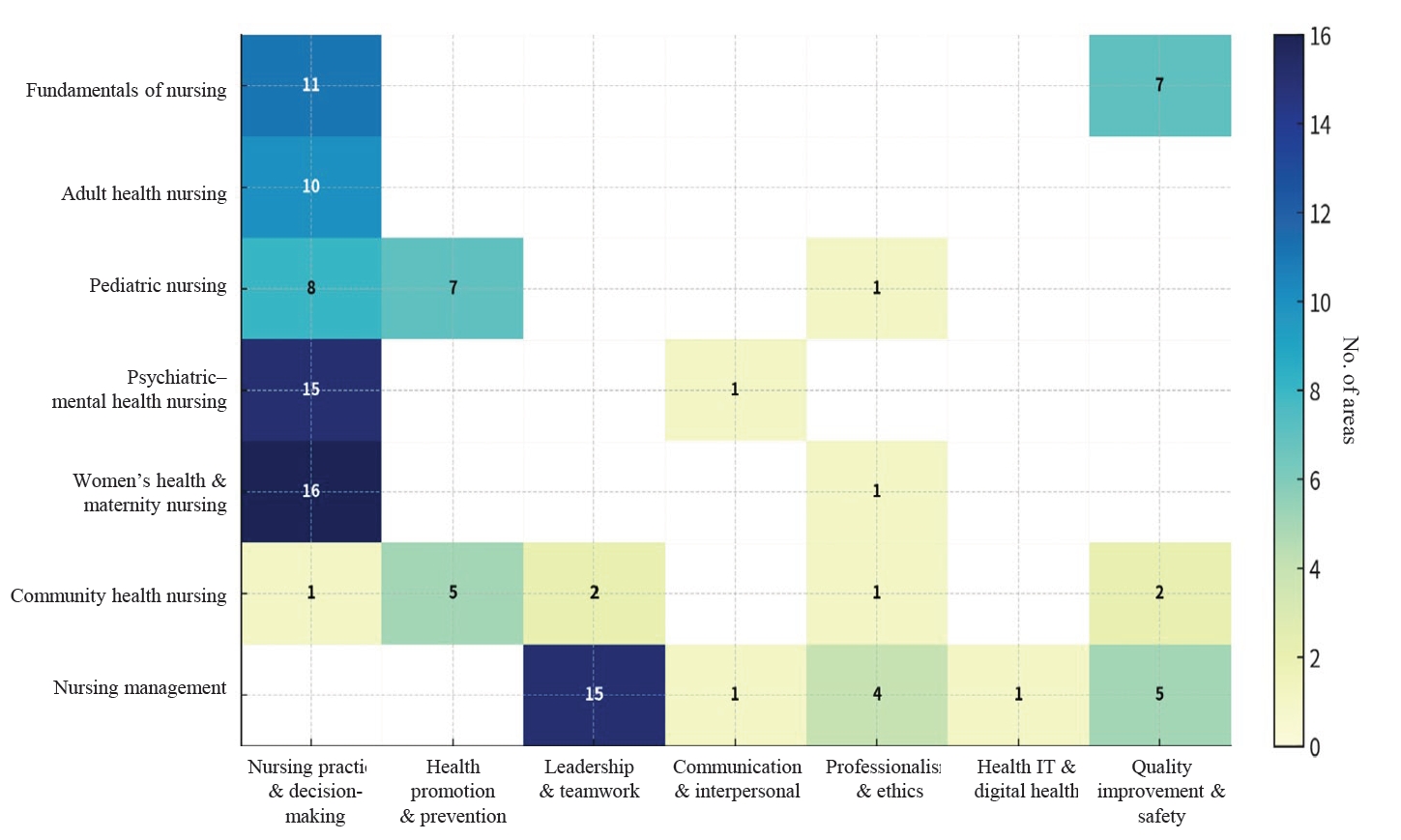
This study aimed to address the shift toward competency-based education and the planned 2028 “Integrated Nursing” National Licensing Examination (NLE), this study aimed to establish structural alignment among NLE domains, the seven integrated nursing competencies (INCs), and curriculum goals, with a particular focus on implementing symptom-based clinical reasoning (SBCR).
Methods
This Delphi-based methodological study included seven content experts for content validity index (CVI) assessment and 24 nursing education experts who participated in a consensus workshop. The item-level CVI and the scale-level CVI/average were calculated to confirm the linkage between INCs and NLE domains. In addition, qualitative analysis of workshop materials and meeting records was conducted to derive 10 integrated learning topics and to develop an SBCR educational model for the key symptom of headache, grounded in Miller’s Clinical Competence Pyramid (levels 2–4).
Results
The analysis confirmed the validity of integrating the INCs within the overall curriculum structure. The resulting framework delineates staged learning objectives and core clinical questions designed to systematically enhance clinical reasoning, promote safe nursing practice, and support professional reflection within a unified curriculum.
Conclusion
This study provides a practical foundation for nursing curriculum redesign by facilitating a transition from fragmented, subject-based instruction to a holistic, patient-centered SBCR model. This approach aligns with the requirements of the integrated NLE and is expected to contribute to meaningful improvements in actual clinical competency.
- 3,108 View
- 314 Download

- Effectiveness of a mobile application for tracking symptoms and enhancing symptom management among breast cancer patients receiving chemotherapy in Bangkok, Thailand: a non-randomized controlled trial
- Duangrat Kaveenuntachai, Supawan Jaiboon, Bualuang Sumdaengrit, Chureeporn Silaguntsuti, Arveewan Vittayatigonnasak, Pornchan Sailamai
- J Korean Acad Nurs 2025;55(2):178-190. Published online May 27, 2025
- DOI: https://doi.org/10.4040/jkan.25011
-
Abstract
PDFePub
- Purpose
This study evaluated the effectiveness of a mobile application in tracking symptoms and improving symptom management and quality of life (QoL) among breast cancer patients undergoing chemotherapy in Thailand.
Methods
A non-randomized controlled trial was used, with 25 participants in the intervention group and 25 in the control group. Research instruments included a demographic data form, the NCI-PRO-CTCAE Items-Thai-Thailand version 1.0, and the European Organization for Research and Treatment of Cancer Quality of Life Core Questionnaire and Breast Cancer-Specific Module.
Results
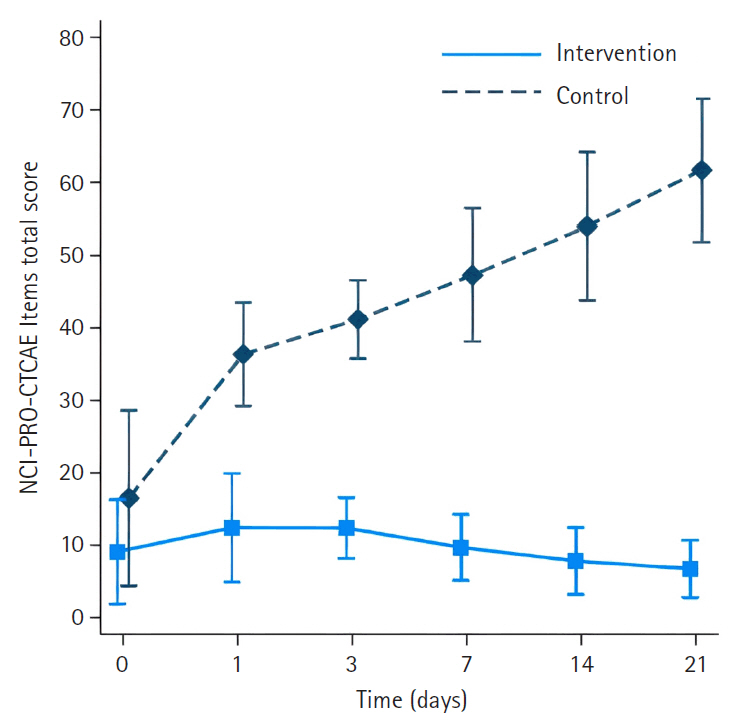
The intervention group had significantly less severe side effects than the control group, with mean differences of –23.33 (95% confidence interval [CI], –27.82 to –18.83) on day 1, –28.18 (95% CI, –33.22 to –23.14) on day 3, –34.63 (95% CI, –40.18 to –29.08) on day 7, –42.56 (95% CI, –48.72 to –36.40) on day 14, and –51.31 (95% CI, –58.13 to –44.48) on day 21 (p<.001 for all). On day 21, participants in the intervention group reported significantly higher scores in the Global Health QoL and Functional Scales compared to the control group (p<.001). Additionally, intervention group participants reported lower scores on the Symptom Scales and higher scores on the Functional Scales than those in the control group (p<.001).
Conclusion
The ChemoPro application helped manage chemotherapy-related symptoms and was associated with improved symptom monitoring and QoL. Nonetheless, the study was limited by a small sample size and restriction to Android users. Future research with larger and more diverse populations is recommended before broader implementation in clinical practice. -
Citations
Citations to this article as recorded by
- Effectiveness of a digital health intervention on the supportive care needs and quality of life in Mexican patients with breast cancer: a randomized clinical trial
Saúl Eduardo Contreras-Sánchez, Svetlana V. Doubova, Rocío Grajales-Álvarez, Ricardo Villalobos-Valencia, Abdel Karim Dip-Borunda, José Gustavo Nuñez-Cerrillo, Alma Diana Huerta-López, Álvaro José Montiel-Jarquín, Arturo García-Galicia, Enrique Isay Talam
BMC Cancer.2026;[Epub] CrossRef - Systematic review of patient-reported outcome item libraries in cancer research: an EORTC Quality of Life Group study
Rosemary Peacock, Christopher Bedding, Bonnie Pacheco, Hayat Hamzeh, Claire Piccinin, Alexandra Gilbert
JNCI: Journal of the National Cancer Institute.2026; 118(6): 971. CrossRef - Digital PRO collection methods during chemotherapy: A scoping review of tools, platforms, and psychometric properties
G. Hari Prakash, Tejaswini BD, Sony Sequeira, Mohammed Mujaheed Hussain, Anush Nayak
Measurement and Evaluations in Cancer Care.2026; 4: 100036. CrossRef - Response pathways and clinical workflow integration of digital symptom management platforms for breast cancer: A scoping review
Jing Yu, Shouze Jin, Yuening Liu, Rui Chen, Yuxin Liu, Hong Ji, Lijuan Wang
Asia-Pacific Journal of Oncology Nursing.2026; : 101029. CrossRef
- Effectiveness of a digital health intervention on the supportive care needs and quality of life in Mexican patients with breast cancer: a randomized clinical trial
- 6,239 View
- 333 Download
- 2 Web of Science
- 4 Crossref
- Formative versus reflective measurement models in nursing research: a secondary data analysis of a cross-sectional study in Korea
- Eun Seo Park, Young Il Cho, Hyo Jin Kim, YeoJin Im, Dong Hee Kim
- J Korean Acad Nurs 2025;55(1):107-118. Published online February 19, 2025
- DOI: https://doi.org/10.4040/jkan.24095
-
Abstract
PDFePub
- Purpose
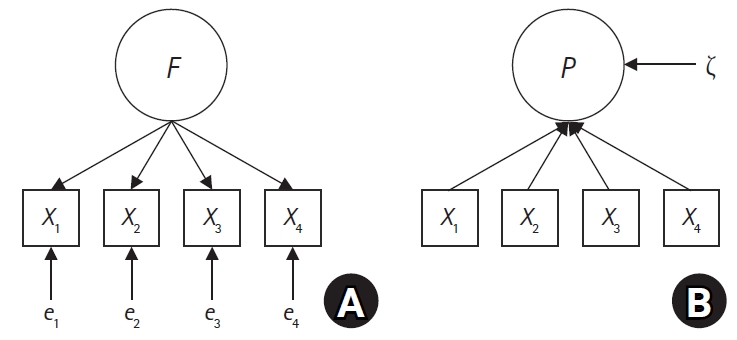
This study aimed to empirically verify the impact of measurement model selection on research outcomes and their interpretation through an analysis of children’s emotional and social problems measured by the Pediatric Symptom Checklist (PSC) using both reflective and formative measurement models. These models were represented by covariance-based structural equation modeling (CB-SEM) and partial least squares SEM (PLS-SEM), respectively.
Methods
This secondary data analysis evaluated children’s emotional and social problems as both reflective and formative constructs. Reflective models were analyzed using CB-SEM, while formative models were assessed using PLS-SEM. Comparisons between these two approaches were based on model fit and parameter estimates.
Results
In the CB-SEM analysis, which assumed a reflective measurement model, a model was not identified due to inadequate fit indices and a Heywood case, indicating improper model specification. In contrast, the PLS-SEM analysis, assuming a formative measurement model, demonstrated adequate reliability and validity with significant path coefficients, supporting the appropriateness of the formative model for the PSC.
Conclusion
The findings indicate that the PSC is more appropriately analyzed as a formative measurement model using PLS-SEM, rather than as a reflective model using CB-SEM. This study highlights the necessity of selecting an appropriate measurement model based on the theoretical and empirical characteristics of constructs in nursing research. Future research should ensure that the nature of measurement variables is accurately reflected in the choice of statistical models to improve the validity of research outcomes. -
Citations
Citations to this article as recorded by- The strategic role of proactivity and socioemotional wealth in family firm success
Felipe Hernández-Perlines, Luis Araya-Castillo, Mercedes Castro-Nuño
Journal of Innovation & Knowledge.2026; 18: 101097. CrossRef - What Makes the Structural Equation Model (SEM) Challenging? A Review of Methodological, Statistical, and Practical Challenges
Loso Judijanto, Sri Nurhayati
WSEAS TRANSACTIONS ON INFORMATION SCIENCE AND APPLICATIONS.2026; 23: 447. CrossRef
- The strategic role of proactivity and socioemotional wealth in family firm success
- 3,795 View
- 203 Download
- 1 Web of Science
- 2 Crossref
Review Paper
- Exploring Symptom Cluster Patterns in Adult Cancer Patients Undergoing Chemotherapy: A Systematic Review
- Pan Yang, Hui-juan Mei, Hao-yu Zhao, Rong-rong Wu, Yong-qin Ge, Yin Lu
- J Korean Acad Nurs 2024;54(4):478-494. Published online November 25, 2024
- DOI: https://doi.org/10.4040/jkan.24041
-
Abstract
PDF
 Supplementary MaterialePub
 Purpose This systematic review aimed to scrutinize the progression of symptom cluster research in adult cancer patients who received primary or adjuvant chemotherapy between 2001 and 2023, providing a comprehensive understanding of clinical practice and future research.
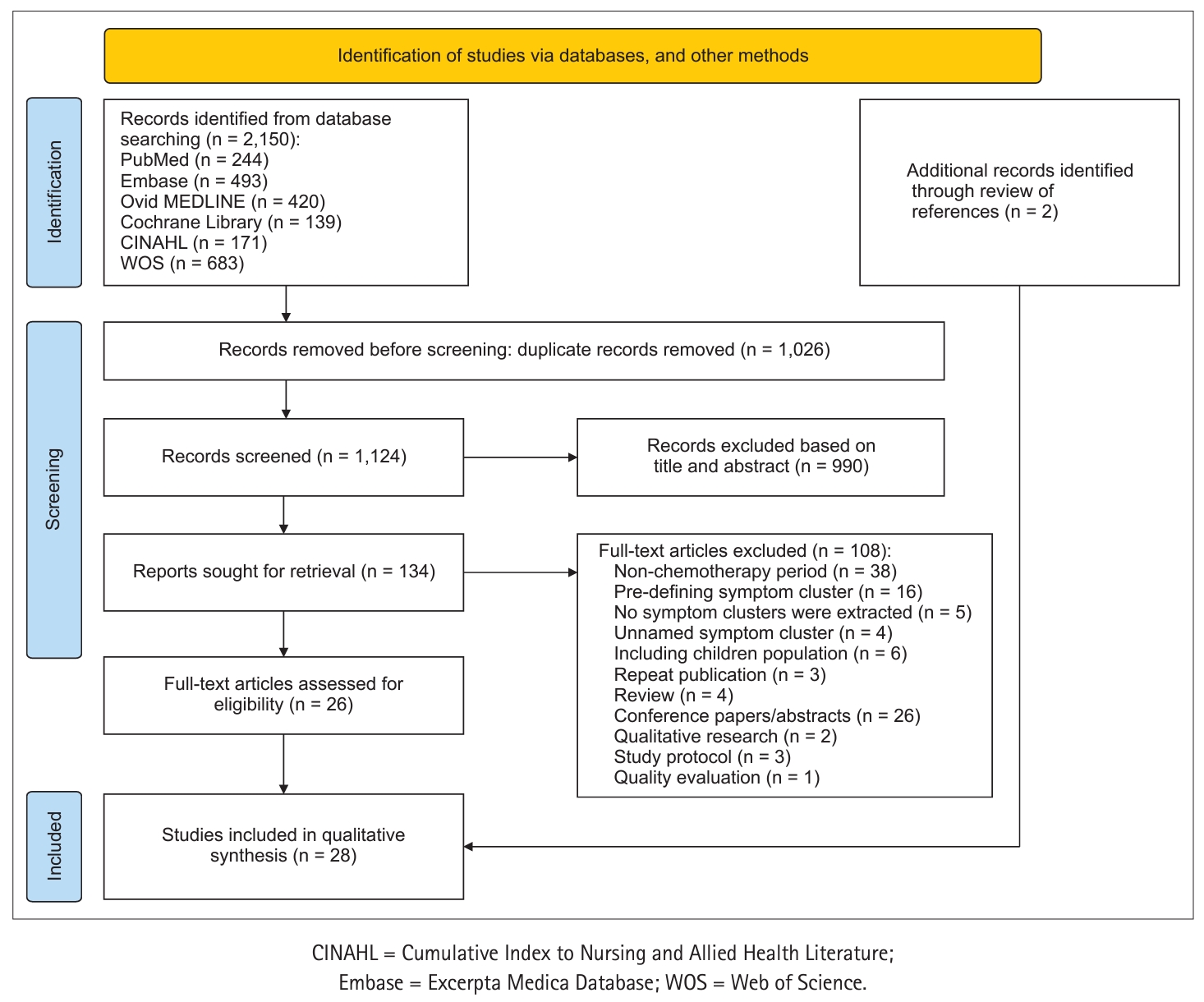
Methods PubMed, Ovid MEDLINE, Excerpta Medica Database, Cumulative Index to Nursing and Allied Health Literature, Cochrane Library, and Web of Science databases were searched for theme words and free words related to symptom clusters, cancer, and chemotherapy. Eligible studies were published between January 1, 2001, and May 30, 2023; adults who were diagnosed with cancer and received primary or adjuvant chemotherapy were evaluated.
Results Twenty-eight studies were included in this review. The Memorial Symptom Assessment Scale emerged as the predominant instrument and exploratory factor analysis was the most frequently employed statistical method to identify symptom clusters. Psychological, gastrointestinal, and physical image symptom clusters were the most commonly delineated. Furthermore, the temporal stability of the symptom clusters showed varying dynamics, with psychological symptom clusters displaying relative consistency over time.
Conclusion Interventions are needed for the most common and stable symptoms in patients with cancer undergoing chemotherapy. Future endeavors may necessitate more longitudinal studies to delve deeper into the temporal stability and dynamic variations of symptom clusters. Such investigations hold promise for advancing symptom cluster research, elucidating the underlying mechanisms, and fostering the development of targeted interventions, thereby enriching the symptom management paradigm in oncological care.
-
Citations
Citations to this article as recorded by- Network analysis used to investigate the symptoms of cancer patients during chemotherapy: a scoping review
Xiaodan Shao, Na Wang, Ke Tang, Kunning Wang, Zhangyan Tan, Jiangxiu Xie, Zhiwei Shen, Yuting Jiang, Yan Zhang
Discover Oncology.2025;[Epub] CrossRef - Symptom cluster in patients with resected pancreatic cancer during adjuvant chemotherapy: A cross-sectional study
Yun Wang, Ningning Xia, Yuan Song, Neng Shi, Kuei-Ching Pan
Asia-Pacific Journal of Oncology Nursing.2025; 12: 100810. CrossRef
- Network analysis used to investigate the symptoms of cancer patients during chemotherapy: a scoping review
- 4,349 View
- 190 Download
- 2 Web of Science
- 2 Crossref
Research Paper
- Effect of Virtual Reality Program for Alleviating Behavioral and Psychological Symptoms of Dementia Patients
- Seon-Min Park, Seung-Yi Choi, Jung-Hee Kim
- J Korean Acad Nurs 2022;52(2):121-133. Published online April 30, 2022
- DOI: https://doi.org/10.4040/jkan.22008
-
Abstract
PDF
- Purpose
This study examined the impact of a virtual reality intervention program based on psychological needs on behavioral and psychological symptoms, apathy, and quality of life (QOL) in patients with dementia or mild cognitive impairment living in nursing facilities.
Methods
This study is nonequivalent control group pretest-posttest design of quasi-experimental study. The study collected data from November 18, 2020 to July 24, 2021 from patients with dementia or mild cognitive impairment (30 in the experimental group and 30 in the control group) at three nursing facilities in G city using self-reporting and caregiver-informant reporting methods. The analysis employed the chi-square test, Fisher’s exact test, paired t-test, independent t-test, Wilcoxon signed rank test, Mann–Whitney U, repeated measures ANOVA, GEE, using SPSS/WIN 27.0.
Results
The severity of behavioral and psychological symptoms (Wald χ2 = 2.68, p = .102) and the care burden of caregivers (Wald χ2 = 1.72, p = .190) were not significant and was no significant time and group interaction effect (Wald χ2 = 0.63, p = .426, Wald χ2 = 0.52, p =. 471). The difference in apathy and QOL score were statistically significant for the group-time interaction (F = 43.65, p < .001; F = 4.35, p= .041).
Conclusion
The virtual reality intervention program of this study shows a positive effect on the apathy reduction and QOL of patients with dementia or mild cognitive impairment residing in nursing facilities. -
Citations
Citations to this article as recorded by- The effectiveness of nursing interventions for elderly dementia patients based on virtual reality technology: A systematic review and meta-analysis
Jun Wen, Hong Yan, Siyu Wang, Jialan Xu, Zitong Zhou
Ageing Research Reviews.2024; 93: 102135. CrossRef - Development of the “living well” concept for older people with dementia
Jiyoung Kim, Nayeon Shin
BMC Geriatrics.2023;[Epub] CrossRef
- The effectiveness of nursing interventions for elderly dementia patients based on virtual reality technology: A systematic review and meta-analysis
- 3,196 View
- 139 Download
- 3 Web of Science
- 2 Crossref
Original Articles
- Predictors of Behavioral and Psychological Symptoms of Dementia: Based on the Model of Multi-Dimensional Behavior
- Jeong Eun Yang, Gwi-Ryung Son Hong
- J Korean Acad Nurs 2018;48(2):143-153. Published online January 15, 2018
- DOI: https://doi.org/10.4040/jkan.2018.48.2.143
-
Abstract
PDF
Abstract Purpose The purpose of this study was to identify factors predicting behavioral and psychological symptoms of dementia (BPSD) in persons with dementia. Factors including the patient, caregiver, and environment based on the multi-dimensional behavioral model were tested.
Methods The subjects of the study were 139 pairs of persons with dementia and their caregivers selected from four geriatric long-term care facilities located in S city, G province, Korea. Data analysis included descriptive statistics, inverse normal transformations, Pearson correlation coefficients, Spearman's correlation coefficients and hierarchical multiple regression with the SPSS Statistics 22.0 for Windows program.
Results Mean score for BPSD was 40.16. Depression (β=.42,
p <.001), exposure to noise in the evening noise (β=-.20,p =.014), and gender (β=.17,p =.042) were factors predicting BPSD in long-term care facilities, which explained 25.2% of the variance in the model.Conclusion To decrease BPSD in persons with dementia, integrated nursing interventions should consider factors of the patient, caregiver, and environment.
-
Citations
Citations to this article as recorded by- The influence path of caregivers’ positive aspects, expressed emotion and coping style on behavioral and psychological symptoms of dementia
Shuang Zhang, Xiumei Ying, Shuyan Fang, Wenxia Wang, Xiangning Zhu, Yueyang Dong, Meng He, An Chang, Jiao Sun
Geriatric Nursing.2022; 44: 143. CrossRef
- The influence path of caregivers’ positive aspects, expressed emotion and coping style on behavioral and psychological symptoms of dementia
- 1,943 View
- 14 Download
- 1 Crossref
- Effect of an Integrated Stress Management program on the Stress Symptoms on the Stress Symptoms, Progressive Muscle Relaxation Method
- Kuem Sun Han
- Journal of Nurses Academic Society 1997;27(2):289-302. Published online March 30, 2017
- DOI: https://doi.org/10.4040/jnas.1997.27.2.289
-
Abstract
PDF
The main purpose of this study was to identify the effects of integrated stress management program on the stress symptoms of psychophysiological patients, especially patients with peptic ulcer. The study employed a quasi -experimental design using two different experiential groups. The samples in the integrated stress management program participated in autogenic training with biofeedback, discussions on effective coping method, cognitive, behavioral, and emotional management. They were also provided with an educational booklet on stress management and an tape on progressive muscle relaxation. Exch session lasted one hour and the program consisted of seven sessions over four weeks. The other group was only given an tape on progressive muscle relaxation. The data were collected from May 20 to september 25, 1996 A total 47 patients from ore university hospital located in Seoul participated, experiment group 1 (integrated stress management training) had 23 subjects and experiment group 2(progressive muscle relaxation training) had 24 subjects. The effects of these programs were measured by the stress symptom scale developed by Kogan(1991) which was translated by Lee(1892) and the healing status of the ulcer evaluated by a physician The data were analyzed using Chi-square test, t-test, ANOVA, repeated measure ANOVA. The result are as follows : 1. The integrated stress management group reported a significantly lower stress symptom score than the group given the progressive muscle relaxation only. 2. The integrated stress management group showed a significantly improved ulcer status as compared to the group given a progressive muscle relaxation only. In conclusion, it was found that the integrated stress management program was more effective in decreasing self-reported stress and physiological symptoms among patients with peptic ulcer as compared to the progressive muscle relaxation group. Based on this finding, the following suggestions can be made. 1. It is necessary to broaden the scope of nursing Practice for psychophysiological patients so nurses can include stress management as part of Patient care. 2. It is necessary to develop stress management Program for other patients whose symptoms are know to be related to stress. 3. It is necessary to replicated this study with a larger sample in different settings.
- 828 View
- 4 Download
- Urinary Mutagenicity, Physical Symptoms and Stress of Nurses Handling Anticancer Drugs
- Bong Im Kim
- Journal of Nurses Academic Society 1996;26(4):963-975. Published online March 30, 2017
- DOI: https://doi.org/10.4040/jnas.1996.26.4.963
-
Abstract
PDF
The purpose of this study was to call attention to the mental, physical and occupational hazards of the anticancer-drug-handling nurses by examining the possible urinary mutagenicity and measuring physical symptoms and stress level of the nurses exposed to anticancer drugs. The experimental group of the urinary mutagenicity assay was 14 nurses handling anticancer drugs at the medical wards of a hospital located in J city; the control group was 12 psychiatric nurses of the same hospital. The test material was the nurses' 24hrs urine, which was concentrated by XAD-2 column chromatography. Tester strains were TA98( +/- S9 mix), TA100( +/- S9 mix), TA1535( +/- S9 mix) and TA1537( +/- S9 mix); Salmonella mammalian-microsomal test (Ames test) was employed for the urinary mutagenicity assay. The physical symptoms of which the nurses experienced were investigated through self-reports on open-questionnaires. The stress levels of the experimental group were measured by a stress measuring instrument developed by this author. Reliability of this instrument was found to be adequate (Cronbach's Alpha=0.9079). To ascertain the urinary mutagenicity of the experimental group, the mean and the standard deviation of the colonies of Tester strains appearing on the minimal plates were taken and compared differences between two groups. T-test was employed for the significance test of two groups. The physical symptoms were compared between the two groups through the analysis of the nurse' self-reports. The mean and standard deviation of the stress levels of the experimental group were also calculated and were examined through t-test. The results were summarized as follows: 1. The experimental group revealed significantly higher urinary mutagenicity both in the activation method test and the non-activation method test of the tester strains TA98, TA100 and TA1535. In the case of TA1537, two groups showed no difference in the non-activation method test, but the activation method revealed difference. 2. The physical symptoms were also much more frequently reported in the experimental group. 79. 3% of the experimental group reported more than 1 kind of physical symptoms. On the other hand, 33.2% of the control group complained of 1 kind of physical symptom. The items with high symptom frequency were 'headache', 'itching sensation', 'corneal congestion', 'skin allergy'. 3. The mean score of stress in the experimental group was 2.41(range 1-4). The experimental group showed the stress level above 2.0 in the 14 of 15 items in all. The highest stress level were recorded in the following items in the order quoted, 'I fear that anticancer drug may touch any part of body while handling it.', 'I feel concerned there is no protective countermeasure against anticancer drug handling.', 'I am afraid the anticancer drug handling may produce a fetal loss in the future'.
-
Citations
Citations to this article as recorded by- Knowledge and safe handling practices affecting the occupational exposure of nurses and midwives to hazardous drugs: A mixed methods systematic review
Pheona van Huizen, Philip L. Russo, Elizabeth Manias, Lisa Kuhn, Clifford J. Connell
International Journal of Nursing Studies.2024; 160: 104907. CrossRef - Effects of safe handling education on cognition, compliance and stress handling of antineoplastic drugs in clinical nurses
Eun‐Mi Jun, Se‐Won Kang
Nursing Open.2023; 10(6): 4144. CrossRef - Nurses’ Compliance with Safety Guidelines for the Use of Antineoplastic Agents, Observable Symptoms, and Stress from Occupational Exposure
Seon-Ja Park, Hyun-Ju Kim
Journal of Korean Academy of Fundamentals of Nursing.2018; 25(4): 293. CrossRef
- Knowledge and safe handling practices affecting the occupational exposure of nurses and midwives to hazardous drugs: A mixed methods systematic review
- 1,181 View
- 5 Download
- 3 Crossref
- Responses to Symptoms of Acute Myocardial Infarction: Reasons for Delay and Bystanders' Role
- Debra K Moser, Kyungeh An
- Journal of Korean Academy of Nursing 2002;32(7):1063-1071. Published online March 29, 2017
- DOI: https://doi.org/10.4040/jkan.2002.32.7.1063
-
Abstract
PDF
SIGNIFICANCE OF THE STUDY: Acute myocardial infarction (AMI) is a major cause of death in Korea. Delay in seeking treatment may cause unnecessary exacerbation of the disease and early mortality from AMI. Patients' recognition of symptoms of an AMI and response to those symptoms may influence the delay time. Bystanders' role in patients' seeking treatment after AMI has not been studied in previous research. Understanding reasons for delay in seeking treatment is important in developing interventions for reducing these delays and increasing survival rate from AMI. PURPOSE OF THE STUDY: A retrospective survey was conducted with 144 AMI patients to: (1) investigate time from symptom onset to arrival at the first hospital for treatment of AMI; (2) describe patient's and bystander's response to the patient's symptoms; (3)examine whether patient's and bystander's responses affect delay time.
RESULTS
The mean of overall pre-hospital delay time was 13.64 (21.86) hours and it consisted of patients' delay of 13.64 (22.32) hours and transportation time of 24.86 (19.41) minutes. People living in rural area delayed longer than people living in urban area. Pre-hospital delay time was associated with the bystander: patients delayed longer when they were with their spouse, family and friends than when with colleagues at work. Calling 119 saved transportation time, but did not reduce overall pre-hospital delay time.
CONCLUSION
AND SUGGESTIONS: Patients delay longer than the time window for a successful reperfusion therapy when they experience symptoms of AMI; and calling 119 does not diminish this delay. Bystanders' adequate response to the patients' symptom may reduce the delay time in seeking treatment. Findings from this study may suggest that health education and public campaigns are needed to increase people's recognition of symptoms of an AMI and to promote adequate response from bystanders to the AMI symptoms. In addition, public campaigns urging car operators to yield to the emergency vehicle are needed in order to reduce transportation time.-
Citations
Citations to this article as recorded by- Comparison of Clinical Manifestations and Treatment-Seeking Behavior in Younger and Older Patients with First-time Acute Coronary Syndrome
Seon Young Hwang
Journal of Korean Academy of Nursing.2009; 39(6): 888. CrossRef
- Comparison of Clinical Manifestations and Treatment-Seeking Behavior in Younger and Older Patients with First-time Acute Coronary Syndrome
- 1,316 View
- 1 Download
- 1 Crossref
- Effectiveness of Indoor Environment Management Education for Prevention of Allergic Asthma
- Jee Won Park, Yong Soon Kim, Young Shin Song
- Journal of Korean Academy of Nursing 2002;32(7):1017-1023. Published online March 29, 2017
- DOI: https://doi.org/10.4040/jkan.2002.32.7.1017
-
Abstract
PDF
PURPOSE: The objective of this research is to provide the indoor environment management education program for the asthma patients and their families and then analyze the effectiveness in education preventing allergic asthma.
METHODS
A pre-post single group quasi-experimental design was used to provide an education program about correct indoor environment management to a total of 58 households (29 patient households and 29 normal households). The performance rate of correct indoor environment management procedure, amount of house dust mite antigen, allergy subjective symptoms score and knowledge score about indoor environment management were compared before and after the education to test the effectiveness of the education.
RESULTS
Home-visit education in this research had effects in improving subject households' performance rate of indoor environment management procedures, reducing the amount of house dust mite antigen - an important inducing factor of allergy, and reducing perceived subjective symptoms of allergy.
- 902 View
- 0 Download
- Pre-hospital Delay in Treatment after Acute Myocardial Infarction
- Kyungeh An
- Journal of Korean Academy of Nursing 2001;31(7):1141-1150. Published online March 29, 2017
- DOI: https://doi.org/10.4040/jkan.2001.31.7.1141
-
Abstract
PDF
SIGNIFICANCE OF THE STUDY: Acute myocardial infarction (AMI) is a major cause of death. Most of the deaths from AMI, if diagnosed and treated early enough, can be prevented. Delay in treatment may cause unnecessary exacerbation of the disease and even death in AMI patients. PURPOSE OF THE STUDY: A retrospective survey was conducted to (1) investigate the delay time in AMI patients' seeking treatment from symptom onset to arrival at the first hospital (overall pre-hospital delay), the length of time taken for decision-making (patients' delay) and transport (transportation time); (2) to identify factors associated with delay times; (3) to compare delay times between the group who called 119 and the group who did not.
RESULTS
The mean of overall pre-hospital delay time was 17.42 (+/-24.03) hours and it was consisted of patients' delay, 17.07(+/-24.45), and transportation time, .84 (+/-2.34). None of socio-demographic variables such as age, sex, marital status, monthly income, education, and living environment was associated with either the patients' delay or the overall delay time. Living rural area (F=4.483, p=.016), having previous MI (F=35.252, p=.000), and other heart disease (F=69.435, p=.000) decreased transportation time; having previous heart disease decreased overall pre-hospital delay(F=4.489, p=.039); and having angina (F=92.907, p=.000) and CAD (F=9.724, p=.003) increased transportation time. Place of symptom attack, bystander, whether patients or bystander called 119, modes of transportation, intensity of pain, presence of typical chest pain and anxiety perceived by patients were not associated with any of delay times. No significant differences appeared between the group who called 119 and the group who did not in any of delay times.
CONCLUSION
AND SUGGESTIONS: Although number of patients who arrive at the hospital early enough for treatment tend to be increasing, considerable number of patients still delayed longer than desired when they experienced symptoms of AMI, and calling 119 did not diminish this delay because patients delayed mostly before they decided to call. Living urban area, having previous MI, and heart disease decreased transportation time whereas having previous heart disease decreased the overall pre-hospital delay time and having previous angina and CAD increased transportation time. Further studies to identify reasons for real late arrivals as well as public campaigns to reduce delay time in treatment are needed.-
Citations
Citations to this article as recorded by- Delay in seeking health care from community residents during a time with low prevalence of COVID-19: A cross-sectional national survey in China
Ziyu Wang, Yurong Tang, Yu Cui, Hanwen Guan, Xiaoqian Cui, Yuan Liu, Yanni Liu, Zheng Kang, Qunhong Wu, Yanhua Hao, Chaojie Liu
Frontiers in Public Health.2023;[Epub] CrossRef - Hospital Arrival Rate within Golden Time and Factors Influencing Prehospital Delays among Patients with Acute Myocardial Infarction
Hye Mi Ahn, Hyeongsu Kim, Kun Sei Lee, Jung Hyun Lee, Hyo Seon Jeong, Soung Hoon Chang, Kyeong Ryong Lee, Sung Hea Kim, Eun Young Shin
Journal of Korean Academy of Nursing.2016; 46(6): 804. CrossRef - Morbidity and mortality rates in women with heart disease: Lessons in gender differences from Korea
Myoung-Ae Choe, Kyungeh An
Contemporary Nurse.2003; 14(2): 158. CrossRef
- Delay in seeking health care from community residents during a time with low prevalence of COVID-19: A cross-sectional national survey in China
- 1,407 View
- 1 Download
- 3 Crossref
- A Comparative Study on Climacteric Symptoms of Natural Menopausal Women and Artificial Menopausal Women
- Hyun Sook Jo, Kun Ja Lee
- Journal of Korean Academy of Nursing 2001;31(4):692-702. Published online March 29, 2017
- DOI: https://doi.org/10.4040/jkan.2001.31.4.692
-
Abstract
PDF
PURPOSE: To extend the understanding on climacteric symptoms, and to improve women's health and the quality of life by providing the basic data relating to the climacteric symptoms of natural menopausal women and artificial menopausal women.
METHOD
The subjects of this study were 149 women selected conviniently (89 natural menopausal women and 60 total hystrectomy women) who have visited the climacteric clinic of G. hospital in Inchon, the MENSI questionnaire which was developed by Sarrel (1995)was modified considering Korean culture for the measuring tool of this study with 20 items of question(Cronbach'salpa =.76), duration of data collection with the questionnaire was 5 months from Sept. 1, 2000 to Jan. 30, 2001.
Result
Artificial meanopausal women showed statistically significant higher menopausal symptoms than the natural menopausal women in the most of the items, and psychiatric and urogenital symtoms of artificial menopausal women were significantly higher than those of the natural menopausal women.
CONCLUSION
Nursing intervention for psychological support upon artificial menopausal women and their spouses is recommended more than natural menpause women.-
Citations
Citations to this article as recorded by- Factors influencing quality of life in post-menopausal women
Hyunsook Shin, Eunjoo Lee
Korean Journal of Women Health Nursing.2020; 26(4): 336. CrossRef - Regular Leisure-Time Physical Activity is Effective in Boosting Neurotrophic Factors and Alleviating Menopause Symptoms
Boram Kim, Sunghwun Kang
International Journal of Environmental Research and Public Health.2020; 17(22): 8624. CrossRef - Effects of an Aging Management Program for Middle-aged Women on Resilience and Successful Aging
Hyeyun Jung, Kyung Mi Sung
Korean Journal of Women Health Nursing.2019; 25(4): 392. CrossRef - Factors Influencing Adaptation to Menopause in Middle-aged Women
Eun Joo Lee
Korean Journal of Women Health Nursing.2018; 24(4): 336. CrossRef - The Effect of Emotional Freedom Technique(EFT) as Forest Therapy Program on the Menopause Symptoms and the Quality of Life of the Middle - aged Women
김홍규, 구창덕, 연평식, 이연희
The Journal of Korean institute of Forest Recreation.2016; 20(3): 83. CrossRef - Effect of Light Therapy on Sleep Disturbance and Depression in Climacteric Women
Yun Ah Kim, Mi Hae Sung
Korean Journal of Women Health Nursing.2015; 21(3): 197. CrossRef - Impact of Climacteric Symptoms and Fatigue on the Quality of Life in Breast Cancer Survivors: The Mediating Effect of Cognitive Dysfunction
Gyung Duck Kim
Asian Oncology Nursing.2014; 14(2): 58. CrossRef - The Mediating Effect of Cognitive Function on Climacteric Symptoms and Quality of Life in the Middle-aged Women
Jeong-Hwa Lee, Kyung-Hae Kim, Gyung-Duck Kim
Journal of the Korea Academia-Industrial cooperation Society.2014; 15(7): 4439. CrossRef - Comparison of Climacteric Symptoms and Cognitive Impairment in Breast Cancer Survivors and Healthy Women
Gyung Duck Kim, Bok Yae Chung, Kyung Hae Kim, Hye Sun Byun, Eun Hee Choi
Asian Oncology Nursing.2013; 13(1): 11. CrossRef - Factors Influencing Self-Identity and Menopausal Symptoms on Level of Depression in Middle Aged Women
Mi-Jeong Han, Ji-Hyun Lee
Korean Journal of Women Health Nursing.2013; 19(4): 275. CrossRef
- Factors influencing quality of life in post-menopausal women
- 1,405 View
- 23 Download
- 10 Crossref
- Analysis and Evaluation of the Theory of Unpleasant Symptoms
- Eun Hyun Lee
- Journal of Korean Academy of Nursing 2000;30(7):1627-1635. Published online March 29, 2017
- DOI: https://doi.org/10.4040/jkan.2000.30.7.1627
-
Abstract
PDF
The theory of unpleasant symptoms is a middle-range theory proposed by Lenz and her colleagues (1997). Analysis and evaluation of this theory was performed using Fawcett (1999) and Fawcett and Downs's (1992) guidelines. Results of the theory analysis and evaluation suggest that the theory of unpleasant symptoms has theoretical and social significance and parsimony. However, a lack of internal consistency was evident. For empirical adequacy of the theory, it is recommended that research be conducted examining the complexities of the interaction effects, reciprocal relationships, and medication effects among physiological, psychologic, and situational factors, symptoms, and performance. The knowledge derived from the research findings should be used in practice for patients experiencing symptoms.
-
Citations
Citations to this article as recorded by- An Analysis and Evaluation of the Theory of Unpleasant Symptoms
Seung Eun Lee, Catherine Vincent, Lorna Finnegan
Advances in Nursing Science.2017; 40(1): E16. CrossRef - Relationships of mood disturbance and social support to symptom experience in Korean women with breast cancer
Eun-Hyun Lee, Bok Yae Chung, Hee Boog Park, Ki Hong Chun
Journal of Pain and Symptom Management.2004; 27(5): 425. CrossRef
- An Analysis and Evaluation of the Theory of Unpleasant Symptoms
- 2,114 View
- 71 Download
- 2 Crossref
- Influencing Factors on Symptoms of Stress of Middle Aged Women
- Kuem Sun Han, Pyoung Sook Lee, Yong Mi Lee
- Journal of Korean Academy of Nursing 2000;30(6):1427-1436. Published online March 29, 2017
- DOI: https://doi.org/10.4040/jkan.2000.30.6.1427
-
Abstract
PDF
The purpose of this study was to identify the influencing factor on Symptoms of Stress of Middle Aged Women. The subjects of this study were 35 middle aged women who lives in Seattle, Washington in U.S, and 74 middle aged women who lives in Seoul. Data collection was performed at the University of Washington and Seoul from Oct. 1998 to May. 1999. Data collected through 4 types of questionnaires : SOS, Ways of Coping, Mood Status, Perceived Stress. The results of this study are as follows: 1. The stress symptoms showed positive correlation with emotion-oriented coping, mood status, and perceives stress. 2. Stepwised multiple regression analysis revealed that most powerful predictor of Stress Symptoms was mood status. A combination of perceived stress, mood status and ways of coping account for 64% of the variance in Symptoms of stress in Middle aged women. From the results of the study, the following recommendations are presented as follow: 1. It is necessary to replicate this study with a larger sample. 2. It is necessary to develop a stress management program focused on ways of coping, mood status, perceived stress for middle aged women.
-
Citations
Citations to this article as recorded by- Menopausal stage transitions and associations with overall and domain-specific perceived stress in middle-aged Korean women
Yoonyoung Jang, Yoosoo Chang, Sang Won Jeon, Junhee Park, Byungtae Seo, Jeonggyu Kang, Ria Kwon, Ga-young Lim, Kye-Hyun Kim, Hoon Kim, Yun Soo Hong, Jihwan Park, Di Zhao, Juhee Cho, Eliseo Guallar, Seungho Ryu
Maturitas.2025; 200: 108660. CrossRef - The relationship between psychological distress, depressive symptoms, emotional eating behaviors and the health-related quality of life of middle-aged korean females: a serial mediation model
Jihyun Oh, Sunghee Kim
BMC Nursing.2023;[Epub] CrossRef - Effects of Forest Therapy on Health Promotion among Middle-Aged Women: Focusing on Physiological Indicators
Bum-Jin Park, Chang-Seob Shin, Won-Sop Shin, Chung-Yeub Chung, Si-Hyung Lee, Dong-Jun Kim, Youn-Hee Kim, Chang-Eun Park
International Journal of Environmental Research and Public Health.2020; 17(12): 4348. CrossRef - The Effect of walking exercise on the improvement of housewives' Self-esteem, Stress, Depression in terms of convergence
Hae-Mi Kim
Journal of Digital Convergence.2015; 13(12): 453. CrossRef - Development of the Perceived Stress Inventory: A New Questionnaire for Korean Population Surveys
Eon Sook Lee, Ho Cheol Shin, Jun Hyung Lee, Yun Jun Yang, Jung Jin Cho, Gwiyeoroo Ahn, Yeong Sook Yoon, Eunju Sung
Korean Journal of Family Medicine.2015; 36(6): 286. CrossRef - Study of on Academic Stress Responses According to Sasang Constitutions of Oriental Medicine College Students
Jun-Yong Chang, Kyoung-Shin Kim, Byoung-Soo Kim
Journal of Oriental Neuropsychiatry.2012; 23(3): 77. CrossRef
- Menopausal stage transitions and associations with overall and domain-specific perceived stress in middle-aged Korean women
- 1,392 View
- 2 Download
- 6 Crossref
- A Survey on the Delay Time Before Seeking Treatment and Clinical Symptoms in Patients with Acute Myocardial Infarction
- Oh Jang Park, Cho Ja Kim, Hyang Yeon Lee, Hae Ok Lee
- Journal of Korean Academy of Nursing 2000;30(3):659-669. Published online March 29, 2017
- DOI: https://doi.org/10.4040/jkan.2000.30.3.659
-
Abstract
PDF
Many patients of acute myocardial infarction showed delay time before seeking treatment although they needed immediate thrombolytic therapy once they perceived their symptoms. The objectives of this study were to identify the relationship between clinical symptoms and the delay, and to find the time spent before seeking the treatment. This study was a retrospective research. The delay time for the treatment consisted of the length of delay from symptom onset to patients' decision (T1), from patients' decision making to finding transportation (T2), and from taking transportation to the first hospital arrival(T3). The subjects were 89 patients who were admitted in the ICU and Cardiac Ward at Chonnam University Hospital with the first attack of acute myocardial infarction. The data was collected for three months from March 1st to May 31st of 1998 through questionnaires and reviewing patients' charts: The chart information was suppled by two nurses working at the ICU and Cardiac Ward. The data was analyzed by using frequency, mean and ANOVA through the SAS program. The results of study summarized as follows: 1. Sixty two patients (69.7%) were male and twenty seven patients (30.3%) were female, the ratio of male to female was 2.3 : 1. 2. In daily life, the 70.8% of the patients felt chest pain and discomfort fatigue in 67.4%, dyspnea in 57.3%, and pain in arm, neck, and jaw in 52.8%. During the attack, 97.8% of the patients felt chest pain and discomfort dyspnea in 82.1%, pain in arm, neck, jaw in 67.4% and perspiration in 51.7%. 3. The length of time a patient spent seeking time for treatment (T1+T2+T3) was 94.6 minutes, in which the time for patients' decision making for treatment (T1) was 70.3 minutes, time for finding transportation (T2) was 8.2 minutes, and time for the transportation of the patient to the first hospital (T3) was 16.1 minutes. Time for patients' decision making to go to a hospital(T1) was 74.2% of the total time sought for treatment.
-
Citations
Citations to this article as recorded by- Decision Tree Model of the Treatment-Seeking Behaviors Among Korean Cancer Patients
Hyo-Sook Oh, Hyeoun-Ae Park
Cancer Nursing.2004; 27(4): 259. CrossRef
- Decision Tree Model of the Treatment-Seeking Behaviors Among Korean Cancer Patients
- 1,321 View
- 2 Download
- 1 Crossref
- A study of Stress Reaction, Symptoms of Stress, Health Promoting Behavior, and Quality of Life in Korean Immigrant Middle Aged Women
- Kuem Sun Han
- Journal of Korean Academy of Nursing 2000;30(3):606-618. Published online March 29, 2017
- DOI: https://doi.org/10.4040/jkan.2000.30.3.606
-
Abstract
PDF
The purpose of this study was to identify the level of Symptoms of Stress, Stress Reaction, Health Promoting Behavior, and Quality of Life in Korean Immigrant Middle Aged Women. The subjects of this study were 33 middle aged women who live in Seattle, Washington, U.S.A. Data collection was performed at the U.W from Oct. 1998 to May. 1999. Data collection time was one hour and data was collected through 4 types of questionnaires : SOS, Health Promoting Behaviors, Quality of Life and Demographic data form, and the Physiologic Stress Profile was collected by J&J I-410 biofeedback equipment. The data was analyzed by descriptive statistics and the pearson correlation coefficient using the SAS program. The results of this study are as follows: 1. The level of physiological stress reaction and stress symptoms showed high level and quality of life showed low in general. 2. The Stress Reaction and Symptoms of Stress showed significant negative correlation with health promoting behavior, quality of life in the middle aged women. 3. The health promoting behavior showed significant positive correlation with quality of life in the middle aged women. In conclusion, the physiological stress reaction, symptoms of stress, and health promoting behavior were major influencing factor to quality of life in Korean Immigrant Women. From the results of the study, the following recommendations are presented as follow: 1. It is suggested that the study for developing the health promotion program focused on stress self-regulation for Korean immigrant women. 2. It is suggested that the comparative study for Korean immigrant women and Women in Korea. 3. It is necessary to broaden the scope of nursing practice for middle aged healthy women, so nurses can include a health promotion program focused on stress self-regulating as part of nursing care.
-
Citations
Citations to this article as recorded by- The Association between Spouse Characteristics and Depression Symptoms Among Women whose Children are Married and Independent
Yu-Rim Jeong, Seong-Hwa Jeong, Sam-Sung Han
Journal of Health Informatics and Statistics.2026; 51(3): 138. CrossRef - Bio-social determinants of health-related quality of life of middle aged (45–59 years) population in India
Aarti Nagarkar, Snehal Kulkarni, Rashmi Gadkari
Post Reproductive Health.2020; 26(1): 19. CrossRef - Predictors of Health-Related Quality of Life Among Low-Income Midlife Women
Ok Kyung Ham
Western Journal of Nursing Research.2011; 33(1): 63. CrossRef - A study on the Health Status, Social Support and Acculturative Stress of Filipino Marriage-Migrant Women
Ae-Hwa Jaung, Hye-Jin Kim, Hyun-Ja Jeong
Journal of the Korea Academia-Industrial cooperation Society.2011; 12(12): 5509. CrossRef - Comparison of Health Locus of Control, Depression, Wellbeing, and Health Promoting Lifestyle Profile II in Middle Aged Korean and Korean-American Women
Eun Hee Lee, Ae Young So, Kyung Sook Lee
Korean Journal of Women Health Nursing.2010; 16(2): 157. CrossRef - Health Behavioral Patterns Associated with Psychologic Distress Among Middle-Aged Korean Women
Hye-Sook Shin, Jia Lee, Kyung-Hee Lee, Young-A Song
Asian Nursing Research.2007; 1(1): 61. CrossRef
- The Association between Spouse Characteristics and Depression Symptoms Among Women whose Children are Married and Independent
- 1,238 View
- 2 Download
- 6 Crossref
- A Comparative Study on Complaints of Menopausal Symptom of Nuns and Married Women
- Myung Sook Yoo
- Journal of Korean Academy of Nursing 2000;30(1):18-28. Published online March 29, 2017
- DOI: https://doi.org/10.4040/jkan.2000.30.1.18
-
Abstract
PDF
The Purpose of this study is to extend the understanding and knowledge of menopause by comparing menopausal symptoms of married women and nuns in order to improve health and the quality of life for women. In this study a questionnaires were distributed to 116 nuns and 121 married women, from forty to fifty nine years old in Daegu metropolitan city. This study used the measurement of menopausal symptoms (Cronbach's Alpha=0.96) corrected and complemented by this student with consideration of various literature centered around menopausal symptoms, suggested by Janette M. Perz as 51 questions including 4 realms; [mental psychological factors], [physical physiological factors], [eyesight factors], and [urinary generative factors] in order to measure the degree of menopausal symptoms. The results are as follows : 1. There was a significant difference between educational background, religion, occupation, leisure time, satisfaction of marriage or ascetic life, existence of hormonal treatment, name of medical operation, and existence of counselling about menstruation as general and physiological characteristics of the nuns' group and the married women's group. 2. The menopausal symptoms of the nuns' group and the married women's group according to order in which they were presented were; 'feeling tired and lacking in energy(1.71 points)' 'vision not clear or clouded(1.69 points)', and 'be forgetful (1.57 points)' in nuns' group. 'be forgetful (1.87 points)', 'vision not clear or clouded(1.83 points)' and 'feeling tired and lacking in energy(1.76 points)' in the married women's group. The symptoms which showed the highest rank of menopausal symptoms had a maximum score of 4 points. 3. There was a statistical a significance (t=-3.9807, p<.0001) between the two groups which showed, on an average, 57.92 points in the married women's group and 43.03 points in the nuns' group from 0 to 196 of the possible points of menopausal symptoms. In difference of menopausal symptoms by menstrual aspect of the nuns' group and the married women's group, there was statistically significant difference between the two groups, showing 44.81+/- 26.07 score in the nuns' group and 72.33+/-35.29 score in the married women's group as the mean score of the groups with no menstruation(t=-4.1132, p=0.0001). 4. The differences in menopausal symptoms with respect to the general and physiological characteristics of the nuns' group and the married women's group were that the nuns' group showed less menopausal symptoms on all the items than that of the married women's group. Finally, in these results, the married women's group showed higher menopausal symptoms than that of the nuns' group. Especially as the score of menopausal symptoms since the climacteric was very high it is confirmed to be a new phenomenon. Accordingly, it is considered to be necessary to carry out an indepth study of the factors related to establishing a strategy for nursing service.
-
Citations
Citations to this article as recorded by- The Mediating Effect of Cognitive Function on Climacteric Symptoms and Quality of Life in the Middle-aged Women
Jeong-Hwa Lee, Kyung-Hae Kim, Gyung-Duck Kim
Journal of the Korea Academia-Industrial cooperation Society.2014; 15(7): 4439. CrossRef - The Factors Related to the Menopausal Symptoms of Married Middle-Aged Women: Focus on the Effects of Attitudes toward Menopause and Family Related Variables
Eunkyung Kim, Kyung-Hae Lee
Korean Journal of Human Ecology.2012; 21(6): 1043. CrossRef - Women Religious and Married Women's Attitudes toward Menopause and Menopausal Symptoms
Myung-Sook Yoo
Korean Journal of Women Health Nursing.2010; 16(2): 186. CrossRef - Effects of Self-Foot Reflexology on Stress, Fatigue and Blood Circulation in Premenopausal Middle-Aged Women
Soo Hyun Jang, Kye Ha Kim
Journal of Korean Academy of Nursing.2009; 39(5): 662. CrossRef
- The Mediating Effect of Cognitive Function on Climacteric Symptoms and Quality of Life in the Middle-aged Women
- 1,187 View
- 1 Download
- 4 Crossref
- Neglecting and Ignoring Menopause Within A Gendered Multiple Transitional Context: Low Income Korean Immigrant Women
- Eun Ok Im
- Journal of Korean Academy of Nursing 1999;29(6):1336-1354. Published online March 29, 2017
- DOI: https://doi.org/10.4040/jkan.1999.29.6.1336
-
Abstract
PDF
Researchers have rarely explored menopausal experience in the context of the totality of women's lives, subsequently making the picture of menopause incomplete, discrete and fragmented. Respecting the totality of women's lives, this study addressed how a vulnerable group of women-low income Korean immigrant women-experience menopause within a context of multiple transitions. This is a cross- sectional study using methodological triangulation. A sample of 119 first-generation Korean immigrant women aged 40 to 60 years, who were in low-income jobs, was recruited using convenience sampling methods. From the total sample, 21 peri- or post- menopausal women were recruited for in-depth interviews following the collection of the survey data. Questionnaires, short interviews, and in- depth interviews were used to collect data. The quantitative data were analyzed using descriptive and inferential statistics. Thematic analysis was used to interpret interview data. The findings indicate that menopause was given the lowest priority amidst women's multiple and demanding roles within a gendered multiple transitional (immigration, work and menopause) context. The lack of language clarity to describe women's experience, cultural background, inadequate knowledge, and lack of social supports made menopause hidden, invisible, and inaudible. Conclusions and implications for nursing practice are guided by the goal of understanding women's experiences and meanings of menopause and supporting women through reflecting these experiences into their health care.
-
Citations
Citations to this article as recorded by- Practical Guidelines for Feminist Research in Nursing
Eun-Ok Im
Advances in Nursing Science.2013; 36(2): 133. CrossRef
- Practical Guidelines for Feminist Research in Nursing
- 1,342 View
- 9 Download
- 1 Crossref
- The Predictive Model of Adolescent Women's Depression
- Young Joo Park, Hee Kyung Kim, Jung Nam Sohn, Suk Hee Cheon, Hyun Jung Shin, Young Nam Chung
- Journal of Korean Academy of Nursing 1999;29(4):829-840. Published online March 29, 2017
- DOI: https://doi.org/10.4040/jkan.1999.29.4.829
-
Abstract
PDF
This study was condicted to construct a hypothetical model of depression in Korean adolescent women and validate the fit of the model to the empiricla data. The data were collected from 345 high school girls in Seoul, from May 1 to June 30, 1998. The instruments were the Body Mass Index, Physical Satisfaction Scale, Family Adaptatibility and Cohesion Evaluation Scale III, Family Satisfaction Scale, CES-D and School Adaptation Scale. The data were analyzed using descriptive statistics with the pc-SAS program. The Linear Structural Relationship(LISREL) modeling process was used to find the best fit model which would predict the causal relationships among the variables. The overall fit of the hypothetical model to the data was moderate [X2=69.6(df=17, p=.000), GFI=0.95, AGFI=0.90, RMR=0.087, NNFI=0.86, NFI=0.90]. The predictable variables, especially menstrual symptoms, physical symptoms and family function, had a significant direct effect on depression, but school life adaptation did not have a significant direct effect. These variables explained 18.1% of the total variance.
- 925 View
- 0 Download
- A Study of the Relationship Among Health Promoting Behaviors, Climacteric Symptoms and Depression of Middle-Aged Women
- Eun Kwang Yoo, Myoung Hee Kim, Tae Kyung Kim
- Journal of Korean Academy of Nursing 1999;29(2):225-237. Published online March 29, 2017
- DOI: https://doi.org/10.4040/jkan.1999.29.2.225
-
Abstract
PDF
The purpose of this study was to analyze the relationship among the health promoting behaviors, self-reported climacteric symptoms and depression on a cross-sectional survey design. The subjects were 108 middle-aged women who were non-hystrectomized and ranged in age from 40 to 60. They were selected in Seoul and Kyoung-ki province, Korea. Data were collected from Oct. 25 to Nov. 10, 1997 by a structured questionnaire. The instrument used for this study was the revised Health Promotion Lifestyle Profile(HPLP) developed by Walker, Sechrist and Pender, revised Climacteric Symptoms Scale developed by Chi, Sung Ai, and the Beck's Depression Inventory(BID). The data were analyzed by the SPSS/PC+ program using t-test, ANOVA and Scheffe test as a post hoc and Pearson Correlation Coefficient. The results of the study were as follows ; 1. The mean score of health promoting behaviors was low(2.42+/-0.35). There were statistically significant difference in the score of health promoting behaviors according to the educational background, family income, marital satisfaction, and whether or not taking a restorative food(t=-2.07, F=2.60~7.57, p<0.05). 2. The mean score of self-reported climacteric symptoms was 1.69 ; 99% of middle-aged women had symptoms. There were statistically significant difference in the score of middle-aged women's self-reported climacteric symptoms according to the age, number of children, educational background, occupation, family income, marital satisfaction, whether or not receiving hormone replacement therapy(HRT) or consultation experience with a professional, and perceived health status(t=-2.04~3.69, F=2.87~11.63, p<0.05). 3. The mean score of depression was 10.84. There were statistically significant differences in the score of the depression according to the age, number of children, educational background, occupation, marital satisfaction, whether or not receiving menopausal treatment of consultation by a professional, and perceived health status(t=-2.25~3.00, F=3.50~9.24, p<0.05). 4. Women's degree of health promoting behaviors was a negative correlation with the degree of climacteric symptoms(r=-0.19, p=0.03) and the degree of depression(r=-0.23, p=0.01). The degree of climacteric symptoms was a positive correlation with the degree of depression(r=0.64, p=0.01). In conclusion, health promoting behavior should be considered when developing nursing strategies for middle-aged women, especially when dealing with climacteric symptoms and depression.
-
Citations
Citations to this article as recorded by- Exploring the Relationship between Depression on Menopausal Symptoms and Personality Trails
Niloufar Ahmadi, Mouloud Agajani Delavar, Sepideh Mashayekh-Amiri, Sedighe Esmaeilzadeh
Community Health Equity Research & Policy.2023; 43(2): 125. CrossRef - Mediating effect of a health-promoting lifestyle in the relationship between menopausal symptoms, resilience, and depression in middle-aged women
Sungwon Park
Health Care for Women International.2020; 41(9): 967. CrossRef - The Relationships between Body Mass Index, Nutrition Knowledge and the Health Promotion Behavior of Nursing Students
Su Ol Kim
Journal of Korean Biological Nursing Science.2016; 18(2): 87. CrossRef - The Effect of 12 - Week Forest Walking on Functional Fitness, Self - Efficacy, and Stress in the Middle - Aged Women
Jonghwan Choi, 이재순, 연평식, 김현주, Changseob Shin
The Journal of Korean institute of Forest Recreation.2016; 20(3): 27. CrossRef - A Study on Heart Rate Variability (HRV) of Women with Atrophic Vaginitis
Min-Young Kim, Eun-Sil Yoo, Deok-Sang Hwang, Jin-Moo Lee, Jun-Bock Jang, Kyung-Sub Lee, Chang-Hoon Lee
The Journal of Oriental Obstetrics and Gynecology.2015; 28(3): 11. CrossRef - A Predictive Model of Health Promotion Behavior in Nursing Students
Jae-Woo Oh, Young-Sook Moon
Journal of Digital Convergence.2014; 12(10): 391. CrossRef - A study relationship between dental health perception and practice of college students
Kyeong-Hee Lee, Soo-Kyung Kim
Journal of Korean society of Dental Hygiene.2013; 13(5): 845. CrossRef - The Mediating Effects of Self-efficacy on the relationship between Job-stress and Depression
Hye-Sook Kim
Journal of the Korea Academia-Industrial cooperation Society.2013; 14(10): 5069. CrossRef - Factors influencing health-promoting behaviors in Korean breast cancer survivors
Myungsun Yi, Jeongeun Kim
European Journal of Oncology Nursing.2013; 17(2): 138. CrossRef - Depression and Health Promoting Behavior Depending on the Climacteric Symptoms of Middle-aged Male Workers
Myoung Lyun Heo, Sook Bin Im
Korean Journal of Occupational Health Nursing.2012; 21(3): 239. CrossRef - The effects of participation in a combined exercise program on the metabolic syndrome indices and physical fitness in the obese middle-aged women
Sung-Min Ban, Kyung-Jun Lee, Jeong-Ok Yang
Journal of the Korean Data and Information Science Society.2012; 23(4): 703. CrossRef - A Predictive Model on Health Promotion Behavior in Women who Immigrate for Marriage
Namok Jeong, Myung Ha Lee
Journal of Korean Academy of Nursing.2010; 40(5): 695. CrossRef - Relationships between menopausal symptoms, depression, and exercise in middle-aged women: A cross-sectional survey
Youngwhee Lee, Hwasoon Kim
International Journal of Nursing Studies.2008; 45(12): 1816. CrossRef
- Exploring the Relationship between Depression on Menopausal Symptoms and Personality Trails
- 1,292 View
- 3 Download
- 13 Crossref
- Actual Physical Symptom and Stress in Caregivers of Patients with Cerebrovascular Disease
- Hee Seoung Kim, Hyeoun Ae Park, Mi Jeong Oh
- Journal of Korean Academy of Nursing 1998;28(3):695-704. Published online March 29, 2017
- DOI: https://doi.org/10.4040/jkan.1998.28.3.695
-
Abstract
PDF
This study amis for examines the actual physical symptom and stress in caregivers of patients with cerebrovascular disease. The data were collected by a survey conducted from August to September, 1997 which included 65 caregivers of cerebrovascular disease patient in 4 hospitals located in Seoul. The caregiver's stress was measured by Choi(1992)'s instrument and the actual physical symptoms were investigated. The data were analyzed using ANOV, Scheffe test, pearson correlation coefficient and stepwise multiple regression. The results were as follows : 1. The mean number of caregiver's physical symptom was 3.5. There were significantly higher number of physical symptom in women, those of who have a religious affiliation, those of two perceive their own health status perceived s bad, and those of two perceived their patients disease condition as serious than in their counterparts. Also, the number of caregiver's physical symptom was significantly higher in caregivers whose patients have a paralysis symptom and the disease onset as spontaneous. 2. The average of caregiver's stress was 57.9. The caregiver's stress was the highest in between the ages of 50 and 59. There were also significantly higher level of stress in women, those of two perceived the disease condition of their patient as serious than in counterparts. 3. The most common caregiver's physical symptom was fatigue(87.7%). This was followed by insomnia(58.5%) and muscle (47.4%). 4. Caregiver's physical symptom was positively correlated with caregiver's stress and negatively correlated with patient's activity of daily life. 5. The most important variable affecting the caregiver's physical symptom was patient's activity of daily life which accounted for 12.7% of the total variance in stepwise multiple regression analysis. The most important variable affecting the caregiver's stress was the patient disease condition perceived by the caregiver that accounted for 12.1% of the total variance.
-
Citations
Citations to this article as recorded by- Relationship between Stress and Quality of Life of Family Caregivers of Patient with Lung Cancer
Ju-Young Park
Journal of Korean Oncology Nursing.2010; 10(2): 129. CrossRef
- Relationship between Stress and Quality of Life of Family Caregivers of Patient with Lung Cancer
- 1,182 View
- 1 Download
- 1 Crossref
- A Study on the Depression, Somatic Symptom, Activities of Daily Living for the Elderly Women in an Urban Area
- Kyung Rim Shin, Younhee Kang, Dukyoo Jung, Kyung Ae Choi
- Journal of Korean Academy of Nursing 2007;37(7):1131-1138. Published online March 28, 2017
- DOI: https://doi.org/10.4040/jkan.2007.37.7.1131
-
Abstract
PDF
PURPOSE: The purpose of this study was to investigate the relationships among depression, somatic symptoms, and activities of daily living of elderly women in urban areas. METHOD: After obtaining participant's consent forms, a one-time, face-to-face, and private interview was conducted with each participant from Sep, 2006 to Jan, 2007 by trained graduate-level students. The questionnaire consisted of K-GDS, PHQ-15, Barthel Index, and Instrumental Activity of Daily Living. The collected data was analyzed with the SPSS/PC 12.0 program, which was used for frequency, percentage, mean, standard deviation, Pearson correlation coefficients, and multiple regression. RESULTS: The major findings of this study were as follows 1) 34.1% of participants belonged to the depression group. 2) There were significant relationships between depression and monthly income, somatic symptoms, ADL, IADL, and number of chronic disease. 3) Significant factors influencing depression were somatic symptoms, ADL, and monthly income. CONCLUSION: The results of this study give useful information for designing interventions and program development for appropriate depression management and care for elderly women.
-
Citations
Citations to this article as recorded by- The Association between Internet Use and Depression Risk among Chinese Adults, Middle-Aged and Older, with Disabilities
Xiaodong Zhang, Anqi Li, Niuniu Cui, Bin Guo, Hafiz T. A. Khan, Lei Zhang
Systems.2023; 11(5): 264. CrossRef - Quality of Life and Its Factors in Korean Elderly With Mild Cognitive Impairment
Younhee Kang, Eliza Lee
Clinical Nursing Research.2018; 27(7): 871. CrossRef - Depression Is a Mediator for the Relationship between Physical Symptom and Psychological Well-being in Obese People
Eun Kyoung Goh, Oh Yoen Kim, Hyo Jeong Jeon
Clinical Nutrition Research.2017; 6(2): 89. CrossRef - Depression and Cognitive Function of the Community-dwelling Elderly
Seong Ok Seo, Ae Young So
Journal of Korean Academy of Community Health Nursing.2016; 27(1): 1. CrossRef - The Association between Family Support, Activities of Daily Living and Depression among Hospitalized Older Patients with Chronic Diseases
Jeong Yi Kim, So Yeon Ryu, Mi Ah Han, Seong Woo Choi
Journal of agricultural medicine and community health.2016; 41(1): 13. CrossRef - Prevalence of Depression and its Risk Factors among Aged at Social Service Centers in One Urban Community
Hye-Ryoung Kim
The Korean Journal of Rehabilitation Nursing.2013; 16(2): 79. CrossRef - Symptoms, aging-stereotyped beliefs, and health-promoting behaviors of older women with and without osteoarthritis
Hyun-E Yeom
Geriatric Nursing.2013; 34(4): 307. CrossRef - Prevalence and Its Influencing Factors on Depression among Elderly Vulnerable People in Urban Community
Hye-Ryoung Kim
The Korean Journal of Health Service Management.2013; 7(3): 275. CrossRef - Gender Difference in Influencing Factors on Health related Quality of Life among the Elderly in Community
Seung-Hee Lee
The Journal of Digital Policy and Management.2013; 11(12): 523. CrossRef - Computer and Internet Interventions for Loneliness and Depression in Older Adults: A Meta-Analysis
Mona Choi, Saelom Kong, Dukyoo Jung
Healthcare Informatics Research.2012; 18(3): 191. CrossRef - Factors Influencing Depression Among Patients with Chronic Degenerative Arthritis after Total Knee Arthroplasty
Yeong-Ju Ju, Hee-Kyung Kim
Journal of muscle and joint health.2012; 19(2): 161. CrossRef - Prediction of Depression among Elderly with Mild Cognitive Impairment Living in the Community
Kyung-Rim Shin, Youn-Hee Kang, Mi-Young Kim, Duk-Yoo Jung, Eliza Lee
Korean Journal of Adult Nursing.2012; 24(2): 171. CrossRef - Depression Health Literacy and Help-seeking Intention of the Aged Receiving Customized Home Visiting Health Care Services
Doo-Nam Oh, Ji Yun Lee
Journal of Korean Academy of Community Health Nursing.2012; 23(3): 276. CrossRef - Factors Influencing Depression of Elderly Women in a Metropolitan City
Seung-Ae Yang
Journal of Korean Public Health Nursing.2012; 26(1): 158. CrossRef - The Effects of Health Behavior-related Characteristics, Self-esteem, Activities of Daily Living, and Family Support on Depression in the Community-dwelling Elderly
So Young Lee
Journal of Korean Academy of Community Health Nursing.2010; 21(4): 489. CrossRef - Factors Influencing Depression in Elderly People Living at Home
Myeong Ja Moon
Journal of Korean Academy of Nursing.2010; 40(4): 542. CrossRef - The Effects of Chronic Musculoskeletal Pain and Depression on Health-related Quality of Life by Gender in Community-dwelling Older Adults
Seung-Hee Lee, Soon-Ok Yang
Journal of Korean Academy of Community Health Nursing.2010; 21(1): 21. CrossRef - Depression Among Community-Dwelling Older Adults in Korea: A Prediction Model of Depression
Kyung-Rim Shin, Dukyoo Jung, Inho Jo, Younhee Kang
Archives of Psychiatric Nursing.2009; 23(1): 50. CrossRef - Health Literacy and Health Status of Korean-Chinese Elderly People Living in Yanbian, China
Chun Yu Li, Ogcheol Lee, Gi Soo Shin, Xian Wen Li
Journal of Korean Academy of Nursing.2009; 39(3): 386. CrossRef - The Mediating Effect of Depression in the Relationship between Muscle Strength of Extremities and Falls among Community-Dwelling Elderly
Hyoung-Sook Park, Kyung-Yeon Park
Journal of Korean Academy of Nursing.2008; 38(5): 730. CrossRef
- The Association between Internet Use and Depression Risk among Chinese Adults, Middle-Aged and Older, with Disabilities
- 1,537 View
- 4 Download
- 20 Crossref
- Developing an Instrument to Measure Climacteric Symptoms among Korean and Japanese Women
- AeRi Song, Kazuyo Oishi, Euy Hoon Suh, Harumi Miyahara, Hisayoshi Nakajima, Yuko Nakao, Miyuki Araki, Makiko Yamasaki
- Journal of Korean Academy of Nursing 2006;36(4):637-644. Published online March 28, 2017
- DOI: https://doi.org/10.4040/jkan.2006.36.4.637
-
Abstract
PDF
Purpose The purpose of this study was to construct a measurement instrument for climacteric symptoms among Korean and Japanese women.
Methods From Dec. 1st of 2003 to March 30th of 2004, in-depth interviews were made with 26 women (15 in Jinju, Korea and 11 in Nagasaki, Japan) aged from 45 to 59 years who had not taken hormone replacement therapy to relieve the climacteric symptoms. A draft questionnaire with 45 items was constructed on the basis of the interview data and literature review. Three obstetricians, three PhDs in nursing science, and a chief nurse who was exclusively in charge of the climacteric management, examined the draft questionnaire to evaluate content validity. After deletions 39 items remained for a preliminary questionnaire. A survey was conducted by using a convenient sampling method in Jinju of Korea and Nagasaki of Japan during the period from April 1st, 2004 to July 10th, 2005.
Results Factor analysis identified 4 factors, which were “mental and psychological symptoms”, “physical symp-toms”, “loss of autonomic nervous system symptoms”, “sexual symptoms”. These four factors explained 46.9% of total variance.
Conclusions The results demonstrated that climacteric symptom scale was multidimensional, and the reliability and validity of the scale was supported.
- 1,003 View
- 4 Download
- Factors Predicting Depression in Hemodialysis Patients
- Sang Sook Han, Young Hee Kim
- Journal of Korean Academy of Nursing 2005;35(7):1353-1361. Published online March 28, 2017
- DOI: https://doi.org/10.4040/jkan.2005.35.7.1353
-
Abstract
PDF
Purpose This study was done to provide fundamental data for developing a depression prediction model by discovering main factors that affect depression in patients who do maintenance hemodialysis.
Methods The subjects were 191 patients doing maintenance hemodialysis selected from outpatient dialysis clinics at 9 major general hospitals, The Instrument tools utilized in this study were adapted from depression, fatigue, sleep disturbance, stress, adaptation,symptoms, daily activities, and role limitation and thoroughly modified to verify reliability and validity. The collected data was analyzed with a SPSS-PC 11.0 Window Statistics Program for real numbers, percentage, average, standard deviation, and multiple regression.
Results The correlation factor for depression was (M=2.54) fatigue(M=3.12), sleep disturbance (M=2.82), stress(M=3.04), adaptation(M=2.53), daily activities(M=2.24), symptoms(M=2.37), and role limitation(M=2.24). The strongest factor that affected depression was explained by symptoms of the patients who performed hemodialysis. The analysis of the factors that affected depression revealed a 58.4% prediction in symptoms, stress, role limitation, and adaptation.
Conclusion It has been confirmed that the regression equation model(Depression=7.351 + .266*symptoms + .260*stress -.189*adaptation + .057*fatigue) of this research may serve as a prediction factor for depression in Hemodialysis Patients.
-
Citations
Citations to this article as recorded by- A study on Symptom Experience, Spiritual Well-Being, and Depression in Patients Undergoing Hemodialysis
Ju Yeon Song, Pok-Ja Oh
Journal of the Korea Academia-Industrial cooperation Society.2016; 17(5): 660. CrossRef - Factors Affecting Malnutrition in Hemodialysis Patients
Ok Lae Park, Young Jun Jang, Jong Hwan Jung, Sung Reul Kim
Korean Journal of Adult Nursing.2016; 28(2): 226. CrossRef - Adaptation Experience among Hemodialysis of Women with End-Stage Renal Disease
Eui-Jung Park, Young-Hae Kim, Hyun-Mi Son
Korean Journal of Adult Nursing.2015; 27(5): 493. CrossRef
- A study on Symptom Experience, Spiritual Well-Being, and Depression in Patients Undergoing Hemodialysis
- 1,354 View
- 3 Download
- 3 Crossref
- Anger and Health Status in Late School-Age Children
- Young Joo Park, Eun Sook Park, Soo Jeong Kim, Seung Sook Yang, Hyun Jeong Shin, Hye Sang Im, So Hyun Moon
- Journal of Korean Academy of Nursing 2005;35(5):888-895. Published online March 28, 2017
- DOI: https://doi.org/10.4040/jkan.2005.35.5.888
-
Abstract
PDF
Purpose This cross-sectional study was designed to identify anger-expression types in late school-age children and investigate the relation between the identified anger-expression types and their health status.
Methods One thousand twenty seven children in elementary school fifth and sixth grades were recruited from November to December, 2004. Data was analyzed using descriptive statistics, cluster analysis, 2-test, ANOVA, Duncan's multiple comparison test, and Wilcoxon rank sum test.
Results Three anger-expression types in late school-age children were found; Anger-out/in, Anger-control, and Low anger-expression types. Children frequently using the anger-out/in type among the three types and with a higher state anger reported higher psychosomatic symptoms and depression. Children from a divorced or separated family reported higher state anger.
Conclusion This study suggests that a specific anger management program needs to be developed for late school-age children with high state anger and frequently using the anger out/in expression type. For understanding the anger level and the anger expression types of Korean school-age children, further research needs to be done with large samples using a randomized sampling method.
-
Citations
Citations to this article as recorded by- The Relation of Parenting Stress, Anger and Somatization Symptom of Mothers
Eun-Kyung Kim, Chin Kang Koh
Korean Journal of Stress Research.2016; 24(3): 151. CrossRef - State Anger, Depression, Resilience and Self-esteem According to School Violence Type of Elementary School Students
Yong Mi Lee, So Young Pak, Myeong Hui Choe
The Journal of Korean Academic Society of Nursing Education.2015; 21(2): 246. CrossRef - Anger Expression Types and Interpersonal Problems in Nurses
Aekyung Han, Jongsoon Won, Oksoo Kim, Sang E. Lee
Asian Nursing Research.2015; 9(2): 146. CrossRef - Anger, Anger Expression, Mental Health and Psychosomatic Symptoms of Children in Multi-cultural Families
So-Hyun Moon, Hyo-Ja An
Journal of Korean Academy of Psychiatric and Mental Health Nursing.2011; 20(4): 325. CrossRef - The Relation of Anger and Anger Expression to Eating Disorders in Late School-Age Children
So-Hyun Moon, Younghae Chung, Jung Hye Kim
Journal of Korean Academy of Child Health Nursing.2009; 15(2): 127. CrossRef - Anger Expression Type and Mental Health in Middle Aged Women
Il-Rim Choi
Journal of Korean Academy of Nursing.2009; 39(4): 602. CrossRef
- The Relation of Parenting Stress, Anger and Somatization Symptom of Mothers
- 1,238 View
- 3 Download
- 6 Crossref
- Relationships of Mood Disturbance, Symptom Experience, and Attentional Function in Women with Breast Cancer Based upon the Theory of Unpleasant Symptoms
- Eun Hyun Lee
- Journal of Korean Academy of Nursing 2005;35(4):728-736. Published online March 28, 2017
- DOI: https://doi.org/10.4040/jkan.2005.35.4.728
-
Abstract
Purpose The purpose of this study was to identify direct, mediating, and moderating relationships of mood disturbance, symptom experience, and attentional function in Korean women with breast cancer based upon a middle-range theory of unpleasant symptoms.
Methods This study used a cross-sectional, correlational design. A convenience sample of 125 women receiving chemotherapy for breast cancer was recruited from a university hospital in South Korea. The women completed questionnaires on mood disturbance, symptom experience, and attentional function using the Linear Analogue Self-Assessment Scale, the Symptom Experience Scale, and the Attentional Function Index, respectively.
Results Each mood disturbance and symptom experience showed a significant relationship with attentional function. Symptom experience did not act as a mediator between mood disturbance and attentional function, but it did act as a moderator: patients with a higher level of mood disturbance exhibited a lower level of attentional function when their symptoms were at the level of medium, but not when their symptoms were either high or low.
Conclusion This suggests that clinical interventions for attenuating the influence of mood disturbance on attentional function may be effective only in women experiencing medium level of symptoms.
-
Citations
Citations to this article as recorded by- Pre-Surgery Demographic, Clinical, and Symptom Characteristics Associated with Different Self-Reported Cognitive Processes in Patients with Breast Cancer
Yu-Yin Allemann-Su, Marcus Vetter, Helen Koechlin, Steven M. Paul, Bruce A. Cooper, Kate Oppegaard, Michelle Melisko, Jon D. Levine, Yvette Conley, Christine Miaskowski, Maria C. Katapodi
Cancers.2022; 14(13): 3281. CrossRef - Effects of Chemotherapy-Induced Peripheral Neuropathy in Women With Breast Cancer: A Structural Equation Approach With the Theory of Unpleasant Symptoms
Mijung Kim, Mi Sook Jung
Cancer Nursing.2021; 44(2): 145. CrossRef - The Theory of Unpleasant Symptoms in Pediatric Oncology Nursing: A Conceptual and Empirical Fit?
Fernanda Machado Silva-Rodrigues, Pamela S. Hinds, Lucila Castanheira Nascimento
Journal of Pediatric Oncology Nursing.2019; 36(6): 436. CrossRef - Cognitive Deficits in Korean Women Treated With Chemotherapy for Breast Cancer
Mi Sook Jung, Bernadine Cimprich
Cancer Nursing.2014; 37(3): E31. CrossRef - Factors Affecting Symptom Experiences of Breast Cancer Patients: Based on the Theory of Unpleasant Symptoms
HyoJin Kim, Sanghee Kim, Hyangkyu Lee, SangEun Oh
Asian Oncology Nursing.2014; 14(1): 7. CrossRef - Association between sleep duration and psychological health in overweight and obese children in Korea
Hee Soon Kim, Ok Kyung Ham, Jong Wook Kim, Ji Young Park
Nursing & Health Sciences.2012; 14(2): 238. CrossRef - The Attentional Function Index—a self‐report cognitive measure
Bernadine Cimprich, Moira Visovatti, David L. Ronis
Psycho-Oncology.2011; 20(2): 194. CrossRef
- Pre-Surgery Demographic, Clinical, and Symptom Characteristics Associated with Different Self-Reported Cognitive Processes in Patients with Breast Cancer
- 1,444 View
- 0 Download
- 7 Crossref
- Development and Effectiveness of a Program for Relieving 'Hwa-Byung' Symptoms
- Young Joo Park, Jong Woo Kim, Sung Hoon Cho, So Hyun Moon
- Journal of Korean Academy of Nursing 2004;34(6):1035-1046. Published online March 28, 2017
- DOI: https://doi.org/10.4040/jkan.2004.34.6.1035
-
Abstract
PDF
Purpose This one group experimentation was designed to develop a program for relieving ‘ Hwa-Byung’(HB) symptoms and examine its effects on HB symptoms, pain threshold emotions like anger, anxiety and depression.
Method The program consisted of three components the change of the cognitive thoughts, the formation of a supportive network, and induction of mind-body relaxation. Sixteen middle-aged women with HB were divided into three groups for group dynamics according to the time of the recruitment. Data was collected for nine months at three time points, before, immediately after, and one month later of its application.
Result There were statistically significant differences in the severity level of state anger, state anxiety, depression, and HB symptoms according to the time interval. The means of state anger and state anxiety were reduced after the intervention, but it was slightly increased one month later. The means of depression and HB symptoms were continuously reduced after the intervention and one month later.
Conclusion This was the first management program for HB women in Korea. A future study must be done with the research design formethodological strength revision of the program.
-
Citations
Citations to this article as recorded by- A broken heart from a wounded land: The use of Korean scarf dance as a dance/movement therapy intervention for a Korean woman with haan
Kyung Soon Ko
The Arts in Psychotherapy.2017; 55: 64. CrossRef - Current Trends in Intervention Studies of Hwabyung in Korean Medicine
Hyo-Weon Suh, Eun-Ji Choi, Sang-Ho Kim, Dong Hee Kim, Lak-Hyung Kim, Jong-Woo Kim, Jae-Hyok Lee, Jae-Hwan Lim, Woo-Jin Choi, Sun-Yong Chung
Journal of Oriental Neuropsychiatry.2016; 27(4): 261. CrossRef - Anger, anger expression, cardiovascular risk factors, and gastrointestinal symptoms by hwa-byung symptoms in Korean adult women
Young-Joo Park, Sook-Ja Lee, Nah-Mee Shin, Hyunjeong Shin, Hyun Cheol Kang, Yoon Tae Jin, Song I. Jeon, Inhae Cho
Applied Nursing Research.2015; 28(4): 398. CrossRef - Clinical Guidelines for Hwabyung III. (Diagnosis and Assessment of Hwabyung)
In Chul Jung, Woo Chang Choi, Sang Ryong Lee
Journal of Oriental Neuropsychiatry.2013; 24(spc1): 23. CrossRef - Effects of a Brief Qigong-based Stress Reduction Program (BQSRP) in a distressed Korean population: a randomized trial
Eun-Young Hwang, Sun-Yong Chung, Jae-Heung Cho, Mi-Yeon Song, Sehyun Kim, Jong-Woo Kim
BMC Complementary and Alternative Medicine.2013;[Epub] CrossRef - Clinical Guidelines for Hwabyung V. (Oriental Psychotherapy and Management)
Seung-Gi Lee, Hyung-Won Kang
Journal of Oriental Neuropsychiatry.2013; 24(spc1): 47. CrossRef - The effect of Bunsimgi-eum on Hwa-byung: Randomized, double blind, placebo controlled trial
Seok-Hwan Kim, Yang-Chun Park, Kwon-Eui Hong, Weechang Kang, Sang Ryong Lee, In Chul Jung
Journal of Ethnopharmacology.2012; 144(2): 402. CrossRef - Qualitative Analysis of the Experiences in Mindfulness-Based Stress Reduction(MBSR) on Hwa-Byung Patients
Seung-Yeon Song, Hyun-Ju Cho, Sang-Young Kim, Jong-Woo Kim
Journal of Oriental Neuropsychiatry.2012; 23(4): 153. CrossRef
- A broken heart from a wounded land: The use of Korean scarf dance as a dance/movement therapy intervention for a Korean woman with haan
- 1,415 View
- 4 Download
- 8 Crossref
- Relationship between Eating Disorders, Physical Symptoms, Depression and Health Locus of Control among Elementary School Girls in South Korea
- Mi Hae Sung
- Journal of Korean Academy of Nursing 2004;34(3):576-585. Published online March 28, 2017
- DOI: https://doi.org/10.4040/jkan.2004.34.3.576
-
Abstract
PDF
Purpose The purpose of this study was to identify the relationship between eating disorders, physical symptoms, depression and health locus of control.
Method The research design was a descriptive study done by using a constructive self-report questionnaire. A total of 464 elementary school girls were measured. The instrument was a constructive questionnaire that consisted 136 items. The subjects were divided into 4 groups according to the Body Mass Index (BMI). Data analysis was done by SPSS/WIN Programs using frequency, percentage, mean, SD, ANOVA, Pearson correlation coefficient, and stepwise multiple regression.
Result The score of eating disorders differed significantly by BMI : the score was highest in the group of obese students(F=4.208, P=.015). Stepwise multiple regression analysis revealed that the most powerful predictor of eating disorders was BMI.
Conclusion These results indicate that Korean elementary school girls need more education and counseling on diet. Also, we should take systematic efforts to reestablish the social standard of beauty to promote normal growth development.
-
Citations
Citations to this article as recorded by- A Study on the Correlation between Middle School Students' Eating Disorder Behavior and Scholastic Adjustment
Joo-Yeon Yoo, Yang-Ho Jin, Se-Jeong Bae
Korean Journal of Community Nutrition.2012; 17(6): 707. CrossRef - The Relation of Anger and Anger Expression to Eating Disorders in Late School-Age Children
So-Hyun Moon, Younghae Chung, Jung Hye Kim
Journal of Korean Academy of Child Health Nursing.2009; 15(2): 127. CrossRef - The Relationship between Eating Disorders and Parent-Adolescent Communication in Middle School Students in Rural Areas
Kye-Ha Kim, Kyoung-Mi Yang
Journal of Korean Academy of Nursing.2008; 38(1): 55. CrossRef
- A Study on the Correlation between Middle School Students' Eating Disorder Behavior and Scholastic Adjustment
- 1,376 View
- 4 Download
- 3 Crossref
- A Structural Model for Symptom Management of the Patients with Chronic Fatigue
- Kuem Sun Han
- Journal of Korean Academy of Nursing 2004;34(2):333-343. Published online March 28, 2017
- DOI: https://doi.org/10.4040/jkan.2004.34.2.333
-
Abstract
PDF
Purpose This study was designed to construct a structural model for symptom management of life of the patients with chronic fatigue. The hypothetical model was developed based on the literature review and Self-regulating Model.
Method Data were collected by questionnaires from 252 patients with chronic fatigue in the 8 community from December 2002 to April 2003 in Seoul. Data analysis was done with SAS for descriptive statistics and PC-LISREL Program for Covariance structural analysis.
Result The fit of the hypothetical model to the data was moderate, thus it was modified by excluding 4 path and including free parameters and 3 path to it. The modified model with path showed a good fitness to the empirical data(χ2=318.11, p=0.0, GFI= .98, AGFI= .98, NNFI= .95, RMSR= .03, RMSEA= .05). The symptoms of stress, self-efficacy, and present fatigue level were found to have significant direct effect on symptom management of the patients with chronic fatigue. The ways of coping, perceived stress, and fatigue symptom were found to have indirect effects on symptom management of the patients with chronic fatigue.
Conclusion The derived model is considered appropriate in explaining and predicting symptom management of the patients with chronic fatigue. Therefore, it can effectively be used as a reference model for further studies and suggested direction in nursing practice.
- 1,050 View
- 1 Download
- Effect of Progressive Muscle Relaxation using Biofeedback on Perceived Stress, Stress Response, Immune Response and Climacteric Symptoms of Middle-Aged Women
- Ihn Sook Jeong
- Journal of Korean Academy of Nursing 2004;34(2):213-224. Published online March 28, 2017
- DOI: https://doi.org/10.4040/jkan.2004.34.2.213
-
Abstract
PDF
Purpose This study was aimed to evaluate the effect of progressive muscle relaxation training using biofeedback on perceived stress, stress response, immune response and climacteric symptoms.
Method This was a crossover, pre-post test design. The study subjects are 36 middle-aged women who were selected at 2 public health centers. The independent variable was Biofeedback training for 4 weeks, twice a week and home training for 4 weeks. Dependent variables were perceived stress, stress response, immune response, and climacteric symptoms measured with Hildtch's scale (1996).
Result Progressive muscle relaxation training using biofeedback was not effective in reducing perceived stress, but it was shown to be effective in reducing physiological stress responses such as pulse rate and EMG. Though blood pressure and skin conductance were repeatedly down, and skin temperature slowly increased, there were no statistically significant differences. Progressive muscle relaxation training using biofeedback was not effective in reducing serum cortisol, enhancing immune responses, or decreasing climacteric symptoms.
Conclusion The findings point to a pressing need for further, well-controlled and designed research with consideration in selection of subjects and instruments, frequency of measurements, the sampling method, and intervention modalities.
-
Citations
Citations to this article as recorded by- Menopausal and Climacteric Symptoms, Risk Factors, and Treatment Options: Scoping Review with ☸️SAIMSARA
SAIMSARA Journal.2026;[Epub] CrossRef - Effects of progressive muscle relaxation therapy with home exercise on pain, fatigue, and stress in subjects with fibromyalgia syndrome: A pilot randomized controlled trial
Seoung-A. Yoo, Chang-Yong Kim, Hyeong-Dong Kim, Suhng-Wook Kim
Journal of Back and Musculoskeletal Rehabilitation.2022; 35(2): 289. CrossRef - The Effects of Perceived Stress, Marital Intimacy and Mental Health on the Climacteric Adaptation in Middle-aged Women in Urban Areas
Hyun-Joo Park
The Korean Journal of Rehabilitation Nursing.2019; 22(1): 38. CrossRef - Effects of Progressive Muscle Relaxation Therapy in Colorectal Cancer Patients
Kyeng Jin Kim, Yeon Kyung Na, Hae Sook Hong
Western Journal of Nursing Research.2016; 38(8): 959. CrossRef - Relaxation Therapy for Irritable Bowel Syndrome: A Systematic Review
Seong-Hi Park, Kuem Sun Han, Chang-Bum Kang
Asian Nursing Research.2014; 8(3): 182. CrossRef - Women Religious and Married Women's Attitudes toward Menopause and Menopausal Symptoms
Myung-Sook Yoo
Korean Journal of Women Health Nursing.2010; 16(2): 186. CrossRef
- Menopausal and Climacteric Symptoms, Risk Factors, and Treatment Options: Scoping Review with ☸️SAIMSARA
- 1,554 View
- 18 Download
- 6 Crossref
- The Effects of Medication and Symptom Management Education Program Based on Self Efficacy Theory for the Psychiatric Patients
- Kyung Hee Shon
- Journal of Korean Academy of Nursing 2003;33(8):1145-1152. Published online March 28, 2017
- DOI: https://doi.org/10.4040/jkan.2003.33.8.1145
-
Abstract
PDF
Purpose An effective rehabilitation program had been developed for psychiatric patients' self management of medication and symptoms in Korea. The rehabilitation program was designed to allow the patients to understand their illness, cope with their medical regimen, and prevent a relapse by recognizing any of the symptoms when they recur.
Methods The developed program utilizes the self efficacy method reported by Bandura, it includes manuals and videotapes focusing on real life situations, small group discussions, and telephone coaching. This study investigated the effects of this program with respect to various predictable variables in psychiatric rehabilitation. Thirty eight patients were selected for this study, 18 in the experimental program and 20 as controls.
Results The results showed that the subjects who attended this educational program reported significantly more improvement in attitude toward medication compliance (
p =0.033), and significantly less relapse warning symptom scores (p =0.000) than the controls.Conclusion This program may be a useful psychoeducational resource for professionals in the field of clinical practice in psychiatry.
-
Citations
Citations to this article as recorded by- Validation of the Korean Version of the Depression Coping Self-Efficacy Scale (DCSES-K)
Young Mi Lim, Suzanne Perraud
Archives of Psychiatric Nursing.2016; 30(4): 463. CrossRef
- Validation of the Korean Version of the Depression Coping Self-Efficacy Scale (DCSES-K)
- 1,348 View
- 4 Download
- 1 Crossref
- Trajectory of Fatigue, Quality of Life and Physical Symptoms in Cancer Patients Receiving Radiotherapy
- Young Hee Yang
- Journal of Korean Academy of Nursing 2003;33(5):562-569. Published online March 28, 2017
- DOI: https://doi.org/10.4040/jkan.2003.33.5.562
-
Abstract
PDF
Purpose The purpose of this longitudinal prospective study was to assess changes in fatigue and quality of life for a 6-week course of radiotherapy.
Method A descriptive and longitudinal design was used to this study. Twenty-three subjects receiving radiotherapy from a radiotherapy clinic of a general hospital completed the questionnaires. Fatigue was measured using Lee's scale(1999) and quality of life using Yang's scale(2002) weekly for 6 weeks.
Result Fatigue significantly increased(F=6.043, p=.000), and quality of life significantly decreased(F=3.938, p=.003) and physical symptoms also significantly increased(F=2.432, p=.039) during a 6-week radiotherapy. Multiple regression analysis revealed that fatigue at the first week and physical symptoms at the 6th week were the significant affecting variables(60.1% of the variance) on fatigue. And 63.2% of the variance in quality of life was explained by quality of life and fatigue at the first week and body weight change for 6 weeks radiotherapy.
Conclusion Based on these results, the fatigue and quality of life at the beginning time of radiotherapy have a lasting impact throughout the course of treatment. It suggests that nurses provide patients with information about the occurrence of fatigue during radiotherapy and the practical methods of intervening physical symptoms.
-
Citations
Citations to this article as recorded by- Factors Affecting Palliative Care Needs Among Individuals With Head and Neck, Lung and Oesophageal Cancers Undergoing Radiotherapy
Jaein Kim, Naixue Cui, Dongryul Oh, Hyejin Kim
Journal of Clinical Nursing.2026;[Epub] CrossRef - A Longitudinal Path Analysis of Symptom, Fatigue and Quality of life in Patients with Colorectal Cancer during Chemotherapy
Eun Hee Kim, Soon Rim Suh
Journal of Health Informatics and Statistics.2018; 43(3): 200. CrossRef - Service improving the subjective happiness in Cancer Patient receiving Radiation Therapy
Mi Soon Song, Hyun Li Kim
Journal of Service Research and Studies.2016; 6(2): 51. CrossRef - A Model on Fatigue of Airline Flight Crew: Focus to Working Condition, Intensity of work, Compensation for Satisfaction, and Organizational Commitment
Yo-Sup Noh
Korean Comparative Government Review.2015; 19(3): 125. CrossRef - Quality of Life of Older Cancer Patients in Comparison with Older Chronic Disease Patients and Middle-Aged Cancer Patients
임연옥, Hyunsook Yoon, KIM, YOJIN
Korean Journal of Social Welfare.2013; 65(4): 367. CrossRef - Effects of a Nurse-Led Cognitive-Behavior Therapy on Fatigue and Quality of Life of Patients With Breast Cancer Undergoing Radiotherapy
Haejung Lee, Yeonjung Lim, Myung-Sook Yoo, Yongsuk Kim
Cancer Nursing.2011; 34(6): E22. CrossRef - Effects of Self-Efficacy Promotion Program on Self-Efficacy, Self-Care Behavior, and Quality of Life in Breast Cancer Patients Receiving Radiotherapy
Hea-Kyoung Ko, Geum Ja Park
Journal of Korean Oncology Nursing.2011; 11(2): 136. CrossRef - Fatigue and Quality of Life of Korean Cancer Inpatients
Hye Sun Byun, Gyung Duck Kim, Bok Yae Chung, Kyung Hye Kim
The Korean Journal of Hospice and Palliative Care.2010; 13(2): 98. CrossRef - Transition of Symptoms and Quality of Life in Cancer Patients on Chemotherapy
Min Young Kim
Journal of Korean Academy of Nursing.2009; 39(3): 433. CrossRef - Effects of a Cognitive-Behavioral Nursing Intervention on Anxiety and Depression in Women with Breast Cancer undergoing Radiotherapy
Myung-Sook Yoo, Haejung Lee, Jung-A Yoon
Journal of Korean Academy of Nursing.2009; 39(2): 157. CrossRef - Validation Study of the Korean Version of the M. D. Anderson Symptom Inventory
Young Ho Yun, Tito R. Mendoza, Im Ok Kang, Chang Hoon You, Ju Won Roh, Chang Geol Lee, Won Sup Lee, Keun Seok Lee, Soo-Mee Bang, Sang Min Park, Charles S. Cleeland, Xin Shelley Wang
Journal of Pain and Symptom Management.2006; 31(4): 345. CrossRef
- Factors Affecting Palliative Care Needs Among Individuals With Head and Neck, Lung and Oesophageal Cancers Undergoing Radiotherapy
- 1,378 View
- 2 Download
- 11 Crossref
- Depression in Post Menopausal Women
- Young Whee Lee
- Journal of Korean Academy of Nursing 2003;33(4):471-477. Published online March 28, 2017
- DOI: https://doi.org/10.4040/jkan.2003.33.4.471
-
Abstract
PDF
Purpose This cross-sectional survey research was undertaken to examine the degree of depression in postmenopausal women and to analyze the factors affecting that depression.
Method 325 people from public health center in Inchon were surveyed as the subject of this study. Data collection was conducted through the use of questionnaires.
Results The above half of these sampled people were in depressed state (64.0%) and the mean score of depression was 12.71. There were significant differences in the depression state according to presence of spouse, economic level, exercise, and smoking. A positive correlation was found between depression and climacteric symptoms. Stepwise multiple regression analysis revealed that the most powerful predictor was climacteric symptom. Climacteric symptom, presence of spouse, smoking, and exercise accounted for 45% of the variance in postmenopausal women's depression.
Conclusion Nurses are able to use these results to plan and implement nursing interventions for decreasing depression and consequent the improved quality of life in Korean postmenopausal women. Also, the nurses have to be more aware of the following groups; solitary women, low-income group and smokers, that they have higher mean score of depression.
-
Citations
Citations to this article as recorded by- Menopausal and Climacteric Symptoms, Risk Factors, and Treatment Options: Scoping Review with ☸️SAIMSARA
SAIMSARA Journal.2026;[Epub] CrossRef - Correlation of Body Mass Index with Epidermal Biophysical Properties Varies with Gender in Chinese
Li Ye, Qingsong Lai, Si Wen, Xiaohua Wang, Bin Yang, Mao-Qiang Man
Skin Pharmacology and Physiology.2022; 35(4): 215. CrossRef - Prevalence of Depression among Postmenopausal Women in National Guard Primary
Healthcare Centers, Riyadh, Saudi Arabia
International Journal of Psychiatry.2019;[Epub] CrossRef - Factors affecting the quality of life of middle‐aged women suffering Hwa‐Byung
Young Mi Lim, In Chul Jung, Bok Nam Seo
Journal of Clinical Nursing.2012; 21(15-16): 2377. CrossRef - Factors Influencing the Severity of Menopause Symptoms in Korean Post-menopausal Women
Moon-Soo Lee, Jong-Hun Kim, Man Sik Park, Jaewon Yang, Young-Hoon Ko, Seung-Duk Ko, Sook-Haeng Joe
Journal of Korean Medical Science.2010; 25(5): 758. CrossRef
- Menopausal and Climacteric Symptoms, Risk Factors, and Treatment Options: Scoping Review with ☸️SAIMSARA
- 1,378 View
- 8 Download
- 5 Crossref
- Symptoms, Depression, and Coping Behaviors of University Students
- Mi Kyoung Choi
- Journal of Korean Academy of Nursing 2003;33(3):433-439. Published online March 28, 2017
- DOI: https://doi.org/10.4040/jkan.2003.33.3.433
-
Abstract
PDF
Purpose The purpose of this study was to examine the relationship among subjective symptoms, depression, and stress coping behavior of university students.
Method The survey was carried out on a convenience sample of 298 university students. The questionnaire consisted of each scale for symptoms, depression, and stress coping behaviors. Data analysis procedure included the factor analysis for stress coping behaviors, and the correlation analysis describing a relationship among symptoms, depression, and stress coping behaviors.
Result There were significant correlations between depression and the three types of symptoms : general, psychological, and somatic symptom. Subjects using the negative-emotional-response coping and the self-control coping showed a more severe depression, and those using the problem-solving reappraisal coping and the positive-emotional-response coping showed a milder depression. Subjects using the negative-emotional-response coping complained of all 3 types of symptoms severely, and those using the positive-emotional-response coping complained of general symptoms mildly. Of five stress coping methods, the negative-emotional-response and the positive-emotional-response coping methods were related to both symptoms and depression significantly.
Conclusion This study suggests that the emotional-oriented coping method has more important role for university student's depression and their subjective symptoms than the problem-oriented coping or social supports seeking coping. Further study needs to be conducted to help students effective coping mechanism for good mental health. Also it is necessary for university students to recognize that their symptoms are associated with depression.
-
Citations
Citations to this article as recorded by- Bilişsel Esneklik ve Algılanan Stres: Başa Çıkma Tarzlarının Aracı Etkisinin İncelenmesi
Kader Türk, Esef Ercüment Yerlikaya
AYNA Klinik Psikoloji Dergisi.2025; 12(3): 523. CrossRef - Effects of Empathic Ability and Campus Life Stress on Stress Coping Behaviors in Dental Hygiene Students
Ji-Hyoung Han, Jin-Young Yang, Ji-Min Hwang
Journal of Dental Hygiene Science.2017; 17(5): 439. CrossRef - Effects of Body Image Satisfaction and Interpersonal Relationship on Depression Among Nursing Students in Korea
Yun-Kyung Kim, Nam-Hyun Cha
Journal of the Korea Academia-Industrial cooperation Society.2016; 17(2): 489. CrossRef - The Convergence Influence of Life Stress, Depression and Ego Resiliency on College Life Adaptation in Nursing Students
Hye-Yun Jung
Journal of Digital Convergence.2016; 14(7): 259. CrossRef - The Effect of Physical Self-Concept and Leisure Sport Participation Level on Leisure Sport Satisfaction
Jae-Ahm Park
Journal of the Korea Academia-Industrial cooperation Society.2015; 16(1): 215. CrossRef - Self-Perceived Psychosocial Stress, Anxiety and Depression Symptoms, and Its Related Factors Among College Students
Myung-Jun Lee, Young-Chae Cho
Journal of the Korea Academia-Industrial cooperation Society.2013; 14(6): 2828. CrossRef - Comparison of Depression and Life-stress by Values in University Students
Hae-Ok Jeon
Journal of the Korea Academia-Industrial cooperation Society.2012; 13(5): 2148. CrossRef - Outcomes of a Program to Reduce Depression
Gyung Hee Kim, Kyeha Kim, Hyojung Park
Western Journal of Nursing Research.2011; 33(4): 560. CrossRef - Perceived Stress, Stress Symptoms, and Ways of Coping in Korean College Students
Yang-sook Hah, Jee Young Lee
Journal of Korean Academy of Psychiatric and Mental Health Nursing.2010; 19(4): 457. CrossRef - Development of a Structural Equation Model to estimate University Students' Depression
Kwang-Hi Park
Journal of Korean Academy of Nursing.2008; 38(6): 779. CrossRef
- Bilişsel Esneklik ve Algılanan Stres: Başa Çıkma Tarzlarının Aracı Etkisinin İncelenmesi
- 1,371 View
- 14 Download
- 10 Crossref
- Perceived Stress, Mood State, and Symptoms of Stress of the Patient with Chronic Illness
- Kuem Sun Han
- Journal of Korean Academy of Nursing 2003;33(1):87-94. Published online March 28, 2017
- DOI: https://doi.org/10.4040/jkan.2003.33.1.87
-
Abstract
Purpose The purpose of this study was to identify the factors influencing Symptoms of Stress in patients with chronic illness.
Method Data were collected by questionnaires from 1,748 patients with chronic disease in General Hospital in Seoul. Chronic diseases of were cardiac disease including hypertension, peptic ulcer, pulmonary disease included COPD and asthma, DM, and chronic kidney disease. The data were analyzed using descriptive statistics, pearson correlation coefficients, and stepwise multiple regression.
Result 1. The level of symptoms of stress was moderate(M=2.17). 2. The score of symptoms of stress showed significantly positive correlation with the score of mood state(r=.58, p=.00), perceived stress(r=.57, p=.00), and ways of coping(r=.33, p=.00). The symptoms of stress showed significantly negative correlation with the score of social support(r=-.37, p=.00) and self-esteem(r=-.19, p=.00). 3. The most powerful predictor of symptoms of stress was mood state and the variance explained was 34%. A combination of mood state, ways of coping, perceived stress, social support, and duration of illness account for 45% of the variance in symptoms of stress of the patients with chronic illness.
Conclusion This study suggest that mood state, ways of coping, perceived stress, and social support are significantly influencing factors on symptoms of stress of the patients with chronic illness.
-
Citations
Citations to this article as recorded by- Influence of social support on subjective well-being of patients with chronic diseases in China: chain-mediating effect of self-efficacy and perceived stress
Zhenni Luo, Sisi Zhong, Siyu Zheng, Yun Li, Yan Guan, Weihong Xu, Lu Li, Siyuan Liu, Haozheng Zhou, Xuanhao Yin, Yibo Wu, Diyue Liu, Jiangyun Chen
Frontiers in Public Health.2023;[Epub] CrossRef - Factors Affecting Unmet Healthcare Needs among Adults with Chronic Diseases
Ji-Young Han, Hyeon-Sook Park
Journal of Korean Academy of Community Health Nursing.2021; 32(2): 131. CrossRef - A Correlational Study on the Knowledge, Stress and Self-care Performance among Tuberculosis Patients
Yun Mi Kim, Kyung Hee Yoo
Journal of Korean Academic Society of Nursing Education.2019; 25(3): 366. CrossRef - Relationships of Depression Symptom, Self-Esteem, and Stress to Health-Related Quality of Life in Patients with Hypertension Registered to a Community Health Center
Mi Ni Choi, Eun-Hyun Lee
Journal of Korean Public Health Nursing.2015; 29(2): 165. CrossRef - Relationship between emotional labor and occupational stress of dental counselor
Gey-Pyo Kim, Ji-Young Lee, Byeng-Chul Yu
Journal of Korean society of Dental Hygiene.2013; 13(5): 727. CrossRef - The Relationship between Physical/Mental health and life stress of college students (Focusing on department of dental laboratory technology and dental hygiene)
Yeoun-Soo Kim, Sang-Hui Yu
Journal of Korean Acedemy of Dental Technology.2013; 35(4): 405. CrossRef - An Exploratory Study of Factors associated with the Health Behavior of Working Elderly with Chronic Diseases
Dong Ok Kim, Soon-Nyung Yun
Journal of Korean Academy of Community Health Nursing.2012; 23(4): 395. CrossRef
- Influence of social support on subjective well-being of patients with chronic diseases in China: chain-mediating effect of self-efficacy and perceived stress
- 1,549 View
- 0 Download
- 7 Crossref
- Study on Relations of Variables: Attributions of Somatic Symptoms, Fatigue, Chronic Pain and Depression in the Elderly
- Sung Ok Chang, Young Joo Park, Ji Won Youn
- Journal of Korean Academy of Nursing 2003;33(1):26-33. Published online March 28, 2017
- DOI: https://doi.org/10.4040/jkan.2003.33.1.26
-
Abstract
Purpose The purpose of this study was to investigate the relationships among variables of somatic attribution, chronic pain, depression and chronic fatigue in the elderly.
Methods Empirical data for testing hypothetical models was collected from 311 people over 65 years old in a community settings in Seoul, Korea in June and July, 2000. Data were analyzed by descriptive statistics and correlational analysis using pc-SAS program. The Linear Structural Modeling(LISREL) 8.0 program was used to find the best fit model which explained causal relationship of variables.
Result According to Accepted model, the relation of variables is that the somatic attribution is the influencing variable to chronic pain and depression and chronic pain and depression is the influencing variable to chronic fatigue.
Conclusion The findings of this study give useful information to construct intervention program relating chronic pain, depression and chronic fatigue for the elderly.
-
Citations
Citations to this article as recorded by- The Effects of Lumbar Muscle Myofascial Release Technique in Parkinson’s Disease with Chronic Pain: A Pilot Experimental Study
Su-Jin Lee, Jongmin Lee, Dohyun Ahn, Jong-Moon Hwang
International journal of Pain.2023; 14(2): 48. CrossRef - Psychometric Properties of the Korean Version of the Patient Knowledge Questionnaire-Osteoarthritis
Jung-Suk Kim, Chun-Ja Kim, Elizabeth A. Schlenk
Clinical Nursing Research.2022; 31(1): 69. CrossRef - Effectiveness of massage therapy on the range of motion of the shoulder: a systematic review and meta-analysis
Young-Ran Yeun
Journal of Physical Therapy Science.2017; 29(2): 365. CrossRef - Effects of Depression, and Physical Activity on Fatigue among Elderly with Chronic Disease
Eun-Ju Lee, Euna Park
Journal of the Korea Academia-Industrial cooperation Society.2016; 17(5): 260. CrossRef - Effect of Abdominal Massage beforeIn VitroFertilization Injection on Alleviating Pain among Infertile Women
Ja Ock Ku, Young Joo Park, Jeong Wook Kim, Eun Joung Jeon, Jeong Hee Jang, Young Hee Cho, Hwa Yeun Cho, Jum Mi Park, Seung Shin Lee
Korean Journal of Women Health Nursing.2016; 22(2): 78. CrossRef - Factors Influencing Depression Among Patients with Chronic Degenerative Arthritis after Total Knee Arthroplasty
Yeong-Ju Ju, Hee-Kyung Kim
Journal of muscle and joint health.2012; 19(2): 161. CrossRef - The Effects of Related Factors on Health-related Quality of Life for the Frail Elderly
Eun Shil Yim, Kyoung Hee No
Journal of Korean Academy of Community Health Nursing.2010; 21(1): 12. CrossRef - Structural Equation Modeling on Quality of Life in Stroke Survivors
Minhee Suh, Smi Choi-Kwon
Journal of Korean Academy of Nursing.2010; 40(4): 533. CrossRef - Prediction of Pain Outcomes in Korean Older Adults: Use of a Structural Equation Model
Hae Kyung Chang, Keela A. Herr, Jung Nam Sohn, Bo Kyoung Cha, Young-Hee Yom
Pain Medicine.2007; 8(1): 75. CrossRef - EFFICACY OF QI-THERAPY (EXTERNAL QIGONG) FOR ELDERLY PEOPLE WITH CHRONIC PAIN
KYUNG HEE YANG, YOUNG HEE KIM, MYEONG SOO LEE
International Journal of Neuroscience.2005; 115(7): 949. CrossRef
- The Effects of Lumbar Muscle Myofascial Release Technique in Parkinson’s Disease with Chronic Pain: A Pilot Experimental Study
- 1,478 View
- 0 Download
- 10 Crossref
- Hospital Arrival Rate within Golden Time and Factors Influencing Prehospital Delays among Patients with Acute Myocardial Infarction
- Hye Mi Ahn, Hyeongsu Kim, Kun Sei Lee, Jung Hyun Lee, Hyo Seon Jeong, Soung Hoon Chang, Kyeong Ryong Lee, Sung Hea Kim, Eun Young Shin
- J Korean Acad Nurs 2016;46(6):804-812. Published online December 30, 2016
- DOI: https://doi.org/10.4040/jkan.2016.46.6.804
-
Abstract
PDF
Purpose This research was done to identify the hospital arrival rate and factors related to prehospital delay in arriving at an emergency medical center within the golden time after symptom onset in patients with acute myocardial infarction (AMI).
Methods Data used in the research was from the National Emergency Department Information System of the National Emergency Medical Center which reported that in 2014, 9,611 patients went to emergency medical centers for acute myocardial infarction. Prehospital time is the time from onset to arrival at an emergency medical center and is analyzed by subdividing arrival and delay based on golden time of 2 hour.
Results After onset of acute myocardial infarction, arrival rate to emergency medical centers within the golden time was 44.0%(4,233), and factors related to prehospital delay were gender, age, region of residence, symptoms, path to hospital visit, and method of transportation.
Conclusion Results of this study show that in 2014 more than half of AMI patients arrive at emergency medical centers after the golden time for proper treatment of AMI. In order to reduce prehospital delay, new policy that reflects factors influencing prehospital delay should be developed. Especially, public campaigns and education to provide information on AMI initial symptoms and to enhance utilizing EMS to get to the emergency medical center driectly should be implemented for patients and/or caregivers.
-
Citations
Citations to this article as recorded by- The effect of public reporting of acute myocardial infarction on the choice of hospital
Mira Kim, Kyungshin Lee, Kyunghee Chae, Chai-Young Jung, Sangmin Lee, Hude Quan, Sukil Kim, Ricardas Radisauskas
PLOS One.2025; 20(5): e0323780. CrossRef - Acute myocardial infarction treatment delay in South Asia: a systematic review and meta-analysis
Deepthi Ramamurthy, Meely Panda, Manjula Rangappa, Suthanthira Kannan, Rashmi Kundapur, Swetha Rajeshwari, Padmavathi Subbiah, Pradeep Aggarwal, Sumit Aggarwal
Future Cardiology.2025; 21(11): 913. CrossRef - Regional Health Disparities between Mortality Rates in Three Leading Causes of Death : A Comparative Study of Spatial Dependence in Local Death Rate between Cancer, Heart Disease, and Pneumonia
Hee-Jung Jun, SeungYeoup Kang
Journal of Korea Planning Association.2023; 58(2): 38. CrossRef - Determination of the optimal location of samples on quartz tuning fork-based biosensors: a computational study
Amir Hossein Atabaki, Abbas Montazeri, Hashem Rafii-Tabar, Pezhman Sasanpour
Biomedical Physics & Engineering Express.2021; 7(6): 065024. CrossRef - Blood Pressure Awareness and Knowledge of Cardio-Cerebrovascular Diseases in South Korean Women with Hypertension
Yeo Won Jeong
Healthcare.2021; 9(3): 360. CrossRef - Predictors of anticipated coping behavior at myocardial infarction symptom onset among a nationwide sample of Korean adults
Kyong Sil Park
Epidemiology and Health.2021; 43: e2021006. CrossRef - The Effect of Residence in Underserved Emergency Medical Services Areas on Awareness of Myocardial Infarction Symptoms in Korea
Mirae Jo, Heeyoung Oh, Suk-Yong Jang
Journal of Health Informatics and Statistics.2021; 46(1): 8. CrossRef - Study on Cases of Priority Traffic Signal System for Emergency Vehicles: Based on a City’s Pilot Operation Cases in Chungcheongbukdo Province
Jin-Hyeon Kim, Hyo-Ju Lee
Fire Science and Engineering.2020; 34(1): 121. CrossRef - Effect of percutaneous coronary intervention team prenotification based on real time electrocardiogram transmission in interhospital transfer of ST elevation myocardial infarction patients: pilot trial of Preparing Revascularization Effort before Patients
Man Soo Jung, Yong Won Kim, Sanghun Lee, Jun Seok Seo, Jeong Hun Lee, Seung Chul Lee, Han Ho Do
Clinical and Experimental Emergency Medicine.2020; 7(2): 114. CrossRef
- The effect of public reporting of acute myocardial infarction on the choice of hospital
- 2,175 View
- 21 Download
- 9 Crossref
- Factors Influencing Musculoskeletal Symptoms in Military Personnel during Basic Combat Training
- Jeong Min Yi, Gwang Suk Kim
- J Korean Acad Nurs 2016;46(4):523-533. Published online August 31, 2016
- DOI: https://doi.org/10.4040/jkan.2016.46.4.523
-
Abstract
PDF
Purpose This study was done to examine physical, psycho-social, and individual factors influencing musculoskeletal symptoms among Korean military trainees.
Methods Using a correlation study design, military trainees who had completed almost of all the basic combat training (BCT) days were recruited from two military training units selected by convenience sampling. Data from 415 participants were analyzed.
Results Prevalence of musculoskeletal symptoms was 29.6% defined as a participant having pain or discomfort in one or more body parts during training hours for more than seven consecutive days. Back/pelvic (10.8%), knees (10.1%), shoulders (7.7%), feet/toes (5.6%), ankles (4.8%) were prone to musculoskeletal symptoms. Musculoskeletal symptoms appeared to be related to physical exertion during BCT, stress during BCT, social support from fellow trainees, or previous musculoskeletal injuries. In the logistic regression model, physical exertion during BCT (OR=2.27, 95% CI: 1.42~3.65), stress during BCT (OR=1.79, 95% CI: 1.15~2.78), and previous musculoskeletal injuries (OR=1.58, 95% CI: 1.01~2.47) were the significant factors affecting prevalence of musculoskeletal symptoms.
Conclusion Findings indicate that physical exertion and psycho-social stress should be managed to prevent musculoskeletal symptoms in military trainees with more attention being given to trainees having a history of musculoskeletal injuries.
- 1,567 View
- 12 Download
Review Articles
- Stimulation-Oriented Interventions for Behavioral Problems among People with Dementia: A Systematic Review and Meta-Analysis
- Eun Young Kim, Sung-Dong Hwang, Eun Joo Kim
- J Korean Acad Nurs 2016;46(4):475-489. Published online August 15, 2016
- DOI: https://doi.org/10.4040/jkan.2016.46.4.475
-
Abstract
PDF
Abstract Purpose This study was a systematic review and meta-analysis designed to investigate the effects of stimulation-oriented interventions for behavioral problems among people with dementia.
Methods Based on the guidelines of the Preferred Reporting Items for Systematic Reviews and Meta-analyses (PRISMA), a literature search was conducted using seven electronic databases, gray literature, and other sources. Methodological quality was assessed using the Scottish Intercollegiate Guidelines Network (SIGN) for randomized controlled trials (RCTs). Data were analyzed using R with the ‘meta’ package and the Comprehensive Meta-Analysis (CMA 2.0) program.
Results Sixteen studies were included for meta-analysis to investigate the effect of stimulation-oriented interventions. The quality of individual studies was rated as ‘++’ for eight studies and ‘+’ for the rest. The effect sizes were analyzed according to three subgroups of interventions (light, music, and others); Hedges’ g=0.04 (95% CI: -0.38~0.46), -0.23 (95% CI: -0.56~0.10), -0.34 (95% CI: -0.34~0.00), respectively. To explore the possible causes of heterogeneity (I2=62.8%), meta-regression was conducted with covariates of sample size, number of sessions, and length of session (time). No moderating effects were found for sample size or number of sessions, but session time showed a significant effect (Z=1.96, 95% CI: 0.00~0.01). Finally, a funnel plot along with Egger's regression test was performed to check for publication bias, but no significant bias was detected.
Conclusion Based on these findings, stimulation-oriented interventions seem to have a small effect for behavioral problems among people with dementia. Further research is needed to identify optimum time of the interventions for behavioral problems among dementia patients.
-
Citations
Citations to this article as recorded by- Effects of Horticultural Therapy on Korean Elderly with Dementia: A Meta-analysis
Kyung Ja Kang, Mi-Jung Kang
Journal of Korean Academy of psychiatric and Mental Health Nursing.2021; 30(4): 352. CrossRef - Effect of aquatic exercise on gait in persons with chronic stroke: a meta-analysis study in Korea
Dong-Jin Lee, Sung-Hyoun Cho
Physical Therapy Rehabilitation Science.2019; 8(2): 112. CrossRef
- Effects of Horticultural Therapy on Korean Elderly with Dementia: A Meta-analysis
- 2,360 View
- 21 Download
- 2 Crossref
- Properties of the Measures to Assess Oxaliplatin-induced Peripheral Neuropathy: A Literature Review
- Sang Hui Chu, Yoon Ju Lee, Young Joo Lee, Charles S. Cleeland
- J Korean Acad Nurs 2015;45(6):783-801. Published online December 31, 2015
- DOI: https://doi.org/10.4040/jkan.2015.45.6.783
-
Abstract
PDF
Purpose The purpose of this study is to provide a comprehensive overview of the various measures available for assessment of oxaliplatin-induced peripheral neuropathy (OXLIPN) and to evaluate the measurement properties of each assessment tool.
Methods A systematic review was conducted to identify existing measures for OXLIPN found in the databases of PubMed, Cochrane Library, Embase, RISS and KoreaMed. The quality of the 24 identified tools was evaluated based on their properties of measurement including content validity, internal consistency, criterion validity, construct validity, reproducibility, responsiveness, floor-ceiling effects and interpretability.
Results Ten (41.7%) of the 24 tools were identified as specific measures for assessing OXLIPN and the most popular type of measures were clinical grading systems by clinicians (58.3%) and only 29.2% of measures were identified as patient reported outcomes. The most frequently used tool was National Cancer Institute-Common Toxicity Criteria (NCI-CTC), but the validity of NCI-CTC has not been reported appropriately. Overall, the Neuropathic Pain Symptom Inventory (NPSI) received the best psychometric scores, and the Chemotherapy-induced Peripheral Neuropathy Assessment Tool (CIPNAT) and Functional Assessment of Cancer Therapy/Gynaecologic Oncology Group-neurotoxicity-12 (FACT/GOG-Ntx-12) followed NPSI.
Conclusion To select appropriate measure, evidences should be accumulated through the clinical use of tools. Therefore, practitioner and researchers are urged to report relevant statistics required for the validation of the currently used measures for assessment of OXLIPN.
-
Citations
Citations to this article as recorded by- Comprehensive Overview of Therapeutic Strategies in Colon Cancer: Chemotherapy, Targeted Therapy, and Immunotherapy
Seerwan Hamadameen Sulaiman, Hemn A. H. Barzani, Rebaz Anwar Omer, Zanco Hassan Jawhar, Ali Abdulhameed Mohammedsaeed
Cell Biochemistry and Function.2026;[Epub] CrossRef - Psychometric Properties of the Korean Version of the Chemotherapy-Induced Peripheral Neuropathy Assessment Tool
Mi Sook Jung, Mijung Kim, Kyeongin Cha, Xirong Cui, Ji Wan Lee
Research and Theory for Nursing Practice.2022; 36(4): 422. CrossRef - A Systematic Review of Measurement Properties of Spirituality related Assessment Tools Published in Korean Journals
Il-Sun Ko, Jin Sook Kim, Soyoung Choi
Journal of Korean Academy of Fundamentals of Nursing.2021; 28(1): 133. CrossRef - The Efficacy of Acupuncture in Chemotherapy-Induced Peripheral Neuropathy: Systematic Review and Meta-Analysis
Tsai-Ju Chien, Chia-Yu Liu, Ching-Ju Fang, Chun-Yu Kuo
Integrative Cancer Therapies.2019;[Epub] CrossRef - The psychometric properties of the Turkish version of the Chemotherapy-Induced Peripheral Neuropathy Assessment Tool (CIPNAT)
Sevinç Kutlutürkan, Elif Sözeri Öztürk, Fatma Arıkan, Burcu Bayrak Kahraman, Keziban Özcan, Mürvet Artuk Uçar
European Journal of Oncology Nursing.2017; 31: 84. CrossRef
- Comprehensive Overview of Therapeutic Strategies in Colon Cancer: Chemotherapy, Targeted Therapy, and Immunotherapy
- 2,440 View
- 11 Download
- 5 Crossref
Original Articles
- Symptom Management to Predict Quality of Life in Patients with Heart Failure: A Structural Equation Modeling Approach
- Ja Ok Lee, Rhayun Song
- J Korean Acad Nurs 2015;45(6):846-856. Published online December 15, 2015
- DOI: https://doi.org/10.4040/jkan.2015.45.6.846
-
Abstract
PDF
Abstract Purpose The focus of this study was on symptom management to predict quality of life among individuals with heart failure. The theoretical model was constructed based on situation-specific theory of heart failure self-care and literature review.
Methods For participants, 241 outpatients at a university hospital were invited to the study from May 19 to July 30, 2014. Data were collected with structured questionnaires and analyzed using SPSSWIN and AMOS 20.0.
Results The goodness of fit index for the hypothetical model was .93, incremental fit index, .90, and comparative fit index, .90. As the outcomes satisfied the recommended level, the hypothetical model appeared to fit the data. Seven of the eight hypotheses selected for the hypothetical model were statistically significant. The predictors of symptom management, symptom management confidence and social support together explained 32% of the variance in quality of life. The 28% of variance in symptom management was explained by symptom recognition, heart failure knowledge and symptom management confidence. The 4% of variance in symptom management confidence was explained by social support.
Conclusion The hypothetical model of this study was confirmed to be adequate in explaining and predicting quality of life among patients with heart failure through symptom management. Effective strategies to improve quality of life among patients with heart failure should focus on symptom management. Symptom management can be enhanced by providing educational programs, encouraging social support and confidence, consequently improving quality of life among this population.
-
Citations
Citations to this article as recorded by- Challenges in the home-based symptom management journey of patients with heart failure: A qualitative mapping study
Qingyun Lv, Hairong Chang, Yue Wang, Yaqi Wang, Jingwen Liu, Yuan He, Xiaonan Zhang, Xiaoying Zang
Geriatric Nursing.2026; 72: 104198. CrossRef - Correlation between symptom status, health perception, and spiritual well‐being in heart failure patients: A structural equation modeling approach
Hacer Eroglu, Zehra Gok Metin
Journal of Nursing Scholarship.2024; 56(4): 490. CrossRef - Factors associated with self-care behaviours among Koreans with heart failure
Choung Ryou, Seok-Min Kang, Yeonsoo Jang
European Journal of Cardiovascular Nursing.2021; 20(1): 64. CrossRef - Association Between Symptoms of Patients With Heart Failure and Patient Outcomes Based on Electronic Nursing Records
Seung Yeon Baik, Gi Wook Ryu, Hyangkyu Lee, Siwook Lee, Mona Choi
CIN: Computers, Informatics, Nursing.2021; 39(12): 1027. CrossRef - Factors associated with health-related quality of life in Chinese patients with heart failure: a cross-sectional study
Guangpeng Wang, Qingmin Yang
Collegian.2020; 27(5): 512. CrossRef - Symptom clusters and quality of life in Chinese patients with heart failure
Guangpeng Wang, Xueyan Liu, Qingmin Yang
Collegian.2020; 27(5): 521. CrossRef - Prediction of Heart Failure Symptoms and Health-Related Quality of Life at 12 Months From Baseline Modifiable Factors in Patients With Heart Failure
Seongkum Heo, Debra K. Moser, Terry A. Lennie, Mary Fischer, JinShil Kim, Mary N. Walsh, Songthip Ounpraseuth, Stephanie Turrise
Journal of Cardiovascular Nursing.2020; 35(2): 116. CrossRef - Gene expression and levels of IL-6 and TNFα in PBMCs correlate with severity and functional class in patients with chronic heart failure
V. Eskandari, A. A. Amirzargar, M. J. Mahmoudi, Z. Rahnemoon, F. Rahmani, S. Sadati, Z. Rahmati, F. Gorzin, M. Hedayat, N. Rezaei
Irish Journal of Medical Science (1971 -).2018; 187(2): 359. CrossRef
- Challenges in the home-based symptom management journey of patients with heart failure: A qualitative mapping study
- 1,965 View
- 16 Download
- 8 Crossref
- Factors Influencing Quality of Life during Chemotherapy for Colorectal Cancer Patients in South Korea
- Yongae Baek, Myungsun Yi
- J Korean Acad Nurs 2015;45(4):604-612. Published online August 31, 2015
- DOI: https://doi.org/10.4040/jkan.2015.45.4.604
-
Abstract
PDF
Purpose The purpose of this study was to investigate the levels of physical symptoms, anxiety, depression, and quality of life (QOL) during chemotherapy for colorectal cancer patients in South Korea and to identify factors influencing their QOL.
Methods Data were collected from 144 colorectal cancer patients receiving chemotherapy during 2012 at one general hospital located in Seoul. Physical symptoms were measured by the M. D. Anderson Symptom Inventory-Gastrointestinal Cancer Module, and anxiety and depression were measured by the Hospital Anxiety Depression Scale. QOL was measured by the Functional Assessment of Cancer Therapy-Colorectal. Data were analyzed using descriptive statistics, t-test, one-way ANOVA, Scheffé post hoc test, Pearson correlation and stepwise multiple regression.
Results Mean age of the participants was 56.6 and most of them were not employed. In terms of cancer stage, 38.2% were in stage 3, followed by stage 4 (34.7%). The most frequent symptom was lack of appetite, followed by sleep disturbance and fatigue. The mean score for anxiety was 5.40 with a prevalence of 23% and that of depression 8.85 with a prevalence of 64.6%. The mean score for quality of life was 81.93 out of 136 and 75.3% of the variance in QOL was explained by depression, symptoms, anxiety, treatment place, and occupational status. Depression was the strongest predictive factor.
Conclusion Oncology professionals need to pay special attention to relieving depression as well as physical symptoms to improve QOL during chemotherapy for colorectal cancer patients.
-
Citations
Citations to this article as recorded by- Factors associated with psychological distress among newly diagnosed patients with gastric cancer: A cross-sectional study
Hyunju Ji, Ji Yea Lee
Asia-Pacific Journal of Oncology Nursing.2026; 13: 100981. CrossRef - Factors Influencing Quality of Life in Pancreatic Cancer Patients Undergoing Home-Based Chemotherapy via Disposable Infusion Pumps
hyesun Kim, Inju Hwang, Miyeong Kim, Eunha Bae, Nayeon Lee, Minji Jung, minkyeong Jo
Journal of Fundamental Nursing Science.2026; 33(3): 334. CrossRef - Influences of Patient Activation on Quality of Life in Colorectal Cancer Patients Receiving Chemotherapy through a Chemoport
Hyun Seung Lee, Jeong Hye Kim
Asian Oncology Nursing.2025; 25(4): 206. CrossRef - Disease Perception, Stigma, Distress, Physical Symptom Experience and Quality of Life in Colorectal Cancer Patients Undergoing Chemotherapy: A Cross-Sectional Study
Eun-Hee Lee, Dongwon Choi
Journal of Korean Academy of Fundamentals of Nursing.2024; 31(4): 494. CrossRef - Effects of Family Support and Health Promotion Behaviors on Quality of Life of Cancer Patients after Gastrectomy
Eun Hee Yang, Jeong Hee Kang
Asian Oncology Nursing.2024; 24(4): 196. CrossRef - Anxiety and depression prevalence in digestive cancers: a systematic review and meta-analysis
Mohammad Zamani, Shaghayegh Alizadeh-Tabari
BMJ Supportive & Palliative Care.2023; 13(e2): e235. CrossRef - The Experience of Chemotherapy Related Cognitive Impairment in Patients with Cancer
Pok Ja Oh, Ji Hyun Kim
Asian Oncology Nursing.2022; 22(1): 1. CrossRef - Effect of Ambulatory Chemotherapy (Portable Infusion Pump Use) Video Education on Knowledge, Self-efficacy and Anxiety of Colorectal Cancer Patients
Eun Hee Choi, Eun Young Park, Young A Park, You Hee Son, Myung Jin Jang
Asian Oncology Nursing.2022; 22(3): 193. CrossRef - A Structural Model of Quality of Life in Patients after Colorectal Cancer Surgery
Jeong Won Yeom, Yeon Ok Suh
International Journal of Environmental Research and Public Health.2022; 19(5): 2564. CrossRef - Factors Influencing Supportive Care Needs of Colorectal Cancer Survivors
Hyekyung Kim, Yang-Sook Yoo
Asian Nursing Research.2021; 15(1): 60. CrossRef - Effect of PRM1201 Combined With Adjuvant Chemotherapy on Preventing Recurrence and Metastasis of Stage III Colon Cancer: A Randomized, Double-Blind, Placebo-Controlled Clinical Trial
Ru Jia, Ningning Liu, Guoxiang Cai, Yun Zhang, Haijuan Xiao, Lihong Zhou, Qing Ji, Ling Zhao, Puhua Zeng, Huaimin Liu, Jiege Huo, Xiaoqiang Yue, Yi Zhang, Chaojun Wu, Xiaoting Sun, Yuanyuan Feng, Hongjie Liu, Hui Liu, Zhifen Han, Youying Lai, Yanbo Zhang,
Frontiers in Oncology.2021;[Epub] CrossRef - Comparing the effect of acupressure and ginger on chemotherapy gastrointestinal side-effects in children with leukemia
Magda A. Essawy, Rasha M. Abohadida, Wafaa M. Abd-Elkader, Hoda M. Fathy, Hoda M. Hassab
Complementary Therapies in Medicine.2021; 60: 102730. CrossRef - Experience and Satisfaction of Cancer Patients With a Central Venous Catheter at a Tertiary Hospital in South Korea
Jeong Yun Park, Da In Lee
Journal of Infusion Nursing.2020; 43(2): 97. CrossRef - Changes in chemotherapy-induced peripheral neuropathy, disturbance in activities of daily living, and depression following chemotherapy in patients with colorectal cancer: A prospective study
Pok-Ja Oh, Jung Ran Lee, Sook-Kyoung Kim, Jeong-Hye Kim
European Journal of Oncology Nursing.2020; 44: 101676. CrossRef - The prognoses and postoperative outcomes of patients with both colorectal cancer and liver cirrhosis based on a nationwide cohort in Korea
Nari Shin, Eon Chul Han, Sungho Won, Seung-Bum Ryoo, Eun Kyung Choe, Byung Kwan Park, Kyu Joo Park
Annals of Surgical Treatment and Research.2020; 99(2): 82. CrossRef - Oxaliplatin-induced Peripheral Neuropathy, Symptoms, Distress and Quality of Life among Korean Patients with Gastrointestinal Cancer
Hye Jeong Jung, Soo jung Ahn, Yoo Ri Yang, Kyoung A Kim, Sang Joon Shin, Min Kyu Jung, Sang Hui Chu
Asian Oncology Nursing.2019; 19(4): 204. CrossRef - The Effect of Self-efficacy and Depression on Sense of Family Coherence in Cancer Patients Undergoing Chemotherapy and Primary Caregivers in Day Care Wards: Using the Method Actor-partner Interdependence Model
Eun-Hee Do, Eun Joung Choi
Asian Oncology Nursing.2019; 19(4): 214. CrossRef - Development and Evaluation of Enhanced Recovery After Surgery Program for Patients with Colorectal Cancer Surgery
Eun Ja Kim, Jeong Sook Park
Korean Journal of Adult Nursing.2019; 31(6): 677. CrossRef - Postoperative Weight Changes, Nutritional Status and Clinical Significance of Colorectal Cancer Patients
Sun Young Kim, Ji Sun Kim, Eon Chul Han
Surgical Metabolism and Nutrition.2019; 10(2): 46. CrossRef - The Effect of Symptom Experience, Nutritional Status, and Self Care on Quality of Life in Elderly Patients with Colorectal Cancer
Jeong Won Yeom, Yeon Ok Suh
The Korean Journal of Rehabilitation Nursing.2019; 22(1): 48. CrossRef - Factors influencing quality of life in patients with multiple myeloma
Hee-Young Kang, Eun-Young Choi
Contemporary Nurse.2019; 55(2-3): 109. CrossRef - Distress and Quality of Life in Patients with Esophageal Cancer
Yeon Hwa Ju, Yeon Hee Kim, Jeong Hye Kim
Asian Oncology Nursing.2018; 18(1): 40. CrossRef - Psychosocial Adjustment in Korean Colorectal Cancer Survivors
Hyejin Sun, Jia Lee
Journal of Korean Academy of Nursing.2018; 48(5): 545. CrossRef - Effect of Auricular Acupressure on Nausea, Vomiting, and Retching in Patients with Colorectal Cancer Receiving Chemotherapy
Nayeon Shin, Jummi Park
Korean Journal of Adult Nursing.2018; 30(3): 227. CrossRef - Discomfort related to Peripherally Inserted Central Catheters in Cancer Patient
Misun Yi, Im-Ryung Kim, Eun-Kyung Choi, Seyoung Lee, Mikyong Kwak, Juhee Cho, Jin Seok Ahn, In Gak Kwon
Asian Oncology Nursing.2017; 17(4): 229. CrossRef - Effect of Cancer Symptoms and Fatigue on Chemotherapy-related Cognitive Impairment and Depression in People with Gastrointestinal Cancer
Pok Ja Oh, Jung Ran Lee
Journal of Korean Academy of Nursing.2016; 46(3): 420. CrossRef
- Factors associated with psychological distress among newly diagnosed patients with gastric cancer: A cross-sectional study
- 2,166 View
- 29 Download
- 26 Crossref
- Symptom Clusters in Korean Patients with Acute Myocardial Infarction
- Eunjin Park, Jia Lee
- J Korean Acad Nurs 2015;45(3):378-387. Published online June 30, 2015
- DOI: https://doi.org/10.4040/jkan.2015.45.3.378
-
Abstract
PDF
Purpose Acute myocardial infarction (AMI) leads to death if the patient does not receive emergency treatment. Thus it is very important to recognize the symptoms in the early stage. The purpose of this study was to identify clusters of symptoms that represent AMI in Koreans.
Methods The study used a retrospective, descriptive design with secondary data analysis. Data were abstracted from 725 medical records of AMI patients admitted from June 1, 2006 to August 15, 2014 at a university hospital.
Results Analysis of the AMI symptoms revealed five symptom clusters; Cluster 1 (n=140): middle chest pain (100%), shortness of breath, and cold sweating, Cluster 2 (n=256): substernal pain (100%), cold sweating, and shortness of breath, Cluster 3 (n=47): substernal pain (95.7%), left arm pain, shortness of breath, cold sweating, left shoulder pain, right arm pain, and the lower neck pain, Cluster 4 (n=212): shortness of breath (28.3%), left chest pain, and upper abdominal pain, and Cluster 5 (n=70): cold sweating (100%), left chest pain, shortness of breath, left shoulder pain, and upper abdominal pain. Length of hospital stay and mortality rate were significantly different according to symptom clusters (F=2.52,
p =.040; F=3.62,p =.006, respectively).Conclusion Symptom clusters of AMI from this study can be used for AMI patients in order to recognize their symptoms at an early stage. The study findings should be considered when developing educational prevention programs for Koreans with AMI.
-
Citations
Citations to this article as recorded by- Atypical Symptoms on Admission Predict Progression to Heart Failure in Patients With First-Time Myocardial Infarction: Using Data From the Korean Multicenter Cohort Registry
Seon Young Hwang, In Ae Uhm, Sun Hwa Kim, Jiyoung Kim, Myung Ho Jeong
Journal of Cardiovascular Nursing.2026; 41(1): E33. CrossRef - Factors Associated with Mortality of Older Adults Hospitalized via Emergency Departments in Korea
Jungeun Lim, Jia Lee
Korean Journal of Adult Nursing.2020; 32(3): 273. CrossRef - Factors Affecting Care Workers’ Coping Abilities in Emergencies to the Korean Elderly
Soon-Ok Kim, JaeLan Shim
International Journal of Environmental Research and Public Health.2019; 16(16): 2946. CrossRef - Symptom clusters and treatment time delay in Korean patients with ST-elevation myocardial infarction on admission
Hee-Sook Kim, Sang Jun Eun, Jin Yong Hwang, Kun-Sei Lee, Sung-il Cho
Medicine.2018; 97(19): e0689. CrossRef
- Atypical Symptoms on Admission Predict Progression to Heart Failure in Patients With First-Time Myocardial Infarction: Using Data From the Korean Multicenter Cohort Registry
- 1,929 View
- 26 Download
- 4 Crossref
- A Path Analysis on Factors Influencing Second Primary Cancer Screening Practices in Stomach, Colon, and Breast Cancer Survivors
- Young Hee Yang
- J Korean Acad Nurs 2014;44(2):139-148. Published online April 30, 2014
- DOI: https://doi.org/10.4040/jkan.2014.44.2.139
-
Abstract
PDF
Purpose This study was conducted to identify the factors influencing second primary cancer (SPC) screening practice by examining the relationships of physical symptoms, knowledge and attitudes regarding SPC screening, perceived risk, primary cancer type, and demographic factors of cancer survivors.
Methods Participants were 308 survivors of stomach, colon, or breast cancer recruited from 2 university hospitals in Korea. Data were collected using a questionnaire and analyzed using IBM SPSS 21.0 and AMOS 18.0.
Results The proportion of participants taking all cancer screenings according to national guidelines was 40%. They had moderate knowledge and a relatively positive attitude regarding SPC screening and high cancer risk perception. The participants had taken fewer SPC screenings after than before cancer diagnosis. The factors influencing cancer risk perception were age, physical symptoms, knowledge regarding SPC and primary cancer type (stomach). The factors influencing SPC screening practice were age, gender, economic status, knowledge regarding SPC screening, and primary cancer types (colon).
Conclusion It is important for clinical professionals to recognize that survivors of cancer are susceptible to another cancer. Education on SPC screening for these survivors should focus on communicating with and encouraging them to have regular cancer screenings.
-
Citations
Citations to this article as recorded by- Development of Integrated Supportive Care Nursing Competence Scale for Cancer Survivors
Eun-Jung Bae, Yun-Hee Kim
Healthcare.2024; 12(7): 755. CrossRef - Health Behaviors of Cancer Survivors According to the Employment Status and Occupation: A Cross-Sectional Study
Ka Ryeong Bae, Wi-Young So, Su Jung Lee
Healthcare.2023; 11(22): 2974. CrossRef - Survivors’ health competence mediates the association between wearable activity tracker use and self-rated health: HINTS analysis
Steven De La Torre, Donna Spruijt-Metz, Albert J. Farias
Journal of Cancer Survivorship.2022; 16(6): 1268. CrossRef - Factors Associated with Health Check-up and Cancer Screening Participation among Family Caregivers of Patients with Dementia: A Cross-Sectional Study
Bomgyeol Kim, Yejin Lee, Jin-Won Noh, Tae Hyun Kim
BMC Public Health.2021;[Epub] CrossRef - Factors Influencing Supportive Care Needs of Colorectal Cancer Survivors
Hyekyung Kim, Yang-Sook Yoo
Asian Nursing Research.2021; 15(1): 60. CrossRef - Factors Influencing Quality of Life among Cancer Survivors: Based on the Korean National Health and Nutrition Examination Survey (KNHANES) for 2019
Hee Jung Kim
The Korean Journal of Rehabilitation Nursing.2021; 24(2): 109. CrossRef - Colorectal cancer screening practices among cancer survivors five years after diagnosis
Adeline Monet, Rajae Touzani, Anne-Déborah Bouhnik, Marc-Karim Bendiane, Julien Mancini
Journal of Public Health.2021; 29(4): 805. CrossRef - An Integrated TK-TD Model for Evaluation of Radix Aconitikusnezoffii (RAK)
Xin Miao, Ren Bu, Yang Liu, Bing Li, Xiaofei Zhang, Haiyan Xing, Gang Li
Pharmacology.2020; 105(11-12): 669. CrossRef - A Comparative Study on the Characteristics of Cancer Patients and Cancer Survivors
So Young Baek, Ja Yun Choi
Asian Oncology Nursing.2018; 18(1): 11. CrossRef - Breast and Cervical Cancer Screening Behavior in Female Cancer Survivors: The Korea National Health and Nutrition Examination Survey, 2007–2012
Eun-Ae Lee, Jinyoung Shin, Eun-Joo Hwang, Jung-Woong Lee
Korean Journal of Family Medicine.2017; 38(3): 116. CrossRef - The necessity of analysis of cancer survivor concept in Korea
Jiyoung Kim
Journal of Comprehensive Nursing Research and Care.2017;[Epub] CrossRef - The Factors Related to the Non-Practice of Cancer Screening in Cancer Survivors: Based on the 2007-2012 Korean National Health and Nutrition Examination Survey
Song-Ei Yang, Nam-Kyung Han, Sun-Mi Lee, Tae-Hyun Kim, Woojin Chung
Health Policy and Management.2015; 25(3): 162. CrossRef
- Development of Integrated Supportive Care Nursing Competence Scale for Cancer Survivors
- 1,865 View
- 7 Download
- 12 Crossref
- Structural Equation Modeling On Health-related Quality of Life in Patients with Obstructive Sleep Apnea
- Su Jung Choi, Keum Soon Kim
- J Korean Acad Nurs 2013;43(1):81-90. Published online February 28, 2013
- DOI: https://doi.org/10.4040/jkan.2013.43.1.81
-
Abstract
PDF
Purpose This study was done to test structural equation modeling of health-related quality of life (QOL) of men with obstructive sleep apnea in order to identify parameters affecting QOL and provide guidelines for interventions and strategies to improve QOL in these patients.
Methods Model construction was based on 'The conceptual model of patient outcome in health-related QOL' by Wilson and Cleary, using the variables; age, physiological factors, social support, cognitive appraisal, symptoms and QOL. Participants were 201 adult male patients recruited at a tertiary university hospital in Seoul. Data were collected via questionnaires, polysomnography, and clinical records.
Results Age and symptoms directly influenced QOL. Social support and cognitive appraisal about sleep did not have a direct influence on QOL, but indirectly affected it via symptoms. QOL was lower in patients who were younger and had more severe symptoms. Symptoms were more severe for patients with lower social support and more dysfunctional cognitive appraisal. When social support was lower, cognitive appraisal was more dysfunctional.
Conclusion These results suggest it is necessary to not only manage symptoms, but also apply interventions to increase social support and cognitive appraisal about sleep in order to increase QOL in patients with obstructive sleep apnea.
-
Citations
Citations to this article as recorded by- Correlation between Sleep Disorders and Sleepy Drivers
Ki-Bong Kim, Hyun-Ho Sung, Sang-Nam Park, Bok-Jo Kim, Chang-Eun Park
Korean Journal of Clinical Laboratory Science.2015; 47(4): 216. CrossRef
- Correlation between Sleep Disorders and Sleepy Drivers
- 1,734 View
- 14 Download
- 1 Crossref
- Factors Predicting Patient Discomfort after Coronary Angiography
- Ae Ran Park, Ja Yun Choi
- J Korean Acad Nurs 2009;39(6):860-867. Published online December 31, 2009
- DOI: https://doi.org/10.4040/jkan.2009.39.6.860
-
Abstract
PDF
Purpose The purpose of this study was to identify the factors that predict discomfort after coronary angiography or percutaneous coronary intervention (PCI) among hospitalized patients.
Methods A total of 203 patients who underwent coronary angiography or PCI were recruited from C hospital located in S city, J province, from June through August 2008. The level of discomfort was measured and standardized by two instruments, discomfort questionnaire and the Visual Analogue Scale (VAS).
Results Stepwise multiple regression showed that the factors predicting the level of discomfort were type of angiography, gender, previous angiography, dysuria, pre-information, and sleep satisfaction, which together explained 30.6% of the total variance of the level of discomfort.
Conclusion Patients who had previous experience with these procedures, received a pre-information about the upcoming procedure, had no dysuria, and had slept well after the procedure were less likely to complain discomfort. Pre-informed education should be given by nurses to patients who will have an angiography or PCI to reduce their physical and emotional discomforts.
-
Citations
Citations to this article as recorded by- Effects of multimedia‐based information on anxiety, discomfort and satisfaction with care among patients undergoing cerebral angiography: A quasi‐experimental study
Hyunjung Choi, Jiyoung Kim
Journal of Clinical Nursing.2022; 31(7-8): 949. CrossRef - Effects of Aromatherapy on Stress Responses, Autonomic Nervous System Activity and Blood Pressure in the Patients Undergoing Coronary Angiography: A Non-Randomized Controlled Trial
Eun Jeong Song, Mi Young Lee
Journal of Korean Academy of Nursing.2018; 48(1): 1. CrossRef - Discomfort Reported by Patients After Cardiac Catheterization Using the Femoral or Radial Approaches
Caroline Dal Piva, Eliane Vaz, Maria Antonieta Moraes, Silvia Goldmeyer, Graciele Fernanda da Costa Linch, Emiliane Nogueira de Souza
Revista Brasileira de Cardiologia Invasiva (English Edition).2014; 22(1): 36. CrossRef
- Effects of multimedia‐based information on anxiety, discomfort and satisfaction with care among patients undergoing cerebral angiography: A quasi‐experimental study
- 1,758 View
- 3 Download
- 3 Crossref
- Identification and Validation of Symptom Clusters in Patients with Hepatocellular Carcinoma
- Myung Sook Cho, In Gak Kwon, Hee Sun Kim, Kyunghee Kim, Eunjung Ryu
- J Korean Acad Nurs 2009;39(5):683-692. Published online October 31, 2009
- DOI: https://doi.org/10.4040/jkan.2009.39.5.683
-
Abstract
PDF
Purpose The purpose of this study was to identify cancer-related symptom clusters and to validate the conceptual meanings of the revealed symptom clusters in patients with hepatocellular carcinoma.
Methods This study was a cross-sectional survey and methodological study. Patients with hepatocellular carcinoma (N=194) were recruited from a medical center in Seoul. The 20-item Symptom Checklist was used to assess patients' symptom severity. Selected symptoms were factored using principal-axis factoring with varimax rotation. To validate the revealed symptom clusters, the statistical differences were analyzed by status of patients' performance status, Child-Pugh classification, and mood state among symptom clusters.
Results Fatigue was the most prevalent symptom (97.4%), followed by lack of energy and stomach discomfort. Patients' symptom severity ratings fit a four-factor solution that explained 61.04% of the variance. These four factors were named pain-appetite cluster, fatigue cluster, itching-constipation cluster, and gastrointestinal cluster. The revealed symptom clusters were significantly different for patient performance status (ECOG-PSR), Child-Pugh class, anxiety, and depression.
Conclusion Knowing these symptom clusters may help nurses to understand reasonable mechanisms for the aggregation of symptoms. Efficient symptom management of disease-related and treatment-related symptoms is critical in promoting physical and emotional status in patients with hepatocellular carcinoma.
-
Citations
Citations to this article as recorded by- Symptoms and symptom clusters in patients with hepatocellular carcinoma and commonly used instruments: An integrated review
Thitiporn Pathomjaruwat, Yaowarat Matchim, Jane M. Armer
International Journal of Nursing Sciences.2024; 11(1): 66. CrossRef - Symptom clusters and network analysis of patients with intermediate and advanced liver cancer treated with targeted immunotherapy
Mei Chen, Shan Li, Guangzhi Jin, Rui Li, Zhi Qi, Yalun He
Supportive Care in Cancer.2024;[Epub] CrossRef - Anxiety and depression prevalence in digestive cancers: a systematic review and meta-analysis
Mohammad Zamani, Shaghayegh Alizadeh-Tabari
BMJ Supportive & Palliative Care.2023; 13(e2): e235. CrossRef - Symptom Clusters in Patients with Non-Hodgkin’s Lymphoma Receiving Chemotherapy
YuJeong Kim, In Gak Kwon
Asian Oncology Nursing.2022; 22(2): 93. CrossRef - Symptom clusters of ovarian cancer patients undergoing chemotherapy, and their emotional status and quality of life
Kyung-Hye Hwang, Ok-Hee Cho, Yang-Sook Yoo
European Journal of Oncology Nursing.2016; 21: 215. CrossRef - Effects of Acupressure on Fatigue and Depression in Hepatocellular Carcinoma Patients Treated with Transcatheter Arterial Chemoembolization: A Quasi-Experimental Study
Su-Chen Lan, Yueh-E Lin, Shu-Ching Chen, Yu-Fang Lin, Yu-Jen Wang
Evidence-Based Complementary and Alternative Medicine.2015; 2015: 1. CrossRef - Quality of Life in Colorectal Cancer Patients according to the Severity of Symptom Clusters Classification
Gyeonghui Jeong, Kyunghee Kim, Yeunhee Kwak
Asian Oncology Nursing.2014; 14(2): 74. CrossRef - Development and Evaluation of Learning Program for Oncology Unit-based Core Nursing Practice - Outcomes based Cancer Patients Pain Management Learning Program -
Yeon Hee Kim, Young Sun Jung, Soon Haeng Lee, Kyoung Ok Kim, Young Nam Jeong, Hye Ryun Jung, Kyunghee Kim
Asian Oncology Nursing.2013; 13(4): 231. CrossRef - Symptom Clusters and Quality of Life in Korean Patients With Hepatocellular Carcinoma
Eunjung Ryu, Kyunghee Kim, Myung Sook Cho, In Gak Kwon, Hee Sun Kim, Mei R. Fu
Cancer Nursing.2010; 33(1): 3. CrossRef
- Symptoms and symptom clusters in patients with hepatocellular carcinoma and commonly used instruments: An integrated review
- 2,194 View
- 27 Download
- 9 Crossref
- Effects of a Palliative Care Program based on Home Care Nursing
- Moon Sook Hwang, Ho Sihn Ryu
- J Korean Acad Nurs 2009;39(4):528-538. Published online August 31, 2009
- DOI: https://doi.org/10.4040/jkan.2009.39.4.528
-
Abstract
PDF
Purpose This study was done to develop and test a palliative care program based on home care nursing.
Methods A quasi-experimental design was employed. Changes in the variables were evaluated to test effects of the developed program. Participants were patients with terminal cancer and their families receiving home care nursing from six hospitals (experimental group: 24 and control group: 22). Data collection was conducted from February to October, 2006. Chi-square test, Fisher's exact test, t-test, Mann-Whitney U test and repeated measures ANOVA were used to analyse the data.
Results Hypothesis 1, the experimental group receiving this program will experience less pain (severe, average, weak pain) than the control group, was supported. Hypothesis 2, the experimental group will have less symptom experience than the control group, was supported. Hypothesis 3, the experimental group will have higher QOL than the control group, was supported and the last hypothesis 4, family burden in the experimental group will be less than the control group, was supported.
Conclusion The home care nursing based palliative program developed in this study was found to be an effective program to reduce patient pain and symptom experience, to improve patient QOL and to decrease family burden.
-
Citations
Citations to this article as recorded by- The Effect of Hospice Patients' Pain, Anxiety, Depression, Perception of Dignity, and Spiritual Well-Being on their Attitudes toward Dignified Death
Yun Sil Ahn, Pok Ja Oh
Korean Journal of Adult Nursing.2021; 33(3): 212. CrossRef - Cost-Effectiveness Analysis of Hospice-Palliative Care for Adults with Terminal Cancer in South Korea
Yeong Jun Ju, Woorim Kim, Yoon Soo Choy, Joo Eun Lee, Sang Ah Lee, Jieun Jang, Eun-Cheol Park
The Korean Journal of Medicine.2019; 94(3): 273. CrossRef - Effects of Integrated Palliative Care Intervention on Quality of Life in Terminal Cancer Patients: A Meta-analysis
Kae Hwa Jo, Ae Ran Park, Jin Ju Lee
The Korean Journal of Hospice and Palliative Care.2015; 18(2): 136. CrossRef - Effectiveness and cost-effectiveness of home palliative care services for adults with advanced illness and their caregivers
Barbara Gomes, Natalia Calanzani, Vito Curiale, Paul McCrone, Irene J Higginson, Maja de Brito
Cochrane Database of Systematic Reviews.2013;[Epub] CrossRef - Analysis of Use of Government Support for Palliative Care Units in Korea
Hyo Young Kim, Eun Sil Yoo, Yeol Kim, Kyoung Ae Kong, Hye Young Song, Jin Young Choi
The Korean Journal of Hospice and Palliative Care.2011; 14(4): 212. CrossRef - Development and Evaluation of 「Hospice Smart Patient」 Service Program
Chai-Soon Park, Yang-Sook Yoo, Dong-Won Choi, Hyun-Jeong Park, Ji-In Kim
Journal of Korean Academy of Nursing.2011; 41(1): 9. CrossRef
- The Effect of Hospice Patients' Pain, Anxiety, Depression, Perception of Dignity, and Spiritual Well-Being on their Attitudes toward Dignified Death
- 2,009 View
- 27 Download
- 6 Crossref
- Transition of Symptoms and Quality of Life in Cancer Patients on Chemotherapy
- Min Young Kim
- J Korean Acad Nurs 2009;39(3):433-445. Published online June 29, 2009
- DOI: https://doi.org/10.4040/jkan.2009.39.3.433
-
Abstract
PDF
Purpose The purpose of this study was to assess changes in pain, fatigue, anorexia, anxiety and quality of life (QOL) in patients with cancer who were on chemotherapy.
Methods Symptoms and QOL were examined both before chemotherapy and after 2 cycles of chemotherapy. The participants were 76 cancer patients receiving chemotherapy in one of 7 hospitals.
Results The patients experienced a mean of 2.22-2.23 symptoms out of 4 symptoms. Patients who were female, or suffered from breast or colorectal cancer experienced more symptoms. Fatigue at present, and most severe fatigue and anorexia in the previous 3 weeks increased significantly. Anxiety and QOL decreased significantly after 2 cycles of chemotherapy. Number of symptoms, anorexia at present, most severe anorexia in past 3 weeks, and anxiety had negative correlations. QOL before chemotherapy showed a positive correlation with QOL after 2 cycles of chemotherapy. In a regression analysis, anxiety, QOL at baseline, income, and the most severe pain in the past 3 weeks were significant predictors of QOL.
Conclusion Physical and psychological factors were significant predictors of both QOL and each subscale, and these factors correlated with each other. These results demonstrate the needs for early assessment and intervention from the start of chemotherapy to decrease symptoms and improve QOL.
-
Citations
Citations to this article as recorded by- Analysis of Telephone Counseling of Patients in Chemotherapy Using Text Mining Technique
Seoyeon Kim, Jihyun Jung, Heiyoung Kang, Jeehye Bae, Kayoung Sim, Miyoung Yoo, Eunyoung, E. Suh
Asian Oncology Nursing.2022; 22(1): 46. CrossRef - The Effects of Foot Reflexology on the Physical Symptoms of Cancer Patients
Young-Ran Yeun, Yi-Sub Kwak, Hye-Young Kim
Exercise Science.2021; 30(1): 8. CrossRef - The “Ick” Factor: An Unrecognized Affective Predictor of Physical Symptoms During Chemotherapy
Vinayak Dev, Nathan S Consedine, Lisa M Reynolds
Annals of Behavioral Medicine.2021; 55(4): 345. CrossRef - Factors Related to Smoking Recurrence within Six-months Smoking Cessation among Employees in Enterprises with Smaller than 300 Workers
Byung Jun Jin, Chul-Woung Kim, Seung Eun Lee, Hyo-Bin Im, Tae-Yong Lee
Journal of Korean Academy of Community Health Nursing.2021; 32(1): 107. CrossRef - Review of Clinical Study over the Last 10 Years on Korean Medicine Treatment for Cancer: Focusing on Korean Database
Ji-Won Choi, Yeon-Kyeong Nam, Jung-Han Lee, Hyeon-Jun Woo
Journal of Korean Medicine Rehabilitation.2021; 31(4): 75. CrossRef - Factors Related to Utilization of Smoking Cessation Support Service among Attempters for Quitting Smoking
Hyun-Woo Kim
Journal of Health Informatics and Statistics.2020; 45(4): 349. CrossRef - Factors Affecting Sleep Disturbances in Hospitalized Patients with Colorectal Cancer undergoing Chemotherapy: A Retrospective Study
Jihyeon Song, Smi Choi-kwon
Korean Journal of Adult Nursing.2019; 31(1): 100. CrossRef - Factors associated with the satisfaction of smoking cessation programs in clinics among Korean military personnel: An application of Transtheoretical model
Eunjoo Kwon, Eun-Hee Nah
Korean Journal of Health Education and Promotion.2019; 36(5): 1. CrossRef - A Longitudinal Path Analysis of Symptom, Fatigue and Quality of life in Patients with Colorectal Cancer during Chemotherapy
Eun Hee Kim, Soon Rim Suh
Journal of Health Informatics and Statistics.2018; 43(3): 200. CrossRef - The Effect of Visual Information Blocking Nursing Intervention on Stress and Anxiety during Chemoport Insertion in Adult Cancer Patients of Operation Rooms
Mimi Lee, Wanju Park
Korean Journal of Adult Nursing.2018; 30(2): 194. CrossRef - The study on developing the self care tool for the elderly cancer patient undergoing hemotherapy : Focusing on the effect of Health Monitoring Diary
Yeon Ok Lim, Yojin Kim, Hyunsook Yoon, Dae Young Zang, Dae Ro Choi, Kyoungwon Choi
Korean Journal of Health Education and Promotion.2018; 35(2): 73. CrossRef - Effects of Telephone Counseling Support on Distress, Anxiety, Depression, and Adverse Events in Cancer Patients Receiving Chemotherapy
Oh Nam Ok, Min Sun Nam, Mi Sun Yi, Seon Mi Cho, Eun Ji Kim, Yun Hee Ham, In Gak Kwon
Asian Oncology Nursing.2017; 17(1): 37. CrossRef - Discomfort related to Peripherally Inserted Central Catheters in Cancer Patient
Misun Yi, Im-Ryung Kim, Eun-Kyung Choi, Seyoung Lee, Mikyong Kwak, Juhee Cho, Jin Seok Ahn, In Gak Kwon
Asian Oncology Nursing.2017; 17(4): 229. CrossRef - A prospective exploration of symptom burden clusters in women with breast cancer during chemotherapy treatment
Maria Browall, Yvonne Brandberg, Salmir Nasic, Per Rydberg, Jonas Bergh, Andreas Rydén, Hanjing Xie, Irene Eriksson, Yvonne Wengström
Supportive Care in Cancer.2017; 25(5): 1423. CrossRef - Quality of life changes during adjuvant chemotherapy in patients with colon cancer
Seo Hee Lee, Taek-Gu Lee, Moo Jun Baek, Jang Jin Kim, Sung-Su Park, Sang-Jeon Lee
Korean Journal of Clinical Oncology.2016; 12(1): 60. CrossRef - Symptom clusters of ovarian cancer patients undergoing chemotherapy, and their emotional status and quality of life
Kyung-Hye Hwang, Ok-Hee Cho, Yang-Sook Yoo
European Journal of Oncology Nursing.2016; 21: 215. CrossRef - Factors Influencing Quality of Life during Chemotherapy for Colorectal Cancer Patients in South Korea
Yongae Baek, Myungsun Yi
Journal of Korean Academy of Nursing.2015; 45(4): 604. CrossRef - Factors Influencing the quality of life in thyroid cancer patients after thyroidectomy
Jeong-Sook Jeong, In-Sook Kim, Eun-Seon Lee
Journal of the Korea Academia-Industrial cooperation Society.2015; 16(8): 5442. CrossRef - Changes of Symptom Distress and Quality of Life in Breast Cancer Patients Receiving Adjuvant Therapy
Jin-Hee Park, Sun Hyoung Bae, Young-Mi Jung
Asian Oncology Nursing.2015; 15(2): 67. CrossRef - Impact of Bowel Function, Anxiety and Depression on Quality of Life in Patients with Sphincter-preserving Resection for Rectal Cancer
Hyun Jun Kwoun, Yun Hee Shin
Journal of Korean Academy of Nursing.2015; 45(5): 733. CrossRef - Pain as a determinant of the emotional state of women after radical cancer surgery and chemotherapy
Renata B. Stępień, Grażyna R. Wiraszka, Kazimiera Zdziebło, Magdalena Majzner
Medical Studies.2015; 30(4): 241. CrossRef - The Effects of a Smoking Cessation Program on Stress and Emotional Status of the Korean Male Office Workers
Mi-Young Yang, Kyung-Min Ahn, Aeree Sohn
Journal of the Korea Academia-Industrial cooperation Society.2013; 14(12): 6364. CrossRef - Anxiety, Depression and Uncertainty in Cancer Patients Participating in Clinical Trial of Anticancer Drugs
Haejin Kim, Myungsun Yi
Korean Journal of Adult Nursing.2013; 25(1): 53. CrossRef - Effects of Foot Massage and Supportive Communication by Hospice Volunteers on Depression, Anxiety, and Mood of Cancer Patients Who Undergo Intravenous Chemotherapy at Out-patient Department
Hea Kung Hur, Hee Young Song
The Korean Journal of Hospice and Palliative Care.2010; 13(4): 232. CrossRef
- Analysis of Telephone Counseling of Patients in Chemotherapy Using Text Mining Technique
- 2,063 View
- 12 Download
- 24 Crossref
- Factors associated with Lower Urinary Tract Symptoms for Patients with Parkinson's Disease
- Hyo Jeong Song, Ji Hoon Kang, Eun Joo Lee, Jung-Sik Huh, Young-Joo Kim, Chul Soo Kim, Myung Ja Kim, Seung Kyo Chaung, Hye Ja Park, Hyung Chang Kang, Keun Heau Oh
- J Korean Acad Nurs 2009;39(1):116-123. Published online February 28, 2009
- DOI: https://doi.org/10.4040/jkan.2009.39.1.116
-
Abstract
PDF
Purpose The study was done to identify lower urinary tract symptoms (LUTS) and to evaluate the factors affecting LUTS for the people with Parkinson's disease.
Methods The research design was a cross-sectional study with interviews using a structured questionnaire. The participants were 72 patients with Parkinson's disease who were seen in the Neurology clinic of a university hospital from September to November 2005.
Results Mean score of LUTS for the participants was 10.11. In each symptom score of LUTS (range 0-5), weak stream was the highest 2.06, followed by nocturia 1.71, and urgency 1.61. The severity of LUTS was moderate to severe group for 51%. LUTS were significantly different by regular exercise. Positive correlations were observed between Hoehn and Yahr stage (stage of disease severity) and frequency and between Hoehn and Yahr stage and urgency (r=.280, p=.018; r=.328, p=.005). LUTS were significantly predicted by regular exercise (p=.001) which explained 15.0% of the variance in LUTS.
Conclusion Regular exercise was found to be a very important factor associated with LUTS for patients with Parkinson's disease.
-
Citations
Citations to this article as recorded by- Characteristics and risk factors of lower urinary tract dysfunction in patients with Parkinson's disease: A systematic evaluation and meta-analysis
Hongxia Zhuang, Xueqi Wang, Hao Xu, Xiaolei Jing, Jiajia Yue
Clinical Neurology and Neurosurgery.2021; 209: 106885. CrossRef
- Characteristics and risk factors of lower urinary tract dysfunction in patients with Parkinson's disease: A systematic evaluation and meta-analysis
- 1,892 View
- 7 Download
- 1 Crossref
 First
First Prev
Prev


