
 Submit an article

Search
- Page Path
- HOME > Search
Research Papers
- Development of a predictive model for exclusive breastfeeding at 3 months using machine learning : a secondary analysis of a cross-sectional survey
- Hyun Kyoung Kim
- J Korean Acad Nurs 2025;55(4):519-527. Published online October 28, 2025
- DOI: https://doi.org/10.4040/jkan.25086
-
 Abstract
 PDF
PDF ePub
ePub - Purpose
This study aimed to develop a machine learning model to predict exclusive breastfeeding during the first 3 months after birth and to explore factors affecting breastfeeding outcomes.
Methods
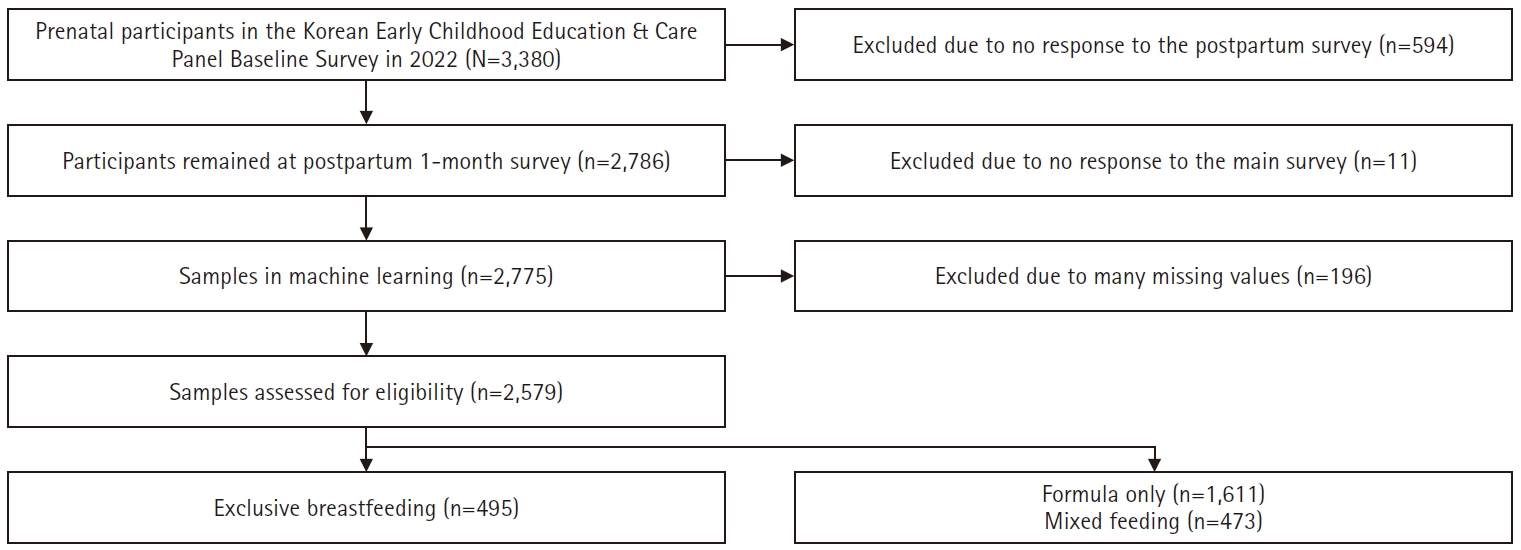
Data from 2,579 participants in the Korean Early Childhood Education & Care Panel between March 1 and June 3, 2025 were analyzed using Python version 3.12.8 and Colab. The dataset was split into training and testing sets at an 80:20 ratio, and five classifiers (random forest, logistic regression, decision tree, AdaBoost, and XGBoost) were trained and evaluated using multiple performance metrics and feature importance analysis.
Results
The confusion matrix of the random forest classifier model demonstrated strong performance, with a precision of 86.6%, accuracy of 84.8%, recall of 96.8%, F1-score of 91.9%, and an area under the curve of 86.0%. Twenty-one features were analyzed, from which feeding plan, breastfeeding at 1 month, marriage period, maternal prenatal weight, self-respect, alcohol consumption, grit, value placed on children, maternal age, and depression emerged as important predictors of exclusive breastfeeding in the first 3 months.
Discussion
A robust model was developed to predict exclusive breastfeeding that identified feeding planning and breastfeeding at 1 month as the most influential predictors. The model could be implemented in clinical and community settings to guide tailored breastfeeding support strategies, coupled with the integration of maternal self-respect, grit, and the value placed on children in counseling programs to promote exclusive breastfeeding. -
Citations
Citations to this article as recorded by
- Effects of Digital Health Interventions on Breastfeeding Rates, Self-Efficacy, and Knowledge: Systematic Review and Meta-Analysis
Jiahe Sun, Yu Wang, Shuang Hu, Yajie Ding, Congshan Pu, Danni Song, Jiaai Xia, Chunjian Shan
Journal of Medical Internet Research.2026; 28: e92184. CrossRef
- Effects of Digital Health Interventions on Breastfeeding Rates, Self-Efficacy, and Knowledge: Systematic Review and Meta-Analysis
- 3,300 View
- 232 Download
- 1 Web of Science
- 1 Crossref

- Moderating Effect of General Self-Efficacy on the Relationship between Pregnancy Stress, Daily Hassles Stress, and Preterm Birth Risk in Women Experiencing Preterm Labor: A Cross-Sectional Study
- Hyun-Jeong Cho, Jeung-Im Kim
- J Korean Acad Nurs 2024;54(3):329-339. Published online August 31, 2024
- DOI: https://doi.org/10.4040/jkan.24008
-
Abstract
PDF
- Purpose
This study investigated the moderating role of general self-efficacy (GSE) on how stress caused by pregnancy and daily hassle affect the risk of preterm birth (PTB) in women experiencing preterm labor.
Methods
This cross-sectional study included 196 pregnant women experiencing preterm labor before 37 weeks of gestation. We used IBM SPSS Statistics 27 and employed Hayes process macro version 4 (model 1) and hierarchical regression to analyze the moderating effect of GSE on the relationship between pregnancy stress, daily hassle stress, and PTB risk.
Results
Stress caused by pregnancy and daily hassle was positively correlated to PTB risk (r = .54, p < .001; r = .25, p < .001, respectively). While GSE did not significantly correlate with pregnancy stress, it negatively correlated with daily hassle stress (r = - .19, p = .009). GSE significantly moderated the relationship between combined stressors and PTB risk. As GSE levels increased, escalation in PTB risk in response to increasing stress levels was a more pronounced, highlighting a complex interaction between higher GSE levels and response to escalating stress levels. This model accounted for 39.5% of the variance in the PTB risk.
Conclusion
Higher GSE may amplify the impact of stress on PTB risk, rather than mitigate it, which suggests a more nuanced role of GSE in the stress response of pregnant women at risk of preterm labor. GSE should be considered in care strategies, and managing its impact on stress perception and responses in pregnant women is crucial. -
Citations
Citations to this article as recorded by- Evaluating the Effectiveness of Digital Interventions for Stress Management in Pregnant Women: Systematic Review and Meta-Analysis
Jeung-Im Kim, Joo Yun Lee, So-Hee Park
JMIR mHealth and uHealth.2026; 14: e66267. CrossRef - Pregnancy stress in women at high risk of preeclampsia with their anxiety, depression, self-management capacity: a cross-sectional study
Xing Cong, Jinmei Wang, Liu Yang, Lingling Cui, Yurong Hua, Ping Gong
Frontiers in Psychology.2025;[Epub] CrossRef - Anxiety, Coping, and Self-Efficacy as a Psychological Adjustment in Mothers Who Have Experienced a Preterm Birth
Agata Białas, Karolina Kamecka, Paweł Rasmus, Dariusz Timler, Remigiusz Kozłowski, Anna Lipert
Journal of Clinical Medicine.2025; 14(12): 4174. CrossRef - Associations Among Pregnancy Stress, Childbirth Confidence, and COVID-19 Infection Experience in Pregnant Women in the Early Third Trimester (28–32 Weeks)
Yun-Sun Yang, Jeung-Im Kim
Journal of Korean Maternal and Child Health.2025; 29(3): 147. CrossRef
- Evaluating the Effectiveness of Digital Interventions for Stress Management in Pregnant Women: Systematic Review and Meta-Analysis
- 3,265 View
- 152 Download
- 3 Web of Science
- 4 Crossref
Original Articles
- Opening Status of the Korea Midwifery Birthing Centers and Development of Midwifery Practice Guideline
- Ji Young Song, Young-Joo Park
- J Korean Acad Nurs 2020;50(4):583-598. Published online August 31, 2020
- DOI: https://doi.org/10.4040/jkan.20032
-
Abstract
PDF
- Purpose
This study was to investigate the operational status of the midwifery birthing centers (MBCs) and midwives’ job status (Phase 1) and to develop midwifery practice guidelines (MPG) (Phase 2) in Korea.
Methods
In the first phase, the subjects were 15 midwives who operated 11 of 14 MBCs that were opened as of August 2018. The questionnaire consisted of items to measure the operational status of the MBC and midwives’ job status. In the second phase, the MPG was developed from literature review, interviews with five midwives opening their MBCs, surveys with 74 midwives, and a validity evaluation conducted by seven experts.
Results
The distribution of operating MBCs was five in Gyunggi-do, two each in Seoul and Incheon, one each in Busan, Chungcheongbuk-do, Gyeongsangbuk-do, Gyeongsangnam-do and Jeju-do. The mean age of midwives was 54.3 and all were female. In 2017, a total of 762 births including 81 homebirths were performed by midwives. The job performance was highest in the order of neonatal care 3.81, childbirth care 3.56, and postpartal care 3.53, respectively. The MPG included seven areas of prenatal care, childbirth care, postpartal care, neonatal care, primary health care, law/ ethics, and administration, with 56 tasks and 166 task elements.
Conclusion
This study provides the valid basic data for the operational status of the MBC and the midwives’ job status. The MPG describes the midwife’s job and may be used as basic data for preparing policies for the development of midwifery practice in Korea. -
Citations
Citations to this article as recorded by- Midwifery Practices and the Adequacy of Midwifery Fees in Korean Midwifery Centers
Jinhyun Kim, Eunhee Lee, Dong Ok Kim
Journal of Korean Maternal and Child Health.2026; 30(1): 53. CrossRef - Preparation of the nursing workforce in the field of women’s health
Sukhee Ahn
Women's Health Nursing.2024; 30(2): 91. CrossRef - A Job analysis of Hospital Midwives: A DACUM Analysis
Yunmi Kim, Sunok Lee, Jummi Park, Sunhee Lee, Miyoung An, Buyoun Kim
Journal of The Korean Society of Maternal and Child Health.2023; 27(2): 119. CrossRef - A comparison of the perceived importance and performance of midwives’ roles between midwives and nurses in Korea: a cross-sectional study
Kyungwon Kim, Yunmi Kim, Jummi Park
Korean Journal of Women Health Nursing.2023; 29(4): 263. CrossRef - Expanding the role of midwives in Korea
Kyung Won Kim
Korean Journal of Women Health Nursing.2021; 27(3): 167. CrossRef - 2020 Year of the nurse and the midwife: a call for strengthening midwifery in response to South Korea’s ultra-low birth rate
Yun Mi Kim
Korean Journal of Women Health Nursing.2020; 26(4): 255. CrossRef
- Midwifery Practices and the Adequacy of Midwifery Fees in Korean Midwifery Centers
- 3,732 View
- 39 Download
- 4 Web of Science
- 6 Crossref
- An Ethnographic Study about Taegyo Practice in Korea
- Hyeon Ok Kim
- Journal of Nurses Academic Society 1997;27(2):411-422. Published online March 30, 2017
- DOI: https://doi.org/10.4040/jnas.1997.27.2.411
-
Abstract
PDF
The purpose of this study is twofold :(i) to investigate how much effort the married couples are making for the good health of both the pregnant woman and her unborn child from the time of their marriage to and during the period of conception ; and(ii) to comprehensive investigate socio-cultural backgrounds which affect prenatal effort. Result of this study provide a basis for the prenatal care program which will be appropriate to our culture. This study has been done by the ethnographic research method. The subjects of this study are 53 people in all consisting of 33 pregnant women and 20 husbands. In order to investigate socio-cultural factors which influence Taegyo, producers of Taegyo music were interviewed. In addition, the researcher surveyed the markets of Taegyo music, participated in special courses of prenatal education, analyzed the content of the books and periodicals dealing and collected the concept of Taegyo distributed by the mass media. The full-fledged study continued for eight months from February to August, 1996. The data were analyzed as soon as they were collected. Spradly's(1979, 1980) developmental, sequential method of domain analysis, taxonomic analysis, componential analysis, and theme analysis in this order was adopted as the procedure of analyzing the data. To obtain the exactness of study, Sandelowski's(1986) four criteria, that is, Credibility, Fittingness, Auditability, and Confirmability were applied to all stages of data collection, data analysis, the interpretation of the result, and the description of the result. The following are the result : 1. The couples' Taegyo at the stage of preconception was related to their physical, psychological, spiritual conditions under which a healthy baby will be born. Specific methods they prefer are : "the choice of one's spouse," "physical check-up," "physical good health," "praying," and so on. 2. When the married couple have sex in order to conceive, their Taegyo was related to the imposition of their physical, psychological, and environmental conditions. Specific methods they prefer are: "having sex at specific time," "having sex in nice place," "to purify their minds while having sex," and so on. 3. The married couples' Taegyo while they are in pregnancy was related to the imposition of their physical, psychological, emotionmental, environmental, social and spiritual conditions. Specific methods they prefer are : "listening to music," "reading," "looking at beautiful things only," "to avoid looking at or listening to bad things," "to eat food in good shape," "to avoid drugs," "eating Korean herbal medicine," "sexual abstinence," "to avoid dangerous places," " to keep emotional tranquility," "moderate exercises and rest," "leading a pure life," "praying," "being aware of their words and behavior," "for the couple to keep a good relationship," "interaction with their unborn child," "to support Taegyo for pregnant women," and so on. 4. The married couple put Taegyo into practice on the basis of the following principles : the principle of respecting an unborn child, the principle of forming a good disposition, the principle of top-down parental love, the principle of synergy between a pregnant woman and her unborn child, the principle of expecting a good child, the principle of forming a good habit, and the principle of acquiring a parental role. 5. The practice of Taegyo is influenced by such factors as the married couple, the supporting system, and the married couple, the supporting system, and the mass media. As the husband-and-wife factor, their information of Taegyo, the degree of importance is assigned to their characters, their time to spare, their healthiness, the age of pregnant woman, their conception plan, their religion, their belief of the Taegyo effects, and the birth of a baby in this order. The factor of the supporting system consists of her husband's support, he family support, and her neighbor's support. The mass media specialized in Taegyo, periodicals for pregnant women, booklets for advertizing powdered milk, Taegyo music of record manufacturing companies, and the teaching materials for gifted children. Among these the mass media is especially taking advantage of Taegyo as its main source of economic profits and leading the public behavior pattern to a prodigal one. Taegyo is a self-control behavior which requires practice for the following : the physical and psychological good health of the pregnant woman and her unborn child, the development of the unborn child's good character, the envelopment of the unborn child's intelligence and talents, the expectation of the unborn child's good features, shape a good habit, the expectation of the unborn child's bright future, and the learning of a parental role, the expectation of male birth. Above all it is a type of our good cultural tradition which pursues a value higher than the one that the prenatal care does. The principles of pregnancy care inherent in the habit of Taegyo will provide us a guideline for the development of the prenatal care.
-
Citations
Citations to this article as recorded by- Gender Differences in Awareness of Preconception Care and Pregnancy
Dong Sook Cho, Eun Jung Kim, Eun Mi Jun
Korean Journal of Women Health Nursing.2013; 19(4): 219. CrossRef - Effects of a Coaching-based Childbirth Program on Anxiety and Childbirth Self-efficacy among Primigravida Women
Sue Kim, Hee-Sook Kim, Ha-Yoon Cheong
Korean Journal of Women Health Nursing.2011; 17(4): 369. CrossRef - Factors Associated with the Practice of Traditional Prenatal Education (Taegyo) among Pregnant Korean Women
Young Hee Kim
Korean Journal of Women Health Nursing.2011; 17(5): 491. CrossRef - Effects of aTaegyoProgram on Parent-Fetal Attachment and Parenthood in First Pregnancy Couples
Kyung Mi Yang, Soon-Lae Kim
Journal of Korean Academy of Nursing.2010; 40(4): 571. CrossRef
- Gender Differences in Awareness of Preconception Care and Pregnancy
- 1,629 View
- 10 Download
- 4 Crossref
- Pregnancy, Abortion and Delibery Rates for Korean Teenagers
- Young Joo Park, Pyoung Sahm Ku, Tak Kim, Jae Chul Shin, Chan Lee, Joon Moon, Min Jung Oh
- Journal of Korean Academy of Nursing 1998;28(3):573-582. Published online March 29, 2017
- DOI: https://doi.org/10.4040/jkan.1998.28.3.573
-
Abstract
PDF
The purpose of this study was to investigate pregnancy, abortion and delivery rates among Korean teenagers. The subjects of this study were 11,433 teenagers aged 13-19 year in Seoul, Pusan, Taegu, Kwangju, Insheon, Taejeon and Ansan, Korea. Data were collected from Feb. 1994 to May 1995, 16 months, by schoolnurses or the researchers. The results showed pregnancy rate was 7.2 per 1,000 teenagers, the abortion rate was 4.3 per 1,000 teenagers, and delivery rate was 1.2 per 1,000 teenagers. In the pregnancy experience, the main factors related to teenage pregnancy were love or marriage engagement. In the abortion experience, 53.9% of teenagers had more than two abortion experiences, 38.1% midtrimester abortion, 22% complications after abortion. In the delivery experience, 64.3% of teenagers delivered with no prenatal care and 42.9% had a delay in realizing they were pregnant. Fifty percent were delivered by non-professionals in non-medical institutions.
-
Citations
Citations to this article as recorded by- Predictive Factors for Sexual Behaviors among High School Students in South Korea: a Nationwide Analysis
Seung Wan Hong, Jae Hyuck Lee, Young Sung Suh, Dae Hyun Kim
Keimyung Medical Journal.2022; 41(1): 32. CrossRef - Estimates of induced abortion in South Korea: Health facilities survey
Hyeong Sik Ahn, Hyun‐Joo Seol, Ji‐Eun Lim, Sung‐hee Hong, Sun Young Lee, Moon‐Il Park, Soon Duck Kim, Hai‐Joong Kim
Journal of Obstetrics and Gynaecology Research.2012; 38(1): 324. CrossRef - HIV/AIDS Knowledge, Attitudes, Related Behaviors, and Sources of Information Among Korean Adolescents
Hyera Yoo, Sun Hae Lee, Bo Eun Kwon, Sulki Chung, Sanghee Kim
Journal of School Health.2005; 75(10): 393. CrossRef - HIV/AIDS Knowledge, Attitudes, Related Behaviors, and Sources of Information Among Korean Adolescents
Hyera Yoo, Sun Hae Lee, Bo Eun Kwon, Sulki Chung, Sanghee Kim
Journal of School Health.2005; 75(10): 393. CrossRef - Children’s health retention in South Korea and the United States: a cross-cultural comparison
Betsy M McDowell, Nahn Joo Chang, Sang Soon Choi
Journal of Pediatric Nursing.2003; 18(6): 409. CrossRef
- Predictive Factors for Sexual Behaviors among High School Students in South Korea: a Nationwide Analysis
- 2,240 View
- 2 Download
- 5 Crossref
- Effects of a Workbook Program on the Perceived Stress Level, Maternal Role Confidence and Breast Feeding Practice of Mothers of Premature Infants
- Yung Sook Jang
- Journal of Korean Academy of Nursing 2005;35(2):419-427. Published online March 28, 2017
- DOI: https://doi.org/10.4040/jkan.2005.35.2.419
-
Abstract
PDF
Purpose The purpose of this study was to identify the effects of a workbook program on percieved stress levels, maternal role confidence and breastfeeding practices of mothers of premature infants.
Method This study employed a quasi-experimental non-equivalent pre-and-post test to compare the two groups. Data was collected from 32 subjects from March 10. to September 5, 2003 at an NICU located in S. city. In the sample, fifteen mothers were in the experimental group and seventeen were in the control group. A workbook program was provided twice during a period from two-three days after the baby's admission to one week after the first intervention. The instruments used were the PSS and self confidence scale. Data was analyzed by means of frequency, SD, χ2-test, Fisher's exact test, Mann-Whitney test, and the Wilcoxon signed rank test.
Result There was a significant difference in perceived stress levels between the experimental and control group (U=2.366, p=.018). There was not a significant difference in maternal role confidence between the two groups (U=1.002, p=.316). There was a significant difference in breastfeeding practice between the two groups (χ2= 4.910, p=.035).
Conclusion It is concluded that a program using a workbook has a positive effect on decreasing the perceived stress level and increasing breastfeeding practice.
-
Citations
Citations to this article as recorded by- Effects of Systematic Discharge Education Program on Anxiety and Parenting Confidence in Mothers of Premature Infants
Eunyoung Kim, Aeran Jo, Meenam Hwang, Hyunjin Moon, Daeun Jeong, Myungjin Jang, Choyeon Lim
Journal of The Korean Society of Maternal and Child Health.2023; 27(2): 71. CrossRef - Effects of a newborn care education program using ubiquitous learning on exclusive breastfeeding and maternal role confidence of first-time mothers in Vietnam: a quasi-experimental study
Tran Thi Nguyet, Nguyen Vu Quoc Huy, Yunmi Kim
Korean Journal of Women Health Nursing.2021; 27(4): 278. CrossRef - Effects of an Infant Care Education Program for Mothers of Late-preterm Infants on Parenting Confidence, Breastfeeding Rates, and Infants' Growth and Readmission Rates
Eun Hye Jang, Hyeon Ok Ju
Child Health Nursing Research.2020; 26(1): 11. CrossRef - Effects of a Maternal Role Adjustment Program on First-time Mothers
Su Jeong Kim, Ji Min Seo
Korean Journal of Women Health Nursing.2018; 24(3): 322. CrossRef - Development and Evaluation of a Video Discharge Education Program focusing on Mother-infant Interaction for Mothers of Premature Infants
Jin Suk Ra, Jiyoung Lim
Journal of Korean Academy of Nursing.2012; 42(7): 936. CrossRef - A Study on the Experience of Breastfeeding Education for Women with Children 24 Months of Age and Younger
Ji-Eun Kim, Dong-Yean Park
The Korean Journal of Community Living Science.2012; 23(4): 523. CrossRef - Effects of a Discharge Education Program Using On-line Community for Parents of Premature Infants
Jeong Soon Kim, Hee Sun Shin
Journal of Korean Academy of Child Health Nursing.2010; 16(4): 344. CrossRef - Effects of a Breast-Feeding Empowerment Program on Exclusive Breast-Feeding
Yunmi Kim
Journal of Korean Academy of Nursing.2009; 39(2): 279. CrossRef
- Effects of Systematic Discharge Education Program on Anxiety and Parenting Confidence in Mothers of Premature Infants
- 1,456 View
- 19 Download
- 8 Crossref
- Effects of Cycled Lighting on Body Weight, Physiological Variables and Behavioral States in Low Birth Weight Infants
- In Sook Jung
- Journal of Korean Academy of Nursing 2005;35(1):143-153. Published online March 28, 2017
- DOI: https://doi.org/10.4040/jkan.2005.35.1.143
-
Abstract
PDF
Purpose This study was aimed at finding the effects of cycled lighting on body weight, physiological variables and the behavioral state of LBWI (low birth weight infants) in the NICU.
Method The subjects were 20 LBWI at 2 NICUs. They were assigned to an experimental or control group which consisted of 10 subjects in each. Cycled light was applied to the experimental group for 10 days.
Result It was certified that the application of cycled lighting resulted in increased body weight and O2 saturation, and decreased heart rate of the LBWI. However, there was no effect in decrease of respiration and stabilization of the behavioral state.
Conclusion The application of cycled lighting might be a nursing intervention which would in turn have positive effects on the growth of LBWI.
-
Citations
Citations to this article as recorded by- Effectiveness of combined versus single circadian interventions in neonatal and pediatric intensive care units: a systematic review with meta-analysis
Constanza C. Corrotea-Maltez, Catalina V. Fernández-Flores, Constanza L. Gutiérrez-Neira, Antonia J. Nirrian-Pérez, Javiera Mansilla-Muñoz, Liliana Bustos-González
Frontiers in Neurology.2026;[Epub] CrossRef - Cycled light in the intensive care unit for preterm and low birth weight infants
Iris Morag, Yu-Tian Xiao, Matteo Bruschettini
Cochrane Database of Systematic Reviews.2024;[Epub] CrossRef - Effect of Lights-Out at Night Time on Body Weight, Physiological Variables, and Behavioral Status in Premature Infants
Kyeong Nam Lee, Bo Min Seo, Deog Hwan Moon, Ga Won Jeon, Jong Beom Sin
Neonatal Medicine.2016; 23(2): 102. CrossRef - Effects of Cycled Lighting on Circadian Rhythms of Premature Infants
Seong-Jin Lee, Kyung-Ja Han, Kyung-Sook Bang
Journal of Korean Academy of Child Health Nursing.2012; 18(2): 85. CrossRef
- Effectiveness of combined versus single circadian interventions in neonatal and pediatric intensive care units: a systematic review with meta-analysis
- 1,571 View
- 22 Download
- 4 Crossref
- Comparison of Maternal Self-esteem, Postpartal Depression, and Family Function in Mothers of Normal and of Low Birth-weight Infants
- Young Mee Ahn, Jung Hyun Kim
- Journal of Korean Academy of Nursing 2003;33(5):580-590. Published online March 28, 2017
- DOI: https://doi.org/10.4040/jkan.2003.33.5.580
-
Abstract
PDF
Purpose The study investigates the degree of maternal self-esteem, postpartal depression, and family function in mothers of normal and of low birth-weight infants.
Method A retrospective cohort design was applied to compare the variables of interest between a group of 73 mothers with normal birth weight infants and a group of 45 mothers with low birth-weight infants, using the maternal self-report inventory(MSRV), Edinburgh Postnatal Depression Scale(EPDS) and Family APGAR(FAPGAR).
Result The total mean score was 82.57 for MSRV, 8.45 for EPDS, and 6.83 for FAPGAR with no differences between two groups. A positive correlation was found between MSRV and FAPGAR, while a negative correlations between MSRV and EPDS, and FAPGAR and EPDS. Regardless of the direction of the relationship, the degrees of the correlations were stronger in low birth-weight mothers group than in normal group.
Conclusion No differences in MSRV, EPDS and FAPGAR between the normal and the low birth-weight group considered as beneficial effects of the follow-up management which low birth-weight group was engaged in. This suggested the early intervention(follow-up) for the family with risk factor(low birth-weight) could reduce negative outcomes such as the impaired maternal self-esteem and family function, and the occurrence of postpartal depression, retrospectively.
-
Citations
Citations to this article as recorded by- Longitudinal Relationship Study of Depression and Self-Esteem in Postnatal Korean Women Using Autoregressive Cross-Lagged Modeling
Jeong-Won Han, Da-Jung Kim
International Journal of Environmental Research and Public Health.2020; 17(10): 3743. CrossRef - Effects of Kangaroo Care on Physical Development and Adaptation of External Environment of Prematurity, and Maternal Role Confidence who Delivered Premature Infants
Ji-Won Lee, Yong-Sook Eo, Jung Hwa Han
Journal of the Korea Academia-Industrial cooperation Society.2016; 17(12): 128. CrossRef - The Correlation between Maternal Adult Attachment Style and Postpartum Depression and Parenting Stress
Sung Yong Park, Sun Mi Kim, Baik Seok Kee, Doug Hyun Han, Churl Na, Gwang Jun Kim, Min Young Park, Na Mi Lee
Journal of Korean Neuropsychiatric Association.2015; 54(4): 515. CrossRef - Effects of Self Efficacy, Body Image and Family Support on Postpartum Depression in Early Postpartum Mothers
Ji-Won Lee, Yong-Sook Eo, Eun-Hye Moon
Journal of the Korea Academia-Industrial cooperation Society.2015; 16(6): 4011. CrossRef - Effects of Music Therapy and Phone Counseling on Postpartum Depression and Maternal Identity in High Risk Women
Hae Won Kim, Sun OK Kim, Hye Gyung Kim, Hyang Ran Jeon
Perspectives in Nursing Science.2014; 11(1): 63. CrossRef - Effects of Postpartum Depression and Temperament of Infant on Child-care Stress among Mothers of Newborn Infants
Hye-Jin Kwon, Kyung-Hee Kim, Mi-Hye Choi, Ju-Yeon Cho, Young-Mi Ahn, Ki-Sook Kim
Journal of Korean Academy of Child Health Nursing.2011; 17(2): 69. CrossRef - A Comparative Study on the Postpartum Depression of Vietnamese Marriage Immigrant Women and Korean Women
Eun Young Choi, Eun Hee Lee, Jung Sook Choi, Sun Ha Choi
Korean Journal of Women Health Nursing.2011; 17(1): 39. CrossRef - Kangaroo Care on Premature Infant Growth and Maternal Attachment and Post-partum Depression in South Korea
H. Y. Ahn, J. Lee, H.-J. Shin
Journal of Tropical Pediatrics.2010; 56(5): 342. CrossRef - Postpartum Depressive Score and Related Factors Pre- and Post-delivery
Sun Ok Lee, Jung Hee Yeo, Suk Hee Ahn, Hyeon Sook Lee, Hyun Joo Yang, Mi Jung Han
Korean Journal of Women Health Nursing.2010; 16(1): 29. CrossRef - Subjective Sleep Quality in Depressed and Non-Depressed Mothers During the Late Postpartum Period
Eun-Jung Cho
Korean Journal of Women Health Nursing.2009; 15(2): 108. CrossRef - Development and Evaluation of an e-Learning Program for Mothers of Premature Infants
Nae-Young Lee, Young-Hae Kim
Journal of Korean Academy of Nursing.2008; 38(1): 152. CrossRef
- Longitudinal Relationship Study of Depression and Self-Esteem in Postnatal Korean Women Using Autoregressive Cross-Lagged Modeling
- 1,436 View
- 4 Download
- 11 Crossref
- Effects of Body Position and Time after Feeding on Gastric Residuals in LBW Infants
- Sun Kyung Hwang, Hyun Ok Ju, Young Soon Kim, Hwa Za Lee, Young Hae Kim
- Journal of Korean Academy of Nursing 2003;33(4):488-494. Published online March 28, 2017
- DOI: https://doi.org/10.4040/jkan.2003.33.4.488
-
Abstract
PDF
Purpose To examine the effects of body position and time after feeding on gastric residuals in low birth weight infants(LBW).
Methods A repeated measures design was conducted. Twenty LBW infants being fed via indwelling nasogastric tubes were randomly assigned to one of 5 different position orderings. In each position, gastric residuals were measured at 30, 60, 90, 120, 150, and 180 minutes after feeding.
Results In comparisons of gastric residuals with position and time, the main effects of position and time were statistically significant (F = 5.038,
p = 0.001; F = 429.763,p < 0.001, respectively), but the interaction between position and time was found not to be significant. In pairwise comparisons, the gastric residuals were more reduced in the right anterior oblique and prone positions compared with the left lateral position (P < 0.05) and the differences across time periods were significant (p < 0.001).Conclusion The body position after feeding has a significant affect on gastric residuals over time in LBW infants. The right anterior oblique or prone position is recommended rather than left lateral position after feeding. Knowledge of the proper position and the pattern of gastric emptying over time after feeding may lead to the development of evidence-based nursing care.
-
Citations
Citations to this article as recorded by- The Effects of Different Nursing Positions During Preterm Infants Feeding on Gastric Residual Volume and Emptying Rate: A Systematic Review and Network Meta‐Analysis
Amal Mohamed Elhusein, Hammad Ali Fadlalmola
International Journal of Nursing Practice.2024;[Epub] CrossRef - Efficacy of body position on gastric residual in preterm infant: a systematic review and meta-analysis
Kurvatteppa Halemani, Alwin Issac, Sanjay Dhiraaj, Prabhaker Mishra
Clinical and Experimental Pediatrics.2023; 66(6): 262. CrossRef - Effect of different positions on gastric residuals in preterm infants initiating full enteral feeding
Duygu Gözen, Zeynep Erkut, Rabia Uslubaş, Leyla Bilgin
Nutrition in Clinical Practice.2022; 37(4): 945. CrossRef - The Effect of Body Position on Gavage Residual Volume of Gastric in Intensive Care Units Patients
J Rezae, H Kadivarian, A Abdi, M Rezae, K Karimpour, S Rezae
Iran Journal of Nursing.2018; 30(110): 58. CrossRef - Preventing Respiratory Complications of Tube Feedings: Evidence-Based Practice
Norma A. Metheny
American Journal of Critical Care.2006; 15(4): 360. CrossRef
- The Effects of Different Nursing Positions During Preterm Infants Feeding on Gastric Residual Volume and Emptying Rate: A Systematic Review and Network Meta‐Analysis
- 1,580 View
- 7 Download
- 5 Crossref
- Multiple Factors in the Second Trimester of Pregnancy on Preterm Labor Symptoms and Preterm Birth
- Jeung-Im Kim, Mi-Ock Cho, Gyu-Yeon Choi
- J Korean Acad Nurs 2017;47(3):357-366. Published online January 15, 2017
- DOI: https://doi.org/10.4040/jkan.2017.47.3.357
-
Abstract
PDF
Abstract Purpose The aim of this study was to determine the influence of various factors on preterm labor symptoms (PLS) and preterm birth (PB).
Methods This prospective cohort study included 193 women in the second stage of pregnancy. Multiple characteristics including body mass index (BMI), smoking, and pregnancy complications were collected through a self-report questionnaire. Pregnancy stress and PLS were each measured with a related scale. Cervical length and birth outcome were evaluated from medical charts. Multiple regression was used to predict PLS and logistic regression was used to predict PB.
Results Multiple regression showed smoking experience, pregnancy complications and pregnancy specific stress were predictors of PLS and accounted for 19.2% of the total variation. Logistic regression showed predictors of PB to be twins (OR=13.68, CI=3.72~50.33,
p <.001), shorter cervix (<25mm) (OR=5.63, CI=1.29~24.54,p <.05), BMI >25 (kg/m2) (OR=3.50, CI=1.35~9.04,p <.01) and a previous PB (OR=4.15, CI=1.07~16.03,p <.05).Conclusion The results of this study show that the multiple factors affect stage II pregnant women can result in PLS or PB. And preterm labor may predict PB. These findings highlight differences in predicting variables for pretrm labor and for PB. Future research is needed to develop a screening tool to predict the risk of preterm birth in pregnant women.
-
Citations
Citations to this article as recorded by- Development and Content Structure Evaluation of a Wearable-Integrated Mobile Application Prototype for Preterm Birth Risk Prevention: A Pilot Study
Jeung-Im Kim, So-Hee Park, Eun-Jin Lee, Mi-Youn Jang, Young-Seob Jeong, Jun-Ha Hwang, Jung-Hyun Park, Seung-Dong Lee
Journal of Korean Maternal and Child Health.2026; 30(3): 162. CrossRef - Development and Effect of Prenatal Education Programs Using Virtual Reality for Pregnant Women Hospitalized With Preterm Labor: Experimental Study
SeoA Park, Hyeyoung Kim
Journal of Medical Internet Research.2025; 27: e75585. CrossRef - Associations Among Pregnancy Stress, Childbirth Confidence, and COVID-19 Infection Experience in Pregnant Women in the Early Third Trimester (28–32 Weeks)
Yun-Sun Yang, Jeung-Im Kim
Journal of Korean Maternal and Child Health.2025; 29(3): 147. CrossRef - Risk factors and the possibility of predicting late premature birth
L. S. Fatkullina, I. F. Fatkullin, S. A. Knyazev
Medical Herald of the South of Russia.2024; 15(2): 25. CrossRef - Incidence of Preterm Infants, Indications of Admission, Risk Factors, and Discharge Outcome: A Retrospective Study
Atyat Mohammed Hassan
The Open Nursing Journal.2022;[Epub] CrossRef - Prevalence and predictors of spontaneous preterm births in Nepal: findings from a prospective, population-based pregnancy cohort in rural Nepal–a secondary data analysis
Seema Subedi, Elizabeth A Hazel, Diwakar Mohan, Scott Zeger, Luke C Mullany, James M Tielsch, Subarna K Khatry, Steven C LeClerq, Robert E Black, Joanne Katz
BMJ Open.2022; 12(12): e066934. CrossRef - Development Process for Preterm Birth Risk Assessment Scale in High-Risk Pregnancy: 1st Phase of Preliminary Scale Development
Jeung-Im Kim
Journal of The Korean Society of Maternal and Child Health.2022; 26(3): 171. CrossRef - Systematic Review of Prediction Models for Preterm Birth Using CHARMS
Jeung-Im Kim, Joo Yun Lee
Biological Research For Nursing.2021; 23(4): 708. CrossRef - Visualization of unstructured personal narratives of perterm birth using text network analysis
Jeung-Im Kim
Korean Journal of Women Health Nursing.2020; 26(3): 205. CrossRef - Incidence, risk factors and consequences of preterm birth – findings from a multi-centric observational study for 14 months in Nepal
Abhishek Gurung, Johan Wrammert, Avinash K. Sunny, Rejina Gurung, Netra Rana, Yuba Nidhi Basaula, Prajwal Paudel, Amrit Pokhrel, Ashish KC
Archives of Public Health.2020;[Epub] CrossRef - Factors influencing Stress in Spouses of Hospitalized Women Diagnosed with Preterm Labor
Jeong Im Lee, Sehoon Hong
Korean Journal of Women Health Nursing.2019; 25(4): 459. CrossRef - Preterm Labor and Birth: Definition, Assessment, and Management
Jeung-Im Kim
Korean Journal of Women Health Nursing.2018; 24(3): 231. CrossRef - The Association Between Low 50 g Glucose Challenge Test Values and Adverse Pregnancy Outcomes
Hayan Kwon, Joonho Lee, Byung-Wan Lee, Ja-Young Kwon, Young-Han Kim
Journal of Women's Health.2018; 27(6): 801. CrossRef
- Development and Content Structure Evaluation of a Wearable-Integrated Mobile Application Prototype for Preterm Birth Risk Prevention: A Pilot Study
- 2,819 View
- 40 Download
- 13 Crossref
- Effects of a Customized Birth Control Program for Married Immigrant Postpartum Mothers
- So Young Kim, So Young Choi
- J Korean Acad Nurs 2016;46(6):780-792. Published online December 30, 2016
- DOI: https://doi.org/10.4040/jkan.2016.46.6.780
-
Abstract
PDF
Purpose This study was conducted to develop a customized birth control program and identify its effects on attitude, subjective norm, behavioral control, intention, and behavior of contraception among immigrant postpartum mothers.
Methods In this experimental study, Vietnamese, Filipino or Cambodian married immigrant postpartum mothers were recruited. They were assigned to the experiment group (n=21) or control group (n=21). The customized birth control program was provided to the experimental group for 4 weeks.
Results The experimental group showed a significant increase in the score of attitude, subjective norm, behavioral control, intention, and behavior of contraception.
Conclusion Findings in this study indicate that the customized postpartum birth control program, a systematic and integrative intervention program composed of customized health education, counseling and telephone monitoring, is able to provide effective planning for postpartum health promotion and birth control behavior practice in married immigrant women.
- 1,842 View
- 21 Download
- Effects of a Hospital Based Follow-Up Program for Mothers with Very Low Birth Weight Infants
- Min Hee Kim, Eun Sun Ji
- J Korean Acad Nurs 2016;46(1):79-89. Published online February 29, 2016
- DOI: https://doi.org/10.4040/jkan.2016.46.1.79
-
Abstract
PDF
Purpose This paper reports the results of a hospital centered follow-up program on parenting stress, parenting efficacy and coping for mothers with very low birth weight (VLBW) infants.
Methods The follow-up program consisted of home visiting by an expert group and self-help program for 1 year. A non-equivalent control group pre-post quasi-experimental design was used. Participants were 70 mothers with low birth weight infants and were assigned to one of two groups, an experimental groups (n=28), which received the family support program; and a control group (n=27), which received the usual discharge education. Data were analyzed using χ2-test, t-test, and ANCOVA with IBM SPSS statistics 20.0.
Results Mothers' parenting stress (F=5.66,
p =.004) was significantly decreased in the experimental group. There were also significant increases in parenting efficacy (F=13.05,p <.001) and coping (F=8.91,p =.002) in the experimental group.Conclusion The study findings suggest that a follow-up program for mothers with VLBW infants is an effective intervention to decrease mothers' parenting stress and to enhance parenting efficacy and coping.
-
Citations
Citations to this article as recorded by- Effects of a Community-based Follow-up Program for Parents with Premature Infants on Parenting Stress, Parenting Efficacy, and Coping
Eun Sun Ji, Ka Ka Shim
Child Health Nursing Research.2020; 26(3): 366. CrossRef - Correlations between a Flexible Parental Visiting Environment and Parental Stress in Neonatal Intensive Care Units
Su Jin Lee, Eun Kyoung Choi, Jeongok Park, Hee Soon Kim
Child Health Nursing Research.2019; 25(4): 377. CrossRef - Experiences of Mothers' Attachment in a Follow-Up Program Using Early Intervention for Low-Birth-Weight Infants
Jia Lee, Jinhee Choi Kang, Eun Sun Ji
Asian Nursing Research.2019; 13(3): 177. CrossRef - A Literature Review of Research on Leadership of Korean Hospital Nurse
Sunmi Kim, Myoung Hee Seo, Seok Hee Jeong, Hee Sun Kim, Yoon Lee Kim
Journal of Korean Academy of Nursing Administration.2019; 25(5): 404. CrossRef - Experiences of Mothers of Premature Infants Receiving Rehabilitation Therapy
Hyun-Ju Kang
Child Health Nursing Research.2018; 24(3): 298. CrossRef
- Effects of a Community-based Follow-up Program for Parents with Premature Infants on Parenting Stress, Parenting Efficacy, and Coping
- 1,852 View
- 4 Download
- 5 Crossref
- Development and Evaluation of Breastfeeding Promotion Program for Mothers with Breast Engorgement following Cesarean Birth
- Jeongsug Cho, Sukhee Ahn
- J Korean Acad Nurs 2014;44(2):170-178. Published online April 30, 2014
- DOI: https://doi.org/10.4040/jkan.2014.44.2.170
-
Abstract
PDF
Purpose This study was to develop a breastfeeding promotion program and to test effects of the program on levels of breast discomfort, breast size, sodium in breast milk, and type of feeding in mothers with breast engorgement following cesarean birth.
Methods A non-synchronized non-equivalent control group pretest-posttest design was used in this study. The participants were 70 postpartum mothers who were admitted to a postpartum care center and experienced breast engorgement following cesarean birth. The planned nursing intervention was the breastfeeding promotion program consisting of breast massage and 1:1 breastfeeding education, counseling, and support focusing on individualized problem solving provided for 10 days. Fifty-three women completed the program (experimental group 26, control group, 27). Measurements were level of breast discomfort, breast size, sodium in breast milk and type of feeding at pre and posttest.
Results Women who participated in the program experienced lower scores for breast discomfort, greater decrease in breast size, lower levels of sodium in breast milk, and practiced breastfeeding more than those in the control group.
Conclusion Results indicate that this breastfeeding promotion program is effective in reducing breast engorgement and improving breastfeeding practices, and is therefore recommended to enhance breastfeeding promotion practice in postpartum care centers.
-
Citations
Citations to this article as recorded by- Effectiveness of the Natural Breast Self-Circulation Program on Postpartum Breast Engorgement, Mental Health, and Quality of Life Among Early Postpartum Women: A Quasi-Experimental Study
Ohsuk Hwang, Miran Jung
Healthcare.2026; 14(9): 1158. CrossRef - Effect of midwife-led continuity of care combined with individualized breast management on postpartum recovery and lactation function in women undergoing cesarean section
Hua Cai, Yan Lu, Xinyi Kang, Liping Chen
Frontiers in Medicine.2025;[Epub] CrossRef - A randomized controlled trial of pectoralis major myofascial release massage for breastfeeding mothers: breast pain, engorgement, and newborns’ breast milk intake and sleeping patterns
Won-Ryung Choi, Myung-Haeng Hur, Yeon-Suk Kim, Ju-Ri Kim
Korean Journal of Women Health Nursing.2023; 29(1): 66. CrossRef - Effect of aloe vera gel compresses on breast engorgement among postpartum mother
Siti Raihanah, Jasmawati Jasmawati, Nursyahid Siregar
Healthcare in Low-resource Settings.2023;[Epub] CrossRef - Relationship between Selected Trace Elements in Human Milk and Psychosocial Characteristics in Korean Early Postpartum Women
Sookjin Noh, Eunjoo Lee
International Journal of Environmental Research and Public Health.2021; 18(1): 350. CrossRef - The Influence of Knowledge and Health Beliefs about Gestational Diabetes on Breastfeeding Intention of Women with Gestational Diabetes
Seungmi Park, Deulle Min, Jiyeon Park
Journal of Korean Academy of Community Health Nursing.2020; 31(4): 427. CrossRef - A Systematic Review of Breast Care for Postpartum Mothers
Ji-Ah Song, Myung Haeng Hur
Korean Journal of Women Health Nursing.2019; 25(3): 258. CrossRef - Fibroadenoma of bilateral axillary ectopic breast tissue: A rare case report based on Orem’s Self Care theory
G Pinar, H Erbaba
Archives of Nursing Practice and Care.2019; 5(1): 008. CrossRef - Effects of Breastfeeding Interventions on Breastfeeding Rates at 1, 3 and 6 Months Postpartum: A Systematic Review and Meta-Analysis
Seol Hui Park, Seang Ryu
Journal of Korean Academy of Nursing.2017; 47(6): 713. CrossRef - Effects of Boheotang-gagam on Milk Production and Factors Related Lactation in Postpartum Mice
Ah-Yeong Lee, Eun-Hee Lee, Ji-Yeong Im, Hong-Jun Kim, Chang-Hyun Lee
The Journal of Oriental Obstetrics and Gynecology.2016; 29(1): 35. CrossRef - Comparison of Lactation Problems, Knowledge, and Adaptation on Breastfeeding between Users and Non-Users of Lactation Clinic
Myoung Hee Yun, Hye Sook Shin
Journal of East-West Nursing Research.2014; 20(2): 112. CrossRef
- Effectiveness of the Natural Breast Self-Circulation Program on Postpartum Breast Engorgement, Mental Health, and Quality of Life Among Early Postpartum Women: A Quasi-Experimental Study
- 2,110 View
- 36 Download
- 11 Crossref
- Effects of a One Session Spouse-Support Enhancement Childbirth Education on Childbirth Self-Efficacy and Perception of Childbirth Experience in Women and their Husbands
- So Ye Eom, Eun Sil Kim, Hyun Jung Kim, Yang Ok Bang, Nami Chun
- J Korean Acad Nurs 2012;42(4):599-607. Published online August 31, 2012
- DOI: https://doi.org/10.4040/jkan.2012.42.4.599
-
Abstract
PDF
Purpose This study was conducted to evaluate the effect of a one-session spouse-support enhancement childbirth education on childbirth self-efficacy and perception of childbirth experience.
Methods The design of this study was a nonequivalent control group pretest-posttest experiment. The participants in the study were 31 couples in the experimental group and 30 in the control group. The experimental couples were provided with one session on spouse-support enhancement childbirth education the night before delivery. Data were collected at two hours after delivery using the Childbirth Self-Efficacy Inventory (CBSEI) and perception of childbirth experience scale. Data were analyzed using PASW statistics 18 program. Frequencies, percentage, mean, χ2 test, t-test were used for data analysis.
Results Childbirth self-efficacy significantly increased in the experimental group as compared to the control group, but there was no significant difference in perception of childbirth experience in the experimental group compared to the control group.
Conclusion The results suggest that a one-session childbirth education has beneficial effects on enhancing childbirth self-efficacy in pregnant couples. A one-session spouse-support enhancement childbirth education is recommended as an effective nursing intervention to promote couple's childbirth self-efficacy and it is also recommended that modifications of program to promote women's childbirth experience should be considered.
-
Citations
Citations to this article as recorded by- SINGLE SESSION THERAPY: PAST, PRESENT, AND FUTURE
Michael F. Hoyt
International Journal of Brief Therapy and Family Science.2026; 16(1): 1. CrossRef - Effect of Continued Midwifery Support in Labor on Childbirth Experience
and Self-esteem of Primipara Women: A Randomized Controlled Trial
Nasrin Soleimani, Mansoureh Refaei, Farideh Kazemi
Current Women s Health Reviews.2024;[Epub] CrossRef - The effect of face-to-face and virtual prenatal care training of spouses on the pregnancy experience and fear of childbirth of primiparous women: A controlled quasi-experimental study
Zari Doaltabadi, Leila Amiri-Farahani, Seyedeh Batool Hasanpoor-Azghady, Shima Haghani
Journal of Telemedicine and Telecare.2023; 29(10): 775. CrossRef - Examining the Incidence and Clients’ Experiences of Single Session Therapy in Italy: A Feasibility Study
Flavio Cannistrà, Federico Piccirilli, Pier Paolo D’Alia, Angelica Giannetti, Lorenza Piva, Ferruccio Gobbato, Roberta Guzzardi, Alice Ghisoni, Giada Pietrabissa
Australian and New Zealand Journal of Family Therapy.2020; 41(3): 271. CrossRef - A Concept Analysis of Labor Support
Miyoung Chae, Horan Park
Korean Journal of Women Health Nursing.2018; 24(2): 138. CrossRef - Experiences of Nursing College Students attended to Delivery Practice at Midwifery Clinic
Chaisoon Park, Hyejin Kim, Soongyo Yeoum
Korean Journal of Women Health Nursing.2015; 21(2): 115. CrossRef - Effects of a Mobile Web-based Pregnancy Health Care Educational Program for Mothers at an Advanced Maternal Age
Hee Jung Wang, Il Ok Kim
Journal of Korean Academy of Nursing.2015; 45(3): 337. CrossRef
- SINGLE SESSION THERAPY: PAST, PRESENT, AND FUTURE
- 1,958 View
- 8 Download
- 7 Crossref
- Effects of Antenatal Depression and Antenatal Characteristics of Pregnant Women on Birth Outcomes: A Prospective Cohort Study
- Hae Won Kim, Yeon Yi Jung
- J Korean Acad Nurs 2012;42(4):477-485. Published online August 31, 2012
- DOI: https://doi.org/10.4040/jkan.2012.42.4.477
-
Abstract
PDF
Purpose This study was done to evaluate the effects of antenatal depression on birth outcomes.
Methods The participants were 255 pregnant women who were followed in a prospective study. Of these, 197 cases were examined included birth weight, Apgar scores at 5 minute, premature contraction, complication of labor, delivery types and laboratory data. Descriptive statistics, ANOVA, Chi square test of linear by linear association, Kruskal Wallis test, Relative Risk, univariate and adjusted multiple logistic regression were used for data analysis with SPSS/Win.
Results Level of antenatal depression was associated with low birth weight (χ2=7.69,
p =.010). High risk pregnancy was a predictor of low birth weight (OR=6.98 [1.21-40.30]) and baby's weight (OR=2.12, [1.05-4.28]). Prepregnancy body mass index (BMI) was a predictor of complications in labor (OR=3.59, [1.03-12.48]). But there were no significant effects of antenatal depression on other birth outcomes.Conclusion The results of this study indicate that women with antenatal depression, high risk pregnancy, prepregnancy BMI≥23 kg/M2 should be monitored and managed to ensure favorable birth outcomes.
-
Citations
Citations to this article as recorded by- High-risk Pregnancy Nursing: Analyzing the Impact of Prenatal Stress, Maternal-Fetal Attachment, and Social Support on Prenatal Depression
Jae Hui Choe, Sun Jeong Yun, Hye Young Kim
The Open Nursing Journal.2024;[Epub] CrossRef - Effectiveness of Telephone-Based Interpersonal Psychotherapy on Antenatal Depressive Symptoms: A Prospective Randomized Controlled Trial in The Kingdom of Jordan
Sanaa Abujilban, Hasan Al-Omari, Esra’a Issa, Ayat ALhamdan, Lama Al-nabulsi, Lina Mrayan, Khadejah F. Mahmoud, W. George Kernohan
Journal of the American Psychiatric Nurses Association.2024; 30(3): 635. CrossRef - Association between maternal antenatal depression and neonatal Apgar score: A systematic review and meta-analysis of prospective cohort studies
Yi-Fei Sun, Qing Chang, Qi-Jun Wu, Shan-Yan Gao, Si-Tian Zang, Ya-Shu Liu, Yu-Hong Zhao
Journal of Affective Disorders.2021; 278: 264. CrossRef - Healthy mothers, happy children. Prenatal assessment for psychosocial factors in public hospitals of the Republic of Cyprus
Eleni Hadjigeorgiou, Yianna Koliandri, Andria Spyridou
Minerva Psichiatrica.2020;[Epub] CrossRef - Relation between Mother’s Taekyo, Prenatal and Postpartum Depression, and Infant’s Temperament and Colic: A Longitudinal Prospective Approach
Kyung-Sook Bang, Insook Lee, Sungjae Kim, Yunjeong Yi, Iksoo Huh, Sang-Youn Jang, Dasom Kim, Sujin Lee
International Journal of Environmental Research and Public Health.2020; 17(20): 7691. CrossRef - Correlations among Perceptions and Practice of Taegyo and Maternal-Fetal Attachment in Pregnant Women
Sang-Youn Jang, Kyung-Sook Bang
Child Health Nursing Research.2019; 25(4): 398. CrossRef - Detección de síntomas depresivos en mujeres gestantes de alta complejidad obstétrica y factores correlacionados
Ana María Guerra, Diana María Dávalos Pérez, Alejandro Castillo Martínez
Revista Colombiana de Psiquiatría.2017; 46(4): 215. CrossRef - Depressive symptoms and psychosocial risk factors in high complexity obstetric patients admitted to a critical care obstetric unit in Cali, Colombia
Ana María Guerra, Diana María Dávalos Pérez, Alejandro Castillo Martínez
Revista Colombiana de Psiquiatría (English ed.).2017; 46(4): 215. CrossRef - Periodontal Disease and Health Related Quality of Life (HRQoL) in Pregnant Women
Hae-jin Park, Haejung Lee, Soohyun Cho
Korean Journal of Women Health Nursing.2016; 22(4): 191. CrossRef - Prenatal screening for psychosocial risks in a high risk-population in Peru using the KINDEX interview
Andria Spyridou, Maggie Schauer, Martina Ruf-Leuschner
BMC Pregnancy and Childbirth.2016;[Epub] CrossRef - Die KINDEX-App - ein Instrument zur Erfassung und unmittelbaren Auswertung von psychosozialen Belastungen bei Schwangeren in der täglichen Praxis bei Gynäkologinnen, Hebammen und in Frauenkliniken
Martina Ruf-Leuschner, Nicole Brunnemann, Maggie Schauer, Rüdiger Pryss, Eva Barnewitz, Martin Liebrecht, Wilfried Kratzer, Manfred Reichert, Thomas Elbert
Verhaltenstherapie.2016; 26(3): 171. CrossRef - Obstetric care providers are able to assess psychosocial risks, identify and refer high-risk pregnant women: validation of a short assessment tool – the KINDEX Greek version
Andria Spyridou, Maggie Schauer, Martina Ruf-Leuschner
BMC Pregnancy and Childbirth.2015;[Epub] CrossRef - The Association Between Maternal Depression During Pregnancy and Adverse Birth Outcomes: A Retrospective Cohort Study of PRAMS Participants
Kenesha F. Smith, Larissa R. Brunner Huber, L. Michele Issel, Jan Warren-Findlow
Journal of Community Health.2015; 40(5): 984. CrossRef - Life Stress, Social Support, and Antepartum Depression among Married Immigrant Women from Southeast Asia
Hyeon Hee Shin, Yeong Hee Shin
Journal of Korean Academy of Community Health Nursing.2015; 26(2): 108. CrossRef - Effect of antenatal depression on maternal dietary intake and neonatal outcome: a prospective cohort
Ayesha Saeed, Tahira Raana, Amina Muhammad Saeed, Ayesha Humayun
Nutrition Journal.2015;[Epub] CrossRef - Obstetric care providers assessing psychosocial risk factors during pregnancy: validation of a short screening tool – the KINDEX Spanish Version
Andria Spyridou, Maggie Schauer, Martina Ruf-Leuschner
Child and Adolescent Psychiatry and Mental Health.2014;[Epub] CrossRef - Effects of Music Therapy and Phone Counseling on Postpartum Depression and Maternal Identity in High Risk Women
Hae Won Kim, Sun OK Kim, Hye Gyung Kim, Hyang Ran Jeon
Perspectives in Nursing Science.2014; 11(1): 63. CrossRef - Factors associated with Postpartum Depression and Its Influence on Maternal Identity
Yoen Yi Jung, Hae Won Kim
Korean Journal of Women Health Nursing.2014; 20(1): 29. CrossRef - Prenatal maternal depression is associated with low birth weight through shorter gestational age in term infants in Korea
Hyoung Yoon Chang, Katherine M. Keyes, Kyung-Sook Lee, In Ae Choi, Se Joo Kim, Kyung Won Kim, Youn Ho Shin, Kang Mo Ahn, Soo-Jong Hong, Yee-Jin Shin
Early Human Development.2014; 90(1): 15. CrossRef - Status of Antepartum Depression and Its Influencing Factors in Pregnant Women
Eun-Joo Lee, Jeong-Sook Park
Journal of the Korea Academia-Industrial cooperation Society.2013; 14(8): 3897. CrossRef
- High-risk Pregnancy Nursing: Analyzing the Impact of Prenatal Stress, Maternal-Fetal Attachment, and Social Support on Prenatal Depression
- 1,799 View
- 10 Download
- 20 Crossref
 First
First Prev
Prev


