Skip Navigation
Skip to contents

J Korean Acad Nurs : Journal of Korean Academy of Nursing

OPEN ACCESS

Articles

Page Path
HOME > J Korean Acad Nurs > Volume 55(4); 2025 > Article
Research Paper
Multidimensional factors influencing the completion of advance directives among community-dwelling older Koreans
Hee-Ju Jiorcid, Soong-Nang Jangorcid
Journal of Korean Academy of Nursing 2025;55(4):543-556.
DOI: https://doi.org/10.4040/jkan.25098
Published online: November 18, 2025

Red Cross College of Nursing, Chung-Ang University, Seoul, Korea

Corresponding author: Soong-Nang Jang Red Cross College of Nursing, Chung-Ang University, 84 Heukseok-ro, Dongjak-gu, Seoul 06974, Korea E-mail: sjang@cau.ac.kr
• Received: July 14, 2025   • Revised: October 10, 2025   • Accepted: October 10, 2025

© 2025 Korean Society of Nursing Science

This is an Open Access article distributed under the terms of the Creative Commons Attribution NoDerivs License (http://creativecommons.org/licenses/by-nd/4.0) If the original work is properly cited and retained without any modification or reproduction, it can be used and re-distributed in any format and medium.

  • 590 Views
  • 32 Download
prev next
  • Purpose
    This study aimed to examine the multidimensional factors associated with the completion of advance directives (ADs) among community-dwelling older Koreans, guided by conceptual frameworks developed in Asian contexts.
  • Methods
    Data from the 2023 National Survey of Older Koreans (sixth wave) were analyzed for 9,951 community-dwelling older Koreans aged 65 years or older. Complex sample cross-tabulation and binary logistic regression analyses were conducted.
  • Results
    In total, 11.1% of community-dwelling older Koreans had completed an AD. Significant factors associated with AD completion were identified across four domains—personal situation: age, educational level, religion, and housing preference in the event of poor health; socio-cultural: presence of children, participation in social activities and satisfaction with social relationships; physical and illness: the number of chronic diseases; and value system: awareness of hospice and palliative services, participation in death preparedness education, and documentation of organ donation.
  • Conclusion
    Among older Koreans, AD completion represents more than a documentation process; it reflects a complex decision-making process shaped by their values and life circumstances, underscoring the need for supportive interventions. As the highest AD completion rates are found among older adults, related policies should be aligned with older adult-centered policy frameworks.
A key component of death preparedness—which entails discussing one’s goals and preferences for end-of-life care before the potential loss of decision-making or communication capacity—is advance care planning (ACP) [1,2], whose key aspect is documentation [3]. Advance directives (AD) are a method for documenting care preferences [4]. An AD is a legal document in which individuals can specify their preferences for medical treatments at the end of life, should they lose their decision-making capacity [5]. An AD—as a documented outcome of ACP—is associated with reduced hospitalization rates, improved satisfaction with end-of-life care, and decreased decisional conflicts among medical surrogates [6-8].
In this context, many countries have established institutional frameworks to ensure that medical care aligns with individual treatment preferences [9]. In South Korea, the Act on Hospice and Palliative Care and Decisions on Life-Sustaining Treatment for Patients at the End of Life (LST Decision Act, enacted in 2016 and implemented in 2018) established the legal validity of AD. Upon completion, the AD is registered with a government-designated registry. If two physicians determine that a patient is at the end-of-life stage, the AD is reviewed by the attending physician or, if necessary, by two physicians. These decisions are then implemented in a healthcare institution with an institutional ethics committee.
As of March 2025, 84.8% of individuals having a registered AD were aged 65 years or older [10]. This may reflect older adults’ closer proximity to death, greater likelihood of experiencing functional and cognitive decline and multimorbidity, and a more realistic awareness of end-of-life issues [9]. However, autonomy—a prerequisite for completing AD in older adults—cannot be defined solely by independence or decision-making capacity, as it is influenced by an interaction of factors, including health status, social relationships, interdependence, and a broader life context [11,12].
The Institute of Medicine has identified community-dwelling older adults as a key target group for ACP policy development [13,14]. As 88.5% of ADs in Korea were completed through community-based organizations in 2023 [15], exploring the factors influencing AD completion among community-dwelling older Koreans is particularly important. AD completion has a multidimensional nature, shaped not only by individual characteristics but also psychological, social, and institutional contexts [16]. However, previous studies on the factors influencing AD completion among community-dwelling older adults have primarily focused on readiness, including knowledge, attitudes, and preference for ACP [17-20]. Moreover, few studies have explored the complex factors influencing AD completion among older adults who have actually completed an AD [21,22].
Therefore, this study aims to examine the multidimensional factors associated with the completion of AD among community-dwelling older Koreans.
1. Study design
The study comprised a cross-sectional secondary data analysis using data from the 2023 National Survey of Older Koreans (6th wave), conducted in 2023.
2. Conceptual framework
Factors influencing AD completion operate across multiple dimensions [16,23] and are particularly shaped by cultural contexts [24]. To systematically analyze these multidimensional characteristics, this study adopted the conceptual framework proposed by Chan et al. [25], which classifies the factors influencing AD completion into six clusters: personal situation, socio-cultural, physical and illness, value system, conditional, and process of AD. This framework reflects cultural characteristics of Asian contexts, where family-centered decision-making, avoidance of death-related discussions, and prioritization of group harmony over individual autonomy are emphasized [25], and it is useful for explaining the multidimensional factors that influence AD completion.
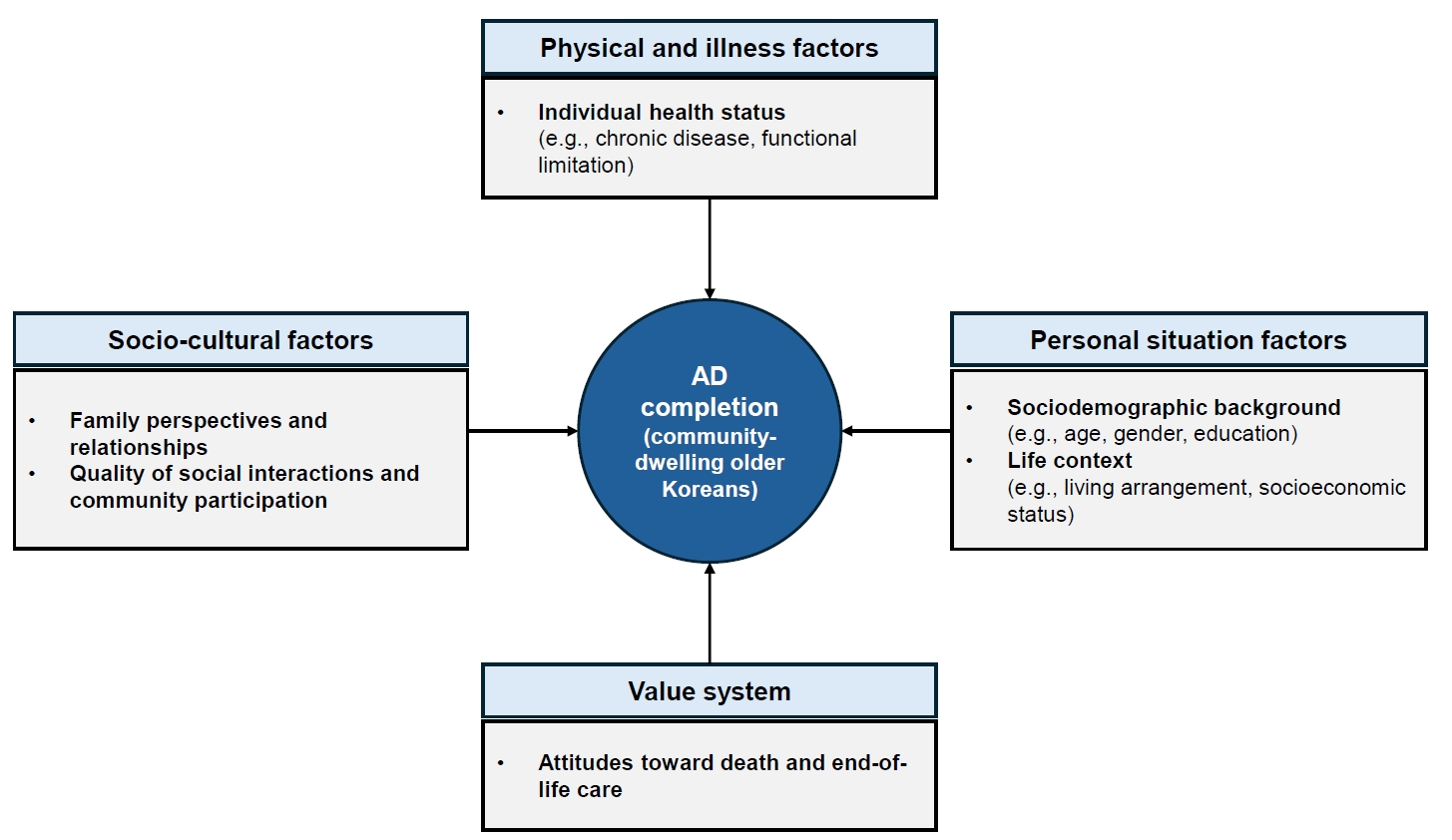
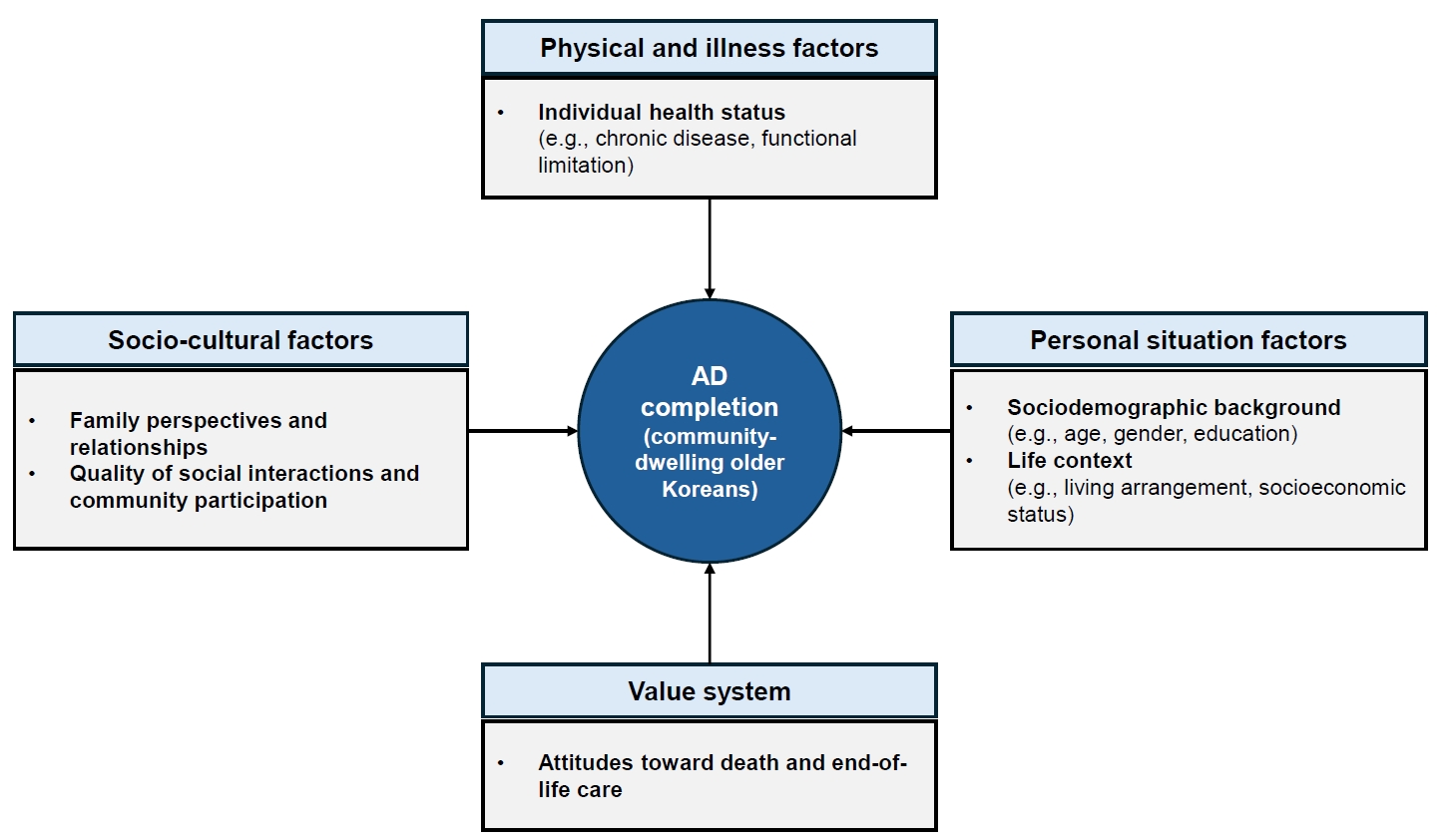
However, this framework was originally developed in the context of palliative care units, where ADs are discussed and completed with healthcare professionals. In contrast, because AD completion among community-dwelling older adults in Korea primarily occurs through community-based organizations rather than healthcare institutions, the conditional and process factors—which presuppose discussions with healthcare professionals—were not relevant to the experiences of the study population. Accordingly, these two factors were excluded, and the framework was reconstructed into four groups of factors—personal situation, socio-cultural, physical and illness, and value system—based on the context of community-dwelling older Koreans and a review of prior studies, and was employed for the analysis (Figure 1).
The four groups of factors were defined as follows: personal situation (sociodemographic background and life context), socio-cultural (family perspectives and quality of social interactions, including presence of children), physical and illness (individual health status), and value system (attitudes toward death and end-of-life care). In particular, this study considered the presence of children as a key factor influencing the nature of family relationships and included it under socio-cultural factors. Physical and illness factors were defined as variables reflecting an individual’s health status, whereas value system factors were defined as variables reflecting personal attitudes and perceptions regarding the purpose and meaning of ADs and end-of-life care.
Therefore, this study adapted and reconstructed the framework of Chan et al. [25] to align with the context of community-dwelling older Koreans and the characteristics of the dataset, with the aim of examining the multidimensional factors influencing AD completion in this population.
3. Description of primary data
The 2023 National Survey of Older Koreans (6th wave) is a nationwide survey conducted every 3 years since 2008, targeting adults aged 65 years or older. It is based on the Older Persons Welfare Act and aims to provide foundational data for the development of aging-related policies in Korea [26].
This nationwide survey applied a stratified cluster sampling method based on a complex sampling design to ensure its representativeness. Stratification was conducted in three stages based on Korea’s (1) 17 administrative regions, (2) area type (urban versus rural), and (3) housing type (apartment versus non-apartment housing). Based on these criteria, 52 strata were constructed. Within each stratum, survey areas and sample households were selected, and a complete enumeration survey was conducted for all adults aged 65 years or older residing in the selected households [26].
4. Samples used for analysis
The 2023 National Survey of Older Koreans (6th wave) was conducted with a nationwide target population of 9.5 million adults aged 65 years or older. Data were collected from 10,178 older Koreans residing in 7,605 households across 977 survey areas. After excluding cases with incomplete responses, data from 10,078 older Koreans were made publicly available [26]. Analyses were conducted using data from 9,951 older Koreans who completed the survey through self-response.
5. Measurement

1) Dependent variable

An AD is a legal document in which individuals specify, in advance, the medical treatments they would accept or refuse in the event of losing their decision-making capacity in the future [5]. In this study, AD completion was measured using the item, “Have you completed advance directives in preparation for end-of-life care?” Responses were collected as a binary variable (“yes” or “no”).

2) Independent variables

(1) Personal situation factors

Personal situation factors were assessed using the following variables: sex, age, educational level, religion, annual family income level, living status, life satisfaction, housing preference in the event of poor health.
Sex was categorized as male or female. Age was recategorized into four groups: 65–69 years, 70–79 years, 80–89 years, and 90 years or older. Educational level was categorized as follows: illiterate or barely literate, elementary school, middle school, high school, and college or higher. Religion was dichotomized as having a religion or not.
Family income level was measured as annual equivalized household income, calculated by dividing the total annual household income by the square root of the number of household members. This measure adjusts for household size to allow fair comparisons across households of different sizes. Using this variable, family income level was recategorized into quintiles (1st–5th) according to the original dataset classification.
Living status was categorized as living alone, living with a spouse, living with children, or other.
Life satisfaction was measured using the question, “How satisfied are you with your overall life?” Responses were recategorized into three groups: satisfied (very satisfied and satisfied), neutral, and dissatisfied (dissatisfied and very dissatisfied).
Housing preference in the event of poor health was assessed using the item, “Where would you prefer to live if your health deteriorated to the point where independent daily living became difficult?” Responses were categorized as follows: live at home, move in with family, move near family, senior housing residence, or senior care facility. Other responses were excluded from the analysis (n=12).

(2) Socio-cultural factors

Socio-cultural factors included presence of children, presence of friends or neighbors, participation in social activities, and satisfaction with social relationships.
Presence of children was recoded based on co-residing children and non-co-residing surviving children; respondents with at least one child in either category were classified as “having children” while those with no children in both categories were classified as “having no children.”
The presence of friends or neighbors was assessed using the item, “Do you have close friends, neighbors, or acquaintances?” with responses classified as “yes” or “no.”
Participation in social activities was defined according to previous research based on participation in at least one of the following within the past year [27,28]: hobby groups, alumni or peer groups, or political/social organizations. Respondents were classified as participants or non-participants depending on whether they had engaged or not engaged in any activity.
Satisfaction with social relationships was measured using the item, “How satisfied are you with your interactions with friends and neighbors, excluding family members?” Responses were recategorized into three groups: satisfied (very satisfied and satisfied), neutral, and dissatisfied (dissatisfied and very dissatisfied).

(3) Physical and illness factors

Physical and illness factors were assessed based on the number of chronic diseases and overall functional status.
The number of chronic diseases was assessed based on responses to the item, “Do you have any chronic diseases diagnosed by a physician, that lasted for 3 months or longer?” The number of reported conditions was categorized as 0, 1, 2, or ≥3.
Overall functional status was derived by combining measures of activities of daily living (ADL) and instrumental activities of daily living (IADL). ADL included seven items related to basic daily functions, such as dressing, washing, and mobility. IADL included ten items related to more complex functions, such as meal preparation, laundry, and medication management. Each item was rated as “independent,” “partially dependent,” or “fully dependent.” Respondents were classified as having functional limitations if they reported “partially dependent” or “fully dependent” on at least one ADL or IADL item and having no functional limitations if they reported being “independent” on all items.

(4) Value system

Value system factors included awareness of hospice and palliative care services, participation in death preparedness education, and documentation of organ donation. Awareness of hospice and palliative care services was assessed using the item, “Are you aware of hospice and palliative care services?” with response options of “yes,” “no,” and “Have heard of it, but do not know well.” Participation in death preparedness education was measured based on whether the respondent had ever attended such education programs (“yes” or “no”). Organ donation documentation was assessed using the item, “Have you registered for organ donation?” with responses of “yes” or “no.”
6. Data analysis
The original data were downloaded on February 27, 2025, following approval from the Institutional Review Board (IRB). The data were collected using a complex sampling design; hence, stratification, clustering, and sampling weights were applied in the analysis.
Participants’ characteristics were presented using the actual sample size (unweighted frequencies) and weighted estimates (percentages) based on complex sample weights. Differences in variables according to the AD completion status were examined using complex sample cross-tabulation analysis, and statistical significance was tested using the Rao-Scott chi-square test.
According to previous studies showing that AD completion in older adults is formed by the interaction of various factors [11,12], this study included all theoretically relevant variables and examined them using complex sample binary logistic regression to comprehensively capture the multidimensional factors influencing AD completion and to control for confounding effects among variables. Complex sample binary logistic regression analyses were performed using the svy command in Stata/MP ver. 18.0 (Stata Corp.) to account for the stratified multistage cluster sampling design. Sampling weights (post-stratification weights), stratification, and primary sampling units were specified according to the original survey design defined by the survey organization. All analyses were performed using Stata/MP ver. 18.0 (Stata Corp.), with the significance level set at p<.05.
7. Ethical considerations
The 2023 National Survey of Older Koreans (6th wave) used in this study was approved by the IRB of the Korea Institute for Health and Social Affairs (approval no., 2023-078) and conducted with approval from Statistics Korea (approval no., 117071). This study involved secondary data analysis and was exempted from review by the IRB of Chung-Ang University (approval no., 1041078-20250107-HR-006). Accordingly, the original data were obtained from the providing institution without requiring additional informed consent from participants.
According to the results, approximately 11.14% of older Koreans had completed an AD, corresponding to 1,109 respondents out of the total sample of 9,951 (actual unweighted frequencies). Differences in AD completion by factors were analyzed using the Rao-Scott chi-square test, and the main results are presented in Table 1.
1. Differences in factors of AD completion
Among personal situation factors, educational level showed a significant association with AD completion (χ2=8.68, p<.001). In the AD completion group, 13.3% of respondents had college-level or higher education, which was approximately twice the rate observed in the non-completion group (6.3%). Conversely, the proportion of respondents with no formal education or low literacy was 12.4% and 8.2% in the non-completion and completion groups, respectively. Religion also showed a significant association with AD completion (χ2=28.21, p<.001).
Life satisfaction was also significantly associated with AD completion (χ2=3.23, p=.043). The proportion of respondents reporting “satisfied” for life satisfaction was 46.1% in the AD completion group, compared to 39.5% in the non-completion group.
In addition, there was a significant difference in AD completion status according to housing preference in the event of poor health (χ2=4.93, p<.001). Among respondents who preferred to remain at home, 38.6% were in the AD completion group, compared to 50.2% in the non-completion group.
Among socio-cultural factors, the presence of friends or neighbors was significantly associated with AD completion (χ2=4.85, p=.028). Participation in social activities was also significantly associated with AD completion (χ2=18.59, p<.001). Furthermore, satisfaction with social relationships showed a significant difference by AD completion status (χ2=6.43, p=.002), with 52.9% of respondents in the AD completion group reporting high satisfaction, compared to 44.4% in the non-completion group.
Among physical and illness factors, the number of chronic diseases was significantly associated with AD completion (χ2=6.21, p<.001), with the highest AD completion rate (43.8%) observed among respondents with three or more chronic diseases.
Within value system factors, all variables showed significant associations with AD completion: awareness of hospice and palliative care service (χ2=12.62, p<.001), participation in death preparedness education (χ2=58.18, p<.001), and documentation of organ donation (χ2=194.88, p<.001).
2. Factors associated with AD completion
To comprehensively analyze the factors influencing AD completion, a complex sample binary logistic regression was performed using all variables included in the complex sample cross-tabulation analysis as independent variables. A total of 35 independent parameters were included in the regression model after dummy coding of categorical variables. The events per variable (EPV), calculated based on the number of AD completions (n=1,109), was approximately 31.7 (1,109/35), exceeding the recommended threshold of EPV ≥10 [29]. Therefore, the risk of overfitting in this analysis was considered to be low. Additionally, multicollinearity was assessed, with a mean variance inflation factor of 1.96, indicating no significant multicollinearity. The results are presented in Table 2.
Among personal situation factors, age was not significant in cross-sectional analyses but was significantly associated with AD completion in some categories in complex-samples logistic regression analyses. Compared to the 65–69 age group, the likelihood of AD completion was higher in the 70–79 (adjusted odds ratio [aOR], 1.50; 95% confidence interval [CI], 1.19–1.90) and 80–89 (aOR, 1.68; 95% CI, 1.13–2.50) age groups. No significant association was found between being aged 90 years or older and AD completion (aOR, 1.65; 95% CI, 0.77–3.55).
Educational level was also a significant factor. Compared to individuals who were illiterate or barely literate, those with a college degree or higher had a greater likelihood of completing an AD (aOR, 2.79; 95% CI, 1.60–4.84). The group with a religion was more likely to complete an AD than the group without a religion (aOR, 1.30; 95% CI, 1.09–1.54).
Housing preference in the event of poor health was also significantly associated with AD completion. Compared to those who preferred to remain at home, respondents who preferred living with family (aOR, 1.98; 95% CI, 1.20–3.30), living near family (aOR, 1.69; 95% CI, 1.05–2.73), in senior housing (aOR, 1.51; 95% CI, 1.11–2.04), or care facilities (aOR, 1.47; 95% CI, 1.09–1.98) were more likely to complete an AD.
Within socio-cultural factors, presence of children was significantly associated with AD completion (aOR, 1.57; 95% CI, 1.01–2.44). The group that participated in social activities was more likely to complete an AD compared to the group that did not participate (aOR, 1.42; 95% CI, 1.12–1.80). Satisfaction with social relationships also had a significant association with AD completion. The group with high satisfaction was more likely to complete an AD compared to that with low satisfaction (aOR, 1.58; 95% CI, 1.03–2.41).
Among physical and illness factors, the number of chronic diseases had a significant association with AD completion. Both the group with two chronic diseases (aOR, 1.50; 95% CI, 1.06–2.13) and the group with three or more chronic diseases (aOR, 2.07; 95% CI, 1.43–3.00) were more likely to complete an AD compared to that with no chronic diseases.
All the variables within the value system were significantly associated with AD completion. The group that was aware of hospice services was more likely to complete an AD compared to the group that was unaware (aOR, 1.53; 95% CI, 1.06–2.20). The group that had received death preparedness education was significantly more likely to complete an AD compared to the group that had not received such education (aOR, 2.58; 95% CI, 1.57–4.24). The presence of organ donation documentation was significantly associated with AD completion (aOR, 5.32; 95% CI, 3.27–8.67).
Life satisfaction and presence of friends or neighbors showed significant differences in the cross-tabulation analysis, and no significance was associated with AD completion in the complex sample logistic regression analysis.
This study conducted a multidimensional analysis of the factors associated with AD completion among community-dwelling older Koreans aged 65 years or older, using nationally representative data. Its analysis showed that 11.14% of community-dwelling older Koreans had completed an AD, which is comparable to the official AD registration rate of 17.3% among adults aged 65 and above as of December 2024 [10]. This study was based on a previously proposed conceptual framework of factors influencing AD completion in Asian contexts [25]. It focused on four groups of factors: personal situation, socio-cultural, physical and illness, and value system.
Among the personal situation factors, age, educational level, religion, and housing preference in the event of poor health were significantly associated with AD completion.
The association between age and AD completion is consistent with previous studies [30,31]. However, prior research has typically treated age as a continuous variable or used 60 years as a cutoff, which limits the extent to which the characteristics of the oldest-old (nonagenarians) can be captured. In this study, no significant association was observed between AD completion and age among the nonagenarian group. This may be explained by two factors. First, the number of AD completions in this group was small (n=16), which may have limited the statistical power. Second, nonagenarians may represent a distinct subgroup of older Koreans with different physical and cognitive characteristics, requiring a differentiated approach [32]. Future research with a larger sample of nonagenarians is necessary to identify the patterns of AD completion in this population.
Sex was not significantly associated with AD completion. This result differs from previous studies [16,33]. It also differs from official statistics on AD registration, which show that among registrants aged 65 years and older, 66% are women and 33% are men [10]. This discrepancy may be attributable to differences between the study sample and the overall population of AD registrants. Our study focused only on community-dwelling older Koreans, whereas AD registration takes place not only in community settings but also in some healthcare institutions, which may have influenced the results. Therefore, future research should compare and analyze sex differences in AD registration across different settings and contexts, including both community and institutional environments.
Individuals with a college degree or higher were more likely to complete an AD compared to those who were illiterate or barely literate. This finding is consistent with previous studies reporting that educational attainment is significantly associated with AD completion [16,30,34]. This may be related to differences in access to health-related information and communication skills shaped by individuals’ educational experiences [34], which can affect their engagement in autonomous decision-making regarding end-of-life care. Therefore, tailored interventions and educational support should be considered for individuals with lower educational levels.
In this study, participation in death preparedness education and awareness of hospice and palliative care services were significantly associated with AD completion. Thus, in addition to educational levels, access to information is a key factor influencing AD completion. Access to information can facilitate end-of-life discussions, which are essential for supporting AD completion. In this context, A randomized trial among older veterans found that an easy-to-read AD and interactive online education increased ACP documentation and engagement [35], suggesting that tailored information facilitates end-of-life discussions. Accordingly, strategies that address educational levels and information accessibility—tailored and multifaceted approaches, including face-to-face education—are necessary to support AD completion.
In this study, family income was not significantly associated with AD completion. This finding differs from previous studies that reported higher income was linked to an increased likelihood of AD completion [36]. Such a discrepancy may be interpreted in light of differences in institutional contexts between the United States and Korea. In the United States, AD completion operates as a voluntary registration system based on state laws [37], which may have made it difficult to sufficiently consider equity, thereby allowing income level to influence completion. In contrast, in Korea, the government designates and expands registration institutions and manages a centralized database to ensure universal access through an institutional management system. Accordingly, family income does not appear to have a direct effect on AD completion in Korea.
Among physical and illness factors, having two or more chronic conditions was significantly associated with a higher likelihood of AD completion, consistent with previous findings [16,34]. Furthermore, A higher likelihood of AD completion was observed among individuals who preferred informal caregiving such as moving in with family or near family, as their housing preference in the event of poor health. Informal caregiving is associated with place of death, which is considered an important indicator of the quality of death [38].
A preference for informal care implies that the individual expects that a family caregiver will be available to provide such care. Based on this premise, the findings of this study can be interpreted in two ways. First, as discussions regarding end-of-life preferences generally occur within a trusted environment [39], individuals who trust their family and prefer to receive care from them are more likely to engage in end-of-life discussions [40], and consequently, may also be more likely to complete an AD. Second, this may reflect a psychological attitude, common in Asian cultures, of not wanting to place a caregiving burden on family members [34,41,42], which aligns with the perception that completing an AD can help reduce this burden [41]. These findings suggest that as chronic conditions accumulate, older Koreans tend to document their preferences for end-of-life medical care in advance to alleviate the caregiving burden on family members. On the surface, the tendency to rely on family and the desire not to place a caregiving burden on them may appear contradictory. However, since the older Koreans in this study responded based on a hypothetical future scenario rather than an actual situation, it is possible that both motivations coexisted.
In this context, the concept of “aging in place (AIP)” aims to support older adults in maintaining autonomy and independence while remaining in familiar community environments. In line with this goal, the Korean government is developing formal caregiving systems to promote AIP [43]. However, Korea’s current legal framework restricts the implementation of withholding or withdrawing life-sustaining treatment in accordance with patients’ ADs primarily to certain registered medical institutions, typically general hospitals, or higher-level facilities. Consequently, AD-related services are confined to institutional settings, which hinders their integration with community-based AIP initiatives. Therefore, it would be necessary to revise AD-related policies to facilitate implementation within community-based settings, facilitating more effective integration with AIP strategies.
In this study, the presence of children was identified as a significant factor associated with a higher likelihood of AD completion, whereas living status, reflecting family co-residence, was not significantly associated. Considering that AD functions as a documentation strategy within ACP [3], our findings should be interpreted within the broader ACP framework, within which previous studies have reported that individuals with children or a spouse were more likely to engage in ACP [20,44,45]. Moreover, the role of family is particularly salient in Asian contexts, where family-centered cultural characteristics shape ACP [25,46].
In particular, under the influence of filial piety values, adult children often play a leading role in end-of-life decision-making for older adults [47]. Thus, the existence of children as decision-making agents may be more important than whether or not family members live together. In line with this interpretation, several studies conducted in Asian contexts have reported that family opposition is a major barrier to AD completion [30,48]. In Asian contexts, family-centeredness is known to play a major role in shaping ACP, making it essential to consider the concept of relational autonomy—wherein patient autonomy is defined within family relationships—when developing ACP-related policies and clinical practices [49-51].
Taken together, these findings suggest that the presence of family members or living arrangements alone may not directly influence AD completion; rather, contextual factors, such as the quality of family relationships, cultural values, and decision-making dynamics, may be more significant. Therefore, future research should directly examine factors such as family interactions, communication processes, and role distribution within families to gain a deeper understanding of the family’s influence on AD completion.
Among socio-cultural factors, participation in social activities and satisfaction with social relationships were significantly associated with AD completion. This finding is consistent with those of previous studies [52,53]—the autonomy of older adults is influenced by individual characteristics and social relationships. Older Koreans who have higher satisfaction with social relationships may experience enhanced autonomy through positive social relationships, which, in turn, can lead to greater engagement in AD completion.
Additionally, participation in social activities was also identified as a factor that increases the likelihood of AD completion. This may be because social activities foster group cohesion, promote the exchange and dissemination of health information, leading to changes in health behaviors [54], and serve as a means to alleviate social isolation and provide emotional support [52,55]. Therefore, it is necessary to establish an infrastructure that promotes social participation among older adults. Moreover, policy efforts are necessary to ensure that adequate information on ADs is accessible even to older adults, whose social participation is limited. This can be achieved by implementing tailored education and counseling programs through public institutions that maintain close contact with socially isolated older adults, and by promoting awareness of ADs through various media channels to enhance public understanding.
Within the value system, documentation of organ donation was associated with a higher likelihood of AD completion. One possible explanation is the low prevalence of both behaviors, which can inflate statistical significance. Another explanation is that both decisions share a common context of preparing for the end of life.
Previous studies have pointed out that these two decisions are difficult to implement concurrently under Korea’s current institutional framework, and a decline in organ donation registration has been observed since LST Decision Act [53]. This issue may stem from a conflict between the two systems. As organ donation registration and AD completion are considered elements of end-of-life self-determination, legal and institutional adjustments are necessary to ensure that both decisions are supported.
This study has several limitations. First, as it was a cross-sectional secondary analysis of national survey data, causal relationships could not be determined. Second, as AD completion was assessed through self-reporting, the possibility of reporting bias cannot be ruled out. Furthermore, as the analysis included only cases completed through self-response, a potential exists for selection bias related to cognitive or functional status among the study participants. Third, given the large sample size, even relatively small effects may have reached statistical significance. In addition, the uneven distribution of certain independent variables (e.g., very low participation in death preparedness education or documentation of organ donation) resulted in wide confidence intervals for some estimates. These issues warrant caution in the interpretation of the findings. Fourth, although the survey included a wide range of variables related to the lives of older adults, it may not have captured all the relevant factors influencing AD completion, leaving the possibility of omitted variables. As this study focused on analyzing four groups of factors from the conceptual framework, it did not encompass all possible dimensions, such as conditional or process-related factors. Finally, although ADs represent a component of ACP, this study focused solely on the completion of AD documentation and did not encompass the broader processes of discussion or planning.
Nevertheless, as AD completion among older adults is influenced by multiple factors [11,12], this study provides a more comprehensive understanding by exploring these factors from a multidimensional perspective. Contrary to previous studies that focused mainly on attitudes or intentions toward ACP, this study uniquely examines actual AD completion behaviors, applying a conceptual framework that reflects Asian cultural characteristics.
In particular, the use of nationally representative survey data strengthens the relevance of its findings by reflecting the older adult population’s characteristics. Considering the complex factors influencing AD completion among older adults, nursing practice across various care settings can play a key role in facilitating person-centered ACP discussions, helping to close the gap between the act of completing an AD and the realization of genuine self-determination.
This study used data from the 2023 National Survey of Older Koreans (6th wave) to analyze the factors associated with AD completion among community-dwelling older Koreans from a multidimensional perspective. Age, educational level, religion, housing preference in the event of poor health, participation in death preparedness education, and documentation of organ donation were significantly associated with AD completion. In particular, awareness of hospice and palliative service, presence of children, participation in social activities, satisfaction with social relationships, and number of chronic diseases were significantly related to AD completion.
These insights highlight the significance of viewing AD completion as a practical process of supporting autonomy within community-based policies for older adults by providing empirical evidence to promote the alignment and integration of end-of-life care policies. Future end-of-life decision-making policies should prioritize integrating AD processes into community-based care systems, while nursing interventions should focus on developing ACP promotion strategies and nurse-led counseling and education programs. Such approaches can help ensure that older adults are supported in achieving genuine self-determination at the end of life.

Conflicts of Interest

No potential conflict of interest relevant to this article was reported.

Acknowledgements

None.

Funding

None.

Data Sharing Statement

The raw data in this study can be accessed through the Statistics Korea Micro Data Integrated Service website (https://mdis.kostat.go.kr/index.do) after agreeing to the ‘User Agreement for Raw Data Access.’ The dataset analyzed in this study was derived from the original raw data. The processed dataset is not publicly available; however, it can be requested.

Author Contributions

Conceptualization and/or Methodology: SNJ, HJJ. Data curation and/or Analysis: HJJ. Project administration and/or Supervision: SNJ. Resources and/or Software: HJJ. Validation: SNJ. Writing original draft or/and Review & Editing: SNJ, HJJ. Final approval of the manuscript: all authors.

Fig. 1.
Study framework: multidimensional factors associated with advance directive (AD) completion.
jkan-25098f1.jpg
Table 1.
Comparison of characteristics by advance directive completion status (N=9,951)
Characteristic Total Advance directive completion
Yes No Rao-Scott χ2 (p)a)
Personal situation factors
 Sex 0.13 (.722)
  Male 3,824 (44.0) 426 (43.5) 3,398 (44.1)
  Female 6,127 (56.0) 683(56.5) 5,444 (55.9)
 Age (yr) 2.29 (.081)
  65–69 3,243 (34.8) 325 (29.7) 2,918 (35.5)
  70–79 4,400 (41.1) 546 (45.9) 3,854 (40.5)
  80–89 2,135 (21.7) 222 (21.9) 1,913 (21.7)
  ≥90 173 (2.4) 16 (2.5) 157 (2.4)
 Educational level 8.68 (<.001)
  Illiterate or barely literate 1,435 (11.9) 121 (8.2) 1,314 (12.4)
  Elementary school 2,920 (28.2) 346 (29.7) 2,574 (28.0)
  Middle school 2,114 (21.4) 202 (17.7) 1,912 (21.8)
  High school 2,860 (31.5) 317 (31.1) 2,543 (31.5)
  College or more 622 (7.1) 123 (13.3) 499 (6.3)
 Religion 28.21 (<.001)
  Yes 4,071 (60.0) 576 (49.3) 3,495 (61.3)
  No 5,880 (40.0) 533 (50.7) 5,347 (38.7)
 Family income level (/yr) 1.16 (.324)
  1st quintile (lowest) 2,107 (20.0) 199 (18.5) 1,908 (20.2)
  2nd quintile 2,167 (20.0) 271 (20.1) 1,896 (19.9)
  3rd quintile (middle) 2,026 (19.9) 222 (18.6) 1,804 (20.1)
  4th quintile 1,910 (20.1) 202 (18.9) 1,708 (20.3)
  5th quintile (highest) 1,741 (20.0) 215 (23.9) 1,526 (19.6)
 Living status 2.25 (.088)
  Lives alone 3,423 (33.0) 383 (33.2) 3,040 (32.9)
  Lives with a spouse 5,419 (55.3) 647 (58.4) 4,772 (55.0)
  Lives with adult children 940 (10.0) 68 (7.5) 872 (10.3)
  Other 169 (1.7) 11 (0.9) 158 (1.8)
 Life satisfaction 3.23 (.043)
  Good 3,983 (40.3) 505 (46.1) 3,478 (39.5)
  Average 5,110 (51.0) 528 (46.5) 4,582 (51.6)
  Bad 858 (8.7) 76 (7.5) 782 (8.9)
 Housing preference in the event of poor healthb) 4.93 (<.001)
  Live at home 4,981 (48.9) 433 (38.6) 4,548 (50.2)
  Move in with family (cohabitation) 259 (2.5) 32 (3.8) 227 (2.4)
  Move near family (independent) 396 (4.3) 66 (6.0) 330 (4.1)
  Senior housing residence (no insurance) 1,489 (16.5) 211 (22.8) 1,278 (15.7)
  Senior care facility (insurance) 2,814 (27.7) 366 (28.8) 2,448 (27.6)
Socio-cultural factors
 Presence of children 2.60 (.107)
  Yes 9,410 (94.0) 1,067 (95.6) 8,343 (93.8)
  No 541 (6.0) 42 (4.4) 499 (6.2)
 Presence of friends or neighbors 4.85 (.028)
  Yes 8,946 (89.8) 1,027 (92.6) 7,919 (89.5)
  No 1,005 (10.2) 82 (7.5) 923 (10.5)
 Participation in social activities 18.59 (<.001)
  Yes 5,340 (53.3) 708 (34.6) 4,632 (46.0)
  No 4,611 (44.7) 401 (65.4) 4,210 (54.0)
 Satisfaction with social relationships 6.43 (.002)
  Good 4,583 (45.3) 606 (52.9) 3,977 (44.4)
  Average 4,454 (45.1) 434 (39.6) 4,020 (45.8)
  Bad 914 (9.6) 69 (7.5) 845 (9.8)
Physical and illness factors
 No. of chronic diseases 6.21 (<.001)
  0 1,363 (14.1) 97 (10.7) 1,266 (14.4)
  1 2,163 (22.2) 184 (18.2) 1,979 (22.7)
  2 2,744 (28.1) 308 (27.3) 2,436 (28.2)
  ≥3 3,681 (35.6) 520 (43.8) 3,161 (34.6)
 Overall functional status 1.20 (.274)
  Limited 1,648 (17.7) 190 (19.7) 1,458 (17.4)
  Unlimited 8,303 (82.3) 919 (80.3) 7,384 (82.6)
Value system
 Awareness of hospice and palliative services 12.62 (<.001)
  Yes 1,355 (16.0) 242 (26.5) 1,113 (14.7)
  Heard of 4,195 (43.4) 394 (37.8) 3,801 (44.1)
  None 4,401 (40.5) 473 (35.7) 3,928 (41.2)
 Participation in death preparedness education 58.18 (<.001)
  Yes 297 (4.2) 115 (13.6) 182 (3.0)
  No 9,654 (95.8) 994 (86.4) 8,660 (97.0)
 Documentation of organ donation 194.88 (<.001)
  Yes 361 (4.5) 162 (14.6) 199 (2.3)
  No 9,590 (95.5) 947 (85.4) 8,643 (97.7)

Values are presented as unweighted frequency (weighted %), unless otherwise stated. Weighted percentages are presented. Percentages may not total 100 because of rounding.

a)Rao-Scott χ2 test using complex sample design. b)“Other” responses excluded (n=12).

Table 2.
Factors associated with advance directive completion (N=9,951)
Independent variable Classification Advance directive completion
Crude Adjusted
OR (95% CI)a) p aOR (95% CI)a) p
Personal situation factors
 Sex (ref: male) Female 1.03 (0.89–1.18) .721 1.10 (0.93–1.30) .269
 Age (yr) (ref: 65–69) 70–79 1.36 (1.11–1.65) .003 1.50 (1.19–1.90) .001
80–89 1.21 (0.90–1.62) .214 1.68 (1.13–2.50) .011
≥90 1.28 (0.64–2.57) .486 1.65 (0.77–3.55) .199
 Educational level (ref: illiterate or barely literate) Elementary school 1.60 (1.17–2.20) .003 1.54 (1.11–2.12) .009
Middle school 1.23 (0.88–1.72) .234 1.23 (0.85–1.79) .271
High school 1.49 (1.06–2.10) .022 1.47 (0.98–2.20) .063
College or more 3.20 (2.01–5.09) <.001 2.79 (1.60–4.84) <.001
 Religion (ref: no) Yes 1.63 (1.36–1.95) <.001 1.30 (1.09–1.54) .004
 Family income level (/yr) (ref: 1st quintile) 2nd quintile 1.10 (0.83–1.50) .502 1.21 (0.94–1.57) .141
3rd quintile (middle) 1.01 (0.72–1.43) .942 1.03 (0.75–1.41) .845
4th quintile 1.02 (0.72–1.43) .926 1.02 (0.74-1.40) .915
5th quintile (highest) 1.33 (0.92–1.93) .128 1.34 (0.92–1.96) .127
 Living status (ref: lives alone) Lives with a spouse 1.06 (0.86–1.30) 0.61 1.11 (0.89–1.38) .337
Lives with adult children 0.72 (0.47–1.11) 0.14 0.71 (0.45–1.11) .130
Other 0.52 (0.25–1.06) 0.07 0.67 (0.33–1.38) .276
 Life satisfaction (ref: bad) Average 1.07 (0.74–1.54) .723 0.93 (0.61–1.43) .756
Good 1.38 (0.91–2.11) .134 0.94 (0.57–1.56) .814
 Housing preference in the event of poor health (ref: lives at home) Move in with family (cohabitation) 2.13 (1.28–3.53) .003 1.98 (1.20–3.30) .008
Move near family (independent) 1.91 (1.13–3.21) .015 1.69 (1.05–2.73) .030
Senior housing residence (no insurance) 1.88 (1.37–2.59) <.001 1.51 (1.11–2.04) .008
Senior care facility (insurance) 1.35 (0.99–1.84) .054 1.47 (1.09–1.98) .013
Socio-cultural factors
 Presence of children (ref: no) Yes 1.44 (0.92–2.23) .109 1.57 (1.01–2.44) .046
 Presence of friends or neighbors (ref: no) Yes 1.46 (1.04–2.04) .029 1.26 (0.88–1.81) .203
 Social activity participation (ref: no) 1.61 (1.30–2.01) <.001 1.42 (1.12–1.80) .004
 Social relationship satisfaction (ref: bad) Average 1.13 (0.80–1.61) .481 1.23 (0.81–1.86) .320
Good 1.56 (1.08–2.25) .017 1.58 (1.03–2.41) .037
Physical and illness factors
 Number of chronic diseases (ref: 0) 1 1.08 (0.78–1.51) .643 1.23 (0.89–1.70) .200
2 1.31 (0.92–1.86) .136 1.50 (1.06–2.13) .022
≥3 1.71 (1.18–2.48) .005 2.07 (1.43–3.00) <.001
 Overall functional status (ref: limited) Unlimited 0.86 (0.65–1.13) .275 0.98 (0.75–1.27) .878
Value system
 Awareness of hospice and palliative service (ref: no) Heard of 0.99 (0.76–1.28) .923 0.87 (0.67–1.13) .307
Yes 2.07 (1.42–3.02) <.001 1.53 (1.06–2.20) .023
 Participation in death preparedness education (ref: no) 5.05 (3.20–7.98) <.001 2.58 (1.57–4.24) <.001
 Documentation of organ donation (ref: no) 7.63 (5.49–10.59) <.001 5.32 (3.27–8.67) <.001

aOR, adjusted odds ratio; CI, confidence interval; OR, odds ratio; Ref, reference group.

a)Complex sample analysis was conducted to aid in survey design and weighting.

Figure & Data

REFERENCES

    Citations

    Citations to this article as recorded by  

      • ePub LinkePub Link
      • Cite
        CITE
        export Copy Download
        Close
        Download Citation
        Download a citation file in RIS format that can be imported by all major citation management software, including EndNote, ProCite, RefWorks, and Reference Manager.

        Format:
        • RIS — For EndNote, ProCite, RefWorks, and most other reference management software
        • BibTeX — For JabRef, BibDesk, and other BibTeX-specific software
        Include:
        • Citation for the content below
        Multidimensional factors influencing the completion of advance directives among community-dwelling older Koreans
        J Korean Acad Nurs. 2025;55(4):543-556.   Published online November 18, 2025
        Close
      • XML DownloadXML Download
      Figure
      • 0
      We recommend
      Related articles
      Multidimensional factors influencing the completion of advance directives among community-dwelling older Koreans
      Image
      Fig. 1. Study framework: multidimensional factors associated with advance directive (AD) completion.
      Multidimensional factors influencing the completion of advance directives among community-dwelling older Koreans
      Characteristic Total Advance directive completion
      Yes No Rao-Scott χ2 (p)a)
      Personal situation factors
       Sex 0.13 (.722)
        Male 3,824 (44.0) 426 (43.5) 3,398 (44.1)
        Female 6,127 (56.0) 683(56.5) 5,444 (55.9)
       Age (yr) 2.29 (.081)
        65–69 3,243 (34.8) 325 (29.7) 2,918 (35.5)
        70–79 4,400 (41.1) 546 (45.9) 3,854 (40.5)
        80–89 2,135 (21.7) 222 (21.9) 1,913 (21.7)
        ≥90 173 (2.4) 16 (2.5) 157 (2.4)
       Educational level 8.68 (<.001)
        Illiterate or barely literate 1,435 (11.9) 121 (8.2) 1,314 (12.4)
        Elementary school 2,920 (28.2) 346 (29.7) 2,574 (28.0)
        Middle school 2,114 (21.4) 202 (17.7) 1,912 (21.8)
        High school 2,860 (31.5) 317 (31.1) 2,543 (31.5)
        College or more 622 (7.1) 123 (13.3) 499 (6.3)
       Religion 28.21 (<.001)
        Yes 4,071 (60.0) 576 (49.3) 3,495 (61.3)
        No 5,880 (40.0) 533 (50.7) 5,347 (38.7)
       Family income level (/yr) 1.16 (.324)
        1st quintile (lowest) 2,107 (20.0) 199 (18.5) 1,908 (20.2)
        2nd quintile 2,167 (20.0) 271 (20.1) 1,896 (19.9)
        3rd quintile (middle) 2,026 (19.9) 222 (18.6) 1,804 (20.1)
        4th quintile 1,910 (20.1) 202 (18.9) 1,708 (20.3)
        5th quintile (highest) 1,741 (20.0) 215 (23.9) 1,526 (19.6)
       Living status 2.25 (.088)
        Lives alone 3,423 (33.0) 383 (33.2) 3,040 (32.9)
        Lives with a spouse 5,419 (55.3) 647 (58.4) 4,772 (55.0)
        Lives with adult children 940 (10.0) 68 (7.5) 872 (10.3)
        Other 169 (1.7) 11 (0.9) 158 (1.8)
       Life satisfaction 3.23 (.043)
        Good 3,983 (40.3) 505 (46.1) 3,478 (39.5)
        Average 5,110 (51.0) 528 (46.5) 4,582 (51.6)
        Bad 858 (8.7) 76 (7.5) 782 (8.9)
       Housing preference in the event of poor healthb) 4.93 (<.001)
        Live at home 4,981 (48.9) 433 (38.6) 4,548 (50.2)
        Move in with family (cohabitation) 259 (2.5) 32 (3.8) 227 (2.4)
        Move near family (independent) 396 (4.3) 66 (6.0) 330 (4.1)
        Senior housing residence (no insurance) 1,489 (16.5) 211 (22.8) 1,278 (15.7)
        Senior care facility (insurance) 2,814 (27.7) 366 (28.8) 2,448 (27.6)
      Socio-cultural factors
       Presence of children 2.60 (.107)
        Yes 9,410 (94.0) 1,067 (95.6) 8,343 (93.8)
        No 541 (6.0) 42 (4.4) 499 (6.2)
       Presence of friends or neighbors 4.85 (.028)
        Yes 8,946 (89.8) 1,027 (92.6) 7,919 (89.5)
        No 1,005 (10.2) 82 (7.5) 923 (10.5)
       Participation in social activities 18.59 (<.001)
        Yes 5,340 (53.3) 708 (34.6) 4,632 (46.0)
        No 4,611 (44.7) 401 (65.4) 4,210 (54.0)
       Satisfaction with social relationships 6.43 (.002)
        Good 4,583 (45.3) 606 (52.9) 3,977 (44.4)
        Average 4,454 (45.1) 434 (39.6) 4,020 (45.8)
        Bad 914 (9.6) 69 (7.5) 845 (9.8)
      Physical and illness factors
       No. of chronic diseases 6.21 (<.001)
        0 1,363 (14.1) 97 (10.7) 1,266 (14.4)
        1 2,163 (22.2) 184 (18.2) 1,979 (22.7)
        2 2,744 (28.1) 308 (27.3) 2,436 (28.2)
        ≥3 3,681 (35.6) 520 (43.8) 3,161 (34.6)
       Overall functional status 1.20 (.274)
        Limited 1,648 (17.7) 190 (19.7) 1,458 (17.4)
        Unlimited 8,303 (82.3) 919 (80.3) 7,384 (82.6)
      Value system
       Awareness of hospice and palliative services 12.62 (<.001)
        Yes 1,355 (16.0) 242 (26.5) 1,113 (14.7)
        Heard of 4,195 (43.4) 394 (37.8) 3,801 (44.1)
        None 4,401 (40.5) 473 (35.7) 3,928 (41.2)
       Participation in death preparedness education 58.18 (<.001)
        Yes 297 (4.2) 115 (13.6) 182 (3.0)
        No 9,654 (95.8) 994 (86.4) 8,660 (97.0)
       Documentation of organ donation 194.88 (<.001)
        Yes 361 (4.5) 162 (14.6) 199 (2.3)
        No 9,590 (95.5) 947 (85.4) 8,643 (97.7)
      Independent variable Classification Advance directive completion
      Crude Adjusted
      OR (95% CI)a) p aOR (95% CI)a) p
      Personal situation factors
       Sex (ref: male) Female 1.03 (0.89–1.18) .721 1.10 (0.93–1.30) .269
       Age (yr) (ref: 65–69) 70–79 1.36 (1.11–1.65) .003 1.50 (1.19–1.90) .001
      80–89 1.21 (0.90–1.62) .214 1.68 (1.13–2.50) .011
      ≥90 1.28 (0.64–2.57) .486 1.65 (0.77–3.55) .199
       Educational level (ref: illiterate or barely literate) Elementary school 1.60 (1.17–2.20) .003 1.54 (1.11–2.12) .009
      Middle school 1.23 (0.88–1.72) .234 1.23 (0.85–1.79) .271
      High school 1.49 (1.06–2.10) .022 1.47 (0.98–2.20) .063
      College or more 3.20 (2.01–5.09) <.001 2.79 (1.60–4.84) <.001
       Religion (ref: no) Yes 1.63 (1.36–1.95) <.001 1.30 (1.09–1.54) .004
       Family income level (/yr) (ref: 1st quintile) 2nd quintile 1.10 (0.83–1.50) .502 1.21 (0.94–1.57) .141
      3rd quintile (middle) 1.01 (0.72–1.43) .942 1.03 (0.75–1.41) .845
      4th quintile 1.02 (0.72–1.43) .926 1.02 (0.74-1.40) .915
      5th quintile (highest) 1.33 (0.92–1.93) .128 1.34 (0.92–1.96) .127
       Living status (ref: lives alone) Lives with a spouse 1.06 (0.86–1.30) 0.61 1.11 (0.89–1.38) .337
      Lives with adult children 0.72 (0.47–1.11) 0.14 0.71 (0.45–1.11) .130
      Other 0.52 (0.25–1.06) 0.07 0.67 (0.33–1.38) .276
       Life satisfaction (ref: bad) Average 1.07 (0.74–1.54) .723 0.93 (0.61–1.43) .756
      Good 1.38 (0.91–2.11) .134 0.94 (0.57–1.56) .814
       Housing preference in the event of poor health (ref: lives at home) Move in with family (cohabitation) 2.13 (1.28–3.53) .003 1.98 (1.20–3.30) .008
      Move near family (independent) 1.91 (1.13–3.21) .015 1.69 (1.05–2.73) .030
      Senior housing residence (no insurance) 1.88 (1.37–2.59) <.001 1.51 (1.11–2.04) .008
      Senior care facility (insurance) 1.35 (0.99–1.84) .054 1.47 (1.09–1.98) .013
      Socio-cultural factors
       Presence of children (ref: no) Yes 1.44 (0.92–2.23) .109 1.57 (1.01–2.44) .046
       Presence of friends or neighbors (ref: no) Yes 1.46 (1.04–2.04) .029 1.26 (0.88–1.81) .203
       Social activity participation (ref: no) 1.61 (1.30–2.01) <.001 1.42 (1.12–1.80) .004
       Social relationship satisfaction (ref: bad) Average 1.13 (0.80–1.61) .481 1.23 (0.81–1.86) .320
      Good 1.56 (1.08–2.25) .017 1.58 (1.03–2.41) .037
      Physical and illness factors
       Number of chronic diseases (ref: 0) 1 1.08 (0.78–1.51) .643 1.23 (0.89–1.70) .200
      2 1.31 (0.92–1.86) .136 1.50 (1.06–2.13) .022
      ≥3 1.71 (1.18–2.48) .005 2.07 (1.43–3.00) <.001
       Overall functional status (ref: limited) Unlimited 0.86 (0.65–1.13) .275 0.98 (0.75–1.27) .878
      Value system
       Awareness of hospice and palliative service (ref: no) Heard of 0.99 (0.76–1.28) .923 0.87 (0.67–1.13) .307
      Yes 2.07 (1.42–3.02) <.001 1.53 (1.06–2.20) .023
       Participation in death preparedness education (ref: no) 5.05 (3.20–7.98) <.001 2.58 (1.57–4.24) <.001
       Documentation of organ donation (ref: no) 7.63 (5.49–10.59) <.001 5.32 (3.27–8.67) <.001
      Table 1. Comparison of characteristics by advance directive completion status (N=9,951)

      Values are presented as unweighted frequency (weighted %), unless otherwise stated. Weighted percentages are presented. Percentages may not total 100 because of rounding.

      a)Rao-Scott χ2 test using complex sample design. b)“Other” responses excluded (n=12).

      Table 2. Factors associated with advance directive completion (N=9,951)

      aOR, adjusted odds ratio; CI, confidence interval; OR, odds ratio; Ref, reference group.

      a)Complex sample analysis was conducted to aid in survey design and weighting.


      J Korean Acad Nurs : Journal of Korean Academy of Nursing
      Close layer
      TOP