Skip Navigation
Skip to contents

J Korean Acad Nurs : Journal of Korean Academy of Nursing


Articles

Page Path
HOME > J Korean Acad Nurs > Ahead-of print articles > Article
Research Paper
Effects of a hybrid delirium nursing competency enhancement program using the metaverse and standardized patients for intensive care unit nurses: a quasi-experimental study
Juwon Yun1orcid, Mi Yang Jeon2orcid

DOI: https://doi.org/10.4040/jkan.26013
Published online: July 27, 2026

1Gyeongsang National University Changwon Hospital, Changwon, South Korea

2College of Nursing, Sustainable Health Research Institute, Gyeongsang National University, Jinju, South Korea

Corresponding author: Mi Yang Jeon College of Nursing, Sustainable Health Research Institute, Gyeongsang National University, 15 Jinju-daero 816beon-gil, Jinju 52727, South Korea E-mail: myjeon68@gnu.ac.kr
†This article is based on the first author's 2025 master's thesis.
• Received: February 4, 2026   • Revised: April 10, 2026   • Accepted: June 4, 2026

© 2026 Korean Society of Nursing Science

This is an Open Access article distributed under the terms of the Creative Commons Attribution NoDerivs License (http://creativecommons.org/licenses/by-nd/4.0) If the original work is properly cited and retained without any modification or reproduction, it can be used and re-distributed in any format and medium.

  • 225 Views
  • 9 Download
  • Purpose
    This study evaluated the effects of a hybrid simulation program using the metaverse and standardized patients to enhance delirium nursing competency among intensive care unit (ICU) nurses. Outcomes included delirium nursing knowledge, attitudes, and performance confidence.
  • Methods
    A quasi-experimental study with cluster allocation was conducted among 52 ICU nurses, including 28 in the experimental group and 24 in the control group. Data were collected from July 8 to August 28, 2024. The experimental group participated in a hybrid delirium nursing competency simulation program comprising two metaverse-based sessions (lectures, quizzes, discussions, and practice) followed by a face-to-face standardized patient simulation session. The control group received a conventional face-to-face lecture on delirium nursing. Data were analyzed using the chi-square test, the Fisher exact test, the independent t-test, and the paired t-test with IBM SPSS Statistics ver. 27.0.
  • Results
    After the intervention, the experimental group demonstrated significantly greater improvement in delirium nursing attitude (t=2.05, p=.046) and performance confidence (t=3.35, p=.002) compared with the control group. However, the change in delirium nursing knowledge did not differ significantly between groups (t=0.71, p=.483).
  • Conclusion
    The hybrid delirium nursing competency program using the metaverse and standardized patients was associated with greater positive changes in ICU nurses’ delirium nursing attitudes and performance confidence than conventional lecture-based education. This immersive and interactive hybrid simulation approach may be a sustainable continuing education strategy for strengthening delirium nursing competency among ICU nurses.
Delirium is a neuropsychiatric syndrome characterized by acute disturbances in cognition and alterations in the level of consciousness. It is often referred to as intensive care unit (ICU) syndrome or post–intensive care syndrome and is marked by a sudden onset and fluctuating course [1,2]. The reported incidence of delirium among patients admitted to ICUs ranges from 15% to 81% [2-5], which is substantially higher than the incidence observed in general ward or long-term care settings [6-9]. Given its significant clinical consequences, the most recent Pain, Agitation/Sedation, Delirium, Immobility, and Sleep Disruption guidelines identify delirium as a key indicator associated with prolonged ICU stay, long-term cognitive impairment, and increased mortality [10].
Patients in the ICU are at high risk for delirium due to factors such as severity of illness, use of sedatives, and environmental stressors like noise and physical restraints [11-13]. ICU nurses play a pivotal role in early detection through 24-hour continuous assessment [3,14]. However, many ICU nurses face significant psychological barriers, including anxiety and a lack of clinical self-efficacy when managing delirious patients who exhibit unpredictable or aggressive behaviors [14,15]. While delirium nursing competency—the integration of knowledge and skills to achieve desirable outcomes [16,17]—is essential, nurses often struggle due to insufficient clinical readiness and low confidence in applying complex assessment tools under pressure [15,17]. Therefore, there is an urgent need for educational interventions that not only provide knowledge but also alleviate psychological burdens and bridge the gap between theory and practice [17-19].
Traditional delirium education [15,18-21], including lectures and e-learning, often lacks the immersion required for complex clinical judgment and faces accessibility challenges due to shift schedules [22,23]. To overcome these limitations, nursing education has increasingly integrated innovative simulation modalities. Metaverse-based education, in particular, has emerged as a transformative pedagogical platform that enhances clinical reasoning, technical skills, and learner engagement across various nursing domains [24,25]. Previous research has demonstrated that immersive virtual environments provide a “psychologically safe” space where learners can practice high-stakes clinical scenarios repeatedly without compromising patient safety [24,26-29]. Such virtual reality simulations have been validated for their efficacy in improving professional competence and self-efficacy in diverse areas, including basic life support and pediatric care [28,30,31].
Furthermore, standardized patient (SP)-based simulation has long been recognized as a gold standard for cultivating interpersonal communication and realistic clinical judgment [32,33]. Extensive literature suggests that interaction with SPs allows nurses to internalize complex competencies by bridging the gap between theoretical knowledge and real-world application [32,34,35]. While both metaverse and SP-based simulations have shown significant individual benefits in general nursing education [25,31,33], their integrative application specifically tailored for the high-acuity environment of ICU delirium care remains underexplored.
However, virtual environments alone may lack the tactile adaptability and non-verbal communication cues essential for high-stakes patient encounters [24,25]. Conversely, while SP simulation provides high contextual realism, it can be resource-intensive if used for basic skill acquisition [31]. To address these limitations, a hybrid approach—utilizing the metaverse for initial virtual rehearsal followed by SP simulation for refined clinical reasoning—creates a synergistic effect that facilitates the “transfer of learning” [36,37]. This dual-stage strategy allows nurses to first build confidence in a low-stakes virtual space and then internalize integrated competencies through realistic human interaction. Despite the potential of these technologies, research integratively combining metaverse platforms with SP simulation for ICU delirium nursing remains scarce.
Therefore, this study developed a hybrid delirium nursing competency enhancement program using metaverse and SPs for ICU nurses, and evaluated its effects on delirium nursing knowledge, attitude, and performance confidence.
1. Study design
This study employed a quasi-experimental study with cluster allocation to evaluate the effects of a hybrid delirium nursing competency enhancement program on ICU. To prevent treatment contamination, the unit of randomization was set at the ICU level rather than the individual level. Two separate ICUs within a single university hospital were designated as clusters. Through a coin toss conducted by a researcher not involved in data collection, one ICU was randomly assigned to the experimental group and the other to the control group. To minimize potential confounding arising from ICU specialty, baseline homogeneity was rigorously tested. Although the surgical ICU (ICU-A) and medical ICU (ICU-B) treated different patient populations, both units operated under the same institutional delirium screening protocols and maintained equivalent nurse-to-patient ratios.
2. Participants
The accessible population consisted of nurses working in the ICUs of Gyeongsang National University Changwon Hospital in Changwon city. To minimize the risk of educational information sharing, two ICUs were randomly allocated: one to the experimental group and the other to the control group. Eligible participants were ICU nurses who voluntarily provided written informed consent.
The inclusion criteria were: (1) registered nurses currently providing direct patient care in an ICU, and (2) having at least 1 year of ICU clinical experience. The 1-year criterion was established based on evidence suggesting that nurses with less experience may have limited exposure to complex delirium cases [20]. Exclusion criteria included prior experience with metaverse-based education to ensure homogeneity of baseline experience and to minimize potential bias arising from varying levels of digital familiarity [29].
The sample size was calculated using G*Power ver. 3.1.9 (Heinrich-Heine-Universität Düsseldorf). Referring to the large effect sizes (1.58–3.68) in previous delirium education studies [17-21], a large effect size (Cohen’s d=0.80) was chosen. With a significance level (α) of .05 and a power (1–β) of .80 for an independent t-test, the minimum required sample size was 26 per group (N=52). While a cluster-based allocation was used to prevent data contamination, the sample size was estimated at the individual level due to the limited number of available clusters.
To account for a potential 10% attrition rate, 58 participants were initially recruited. During the study, one participant from the experimental group and five from the control group withdrew due to unit transfer (n=4) or resignation (n=2). Consequently, data from 52 participants (experimental: 28, control: 24) were included in the final analysis.
3. Measurements/instruments
In this study, participants’ general characteristics, delirium nursing knowledge, delirium nursing attitude, and delirium nursing performance confidence were assessed using a structured self-administered questionnaire. The questionnaire consisted of a total of 95 items, including 10 items on general characteristics, 45 items on delirium nursing knowledge, 25 items on delirium nursing attitude, and 15 items on delirium nursing performance confidence.

1) General characteristics

Participants’ general characteristics included age, educational level, total clinical experience, ICU work experience, experience in caring for patients with delirium, perceived need for delirium education, prior experience with delirium education, pathways of education, number of sessions attended, and awareness of delirium screening tools used within their department. These characteristics were assessed using a total of 10 items.

2) Delirium nursing knowledge

Delirium nursing knowledge was measured using a tool developed by Lee et al. [38]. The instrument consists of 45 dichotomous items across three domains: causes, symptoms, and nursing management of delirium. Each item is scored as 1 for a correct response and 0 for an incorrect or “do not know” response, with higher total scores indicating greater knowledge. At the time of development, the instrument demonstrated acceptable internal consistency (Cronbach’s alpha=.75) [38]. In the present study, the Kuder-Richardson Formula 20 coefficient was .73. While this value is relatively lower than the original, it is interpreted as reflecting the broad and heterogeneous clinical domains of the 45 knowledge items covering varied ICU scenarios. According to psychometric theory, internal consistency coefficients can be lower in instruments that measure broad, multi-dimensional constructs rather than a single, narrow trait [39,40].

3) Delirium nursing attitude

Delirium nursing attitude was assessed using a scale originally developed by Yang [41] and subsequently modified by Park and Park [20]. The instrument measures the perceived importance of delirium nursing interventions as a proxy for clinical attitude, based on the conceptual framework that a nurse's professional attitude is reflected in the value they assign to specific care activities. It consists of 25 items across two domains—preventive interventions (15 items) and therapeutic interventions (10 items)—rated on a 5-point Likert scale ranging from 1 (“not necessary at all”) to 5 (“very necessary”). Higher scores indicate a more positive attitude toward delirium nursing. The internal consistency (Cronbach’s alpha) was .87 in the modified version [20] and .88 in the present study.

4) Delirium nursing performance confidence

Delirium nursing performance confidence was measured using the scale originally developed by Akechi et al. [32] and translated/modified into Korean by Kim and Lee [21]. The instrument consists of 15 items assessing nurses’ performance confidence in 12 domains, including early detection, assessment, intervention planning, medication/environmental management, and patient education. Each item is rated on a 10-point numeric rating scale ranging from 0 (“not confident at all”) to 10 (“very confident”), with higher scores indicating greater performance confidence in delirium nursing care. In the study by Kim and Lee [21], the instrument demonstrated excellent internal consistency (Cronbach’s alpha=.96); in the present study, Cronbach’s alpha was .97.
4. Development and implementation of a hybrid delirium nursing competency enhancement program
In this study, the program adopted a hybrid simulation model grounded in the theory of transfer of training, sequentially integrating metaverse-based theoretical education, virtual practice using metaverse-based scenarios, and face-to-face SP simulation to facilitate progression from theoretical knowledge acquisition to clinical performance.

1) Program development and content validation

The program was developed through a systematic four-stage process to ensure clinical relevance and methodological rigor:

(1) Evidence-based content formulation

A comprehensive literature review was conducted from January 2013 to December 2022 using international and domestic databases, including PubMed, CINAHL, Cochrane Library, and RISS. The search strategy utilized keywords such as ‘intensive care unit,’ ‘delirium,’ ‘nursing competency,’ and ‘simulation.’ From this process, 10 key studies were selected to provide the evidence base for the program’s theoretical and practical components.

(2) Clinical needs analysis

A retrospective analysis of medical records was performed for 648 patients admitted to the ICU between January 1, 2022, and December 31, 2022. The analysis revealed that while 69 patients were administered haloperidol, only 53 patients (8.18%) had explicit documentation of ‘delirium’ or ‘irritability.’ This identified gap—specifically the under-recognition and inconsistent documentation of delirium—was directly incorporated into the ZEPETO-based scenarios and SP scripts to enhance clinical realism.

(3) Expert content validation

To ensure clinical and educational validity, the initial program contents and a 15-item standardized performance checklist (spanning assessment, intervention, and documentation domains) were reviewed by a panel of five experts (two nursing professors and three clinical nurse specialists with over 10 years of ICU experience). Content validity was evaluated using a 4-point Likert scale (1=not at all valid, 4=very valid). The item-level content validity index, calculated as the proportion of experts providing a rating of 3 or 4, achieved 0.80 or higher for all items. To ensure the reliability of the performance checklist, inter-rater reliability (IRR) was established between two researchers, yielding a Cohen’s kappa of .90.

(4) Pilot testing and refinement

Prior to the main study, a pilot test was conducted with three non-participant ICU nurses to evaluate the program’s feasibility, acceptability, and intervention fidelity. Feasibility focused on technical usability (visual clarity and interaction stability) within the metaverse, while acceptability was assessed via self-reported satisfaction and subjective burden. Fidelity was monitored through adherence to the standardized protocol. Participants rated these components on a 5-point Likert scale with a 4.0 threshold for acceptance. Based on the feedback, the virtual layout was simplified to reduce cognitive load, and SP scripts were refined to ensure completion within the target 15-minute duration.

2) Theoretical framework

The program was developed based on the Transfer of Training Theory [36,37,41] and a staged educational transfer framework [42,43], which suggest that clinical competency is most effectively internalized when knowledge is sequentially applied from controlled, low-stakes environments to contexts of increasing realism [44,45]. In alignment with these frameworks, the dual-stage strategy—initial virtual rehearsal in the metaverse followed by face-to-face SP simulation—was designed to facilitate the seamless transition from theoretical knowledge to clinical performance.

3) Educational modalities and settings

(1) Metaverse-based learning environment

The virtual component of the program was implemented using ZEPETO (NAVER Z Corp.), a commercial metaverse platform that allows for avatar-based interaction and immersive environment building. A dedicated “Delirium Nursing Virtual Clinic” was created within the platform, featuring an ICU simulation room equipped with virtual monitors, ventilators, and assessment tools.

(2) SP simulation environment

The second stage was conducted in a real clinical simulation laboratory. To maintain high methodological standards, the following SP protocol was implemented: Recruitment: Two ICU-experienced registered nurses (>5 years) were selected for their ability to realistically portray complex delirium symptoms. Training: SPs underwent 8 hours of structured training (four sessions) covering standardized scripts, RASS-based delirium behaviors, and consistent interaction protocols. Standardization: A pilot exercise was conducted and cross-validated by two researchers using a performance checklist. Reliability: Only SPs with a Cohen’s kappa >.80 were included, ensuring IRR and the delivery of an identical simulation experience to all participants. The checklist used for evaluation was adapted from the delirium management guidelines by Lee et al. [38] and modified to fit the specific simulation scenario, with its content validity confirmed by the aforementioned expert panel.

4) Study setting and participants

This study was conducted at Gyeongsang National University Changwon Hospital in Changwon. To minimize treatment contamination, cluster allocation was used for two separate ICUs. ICU-A was assigned as the experimental group, while ICU-B served as the control group. Both units maintained similar patient-to-nurse ratios and treated patients with comparable severity of illness; however, ICU-A primarily handled surgical cases, whereas ICU-B focused on medical emergencies.
5. Study procedure
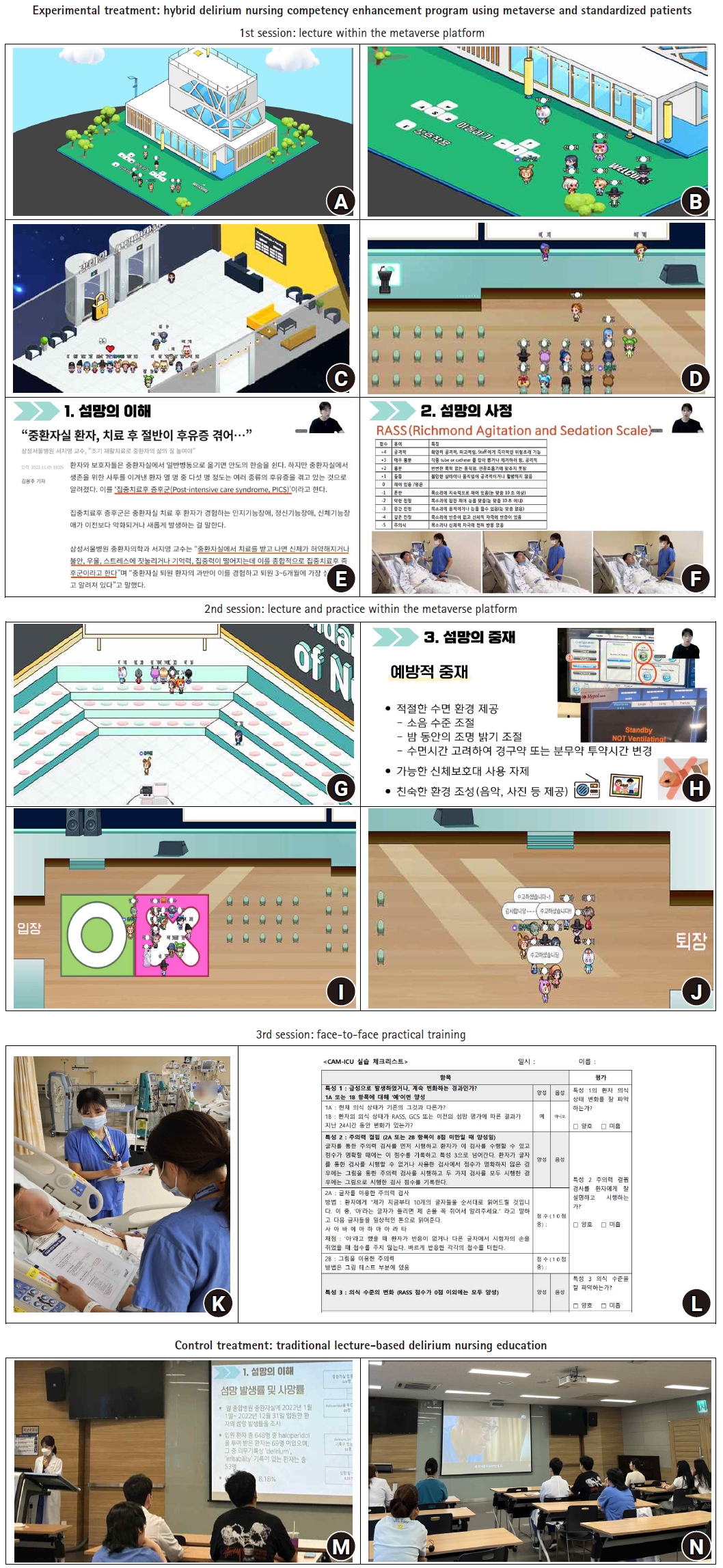
The study procedure consisted of a pre-intervention assessment, a three-session hybrid intervention for the experimental group and a traditional lecture-based intervention for the control group, followed by a post-intervention assessment (Figure 1).

1) Pre-test

The pre-test was conducted between July 8 and July 18, 2024. Participants were selected from nurses who met the inclusion criteria and provided voluntary consent. Data were collected using a self-administered questionnaire (approximately 20 minutes).

2) Intervention

The intervention phase took place from July 24 to August 28, 2024. Intervention (experimental group): Received the 3-session hybrid program as described in Table 1. Control group activities: The control group received a 50-minute traditional face-to-face lecture covering the same topics (delirium assessment and management) to ensure ethical parity in educational opportunities.

3) Post-test

The post-test was administered to the experimental group immediately after the final (third) session. For the control group, the post-intervention assessment was initiated at the same time point when the experimental group's post-assessments began. The same structured questionnaire used at baseline was employed. After all assessments were finalized, control group participants who wished to experience the hybrid program were provided with equivalent training to ensure educational equity.
6. Ethical considerations
This study was approved by the Institutional Review Board (IRB) of Gyeongsang National University Changwon Hospital (IRB no., 2023-07-026-004) and was conducted in accordance with the Declaration of Helsinki. Before participation, all nurses were informed that their involvement was voluntary and that they could withdraw at any time without any negative impact on their career or performance evaluation. Written informed consent was obtained. To minimize potential undue influence within the hierarchical clinical environment, recruitment was conducted directly by the research team through open announcements and individual briefings, without any involvement from unit supervisors or nursing managers in the recruitment process. The enrollment proportion was 66.7% (28 out of 42 eligible nurses) in the experimental ICU and 60.0% (24 out of 40 eligible nurses) in the control ICU, demonstrating a high but voluntary participation rate. To ensure confidentiality, all data were coded without personal identifiers. Identifiable information was stored in an encrypted file, and paper questionnaires were kept in a locked cabinet accessible only to the research team. All study data will be retained for 3 years after completion and then permanently destroyed. In consideration of research ethics, participants in the control group who wished to receive the intervention were provided with a one-to-one practical training session equivalent to that received by the experimental group after the completion of all post-intervention assessments. This ensured that all participants had equal access to advanced educational opportunities. As a token of appreciation, a small incentive was provided to both groups upon completion of the study.
7. Data analysis
Data collected in this study were analyzed using IBM SPSS ver. 27.0 (IBM Corp.). The specific analytical procedures were as follows:
Participants’ general characteristics were summarized using frequencies and percentages, means, and standard deviations. Baseline homogeneity between the experimental and control groups regarding general characteristics and dependent variables was examined using the chi-square test, Fisher’s exact test, or independent t-tests. Normality of the study variables was confirmed through skewness and kurtosis. All variables met the assumptions of normality, with absolute values of skewness <2 and kurtosis <7.
To evaluate the effects of the hybrid delirium nursing competency enhancement program, within-group differences (pre-test vs. post-test) were analyzed using paired t-tests. Between-group differences were analyzed by comparing the change scores (post-test minus pre-test) of the two groups using independent t-tests to account for potential baseline variations between the two clusters. To determine the practical significance of the intervention, effect sizes (Cohen’s d) were calculated for each dependent variable, with values of 0.2, 0.5, and 0.8 representing small, medium, and large effects, respectively. Although a cluster randomized design was employed, individual-level t-tests were applied due to the limited number of clusters (k=2). To support this approach, the intra-cluster correlation or the baseline homogeneity between the two units was carefully verified. The reliability of the measurement instruments was assessed using Cronbach’s alpha for attitude and performance confidence, and the Kuder-Richardson Formula 20 for knowledge.
1. Homogeneity of general characteristics and study variables
The homogeneity of general characteristics between the experimental and control groups was examined prior to the intervention. No significant differences were found between the two groups in terms of age (χ2=1.11, p=.840), educational level (χ2=3.13, p=.380), total clinical experience (χ2=1.70, p=.633), length of ICU experience (χ2=0.98, p=.879), perceived need for delirium education (χ2=2.07, p=.229), prior experience with delirium education (χ2=0.31, p=.781). These results indicated that the experimental and control groups were comparable with respect to baseline demographic characteristics (Table 2).
Baseline homogeneity of the study variables was also confirmed. Prior to the intervention, no significant differences were found between the experimental and control groups in delirium nursing knowledge (36.11±3.06 vs. 37.46±2.67; t=−1.68, p=.099), delirium nursing attitude (110.79±8.16 vs. 114.17±9.14; t=−1.41, p=.165), or delirium nursing performance confidence (82.18±29.70 vs. 94.00±24.76; t=−1.54, p=.129). These findings confirmed baseline equivalence across all outcome measures.
2. Effects of a hybrid delirium nursing competency enhancement program using metaverse and SPs to enhance delirium nursing competency in ICU nurses

1) Delirium nursing knowledge

There were no statistically significant improvements in delirium nursing knowledge scores from baseline to post-intervention for either the experimental group (t=1.62, p=.117) or the control group (t=1.12, p=.273). Furthermore, there was no significant difference in mean change scores between the two groups (t=0.71, p=.483) (Table 3).

2) Delirium nursing attitude

The experimental group showed a statistically significant increase in attitude scores from baseline (t=5.44, p<.001), whereas the control group did not (t=1.53, p=.139). Notably, the mean change score (post–pre difference) was significantly higher for the experimental group than for the control group (t=2.05, p=.046). While the absolute post-intervention scores were comparable between the two groups, these results suggest that the experimental group demonstrated a more substantial improvement in their attitudes towards delirium during the study period (Table 3).

3) Delirium nursing performance confidence

Statistically significant increases in performance confidence scores were demonstrated by both groups from baseline (experimental group: t=6.65, p<.001; control group: t=4.22, p<.001). When the two groups were compared, the mean change score (post–pre difference) for performance confidence was found to be significantly higher in the experimental group than in the control group (t=3.35, p=.002). These findings suggest that, although both methods were effective, the metaverse-based program had a more significant impact on nurses’ confidence in delirium care than the traditional approach (Table 3).
This study was guided by the Transfer of Training Theory. Based on this theoretical framework, a hybrid delirium nursing competency enhancement program was developed, integrating a ZEPETO-based metaverse learning environment with SP simulation. While the program significantly improved nurses’ attitudes and performance confidence, no statistically significant improvements in knowledge scores were observed within or between the groups.
In terms of delirium nursing knowledge, although slight numerical increases were noted in both groups, these changes did not reach statistical significance. This suggests that a single educational session, regardless of the delivery modality, may have limitations in significantly enhancing knowledge levels within a short period. At baseline, participants already demonstrated a relatively high knowledge level (correct response rate >80%), consistent with previous studies [34,46]. The lack of a significant difference between groups likely stems from both groups receiving identical theoretical materials. These findings indicate that knowledge acquisition, as measured in this study, appears to be influenced by the content of instruction rather than the delivery method.
However, a detailed analysis of subdomains revealed that scores related to delirium symptoms were lower than those for etiology or management. Specifically, nurses demonstrated limited understanding of hypoactive and mixed-type delirium symptoms, aligning with findings by Hoch et al. [45]. These results underscore the need for delirium education programs to place greater emphasis on symptom-based instruction that differentiates delirium subtypes.
From the perspective of the Transfer of Learning Theory, knowledge acquisition represents only the preliminary stage of competency. Transforming that foundation into attitudinal and behavioral changes requires more experiential, staged learning environments [36,37]. In this study, the experimental group demonstrated a significantly greater improvement in attitudes toward delirium nursing compared to the control group, surpassing effects reported in previous simulation studies [20]. This interpretation is supported by Chang et al. [46], who demonstrated that metaverse-based educational interventions can effectively promote positive changes in nurses’ attitudes.
This enhanced effect is attributable to the hybrid design: the metaverse provided a “psychologically safe” space for initial engagement, while the SP simulation offered contextual realism. Unlike unidirectional lectures, the interactive, learner-centered metaverse environment allowed nurses to actively engage and receive immediate feedback, fostering a heightened awareness of delirium nursing’s importance. Such attitudinal shifts are critical prerequisites for the successful translation of learning into clinical practice, reflecting learners’ motivation and readiness to apply newly acquired competencies [36].
Regarding performance confidence, ICU nurses demonstrated relatively low levels at baseline, consistent with recent domestic research [47]. This suggests that ICU nurses often experience considerable psychological distress and uncertainty when providing delirium-related care. In this study, performance confidence in the experimental group improved by approximately 20%, a magnitude substantially greater than that of the control group. This significant gain indicates that the combination of virtual rehearsal and hands-on SP simulation effectively reduced the psychological burden associated with complex delirium assessment [28,33]. By practicing in a low-stakes virtual environment before encountering a realistic SP, nurses could refine their clinical reasoning in a staged manner [25,30]. This design directly supports the core assumptions of transfer theory: staged experiences that progressively approximate real-world conditions facilitate the most effective internalization of clinical skills [36].
This study empirically validates a scalable educational model that minimizes spatio-temporal constraints while maximizing engagement. The combination of metaverse-based preparatory learning and simulation-based experiential practice effectively facilitated the transfer from theoretical understanding to clinical performance. Given the low rate of prior delirium education among participants, this program is highly applicable for both new nurse orientations and continuing education.
However, several limitations warrant caution. First, the study was conducted at a single tertiary hospital, potentially limiting the generalizability of the findings to other institutional settings. Second, although the different clinical focuses (surgical vs. medical) of the two ICUs could theoretically influence nurses’ prior exposure to delirium, our baseline analysis confirmed that the two groups were homogeneous regarding clinical experience, prior education, and initial competency levels. Nevertheless, as the small number of clusters (k=2) limited the statistical estimation of the intraclass correlation coefficient and the use of multilevel modeling to fully adjust for unit-specific environmental factors, this remains a methodological limitation. Future research should involve a larger number of clusters in multi-center trials to more robustly account for such clustering effects. Finally, as outcomes, particularly nursing performance confidence, were assessed immediately post-intervention via self-reported questionnaires, the results may not fully reflect the participants’ actual clinical performance. Subsequent studies should incorporate long-term follow-ups and objective, observation-based performance indicators to verify the sustained impact of the hybrid model on patient outcomes.
This study developed a hybrid delirium nursing competency enhancement program using metaverse and SPs for ICU nurses. The findings suggest that hybrid simulation approaches combining metaverse-based learning and SP simulation may be particularly beneficial for strengthening delirium nursing competency, including delirium nursing attitudes and delirium nursing performance confidence. To develop evidence-based training for delirium nursing competency enhancement, future research should incorporate objective measures of actual nursing outcomes, such as observational assessments or performance-based indicators. Furthermore, mixed-methods or qualitative research designs are needed to explore ICU nurses’ learning experiences and the processes of educational transfer associated with hybrid delirium nursing competency enhancement programs using metaverse and SPs.

Conflicts of Interest

No potential conflict of interest relevant to this article was reported.

Acknowledgements

None.

Funding

This research received no external funding.

Data Sharing Statement

Please contact the corresponding author for data availability.

Author Contributions

Conceptualization: JWY, MYJ. Methodology: JWY, MYJ. Software: JWY, MYJ. Validation: JWY, MYJ. Formal analysis: JWY, MYJ. Investigation: JWY. Resources: JWY, MYJ. Data curation: JWY, MYJ. Visualization: JWY, MYJ. Supervision: MYJ. Project administration: MYJ. Funding acquisition: none. Writing–original draft: JWY, MYJ. Writing–review & editing: JWY, MYJ. Final approval of the manuscript: all authors.

Fig. 1.
Hybrid delirium nursing competency enhancement program using metaverse and standardized patients for ICU nurses. The hybrid delirium nursing competency enhancement program consisted of three sequential sessions. (A–F) The first session involved a lecture delivered within a metaverse-based learning environment. (G–J) The second session included both lecture and virtual practice using metaverse-based scenarios within the metaverse platform. (K, L) The third session comprised face-to-face standardized patient simulation in the intensive care unit setting. (A–L) The experimental group received the full hybrid delirium nursing competency enhancement program integrating metaverse-based learning and standardized patient simulation, (M, N) whereas the control group received a traditional face-to-face lecture covering the same delirium nursing content.
jkan-26013f1.jpg
Table 1.
The hybrid delirium nursing competency enhancement program
Session Educational transfer phase Topic Method and platform Key educational content and activities Duration (min)
Session 1 Cognitive transfer (knowledge and attitude formation) Understanding and assessment of delirium Metaverse platform (ZEPETO) • Definition, risk factors, incidence, and prognosis of delirium 30–40
• Characteristics and step-by-step application of the CAM-ICU tool
• Avatar-based Q&A and OX quizzes to assess comprehension
Session 2 Skill transfer (virtual application and repetitive practice) Delirium interventions and virtual simulation Metaverse platform (ZEPETO) • Virtual delirium assessment using standardized patient case videos 30–40
• Preventive and therapeutic delirium nursing interventions and precautions related to medication use
• Discussion of clinical application strategies and advanced quizzes
Session 3 Clinical performance transfer (situated clinical practice) Clinical practice of delirium nursing (bedside) Standardized patient simulation • One-to-one face-to-face practice with standardized patients in an ICU setting 20–30
• Application of the CAM-ICU and classification of delirium subtypes

The program was designed based on a staged educational transfer framework, progressing from metaverse-based theoretical learning (cognitive transfer), to virtual simulation using standardized patient cases (skill transfer), and finally to face-to-face standardized patient simulation in an intensive care unit setting (clinical performance transfer).

ICU, intensive care unit.

Table 2.
Homogeneity of general characteristics and study variables between the experimental and control groups (N=52)
Characteristic Exp. (n=28) Cont. (n=24) χ2 or t p
Age (yr)a) 1.11 .840
 <25 3 (10.7) 4 (16.7)
 25–<30 16 (57.2) 14 (58.3)
 30–<35 6 (21.4) 5 (20.8)
 35–40 3 (10.7) 1 (4.2)
Educational level 3.13 .380
 3-year college 4 (14.3) 6 (25.0)
 Bachelor’s degree 23 (82.1) 15 (62.5)
 ≥Graduate school 1 (3.6) 3 (12.5)
Total clinical experience (yr) 1.70 .633
 1–<3 8 (28.6) 8 (33.3)
 3–<5 6 (21.4) 6 (25.1)
 5–<8 8 (28.6) 8 (33.3)
 ≥8 6 (21.4) 2 (8.3)
ICU experience (yr) 0.98 .879
 1–<3 13 (46.4) 9 (37.4)
 3–<5 7 (25.1) 7 (29.2)
 5–<8 6 (21.4) 7 (29.2)
 ≥8 2 (7.1) 1 (4.2)
Experience caring for delirium patients
 Yes 28 (100.0) 24 (100.0) -
 No 0 (0.0) 0 (0.0)
Perceived need for delirium education 2.07 .229
 Very necessary 17 (60.7) 19 (79.2)
 Necessary 11 (39.3) 5 (20.8)
 Neutral 0 (0.0) 0 (0.0)
 Not necessary 0 (0.0) 0 (0.0)
Previous delirium education 0.31 .781
 Yes 15 (53.6) 11 (45.8)
 No 13 (46.4) 13 (54.2)
Delirium nursing knowledge 36.11±3.06 37.46±2.67 –1.68 .099
Delirium nursing attitude 110.79±8.16 114.17±9.14 –1.41 .165
Delirium nursing performance confidence 82.18±29.70 94.00±24.76 –1.54 .129

Values are presented as number (%) or mean±standard deviation.

Cont., control group; Exp., Experimental group; ICU, intensive care unit.

a)The chi-square test was used for categorical variables, and the independent t-test was used for continuous variables.

Table 3.
Effects of the hybrid delirium nursing competency enhancement program (N=52)
Variable Pretest Posttest Posttest–pretest Within-group t (p) Between-group t (p) Effect size (Cohen’s d)
Delirium nursing knowledge
 Exp. (n=28) 36.11±3.06 37.11±2.38 1.00 (–0.27–2.27) 1.62 (.117) 0.71 (.483) 0.20
 Cont. (n=24) 37.46±2.67 37.92±3.09 0.46 (–0.39–1.30) 1.12 (.273)
Delirium nursing attitude
 Exp. (n=28) 110.79±8.16 116.39±8.27 5.61 (3.49–7.72) 5.44 (<.001) 2.05 (.046) 0.57
 Cont. (n=24) 114.17±9.14 116.29±8.80 2.13 (–0.74–4.99) 1.53 (.139)
Delirium nursing performance confidence
 Exp. (n=28) 82.18±29.70 108.32±22.37 26.14 (17.94–34.34) 6.65 (<.001) 3.35 (.002) 0.93
 Cont. (n=24) 94.00±24.76 103.92±21.60 9.92 (5.06–14.78) 4.22 (<.001)

Values are presented as mean±standard deviation or mean difference (95% confidence interval) unless otherwise stated. Within-group differences were analyzed using the paired t-test. Between-group differences were analyzed using the independent t-test based on changes in scores.

Cont., control group; Exp., experimental group.

  • 1. Stollings JL, Kotfis K, Chanques G, Pun BT, Pandharipande PP, Ely EW. Delirium in critical illness: clinical manifestations, outcomes, and management. Intensive Care Med. 2021;47(10):1089-1103. https://doi.org/10.1007/s00134-021-06503-1ArticlePubMedPMC
  • 2. Kotfis K, Marra A, Ely EW. ICU delirium: a diagnostic and therapeutic challenge in the intensive care unit. Anaesthesiol Intensive Ther. 2018;50(2):160-167. https://doi.org/10.5603/AIT.a2018.0011ArticlePubMed
  • 3. Gregory KA. Easy as ABC: how staff nurses transformed unit culture to assess and manage delirium in the intensive care unit. Crit Care Nurse. 2016;36(5):73-76. https://doi.org/10.4037/ccn2016821ArticlePubMed
  • 4. Noh EY, Park YH. Prevalence of delirium and risk factors in heart surgery patients in intensive care unit: a retrospective study. Korean J Adult Nurs. 2019;31(2):146-155. https://doi.org/10.7475/kjan.2019.31.2.146Article
  • 5. Ahn JS, Oh J, Park J, Kim JJ, Park JY. Incidence and procedure-related risk factors of delirium in patients admitted to an intensive care unit. Korean J Psychosom Med. 2019;27(1):35-41. https://doi.org/10.22722/KJPM.2019.27.1.35Article
  • 6. Ho MH, Nealon J, Igwe E, Traynor V, Chang HR, Chen KH, et al. Postoperative delirium in older patients: a systematic review of assessment and incidence of postoperative delirium. Worldviews Evid Based Nurs. 2021;18(5):290-301. https://doi.org/10.1111/wvn.12536ArticlePubMed
  • 7. Komici K, Guerra G, Addona F, Fantini C. Delirium in nursing home residents: a narrative review. Healthcare (Basel). 2022;10(8):1544. https://doi.org/10.3390/healthcare10081544ArticlePubMedPMC
  • 8. Kim MS, Jun JY, Chun HJ, Kim YO. The incidence and related risk factors of delirium in the older inpatients with neurological disorders in a tertiary hospital. Korean J Adult Nurs. 2018;30(3):255-265. https://doi.org/10.7475/kjan.2018.30.3.255Article
  • 9. Lee EJ, Jang M, Kim MH, Yun HJ, Kim EM, Chung YI, et al. The incidence and risk factors of delirium in elderly surgical patients. J Korean Clin Nurs Res. 2022;28(2):137-145. https://doi.org/10.22650/JKCNR.2022.28.2.137Article
  • 10. Devlin JW, Skrobik Y, Gélinas C, Needham DM, Slooter AJ, Pandharipande PP, et al. Clinical Practice Guidelines for the prevention and management of pain, agitation/sedation, delirium, immobility, and sleep disruption in adult patients in the ICU. Crit Care Med. 2018;46(9):e825-e873. https://doi.org/10.1097/CCM.0000000000003299ArticlePubMedPMC
  • 11. Van Rompaey B, Elseviers MM, Schuurmans MJ, Shortridge-Baggett LM, Truijen S, Bossaert L. Risk factors for delirium in intensive care patients: a prospective cohort study. Crit Care. 2009;13(3):R77. https://doi.org/10.1186/cc7892ArticlePubMedPMC
  • 12. Kim MY, Park UJ. Noise levels in intensive care units and patient’s perception. J Korean Crit Care Nurs. 2015;8(1):41-49.
  • 13. Jeong IS, Cho MK. Factors affecting delirium in ICU patients. Int J Environ Res Public Health. 2023;20(10):5889. https://doi.org/10.3390/ijerph20105889ArticlePubMedPMC
  • 14. Kang YS, Kim SH, Lee MJ, Lee HJ, Lim OB, Hong SB, et al. Investigation of delirium occurrence and intervention status in intensive care unit at a hospital and perception of delirium by medical staff. J Korean Crit Care Nurs. 2023;16(1):71-86. https://doi.org/10.34250/jkccn.2023.16.1.71Article
  • 15. Kim HJ, Song E. Factors influencing the nursing performance of delirium care in intensive care unit nurses. J Soc Converg Stud. 2023;7(2):1-12. https://doi.org/10.37181/JSCS.2023.7.2.001Article
  • 16. Benner P, Kyriakidis PH, Stannard D. Clinical wisdom and interventions in acute and critical care: a thinking-in-action approach. 2nd ed. Springer Publishing Company; 2011.
  • 17. Roh YS. The training needs of Korean intensive care unit nurses regarding delirium. Intensive Crit Care Nurs. 2021;62:102954. https://doi.org/10.1016/j.iccn.2020.102954ArticlePubMed
  • 18. Yıldırım F, Türkleş S, Altundal Duru H. The effect of delirium information training given to intensive care nurses on patient care: quasi-experimental study. PeerJ. 2022;10:e13143. https://doi.org/10.7717/peerj.13143ArticlePubMedPMC
  • 19. Hebeshy MI, Gaballah S, Elsayed ER. Effect of educational training about CAM-ICU on nurses’ knowledge, confidence, and practice to detect delirium among critically ill patients in intensive care unit. BMC Nurs. 2025;24(1):673. https://doi.org/10.1186/s12912-025-03395-0ArticlePubMedPMC
  • 20. Park J, Park JW. Effects of a delirium education program for nurses on knowledge of delirium, importance of nursing intervention and nursing practice. J Korean Acad Soc Home Care Nurs. 2013;20(2):152-159.
  • 21. Kim M, Lee H. The effects of delirium care training program for nurses in hospital nursing units. Korean J Adult Nurs. 2014;26(5):489-499. https://doi.org/10.7475/kjan.2014.26.5.489Article
  • 22. Kim JW, Jo IG, Park GH, Kim SJ, Park YH, Heo JH, et al. Analysis of research trend on hospital nurse education and training in Korea using network analysis. Health Serv Manag Rev. 2022;16(2):31-41. https://doi.org/10.18014/hsmr.2022.16.2.31Article
  • 23. Jeong Y, Lim T, Ryu J. The effects of spatial mobility on metaverse based online class on learning presence and interest development in higher education. J Korean Assoc Educ Inf Media. 2021;27(3):1167-1188. https://doi.org/10.15833/KAFEIAM.27.3.1167Article
  • 24. Bernardes A, Gardim L, Araújo AA, Jensen R, Motta RA, Almeida DM, et al. Exploring the metaverse in the education of healthcare students: a scoping review. Rev Lat Am Enfermagem. 2024;32:e4347. https://doi.org/10.1590/1518-8345.7256.4347ArticlePubMedPMC
  • 25. Jans C, Lucas C, Levett-Jones T. Utilization, application and effectiveness of metaverse in simulation-based nursing education: a systematic review. Clin Simul Nurs. 2025;108:101807. https://doi.org/10.1016/j.ecns.2025.101807Article
  • 26. Nagendran A, Compton S, Follette WC, Golenchenko A, Compton A, Grizou J. Avatar led interventions in the Metaverse reveal that interpersonal effectiveness can be measured, predicted, and improved. Sci Rep. 2022;12(1):21892. https://doi.org/10.1038/s41598-022-26326-4ArticlePubMedPMC
  • 27. Park SJ. A study on the methods of metaverse education in future society. J Future Converg Educ. 2021;2(2):61-81. https://kiss.kstudy.com/Detail/Ar?key=3973457
  • 28. Cho MK, Kim MY. Enhancing nursing competency through virtual reality simulation among nursing students: a systematic review and meta-analysis. Front Med (Lausanne). 2024;11:1351300. https://doi.org/10.3389/fmed.2024.1351300ArticlePubMedPMC
  • 29. Radianti J, Majchrzak TA, Fromm J, Wohlgenannt I. A systematic review of immersive virtual reality applications for higher education: design elements, lessons learned, and research agenda. Comput Educ. 2020;147:103778. https://doi.org/10.1016/j.compedu.2019.103778Article
  • 30. Verkuyl M, Lapum JL, St-Amant O, Hughes M, Romaniuk D. Curricular uptake of virtual gaming simulation in nursing education. Nurse Educ Pract. 2021;50:102967. https://doi.org/10.1016/j.nepr.2021.102967ArticlePubMedPMC
  • 31. Brix LD, Skjødt-Jensen AM, Jensen TH, Aarkrog V. Enhancing nursing students’ self-reported self-efficacy and professional competence in basic life support: the role of virtual simulation prior to high-fidelity training. Teach Learn Nurs. 2025;20(1):e236-e243. https://doi.org/10.1016/j.teln.2024.10.020Article
  • 32. Akechi T, Ishiguro C, Okuyama T, Endo C, Sagawa R, Uchida M, et al. Delirium training program for nurses. Psychosomatics. 2010;51(2):106-111. https://doi.org/10.1176/appi.psy.51.2.106ArticlePubMed
  • 33. Jeong EH. Development and effects of a delirium management education program for practitioners in long-term care facilities [dissertation]. Seoul: Korea University; 2020.
  • 34. Murungi EB, Baluku E, Kabedi PN. Improving nurses’ knowledge and practices of delirium assessment using CAM-ICU: a quasi-experimental study. Adv Med Educ Pract. 2023;14:557-566. https://doi.org/10.2147/AMEP.S398606ArticlePubMedPMC
  • 35. Chang RL, Siao SF, Ku SC, Yeh YC, Chang YC, Chen CC. Improving intensive care unit nurses' delirium assessment performance through a multimodal educational intervention. Nursing in Critical Care. 2025;30(5):e70168. https://doi.org/10.1111/nicc.70168Article
  • 36. Baldwin TT, Ford JK. Transfer of training: a review and directions for future research. Pers Psychol. 1988;41(1):63-105. https://doi.org/10.1111/j.1744-6570.1988.tb00632.xArticle
  • 37. Salas E, Tannenbaum SI, Kraiger K, Smith-Jentsch KA. The science of training and development in organizations: what matters in practice. Psychol Sci Public Interest. 2012;13(2):74-101. https://doi.org/10.1177/1529100612436661ArticlePubMed
  • 38. Lee YW, Kim CG, Kong ES, Kim KB, Kim NC, Kim HK, et al. A study of nurses’ knowledge level and assessment experience of delirium. J Korean Acad Adult Nurs. 2007;19(1):35-44.
  • 39. Tavakol M, Dennick R. Making sense of Cronbach’s alpha. Int J Med Educ. 2011;2:53-55. https://doi.org/10.5116/ijme.4dfb.8dfdArticlePubMedPMC
  • 40. Streiner DL, Norman GR, Cairney J. Health measurement scales: a practical guide to their development and use. 5th ed. Oxford University Press; 2015. 399 p.
  • 41. Yang YA. ICU nurses’ knowledge and nursing performance on patients’ symptoms of delirium [master’s thesis]. Seoul: The Catholic University of Korea; 2006.
  • 42. Jeffries PR. A framework for designing, implementing, and evaluating simulations used as teaching strategies in nursing. Nurs Educ Perspect. 2005;26(2):96-103. PubMed
  • 43. Berragan L. Simulation: an effective pedagogical approach for nursing? Nurse Educ Today. 2011;31(7):660-663. https://doi.org/10.1016/j.nedt.2011.01.019ArticlePubMed
  • 44. Qaddumi J, Awawdi K, Tarabeih M. Evaluating the effectiveness of educational intervention on ICU nurses' knowledge of delirium: a quasi-experimental approach. Nurs Rep. 2025;15(6):205. https://doi.org/10.3390/nursrep15060205ArticlePubMedPMC
  • 45. Hoch J, Bauer JM, Bizer M, Arnold C, Benzinger P. Nurses’ competence in recognition and management of delirium in older patients: development and piloting of a self-assessment tool. BMC Geriatr. 2022;22(1):879. https://doi.org/10.1186/s12877-022-03573-8ArticlePubMedPMC
  • 46. Chang W, Lin CC, Crilly J, Lee HL, Chen LC, Han CY. Virtual reality simulation for undergraduate nursing students for care of patients with infectious diseases: mixed methods study. JMIR Med Educ. 2025;11:e64780. https://doi.org/10.2196/64780Article
  • 47. Lim MR, Cho GY. Factors influencing intensive care unit nurses’ competency in delirium care in a tertiary general hospital. J Korean Crit Care Nurs. 2024;17(3):37-49. https://doi.org/10.34250/jkccn.2024.17.3.37Article

Figure & Data

REFERENCES

    Citations

    Citations to this article as recorded by  

      • ePub LinkePub Link
      • Cite
        CITE
        export Copy Download
        Close
        Download Citation
        Download a citation file in RIS format that can be imported by all major citation management software, including EndNote, ProCite, RefWorks, and Reference Manager.

        Format:
        • RIS — For EndNote, ProCite, RefWorks, and most other reference management software
        • BibTeX — For JabRef, BibDesk, and other BibTeX-specific software
        Include:
        • Citation for the content below
        Effects of a hybrid delirium nursing competency enhancement program using the metaverse and standardized patients for intensive care unit nurses: a quasi-experimental study
        Close
      • XML DownloadXML Download
      Figure
      • 0
      We recommend
      Related articles
      Effects of a hybrid delirium nursing competency enhancement program using the metaverse and standardized patients for intensive care unit nurses: a quasi-experimental study
      Image
      Fig. 1. Hybrid delirium nursing competency enhancement program using metaverse and standardized patients for ICU nurses. The hybrid delirium nursing competency enhancement program consisted of three sequential sessions. (A–F) The first session involved a lecture delivered within a metaverse-based learning environment. (G–J) The second session included both lecture and virtual practice using metaverse-based scenarios within the metaverse platform. (K, L) The third session comprised face-to-face standardized patient simulation in the intensive care unit setting. (A–L) The experimental group received the full hybrid delirium nursing competency enhancement program integrating metaverse-based learning and standardized patient simulation, (M, N) whereas the control group received a traditional face-to-face lecture covering the same delirium nursing content.
      Effects of a hybrid delirium nursing competency enhancement program using the metaverse and standardized patients for intensive care unit nurses: a quasi-experimental study
      Session Educational transfer phase Topic Method and platform Key educational content and activities Duration (min)
      Session 1 Cognitive transfer (knowledge and attitude formation) Understanding and assessment of delirium Metaverse platform (ZEPETO) • Definition, risk factors, incidence, and prognosis of delirium 30–40
      • Characteristics and step-by-step application of the CAM-ICU tool
      • Avatar-based Q&A and OX quizzes to assess comprehension
      Session 2 Skill transfer (virtual application and repetitive practice) Delirium interventions and virtual simulation Metaverse platform (ZEPETO) • Virtual delirium assessment using standardized patient case videos 30–40
      • Preventive and therapeutic delirium nursing interventions and precautions related to medication use
      • Discussion of clinical application strategies and advanced quizzes
      Session 3 Clinical performance transfer (situated clinical practice) Clinical practice of delirium nursing (bedside) Standardized patient simulation • One-to-one face-to-face practice with standardized patients in an ICU setting 20–30
      • Application of the CAM-ICU and classification of delirium subtypes
      Characteristic Exp. (n=28) Cont. (n=24) χ2 or t p
      Age (yr)a) 1.11 .840
       <25 3 (10.7) 4 (16.7)
       25–<30 16 (57.2) 14 (58.3)
       30–<35 6 (21.4) 5 (20.8)
       35–40 3 (10.7) 1 (4.2)
      Educational level 3.13 .380
       3-year college 4 (14.3) 6 (25.0)
       Bachelor’s degree 23 (82.1) 15 (62.5)
       ≥Graduate school 1 (3.6) 3 (12.5)
      Total clinical experience (yr) 1.70 .633
       1–<3 8 (28.6) 8 (33.3)
       3–<5 6 (21.4) 6 (25.1)
       5–<8 8 (28.6) 8 (33.3)
       ≥8 6 (21.4) 2 (8.3)
      ICU experience (yr) 0.98 .879
       1–<3 13 (46.4) 9 (37.4)
       3–<5 7 (25.1) 7 (29.2)
       5–<8 6 (21.4) 7 (29.2)
       ≥8 2 (7.1) 1 (4.2)
      Experience caring for delirium patients
       Yes 28 (100.0) 24 (100.0) -
       No 0 (0.0) 0 (0.0)
      Perceived need for delirium education 2.07 .229
       Very necessary 17 (60.7) 19 (79.2)
       Necessary 11 (39.3) 5 (20.8)
       Neutral 0 (0.0) 0 (0.0)
       Not necessary 0 (0.0) 0 (0.0)
      Previous delirium education 0.31 .781
       Yes 15 (53.6) 11 (45.8)
       No 13 (46.4) 13 (54.2)
      Delirium nursing knowledge 36.11±3.06 37.46±2.67 –1.68 .099
      Delirium nursing attitude 110.79±8.16 114.17±9.14 –1.41 .165
      Delirium nursing performance confidence 82.18±29.70 94.00±24.76 –1.54 .129
      Variable Pretest Posttest Posttest–pretest Within-group t (p) Between-group t (p) Effect size (Cohen’s d)
      Delirium nursing knowledge
       Exp. (n=28) 36.11±3.06 37.11±2.38 1.00 (–0.27–2.27) 1.62 (.117) 0.71 (.483) 0.20
       Cont. (n=24) 37.46±2.67 37.92±3.09 0.46 (–0.39–1.30) 1.12 (.273)
      Delirium nursing attitude
       Exp. (n=28) 110.79±8.16 116.39±8.27 5.61 (3.49–7.72) 5.44 (<.001) 2.05 (.046) 0.57
       Cont. (n=24) 114.17±9.14 116.29±8.80 2.13 (–0.74–4.99) 1.53 (.139)
      Delirium nursing performance confidence
       Exp. (n=28) 82.18±29.70 108.32±22.37 26.14 (17.94–34.34) 6.65 (<.001) 3.35 (.002) 0.93
       Cont. (n=24) 94.00±24.76 103.92±21.60 9.92 (5.06–14.78) 4.22 (<.001)
      Table 1. The hybrid delirium nursing competency enhancement program

      The program was designed based on a staged educational transfer framework, progressing from metaverse-based theoretical learning (cognitive transfer), to virtual simulation using standardized patient cases (skill transfer), and finally to face-to-face standardized patient simulation in an intensive care unit setting (clinical performance transfer).

      ICU, intensive care unit.

      Table 2. Homogeneity of general characteristics and study variables between the experimental and control groups (N=52)

      Values are presented as number (%) or mean±standard deviation.

      Cont., control group; Exp., Experimental group; ICU, intensive care unit.

      The chi-square test was used for categorical variables, and the independent t-test was used for continuous variables.

      Table 3. Effects of the hybrid delirium nursing competency enhancement program (N=52)

      Values are presented as mean±standard deviation or mean difference (95% confidence interval) unless otherwise stated. Within-group differences were analyzed using the paired t-test. Between-group differences were analyzed using the independent t-test based on changes in scores.

      Cont., control group; Exp., experimental group.


      J Korean Acad Nurs : Journal of Korean Academy of Nursing
      Close layer
      TOP