Skip Navigation
Skip to contents

J Korean Acad Nurs : Journal of Korean Academy of Nursing


Articles

Page Path
HOME > J Korean Acad Nurs > Ahead-of print articles > Article
Research Paper
Concept mapping study of positive patient experiences among family members of nursing home residents in South Korea
Hyoungshim Choi1orcid, InJa Choi2orcid, Jui Kim3orcid

DOI: https://doi.org/10.4040/jkan.26021
Published online: July 29, 2026

1Department of Nursing, Hansei University, Gunpo, South Korea

2Hugen Research Institute, Seoul, South Korea

3Department of Nursing, Ansan University, Ansan, South Korea

Corresponding author: Jui Kim Department of Nursing, Ansan University, 155 Ansandaehak-ro, Sangnok-gu, Ansan 15328, South Korea E-mail: juikim@ansan.ac.kr
• Received: February 6, 2026   • Revised: April 9, 2026   • Accepted: May 23, 2026

© 2026 Korean Society of Nursing Science

This is an Open Access article distributed under the terms of the Creative Commons Attribution NoDerivs License (http://creativecommons.org/licenses/by-nd/4.0) If the original work is properly cited and retained without any modification or reproduction, it can be used and re-distributed in any format and medium.

  • 248 Views
  • 13 Download
  • Purpose
    This study focused on identifying key components and dimensions of positive patient experiences perceived by family members of nursing home residents in South Korea, which may inform strength-based quality improvement in nursing home care.
  • Methods
    Data were collected from May 8, 2023, to July 18, 2023, through interviews with 19 family members of nursing home residents aged 65 years or older who had lived in the facility for at least 30 days. Interview data were used to develop empirical statements on the nature of residents’ experiences as perceived by family members. These data were then analyzed using concept mapping to identify components of positive patient experiences from the perspectives of family members of nursing home residents in Korea.
  • Results
    Multidimensional scaling and hierarchical cluster analysis yielded 59 core statements, two dimensions, and four clusters of positive patient experiences. The two dimensions were type of support (physical vs. emotional) and centrality of care (resident-centered vs. family-centered). The four clusters of positive patient experiences were “facility management focused on quality of life,” “active communication and engagement,” “respect and trust,” and “professional and personalized care.”
  • Conclusion
    These findings provide insight into the experiences valued by family members of older adults in nursing homes. The concept map may inform development of a patient experience index tailored to family members of nursing home residents.
Since the 1990s, healthcare systems in highly developed countries have been using patient experiences as an indicator of healthcare quality [1]. This approach is preferred over satisfaction surveys because it focuses on patients’ subjective evaluations, reduces the tendency for overly positive responses, is easier to complete, and more effectively identifies issues in healthcare services [2,3]. Measuring patient experience is particularly important for residents in nursing homes, as they receive care where they live [4]. When used as a performance indicator, patient experience of residents in nursing homes must assess both the quality of care and the quality of life, setting it apart from patient experience surveys typically conducted at hospital discharge [5]. Despite cognitive decline among nursing home residents, measuring their patient experience remains essential, as it prioritizes their perspectives, relationships, social environment, and overall life experiences, which can be incorporated into therapeutic interventions [6]. Globally, nursing homes employ various methods—such as patient experience surveys, satisfaction surveys, and quality of life assessments—to reflect patient-centered perspectives [7].
In self-reported surveys by nursing home residents, family proxy responses tend to align well with residents’ answers when assessing observable aspects such as mobility and speech ability [8]. However, significant discrepancies arise in subjective areas such as depression and well-being [8]. Consequently, while residents’ perspectives are considered the gold standard for measuring both the quality of care received and their perceived quality of life [9], two-thirds of nursing home residents experience some degree of cognitive impairment, and those with severe cognitive decline may struggle to articulate their perceptions of quality of care [6,10]. Therefore, assessing family members’ experiences is crucial to complement resident experience surveys [8].
Patient experience surveys conducted among nursing home residents’ family members indicated that satisfactory patient experiences were positively correlated with perceived autonomy and staff performance, and negatively correlated with core matrix of declining nursing home service quality, such as hospitalization rates, pressure ulcer incidence, and mortality rates [11]. Additionally, a study conducted in the United States on patient experience surveys among nursing home residents’ families found that assessments of qualitative aspects of services—attentiveness to care, personal hygiene, regular medical services, physical environment, cleanliness, social relationships, food quality, communication with family members, and physical therapy—had a moderate positive correlation with the five key quantitative quality indicators: falls, pressure ulcers, urinary tract infections, improvement in activities of daily living, and emergency department visits [12]. However, when the same aspects were assessed by nursing home residents themselves, a significant negative correlation was observed [12]. This discrepancy may reflect differences in evaluative priorities, residents’ psychological adaptation to institutionalization, or the “satisfaction paradox,” whereby older adults report a high level of satisfaction despite objectively compromised care conditions. Consequently, family members’ assessments may provide a more sensitive benchmark for evaluating institutional quality in dimensions related to safety, professionalism, and system-level care processes [13-15].
Recent studies on nursing home residents’ patient experiences have primarily focused on qualitative research, including residents’ perceptions of and trust in primary caregivers, caregiving burden, key factors influencing nursing home residents’ quality of life, and their family experiences [16-18]. However, empirical research specifically examining the patient experiences of nursing home residents’ family members remains scarce. In Korea, although one study developed a patient experience scale for nursing home residents, no such scale exists for their families [19]. Simply translating and adopting foreign scales poses challenges, as it fails to reflect the unique characteristics of Korean healthcare system and does not guarantee cultural and conceptual equivalence across countries [20]. In the Korean context, family members’ experiences of nursing home care are shaped by distinct cultural and systemic factors. Traditional values of filial piety (Hyo) continue to emphasize their moral responsibility for direct family caregiving, often leading to guilt and emotional burden when older adults are institutionalized. Additionally, with its rapid expansion and standardized reimbursement structures, Korea’s Long-Term Care Insurance system has produced unique patterns of service delivery that differ from those of Western countries. These cultural and institutional characteristics limit the cultural equivalence of imported instruments, and underscore the necessity of developing a family-centered experience framework grounded for the Korean context [21,22].
Concept mapping, a structured conceptualization method, allows participants to independently generate ideas and organize them into meaningful clusters, visually representing their conceptual understanding of a given phenomenon [23]. As a hybrid approach, it integrates both qualitative and quantitative research methodologies to capture participants’ experiential insights and incorporates quantitative methods for data analysis [24]. Concept mapping facilitates both individualized and generalized approaches, making it a valuable tool for scale development and program effectiveness evaluations [24]. The purpose of this study is to apply concept mapping to identify key components for developing a patient experience index tailored to the families of nursing home residents. This approach, grounded in patient experience, human experience, and person- and family-centered care frameworks, captures families’ subjective perceptions and organizes them into meaningful clusters, providing a foundation for evidence-based nursing interventions and quality improvement in nursing homes [23,25,26].
This study focused on identifying the components of positive patient experiences, as these can serve as actionable and strength-based indicators for quality improvement in nursing home care. By explicitly focusing on positive patient experiences, the concept-mapping process may have excluded neutral or negative perceptions and thereby introduced recall bias. However, this strengths-based approach was intentionally adopted to identify actionable service attributes that families considered exemplary and worthy of practical reinforcement. To achieve this aim, three research objectives were established: (1) to identify key components of positive patient experiences from the perspective of nursing home residents’ family members, (2) to identify the dimensions and clusters of positive patient experiences perceived by nursing home residents’ family members, and (3) to assess the importance that nursing home residents’ family members assign to clusters of positive patient experiences.
1. Study design
This study employed a mixed-methods concept mapping methodology, which integrates qualitative and quantitative approaches. In the initial phase, focus group interviews (FGIs) were conducted to qualitatively explore family members’ perceptions of positive patient experiences. These qualitative data were subsequently structured and analyzed using quantitative techniques, including multidimensional scaling (MDS) and hierarchical cluster analysis (HCA).
2. Participants
A total of 19 participants were recruited from nine nursing homes conveniently selected from the Seoul metropolitan area. After the study was explained by the principal investigator either in person or via telephone, recruitment notices were faxed to facility directors and posted within each facility. Family members interested in participating voluntarily contacted the principal investigator. Snowball sampling was subsequently applied to facilitate additional recruitment. The term “family member” encompassed spouses, adult children, as well as other relatives involved in decision-making or visitation. Although no formal distinction was made between primary and secondary caregivers, we acknowledge that caregiving roles and degrees of facility interaction may vary substantially and could therefore influence experiential evaluations. Inclusion criteria were as follows: (1) adults aged 18 years or older, and (2) family members who had visited the facility at least 3 times in the past 6 months. Those who were not proficient in Korean or had difficulty reading and writing in Hangul were excluded. The inclusion criterion of at least three visits within 6 months was established to ensure that participants had sufficient exposure to routine care processes and staff interactions. While visit frequency does not fully capture the depth of engagement, this threshold was considered a pragmatic balance between inclusivity and experiential relevance in qualitative concept-mapping research.
Concept mapping does not impose strict participant limits. However, Kane and Trochim [23] recommended recruiting at least 10 participants for idea generation. Accordingly, this study initially planned to recruit 20 participants for interviews. Recruitment was discontinued when theoretical saturation was reached, resulting in a final sample size of 19 participants.
3. Research procedure and data analysis
This study followed the five-step concept mapping approach proposed by Kane and Trochim [23] to explore and analyze the positive patient experiences of nursing home residents’ family members: (1) concept mapping preparation stage, (2) idea generation stage, (3) idea statement structuring stage, (4) concept map analysis stage, and (5) concept map interpretation stage.

1) Concept mapping preparation stage

During the concept mapping preparation stage, the research team developed a focus question and recruited participants to generate ideas related to the research topic. The focus question was based on previous research [23] and structured using a 5-point Likert scale to ensure clarity, facilitate participants’ evaluation, and assess validity and appropriateness. To assess its validity and appropriateness, the team applied the three criteria established by Eun and Kim [27]: (1) Are participants expressing relevant ideas aligned with the research topic? (2) Are participants freely sharing their opinions? (3) Do participants fully understand the focus question? Through this process, the final focus question was determined: “As a nursing home resident’s family member, what positive experiences have you had with the facility’s services?”

2) Idea generation stage

The idea generation stage constitutes the core component of the concept mapping study and can be divided into two phases: a data collection phase conducted through FGIs; and a subsequent phase in which idea statements are generated based on the interview data.

(1) Data collection

Data were collected from May 8, 2023, to July 18, 2023, in the Seoul Capital Area. A four-member research team was formed to synthesize and edit the focus question and final statements and determine dimensions and cluster names. The team included three professors and one researcher: a professor with experience in conducting concept mapping studies on positive patient experiences for nursing home residents, a gerontology professor with prior experience in concept mapping, a gerontology professor specializing in nursing home research, and a researcher with experience in conducting multiple concepts mapping studies, including a master’s thesis.
A total of five focus groups were formed, each comprising three to five participants. The timing, location, and interview format of the FGIs were determined through discussion with participants, taking into consideration their convenience and accessibility. Four FGIs were conducted face-to-face in quiet meeting rooms, with participants grouped according to residential proximity. One FGI was conducted online using a non-face-to-face format. The interviews lasted between 60 and 90 minutes, with an average duration of approximately 70 minutes.
Before the interviews, the researcher explained the study’s purpose and procedure, obtained written informed consent, and ensured voluntary participation and data confidentiality. With the participants’ consent, all interviews were audio-recorded to maintain accuracy and reliability. During the first FGI, the principal investigator served as the moderator, while the second researcher, who had extensive experience in concept mapping research, participated as the co-moderator. The third researcher assisted the interview process by taking field notes. For the second through fifth FGIs, the second researcher moderated the interviews, and the third researcher continued to assist by documenting field notes. The focal question was: “As a nursing home resident’s family member, what positive experiences have you had with the facility’s services?” In accordance with the concept mapping methodology, only a single focal question was used to minimize potential moderator bias. Participants were encouraged to freely generate ideas through a brainstorming approach. During the FGIs, the moderator encouraged the generation of as many ideas as possible and asked clarifying questions to improve understanding of unfamiliar or non-standard terms.

(2) Idea statement generation

The discussions yielded a total of 543 statements, which were then reviewed to eliminate repetitions and convergences. After synthesizing and refining the data, the research team finalized a set of 81 statements. The statements were finalized based on the three principles by Kane and Trochim [23]: (1) each statement should contain only one idea, (2) statements should be clearly edited for ease of understanding, and (3) the total number of statements should not exceed 100 to facilitate participant categorization and rating based on similarity and importance. Following discussions within the research team, 59 statements were finalized. The refined statement list was shared with four participants for member checking; the majority confirmed conceptual adequacy, and no substantive disagreements were reported. Minor wording adjustments were made to enhance clarity, while preserving participants’ original intent.

3) Idea statement structuring stage

This stage involves research participants classifying and rating the idea statements generated from the preceding stages in a manner that is meaningful and understandable to them. The participants categorized the 59 finalized statements based on similarity, assigning cluster names, and rating their importance. Each statement was printed on a card, and its importance was assessed using a 5-point Likert scale. To ensure independent evaluation, the sorting and rating process was done individually with the participants working separately.

4) Concept map analysis stage

The concept map analysis stage involves analyzing the information generated by participants and constructing the concept maps. This stage involved examining the dimensions, clusters, and overall structure using MDS and HCA. Based on the results of MDS and HCA, the researcher manually constructed the concept map. The raw data used in the analysis stage consisted of participants’ sorting and rating results of the brainstormed idea statements obtained through the concept mapping structuring process.
First step is generation of group similarity matrix (GSM). Statements were coded in Microsoft Excel (Microsoft Corp.), assigning “0” to statements within the same group and “1” to those in different groups. Individual similarity matrices were created for each of the 19 participants and subsequently summed up to generate the GSM. Following GSM generation, MDS and HCA were performed using IBM SPSS ver. 26.0 (IBM Corp.), and results were synthesized.
Second step is MDS. The purpose of the MDS was to visualize the relationships and complexity of concepts through a simplified spatial representation [23]. The process involved iterative adjustments of spatial positioning among the participants to enhance the accuracy of relative distances. A stress value, representing the goodness of fit between the generated map and the original data, was determined. A lower stress value indicates a higher degree of consistency between the raw data and the produced results [28].
In the final step of the concept map analysis, HCA was conducted using the x and y coordinate values derived from the MDS to systematically group related points [23]. Ward’s linkage method, optimal for producing meaningful clusters based on distance-based data, was employed [23].

5) Concept map interpretation stage

The concept map interpretation stage involved the research team integrating specific data and interpreting the concept map based on domain expertise [23]. Multiple discussions were held with the expert team, and conclusions were incorporated into the results.
4. Ethical considerations
This study was approved by the Public Institutional Review Board Designated by Ministry of Health and Welfare (approval no., P01-202304-01-009). Before data collection, participants were provided with a comprehensive explanation of the study’s purpose, content, procedure, potential risks and benefits, and the voluntary nature of participation. The participants were explicitly informed that they could withdraw from the study anytime without any consequences. Additionally, they were assured that all collected data would be used exclusively for academic research and anonymity would be strictly maintained. Only those who provided written informed consent were included in the study, ensuring full compliance with ethical research standards. Participants were provided with modest compensation after the interview in appreciation of their time and participation.
1. General characteristics of the participants
Among the study participants, 17 were female (89.5%) and two were male (10.5%). The majority (n=14; 73.7%) resided in Seoul, while the remaining (n=5; 26.3%) resided in Gyeonggi-do. Most participants were children of the residents (n=18; 94.7%), while one participant was another relative (granddaughter) (n=1; 5.3%). The duration of stay in the current nursing home was less than 1 year for six residents (31.6%), 1 to 3 years for six residents (31.6%), and more than 3 years for seven residents (36.8%) (Table 1).
2. Dimensions of positive patient experiences
We conducted MDS to visualize the minimum number of dimensions in a spatial configuration that reflects participants’ experiences or content [29]. The number of dimensions was determined based on the following criteria: (1) goodness-of-fit, indexed by the stress value, which measures the discrepancy between distances in the spatial configuration and the original proximity data, with lower values indicating better fit; (2) interpretability, which assesses whether the coordinate values of the dimensions represented in the space can be meaningfully interpreted in relation to the original data; and (3) efficiency, which involves selecting the simplest possible dimensionality while considering the two aforementioned criteria [30].
The MDS yielded the following stress values for different dimensional models: 1D=0.55 (R²=.21), 2D=0.29 (R²=.56), 3D=0.19 (R²=.71), 4D=0.13 (R²=.83), 5D=0.09 (R²=.88), and 6D=0.07 (R²=.91). Kane and Trochim [23] suggested optimal stress values between 0.21 and 0.37. Based on stress value, interpretability, and efficiency criteria, the 2D model was the most suitable for this study.
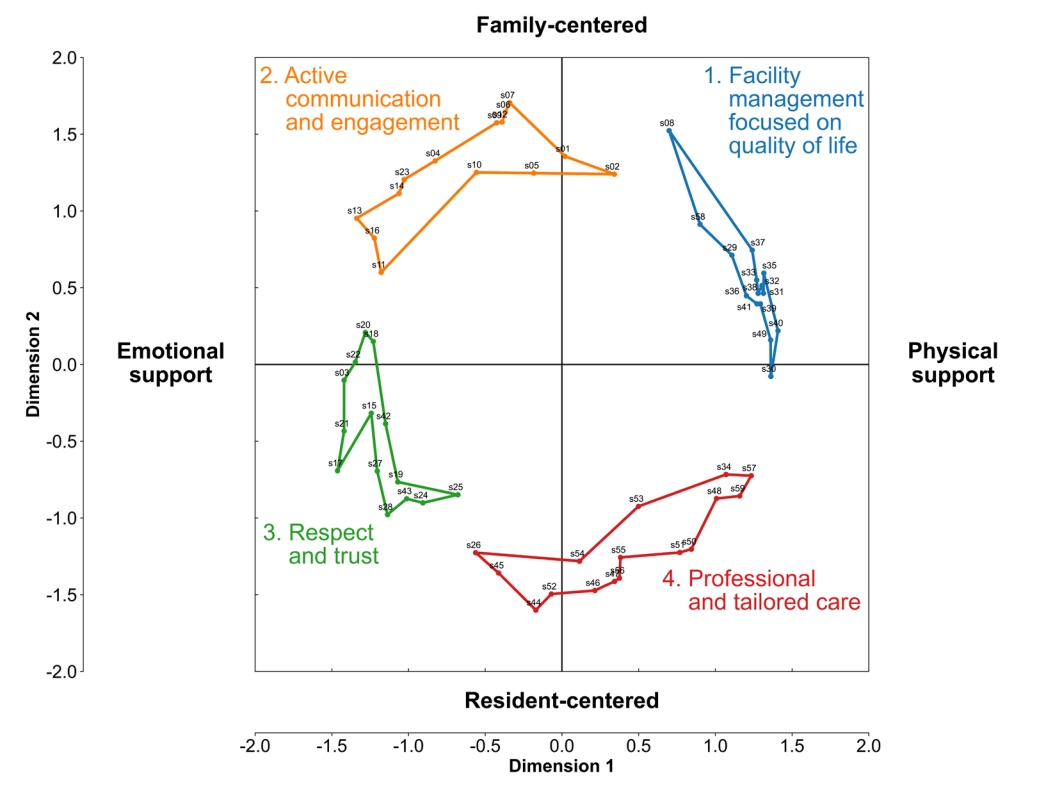
The 2D statements were subsequently analyzed, and the dimensions were named as follows. Dimension 1 (x-axis) was labeled “physical support—emotional support,” the positive direction representing physical support, which concerns facility-related environmental factors, and the negative direction representing emotional support, referring to the psychological services provided by facility staff. Dimension 2 (y-axis) was labeled “family-centered—resident-centered,” the positive direction indicating family-centered aspects, such as information provided to family members, and the negative direction representing resident-centered support, focusing on the direct needs of nursing home residents.
3. Clusters of positive patient experiences
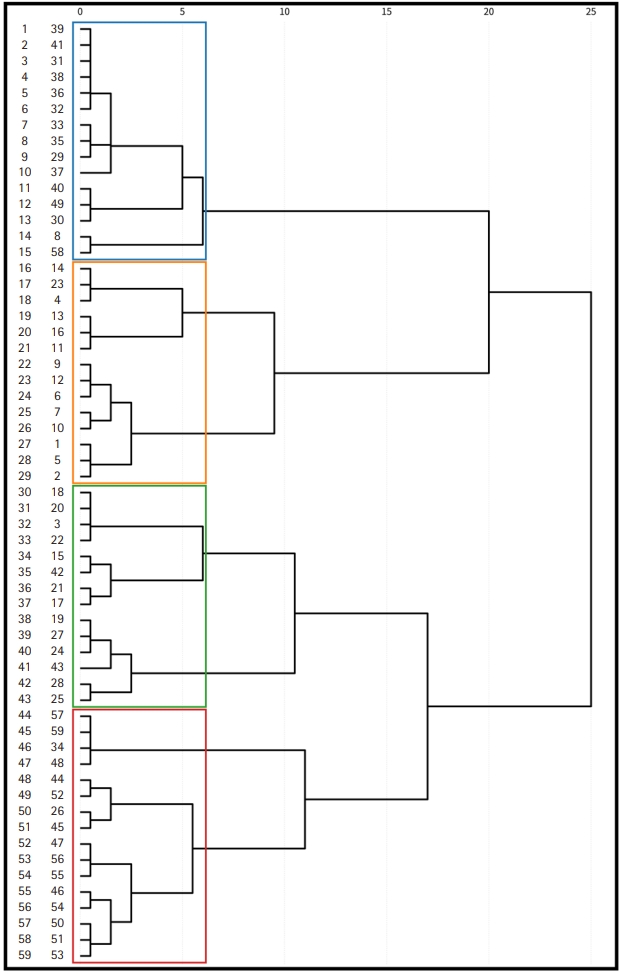
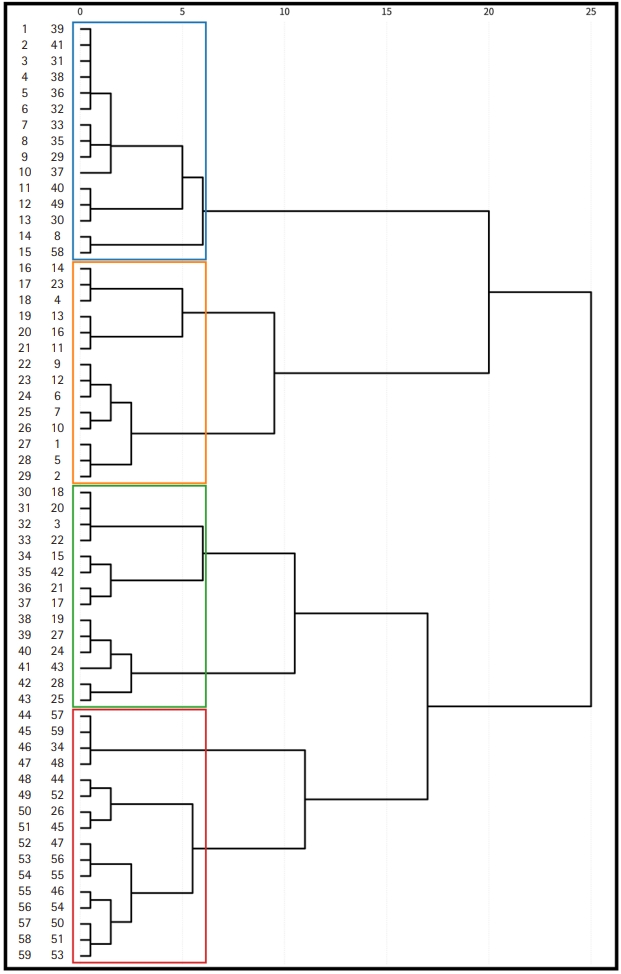
Cluster analysis was performed using a hierarchical approach to determine the optimal number of clusters in the concept map (Figure 1). Ward’s linkage method was applied to x and y coordinate values derived from the MDS, followed by dendrogram analysis to finalize the clusters. The final determination of clusters was guided by the following criteria: (1) number of clusters should not exceed the number suggested by the participants during the structuring stage, (2) each cluster should contain statements with coherent and distinct meanings from other clusters, and (3) maintaining logical similarity between clusters, as indicated by the dendrogram analysis.
Figure 2 presents a concept map illustrating the spatial distribution of the statements derived from MDS and HCA. The map visualizes the grouping of different statements based on conceptual similarity and the representation of these clusters within the two-dimensional space, providing insight into positive patient experiences among nursing home residents’ families.
Table 2 presents the four clusters: Cluster 1 (facility management focused on quality of life) contains 15 statements, Cluster 2 (active communication and engagement) contains 14 statements, Cluster 3 (respect and trust) contains 14 statements, and Cluster 4 (professional and personalized care) contains 16 statements. Although Clusters 3 (respect and trust) and 4 (professional and personalized care) are conceptually related, they represent distinct dimensions. Cluster 3 emphasizes the relational and ethical aspects of care, such as dignity, transparency, and trustworthiness, whereas Cluster 4 reflects technical competence and individualized care delivery. The cluster names were assigned based on consensus discussions focusing on the dominant conceptual theme, while minimizing cross-loading concerns.
4. Importance of positive patient experience factors
Participants rated the importance of each statement using a 5-point Likert scale (1=not at all important, 2=not important, 3=neutral, 4=important, and 5=very important). The average importance score for the final 59 selected statements (4.38±0.74), indicated a high level of perceived importance. Analysis of the score distribution revealed that 26 statements (44.1%) scored above 4.5, 27 statements (45.8%) scored between 4.0 and 4.5, and six statements (10.2%) scored between 3.5 and 4.0, demonstrating that the participants consistently rated the statements as highly important.
Statement 10, “All necessary information is kindly provided during the first consultation,” received the highest importance score (4.89±0.31). This was followed by Statement 19, “The facility fosters a sense of care rather than end-of-life waiting” (4.84±0.37), and Statement 18, “The facility offers reliable care for family members to feel at ease” (4.79±0.41). Several statements scored (4.68±0.47), including Statement 34 “The facility has a partnered hospital nearby for medical management,” Statement 44 “Meals are served in bite-sized portions for those with chewing difficulties,” Statement 47 “Hair and nails are neatly maintained,” and Statement 56 “Residents continue their prescribed medications through the facility.” Statement 52 “Personalized care is provided for bedridden residents” (4.68±0.58). Among the four clusters, Cluster 4 (professional and personalized care) was rated as the most important (4.50±0.71), followed by Cluster 3 (respect and trust) (4.44±0.73). Clusters 1 and 2 showed comparable importance ratings (4.28±0.91 and 4.28±0.83, respectively).
This study employed concept mapping to identify the conceptual structure of positive patient experiences as perceived by the families of nursing home residents. It aimed to establish key components for developing a Korean-specific patient experience scale for nursing home residents’ family members. Rather than the structural configuration itself, the conceptual map highlights how family members interpret nursing home services through both relational and functional lenses, extending evaluation beyond observable care tasks to experiential and ethical dimensions of care delivery
The “physical support—emotional support” dimension represents the patient experience content. Physical support includes environmental and accessibility factors, while emotional support includes respecting residents’ preferences and autonomy and promptly informing families about residents’ concerns to provide reassurance. This categorization aligns with previous concept mapping research on positive patient experiences for nursing home residents conducted in Korea, where service content was similarly divided into physical and emotional aspects [31]. The “family-centered—resident-centered” dimension reflects the patient experience functionality. Family-centered services focus on sharing information with family members, such as photos and videos of residents’ daily lives or updates on the facility’s website. In contrast, resident-centered services include personalized and physical care provided directly to residents. These findings differ slightly from previous concept mapping research on positive patient experiences from the perspective of nursing home residents, where service functions were categorized as “care-centered” and “participation-centered” [31]. This suggests that nursing home residents prioritize services directly affecting their own care, while their families value both the quality of care provided to the resident and the facility-family communication [12,32,33].
Collectively, the interpreted experience suggests that families do not perceive care quality as a collection of discrete services, but as an integrated experience shaped by organizational philosophy, professional competence, and the quality of interpersonal relationships. The breadth of statements across domains indicates that family patient experiences are multifaceted and cannot be sufficiently captured by narrowly defined satisfaction metrics [34]. Comparisons with international nursing home family experience scales showed significant overlap [35]. The CAHPS Nursing Home Family Member Survey, a representative instrument developed by the Agency for Healthcare Research and Quality, measures family experiences in nursing homes. It consists of four multi-item domains and one global rating question [35]. These four domains are as follows: (1) nurses’/aides’ kindness and respect toward residents; (2) meeting basic needs (eating, drinking, and toileting); (3) provision of information and encouragement of family involvement; and (4) staffing, care of belongings, and cleanliness. These domains align closely with the clusters identified in this study. Similarly, a scoping review of international measurement tools for assessing the experiences of nursing home residents’ families identified environment, information and family involvement, tailored care, respect, and a responsive workforce as core components [36], many of which are reflected in this study. Notably, this study uniquely identified “facility management focused on quality of life” as a distinctive cluster, underscoring the role of facility management in shaping families’ perceptions of service quality.
In South Korea, among the official nursing home quality assessment scales, only one measures family satisfaction, collecting responses via telephone surveys. This scale comprises five items: reflection of family consultations and requests, provision of information, cost transparency, service satisfaction, and willingness to recommend the facility. However, service satisfaction is assessed using only one question with three response options (satisfied, neutral, and dissatisfied), making it difficult to capture families’ experiences in detail [37]. Although the existing South Korean evaluation framework incorporates familial satisfaction metrics, these are predominantly limited to basic indicators such as interpersonal civility and basic sanitation. It lacks the psychometric depth required to capture the multifaceted experiences, specifically ‘quality-of-life-oriented institutional governance’ and ‘highly individualized care trajectories’ identified in this study. Previous concept mapping research on positive patient experiences from the perspective of nursing home residents conducted in Korea identified six clusters: safety of care and treatment, responsible and supportive staff, comfort of the living environment, mental well-being, respect, and communication [31]. While the conceptual differences between nursing home residents’ and their families’ experiences are not drastic, this study highlights additional aspects of family experiences, such as active communication and participation, as well as facility management focused on improving residents’ quality of life [25]. In contrast, nursing home residents’ patient experience clusters tend to be more specific and direct, emphasizing living conditions, staff interactions, and safety in care delivery.
A closer examination of the relationship between the dimensions and clusters in this study’s concept map reveals several noteworthy features. First, regarding functional aspects of positive patient experiences as perceived by the families of the nursing home residents, statements were more densely distributed within the emotional support dimension. This suggests that families may have limited direct experience with physical services provided by facility staff, making emotional support services more salient through interactions during facility visits or phone communication. This finding aligns with previous research emphasizing the importance of leveraging family experiences as proxy evaluations of the emotional aspects of care for residents with cognitive impairments who may have difficulty expressing their own perceptions of service quality [12,38,39]. Second, the statements in this study’s concept map were evenly distributed across the four quadrants, contrasting with previous research on positive patient experiences as perceived by nursing home residents, where statements were predominantly concentrated in quadrants related to physical services [31]. This suggests that, unlike nursing home residents, their families can evaluate physical support, emotional support, and multidimensional aspects of care. Mukamel et al. [26] demonstrated that family satisfaction reflects essential relational and communicative aspects of long-term care not captured by clinical quality indicators. Given residents’ limited self-report capacity, incorporating family experience measures is essential for comprehensive, human-centered quality evaluation in nursing homes [26]. This underscores the importance of incorporating family perspectives more actively into nursing home service evaluations. Third, although Cluster 2 (active communication and engagement) contained 14 statements, it was ranked third in terms of importance. Notably, while the overall importance score of the statements in Cluster 2 was relatively high on a 5-point scale (mean=4.28), only one statement, “family members can participate in facility programs,” scored below 4.0 (3.58±0.96). This suggests that, while families acknowledge active participation, they may feel burdened by the demands of actual involvement [40]. Although partnership with family members is widely emphasized as a key element of person-centered care, the present findings reveal an important tension [41,42]. Family members assigned relatively low importance to active participation in facility programs, which may reflect the substantial emotional and practical caregiving burden experienced by families in Korea [43]. Rather than perceiving program participation as a service benefit, family caregivers appeared to prioritize reliable communication and basic care quality [32,44]. These findings suggest that family-centered care should move beyond assumptions of increased participation, and instead adopt flexible engagement models that respect families’ boundaries, offer optional rather than obligatory involvement, and provide them with emotional and informational support, without imposing additional responsibilities [45]. Taken together, the importance ratings further underscore that family members prioritize not only the presence of services, but the reliability and quality with which they are delivered. In particular, the relatively higher importance assigned to professional and personalized care and respect-based interactions suggests that families value trustworthiness and competence as core determinants of positive patient experiences. These findings indicate that importance weightings are closely linked to relational and functional expectations, rather than simple service availability.
Based on the findings, the significance of this study is fourfold. First, it reinforces the need for proxy evaluations by family members to assess patient experiences of nursing home residents with cognitive impairment or dementia, as they may be unable to express their own preferences or patient experiences [16,17,46]. Second, it provides a detailed framework for understanding positive patient experiences from the perspective of nursing home residents’ families in South Korea. The four clusters identified in this study—facility management focused on quality of life, active communication and engagement, respect and trust, and professional and personalized care—share key similarities with international nursing home family experience measurement tools [4,7]. Additionally, this study identifies patient experience aspects not typically included in nursing home residents’ patient experience assessments. Prior studies have developed standardized instruments to assess family caregiver experiences during care transitions, demonstrating that caregiver preparedness and involvement in decision-making are critical determinants of patient safety and quality of care [47]. These findings provide a robust theoretical foundation for the present study, which advocates for the systematic integration of family perspectives into the evaluation of nursing home patient experiences. Therefore, the findings can serve as foundational data for developing a standardized Korean nursing home patient experience scale for nursing home residents’ family members. Third, it pinpoints specific areas for nursing home service quality improvement from the perspective of residents’ families. Future research can expand on this study’s concept map to develop and implement a family experience scale for nursing home residents, enabling precise identification of areas requiring service enhancement. This will contribute directly to nursing home service quality improvement and provide a foundation for developing nursing intervention programs aimed at improving nursing home quality of care. Fourth, it introduces concept mapping as a novel nursing research methodology, demonstrating its innovative application in nursing research.
Despite its contributions, this study has several limitations. First, the study recruited 19 family members of nursing home residents through convenience sampling from facilities in Seoul and Gyeonggi-do in Korea. Since the perceived importance of services may vary based on family characteristics, caution is warranted in generalizing the findings to the families of all nursing home residents. Second, due to the small sample size, this study was unable to conduct concept mapping reflecting differences in nursing home size or regional characteristics. Future research should incorporate larger and more diverse samples to strengthen the validity and applicability of the findings. This study neither systematically accounted for facility-level characteristics, such as ownership, size, staffing ratios, or National Health Insurance Service grades, nor for residents’ clinical profiles, including dementia severity. Consequently, the identified experience clusters should be interpreted as reflecting families’ perceived patient experiences, rather than institution- or diagnosis-specific evaluations. As such, future research should further examine these institutional factors in order to refine the proposed patient experience framework [48].
This study employed concept mapping to identify key factors and the conceptual structure of positive patient experiences as perceived by nursing home residents’ families. Based on the findings, these experiences fall into two dimensions: service content (physical support–emotional support) and service functionality (family-centered–resident-centered). Additionally, four clusters were identified: facility management focused on quality of life, active communication and engagement, respect and trust, and professional and personalized care.
The findings reinforce the critical role of person-centered care in nursing homes, particularly for residents with cognitive decline. Engaging family members as active partners allows nurses to identify residents’ physical and emotional needs overlooked in standard clinical assessments. Recent evidence supports this approach, demonstrating that person-centered care enhances quality of care, addresses behavioral and psychological symptoms of dementia, and promotes holistic well-being [49]. Integrating family perspectives with person-centered care provides a practical foundation for developing a family-informed patient experience index, guiding evidence-based practice, staff education, and policy initiatives aimed at human-centered, relational care.
Based on the findings, the following recommendations are proposed: (1) development of a measurement scale for nursing home patient experiences as perceived by residents’ families, accounting for facility grade and regional differences and (2) further concept mapping and scale development studies involving nursing home residents, their families, and nursing home staff, to gain a comprehensive understanding of patient experiences.

Conflicts of Interest

No potential conflict of interest relevant to this article was reported.

Acknowledgements

None.

Funding

This study was supported by a National Research Foundation of Korea (NRF) grant funded by the Korean government (MEST) (No. RS-2022-00166186).

Data Sharing Statement

Please contact the corresponding author for data availability.

Author Contributions

Conceptualization: HC. Methodology: HC. Software: HC. Validation: JK. Formal analysis: IJC. Investigation: JK. Resources: HC. Data curation: IJC. Visualization: IJC. Supervision: HC. Project administration: HC. Funding acquisition: HC. Writing–original draft: HC. Writing–review & editing: all authors. Final approval of the manuscript: all authors.

Fig. 1.
Dendrogram using Ward's linkage for hierarchical cluster analysis.
jkan-26021f1.jpg
Fig. 2.
Concept map of positive patient experiences among family members of nursing home residents. s, statement.
jkan-26021f2.jpg
Table 1.
Characteristics of the participants (N=19)
Characteristic Category n (%)
Sex Male 2 (10.5)
Female 17 (89.5)
Residence Seoul 14 (73.7)
Gyeonggi-do 5 (26.3)
Relationship with residents Children 18 (94.7)
Spouse 0 (0.0)
Other relatives 1 (5.3)
Age of family member (yr) ≤49 2 (10.5)
50–59 14 (73.7)
≥60 3 (15.8)
Duration of stay in current nursing home (yr) <1 6 (31.6)
1–3 6 (31.6)
>3 7 (36.8)
Table 2.
Cluster names and importance ratings of the statements concerning individual clusters (N=19)
Cluster No. Finalized statements Importance (Mean±SD)
Cluster 1. Facility management focused on quality of life (15 items) 39 The facility has a cozy, home-like atmosphere. 4.37±0.68
41 There is a space where residents can gather and chat. 4.32±0.67
31 The beds are low, facilitating activities of daily living. 4.42±0.69
38 There is a yard or rooftop where residents can grow plants. 3.79±1.18
36 Residents can choose between private and shared rooms. 4.21±1.03
32 The building has good natural lighting. 4.63±0.49
33 Indoor spaces are wide enough for convenient wheelchair movement. 4.53±0.90
35 The facility is located close to public transportation. 4.16±1.06
29 The facility is systematically managed. 4.58±0.50
37 The facility is situated on a flat surface, facilitating visits and outings. 3.95±1.12
40 There are multiple restrooms conveniently located for residents. 4.32±1.00
49 The facility environment is clean and agreeable. 4.53±0.69
30 The kitchen is open, and hygiene is maintained. 4.37±0.83
8 Photos of residents’ daily lives are displayed in the facility. 3.84±1.11
58 There are daily programs that residents can choose to participate in. 4.26±1.04
Cluster 2. Active communication and engagement (14 items) 14 Residents can go out or stay overnight with their family members. 4.37±0.68
23 Residents can have their mobile phones and make calls freely. 4.00±0.81
4 Family members can participate in facility programs. 3.58±0.96
13 Family members are informed immediately, even about minor issues. 4.53±0.61
16 The staff understand, comfort, and actively respond to caregivers’ requests. 4.37±0.68
11 The facility regularly monitors supplies and updates family members. 4.42±0.69
9 Caregivers and family members can communicate via a website or app. 4.00±1.10
12 Video calls can be made with residents. 4.32±0.94
6 Photos and updates are posted daily on social media. 4.16±0.89
7 Video recordings of residents’ daily lives are shared with their family members. 4.37±0.83
10 All necessary information is kindly provided during the first consultation. 4.89±0.31
1 Visits can be scheduled anytime with a reservation. 4.53±0.61
5 Family members can enter residents’ living spaces to have conversations. 4.37±1.06
2 Families can assist in organizing the resident’s room upon admission. 4.00±1.15
Cluster 3. Respect and trust (14 items) 18 The facility offers reliable care for family members to feel at ease. 4.79±0.41
20 The director treats residents kindly and sincerely, enhancing trust. 4.58±0.60
3 Family members can bring residents their favorite foods and assist with meals. 4.05±0.84
22 Residents have opportunities for meaningful roles within the facility. 3.84±1.01
15 Residents feel at home in the facility. 4.32±0.94
42 Residents can freely wear their own clothes from home. 4.53±0.51
21 Staff treat residents warmly as if they were their own parents. 4.53±0.61
17 The facility respects residents’ religious beliefs and provides spiritual care. 4.42±0.90
19 The facility fosters a sense of care rather than end-of-life waiting. 4.84±0.37
27 Staff promptly address issues upon residents’ requests. 4.32±0.74
24 The presence of nurses monitoring residents provides reassurance. 4.58±0.60
43 The facility offers social interaction opportunities, reducing loneliness. 4.37±0.59
28 Staff respond sensitively to even minor changes in residents’ conditions. 4.42±0.60
25 Staff maintain a professional attitude when caring for residents. 4.58±0.60
Cluster 4. Professional and personalized care (16 items) 57 A physiotherapy room offers daily physical and heat therapy. 4.16±1.06
59 Infection control is strictly enforced. 4.58±0.60
34 The facility is partnered with a hospital nearby for medical management. 4.68±0.47
48 Laundry services ensure clothes are always clean. 4.53±0.61
44 Meals are served in bite-sized portions for those with chewing difficulties. 4.68±0.47
52 Personalized care is provided for bedridden residents. 4.68±0.58
26 If hospital treatment is needed, the facility assists with visits and procedures. 4.47±0.61
45 Mealtimes are flexible. 3.58±0.83
47 Hair and nails are neatly maintained. 4.68±0.47
56 Residents continue their prescribed medications through the facility. 4.68±0.47
55 Regular activities support cognitive function and overall health. 4.53±0.61
46 Nutritious meals and snacks are provided regularly. 4.63±0.59
54 Assistance is provided for independent restroom use and daily activities. 4.63±0.59
50 Dental care is provided. 4.58±0.50
51 Residents are bathed at least once a week. 4.53±0.77
53 There are many volunteers, providing sufficient caregiving support. 4.37±1.01

SD, standard deviation.

Figure & Data

REFERENCES

    Citations

    Citations to this article as recorded by  

      • ePub LinkePub Link
      • Cite
        CITE
        export Copy Download
        Close
        Download Citation
        Download a citation file in RIS format that can be imported by all major citation management software, including EndNote, ProCite, RefWorks, and Reference Manager.

        Format:
        • RIS — For EndNote, ProCite, RefWorks, and most other reference management software
        • BibTeX — For JabRef, BibDesk, and other BibTeX-specific software
        Include:
        • Citation for the content below
        Concept mapping study of positive patient experiences among family members of nursing home residents in South Korea
        Close
      • XML DownloadXML Download
      Figure
      • 0
      • 1
      We recommend
      Concept mapping study of positive patient experiences among family members of nursing home residents in South Korea
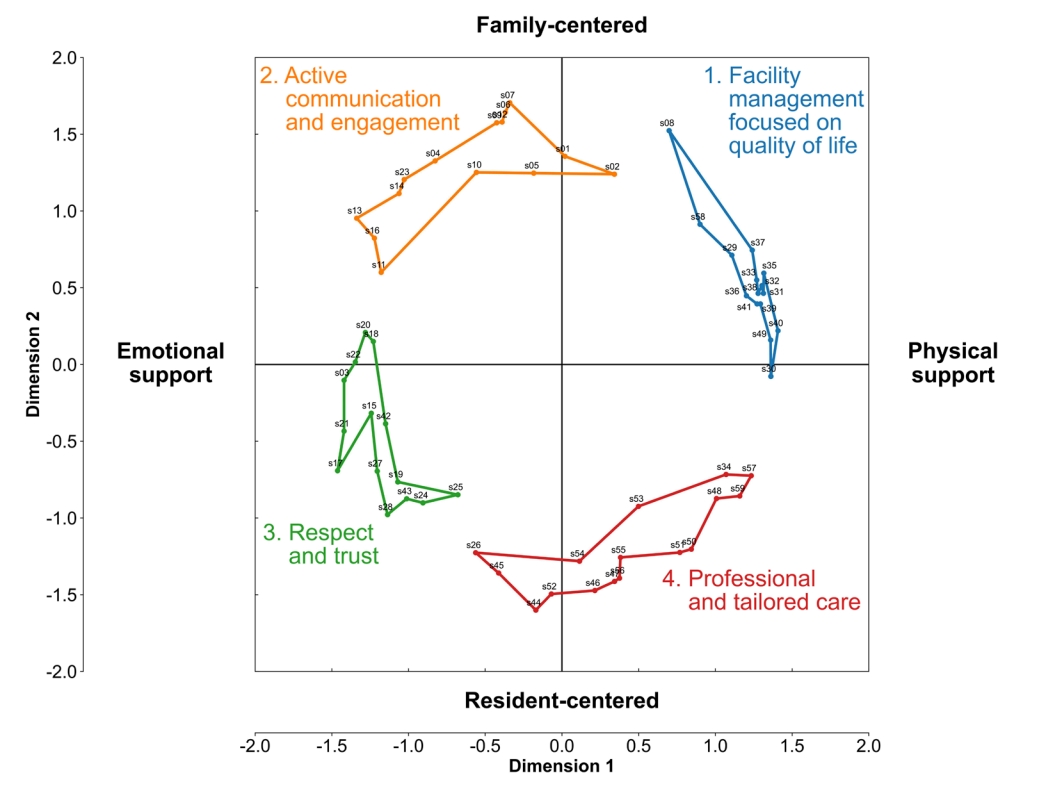
      Image Image
      Fig. 1. Dendrogram using Ward's linkage for hierarchical cluster analysis.
      Fig. 2. Concept map of positive patient experiences among family members of nursing home residents. s, statement.
      Concept mapping study of positive patient experiences among family members of nursing home residents in South Korea
      Characteristic Category n (%)
      Sex Male 2 (10.5)
      Female 17 (89.5)
      Residence Seoul 14 (73.7)
      Gyeonggi-do 5 (26.3)
      Relationship with residents Children 18 (94.7)
      Spouse 0 (0.0)
      Other relatives 1 (5.3)
      Age of family member (yr) ≤49 2 (10.5)
      50–59 14 (73.7)
      ≥60 3 (15.8)
      Duration of stay in current nursing home (yr) <1 6 (31.6)
      1–3 6 (31.6)
      >3 7 (36.8)
      Cluster No. Finalized statements Importance (Mean±SD)
      Cluster 1. Facility management focused on quality of life (15 items) 39 The facility has a cozy, home-like atmosphere. 4.37±0.68
      41 There is a space where residents can gather and chat. 4.32±0.67
      31 The beds are low, facilitating activities of daily living. 4.42±0.69
      38 There is a yard or rooftop where residents can grow plants. 3.79±1.18
      36 Residents can choose between private and shared rooms. 4.21±1.03
      32 The building has good natural lighting. 4.63±0.49
      33 Indoor spaces are wide enough for convenient wheelchair movement. 4.53±0.90
      35 The facility is located close to public transportation. 4.16±1.06
      29 The facility is systematically managed. 4.58±0.50
      37 The facility is situated on a flat surface, facilitating visits and outings. 3.95±1.12
      40 There are multiple restrooms conveniently located for residents. 4.32±1.00
      49 The facility environment is clean and agreeable. 4.53±0.69
      30 The kitchen is open, and hygiene is maintained. 4.37±0.83
      8 Photos of residents’ daily lives are displayed in the facility. 3.84±1.11
      58 There are daily programs that residents can choose to participate in. 4.26±1.04
      Cluster 2. Active communication and engagement (14 items) 14 Residents can go out or stay overnight with their family members. 4.37±0.68
      23 Residents can have their mobile phones and make calls freely. 4.00±0.81
      4 Family members can participate in facility programs. 3.58±0.96
      13 Family members are informed immediately, even about minor issues. 4.53±0.61
      16 The staff understand, comfort, and actively respond to caregivers’ requests. 4.37±0.68
      11 The facility regularly monitors supplies and updates family members. 4.42±0.69
      9 Caregivers and family members can communicate via a website or app. 4.00±1.10
      12 Video calls can be made with residents. 4.32±0.94
      6 Photos and updates are posted daily on social media. 4.16±0.89
      7 Video recordings of residents’ daily lives are shared with their family members. 4.37±0.83
      10 All necessary information is kindly provided during the first consultation. 4.89±0.31
      1 Visits can be scheduled anytime with a reservation. 4.53±0.61
      5 Family members can enter residents’ living spaces to have conversations. 4.37±1.06
      2 Families can assist in organizing the resident’s room upon admission. 4.00±1.15
      Cluster 3. Respect and trust (14 items) 18 The facility offers reliable care for family members to feel at ease. 4.79±0.41
      20 The director treats residents kindly and sincerely, enhancing trust. 4.58±0.60
      3 Family members can bring residents their favorite foods and assist with meals. 4.05±0.84
      22 Residents have opportunities for meaningful roles within the facility. 3.84±1.01
      15 Residents feel at home in the facility. 4.32±0.94
      42 Residents can freely wear their own clothes from home. 4.53±0.51
      21 Staff treat residents warmly as if they were their own parents. 4.53±0.61
      17 The facility respects residents’ religious beliefs and provides spiritual care. 4.42±0.90
      19 The facility fosters a sense of care rather than end-of-life waiting. 4.84±0.37
      27 Staff promptly address issues upon residents’ requests. 4.32±0.74
      24 The presence of nurses monitoring residents provides reassurance. 4.58±0.60
      43 The facility offers social interaction opportunities, reducing loneliness. 4.37±0.59
      28 Staff respond sensitively to even minor changes in residents’ conditions. 4.42±0.60
      25 Staff maintain a professional attitude when caring for residents. 4.58±0.60
      Cluster 4. Professional and personalized care (16 items) 57 A physiotherapy room offers daily physical and heat therapy. 4.16±1.06
      59 Infection control is strictly enforced. 4.58±0.60
      34 The facility is partnered with a hospital nearby for medical management. 4.68±0.47
      48 Laundry services ensure clothes are always clean. 4.53±0.61
      44 Meals are served in bite-sized portions for those with chewing difficulties. 4.68±0.47
      52 Personalized care is provided for bedridden residents. 4.68±0.58
      26 If hospital treatment is needed, the facility assists with visits and procedures. 4.47±0.61
      45 Mealtimes are flexible. 3.58±0.83
      47 Hair and nails are neatly maintained. 4.68±0.47
      56 Residents continue their prescribed medications through the facility. 4.68±0.47
      55 Regular activities support cognitive function and overall health. 4.53±0.61
      46 Nutritious meals and snacks are provided regularly. 4.63±0.59
      54 Assistance is provided for independent restroom use and daily activities. 4.63±0.59
      50 Dental care is provided. 4.58±0.50
      51 Residents are bathed at least once a week. 4.53±0.77
      53 There are many volunteers, providing sufficient caregiving support. 4.37±1.01
      Table 1. Characteristics of the participants (N=19)

      Table 2. Cluster names and importance ratings of the statements concerning individual clusters (N=19)

      SD, standard deviation.


      J Korean Acad Nurs : Journal of Korean Academy of Nursing
      Close layer
      TOP