Skip Navigation
Skip to contents

J Korean Acad Nurs : Journal of Korean Academy of Nursing


Articles

Page Path
HOME > J Korean Acad Nurs > Ahead-of print articles > Article
Research Paper
Psychological reactance to anti-smoking campaigns in designated smoking areas among female smokers in their 20s and 30s: a quasi-experimental study
Hyeonji Mun1orcid, Soontae An1orcid, Hyekyeong Kim2,3orcid

DOI: https://doi.org/10.4040/jkan.25177
Published online: August 10, 2026

1Division of Communication and Media, Ewha Womans University, Seoul, South Korea

2Department of Health Convergence, Ewha Womans University, Seoul, South Korea

3Seoul Tobacco Control Center, Seoul, South Korea

Corresponding author: Soontae An Division of Communication & Media, College of Social Sciences, Ewha Womans University, 52 Ewhayeodae-gil, Seodaemun-gu, Seoul 03760, South Korea E-mail: soontae@ewha.ac.kr
• Received: December 16, 2025   • Revised: January 24, 2026   • Accepted: May 14, 2026

© 2026 Korean Society of Nursing Science

This is an Open Access article distributed under the terms of the Creative Commons Attribution NoDerivs License (http://creativecommons.org/licenses/by-nd/4.0) If the original work is properly cited and retained without any modification or reproduction, it can be used and re-distributed in any format and medium.

  • 265 Views
  • 9 Download
  • Purpose
    This study aimed to determine whether placing anti-smoking campaign messages in designated smoking areas elicits psychological reactance among female smokers and to assess whether message framing (controlling vs. non-controlling) moderates the association between psychological reactance and intention to quit smoking.
  • Methods
    A quasi-experimental survey was conducted with 259 female smokers. Of these, 58 participants completed the survey before exposure to smoking-cessation messages, and 201 completed the survey after exposure. Among the exposed participants, 100 were assigned to the controlling condition and 101 to the non-controlling condition. Measures included psychological reactance, intention to quit smoking, trait reactance, smoking disclosure, and smoking-related covariates. Data were analyzed using analysis of covariance and Hayes’ PROCESS Model 1, with statistical significance set at p<.05.
  • Results
    Smokers exposed to anti-smoking messages within designated smoking areas reported higher psychological reactance (mean±standard deviation: 2.10±0.94) than those not exposed (1.81±0.77), with a significant between-group difference (p=.017). Simple slope analysis revealed that psychological reactance was negatively associated with quit intention under controlling messages (B=–.20, p=.031), but not under non-controlling messages (B=.05, p=.591).
  • Conclusion
    Exposure to anti-smoking messages within designated smoking areas was associated with increased psychological reactance toward smoking cessation. In contrast, autonomy-supportive, non-controlling messages attenuated this effect. These findings suggest that smoking areas may serve as strategic behavioral intervention points when campaigns employ context-sensitive, autonomy-supportive message framing.
    This study was registered with the Clinical Research Information Service (CRIS) of the Republic of Korea (KCT0012514) on 27 August 2026.
Recent trends in smoking prevalence in South Korea show a significant increase in both the proportion of female smokers and the use of e-cigarettes. As of 2023, the rate of e-cigarette use surged from 5.1% to 8.1%, and the number of female smokers has more than doubled within just a few years [1]. Female smoking has become an important public health concern that requires focused investigation and action.
In South Korea, many female smokers tend to conceal or avoid disclosing their smoking behaviors, with a considerable proportion classified as “hidden smokers” [2,3]. This tendency is understood as a consequence of the social stigma against female smoking, which is reinforced by traditional gender expectations surrounding pregnancy and motherhood. Jung-Choi et al. [2] reported that the actual smoking rate among Korean women is approximately 2.4 times higher than the self-reported rate, and that about 60% of female smokers identified themselves as non-smokers, leading to adverse outcomes, including continued smoking, delayed quit attempts, and avoidance of healthcare services [3,4].
South Korea’s smoking cessation policies have primarily relied on regulatory measures such as expanding smoke-free zones and enforcing smoking bans. Although these measures have helped establish smoke-free environments, they have not adequately reflected the sociocultural contexts or psychological characteristics of female smokers. Previous studies have noted that regulation-centered cessation policies often frame smoking as an issue of individual morality, reinforcing social stigma and increasing psychological reactance among female smokers, which ultimately weakens their intention to quit [5-7]. These findings suggest that female smokers have not been sufficiently considered in the design and implementation of smoking cessation policies, resulting in limited effectiveness in promoting meaningful behavioral change.
Particularly in public spaces, female smokers are highly conscious of social expectations surrounding femininity, morality, and self-control [8]. As a consequence, designated smoking areas serve a dual function: while they provide a socially permitted space for smoking and a temporary refuge from everyday stress, they also render smoking behavior highly visible through spatial segregation, thereby reinforcing social norms and stigma rather than suspending them [9,10]. Previous qualitative and review studies have shown that female smokers experience heightened social scrutiny and moral judgment in such contexts, which shapes their emotional and behavioral responses to smoking [4,11]. Within this context, female smokers experience ambivalent emotions in which feelings of liberation coexist with guilt, and acceptance intertwines with resistance. Given this duality, it is necessary to examine the psychological factors experienced by female smokers and to understand how these factors are connected to smoking cessation behaviors.
To better understand these psychological mechanisms, particular attention should be paid to psychological reactance, a motivational response that arises when individuals perceive external control or social pressure as a threat to their freedom. According to the Psychological Reactance Theory (PRT) by Brehm [12], when individuals perceive that their freedom is being restricted, they experience negative cognition and anger, motivating them to restore that threatened freedom [13]. Prior research indicates that when health campaigns or behavioral interventions are perceived as limiting personal autonomy, recipients often experience psychological reactance, which can result in negative attitudes or even a boomerang effect that undermines the intended behavioral change [14].
Importantly, young female smokers constitute a particularly relevant population for examining psychological reactance to anti-smoking campaigns. Young adulthood is characterized by heightened sensitivity to autonomy and resistance to external control, increasing susceptibility to reactance when freedom-threatening messages are encountered, as posited by PRT [15]. For young women, this susceptibility is further shaped by gendered social norms that moralize smoking, making anti-smoking messages—especially in public or semi-public spaces—more likely to be perceived as social judgment rather than health guidance. Consistent with this perspective, Ha et al. [7] found that socially stigmatizing anti-smoking messages elicited resistance rather than increased cessation intention among Korean female smokers.
In the context of health communication, the framing of messages as controlling or non-controlling plays a crucial role in shaping perceived autonomy and levels of reactance. Overly prescriptive or forceful controlling language tends to be interpreted as a threat to freedom and increases resistance, whereas non-controlling language—which respects individual autonomy—can stimulate intrinsic motivation and facilitate behavioral change [16,17]. This approach is grounded in Self-Determination Theory, which posits that satisfying psychological needs for autonomy reduces resistance and enhances self-regulated motivation [18]. Accordingly, autonomy-supportive message framing functions not merely as a milder form of persuasion but as a psychological safeguard that minimizes perceived threats while fostering self-endorsed change.
Maximizing the effectiveness of health messages requires understanding psychological reactance at both cognitive and affective levels and developing strategies to minimize it. Exposure to threatening or controlling messages can evoke anger and negative thoughts that interfere with positive attitude or behavior change. Therefore, reducing psychological reactance is essential to enhance message acceptance and initiate behavioral change [19,20]. For this reason, smoking-cessation campaigns should move beyond simply avoiding confrontational language to instead design messages that serve as psychological safe spaces, activating autonomy and internal motivation among smokers.
Accordingly, this study empirically examines how the relationship between psychological reactance and smoking cessation intention among female smokers varies depending on the framing type of anti-smoking campaign messages implemented within designated smoking areas. Specifically, the study first investigates whether there are differences in the level of psychological reactance toward smoking cessation with or without anti-smoking messages in smoking areas. Second, it tests whether the type of message framing (controlling vs. non-controlling) moderates the effect of psychological reactance on behavioral intention. This approach highlights that smoking areas may function not merely as places for smoking but as potential intervention sites for promoting cessation behaviors. Furthermore, it provides practical implications for developing public health communication strategies that balance persuasion with autonomy. The hypotheses of this study are as follows:
H1. The presence of smoking-cessation messages in designated smoking areas will heighten psychological reactance to quitting smoking.
H2. The effect of psychological reactance on cessation intention will differ depending on the type of smoking-cessation message (controlling vs. non-controlling) presented in the smoking area.
1. Study design
This study employed a quasi-experimental nonequivalent control group pretest-posttest design to examine how different types of smoking-cessation messages displayed in designated smoking areas influence psychological reactance and smoking-cessation intention among female smokers in their 20s and 30s. In addition, a non-exposed comparison group was surveyed prior to message installation to provide baseline reference levels of psychological reactance.
2. Participants
Participants were female smokers in their 20s and 30s recruited near designated smoking areas at a women’s university in Seoul, South Korea. Eligibility criteria defined smokers as individuals who had smoked more than five packs of cigarettes (i.e., ≥100 cigarettes) in their lifetime and had been smoking for at least 1 month prior to participation.
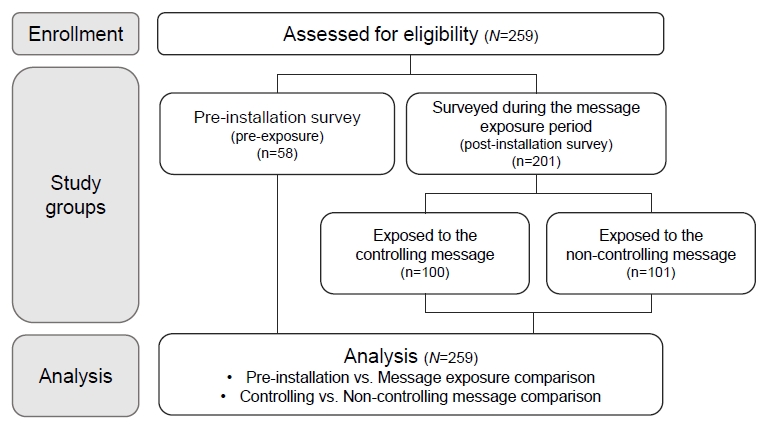
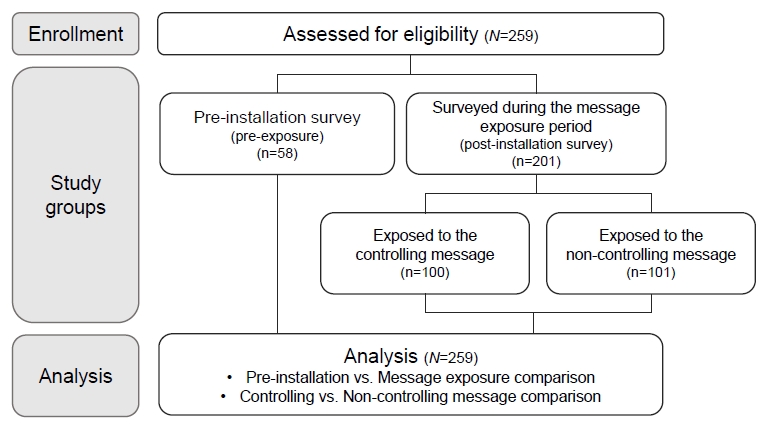
A total of 259 eligible female smokers participated in the study. Of these, 58 participants were surveyed prior to message exposure. One week after the pre-intervention survey, the smoking-cessation posters were installed, and the post-installation survey was administered for 1 month. During the message exposure period, 201 participants were recruited from two major smoking areas on campus where posters with different message framings were displayed, resulting in 100 participants exposed to the controlling message and 101 participants exposed to the non-controlling message. A post-hoc power analysis was conducted using G*Power ver. 3.1 (Heinrich-Heine-Universität Düsseldorf) to verify the adequacy of the sample size. With a medium effect size (f=.25), α=.05, and three groups, the achieved power for the total sample of 259 was 1–β=.96, which exceeds the conventionally recommended threshold of .80, confirming sufficient statistical power for the present study [21].
To minimize the likelihood of duplicate participation, the two smoking areas were selected based on sufficient physical distance, and participants were asked in advance whether they had previously participated in the survey at another location. After confirming eligibility, informed consent was obtained from all participants prior to participation. The flow diagram of study enrollment and procedures is presented in Figure 1.
3. Measurements
This study employed a structured questionnaire that included general characteristics and smoking-related factors. Demographic characteristics consisted of year in school and monthly living expenses (allowance). Smoking- and cessation-related variables included primary cigarette type, daily cigarette consumption, nicotine dependence, cohabitant smoking status, stage of change for smoking cessation, and the number of prior quit attempts.

1) Psychological reactance

In this study, psychological reactance to smoking cessation was measured with or without the anti-smoking messages. In addition, psychological reactance toward the campaign messages themselves was assessed only among participants exposed to the intervention materials.
Psychological reactance toward smoking cessation was assessed using a three-item measure adapted from Kang and Han [22], and was administered to all participants. The original scale by Kang and Han [22] comprised four items and demonstrated high internal consistency (Cronbach’s α=.89). In the present study, one item was removed to improve the reliability and validity of the scale, as its inclusion resulted in a lower item-total correlation. Three of the four items were retained, and the reliability remained high (Cronbach’s α=.87). The items were: “I don’t want to talk about smoking cessation,” “I feel uncomfortable when talking about smoking cessation,” and “I dislike talking about smoking cessation.”
Psychological reactance to the anti-smoking campaign was defined as a cognitive and emotional response that arises when individuals perceive their freedom to be restricted or threatened by a persuasive message [13], and was administered exclusively among participants in the message-exposed conditions. The measure was adapted from Yoo et al. [23] who originally reported high internal consistency for a 13-item scale (Cronbach’s α=.90). In the present study, three items were excluded to improve the reliability and validity of the scale, as their inclusion resulted in lower item-total correlations. Ten items were retained, and the reliability of the resulting scale remained very high (Cronbach’s α=.91).
The 10-item measure captured three components: emotional response, negative cognition, and perceived threat to freedom. The emotional component was assessed with three items (“This message makes me feel unpleasant,” “I feel resistant to it,” and “I feel irritated.”). Negative cognition was measured with three items (“The message is negative,” “I disagree with it,” and “I feel like ignoring it”). Perceived threat to freedom was assessed with four items, including one reverse-coded item: “The message feels pressuring,” “It feels like it restricts my freedom,” “It makes me want to do the opposite,” and the reverse-coded item “This message seems to be helping me.”
The two measures were analyzed separately given that they assessed distinct aspects of psychological reactance and were administered to different participant groups. The three-item scale captured reactance toward smoking cessation in general, while the 10-item scale captured reactance specific to the campaign message among exposed participants only.

2) Smokers’ behavioral intention to cease smoking

Smokers’ behavioral intention to cease smoking was defined as their willingness to engage in actions aimed at quitting [24]. This construct was measured as a multidimensional index comprising cessation intention (six items), intention to seek assistance (three items), and intention to use/visit a local smoking cessation support center (two items).
Cessation intention and intention to seek assistance were adapted from Kim et al. [24] and Fishbein and Ajzen [25]. Cessation intention was assessed using six items: “I am willing to seriously consider quitting,” “I am willing to think about the necessity of quitting,” “I am willing to discuss quitting with people around me,” “I intend to stop smoking in the near future,” “I intend to reduce the number of cigarettes I smoke per day,” and “I am willing to inform others when I decide to quit.” Intention to seek assistance was assessed with three items: “I will look for appropriate methods to attempt quitting,” “I will seek help from people around me,” and “I will participate in professional counseling or programs.”
Intention to use/visit a cessation support center was adapted from Lee and An [26] and assessed with two items: “I am willing to contact a center to receive cessation support,” and “I am willing to visit a nearby center to participate in its services.” In the present study, the overall 11-item scale demonstrated good internal consistency (Cronbach’s α=.88).

3) Control variable

(1) Trait reactance

Trait reactance is a dispositional characteristic that is distinct from situational psychological reactance. Individuals with high trait reactance tend to display oppositional and defiant behaviors and often resist authority or external influence. Accordingly, trait reactance was included as a covariate to strengthen the validity of the analyses examining psychological reactance to smoking-cessation messages.
Trait reactance was measured using four items adapted from Lee and Na [27]. This measure conceptualizes trait reactance as comprising two related subdimensions: rule resistance and rejection of freedom threat. The first two items—“I feel an urge to resist when I encounter rules,” “I feel good when I do the opposite of others,”—indexed rule resistance, whereas the latter two items—“I perceive others’ advice as interference,” and “I become angry when someone restricts my freedom of choice.”—captured rejection of freedom threat.
Although prior research distinguishes two facets (rule resistance, Cronbach’s α=.79; rejection of freedom threat, Cronbach’s α=.84), the present study operationalized trait reactance as a composite score by averaging all four items and reported internal consistency for the overall scale (Cronbach’s α=.77).

(2) Stage of change for smoking cessation

The stage of change for smoking cessation was assessed based on Ahn et al. [28], which adapted the classification of DiClemente et al. [29]. Respondents indicated their readiness to quit smoking using a single time-framed item with five response options (“no intention,” “no plan but some thoughts about quitting,” “within the next 12 months,” “within the next 6 months,” and “within the next 1 month”). Following Ahn et al. [28], responses were coded on a 5-point ordinal scale, with higher values indicating greater readiness to quit smoking.

(3) Interpersonal smoking disclosure

Interpersonal smoking disclosure was measured using selected items adapted from Lee [30], who developed the scale based on the interpersonal level of the ecological model proposed by McLeroy et al. [31]. The selected items assessed individuals’ openness about their smoking status and perceived social support in interpersonal contexts. More specifically, interpersonal smoking disclosure was measured across four components: interpersonal activity patterns related to smoking (two items), the smoking status of people around the respondent (one item), social norms surrounding smoking (three items), and social support for smoking prevention and cessation (two items). A total of eight items were used, including statements such as “There is someone with whom I can openly discuss my personal difficulties,” “I have family members, friends, colleagues, or a partner who smoke,” “I believe my family or acquaintances permit my smoking,” and “My family or acquaintances encourage me to abstain from smoking or quit smoking.” In the present study, the eight items were averaged to create a composite control index capturing multiple interpersonal domains; internal consistency was modest (Cronbach’s α=.58). This relatively low reliability may be attributable to the multidimensional nature of the construct, as the items reflect heterogeneous interpersonal aspects (e.g., disclosure, social norms, and perceived support) rather than a single unidimensional latent factor. Accordingly, the composite index should be interpreted as an exploratory control measure rather than a highly precise psychometric scale.

4) Characteristics related to smoking

To assess characteristics related to smoking, respondents were asked about basic smoking behavior characteristics, such as their usual smoking patterns and daily cigarette consumption, and their level of nicotine dependence was measured. Nicotine dependence was assessed using six items based on the Korean version of the Fagerström Test for Nicotine Dependence (FTND) validated by Ahn et al. [28]. The items measured the time to the first cigarette after waking, loss of control or withdrawal-related behaviors, dependence on specific smoking times (e.g., the first cigarette in the morning), daily smoking amount, smoking patterns, and compulsive smoking tendencies. The total FTND score ranges from 0 to 10, with 0–3 indicating low dependence, 4–6 indicating moderate dependence, and 7–10 indicating high dependence.
4. Research procedure and manipulation
The promotional materials for the smoking-cessation campaign were installed as poster-format X-banners within the designated smoking areas and were displayed for 1 month during the survey period. To isolate the influence of message framing, all materials were designed with an identical structural layout across conditions: each banner consisted of one main sentence, one sub-sentence, and a single illustrative image. The message content was developed with reference to prior studies [13,17,32], and the contact information (phone number and email address) of the Seoul Tobacco Cessation Center was included in both conditions to encourage user engagement.
In the experimental manipulation, message framing varied solely in the degree of controlling versus non-controlling language. Both messages were designed with parallel structures, differing only in whether the language emphasized obligation or personal choice.
Specifically, the controlling message employed imperative language emphasizing obligation (e.g., “you must”) to convey external pressure, accompanied by a statement highlighting health consequences (e.g., “Smoking threatens your health”). Conversely, the non-controlling (autonomy-supportive) message used choice-based and suggestive expressions that emphasized personal agency (e.g., “Smoking is your choice” and “you might consider…”), thereby highlighting autonomy and self-initiation.
That is, the controlling message read: “Smoking threatens your health. To protect your health, you must quit smoking.” The non-controlling message read: “Smoking is your personal choice. If you are determined to improve your health, you can start quitting smoking.” This contrast operationalized the message-type manipulation by presenting obligation-oriented versus autonomy-supportive language.
5. Data analysis
All statistical analyses were conducted using IBM SPSS Statistics ver. 25.0 (IBM Corp.) and the PROCESS macro [33]. Statistical significance was determined at the 5% level (p<.05). Participants’ demographic and smoking-related characteristics were examined using descriptive statistics, including frequencies, percentages, means, and standard deviations (SDs).
To examine differences in psychological reactance between exposure and non-exposure groups while controlling for individual trait reactance, analysis of covariance (ANCOVA) was conducted. Prior to the analysis, the assumption of homogeneity of variances was assessed using Levene’s test. To test the research model, the PROCESS macro with bootstrapping (5,000 resamples) was used, and all continuous variables were mean-centered prior to analysis.
6. Ethical consideration
This study was conducted with the approval of the Institutional Review Board of Ewha Womans University (EWHA-202510-0035-01). Prior to participation, all participants were provided with a clear explanation of the study purpose and procedures to ensure the protection of their rights. An information sheet was distributed detailing the study topic, objectives, procedures, confidentiality measures, and assurance of anonymity. Participants were also informed that their participation was entirely voluntary and that they could withdraw from the study at any time without penalty.
Written informed consent was obtained from all participants before survey administration. Additional consent for the collection of personal information was obtained solely for the purpose of providing participation incentives. Each participant received a mobile coupon worth 5,000 Korean won (KRW) as compensation for their participation. All data collected were encrypted, securely stored, and used exclusively for academic research purposes. In accordance with institutional guidelines, the data will be permanently deleted 3 years after the completion of the study.
1. Manipulation check
To confirm the manipulation of the experimental stimuli, smokers’ perceived threat to freedom and sense of control regarding the message framing were measured using three items, including one reverse-scored item. The level of perceived control in the message was measured on a 5-point scale using the following specific statements: “This message strongly demanded an action I should follow,” “This message felt more like a command than advice,” and “This message felt like it respected my choice (reverse-scored item).” The analysis, conducted using an independent samples t-test, revealed a statistically significant difference between the two groups (t=3.08, p=.002). This confirmed the successful manipulation of the message framing, with the controlling message group (mean±SD: 2.49±0.89) scoring significantly higher than the non-controlling message group (2.11±0.84).
2. Demographic and smoking-related characteristics
A total of 259 female smokers participated in the survey, comprising 58 in the non-exposure control group and 201 in the message-exposure group (Appendix 1). Participants were eligible if they were in their 20s or 30s, which was confirmed through a screening question prior to survey participation. The non-exposure control group consisted of different individuals from the message-exposure group, and demographic and smoking-related characteristics of participants are presented.
The following results describe the characteristics of the message-exposure group (n=201). More than half of the participants were seniors or above (51.7%). Monthly living expenses most commonly exceeded 1,000 thousand KRW (30.8%), followed by 600–800 thousand KRW (28.4%). Regarding smoking behavior, conventional cigarettes were the most frequently used (43.3%), followed by liquid-type electronic or heated tobacco products (31.8%) and dual use of both types (24.9%). A majority of respondents reported smoking at least one cigarette per day (76.6%), and the primary motivations for smoking were stress relief (54.7%) and habitual use (37.8%). Most participants began smoking after graduating from high school—that is, in adulthood (69.2%). Participants’ nicotine dependence, measured by the FTND, was generally low (0–3 points). With respect to the stage of behavioral change for smoking cessation, the largest proportion of participants reported ‘having thoughts about quitting but no specific plans’ (64.7%), indicating recognition of the need for change but an absence of concrete action plans. In addition, 55.2% of respondents had attempted to quit smoking (for at least 24 hours) within the past year. Regarding the number of quit attempts, the largest proportion of participants reported 1–2 quit attempts (36.3%), while 32.8% reported no quit attempts.
3. Psychological reactance with or without smoking-area campaign messages
An ANCOVA was conducted to examine differences in smokers’ psychological reactance toward smoking cessation between exposure and non-exposure groups to smoking-area campaign messages within designated smoking areas, while controlling for individual trait reactance (Table 1). The assumption of homogeneity of variances was met (Levene’s F(1, 257)=1.29, p=.257).
After adjusting for trait reactance, the ANCOVA revealed a significant main effect of message exposure on psychological reactance, F(1, 256)=5.78, p=.017. Trait reactance was also a significant covariate, F(1, 256)=16.55, p<.001, indicating that individuals’ dispositional reactance substantially contributed to variability in psychological reactance toward smoking cessation. Adjusted mean comparisons showed that smokers exposed to anti-smoking campaign messages within designated smoking areas reported significantly higher levels of psychological reactance (mean±SD: 2.10±0.94) than those who were not exposed (1.81±0.77).
4. Moderating effect of message framing on the relationship between psychological reactance and smoking-cessation intention
To examine how message framing moderates the effect of psychological reactance on smoking-cessation intention, a moderation analysis was conducted using the PROCESS macro (Model 1). Control variables included trait reactance, smoking disclosure, previous quit attempts, stage of change for smoking cessation, and smoking characteristics (primary type of cigarette and smoking quantity). The results are presented in Table 2.
Among the control variables, smoking disclosure was positively associated with cessation intention (B=.38, t=4.51, p<.001). Smoking quantity was also positively associated with cessation intention (B=.21, t=2.49, p=.013). Higher stages of behavioral change were associated with significantly increased cessation intention (B=.33, t=5.29, p<.001). However, previous quit attempts were negatively associated with cessation intention (B=–.28, t=–2.81, p=.006). These results may reflect a tendency for repeated quit attempts to weaken smokers’ motivation to quit.
Psychological reactance to anti-smoking messages showed a significant negative effect on smoking-cessation intention (B=–.20, t=–2.17, p=.031). In other words, among smokers exposed to anti-smoking messages within designated smoking areas, higher levels of psychological reactance were associated with lower intentions to quit smoking.
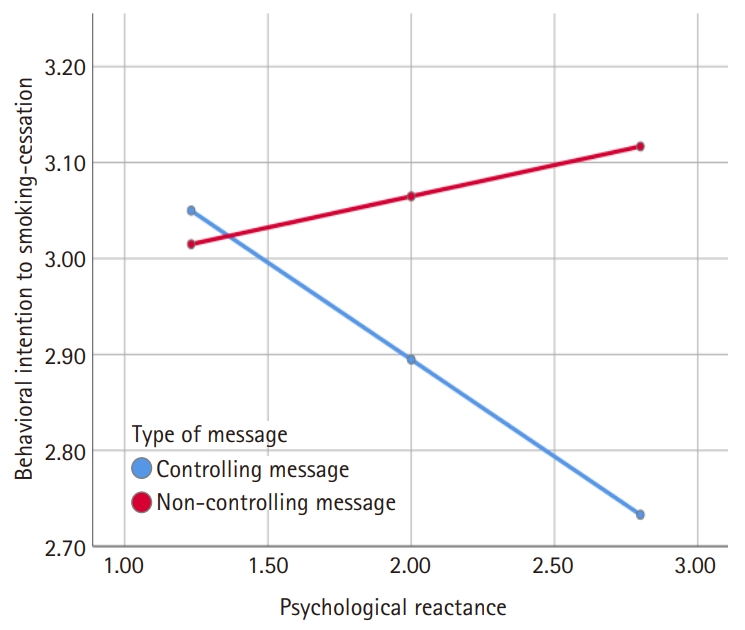
Moreover, the interaction between message framing and psychological reactance within designated smoking areas was significant (B=.25, standard error=0.12, t=2.02, p=.044; 95% confidence interval, 0.02–0.51), indicating that the effect of psychological reactance on cessation intention differed depending on the framing of messages displayed within smoking areas. Simple slope analysis further revealed that under the controlling message condition, higher psychological reactance significantly decreased smoking-cessation intention (B=–.20, p=.031), whereas this association was not significant under the non-controlling (autonomy-supportive) message condition (B=.05, p=.591) (Table 3, Figure 2).
These findings suggest that message framing moderates the relationship between psychological reactance and smoking-cessation intention. Specifically, non-controlling (autonomy-supportive) messages appear to be more effective in maintaining or enhancing cessation intentions among smokers with higher psychological reactance.
The present study provides empirical evidence that designated smoking areas serve as meaningful contexts for smoking-cessation interventions, wherein message framing plays a critical moderating role in the relationship between psychological reactance and cessation intention. The findings revealed that smokers exposed to anti-smoking messages in these areas exhibited higher psychological reactance toward quitting compared to those who were not exposed, consistent with hypothesis 1. Furthermore, the effect of psychological reactance on smokers’ intention to quit was moderated by the type of message framing used in the smoking-area campaign, supporting hypothesis 2.
First, the findings indicated that exposure to anti-smoking campaign messages within designated smoking areas was associated with higher psychological reactance toward smoking cessation. This result is consistent with previous research demonstrating that smoking-cessation messages can induce psychological reactance among smokers [14,22]. This suggests that smokers may perceive smoking cessation campaign messages as a threat to their behavioral freedom—their perceived autonomy to decide whether to smoke—which can elicit reactance [12,13]. Above all, this study empirically confirms that the placement of smoking-cessation campaigns in spatially specific contexts, such as designated smoking areas, may heighten smokers’ perception of freedom threat, thereby amplifying reactance. These findings highlight the need to consider psychological reactance across groups and contexts, as responses to health messages vary by individual and environmental factors and shape smoking cessation intentions [32]. Addressing these factors is key to reducing psychological reactance and improving the effectiveness of smoking cessation campaigns.
Second, this study identified a significant interaction effect between message framing and psychological reactance. Specifically, the negative influence of psychological reactance on intention to quit varied by message framing type. Under the controlling message condition within designated smoking areas, higher levels of psychological reactance were associated with significantly lower intentions to quit, whereas this negative association was attenuated under the non-controlling (autonomy-supportive) message condition. This finding suggests that when smokers experience heightened psychological reactance, autonomy-supportive messages are more effective in stimulating intrinsic motivation to quit by minimizing perceived threats to freedom. These results are consistent with the argument by Wong et al. [34] that overly threatening (controlling) or loss-framed messages can inadvertently increase psychological reactance, thereby undermining smoking-cessation intentions.
Moreover, this study offers practical contributions by focusing specifically on female smokers in their 20s and 30s, a group increasingly noted for navigating cognitive and emotional tensions related to smoking. In the context of rising female smoking rates and increasing scholarly attention to “hidden smokers”—women who conceal their smoking due to identity conflict, social stigma, and normative pressure [8,35]—the findings suggest the need for tailored smoking-cessation strategies that account for these psychosocial dynamics. The evidence presented here suggests that cessation messages should extend beyond informational appeals to incorporate autonomy-enhancing and emotionally resonant approaches that reduce reactance while strengthening both intrinsic motivation and perceived social support.
In addition, by evaluating campaign effects within smoking areas rather than in general public spaces, this study reframes smoking areas as potential sites for persuasive public health interventions. This approach challenges traditional policies that focus mostly on physical control and regulation, highlighting the need for communication strategies that are sensitive to the psychological and contextual factors shaping smokers’ responses to cessation messages. Nonetheless, several limitations should be considered. First, the study employed a quasi-experimental design, which limits causal inference regarding the effects of smoking-cessation messages. Second, all variables were measured using self-reported questionnaires, raising the possibility of social desirability bias. This concern may be particularly salient in the South Korean context, where female smoking remains highly stigmatized within a Confucian-influenced sociocultural environment, potentially leading participants to underreport smoking-related attitudes or respond in socially desirable ways. In addition, the interpersonal smoking disclosure measure showed relatively low internal consistency (Cronbach’s α=.58), likely reflecting the multidimensional nature of the construct; thus, it should be interpreted as an exploratory composite index rather than a highly reliable scale. Furthermore, formal validity evidence for this measure (e.g., content validity index or construct validity) was not established in the present study, which may limit confidence in its psychometric properties.
Third, participants were restricted to those in their 20s and 30s through a screening procedure; however, age was not directly measured, and thus the exact age distribution of the sample could not be verified. This may introduce potential selection bias and limit the generalizability of the findings. Furthermore, although group comparisons were conducted, and individual trait reactance was statistically controlled using ANCOVA, comprehensive baseline equivalence testing was not performed. Therefore, the possibility of unobserved group differences cannot be fully ruled out, which may limit the internal validity of the findings. Fourth, the sample was limited to female smokers who used designated smoking areas at a single women’s university, which warrants caution when generalizing the findings to other populations or to sociocultural contexts in which norms surrounding female smoking may differ. Finally, the study focused on the immediate effects of message exposure, precluding examination of long-term behavioral change or sustained smoking-cessation outcomes. Despite these limitations, the findings highlight opportunities for future research to further investigate designated smoking areas as strategic settings for health communication initiatives and to examine their potential role in supporting smoking-cessation behavior over time.
This study examined psychological reactance to smoking-cessation campaigns implemented within designated smoking areas. The results revealed that anti-smoking messages in smoking areas significantly elevated smokers’ psychological reactance toward cessation. Furthermore, the negative effect of reactance on cessation intention was attenuated when messages were framed in a non-controlling, autonomy-supportive manner, suggesting that message framing plays a critical role in moderating reactance-driven resistance to cessation campaigns. These findings suggest that designated smoking areas function not merely as physical sites for smoking but as potential behavioral intervention points that may motivate smokers to reconsider cessation. Accordingly, the findings provide foundational evidence for developing more effective campaigns that strategically account for message framing and psychological reactance to maximize persuasive impact.
Given that the present study was limited to female smokers, future investigations should include diverse demographic groups—varying in gender, age, occupation, and smoking history—to assess the generalizability of these findings. Moreover, subsequent studies should examine how individual differences among smokers—such as trait reactance, nicotine dependence, and demographic characteristics—moderate the effectiveness of different message framing approaches on psychological reactance and cessation intention. In addition, future research should explore how various message delivery formats, such as digital media, mobile notifications, or interpersonal counseling, interact with message framing to influence psychological reactance and cessation intention, thereby extending the findings beyond the poster-based intervention context of the present study. Additionally, longitudinal studies are warranted to examine whether repeated exposure to autonomy-supportive messages within designated smoking areas produces sustained reductions in reactance and corresponding increases in cessation intention over time.
Finally, beyond quantitative approaches, qualitative inquiry may provide deeper insight into the socio-psychological processes through which smokers construct and express psychological reactance in response to anti-smoking messages in designated smoking areas, thereby offering a more nuanced understanding of how autonomy-supportive message framing shapes cessation-related attitudes and behaviors in real-world contexts. Collectively, these future research directions will contribute to a more comprehensive understanding of the contextual factors shaping smokers’ responses to cessation messages, ultimately informing the design of more strategically effective smoking-cessation campaigns tailored to the spatial and behavioral characteristics of designated smoking areas.

Conflicts of Interest

No potential conflict of interest relevant to this article was reported.

Acknowledgements

None.

Funding

This study was supported by the Seoul Tobacco Control Center Research Fund in Seoul, Republic of Korea.

Data Sharing Statement

Please contact the corresponding author for data availability.

Author Contributions

Conceptualization: HM, SA. Methodology: HM, SA. Software: HM, SA, HK. Validation: HM, SA. Formal analysis: HM, SA. Investigation: HM. Resources: HM, SA, HK. Data curation: HM, SA. Visualization: HM. Supervision: HM, SA. Project administration: HM, SA. Funding acquisition: SA, HK. Writing–original draft: HM, SA, HK. Writing–review & editing: HM, SA, HK. Final approval of the manuscript: all authors.

Fig. 1.
Study flow chart.
jkan-25177f1.jpg
Fig. 2.
Interaction effect of psychological reactance and message framing on smoking-cessation intention.
jkan-25177f2.jpg
Table 1.
Psychological reactance by smoking-area campaign message exposure
Source Type II SS df MS F p
Trait reactance (covariate) 12.84 1 12.84 16.55 <.001
Message exposure (exposed vs. non-exposed) 4.49 1 4.49 5.78 .017
Error 198.62 256 0.78 - -
Total (corrected) 215.31 258 - - -

Dependent variable: psychological reactance; trait reactance was included as a covariate.

df, degrees of freedom; MS, mean square; SS, sum of squares.

Table 2.
Results of the moderation analysis for message framing
Predictor B SE t p
Smoking disclosure .38 0.09 4.51 <.001
Trait reactance .07 0.06 1.26 .211
Primary type of cigarette –.10 0.06 –1.67 .096
Smoking amount .21 0.09 2.49 .013
Stage of change .33 0.06 5.29 <.001
Previous quit attempts –.28 0.10 –2.81 .006
Psychological reactance (X) –.20 0.09 –2.17 .031
Message framing (W) –.33 0.27 –1.23 .220
X*W .25 0.12 2.02 .044

B, unstandardized coefficient; SE, standard error; X, psychological reactance; W, message framing.

Table 3.
Simple slope analysis by message framing condition
Message framing condition Effect (B) SE t p LLCI ULCI
Controlling message –.20 0.09 –2.17 .031 –0.37 –0.02
Non-controlling message .05 0.09 0.54 .591 –0.13 0.23

B, unstandardized regression coefficient; LLCI, lower limit of the confidence interval; SE, standard error; ULCI, upper limit of the confidence interval.

  • 1. Park J. Domestic smoking rate rises, led by e-cigarettes and women: E-cigarette use increases by 3% p. Seoul Economic Daily [Internet]. 2024 Aug 27 [cited 2025 Nov 29]. Available from: https://www.sedaily.com/NewsView/2DD6H69U3T
  • 2. Jung-Choi KH, Khang YH, Cho HJ. Hidden female smokers in Asia: a comparison of self-reported with cotinine-verified smoking prevalence rates in representative national data from an Asian population. Tob Control. 2012;21(6):536-542. https://doi.org/10.1136/tobaccocontrol-2011-050012ArticlePubMed
  • 3. Woo J. Gendered stigma management among young adult women smokers in South Korea. Sociol Perspect. 2018;61(3):487-508. https://doi.org/10.1177/0731121417751377Article
  • 4. David JC, Fonte D, Sutter-Dallay AL, Auriacombe M, Serre F, Rascle N, et al. The stigma of smoking among women: a systematic review. Soc Sci Med. 2024;340:116491. https://doi.org/10.1016/j.socscimed.2023.116491ArticlePubMed
  • 5. Park MB, Kim CB, Nam EW, Hong KS. Does South Korea have hidden female smokers: discrepancies in smoking rates between self-reports and urinary cotinine level. BMC Womens Health. 2014;14:156. https://doi.org/10.1186/s12905-014-0156-zArticlePubMedPMC
  • 6. Kim S, Byun G, Jo G, Park D, Cho SI, Oh H, et al. Gender and tobacco epidemic in South Korea: implications from age-period-cohort analysis and the DPSEEA framework. BMJ Open. 2022;12(4):e058903. https://doi.org/10.1136/bmjopen-2021-058903ArticlePubMedPMC
  • 7. Ha SH, Lee GE, Hwang JS, Lee JH. Resistance to anti-smoking messages related to the higher smoking stigma of Korean female smokers. Front Psychol. 2024;15:1427201. https://doi.org/10.3389/fpsyg.2024.1427201ArticlePubMedPMC
  • 8. Antin TMJ, Annechino R, Hunt G, Lipperman-Kreda S, Young M. The gendered experience of smoking stigma: implications for tobacco control. Crit Public Health. 2017;27(4):443-454. https://doi.org/10.1080/09581596.2016.1249825ArticlePubMed
  • 9. Graham H. Smoking, stigma and social class. J Soc Policy. 2012;41(1):83-99. https://doi.org/10.1017/S004727941100033XArticle
  • 10. Greaves L, Jategaonkar N. Tobacco policies and vulnerable girls and women: toward a framework for gender sensitive policy development. J Epidemiol Community Health. 2006;60(Suppl 2):ii57-ii65. https://doi.org/10.1136/jech.2005.045393Article
  • 11. Lee ES, Kim H, Ju YS, Ock M. Female smoking behaviors and female smoking related social stigma: qualitative research using focus group discussion. J Korean Soc Res Nicotine Tob. 2024;15(1):8-18. https://doi.org/10.25055/JKSRNT.2024.15.1.8Article
  • 12. Brehm JW. A theory of psychological reactance. Academic Press; 1966. 244 p.
  • 13. Dillard JP, Shen L. On the nature of reactance and its role in persuasive health communication. Commun Monogr. 2005;72(2):144-168. https://doi.org/10.1080/03637750500111815Article
  • 14. Rains SA. The nature of psychological reactance revisited: a meta-analytic review. Hum Commun Res. 2013;39(1):47-73. https://doi.org/10.1111/j.1468-2958.2012.01443.xArticle
  • 15. Kim HJ, Lee H, Hong H. Scale development and validation for psychological reactance to health promotion messages. Sustainability. 2020;12(14):5816. https://doi.org/10.3390/su12145816Article
  • 16. Grandpre J, Alvaro EM, Burgoon M, Miller CH, Hall JR. Adolescent reactance and anti-smoking campaigns: a theoretical approach. Health Commun. 2003;15(3):349-366. https://doi.org/10.1207/S15327027HC1503_6ArticlePubMed
  • 17. Quick BL, Kim DK. Examining reactance and reactance restoration with South Korean adolescents: a test of psychological reactance within a collectivist culture. Commun Res. 2009;36(6):765-782. https://doi.org/10.1177/0093650290346797Article
  • 18. Deci EL, Ryan RM. Intrinsic motivation and self-determination in human behavior. Springer Science & Business Media; 2013. 372 p.
  • 19. Quick BL, Stephenson MT. Further evidence that psychological reactance can be modeled as a combination of anger and negative cognitions. Commun Res. 2007;34(3):255-276. https://doi.org/10.1177/0093650207300427Article
  • 20. Rains SA, Turner MM. Psychological reactance and persuasive health communication: a test and extension of the intertwined model. Hum Commun Res. 2007;33(2):241-269. https://doi.org/10.1111/j.1468-2958.2007.00298.xArticle
  • 21. Cohen J. Statistical power analysis for the behavioral sciences. 2nd ed. Routledge; 2013.
  • 22. Kang D, Han EK. The attitudes and intentions to stop smoking by the messages types toward the smoking behaviors. Advert Res. 2015;(105):224-249. https://doi.org/10.16914/ar.2015.105.224Article
  • 23. Yoo S, Park K, Na E. The effect of psychological reactance and fear of influenza A (H1N1) message on the preventive behavioral intention. Korean J Commun Stud. 2010;54(3):27-53.
  • 24. Kim Y, Park D, Kim S. The effects of fear appeal and accrued emotion on intention to quit smoking focusing on the moderating effect of efficacy and the mediating effect of stigma. Korean J Advert Public Relat. 2018;20(1):250-290. https://doi.org/10.16914/kjapr.2018.20.1.250Article
  • 25. Fishbein M, Ajzen I. Prediction and change of behavior: the reasoned action approach. Psychology Press; 2010. 538 p. https://doi.org/10.4324/9780203838020
  • 26. Lee H, An S. Effects of stigmatization in anti-smoking campaigns: the moderating role of smokers’ demographic characteristics and stages of change. J Pract Res Advert Public Relat. 2016;9(4):183-208. https://doi.org/10.21331/jprapr.2016.9.4.008Article
  • 27. Lee HS, Na EY. The effects of persuasive messages on mobile game use on the twenties’ psychological reactance and the changes of awareness toward overuse: focusing on the message types (restrictive vs. instructive) and reactance tendency. Korean J Broadcast Telecommun Stud. 2023;37(2):191-231. https://doi.org/10.22876/kab.2023.37.2.006Article
  • 28. Ahn HK, Lee HJ, Jung DS, Lee SY, Kim SW, Kang JH. The reliability and validity of Korean version of Questionnaire for Nicotine Dependence. J Korean Acad Fam Med. 2002;23(8):999-1008.
  • 29. DiClemente CC, Prochaska JO, Fairhurst SK, Velicer WF, Velasquez MM, Rossi JS. The process of smoking cessation: an analysis of precontemplation, contemplation, and preparation stages of change. J Consult Clin Psychol. 1991;59(2):295-304. https://doi.org/10.1037/0022-006x.59.2.295ArticlePubMed
  • 30. Lee J. Factors influencing smoking intentions among women in their 20s and 30s based on an ecological model [master’s thesis]. Seoul: Ewha Womans University; 2021.
  • 31. McLeroy KR, Bibeau D, Steckler A, Glanz K. An ecological perspective on health promotion programs. Health Educ Q. 1988;15(4):351-377. https://doi.org/10.1177/109019818801500401ArticlePubMed
  • 32. Miller CH, Lane LT, Deatrick LM, Young AM, Potts KA. Psychological reactance and promotional health messages: the effects of controlling language, lexical concreteness, and the restoration of freedom. Hum Commun Res. 2007;33(2):219-240. https://doi.org/10.1111/j.1468-2958.2007.00297.xArticle
  • 33. Hayes AF. Introduction to mediation, moderation, and conditional process analysis: a regression-based approach. 2nd ed. Guilford Press; 2018. 692 p.
  • 34. Wong NC, Harrison KJ, Harvell LA. Reactance and public health messages: the unintended dangers of anti-tobacco PSAs. Stud Media Commun. 2015;3(2):72-83. https://doi.org/10.11114/smc.v3i2.1022Article
  • 35. Stuber J, Meyer I, Link B. Stigma, prejudice, discrimination and health. Soc Sci Med. 2008;67(3):351-357. https://doi.org/10.1016/j.socscimed.2008.03.023ArticlePubMedPMC
Appendix 1.
Demographic characteristics of the non-exposure control group and exposure group (N=259)
Characteristic Non-exposure group (n=58) Exposure group (n=201)
Year in program
 1st year 2 (3.5) 23 (11.5)
 2nd year 5 (8.6) 31 (15.4)
 3rd year 10 (17.2) 43 (21.4)
 4th year or above 41 (70.7) 104 (51.7)
Monthly living expenses (1 thousand KRW)
 <600 14 (24.1) 40 (19.9)
 600–800 11 (19.0) 57 (28.4)
 800–1,000 13 (22.4) 42 (20.9)
 >1,000 20 (34.5) 62 (30.8)
Primary type of cigarette
 Conventional cigarettes 30 (51.7) 87 (43.3)
 Heated/electronic cigarettes 13 (22.4) 64 (31.8)
 Dual use (conventional + heated/e-cigarettes) 15 (25.9) 50 (24.9)
Smoking frequency
 Not every day, but occasionally 3 (5.2) 17 (8.5)
 At least one cigarette per week 8 (13.8) 30 (14.9)
 At least one cigarette per day 47 (81.0) 154 (76.6)
Motivation for smoking
 Stress relief 27 (46.6) 110 (54.7)
 Out of habit 28 (48.3) 76 (37.8)
 To socialize with others (friends, family, partner, co-workers) 1 (1.7) 9 (4.5)
 For weight control (dieting) 0 (0.0) 2 (1.0)
 Other 2 (3.4) 4 (2.0)
Age at first smoking
 Before graduating from elementary school 1 (1.7) 3 (1.5)
 Before graduating from middle school 2 (3.4) 17 (8.5)
 Before graduating from high school 7 (12.1) 42 (20.9)
 After graduating from high school (adulthood) 48 (82.8) 139 (69.1)
Nicotine dependence (FTND score)
 Low (0–3 points) 45 (77.6) 155 (77.1)
 Moderate (4–6 points) 11 (19.0) 44 (21.9)
 High (7–10 points) 2 (3.4) 2 (1.0)
Presence of smoking friends (companions)
 Yes 30 (51.7) 108 (53.7)
 No 28 (48.3) 93 (46.3)
Stage of smoking behavior change
 No intention 7 (12.1) 22 (10.9)
 Considering but no specific plan 37 (63.7) 130 (64.7)
 Within the next 12 months 3 (5.2) 30 (14.9)
 Within the next 6 months 7 (12.1) 14 (7.0)
 Within the next 1 month 4 (6.9) 5 (2.5)
Attempt to quit smoking
 Yes 40 (69.0) 111 (55.2)
 No 18 (31.0) 90 (44.8)
No. of quit attempts
 No attempts 14 (24.1) 66 (32.8)
 1–2 attempts 26 (44.9) 73 (36.4)
 3–4 attempts 1 (1.7) 29 (14.4)
 5 or more attempts 17 (29.3) 33 (16.4)

Values are presented as number (%).

FTND, Fagerström Test for Nicotine Dependence; KRW, Korean won.

Figure & Data

REFERENCES

    Citations

    Citations to this article as recorded by  

      • ePub LinkePub Link
      • Cite
        CITE
        export Copy Download
        Close
        Download Citation
        Download a citation file in RIS format that can be imported by all major citation management software, including EndNote, ProCite, RefWorks, and Reference Manager.

        Format:
        • RIS — For EndNote, ProCite, RefWorks, and most other reference management software
        • BibTeX — For JabRef, BibDesk, and other BibTeX-specific software
        Include:
        • Citation for the content below
        Psychological reactance to anti-smoking campaigns in designated smoking areas among female smokers in their 20s and 30s: a quasi-experimental study
        Close
      • XML DownloadXML Download
      Figure
      • 0
      • 1
      We recommend
      Related articles
      Psychological reactance to anti-smoking campaigns in designated smoking areas among female smokers in their 20s and 30s: a quasi-experimental study
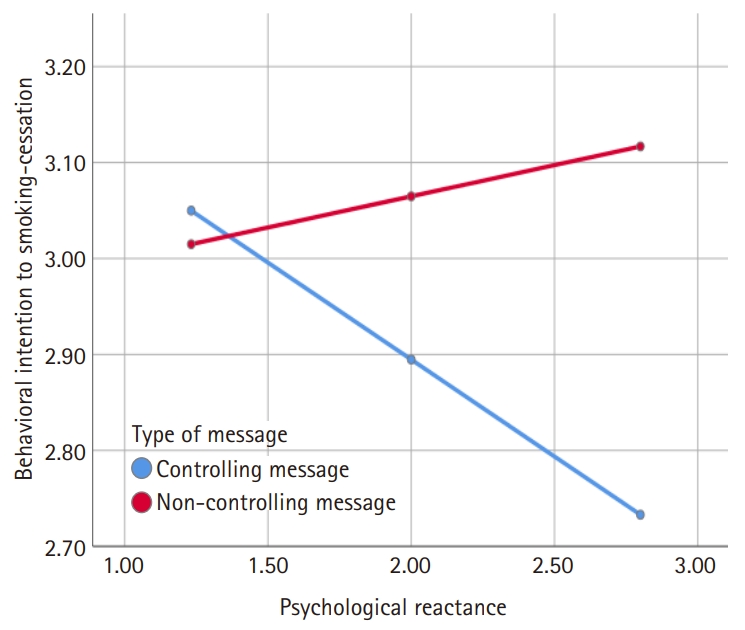
      Image Image
      Fig. 1. Study flow chart.
      Fig. 2. Interaction effect of psychological reactance and message framing on smoking-cessation intention.
      Psychological reactance to anti-smoking campaigns in designated smoking areas among female smokers in their 20s and 30s: a quasi-experimental study
      Source Type II SS df MS F p
      Trait reactance (covariate) 12.84 1 12.84 16.55 <.001
      Message exposure (exposed vs. non-exposed) 4.49 1 4.49 5.78 .017
      Error 198.62 256 0.78 - -
      Total (corrected) 215.31 258 - - -
      Predictor B SE t p
      Smoking disclosure .38 0.09 4.51 <.001
      Trait reactance .07 0.06 1.26 .211
      Primary type of cigarette –.10 0.06 –1.67 .096
      Smoking amount .21 0.09 2.49 .013
      Stage of change .33 0.06 5.29 <.001
      Previous quit attempts –.28 0.10 –2.81 .006
      Psychological reactance (X) –.20 0.09 –2.17 .031
      Message framing (W) –.33 0.27 –1.23 .220
      X*W .25 0.12 2.02 .044
      Message framing condition Effect (B) SE t p LLCI ULCI
      Controlling message –.20 0.09 –2.17 .031 –0.37 –0.02
      Non-controlling message .05 0.09 0.54 .591 –0.13 0.23
      Source Type II SS df MS F p
      Trait reactance (covariate) 12.84 1 12.84 16.55 <.001
      Message exposure (exposed vs. non-exposed) 4.49 1 4.49 5.78 .017
      Error 198.62 256 0.78 - -
      Total (corrected) 215.31 258 - - -
      Table 1. Psychological reactance by smoking-area campaign message exposure

      Dependent variable: psychological reactance; trait reactance was included as a covariate.

      df, degrees of freedom; MS, mean square; SS, sum of squares.

      Table 2. Results of the moderation analysis for message framing

      B, unstandardized coefficient; SE, standard error; X, psychological reactance; W, message framing.

      Table 3. Simple slope analysis by message framing condition

      B, unstandardized regression coefficient; LLCI, lower limit of the confidence interval; SE, standard error; ULCI, upper limit of the confidence interval.

      Values are presented as number (%).

      FTND, Fagerström Test for Nicotine Dependence; KRW, Korean won.


      J Korean Acad Nurs : Journal of Korean Academy of Nursing
      Close layer
      TOP