Skip Navigation
Skip to contents

J Korean Acad Nurs : Journal of Korean Academy of Nursing

OPEN ACCESS

Articles

Page Path
HOME > J Korean Acad Nurs > Ahead-of print articles > Article
Research Paper
Development of emergency nursing educational materials in Lao People's Democratic Republic: a methodological study
Jina Oh1orcid, Eunsil Won1orcid, Seohyun Won1orcid, Sunmi Kim2orcid, Seryung Oh3orcid, Souksavanh Phanpaseuth4orcid, Anousone Sisoulath4orcid, Lamngeun Silavong5orcid

DOI: https://doi.org/10.4040/jkan.25174
Published online: May 21, 2026

1College of Nursing, Inje University, Busan, South Korea

2International Educational Development Cooperation, Pusan National University, Busan, South Korea

3Industry Academic Cooperation Foundation, Inje University, Gimhae, South Korea

4Faculty of Nursing Sciences, University of Health Sciences, Vientiane, Lao PDR

5Nursing Division, Mahosot Hospital, Vientiane, Lao PDR

Corresponding author: Eunsil Won College of Nursing, Inje University, 75 Bokji-ro, Busanjin-gu, Busan 47392, South Korea E-mail: woneunsil@naver.com
• Received: December 12, 2025   • Revised: April 28, 2026   • Accepted: April 28, 2026

© 2026 Korean Society of Nursing Science

This is an Open Access article distributed under the terms of the Creative Commons Attribution NoDerivs License (http://creativecommons.org/licenses/by-nd/4.0) If the original work is properly cited and retained without any modification or reproduction, it can be used and re-distributed in any format and medium.

  • 28 Views
  • 0 Download
  • Purpose
    This study aimed to develop contextualized emergency nursing educational materials tailored to the Lao People’s Democratic Republic (Lao PDR). Emergency nurses in Lao PDR face challenges arising from the lack of standardized, culturally relevant learning resources. Existing materials are often adopted from other countries and do not adequately reflect local needs, contributing to inconsistencies in clinical practice. Developing locally tailored resources, supported by official development assistance, is therefore essential for improving emergency nursing education and practice.
  • Methods
    This study used a methodological design based on the Four-Door Model—Define, Design, Develop, and Disseminate—from 2021 to 2024. A situational analysis was conducted using a mixed-methods approach that included a quantitative survey of 70 nursing professionals and qualitative interviews with 52 stakeholders. Content validity and suitability were evaluated by a panel of six local experts using standardized validation forms and the Suitability Assessment of Materials (SAM).
  • Results
    Ten emergency nursing domains were developed to address both universal principles, including triage protocols and life support interventions, and Lao PDR-specific challenges. Validity and suitability were supported by a SAM score of 77.3%, indicating clinical accuracy and cultural appropriateness. The 269-page coursebook was distributed to partner nursing colleges, three central hospitals, and international organizations.
  • Conclusion
    This study developed the first comprehensive emergency nursing educational materials tailored to the Lao PDR context and written in the local language. These materials support continuing professional development and license renewal every 5 years. They also exemplify an international development paradigm that prioritizes recipient-country ownership and sustainable capacity building through collaborative knowledge creation.
The World Health Assembly resolution (WHA72.16) emphasizes that strengthening emergency medical systems (EMS) is an urgent global priority and identifies it as a fundamental component for achieving Universal Health Coverage (UHC) worldwide [1]. EMS delivers comprehensive and well-coordinated acute and emergency care services, with the overall system performance dependent on the effective collaboration among its constituent elements [2]. In particular, the quality of clinical responses to emergencies in both the pre-hospital and in-hospital settings is closely linked to the knowledge and skills of trained emergency healthcare professionals [3].
Emergency nursing personnel play a key role in the effective functioning of EMS [4]. Evidence from multiple studies indicates that targeted training for emergency nurses leads to improved patient outcomes and reduced healthcare costs. However, in low- and middle-income countries (LMICs), the educational environment for emergency nursing training is less developed than in high-income countries (HICs), leading to lower levels of professional competence among nurses in clinical practice [1]. This makes it difficult to deliver emergency care effectively and causes unequal access to services in areas where it is needed most [1,5]. In fact, despite having more than 3 times the burden of disease from emergencies, measured in disability-adjusted life years, LMICs record only about 3% of the emergency care utilization seen in HICs [5]. If this situation persists, disparities in access to emergency medical services are likely to increase. Addressing this issue requires improving the educational environments that support the development of knowledge and skills among emergency nursing personnel.
In HICs, emergency nursing education has become increasingly advanced through simulation-based training, structured assessment tools, and specialized educational materials. These elements collectively support the enhancement of nurses’ clinical performance and their ability to respond effectively to emergencies [6]. In contrast, in many LMICs, even when emergency nursing education programs exist, they are often short-term or not well adapted to the local context, limiting their sustainability and effectiveness as reported in previous studies [7]. For example, in countries such as Thailand and Singapore, which are classified as upper-middle-income and HICs, evidence-based emergency nursing education bundles have been implemented despite these limitations, with studies reporting improvements in emergency nurses’ knowledge following the training [8,9]. However, in Vietnam, despite the growing national burden of road traffic injuries, the level of emergency and trauma education and response capacity remains low [10]. Although some countries have demonstrated that emergency nursing education can effectively strengthen emergency care competencies, most LMICs, as seen in the case of Vietnam, face difficulties in sustaining such effects due to inadequate educational infrastructure, limited opportunities for ongoing training, and curricula that do not reflect local contexts over time [11,12].
The limitations of emergency nursing education observed across LMICs are also evident in the Lao PDR, a resource-limited country in Southeast Asia. In Lao PDR, nurses carry out emergency duties, including patient triage, nearly twice as often as physicians. However, they continue to experience difficulties in clinical practice because of limited educational resources in emergency nursing [13]. According to local assessments, emergency nursing personnel in Lao PDR have low learning efficiency due to language barriers and limited internet access. In particular, there are no educational materials available in the Lao language that reflect the local context [14]. The Government of Lao PDR has established a national health strategy aiming to achieve UHC by 2030 [15], which requires nurses to participate regularly in education and research through the Continuing Professional Development (CPD) system [16]. These contextual factors in Lao PDR further emphasize the need for high-quality, context-specific educational materials in emergency nursing and justify the urgency and scholarly relevance of the present study.
In Lao PDR, the national health budget accounts for only 2.3% of the gross domestic product, the lowest among Southeast Asian countries [17]. This indicator structurally constrains the national healthcare system and workforce capacity. Low per capita health expenditure (US$ 188.9) is linked to inadequate infrastructure, with only 1.7 beds per 1,000 population [18]. Such fiscal constraints result in a critically low nurse density (10.3 per 10,000) [18]. Furthermore, the lack of formal salary structures forces graduates into unpaid service, hindering professional retention [18]. These deficiencies impede self-sustaining curriculum development, causing reliance on borrowed materials from HICs or neighboring nations [19-21]. This dependency creates a “contextual mismatch” between training content and local resources. To address this, developing locally contextualized materials reflecting the Lao PDR clinical environment is imperative. However, bridging this gap using domestic resources alone is difficult, underscoring the need for international cooperation. As the global development paradigm shifts toward “development effectiveness” under the United Nations Sustainable Development Goals [22], comprehensive capacity-building efforts—specifically participatory curriculum development and localized training systems—have been prioritized. In this context, South Korea has supported educational infrastructure and professional personnel training through official development assistance (ODA) over the past several decades [23-25].
Previous research on emergency nursing educational materials has primarily focused on improving EMS in HICs [26]. Therefore, it is difficult to apply these findings to address the specific circumstances and needs of Lao PDR [26]. Distinct differences in healthcare systems, hospital facility levels, and the scope of nursing practice between Asian LMICs and Western HICs render imported educational materials unsuitable. Specifically, the scope of nursing practice differs significantly; unlike Western models where clinical roles are strictly defined, nurses in Asian settings like Lao PDR often engage in “informal task shifting” to compensate for critical physician shortages [13]. Despite being thrust into these expanded roles, emergency nursing education in Lao PDR faces various challenges due to inadequate learning materials, limited accessibility, language barriers, and poor infrastructure [14]. Consequently, some institutions are forced to rely on textbooks or materials provided by neighboring countries like Thailand [19-21]. Furthermore, the significant disparity in hospital facility standards and available medical equipment between Lao PDR and HICs often renders advanced clinical procedures described in Western materials impractical. These environmental and professional gaps underscore the urgent need to develop independent, locally contextualized educational resources that align with the specific infrastructure available in the Lao healthcare system.
To address these needs, while originated from an international project, this work was formalized into a systematic framework to emphasize its scholarly significance. Accordingly, it was redefined as a replicable model for nursing education in resource-limited settings. Specifically, this study validated the content and suitability of emergency nursing materials for Lao PDR utilizing the Four-Door Model (4D model) [27], ensuring they are contextually appropriate for the local environment.
1. Study design and framework
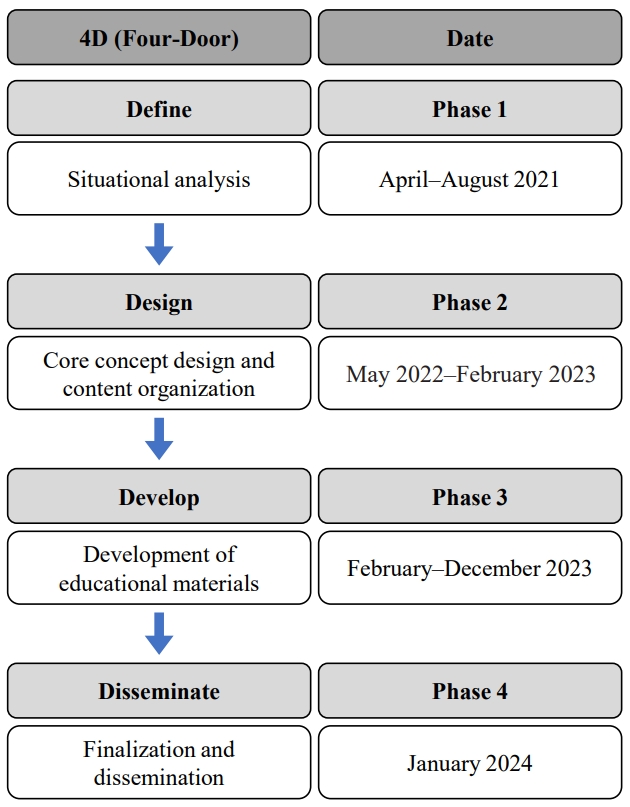
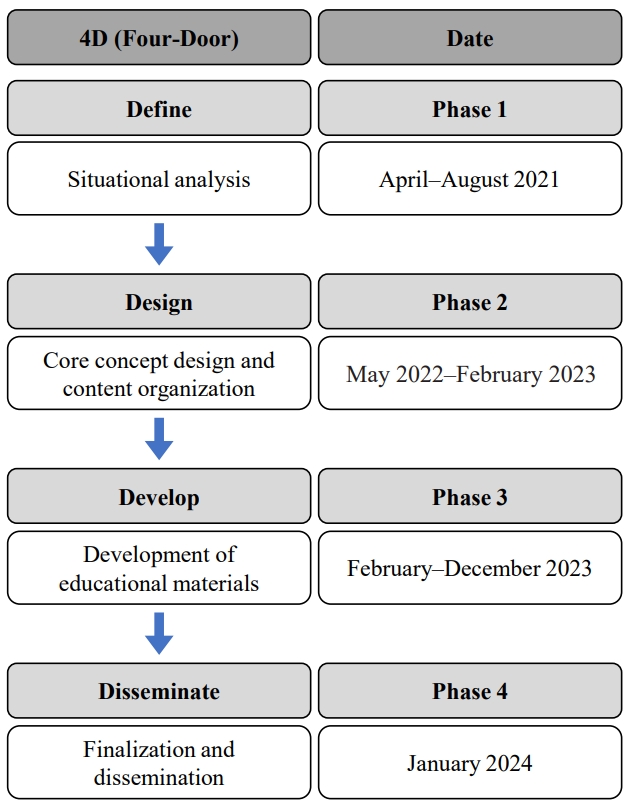
This study is a methodological research design applying the 4D model to develop emergency nursing educational materials reflecting the healthcare environment and regional characteristics of Lao PDR. The 4D model, developed by Thiagarajan et al. [27] in 1974, is a research and development framework used to develop learning tools based on educational development models adopted in previous studies [28]. It consists of four stages: Define, Design, Develop, and Disseminate. Figure 1 illustrates the framework of this study. The names of each stage of this study were (1) situational analysis, (2) core concept design and content organization, (3) development of educational materials, and (4) final content validation.
2. Procedure

1) Define stage: Situational analysis

The first stage of the 4D model defines the development requirements. In our study, situational analyses were conducted using qualitative (interviews) and quantitative (survey) methods. These were performed directly at healthcare institutions in Lao PDR by the research team, which consisted of one Korean nursing expert and two research assistants (one local researcher in Lao PDR and one researcher from Korea). When recruiting eligible individuals for the situational analysis, the research team established prior administrative contact with each institution. The team then personally visited each site to explain the situational analysis’ purpose and the principle of anonymous participation to obtain cooperation. Appropriate data analyses were conducted based on data characteristics to identify key findings.

(1) Interviews for situational analysis

Interviews were conducted directly by the research team from August 6 to August 11, 2021. To ensure comprehensive data collection, all key stakeholders holding relevant positions were invited to participate. Consequently, 52 participants took part, including the directors of three national hospitals in Vientiane, the heads of nursing, and nurses. The interview data were analyzed using content analysis to identify recurring challenges and opportunities in emergency nursing practice.

(2) Survey for situational analysis

Following the interviews, a survey was conducted from August 10 to August 24, 2021. To ensure comprehensive situation analysis, a total population survey was employed. The survey included 40 nurses that was gathered from the emergency nursing unit at the three hospitals and all 30 nursing faculty members from a partner university in Lao PDR.
Prior to these activities in April 2021, as part of the initial stage of Phase 1, a thorough review of existing literature and the construction of the survey instrument were conducted. The survey utilized a questionnaire constructed by the research team, which was based on a thorough review of three authoritative Thai textbooks on emergency medical and nursing [29-31]. This approach was adopted because Thai medical literature serves as the primary clinical reference within the Lao PDR healthcare context. To ensure content validity, the questionnaire was reviewed and validated by two professors specializing in emergency nursing in Korea. For linguistic validation and semantic equivalence, the instrument was translated from English into Lao by a bilingual expert and then back-translated into English by another independent bilingual professional. The questionnaire was divided into knowledge and skills domains. A 5-point Likert scale (1=not important to 5=very important) was used to evaluate the importance of various items such as the role of emergency nurses, triage, legal and ethical issues, data collection, clinical decision-making, and various emergency interventions. This process was conducted as situational analysis to identify the priority areas for educational interventions.

2) Design stage: Core concept design and content organization

Following the situational analysis (Define stage), the Design stage of the 4D model was carried out, focusing on the core concept design and content organization for the emergency nursing education materials. This stage was systematically divided into two key processes: committee formation and operation, and the structuring of core educational areas.

(1) Committee formation and operation

To lead the development and validation process, an “Emergency Nursing Education Committee” was formed as a central decision-making body. The committee included nursing education experts and clinical administrators from central hospitals in Lao PDR to reflect both academic and field-based perspectives. A kick-off meeting was held to align development objectives and initiate the selection of educational topics. Through regular key meetings, the committee reviewed situational analysis findings and established preliminary content guidelines.

(2) Structuring core educational areas

Based on the situational analysis findings, core educational areas were identified by the committee. While the content development was driven by local clinical needs, the involvement of Korean nursing specialists was integrated as a methodological necessity. Consequently, the preliminary core areas were verified for clinical accuracy and alignment with international standards through consultation with Korean nursing specialists. Using their recommendations, the final educational structure was confirmed, and responsibilities for specific domains were assigned to committee members and central hospitals based on their clinical expertise. Furthermore, a difficulty leveling system (low, medium, high) was established to ensure appropriate educational progression according to the learners’ competencies. Difficulty levels were established to ensure appropriate educational progression and to guide instructors in effectively delivering content. Low difficulty domains were designed to establish fundamental emergency nursing concepts; medium difficulty domains were built upon these foundations with more complex clinical applications; and high difficulty domains addressed the most challenging aspects of emergency care, requiring advanced clinical judgment and skills.

3) Develop stage: Development of educational materials

The Develop stage of the 4D model focused on generating detailed educational material content and confirming its quality. This stage was strategically divided into two key processes: content construction and drafting, and validation and quality assessment.

(1) Content construction and drafting

Based on the core educational areas finalized in the Design stage, the committee proceeded to develop the detailed educational content. Through a series of follow-up meetings, members drafted the comprehensive materials by examining the proposed structure, content sequence, and pedagogical approaches for each finalized area. During this process, the committee focused on aligning the content with available resources and the existing clinical environment in Lao PDR to ensure practical applicability. Additionally, a cross-validation approach was adopted, where committee members reviewed and refined sections developed by others to maintain consistency and clinical accuracy across all materials.

(2) Validation and quality assessment

To evaluate the appropriateness and clinical validity of the drafted materials, a multi-dimensional validation process was conducted. First, a panel of local experts with extensive experience in emergency medical and nursing education was invited to perform content validation. The experts assessed the materials for content appropriateness, clinical accuracy, and alignment with local nursing practices in Lao PDR. During this process, experts provided both verbal and written feedback to ensure the practical applicability of the content.
Additionally, to assess the suitability and educational validity of the emergency nursing educational materials, the Suitability Assessment of Materials (SAM) tool was used to evaluate 22 factors across six categories: clarity of content, literacy demand, graphics, layout and typography, learning stimulation, and cultural appropriateness [32]. SAM is a widely used tool for evaluating the suitability of printed materials and health education materials for their intended audience [33-35]. Based on the score range, 0%–39% indicates not suitable material, 40%–69% indicates adequate material, and 70%–100% indicates superior material [32]. To further ensure accessibility, readability metrics were calculated using the Flesch-Kincaid readability tests [36]. In the absence of standardized readability metrics for Lao, the readability of educational materials was assessed in two stages. First, the complexity of the information was objectively measured using the Flesch Reading Ease and Flesch-Kincaid Grade Level indices applied to the English translations. Subsequently, a comprehensive review was conducted by a Lao-English bilingual expert to ensure that the final Lao version was accurately translated and maintained linguistic equivalence with the evaluated English version. This approach was adopted as a methodological alternative to ensure an appropriate reading level for the target population.

4) Disseminate stage: Finalization and dissemination

The Disseminate stage of the 4D model involved finalizing the emergency nursing educational materials by incorporating feedback from the validation process and implementing a dissemination plan. To ensure the widespread adoption, the dissemination methodology employed a multi-channel approach, including (1) formal distribution through official healthcare networks in Lao PDR and (2) implementation of train-the-practitioner programs at participating central hospitals in Vientiane.

5) Ethical considerations

This study was granted exemption from the Institutional Review Board (IRB) of the affiliated university (IRB No. 2025-02-010). The study involved a secondary analysis of de-identified existing administrative data for the purpose of developing educational materials, and all procedures complied with the Declaration of Helsinki to protect participant information. The baseline data were collected as part of a 2021 ODA project. Rather than being a pre-planned academic study, the data collection was an institutional-level initiative aimed at identifying clinical gaps and developing a tailored educational curriculum for the Lao PDR. The authors recognized the academic significance of the development process and transformed this study into a methodological framework.
1. Define stage: Situational analysis

1) Interviews for situational analysis

Analysis of interview data from hospital administrators and nursing staff revealed five major challenges in emergency nursing care across major hospitals in Lao PDR: “Deficiency in professional emergency nursing competencies,” “Inadequate proficiency in emergency equipment utilization,” “Absence of standardized emergency protocols,” “Restricted educational opportunities,” and “Need for specialized preparation for Lao PDR’s unique circumstances” (Table 1).

2) Survey for situational analysis

The results of the quantitative situational analysis showed that the content related to resuscitation received the highest importance rating. The top three knowledge areas were “basic life support” (mean±standard deviation, 4.78±0.45), “advanced cardiac life support” (4.76±0.47), and “post resuscitation care” (4.75±0.51). In the technical field, “intubation management” (4.75±0.47), “ventilator management” (4.74±0.52), and “isolation technology” (4.66±0.54) had the highest scores (Table 2). This competency is important for quickly assessing patients in emergencies and providing appropriate interventions. The results confirmed that content related to resuscitation should be prioritized when developing emergency nursing education materials for Lao PDR.
2. Design stage: Core concept design and content organization

1) Committee formation and operation

The Emergency Nursing Education Committee was formally established on May 30, 2022, comprising 20 members, including faculty members from the university’s collaborative clinical education committee and nursing administrators from three central hospitals in Lao PDR.
A kick-off meeting was held on July 19, 2022, where the committee reached a consensus on the initial selection of educational topics derived from the situational analysis. Through this process, preliminary content guidelines were produced, which were subsequently reviewed by emergency medical faculty from the supporting university in South Korea. Furthermore, in the follow-up meeting on February 3, 2023, detailed implementation plans were finalized by the committee, establishing the specific structure, content sequence, and pedagogical approaches for the materials.

2) Structuring core educational areas

Based on the Define stage analysis, an initial framework comprising eight emergency nursing education domains was established (Table 3). These domains underwent written consultation by two Korean experts, resulting in an expansion from eight to 10 core areas (Table 4). Modifications in the final version were implemented based on consultation with two Korean experts in emergency nursing and ODA. To enhance clinical accuracy, the initial “Nursing care plan of trauma and non-trauma patients” (domain 6) was subdivided into two separate domains: “Nursing care of trauma patients” (domain 6) and “Nursing care of non-trauma patients” (domain 7). Furthermore, reflecting global trends and expert advice, and to provide a more comprehensive educational framework, psychological emergency situations (part of domain 8 and 10; “Nursing interventions for emergency room (ER) patients,” “Psychological emergency interventions”) was newly added, while “Application of pharmacology for ER” (domain 7) was removed. This ensured the materials aligned with international standards for specialized emergency care. The final educational material consisted of 10 comprehensive chapters covering the core areas of emergency nursing practice in Lao PDR (Supplementary Material 1).
These domains were assigned to specific institutions based on their clinical expertise and resources. The content was strategically organized, with each chapter assigned to a hospital based on its clinical expertise. Content was tailored to address common emergency cases in Lao PDR, considering available resources and equipment. The Faculty of Nursing Sciences developed the introduction section, outlining foundational emergency nursing concepts. Hospital A was assigned four chapters on primary assessment, trauma care, non-trauma management, and psychological emergencies. Hospital B was assigned two chapters on triage systems and respiratory emergencies. Hospital C was assigned three chapters addressing basic life support, general emergency nursing care, and snakebite management—a significant concern in the region.
In this initial stage, The Faculty of Nursing Sciences developed the introduction domain, forming the curriculum’s foundation. Hospital A was assigned two domains: primary assessment of ER patients (low difficulty) and nursing care plans for trauma and non-trauma patients (high difficulty). Hospital B was assigned the triage domain (low difficulty) and respiratory emergency interventions (high difficulty). Hospital C was responsible for three domains: basic life support (low difficulty), application of pharmacology in the ER (medium difficulty), and nursing management of snakebite patients (medium difficulty). As previously mentioned, this initial stage was subsequently refined into the final 10 domains based on expert consultation.
3. Develop stage: Development of educational materials

1) Content construction and drafting

The collaborative effort to develop the emergency nursing content culminated in January 2024 with the completion of the manuscript by the Emergency Nursing Education Committee. The content was organized into 10 domains, selected based on three criteria—content appropriateness, clinical accuracy, and alignment with local practices—and the committee finalized the Lao language training material draft consisting of 10 domains (Supplementary Material 1).

2) Validation and quality assessment

For the validation process, six clinical experts recruited through purposive sampling—nurses with over 10 years of ER experience at three central hospitals in Vientiane—meticulously reviewed the entire material, providing detailed feedback on language, terminology, procedures, and situational relevance.
Additionally, the total SAM score evaluated was 34 points out of a possible score of 44, resulting in a percent score of 77.3% (Appendix 1). This falls within the ‘superior material’ range (70%–100%), suggesting that the emergency nursing educational materials are suitable and educationally valid. This validation finalized a comprehensive course structured into 10 chapters and 31 subtopics, comprising 269 pages tailored to the Lao PDR healthcare context (Supplementary Material 1).
The readability analysis of the English translation yielded a Flesch Readability Index score of 60.1 and a Flesch-Kincaid Grade Level of 5.7, with 0% passive voice sentences. These results indicate that the material is accessible to readers at a 5th–6th grade level. This high accessibility was intentionally designed by utilizing a practical, action-oriented format written primarily in the active voice. Instead of long descriptive paragraphs, the material consists of concise instructions (average of 3.3 words per sentence) and bulleted lists. To verify whether these analysis results were reflected in the final output, a bilingual expert confirmed that the Lao PDR version maintained linguistic equivalence with the evaluated English text.
4. Disseminate stage: Finalization and dissemination
Following the integration of expert feedback and quality assessment results, the emergency nursing educational materials were finalized in both English and Lao languages. This structured dissemination approach successfully facilitated the transition from validated educational content to practical implementation, reaching the target audience of emergency nursing professionals in various healthcare settings. Hard copies were distributed as follows: partner nursing colleges (50 copies), three central hospitals (50 copies per hospital), and nursing colleges and hospitals in two additional regions—Luang Prabang in northern Lao PDR and Xieng Khouang in northeastern Lao PDR. Single copies were provided during visits to international organizations, including the Korea Foundation for International Healthcare, World Health Organization (WHO), Korea International Cooperation Agency, Japan International Cooperation Agency, Service Fraternel d'Entraide, and Healthcare Professional Council. Electronic distribution was implemented by sharing PDF versions via YouTube and Facebook. Continuous efforts will be made to expand the dissemination of these educational materials across additional provinces and healthcare institutions throughout Lao PDR, with the aim of integrating them into the CPD framework for nurses and midwives established by the Ministry of Health [16].
This study adopted the 4D model as an instructional design framework to systematically develop emergency nursing educational materials optimized for the local environment in Lao PDR. From an academic perspective, this study exhibits the characteristics of “Type 1 developmental research” as defined by Richey and Klein [37]. Type 1 research focuses on describing the entire process of analyzing, designing, developing, and evaluating a specific instructional product or program and demonstrating its validity [37]. In this context, numerous prior studies conducted with health personnel in LMICs also report that the development of educational tools reflecting local contexts and their validation prior to implementation are important components of educational research [6-9]. Therefore, the validity verification process conducted in this study focused on establishing internal validity—specifically, ensuring the content validity and structural integrity of the educational materials through expert review—prior to measuring external learner outcomes. As Richey and Klein [37] emphasize, this rigorous establishment of internal validity is an essential prerequisite for ensuring that the developed educational tool can be applied ethically and effectively to learners in the future. This holds significant importance as an academic mechanism for guaranteeing the safety and quality of research in education targeting healthcare personnel in LMICs.
The 4D model ensures methodological rigor and logical consistency throughout the educational material development process. It provides procedural validity, in which each stage is organically linked such that the outputs of the preceding stage serve as the evidence-based foundation for the next. According to a recent systematic review, the 4D model has been extensively applied and validated in research focused on developing educational materials, particularly for module-based and digital learning media [38]. Following this academic trend, previous studies in nursing and health sciences have utilized the 4D model as a valuable methodological framework to integrate learner needs and expert feedback, thereby enhancing the field suitability of educational resources [28,39]. The process—wherein the situational analysis from the Define stage (Stage 1) informs the Design stage (Stage 2), which is further refined in the Develop stage (Stage 3) through expert reviews, SAM, and readability evaluations—demonstrates that the final materials are grounded in rigorous analysis and objective validation rather than the subjective judgment of the research team. Such step-by-step implementation serves as an essential academic mechanism to secure content quality and practical relevance before educational tools for healthcare providers in LMICs are deployed in actual clinical settings.
The situational analysis conducted in the first stage of this study clearly illustrates the specific educational gaps in LMICs, in stark contrast to HICs that possess established protocols and robust educational infrastructures. Previous literature suggests that universal emergency nursing guidelines centered on HICs are designed under the assumption of advanced medical resources; consequently, they present methodological and substantive limitations when applied to clinical practice in resource-limited settings [1,7].
In particular, the inadequate proficiency in equipment utilization and the absence of standardized protocols identified in this study represent the most prominent disparities compared to HICs. This underscores the urgent need to establish practical clinical guidelines based on local conditions, moving beyond mere knowledge transfer. Such systemic gaps translate into specific deficiencies in nursing competencies. Indeed, the lack of knowledge and skills in cardiopulmonary resuscitation (CPR) found in this study aligns with existing research on emergency nursing capacities in low-income countries [7,26]. Furthermore, the high demand for advanced cardiac life support training reported in cases from Kenya [40] and South Africa [41] reaffirms the necessity of skill-oriented education in resource-constrained environments.
Ultimately, the demand for addressing Lao PDR-specific clinical conditions demonstrates that the development of educational materials must be a process of context-optimized reconfiguration rather than a simple translation of existing knowledge. In conclusion, these first stage findings support the development of locally led, customized educational materials as an essential academic and policy alternative for enhancing the quality of emergency care in LMICs.
In addition to reflecting local specificities, the Design stage enhanced the clinical expertise and comprehensiveness of the content by expanding the initial eight domains to 10 through expert consultation. First, separating the existing trauma and non-trauma areas into independent domains was intended to support rapid decision-making among learners by providing clear, differentiated nursing algorithms based on emergency mechanisms. Recent studies have reported that structured triage algorithms or decision-support systems in emergency nursing improve the accuracy and speed of nurses’ clinical decision-making [42]. Furthermore, structured knowledge frameworks and categorized learning structures have been shown to reduce cognitive load and facilitate clinical reasoning and decision-making [6,8].
Moreover, reflecting global health trends and expert opinions, “psychosocial emergency intervention” was newly included instead of adjusting the pharmacological emergency domain. This reflects the academic standards of Holistic Emergency Care, which encompasses mental health issues such as suicide crises [4]. In particular, this study focused on the practical feasibility of psychological interventions in resource-limited settings where basic medical equipment is lacking. Interventions such as Psychological First Aid (PFA) can be delivered based on nurses’ professional competencies and communication skills without reliance on advanced equipment or infrastructure. Therefore, they can be effectively implemented in resource-limited environments as high-value, low-resource interventions [43].
Recent research indicates that the emergency department serves as a primary point of contact for patients in mental health crises, and emergency nurses play a pivotal role in initial assessment and crisis response [1,4]. Holistic care, addressing both physical treatment and psychosocial needs, is essential even in emergency situations. Importantly, such psychological interventions are not intended to replace life-saving procedures but rather serve as complementary approaches that can be implemented concurrently by nurses, even in resource-limited settings. Therefore, in situations where equipment required for physical interventions is lacking, PFA—deliverable solely through nurses’ competencies without the need for additional equipment-should be considered one of the key educational components that nurses can provide in emergency and disaster contexts [43].
Furthermore, the educational materials were developed based on WHO recommendations for the production of health educational resources [3]. While focusing on universally essential emergency care skills, the materials also incorporated common emergency scenarios and regional disease patterns specific to Lao PDR, including trauma, respiratory emergencies, and snakebites. This structure enables local medical staff to apply knowledge directly in clinical settings. In particular, snakebite accidents—a major public health issue in the Lao PDR—show regional variation, with reported incidence rates of 355 and 1,105 cases per 100,000 people in Champone and Phin districts, respectively [44]. However, emergency medical personnel often lack adequate training in managing snakebite patients, frequently leading to suboptimal treatment outcomes [45]. Therefore, by including “nursing management for snakebite patients” in the emergency educational materials, the practical applicability and sustainability of the education can be enhanced through direct linkage with the clinical practice of local medical staff.
The qualitative and quantitative validation procedures conducted after drafting the educational materials in the Develop stage (Stage 3) provide decisive evidence for the clinical acceptance and educational effectiveness of these materials in the Lao PDR nursing context. First, the rigorous review by six local experts, each possessing over 10 years of clinical experience, ensured the suitability of the materials regarding the actual environment of central hospitals in Lao PDR and the use of local technical terminology. This aligns with previous research suggesting that contextual feedback from local experts is a key element in enhancing the clinical realism of healthcare educational resources for developing countries [46,47].
In particular, the “Superior” rating (77.3%) obtained through the SAM suggests that these materials go beyond a mere listing of knowledge and sufficiently meet the structural and cultural requirements to facilitate learner understanding. According to prior studies, SAM is reported as a highly reliable tool widely used to evaluate the readability and suitability of health education materials [32].
Furthermore, the strategic decisions to lower the Flesch-Kincaid Grade Level to 5.7 and exclude the use of passive voice were intended to minimize the cognitive load of learners by delivering complex emergency care knowledge concisely. Previous literature indicates that clear and simple sentence structures are critical factors in facilitating the rapid retrieval and processing of information in urgent emergency situations. Although the absence of a validated readability tool specifically for the Lao language necessitated indirect measurement using the English version, this study sought to prevent content distortion by conducting linguistic equivalence verification through bilingual experts. Such multifaceted validation serves as a methodological mechanism to prove that the educational content—directly constructed by clinical experts in the recipient country—is a customized outcome that achieves both academic rigor and optimization for the comprehension level of local learners.
The hybrid online and offline dissemination strategy implemented in the Disseminate stage (Stage 4) is significant in that it maximized the accessibility of educational materials in a resource-limited environment and established the foundation for the standardization of emergency nursing education in Lao PDR. Distributing hard copies not only to central hospitals in Vientiane but also to regional hubs in the north and south was a practical effort to bridge the healthcare education gap between regions. This aligns with previous suggestions that field-based educational accessibility must be expanded to mitigate disparities in health education caused by geographical constraints [48]. Furthermore, digital distribution via social media served as an efficient alternative for overcoming spatiotemporal constraints, suggesting that social media can function as a core tool for building sustainable educational networks in resource-limited countries [49].
In particular, the continuous efforts to integrate these materials into the CPD framework for nurses and midwives, administered by the Ministry of Health (MOH) of Lao PDR, represent the most critical policy orientation of this study. This is a product of academic and political commitment to ensure that content developed through an ODA project does not remain a one-time event but is sustainably incorporated into the health system to function as sustainable educational infrastructure [22,24,25]. Moreover, securing the official credibility of the materials through sharing with major international organizations such as WHO and Korea Foundation for International Healthcare suggests the potential for this research model to be scaled as a standard guideline for health education development in other LMICs.
The development of the educational materials in this study was based on a South Korean ODA project and holds a distinct value by implementing a Recipient-Country-led model that directly responds to the needs of Lao PDR, rather than a donor-driven approach. The collaborative structure, in which local Lao PDR clinicians and nursing faculty took the lead in development while Korean experts provided consultation, serves as an exemplary case of substantive capacity exchange beyond mere technology transfer. According to literature, ensuring the ownership of the recipient country is an important factor in the sustainability of health development projects [24,25]. This case, which integrated Korean systematic emergency nursing education experience into a collaborative system with local experts, enhanced the international standing of the Korean nursing community while presenting an international educational cooperation model immediately applicable to LMICs, particularly those with resource-limited settings similar to Lao PDR. Such development procedures and collaborative structures will serve as a practical policy and academic foundation that can be extended to other nursing fields and countries with similar economic levels.
Collectively, the development of these emergency nursing educational materials followed three core directions to bridge the gap with HICs and maximize clinical field competency. First, by accurately reflecting the frequent emergency situations and regional disease patterns in Lao PDR, it established context-specific content rather than a simple transposition of external guidelines. Second, it concentrated efforts on core emergency skills immediately required in the field, such as CPR, triage, trauma, and respiratory emergency response. Third, it sought to practically overcome the constraints of the Lao PDR healthcare environment by presenting alternative approaches and priority-setting strategies that enable the best outcomes within currently available resources, without relying on expensive equipment or medication. This educational framework, developed to reflect the healthcare context of Lao PDR, represents a key academic contribution of this study. It may serve as a standardized educational framework that can be referenced not only in Lao PDR but also in diverse LMIC settings with resource constraints. Overall, this model accommodates both local specificity and global applicability, and has the potential to function as a transferable model for improving the quality of nursing education across various resource-limited settings.
Despite these academic and practical implications, this study has some limitations. First, although the materials were distributed to three national hospitals in Lao PDR, no clinical efficacy evaluation based on quantitative data—such as triage accuracy or treatment outcomes—has yet been conducted. Furthermore, the use of English-based metrics as a proxy in assessing the readability of these educational materials constitutes a methodological limitation. Since there is currently no standardized readability tool for the Lao language, caution is required when interpreting the results of this study; this suggests the need to develop linguistic indicators for the precise evaluation of educational materials in Lao PDR in the future. Finally, since emergency nursing guidelines evolve rapidly based on the latest evidence, continuous updating of the materials will be essential. To this end, this study went beyond simply delivering materials and included a capacity-building program that enables local Lao PDR experts to proactively revise and supplement the content. This approach supports the sustainability of the research by ensuring that the recipient country can independently maintain the currency of the educational materials and operate a self-sustaining education system in the future.
This study developed emergency nursing educational materials suitable for the Lao PDR healthcare environment using a 4D model. These materials are designed to support the enhancement of clinical response capabilities among local nurses, covering everything from core competencies required of emergency medical personnel to responses to situations specific to Lao PDR. These findings provide practical educational resources that can be utilized to strengthen and standardize emergency nursing education in resource-limited settings. For these educational materials to serve as a sustainable educational infrastructure, they need to be institutionally integrated into the Lao MOH CPD system. Furthermore, future research should evaluate the impact of these educational materials on nurses’ competencies and patient outcomes.

Conflicts of Interest

No potential conflict of interest relevant to this article was reported.

Acknowledgements

None.

Funding

This study was supported by the Leading University Project for International Cooperation through the National Research Foundation of Korea (NRF) funded by the Ministry of Education (MOE) (grant number: 2020H1A7A2A02000042).

Data Sharing Statement

Please contact the corresponding author for data availability.

Supplementary Data

Supplementary data to this article can be found online at https://doi.org/10.4040/jkan.25174.

Supplementary Material 1.

jkan-25174-Supplementary-Material-1.pdf

Author Contributions

Conceptualization: JO, EW, SW. Data curation: JO, SK, SO, SP, AS, LS. Final approval of the manuscript: all authors. Formal analysis: JO, SK, SO, SP, AS, LS. Funding acquisition: JO. Investigation: SK, SO, SP, AS, LS. Methodology: JO, EW, SW. Project administration: JO, EW, SP, AS. Resources: SP, AS, LS. Software: SP, AS, LS. Supervision: JO, EW, SP, AS. Validation: JO, SP, AS, LS. Visualization: EW, SW. Writing–original draft: JO, EW, SW. Writing–review & editing: JO, EW, SW, SK, SO, SP, AS, LS.

Fig. 1.
Research process based on the 4D (Four-Door) Model.
jkan-25174f1.jpg
Table 1.
Current status and problems of emergency nursing in hospitals in Lao PDR
Key finding Description
Deficiency in professional emergency nursing competencies Significant lack of skills in immediate response capabilities during emergencies
Inadequate proficiency in emergency equipment utilization Despite the availability of modern equipment (AEDs, monitoring devices), proper utilization remains problematic
Absence of standardized emergency protocols Lack of established protocols and educational materials creates inconsistency in mental health care quality across institutions
Restricted educational opportunities Limited access to training due to bureaucratic requirements and insufficient availability of international-standard programs
Need for specialized preparation for unique circumstances in Lao PDR Requirement for training specifically addressing traffic accidents, infectious diseases, and maternal emergencies

AED, automated external defibrillator; Lao PDR, Lao People’s Democratic Republic.

Table 2.
Priority knowledge and skill domains in emergency nursing (N=70)
Category Mean±SD
Knowledge
 Basic life support 4.78±0.45
 Advanced cardiac life support 4.76±0.47
 Post-resuscitation care 4.75±0.51
Skill
 Intubation management 4.75±0.47
 Ventilator management 4.74±0.52
 Isolation technology 4.66±0.54

SD, standard deviation.

Table 3.
Initial framework of emergency nursing educational domains
Domain Content Level Contribution
1. Introduction - Collaborative university
2. Primary assessment of ER patients 2.1 Food poisoning Low A Hospital
2.2 Gastrointestinal bleeding
3. Triage 3.1 Guidelines for triage of emergency patients Low B Hospital
4. Basic life support 4.1 Cardiopulmonary resuscitation basic life support Low C Hospital
4.2 Advanced life support
4.3 Cardiopulmonary resuscitation in children
5. Respiratory emergency interventions 5.1 Airway obstruction High B Hospital
6. Nursing care plan of trauma and non-trauma patients 6.1 Hypoglycemic shock patients High A Hospital
6.2 Hypotension patients due to blood loss
6.3 Cardiogenic shock patients
6.4 Ischemic and hemorrhagic stroke in shock patients
6.5 Abdominal trauma
6.6 Broken arm & leg
6.7 Head trauma
6.8 Neck trauma
6.9 Spinal trauma
7. Application of pharmacology for ER 7.1 Respiratory-asthma Medium C Hospital
7.2 Respiratory-airway obstruction
7.3 Respiratory-anaphylactic shock
7.4 Food poisoning
8. Nursing management of snakebite patients 8.1 Snakebite patients Medium C Hospital

ER, emergency room.

Table 4.
Final domains and contents of emergency nursing education materials
Domain Content
1. Introduction 1.1 Emergency nursing competencies in Lao PDR
1.2 Scope and standards of emergency nursing in Lao PDR
1.3 Emergency nursing ethics and regulations
2. Primary assessment of ER patients 2.1 Vital sign assessment (BT, BP, PR, RR, SpO2), Glasgow Coma Scale (GCS), Basic Head to Toe assessment
3. Triage 3.1 Guidelines for triage of emergency patients
3.2 Pain control
4. Basic life support 4.1 Cardiopulmonary resuscitation basic life support
4.2 Advanced life support
4.3 Cardiopulmonary resuscitation in children
5. Respiratory emergency interventions 5.1 Emergency nursing care of a patient with airway obstruction
5.2 Emergency nursing care of a patient with pneumonia
5.3 Emergency nursing care of a patient with chest injury
5.4 Emergency nursing care of a patient with frontal osteomyelitis
6. Nursing care of trauma patients 6.1 Emergency nursing care of a patient with abdominal trauma
6.2 Emergency nursing care of a patient with broken arm
6.3 Emergency nursing care of a patient with broken leg
6.4 Emergency nursing care of a patient with head trauma
6.5 Emergency nursing care of a patient with c-spine trauma
6.6 Emergency nursing care of a patient with spinal trauma
7. Nursing care of non-trauma patients 7.1 Emergency nursing care of hypovolemic shock patients
7.2 Emergency nursing care for cardiogenic shock patients
7.3 Emergency nursing care for ischemic stroke in shock patients
7.4 Emergency nursing care for hemorrhagic stroke in shock patients
8. Nursing interventions for ER patients 8.1 Nursing interventions for food poisoning
8.2 Nursing interventions for gastrointestinal bleeding
8.3 Nursing interventions for hypoglycemia
8.4 Nursing interventions for hyperglycemia
8.5 Nursing interventions for asthma
8.6 Nursing interventions for anaphylactic shock
9. Nursing management of snakebite patients 9.1 Nursing care of snakebite patients
10. Psychological emergency interventions 10.1 Psychological emergency interventions

ER, emergency room; Lao PDR, Lao People’s Democratic Republic; BT, body temperature; BP, blood pressure; PR, pulse rate; RR, respiration rate; SpO2, oxygen saturation; GCS, Glasgow Coma Scale.

  • 1. World Health Assembly. Emergency care systems for universal health coverage: ensuring timely care for the acutely ill and injured: WHA72.16. World Health Organization; 2019.
  • 2. Anderson PD, Suter RE, Mulligan T, Bodiwala G, Razzak JA, Mock C, et al. World Health Assembly Resolution 60.22 and its importance as a health care policy tool for improving emergency care access and availability globally. Ann Emerg Med. 2012;60(1):35-44. https://doi.org/10.1016/j.annemergmed.2011.10.018ArticlePubMed
  • 3. Lindström V, Falk AC. Emergency care nurses’ self-reported clinical competence before and after postgraduate education: a cross-sectional study. Int Emerg Nurs. 2023;70:101320. https://doi.org/10.1016/j.ienj.2023.101320ArticlePubMed
  • 4. Hodgson NR, Kwun R, Gorbatkin C, Davies J, Fisher J; ACEP Emergency Medicine Practice Committee. Emergency department responses to nursing shortages. Int J Emerg Med. 2024;17(1):51. https://doi.org/10.1186/s12245-024-00628-yArticlePubMedPMC
  • 5. Chang CY, Abujaber S, Reynolds TA, Camargo CA, Obermeyer Z. Burden of emergency conditions and emergency care usage: new estimates from 40 countries. Emerg Med J. 2016;33(11):794-800. https://doi.org/10.1136/emermed-2016-205709ArticlePubMedPMC
  • 6. Goldsworthy S, Muir N, Baron S, Button D, Goodhand K, Hunter S, et al. The impact of virtual simulation on the recognition and response to the rapidly deteriorating patient among undergraduate nursing students. Nurse Educ Today. 2022;110:105264. https://doi.org/10.1016/j.nedt.2021.105264ArticlePubMed
  • 7. Rybarczyk MM, Ludmer N, Broccoli MC, Kivlehan SM, Niescierenko M, Bisanzo M, et al. Emergency medicine training programs in low- and middle-income countries: a systematic review. Ann Glob Health. 2020;86(1):60. https://doi.org/10.5334/aogh.2681ArticlePubMedPMC
  • 8. Damkliang J, Considine J, Kent B, Street M. Using an evidence-based care bundle to improve Thai emergency nurses’ knowledge of care for patients with severe traumatic brain injury. Nurse Educ Pract. 2015;15(4):284-292. https://doi.org/10.1016/j.nepr.2015.03.007ArticlePubMed
  • 9. Subramanian P, Choy KL, Gobal SV, Mansor M, Ng KH. Impact of education on ventilator-associated pneumonia in the intensive care unit. Singapore Med J. 2013;54(5):281-284. https://doi.org/10.11622/smedj.2013109ArticlePubMed
  • 10. World Health Organization. Global status report on road safety 2018. World Health Organization; 2019.
  • 11. Whitaker J, Denning M, O’Donohoe N, Poenaru D, Guadagno E, Leather A, et al. Assessing trauma care health systems in low- and middle-income countries, a protocol for a systematic literature review and narrative synthesis. Syst Rev. 2019;8(1):157. https://doi.org/10.1186/s13643-019-1075-8ArticlePubMedPMC
  • 12. Songwathana P, Timalsina R. Disaster preparedness among nurses of developing countries: an integrative review. Int Emerg Nurs. 2021;55:100955. https://doi.org/10.1016/j.ienj.2020.100955ArticlePubMed
  • 13. Silavong L, Utriyaprasit K, Wanitkun N, Viwatwongkasem C. A nationwide survey and system analysis of emergency triage system in Lao People’s Democratic Republic. Siriraj Med J. 2023;75(4):241-247. https://doi.org/10.33192/smj.v75i4.260580Article
  • 14. Kilpatrick AL, Bouphavanh K, Sengchanh S, Namvongsa V, Gray AZ. Medical education in Lao People’s Democratic Republic: the challenges students face in accessing learning resources. Asia Pac Sch. 2019;4(2):39-47. https://doi.org/10.29060/TAPS.2019-4-2/OA2034Article
  • 15. Lao People’s Democratic Republic Ministry of Health. Health sector reform strategy 2021-2030 [Internet]. Lao PDR; 2022 [cited 2025 Jan 18]. Available from: https://rtm.org.la/sector-working-groups/health/
  • 16. Suliyong S. Health ministry hosts groundbreaking Continuing Professional Development meeting for nurses and midwives. Vientiane Times [Internet]. 2025 Feb 28 [cited 2025 Feb 28]. Available from: https://www.vientianetimes.org.la/freefreenews/freecontent_042_Health_y25.php
  • 17. World Bank. World Development Indicators: current health expenditure (% of GDP) - Lao PDR [Internet]. World Bank; 2024 [cited 2026 Mar 13]. Available from: https://data.worldbank.org/indicator/SH.XPD.CHEX.GD.ZS?locations=LA
  • 18. Asian Development Bank (ADB). Enhancing nursing education and training in Asia and the Pacific: ADB Briefs No. 369 [Internet]. ADB; 2025 [cited 2025 Feb 28]. Available from: https://www.adb.org/publications/series/adb-briefs
  • 19. Termkitvanich P. Prehospital emergency care. Department of Emergency Medicine, Faculty of Medicine Ramathibodi Hospital, Mahidol University; 2022.
  • 20. Thianpratha W, Angkratanirat C, Yuksen C. Emergency care: the pocket guide book. Department of Emergency Medicine, Faculty of Medicine Ramathibodi Hospital, Mahidol University; 2022.
  • 21. Yuksen C. Prehospital trauma care. National Institute for Emergency Medicine (NIEM) & Chulabook; 2022.
  • 22. United Nations (UN), Department of Economic and Social Affairs. Sustainable Development: the 17 goals [Internet]. UN; 2025 [cited 2025 Jun 19]. Available from: https://sdgs.un.org/goals
  • 23. Kang S, Seo H, Ho BD, Nguyen PT. Implementation of a Sustainable Training System for Emergency in Vietnam. Front Public Health. 2018;6:4. https://doi.org/10.3389/fpubh.2018.00004ArticlePubMedPMC
  • 24. Kim EM, Ha EH, Kwon MJ. South Korea’s global health outreach through official development assistance: analysis of aid activities of South Korea’s leading aid agencies, 2008-2012. Asia Pac Policy Stud. 2015;2(2):338-346. https://doi.org/10.1002/app5.88Article
  • 25. Nam EW. International health cooperation and challenges for official development assistance. Health Policy Manag. 2018;28(3):320-326. https://doi.org/10.4332/KJHPA.2018.28.3.320Article
  • 26. Nasr AO. Improving resuscitation practices in low-and middle-income countries: a global imperative. J Acute Care Resusc. 2024;1(3):61-63. https://doi.org/10.4103/jacresus.jacresus_18_24ArticlePubMed
  • 27. Thiagarajan S, Semmel DS, Semmel MI. Instructional development for training teachers of exceptional children. Indiana University; 1974. 192 p.
  • 28. Purwati Y, Suryani, Asnindari LN. Interprofessional education for maternal and pediatric health curriculum development: focusing on the quality of health education. EAS J Nurs Midwifery [Internet]. 2021 [cited 2025 Jun 19];3(3):126-135. Available from: https://www.easpublisher.com/article/articleID=2146
  • 29. National Institute for Emergency Medicine. Pre-hospital trauma care. National Institute for Emergency Medicine; 2021.
  • 30. National Institute for Emergency Medicine. Comprehensive emergency care guide book. National Institute for Emergency Medicine; 2021.
  • 31. National Institute for Emergency Medicine. Pre-hospital emergency care. National Institute for Emergency Medicine; 2021.
  • 32. Doak CC, Doak LG, Root JH. Teaching patients with low literacy skills. 2nd ed. Lippincott; 1996.
  • 33. Weintraub D, Maliski SL, Fink A, Choe S, Litwin MS. Suitability of prostate cancer education materials: applying a standardized assessment tool to currently available materials. Patient Educ Couns. 2004;55(2):275-280. https://doi.org/10.1016/j.pec.2003.10.003ArticlePubMed
  • 34. Sage O, Wang F, DiAngelo C, Marsden S, Faustini C, Grant S, et al. Enhancing nutrition education resources through the development and refinement of a checklist using the suitability assessment of materials (SAM). Nutr Health. 2026;32(1):31-40. https://doi.org/10.1177/02601060251365357ArticlePubMedPMC
  • 35. Sekine M, Goto A, Suzuki T, Onodera M, Kobashi Y, Iseki K. Accessibility of medical information leaflets for patients in emergency care settings in Japan. Health Lit Commun Open. 2025;3(1):2515080. https://doi.org/10.1080/28355245.2025.2515080Article
  • 36. Flesch R. A new readability yardstick. J Appl Psychol. 1948;32(3):221-233. https://doi.org/10.1037/h0057532ArticlePubMedPMC
  • 37. Richey RC, Klein JD. Design and development research: methods, strategies, and issues. Routledge; 2014. 200. https://doi.org/10.4324/9780203826034Article
  • 38. Indaryanti RB, Harsono H, Sutama S, Murtiyasa B, Soemardjoko B. 4D research and development model: trends, challenges, and opportunities review. J Kajian Ilmiah. 2025;25(1):91-98. https://doi.org/10.31599/na7deq07Article
  • 39. Aung KT. Nurse empowerment through dynamic xMOOCs using a 4D development model approach. In: Jesus A, editor. Technological approaches to medical and pharmaceutical education. IGI Global Scientific Publishing; 2025. p. 185-222. https://doi.org/10.4018/979-8-3373-1127-2.ch006Article
  • 40. Ndung’u A, Ndirangu E, Sarki A, Isiaho L. A cross-sectional study of self-perceived educational needs of emergency nurses in two tertiary hospitals in Nairobi, Kenya. J Emerg Nurs. 2022;48(4):467-476. https://doi.org/10.1016/j.jen.2022.04.001ArticlePubMed
  • 41. Dulandas R, Brysiewicz P. A description of the self-perceived educational needs of emergency nurses in Durban, KwaZulu-Natal, South Africa. Afr J Emerg Med. 2018;8(3):84-88. https://doi.org/10.1016/j.afjem.2018.03.001ArticlePubMedPMC
  • 42. Suamchaiyaphum K, Jones AR, Fazeli PL. Factors associated with triage clinical decision-making among emergency nurses: a scoping review. J Nurs Care Qual. 2026;41(2):134-141. https://doi.org/10.1097/NCQ.0000000000000903ArticlePubMed
  • 43. Said NB, Molassiotis A, Chiang VCL. Psychological first aid training in disaster preparedness for nurses working with emergencies and traumas. Int Nurs Rev. 2022;69(4):548-558. https://doi.org/10.1111/inr.12749ArticlePubMed
  • 44. Vongphoumy I, Phongmany P, Sydala S, Prasith N, Reintjes R, Blessmann J. Snakebites in two rural districts in Lao PDR: community-based surveys disclose high incidence of an invisible public health problem. PLoS Negl Trop Dis. 2015;9(6):e0003887. https://doi.org/10.1371/journal.pntd.0003887ArticlePubMedPMC
  • 45. Aga AM, Mulugeta D, Motuma A, Wakitole B, Muleta D, Ferede H, et al. Health professionals’ knowledge, attitudes, and practices in snakebite management: a study from high-burden areas in the Afar Region, Ethiopia. PLoS Negl Trop Dis. 2025;19(11):e0013713. https://doi.org/10.1371/journal.pntd.0013713ArticlePubMedPMC
  • 46. Robinson SJ, Ritchie AM, Pacilli M, Nestel D, McLeod E, Nataraja RM. Simulation-based education of health workers in low- and middle-income countries: a systematic review. Glob Health Sci Pract. 2024;12(6):e2400187. https://doi.org/10.9745/GHSP-D-24-00187ArticlePubMedPMC
  • 47. Mkubwa B, Angwenyi V, Pacione L, Nzioka B, John M, Kibirige N, et al. Contextualization and adaptation of the child and adolescent mental and behavioural disorders module of the mhGAP-IG in Kilifi and Nairobi counties in Kenya. Glob Ment Health (Camb). 2025;12:e92. https://doi.org/10.1017/gmh.2025.10049ArticlePubMedPMC
  • 48. Strasser RP, Wright J, Abdalla ME, Van Schaik L, Muller JV. Editorial: Distributed training and rural health professions education. Front Med (Lausanne). 2025;12:1704188. https://doi.org/10.3389/fmed.2025.1704188ArticlePubMedPMC
  • 49. Guillaume D, Troncoso E, Duroseau B, Bluestone J, Fullerton J. Mobile-social learning for continuing professional development in low- and middle-income countries: integrative review. JMIR Med Educ. 2022;8(2):e32614. https://doi.org/10.2196/32614ArticlePubMedPMC
Appendix 1.
SAM scoring at the Develop stage (Phase 3) in this study
jkan-25174-Appendix-1.pdf

Figure & Data

REFERENCES

    Citations

    Citations to this article as recorded by  

      • ePub LinkePub Link
      • Cite
        CITE
        export Copy Download
        Close
        Download Citation
        Download a citation file in RIS format that can be imported by all major citation management software, including EndNote, ProCite, RefWorks, and Reference Manager.

        Format:
        • RIS — For EndNote, ProCite, RefWorks, and most other reference management software
        • BibTeX — For JabRef, BibDesk, and other BibTeX-specific software
        Include:
        • Citation for the content below
        Development of emergency nursing educational materials in Lao People's Democratic Republic: a methodological study
        Close
      • XML DownloadXML Download
      Figure
      • 0
      We recommend
      Development of emergency nursing educational materials in Lao People's Democratic Republic: a methodological study
      Image
      Fig. 1. Research process based on the 4D (Four-Door) Model.
      Development of emergency nursing educational materials in Lao People's Democratic Republic: a methodological study
      Key finding Description
      Deficiency in professional emergency nursing competencies Significant lack of skills in immediate response capabilities during emergencies
      Inadequate proficiency in emergency equipment utilization Despite the availability of modern equipment (AEDs, monitoring devices), proper utilization remains problematic
      Absence of standardized emergency protocols Lack of established protocols and educational materials creates inconsistency in mental health care quality across institutions
      Restricted educational opportunities Limited access to training due to bureaucratic requirements and insufficient availability of international-standard programs
      Need for specialized preparation for unique circumstances in Lao PDR Requirement for training specifically addressing traffic accidents, infectious diseases, and maternal emergencies
      Category Mean±SD
      Knowledge
       Basic life support 4.78±0.45
       Advanced cardiac life support 4.76±0.47
       Post-resuscitation care 4.75±0.51
      Skill
       Intubation management 4.75±0.47
       Ventilator management 4.74±0.52
       Isolation technology 4.66±0.54
      Domain Content Level Contribution
      1. Introduction - Collaborative university
      2. Primary assessment of ER patients 2.1 Food poisoning Low A Hospital
      2.2 Gastrointestinal bleeding
      3. Triage 3.1 Guidelines for triage of emergency patients Low B Hospital
      4. Basic life support 4.1 Cardiopulmonary resuscitation basic life support Low C Hospital
      4.2 Advanced life support
      4.3 Cardiopulmonary resuscitation in children
      5. Respiratory emergency interventions 5.1 Airway obstruction High B Hospital
      6. Nursing care plan of trauma and non-trauma patients 6.1 Hypoglycemic shock patients High A Hospital
      6.2 Hypotension patients due to blood loss
      6.3 Cardiogenic shock patients
      6.4 Ischemic and hemorrhagic stroke in shock patients
      6.5 Abdominal trauma
      6.6 Broken arm & leg
      6.7 Head trauma
      6.8 Neck trauma
      6.9 Spinal trauma
      7. Application of pharmacology for ER 7.1 Respiratory-asthma Medium C Hospital
      7.2 Respiratory-airway obstruction
      7.3 Respiratory-anaphylactic shock
      7.4 Food poisoning
      8. Nursing management of snakebite patients 8.1 Snakebite patients Medium C Hospital
      Domain Content
      1. Introduction 1.1 Emergency nursing competencies in Lao PDR
      1.2 Scope and standards of emergency nursing in Lao PDR
      1.3 Emergency nursing ethics and regulations
      2. Primary assessment of ER patients 2.1 Vital sign assessment (BT, BP, PR, RR, SpO2), Glasgow Coma Scale (GCS), Basic Head to Toe assessment
      3. Triage 3.1 Guidelines for triage of emergency patients
      3.2 Pain control
      4. Basic life support 4.1 Cardiopulmonary resuscitation basic life support
      4.2 Advanced life support
      4.3 Cardiopulmonary resuscitation in children
      5. Respiratory emergency interventions 5.1 Emergency nursing care of a patient with airway obstruction
      5.2 Emergency nursing care of a patient with pneumonia
      5.3 Emergency nursing care of a patient with chest injury
      5.4 Emergency nursing care of a patient with frontal osteomyelitis
      6. Nursing care of trauma patients 6.1 Emergency nursing care of a patient with abdominal trauma
      6.2 Emergency nursing care of a patient with broken arm
      6.3 Emergency nursing care of a patient with broken leg
      6.4 Emergency nursing care of a patient with head trauma
      6.5 Emergency nursing care of a patient with c-spine trauma
      6.6 Emergency nursing care of a patient with spinal trauma
      7. Nursing care of non-trauma patients 7.1 Emergency nursing care of hypovolemic shock patients
      7.2 Emergency nursing care for cardiogenic shock patients
      7.3 Emergency nursing care for ischemic stroke in shock patients
      7.4 Emergency nursing care for hemorrhagic stroke in shock patients
      8. Nursing interventions for ER patients 8.1 Nursing interventions for food poisoning
      8.2 Nursing interventions for gastrointestinal bleeding
      8.3 Nursing interventions for hypoglycemia
      8.4 Nursing interventions for hyperglycemia
      8.5 Nursing interventions for asthma
      8.6 Nursing interventions for anaphylactic shock
      9. Nursing management of snakebite patients 9.1 Nursing care of snakebite patients
      10. Psychological emergency interventions 10.1 Psychological emergency interventions
      Table 1. Current status and problems of emergency nursing in hospitals in Lao PDR

      AED, automated external defibrillator; Lao PDR, Lao People’s Democratic Republic.

      Table 2. Priority knowledge and skill domains in emergency nursing (N=70)

      SD, standard deviation.

      Table 3. Initial framework of emergency nursing educational domains

      ER, emergency room.

      Table 4. Final domains and contents of emergency nursing education materials

      ER, emergency room; Lao PDR, Lao People’s Democratic Republic; BT, body temperature; BP, blood pressure; PR, pulse rate; RR, respiration rate; SpO2, oxygen saturation; GCS, Glasgow Coma Scale.


      J Korean Acad Nurs : Journal of Korean Academy of Nursing
      Close layer
      TOP