Skip Navigation
Skip to contents

J Korean Acad Nurs : Journal of Korean Academy of Nursing

OPEN ACCESS

Articles

Page Path
HOME > J Korean Acad Nurs > Ahead-of print articles > Article
Research Paper
Development and psychometric testing of the Perceived Postoperative Care Competency Scale for Nursing Students: a methodological study
Perihan Şimşek1orcid, Gül Çakir Özmen2orcid, Melek Ertürk Yavuz3orcid, Sema Koçan4orcid, Dilek Çilingir2orcid

DOI: https://doi.org/10.4040/jkan.25123
Published online: February 24, 2026

1Department of Emergency Aid and Disaster Management, Faculty of Applied Science, Trabzon University, Trabzon, Türkiye

2Department of Nursing, Faculty of Health Science, Karadeniz Technical University, Trabzon, Türkiye

3Department of Nursing, Faculty of Health Science, Artvin Çoruh University, Artvin, Türkiye

4Department of Nursing, Faculty of Health Science, Recep Tayyip Erdoğan University, Rize, Türkiye

Corresponding author: Perihan Şimşek Trabzon University, Söğütlü, Adnan Kahveci Boulevard, 61335 Akçaabat, Trabzon, Türkiye E-mail: psimsek19@hotmail.com
• Received: August 28, 2025   • Revised: November 30, 2025   • Accepted: January 19, 2026

© 2026 Korean Society of Nursing Science

This is an Open Access article distributed under the terms of the Creative Commons Attribution NoDerivs License (http://creativecommons.org/licenses/by-nd/4.0) If the original work is properly cited and retained without any modification or reproduction, it can be used and re-distributed in any format and medium.

  • 41 Views
  • 0 Download
  • Purpose
    To improve the quality of postoperative care and promote recovery after surgery, it is important that nursing education is competency-based and that competency assessment is an integral part of the educational process. The purpose of this study was to develop a tool to evaluate nursing students’ perceived competence in postoperative care.
  • Methods
    This cross-sectional methodological study followed DeVellis’s scale development steps and was conducted between December 2022 and March 2023. In this study, 892 students were invited and 703 responded. After exclusions, data from 645 students were analyzed to examine the psychometric structure of the scale using exploratory factor analysis (n=327) and confirmatory factor analysis (n=318). Reliability was assessed by calculating Cronbach’s α coefficients and by test–retest measurement (n=46).
  • Results
    The proposed scale was confirmed to consist of five factors and 28 items (χ2/degrees of freedom=2.25, root mean square error of approximation=.06, normed fit index=.90, and goodness-of-fit index=.85). Cronbach’s α was .97 for the total scale. The data demonstrated high test–retest stability (intraclass correlation coefficient=.88). The scale developed and psychometrically tested in this study revealed a five-factor structure: legal responsibilities and ethical principles (seven items), postoperative nursing care (seven items), interpersonal relations and communication (four items), leadership (six items), and education and professional development (four items).
  • Conclusion
    The scale, which demonstrated very good psychometric properties, would be helpful in assessing perceived postoperative nursing competence among nursing students. This may help students graduate with the necessary knowledge and skills required for postoperative care. However, further research involving larger samples and more diverse cultural contexts is needed to enhance the generalizability of the scale.
Postoperative care requires continuous observation and specialized nursing interventions due to physiological changes, limited mobility, and emotional vulnerability in surgical patients, who are also at risk for complications such as infection, bleeding, respiratory failure, and postoperative nausea and vomiting [1]. Complication rates during the postoperative period have been reported to range from 12.5% to 48.0% [2,3]. To ensure patient safety and quality of care, and to prevent complications and recognize them as early as possible, nurses must be competent in preventing, recognizing, and managing postoperative complications. They also need to be competent in symptom control, pain management, planning nutrition, hydration, mobilization, and discharge education [1].
Nursing competence is a multifaceted concept with varying definitions across theoretical and professional frameworks. First and foremost, Benner [4] made a valuable contribution to building the conceptual framework nursing competence and described the competent nurse as follows: “The competent nurse lacks the speed and flexibility of the nurse who has reached the proficient level, but the competency stage is characterized by a feeling of mastery and the ability to cope with and manage the many contingencies of clinical nursing.” With the diversification of nursing roles, regulatory and professional bodies have defined core competency domains, including professional values, communication, clinical decision-making, and leadership [5]. In this context, the European Operating Room Nurses Association (EORNA) defined five core competency domains for perioperative nursing, encompassing professional practice, nursing care, communication, leadership, and professional development [6].
The EORNA Framework for Perioperative Nurse Competencies was developed by the EORNA Education Committee in 2009 and is periodically updated. It includes specific perioperative nursing skills such as patient monitoring, infection control, and perioperative care, as well as core nursing skills like communication, teamwork, and patient advocacy [7].
This study used the European Union definition of competency as “the proven ability to use knowledge, skills and personal, social and/or methodological abilities, in work or study situations and in professional and personal development,” adopted by EORNA. Also, the concept of competency is based on and evaluated according to the dimensions established by the EORNA [6].
Professional experience is of great importance in the development of competence in all of these nursing care practices [5]. However, newly graduated nurses are also responsible for caring for high-risk patients, and inadequate competence and additional factors such as theory-practice gaps affect their ability to provide safe direct care, leaving them open to potential errors [8]. Therefore, in order for nurses to work more effectively and safely in a surgical unit, it is very important that they learn the basic skills of postoperative care and develop their competencies in this special area before starting their clinical experience [9].
The competency-based nursing education plays a critical role in acquiring these competencies [5,9]. Integrating competencies into the curriculum ensures that nursing education aligns with current practice standards and expectations. This alignment allows students to step into the healthcare environment they will encounter after graduation with greater awareness and preparation. It also allows students to focus on the crucial skills and knowledge required for professional practice, ensuring they are well-prepared. This adaptability is crucial in an ever-changing healthcare landscape [10].
Although competency-based education approach is of great importance for the training of qualified nurses, there is a notable gap regarding valid and reliable instruments for measuring competence in specific areas of nursing care [11]. This gap becomes more apparent in the field of postoperative nursing care and particularly for nursing students. Postoperative nursing care is a complex process that requires a variety of skills, including clinical decision-making, managing complications, ensuring patient safety, communicating effectively, and acting with ethical responsibility [1]. However, nursing students’ practice in critical care settings is generally limited to an observational or supportive role [8-10]. To accurately identify the learning needs of students with limited opportunities to apply their knowledge in real clinical settings, it is crucial to objectively assess their perceived level of competence in the relevant field [11,12]. However, no measurement tool that assesses nursing students’ postoperative care competencies using a structured approach has been found in the literature. When current scales in the context of surgical nursing care are examined in terms of target population, scope, and theoretical frameworks, it becomes clear that most of them are designed for nurses working in operating theatres and focus on assessing knowledge, leadership, communication, safety, and care quality practices [13-16]. On the other hand, scales for students assess general competency areas such as critical thinking, communication, ethics, and general clinical skills, rather than specific skill areas of postoperative care [11,12]. However, in the Nursing Competence Scale, the ability to perform ‘postoperative care’ is evaluated among the 20 basic nursing abilities, and the Clinical Competence Questionnaire includes an item on postoperative care [17,18]. Furthermore, existing scales are based on broad and generalized conceptual frameworks such as the Benner model and Alberto Bandura’s theory [19]. Therefore, they are not grounded in the specific requirements of postoperative care.
Competency scales provide a framework for objectively measuring student knowledge and skills in competency-based education programs. These scales allow educators to identify best practices and areas for improvement by facilitating comparisons across groups and institutions. However, the literature shows that self-assessment scales do not always align with actual measures, and in particular, those with less knowledge and skills tend to rate themselves as more competent [20]. Therefore, self-assessment scales should be used in parallel with standard measures to achieve the most successful outcomes in training. In this context, this study aimed to develop the “Perceived Postoperative Nursing Care Competence Scale for Nursing Students” in order to evaluate the perceived competence of nursing students in postoperative patient care.
1. Study design
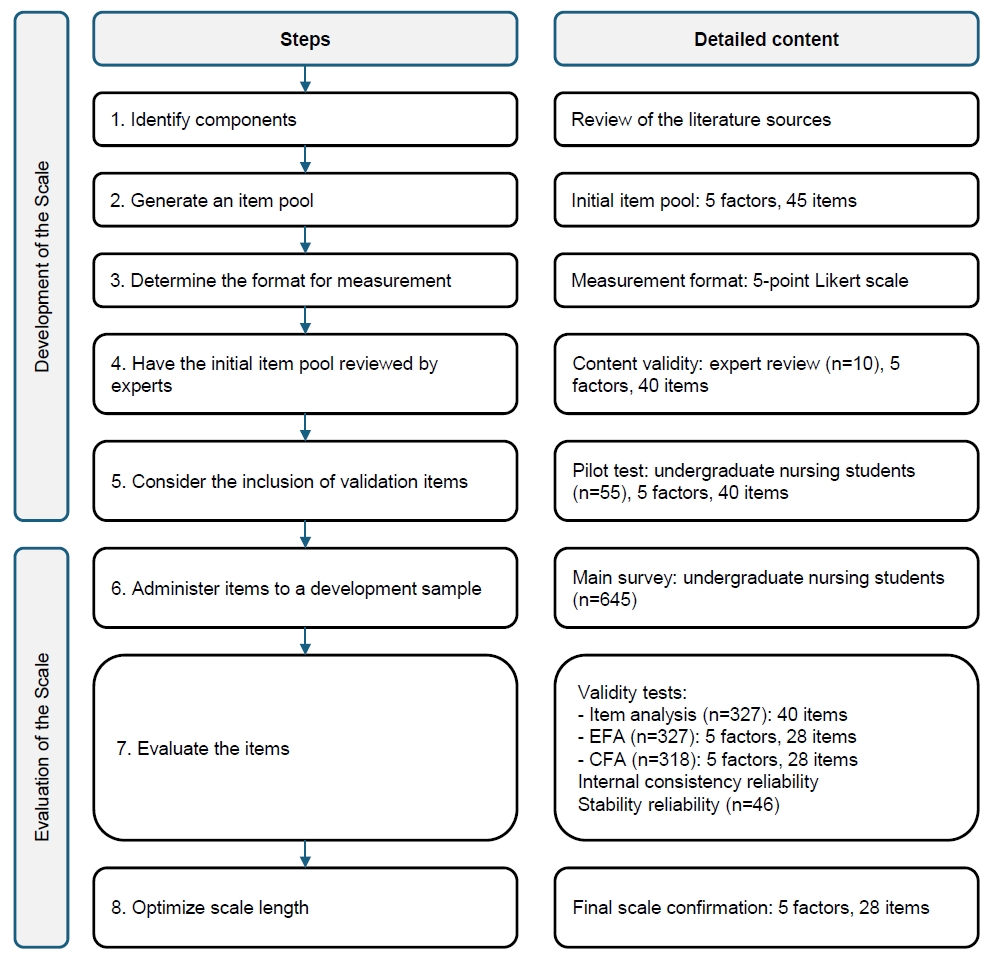
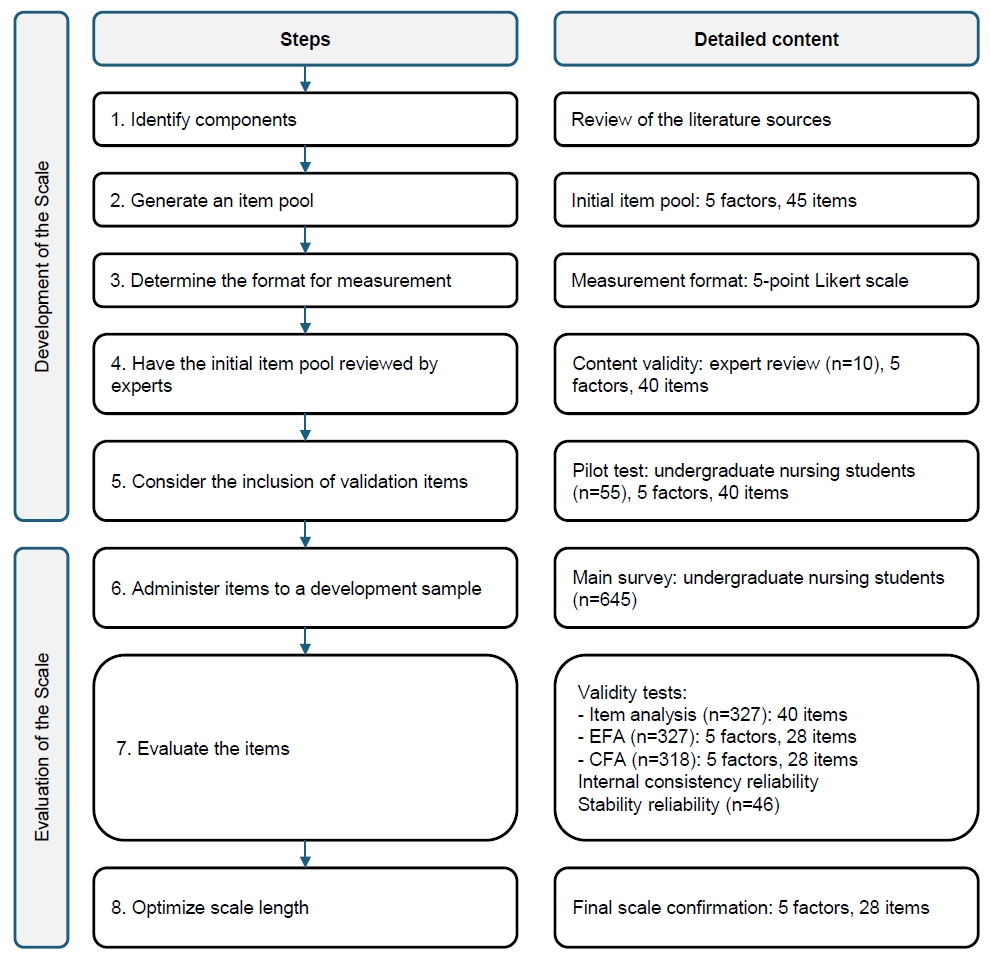
This methodological research was conducted using the scale development framework by DeVellis [21] in eight steps (Figure 1): (1) clearly defining the construct to be assessed, (2) generating a comprehensive pool of items, (3) specifying the measurement format, (4) obtaining expert review of the initial items, (5) considering the use of validation items, (6) conducting a pilot test with a sample, (7) analyzing and refining the items through exploratory and confirmatory factor analyses, and (8) finalizing the scale by optimizing its length. The study was reported in accordance with the STROBE (Strengthening the Reporting of Observational Studies in Epidemiology) guidelines.

1) Step 1: clearly defining the construct to be assessed

The construct targeted in this study was the perceived competence of nursing students in postoperative care. Despite the growing recognition of the importance of postoperative care competence and the increasing need for qualified nursing care due to the rise in trauma cases and surgical diseases resulting from conflicts, accidents, and disasters, there is still no specific instrument in this field. Therefore, this construct was selected as the focus of measurement. The conceptualization of this construct was grounded in an examination of the literature and supported by established frameworks, including the novice-to-expert framework by Benner [4], the Nursing and Midwifery Council standards of competence [22], and EORNA’s perioperative competencies [6].

2) Step 2: generating a pool of items

The literature review by Wu et al. [23] reported that the majority of competence assessment instruments were created on the basis of the standards of competence set by the professional nursing organizations. The current study established the main dimensions of the scale in accordance with the core competencies of perioperative nursing as set by EORNA [6,24]. Subsequently, to create the set of items, existing scales related to nursing competency and the literature on postoperative care were reviewed [1,4-6,11-17,22-24]. In this process, item pools for the five different dimensions defined by EORNA were developed separately and later combined to ensure consistency with the framework underlying the research.

3) Step 3: specifying the measurement format

The scale items were written in the form of statements and a 5-point Likert response format was used. Each item was scored as 1=strongly disagree, 2=disagree, 3=neither agree nor disagree, 4=agree, and 5=strongly agree, with higher scores indicating higher levels of perceived competence.

4) Step 4: obtaining expert review of the initial items

After the baseline item set was created, the research team, four of whom have at least 5 years of surgical nursing experience, met online to discuss the items. During these discussions, the spelling, grammar and commonality of the items were reviewed and five items were excluded from the item set by consensus of the team. There were 45 five-point Likert-type items in the baseline item set. The allocation of the items across dimensions was as follows: legal responsibilities and ethical principles (eight items), postoperative nursing care (17 items), interpersonal relations and communication (six items), leadership (six items), and education and professional development (eight items).
To determine how well each item aligned with the targeted conceptual domain, the content validity index (CVI) approach was employed. In line with the Davis method [25], a panel of 10 expert nurses reviewed the initial 45 items of the draft scale and provided their judgments using a 4-point rating scale. The eligibility criteria for the experts included having a doctoral degree, teaching postoperative care to undergraduate nursing students, and holding an academic position of at least assistant professor. These nurses rated each item for representativeness and relevance to the content. The evaluation was performed using a 4-point Likert scale (4=very suitable, 3=suitable, 2=somewhat suitable, and 1=unsuitable) and a CVI was calculated. The CVI for an item refers to the ratio of experts who graded the item as very suitable or suitable to all of the experts involved. A value of CVI >.80 was accepted as the cut-off point [25].

5) Step 5: considering inclusion of validation items

In this step, the inclusion of validation items was considered. However, no additional validation items were incorporated, as the scale development process primarily focused on measuring the target construct itself.

6) Step 6: conducting a pilot test with a sample

Prior to construct validity testing, a pilot study was conducted with 55 undergraduate nursing students (78.18% female; mean age 19.20±2.31 years). Students were informed about the research and invited to participate in the pilot study on a voluntary basis. The URL of the form via WhatsApp (whatsapp.com) was sent to students who agreed to participate, and data were collected anonymously online. In the pilot study, the grammar, comprehensibility, clarity, and wording of the items were evaluated by the nursing students, and no problems with the items were reported. The result of this stage showed that Cronbach’s α coefficients were .984 for the instrument as a whole, and it ranged from .896 to .982 for the dimensions, showing a high level of reliability and very good internal consistency [26]. Students who participated in the pilot study were not included in the main data analysis.

7) Step 7: analyzing and refining the items/evaluate the items

This step aimed to validate that the developed instrument was capable of measuring nursing students’ perceived competences in postoperative nursing care. The psychometric structure of the baseline Perceived Postoperative Care Competency Scale for Nursing Students (PPCC-NS) was investigated through item analysis, exploratory factor analysis (EFA), confirmatory factor analysis (CFA), and reliability testing.

(1) Item analysis

At this stage, item analysis was carried out to examine the internal consistency of the draft scale and to determine the contribution of each item to the overall structure. For this purpose, corrected item–total correlations and Cronbach’s α coefficients were calculated, and the performance of each item was evaluated based on these indicators. Items that did not meet the statistical or conceptual criteria would have been removed; however, all items showed acceptable values and were retained for further analyses [26].

(2) Exploratory factor analysis

To assess whether the scale aligned with the intended theoretical construct, EFA was employed. This analysis helped identify the latent structures represented by the items and contributed to evaluating the construct validity. The Kaiser-Meyer-Olkin (KMO) test was carried out to assess sample adequacy, with values exceeding .80 indicating that the data were suitable for factor analysis. Additionally, Bartlett’s Test of Sphericity was conducted to determine whether the correlations among items justified the use of factor analysis. A p-value below .001 confirmed that the relationships among variables were statistically significant. To uncover the underlying factorial structure, Principal axis factoring, which is the most commonly used method for analyzing relationships between instrument items and domains, was applied. Factor loadings, which show how strongly each item is related to a factor, were assessed using the direct oblimin technique. A factor loading of .40 or higher was considered acceptable [27].

(3) Confirmatory factor analysis

The factor structure of the scale was validated using CFA. The study employed several common goodness-of-fit indices (GFI) to evaluate how well the model fit the data. These indices included: chi-square to degrees of freedom ratio (χ2/df <5), comparative fit index (CFI >.90), Tucker-Lewis index (TLI >.90), normed fit index (NFI >.90), root mean square error of approximation (RMSEA <.08), and GFI (>.85) [28-31].

(4) Reliability

Cronbach’s α was used to measure internal consistency and reliability, with a value greater than .70 considered acceptable [26]. The stability reliability of the PPCC-NS was assessed using a test–retest method with 46 nursing students (82.61% female; average age 20.48±1.03 years), conducted 2 weeks apart.

8) Step 8: Optimizing the scale length

The refinement of the scale was achieved through the factor analyses, during which items not meeting the statistical criteria were removed. Thus, the final scale length was determined based on empirical evidence from exploratory and confirmatory factor analyses rather than a separate optimization process.
2. Participants and setting
The scale was originally developed in Türkiye and the items were prepared in Turkish. Data collection took place at four universities located in Türkiye’s Eastern Black Sea region, where the research team was affiliated. Therefore, the study used the convenience sampling method in which the sample is selected from a group that is readily available or convenient to the researchers [32].
The following criteria were used for enrollment: To have successfully completed the surgical nursing course and to be studying in the nursing department of the universities included in the study. Students who had not completed the internship of the course face-to-face, due to the COVID-19 (coronavirus disease 2019) pandemic, were excluded from the study.
A commonly accepted guideline for assessing validity and reliability is to recruit a sample size of five to 10 participants per item on the scale [33]. With 40 items in the initial PPCC-NS, an acceptable sample size ranged from 200 to 400 participants. The study collected two independent samples: 353 students for the EFA and 350 students for the CFA, resulting in a total of 703 nursing students (Figure 1). Participants were assured of both anonymity and privacy and all participants consented to the study by clicking the “I have been informed about the study and I give my consent” button on the online form.
3. Data collection
Data were collected via a two-part online form created using Google Forms (Google LLC) between December 2022 and March 2023. At the beginning of the data form, five demographic questions (age, gender, class, university, and marital status) were included. These questions are followed by the items of the PPCC-NS scale. Nursing students were individually sent the URL of the form via WhatsApp. Data were extracted from Google Forms as an Excel file, edited and transferred to SPSS. Data collection for the EFA analysis was conducted during December 2022 and for the CFA analysis was during January 2023. The sample from which data were collected to perform the CFA analysis and the sample from which data were collected to perform the EFA analysis were completely different from each other.
4. Statistical analysis
Descriptive statistics and factor analysis were conducted using IBM SPSS ver. 22.0 (IBM Corp.), while the factor structure was tested using AMOS 23.0 (IBM Corp.). The appropriateness of items and structure was evaluated through EFA, which identified items with high correlations to construct the factor structures. The decision on the number of factors was based on the assessment of eigenvalues above 1 and evaluating the scree plot. The factor structure revealed through EFA was subsequently tested and confirmed using CFA. To examine the scale’s internal consistency, both item-total correlations and Cronbach’s α values were computed [33]. The stability reliability of the PPCC-NS was evaluated using dependent groups t-tests and the intraclass correlation coefficient (ICC) based on absolute agreement and a two-way mixed-effects model. Kurtosis and skewness values were examined to assess conformity to normal distribution, with values between –2 and +2 indicating normal distribution [34]. Statistical significance was defined as a p-value less than .05.
5. Ethical approval
The study was approved by the Institutional Ethics Committee of Artvin Çoruh University (number: E-18457941-050.99-72808; date: November 30, 2022). In addition, informative explanations about the study were included in the online form, and students declared that they were informed about the research and accepted participation by selecting the “I approve” option.
1. Content validity of the scale
According to expert review, five of the items forming the initial PPCC-NS scale were eliminated because the content validity indices were below .80. Four of these items belonged to the postoperative nursing care sub-dimension and one to the education and professional development sub-dimension. Details of the removed items are presented in (Appendix 1).
The study established content validity of the 40-item draft scale with CVI ranging from .80 to 1.0 [25]. Additionally, upon feedback from experts, three items were revised in terms of wording within the scope of content validity.
2. Demographic characteristics
A total of 703 students from the involved universities were included in the final sample (892 students invited; response rate 78.81%). Data forms completed by 26 students from the EFA sample (n=353) and 32 students from the CFA sample (n=350) were excluded from the study because they contained extreme values. The research results were obtained by analyzing valid data from 327 students for EFA and 318 students for CFA.

1) Sample for EFA

Of the 327 respondent nursing students, 26.29% (n=86) were from year 2, 51.07% (n=167) were from year 3, and 22.62% (n=74) were from year 4. Most participants (n=265; 81.03%) were women, and 325 (99.38%) were unmarried. The mean age of the students was 21.0±1.43 (minimum=18, maximum=32) years.

2) Sample for CFA

The sample consisted of 71.69% (n=228) females and 98.11% (n=312) unmarried students with a mean age of 21.82±4.69 years. The distribution of students in ascending order by grade was 18.55%, 41.19%, and 40.25%, respectively.
3. Item analysis
Item analysis was conducted prior to examining the construct validity of the 40-item draft scale. Item means ranged between 4.04±.90 and 4.73±.51. For the draft scale, total Cronbach’s α was .962 and standardized Cronbach’s α was .963. Since the correlation coefficients were in the range of .50 to .71 according to the corrected item-total correlation analysis, no item was removed from the scale (Table 1).
4. Exploratory factor analysis
Since a significant correlation was found between the theoretical sub-dimensions of the initial PPCC-NS (.51≤ r ≤.78, p<.001), to reveal the factor structure, EFA was conducted using principal axis factoring and direct oblimin methods. The Bartlett’s test of sphericity statistic was calculated as χ2=8,257.70, p<.001, and the KMO measure was .947, indicating that the data set was sufficient for EFA in terms of homogeneity and sample size. In the factor analysis, 12 of the 40 items were deleted from the scale because their factor loadings were not larger than .40 (Appendix 1). Finally, factor analysis revealed five factors with eigenvalues ≥1.0, explaining 53.68% of the cumulative variance. These factors were consistent with the perioperative competency sub-dimensions defined by EORNA in the study. Therefore, the structure discovered as a result of factor analysis consisted of the following five factors: Factor 1: legal responsibilities and ethical principles (seven items); Factor 2: postoperative nursing care (seven items); Factor 3: interpersonal relations and communication (four items); Factor 4: leadership (six items); and Factor 5: education and professional development (four items) (Table 2). It was found that there was a significant relationship between the sub-dimensions that emerged in the EFA (.37≤ r ≤.70, p<.001).
5. Confirmatory factor analysis
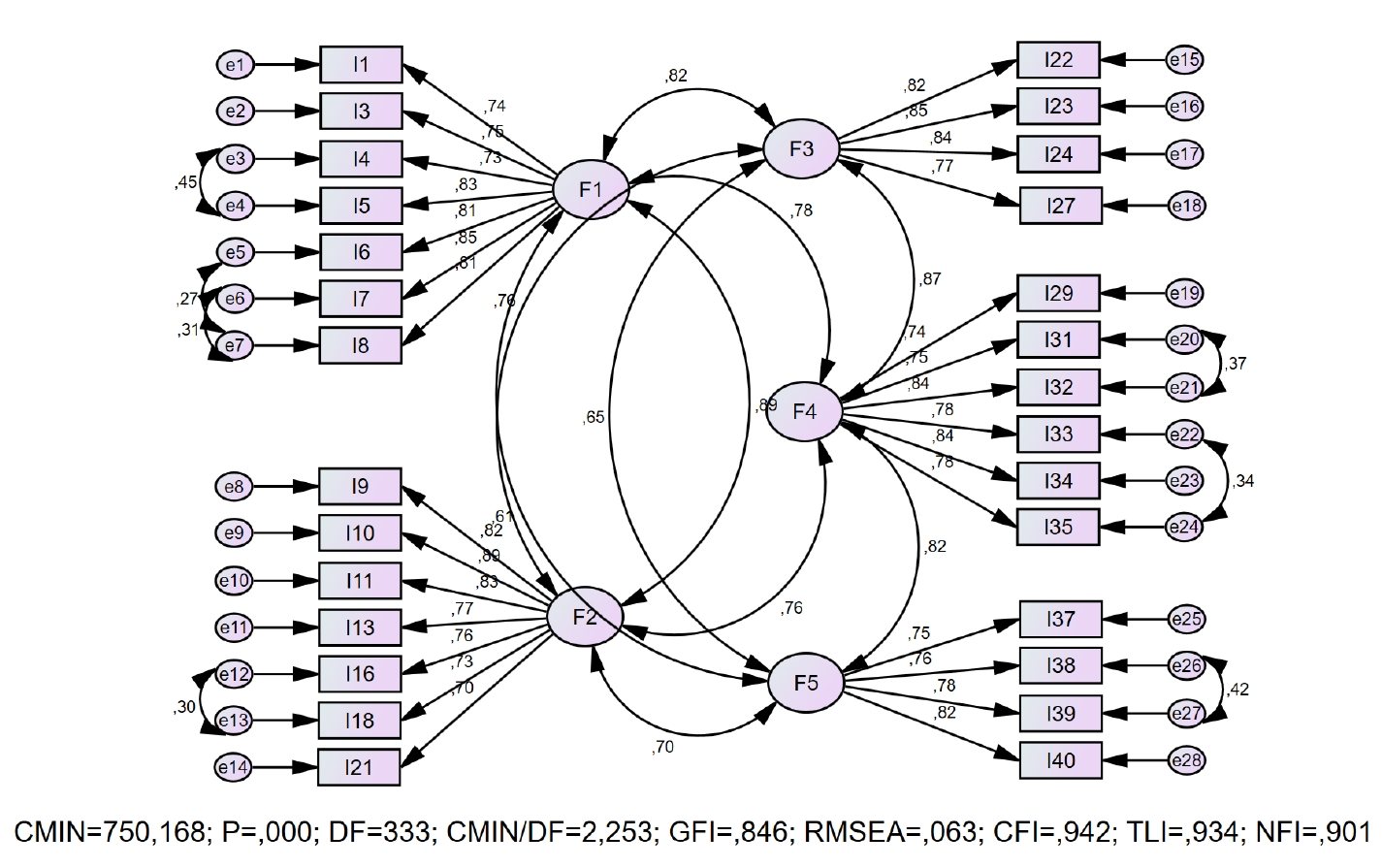
The 5-factor, 28-item model revealed by the EFA analysis was tested for validity with the CFA analysis (Figure 2). The CFA analysis showed that the data fit well with the model: χ2 (333, N=318)=750.168, p<.001, χ2/df=2.25, GFI=.85, NFI=.90, TLI=.93, CFI=.94, and RMSEA=.06. Factor loadings of items in all factors varied between .70 and .89 (Appendix 2). In addition, structural correlations between factors ranged from .27 to .89. and all the relationships were found to be positive and significant. These results showed that the structure of the scale obtained by the EFA was also confirmed by the CFA.
6. Tests of reliability
Cronbach’s α was found to be .97 for the total scale. Regarding the sub-dimensions of the scale, this value was found to vary between .87 and .92 (Appendix 3).
7. Stability reliability
The results of the paired samples t-test and the ICC were taken into account when testing the test–retest reliability. The ICCs were found to vary between .69 and .96. In addition, the results of the paired samples t-test confirmed that there was no statistically significant difference between the test and retest scores for the sub-dimensions and total scores (t=.867–1.742; p>.05) (Table 3).
In this study, the PPCC-NS was developed, and its psychometric properties were examined with the goal of developing an instrument to assess perceived competence in postoperative nursing care for nursing students. Psychometric analysis revealed that the PPCC-NS has satisfactory reliability and construct validity. The PPCC-NS is a self-report tool. Therefore, although it does not provide an objective assessment of competence, its educational utility should not be overlooked. The scale can be used by educators to identify areas in which students perceive themselves as less competent and to guide targeted curriculum planning and individualized feedback. In this way, the PPCC-NS may contribute to improving student learning outcomes, enhancing self-awareness, and better preparing nursing students for their professional roles.
Content validity assesses the alignment between a construct and scale items and it is typically evaluated by expert panels examine item relevance, clarity, and suitability. It is generally recommended that content validity be assessed by 2–10 experts, with an agreement level exceeding .80 [25]. In this study, the item pool was rated by 10 experts, with an acceptable lower limit of inter-rater agreement set at .80. Indicating that this scale has good content validity, the CVI scores of each item in the original version of the scale ranged from .80 to 1.
The EFA is a statistical technique used to group variables that measure the same characteristic or underlying structure within factors [27]. In interpreting the factor structure, factor loadings play a key role, as they express the relationship between the items and the factors and indicate the weight of each item within its factor. It is recommended that factor loadings be greater than .40. In this study, 12 items with factor loadings below .40 were excluded from the draft scale. In addition, to determine the number of factors to be retained, the eigenvalue criterion was considered. The eigenvalue measures the amount of variance explained by a factor, and a factor with an eigenvalue greater than 1 was considered significant [27,35]. Five factors consisting of 28 items with eigenvalues greater than 1 emerged from the study, and these factors were compatible with the competence areas defined by EORNA, as theoretically suggested.
The reliability of the scale was tested through the calculation of Cronbach α internal consistency coefficient, and the alpha value between .70 and 1.00 was accepted as a reliability indicator [26]. It was suggested that the PPCC-NS has a reliable scale, as its internal consistency coefficient is higher than .70. In addition, it was found that the alpha coefficients of the sub-dimensions of the scale vary between .87 and .92. These results show that the developed scale is a reliable tool for the measurement of nursing students’ perceptions of competence in postoperative nursing care.
The literature indicates that determining a single cut-off value for each fit index is challenging because fit indices perform differently under varying conditions; however, cut-off values close to .95 for TLI and CFI and .06 for RMSEA are generally accepted as adequate, as they are associated with acceptable Type I and low Type II error rates [28,29]. In the present study, the GFI supported the accuracy of the proposed model, although some indices were close to threshold values (e.g., NFI=.90, GFI=.85), possibly due to model complexity and the relatively high number of items. Future studies may improve model fit by reducing item numbers, validating the scale with different samples, and testing alternative model specifications. Discriminant validity, which reflects a scale’s ability to distinguish between constructs, is generally supported by inter-factor correlations below r=.85 (or <.90 depending on context) [36]; however, the observed inter-factor correlation of .89 in this study suggests potential conceptual overlap among subdimensions. This may be explained by the close interrelationship of knowledge, skill, and attitude domains underlying postoperative care competence, but it also represents a limitation in terms of discriminant validity. Additionally, the high total Cronbach’s α coefficient (.97) indicates strong internal consistency while also suggesting possible item redundancy. Therefore, future research should re-evaluate scale items using diverse samples and examine inter-item relationships to strengthen discriminant validity and enhance the scale’s practical applicability.
First defined by EORNA in 1997, then in 2012 and 2019, the areas of competence in perioperative nursing guide both nursing education and clinical practice in the care of surgical patients [6,24]. While it is very important for nurses to become competent in these areas in terms of the quality and safety of surgical care, this competence also contributes to surgical nurses’ awareness of their responsibilities, leadership and management roles and the development of the nursing profession [24,37]. The Perceived Preoperative Nursing Care Competence Scale for Nursing Students (PPreCC-NS), developed by this study team, was also designed according to the EORNA areas of competence. However, since some of the items designed for the leadership sub-dimension in the draft scale had CVI <.80, some had factor loadings <.50, and some were loaded on different sub-dimensions, the leadership sub-dimension was not created in the final scale structure. The sub-dimension “Evaluation and follow-up of the patient,” which is not part of the EORNA competencies, was also included in the scale [38]. It is very important for this study that the PPCC-NS is structured according to EORNA’s areas of competence. On the other hand, several items excluded during the content validity stage, such as those related to postoperative nausea and vomiting management, monitoring of fluid–electrolyte balance, pain management, and early detection of complications, represent core components of postoperative care. Omitting these items from the measurement scope could limit the distinct contribution of the scale. To make the PPCC-NS more comprehensive, future studies could add revised versions of these essential items back into the scale.
Although the concept of nursing competence has a universal framework, it is shaped by the healthcare systems, educational models, and cultural dynamics of each country [5,11,12]. In Türkiye, nursing students often face limited opportunities for hands-on clinical practice, and the gap between theoretical learning and practical application is frequently emphasized [38]. Moreover, the postoperative care period is culturally characterized by strong family involvement. Therefore, the postoperative care process requires nurses to be competent not only in clinical knowledge and skills but also in effective communication with patients and their families, while maintaining ethical responsibility throughout the care process [39]. Accordingly, the scale developed in this study was designed in line with the core competency domains defined by EORNA, while also taking into account the influence of cultural context.
Postoperative nursing care is a critical area in which nursing students must acquire fundamental knowledge and skills as they transition into their professional roles. Although students are not primarily responsible for postoperative care, they do play a supporting role in processes specific to the postoperative period, such as physical assessment, patient safety, managing complications, and communication, during their clinical internships. Furthermore, they are expected to acquire the necessary knowledge and skills in these areas throughout their education. Therefore, it is crucial to determine students’ perceived competence levels in postoperative care in order to evaluate the outcomes of educational programs and accurately identify clinical learning needs. Although various scales have been developed to assess nursing competence, most focus on general nursing practice or the preoperative and intraoperative periods [13-16,19,23]. Existing scales for nursing students mostly evaluate basic professional competencies in general clinical practice, rather than addressing postoperative care as an independent structure [11,12]. No specific instrument has been identified that independently assesses competencies related to the postoperative period, including surgical site care, management of fluid and electrolyte balance, complication detection, prevention of postoperative deep vein thrombosis, and discharge education. In this respect, the PPCC-NS makes a unique contribution by assessing perceived competence in postoperative nursing care as a distinct domain. For example, the Scale of Quality of Postoperative Care (QaPoC) was designed to measure the quality of postoperative care provided by clinical nurses, whereas the PPCC-NS aims to evaluate nursing students’ perceived competence in this field [13]. Conceptually, the two instruments also differ. The QaPoC assesses the quality of delivered care, whereas PPCC-NS measures self-perceived competence based on knowledge, skills, and attitudes. Through this focus, the PPCC-NS fills an important gap in nursing education.
In addition, the psychometric findings of the PPCC-NS are in line with those of other nursing competence scales developed and validated in different cultural contexts. The original Nursing Student Competence Scale demonstrated acceptable model fit indices (χ2/df=2.24, RMSEA=.07, CFI=.94). Its Turkish adaptation showed similar results (χ2/df=2.25, RMSEA=.06, CFI=.94, GFI=.85) and explained 75.8% of the total variance [40]. Similarly, in samples of nursing students, the Arabic and Chinese adaptations of the Nurse Professional Competence–Short Version demonstrated satisfactory psychometric properties, with χ2/df values around 2.2–2.6, RMSEA values between .05 and .08, and CFI values between .90 and .93. This confirms good model fit and cross-cultural stability [41,42]. The PPreCC-NS revealed a five-factor structure that explained 62.2% of the variance, with fit indices that were considered acceptable (χ2/df=2.74, RMSEA=.07, CFI=.92, GFI=.88) [43]. These results suggest that the PPreCC-NS demonstrates reliability and validity levels similar to those of well-established competence scales. Furthermore, by specifically including the postoperative nursing care practices, the PPCC-NS addresses an important gap in competence assessment that has been underrepresented in previous tools.
Competency scales play a crucial role in improving educational processes in nursing. Indeed, they are used for educational needs assessment, providing concrete data on which competency areas students or recent graduates need to strengthen [44]. They are also reported to be effective in providing formative feedback: periodically assessing students’ competency levels increases self-awareness and helps faculty to develop personalized learning plans [45]. Furthermore, such scales are widely used in program evaluation and accreditation processes. Many educational institutions use valid and reliable tools to report graduate competency levels, and accrediting bodies accept this data as an indicator of educational quality [46]. Competency scales can also be used to evaluate the effectiveness of teaching strategies, with the success of simulation, case-based learning and virtual reality-based educational activities being demonstrated quantitatively through pre- and post-test results [47]. Therefore, the scale developed in this study has the potential to contribute to targeted planning of postoperative care training and the education of more competent nurses in this area. Furthermore, given that a high level of competence is directly related to the quality and safety of patient care [10], it is expected that the scale will contribute to an increase in the safety and quality of postoperative care.
The scale developed in the study is a self-assessment scale and will not provide an objective measure of competency. There is a relationship between perceived and actual nursing competence [48]. Furthermore, some studies have shown that nurses who perceive themselves as competent tend to have higher levels of critical thinking, patient safety culture, and job performance [49,50]. However, it is important to note that self-perception of competence may not always be perfectly aligned with actual clinical performance [20]. For this reason, external evaluations and assessments are also critical in determining the postoperative care competency of nursing students.
The study has several limitations. Firstly, although ICC values ranged from .69 to .96, one subscale value (.69) was slightly below the commonly cited .70 threshold. This may indicate limited reliability in that dimension. Future refinement of the scale could include reviewing inter-item correlations and considering item improvements to strengthen reliability. In addition to this, the high mean values of the scale items in this study (4.04–4.73) suggest that participants’ responses were mostly concentrated at the higher end of the scale. This suggests that the scale has a limited ability to distinguish between individual differences. To address this limitation, future studies are recommended that involve revising the items, adjusting the difficulty level or testing alternative response formats. Another limitation for this study is that the convenience sampling method was used. Therefore, the respondents do not represent a cross section of nursing students in the country. Furthermore, the findings of this study cannot be generalized to other cultural contexts. Also, the fact that the construct of the scale could not be assessed with a “gold standard” measure due to the lack of another specific tool to measure the nursing students’ competence in postoperative care constitutes a limitation of the study. The use of self-reporting methods is another potential concern, as this method may lead to participant bias and create a weakness in the study. Finally, when cross-sectional methods are used for the estimation of models whose parameters may be subject to change over time, the actual model parameters may not be determined and the results obtained may not be statistically valid. For this reason, longitudinal studies can help to establish validity.
Postoperative care is a critical area of practice within nursing, requiring specialized knowledge and skills. Systematically assessing students’ competencies in postoperative care is crucial for ensuring they acquire the basic knowledge and skills in this area throughout their education. Although there are a number of validated and reliable competence scales available for use with nursing students, they are not specific to postoperative care. The results of this study suggested that the PPCC-NS, including 28 items with five factors, is a valid instrument for assessing perceived competence of nursing students in postoperative care. The PPCC-NS scores range from a minimum of 28 to a maximum of 140, with higher scores indicating greater perceived competence in postoperative care. In practical terms, the PPCC-NS could be used by nurse educators as a tool to assess levels of competency in training programs. Future studies evaluating the psychometric properties of the PPCC-NS, especially in other cultures and samples, will be valuable.

Conflicts of Interest

No potential conflict of interest relevant to this article was reported.

Acknowledgements

None.

Funding

None.

Data Sharing Statement

Please contact the corresponding author for data availability.

Author Contributions

Conceptualization or/and Methodology: PŞ, DÇ. Data curation or/and Analysis: PŞ, GÇÖ, SK, MEY. Funding acquisition: none. Investigation: PŞ, GÇÖ, SK, MEY. Project administration or/and Supervision: PŞ, DÇ. Resources or/and Software: none. Validation: PŞ, DÇ. Visualization: PŞ. Writing: original draft or/and Review & Editing: PŞ, GÇÖ, SK, MEY, DÇ. Final approval of the manuscript: all authors.

Fig. 1.
Study flow diagram.
jkan-25123f1.jpg
Fig. 2.
Confirmatory factor analysis. F1: legal responsibilities and ethical principles, F2: postoperative nursing care, F3: interpersonal relations and communication, F4: leadership, F5: education and professional development. χ2=750.168; p=.000; degrees of freedom (df)=333; χ2/df=2.253; goodness-of-fit index=.846; root mean square error of approximation=.063; comparative fit index=.942; Tucker-Lewis index=.934; normed fit index=.901.
jkan-25123f2.jpg
Table 1.
Descriptive statistics (N=327)
No. Item Mean±SD Corrected item-total correlation Cronbach’s α if item deleted
I1 I can comply with the basic ethical principles in postoperative nursing practices 4.37±.70 .52 .96
I3 I can take responsibility for postoperative care practices 4.32±.75 .55 .96
I4 I can consult health care professionals about postoperative care practices that are beyond my capacity 4.66±.58 .54 .96
I5 I can ensure the confidentiality and security of patient information that I receive 4.73±.52 .52 .96
I6 I can document my nursing practice in the postoperative period 4.47±.66 .54 .96
I7 I can take measures to ensure patient safety in postoperative care 4.59±.58 .62 .96
I8 I can use checklists to ensure patient safety in postoperative care 4.5±.65 .63 .96
I9 I can carry out a physical assessment of the patient in the postoperative period 4.42±.63 .54 .96
I10 I can provide postoperative nursing care according to relevant procedures and protocols 4.36±.67 .66 .96
I11 I can provide patient-specific care using the nursing process in postoperative patient care 4.41±.69 .68 .96
I13 I can apply evidence-based guidelines for surgical site skin care 4.24±.76 .60 .96
I16 I can plan the necessary nursing care for fluid and electrolyte imbalances that may occur after surgery 4.22±.71 .64 .96
I18 I can plan nursing care to prevent the development of deep vein thrombosis after surgery 4.23±.77 .63 .96
I21 I can recognize emergencies that may occur in the postoperative period 4.13±.73 .63 .96
I22 I can provide an appropriate communication environment for the patient to express their concerns by using effective communication techniques 4.39±.73 .68 .96
I23 I can use interpersonal communication skills to enhance the patient’s strategies for coping with postoperative anxiety 4.32±.69 .69 .96
I24 I can provide positive communication and co-operation with patients and their relatives to increase participation in patient care 4.46±.67 .71 .96
I27 During the postoperative care process, I avoid judgmental attitudes and try to understand patients and their relatives 4.52±.65 .57 .96
I29 I can take responsibility for my own professional development in postoperative practices 4.35±.76 .65 .96
I31 I strive to contribute to the self-development of my colleagues in postoperative nursing 4.41±.69 .65 .96
I32 I can contribute to harmonious and organized work of my fellow students in the postoperative care units 4.49±.65 .61 .96
I33 I can consult with members of the surgical team to learn what I do not know about postoperative care 4.6±.60 .66 .96
I34 I can share my knowledge and experience of postoperative care with my peers and nurses 4.5±.70 .71 .96
I35 I can benefit from the knowledge and experience of the surgical team members 4.62±.57 .68 .96
I37 I can follow current research in postoperative care 4.23±.77 .58 .96
I38 I try to contribute to the development of new technological products and equipment to improve postoperative care 4.04±.90 .47 .96
I39 I try to contribute to scientific research regarding postoperative care 4.04±.89 .50 .96
I40 I can benefit from technological developments to increase the effectiveness of postoperative care 4.35±.71 .62 .96

SD, standard deviation.

Table 2.
Factor loadings according to EFA (N=327)
Items CVI Communalities Factors
Initial Extraction 1 2 3 4 5
I1 1 .45 .36 .47
I3 1 .49 .43 .44
I4 1 .54 .50 .57
I5 .90 .54 .54 .68
I6 1 .49 .44 .58
I7 1 .62 .60 .66
I8 .80 .62 .59 .64
I9 .90 .45 .41 .47
I10 .90 .61 .58 .51
I11 .90 .56 .54 .40
I13 1 .51 .47 .45
I16 .80 .52 .49 .44
I18 .80 .58 .47 .44
I21 .90 .58 .52 .52
I22 1 .76 .76 –.81
I23 1 .73 .66 –.64
I24 1 .71 .70 –.65
I27 .80 .57 .53 –.46
I29 .90 .59 .53 –.43
I31 1 .69 .56 –.59
I32 1 .69 .59 –.73
I33 .80 .67 .64 –.67
I34 1 .67 .64 –.61
I35 1 .70 .66 –.61
I37 .80 .64 .59 .62
I38 1 .62 .67 .85
I39 1 .67 .64 .79
I40 .90 .60 .50 .45

F1: legal responsibilities and ethical principles, F2: postoperative nursing care, F3: interpersonal relations and communication, F4: leadership, F5: education and professional development.

CVI, content validity index; EFA, exploratory factor analysis.

Table 3.
Stability reliability (N=46)
Sub-dimensions Mean±SD t p ICC
Test Re-test
F1 30.87±3.83 30.24±3.63 1.73 .090 .87
F2 33.33±10.76 32.80±11.14 .86 .390 .96
F3 17.50±2.47 17.17±2.26 1.00 .320 .72
F4 26.61±3.38 25.85±3.35 1.70 .095 .73
F5 16.61±2.58 16.04±3.00 1.42 .162 .69
Total 124.91±16.56 122.11±17.39 1.74 .088 .88

ICC, intraclass correlation coefficient; SD, standard deviation.

Appendix 1.
Item reduction summary of the PPCC-NS
jkan-25123-Appendix-1.pdf
Appendix 2.
Confirmatory factor analysis results of the PPCC-NS (N=318)
jkan-25123-Appendix-2.pdf
Appendix 3.
Sub-dimensions of the scale (N=318)
jkan-25123-Appendix-3.pdf

Figure & Data

REFERENCES

    Citations

    Citations to this article as recorded by  

      • ePub LinkePub Link
      • Cite
        CITE
        export Copy Download
        Close
        Download Citation
        Download a citation file in RIS format that can be imported by all major citation management software, including EndNote, ProCite, RefWorks, and Reference Manager.

        Format:
        • RIS — For EndNote, ProCite, RefWorks, and most other reference management software
        • BibTeX — For JabRef, BibDesk, and other BibTeX-specific software
        Include:
        • Citation for the content below
        Development and psychometric testing of the Perceived Postoperative Care Competency Scale for Nursing Students: a methodological study
        Close
      • XML DownloadXML Download
      Figure
      • 0
      • 1
      We recommend
      Related articles
      Development and psychometric testing of the Perceived Postoperative Care Competency Scale for Nursing Students: a methodological study
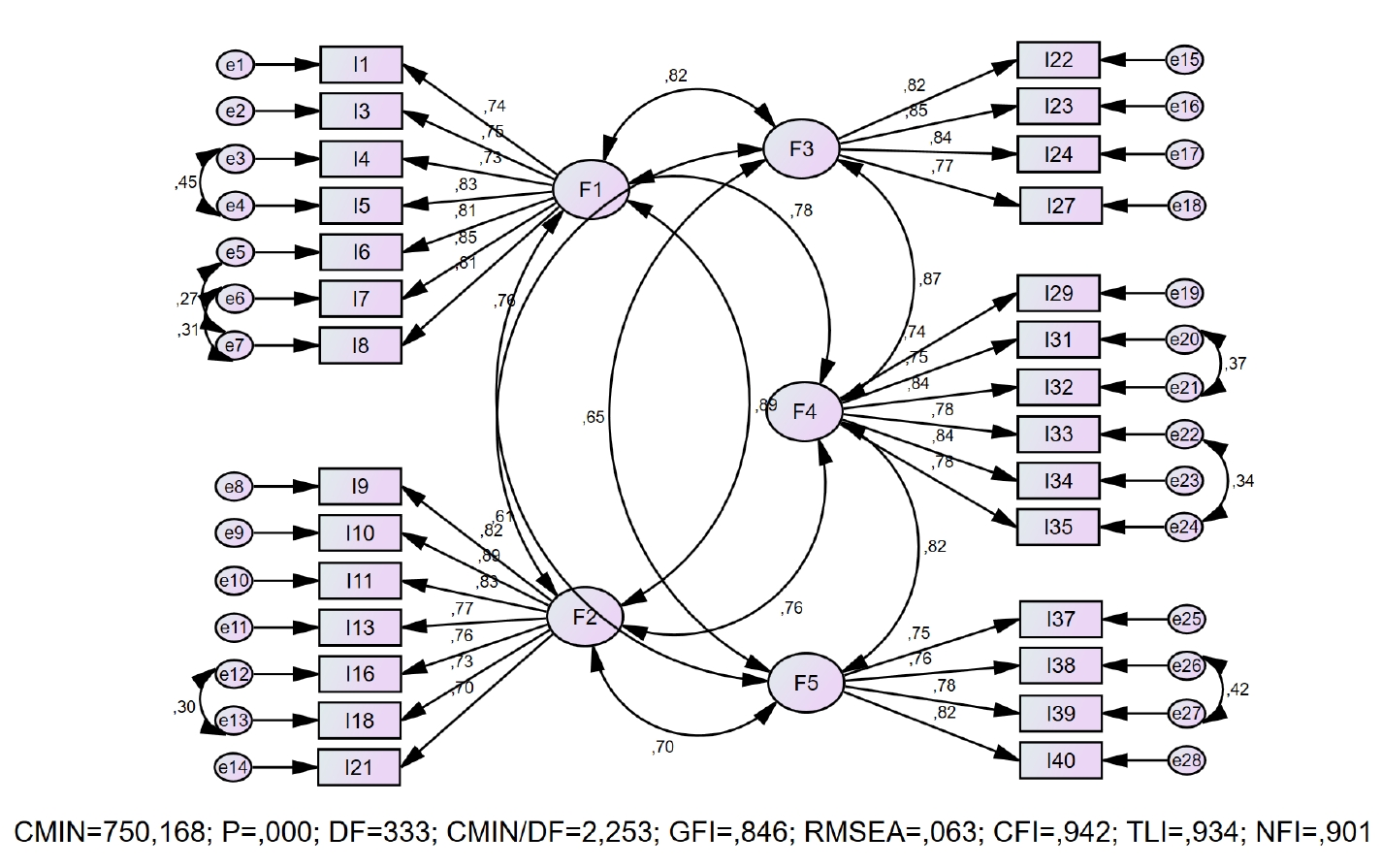
      Image Image
      Fig. 1. Study flow diagram.
      Fig. 2. Confirmatory factor analysis. F1: legal responsibilities and ethical principles, F2: postoperative nursing care, F3: interpersonal relations and communication, F4: leadership, F5: education and professional development. χ2=750.168; p=.000; degrees of freedom (df)=333; χ2/df=2.253; goodness-of-fit index=.846; root mean square error of approximation=.063; comparative fit index=.942; Tucker-Lewis index=.934; normed fit index=.901.
      Development and psychometric testing of the Perceived Postoperative Care Competency Scale for Nursing Students: a methodological study
      No. Item Mean±SD Corrected item-total correlation Cronbach’s α if item deleted
      I1 I can comply with the basic ethical principles in postoperative nursing practices 4.37±.70 .52 .96
      I3 I can take responsibility for postoperative care practices 4.32±.75 .55 .96
      I4 I can consult health care professionals about postoperative care practices that are beyond my capacity 4.66±.58 .54 .96
      I5 I can ensure the confidentiality and security of patient information that I receive 4.73±.52 .52 .96
      I6 I can document my nursing practice in the postoperative period 4.47±.66 .54 .96
      I7 I can take measures to ensure patient safety in postoperative care 4.59±.58 .62 .96
      I8 I can use checklists to ensure patient safety in postoperative care 4.5±.65 .63 .96
      I9 I can carry out a physical assessment of the patient in the postoperative period 4.42±.63 .54 .96
      I10 I can provide postoperative nursing care according to relevant procedures and protocols 4.36±.67 .66 .96
      I11 I can provide patient-specific care using the nursing process in postoperative patient care 4.41±.69 .68 .96
      I13 I can apply evidence-based guidelines for surgical site skin care 4.24±.76 .60 .96
      I16 I can plan the necessary nursing care for fluid and electrolyte imbalances that may occur after surgery 4.22±.71 .64 .96
      I18 I can plan nursing care to prevent the development of deep vein thrombosis after surgery 4.23±.77 .63 .96
      I21 I can recognize emergencies that may occur in the postoperative period 4.13±.73 .63 .96
      I22 I can provide an appropriate communication environment for the patient to express their concerns by using effective communication techniques 4.39±.73 .68 .96
      I23 I can use interpersonal communication skills to enhance the patient’s strategies for coping with postoperative anxiety 4.32±.69 .69 .96
      I24 I can provide positive communication and co-operation with patients and their relatives to increase participation in patient care 4.46±.67 .71 .96
      I27 During the postoperative care process, I avoid judgmental attitudes and try to understand patients and their relatives 4.52±.65 .57 .96
      I29 I can take responsibility for my own professional development in postoperative practices 4.35±.76 .65 .96
      I31 I strive to contribute to the self-development of my colleagues in postoperative nursing 4.41±.69 .65 .96
      I32 I can contribute to harmonious and organized work of my fellow students in the postoperative care units 4.49±.65 .61 .96
      I33 I can consult with members of the surgical team to learn what I do not know about postoperative care 4.6±.60 .66 .96
      I34 I can share my knowledge and experience of postoperative care with my peers and nurses 4.5±.70 .71 .96
      I35 I can benefit from the knowledge and experience of the surgical team members 4.62±.57 .68 .96
      I37 I can follow current research in postoperative care 4.23±.77 .58 .96
      I38 I try to contribute to the development of new technological products and equipment to improve postoperative care 4.04±.90 .47 .96
      I39 I try to contribute to scientific research regarding postoperative care 4.04±.89 .50 .96
      I40 I can benefit from technological developments to increase the effectiveness of postoperative care 4.35±.71 .62 .96
      Items CVI Communalities Factors
      Initial Extraction 1 2 3 4 5
      I1 1 .45 .36 .47
      I3 1 .49 .43 .44
      I4 1 .54 .50 .57
      I5 .90 .54 .54 .68
      I6 1 .49 .44 .58
      I7 1 .62 .60 .66
      I8 .80 .62 .59 .64
      I9 .90 .45 .41 .47
      I10 .90 .61 .58 .51
      I11 .90 .56 .54 .40
      I13 1 .51 .47 .45
      I16 .80 .52 .49 .44
      I18 .80 .58 .47 .44
      I21 .90 .58 .52 .52
      I22 1 .76 .76 –.81
      I23 1 .73 .66 –.64
      I24 1 .71 .70 –.65
      I27 .80 .57 .53 –.46
      I29 .90 .59 .53 –.43
      I31 1 .69 .56 –.59
      I32 1 .69 .59 –.73
      I33 .80 .67 .64 –.67
      I34 1 .67 .64 –.61
      I35 1 .70 .66 –.61
      I37 .80 .64 .59 .62
      I38 1 .62 .67 .85
      I39 1 .67 .64 .79
      I40 .90 .60 .50 .45
      Sub-dimensions Mean±SD t p ICC
      Test Re-test
      F1 30.87±3.83 30.24±3.63 1.73 .090 .87
      F2 33.33±10.76 32.80±11.14 .86 .390 .96
      F3 17.50±2.47 17.17±2.26 1.00 .320 .72
      F4 26.61±3.38 25.85±3.35 1.70 .095 .73
      F5 16.61±2.58 16.04±3.00 1.42 .162 .69
      Total 124.91±16.56 122.11±17.39 1.74 .088 .88
      Table 1. Descriptive statistics (N=327)

      SD, standard deviation.

      Table 2. Factor loadings according to EFA (N=327)

      F1: legal responsibilities and ethical principles, F2: postoperative nursing care, F3: interpersonal relations and communication, F4: leadership, F5: education and professional development.

      CVI, content validity index; EFA, exploratory factor analysis.

      Table 3. Stability reliability (N=46)

      ICC, intraclass correlation coefficient; SD, standard deviation.


      J Korean Acad Nurs : Journal of Korean Academy of Nursing
      Close layer
      TOP