
 Submit an article

Search
- Page Path
- HOME > Search
Review Papers
- Variables associated with compliance with standard precautions among hospital nurses: a systematic review and meta-analysis
- Song Hee Park, Seok Hee Jeong, Chang Seop Lee, Young Man Kim
- J Korean Acad Nurs 2026;56(1):1-26. Published online February 27, 2026
- DOI: https://doi.org/10.4040/jkan.25114
-
 Abstract
 PDF
PDF - Purpose
This study aimed to conduct a systematic review and meta-analysis to identify variables associated with standard precautions compliance among hospital nurses and to comprehensively examine their effect sizes.
Methods
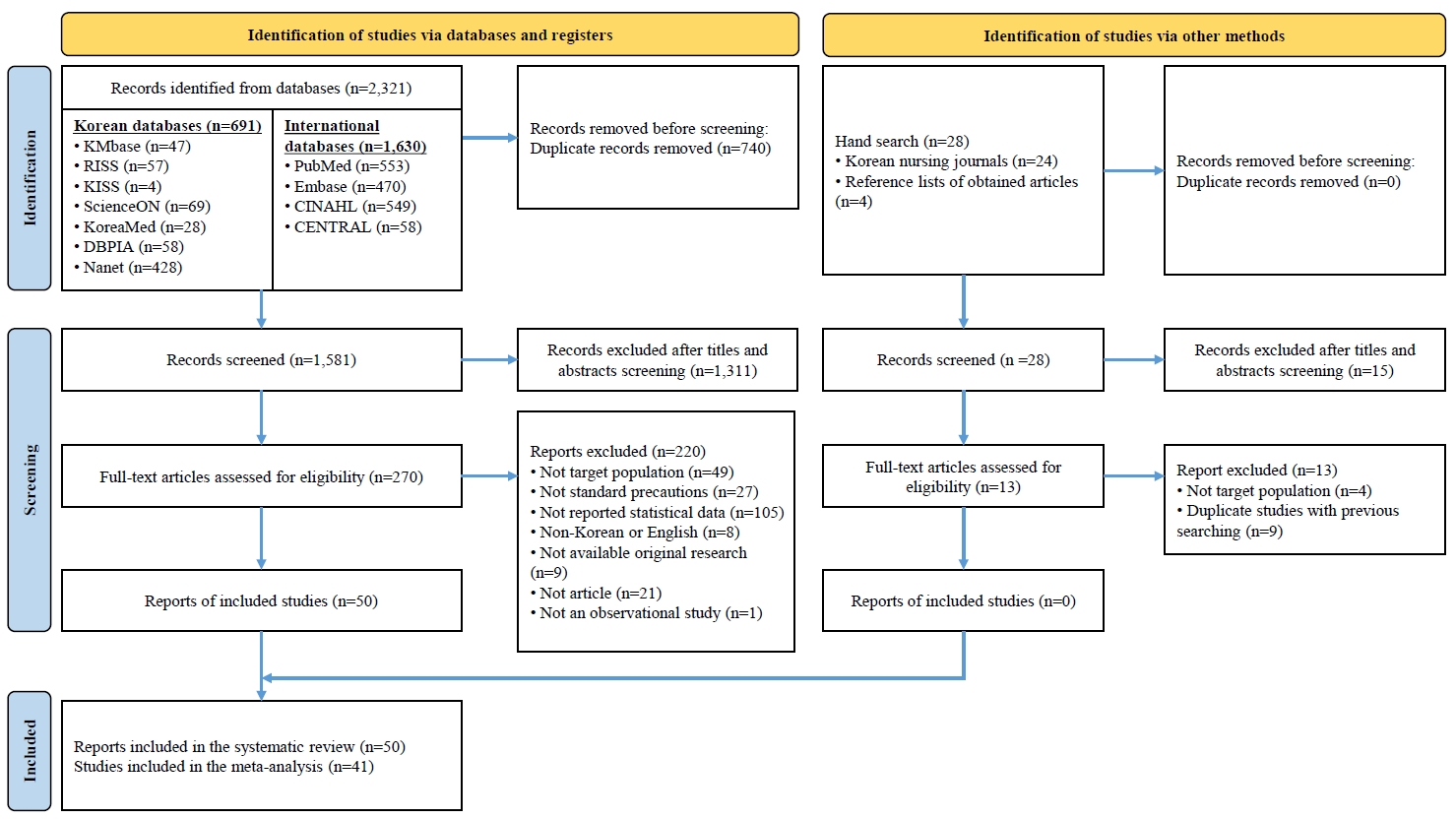
A systematic review and meta-analysis were reported in accordance with the PRISMA and MOOSE guidelines. Studies published in English or Korean were retrieved from KMbase, KoreaMed, KISS, ScienceON, RISS, Nanet, DBpia, PubMed, Embase, CINAHL, and CENTRAL. Data collection was conducted from July 6 to July 16, 2024. To ensure a comprehensive search, no restrictions were placed on the publication period, and studies published up to June 2024 were included in the literature search. Analyses were performed using R ver. 4.4.1.
Results
Of the 2,321 studies screened, 50 were included in the systematic review and 41 were included in the meta-analysis. Variables were categorized according to the ecological model. Among individual-level factors, variables with medium correlation effect sizes (ESr ≥.30) included self-efficacy (ESr=.41; 95% confidence interval [CI], 0.24 to 0.56), perceived barriers (ESr=−.35; 95% CI, −0.59 to −0.05), cues to action (ESr=.34; 95% CI, 0.07 to 0.57), and perceived benefits (ESr=.30; 95% CI, 0.13 to 0.46). Among organizational factors, organizational culture for infection control (ESr=.47; 95% CI, 0.39 to 0.54) and patient safety culture (ESr=.44; 95% CI, 0.35 to 0.53) demonstrated medium effect sizes. Other statistically significant variables with small effect sizes were also identified. No variables were identified within the interpersonal, community, or public policy domains.
Conclusion
This study identified self-efficacy and organizational culture for infection control as key determinants of compliance with standard precautions. Strengthening these factors may reduce healthcare-associated infections and promote safer nursing care (PROSPERO registration number: CRD42024566518). -
Citations
Citations to this article as recorded by
- Factors influencing intensive care unit nurses’ performance of standard precautions in South Korea: a descriptive correlational study
Hana Seo, Nahyun Kim
Journal of Korean Biological Nursing Science.2026; 28(2): 300. CrossRef
- Factors influencing intensive care unit nurses’ performance of standard precautions in South Korea: a descriptive correlational study
- 3,432 View
- 391 Download
- 1 Crossref

- Variables influencing digital health literacy in older adults: a systematic review and meta-analysis
- Jin Hwa Park, Eun Ju Mun
- J Korean Acad Nurs 2025;55(4):651-667. Published online November 27, 2025
- DOI: https://doi.org/10.4040/jkan.25112
-
Abstract
PDF
 ePub
ePub - Purpose
This study aimed to synthesize existing evidence on digital health literacy (DHL) among older adults and to estimate the associations between related influencing factors through a systematic literature review and meta-analysis.
Methods
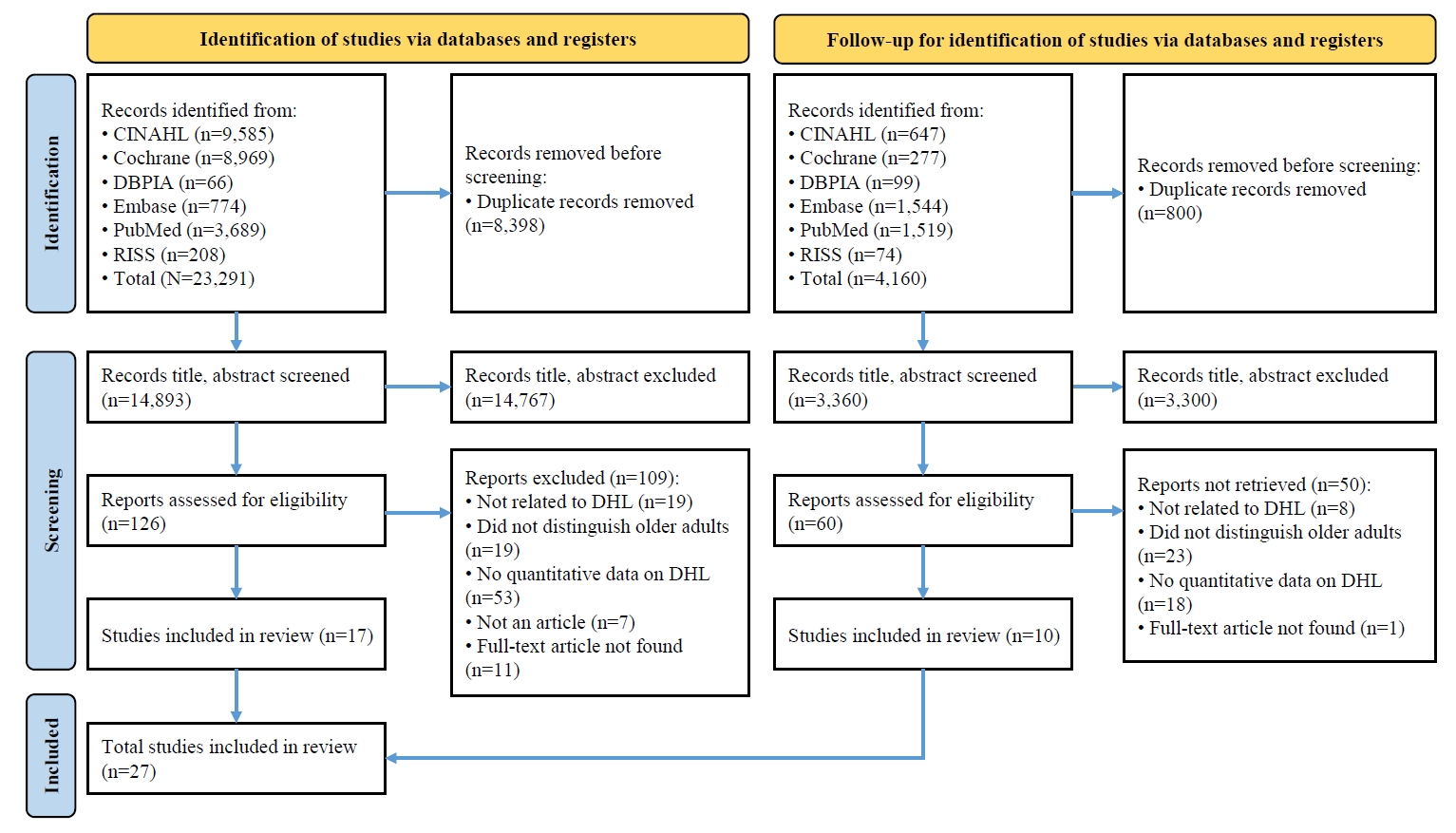
A systematic review and meta-analysis were conducted in accordance with the Preferred Reporting Items for Systematic Reviews and Meta-Analyses (PRISMA) and Meta-Analysis of Observational Studies in Epidemiology (MOOSE) guidelines. Literature searches were performed across PubMed, EMBASE, Cochrane Library, CINAHL, RISS, and DBPIA. The search and screening process was conducted from December 24, 2023, to March 31, 2025. Effect sizes (ESr) using correlation coefficient for each variable were calculated, and meta-analyses were performed using Microsoft Excel and R version 4.3.1.
Results
Forty-seven variables were identified, including two demographic, six physical, six behavioral, 23 psychosocial, and 10 cognitive factors. Meta-analysis results showed that physical, behavioral, psychosocial, and cognitive factors had significant effects on DHL. Among these, digital information level (ESr=.62; 95% confidence interval [CI], 0.55 to 0.69) within the cognitive domain and technophobia (ESr=−.55; 95% CI, −0.47 to −0.40) within the psychosocial domain demonstrated the largest ESr.
Conclusion
Among factors influencing DHL, digital information level and technophobia showed the strongest associations. These findings suggest that improving DHL in older adults requires a dual approach targeting both cognitive and psychosocial dimensions—enhancing digital information skills while reducing technophobia—to effectively support digital engagement and health empowerment in this population (PROSPERO registration number: CRD42023487486). -
Citations
Citations to this article as recorded by- 고령자를 위한 디지털 헬스 리터러시 측정척도의 적합도 검증
소윤 이
The Korean Journal of Physical Education.2026; 65(2): 157. CrossRef
- 고령자를 위한 디지털 헬스 리터러시 측정척도의 적합도 검증
- 4,751 View
- 379 Download
- 1 Crossref
 First
First Prev
Prev


