
 Submit an article


Search
- Page Path
- HOME > Search
Research Papers
- Effects of an expressive writing program for women with high-risk first pregnancies: a quasi-experimental study
- Jae-Mi Kwon, Hye-Jin Kim
- Received March 26, 2026 Accepted September 28, 2026 Published online November 12, 2026
- DOI: https://doi.org/10.4040/jkan.26045 [Epub ahead of print]
-
 Abstract
 PDF
 ePub
- Purpose
This study aimed to develop an expressive writing program for hospitalized women with high-risk first pregnancies and evaluate its effects.
Methods
A quasi-experimental study with a nonequivalent control group pretest–posttest design was used. Hospitalized women with high-risk first pregnancies in the experimental group (n=24) participated in four expressive writing sessions over four days, whereas those in the control group (n=24) received standard nursing care. From May to November 2024, data on stress, state anxiety, depression, and maternal–fetal attachment were collected using structured questionnaires. Two-way repeated-measures analysis of variance was used to assess the effects of time, group, and their interaction on each outcome. This study was registered with the Clinical Research Information Service (CRIS KCT0010097).
Results
For stress, the main effects of time (F=1.13, p=.327) and group (F=2.38, p=.130) were not significant; the time×group interaction (F=1.43, p=.244) was also not significant. For state anxiety, the main effects of time (F=9.41, p<.001) and group (F=5.03, p=.030) were significant, as was the time×group interaction (F=3.21, p=.045). For depression, the time×group interaction was also significant (F=3.13, p=.049).
Conclusion
This study confirmed the effectiveness of an expressive writing program in reducing state anxiety and depression among women with high-risk pregnancies. The findings may inform the development of nursing interventions to address emotional needs in this population, and future use of the program is anticipated.
- 127 View
- 3 Download

- Serial mediation effects of social support and antepartum depression on the relationship between fetal attachment and anxiety in high-risk pregnant couples of South Korea
- Mihyeon Park, Sukhee Ahn
- J Korean Acad Nurs 2025;55(1):19-33. Published online February 4, 2025
- DOI: https://doi.org/10.4040/jkan.24070
-
Abstract
PDFePub
- Purpose
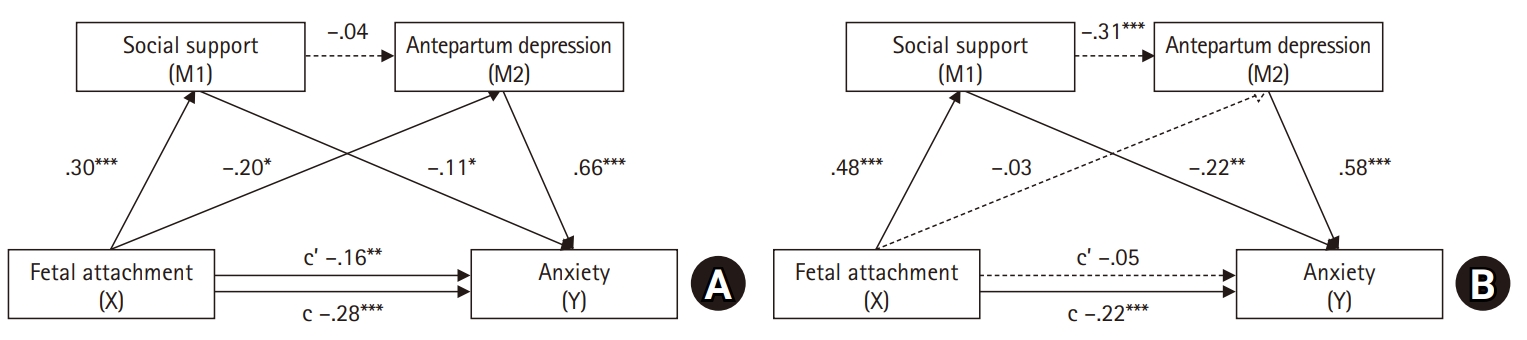
This study examined the direct effects of fetal attachment, social support, and antepartum depression on anxiety in pregnant women with high-risk pregnancy-related conditions and their husbands. Furthermore, it aimed to explore the serial mediation effects of social support and antepartum depression in the relationship between fetal attachment and anxiety.
Methods
A survey-based study was conducted among pregnant women diagnosed with high-risk pregnancy conditions at 24–32 weeks and their husbands, recruited from a pregnant women’s online community between January 20, 2021 and July 20, 2022. Data were collected from 294 individuals (147 couples) using self-report questionnaires. Correlations between variables were analyzed using the IBM SPSS software ver. 26.0 (IBM Corp.), and the mediation effects were assessed using the PROCESS macro, model 6.
Results
In the maternal model, maternal-fetal attachment directly affected anxiety (p=.005), with antepartum depression partially mediating this relationship (95% confidence interval [CI], –0.26 to –0.01). In the paternal model, paternal-fetal attachment had no direct effect on anxiety (p=.458). However, social support and antepartum depression fully mediated the relationship between paternal-fetal attachment and anxiety (95% CI, –0.14 to –0.03).
Conclusion
The findings indicate that social support in the relationship between fetal attachment and depression in high-risk pregnant women and their partners can have direct or indirect effects on the negative emotions of high-risk pregnant couples. It is necessary to assess the level of anxiety in couples experiencing high-risk pregnancies and provide comprehensive nursing interventions that address fetal attachment, social support, and antepartum depression in order to reduce anxiety.
- 4,621 View
- 315 Download
 First
 Prev



