
 Submit an article

Search
- Page Path
- HOME > Search
Research Papers
- Successful aging among the elderly with mild cognitive impairment facing the crisis of old age: a grounded theory study
- Haeyun Shin, Suhye Kwon
- J Korean Acad Nurs 2025;55(2):301-316. Published online May 27, 2025
- DOI: https://doi.org/10.4040/jkan.24114
-
 Abstract
 PDF
PDF ePub
ePub - Purpose
The purpose of this study was to understand experiences of successful aging experience in older adults with mild cognitive impairment.
Methods
The participants were 15 older adults with mild cognitive impairment who had experienced successful aging. Data were collected from January to October 2021 through individual deep, unstructured interviews. Data analysis was performed using Charmaz’s grounded theory method. In addition, the consolidated criteria for reporting qualitative research checklist was used to ensure the quality of the study.
Results
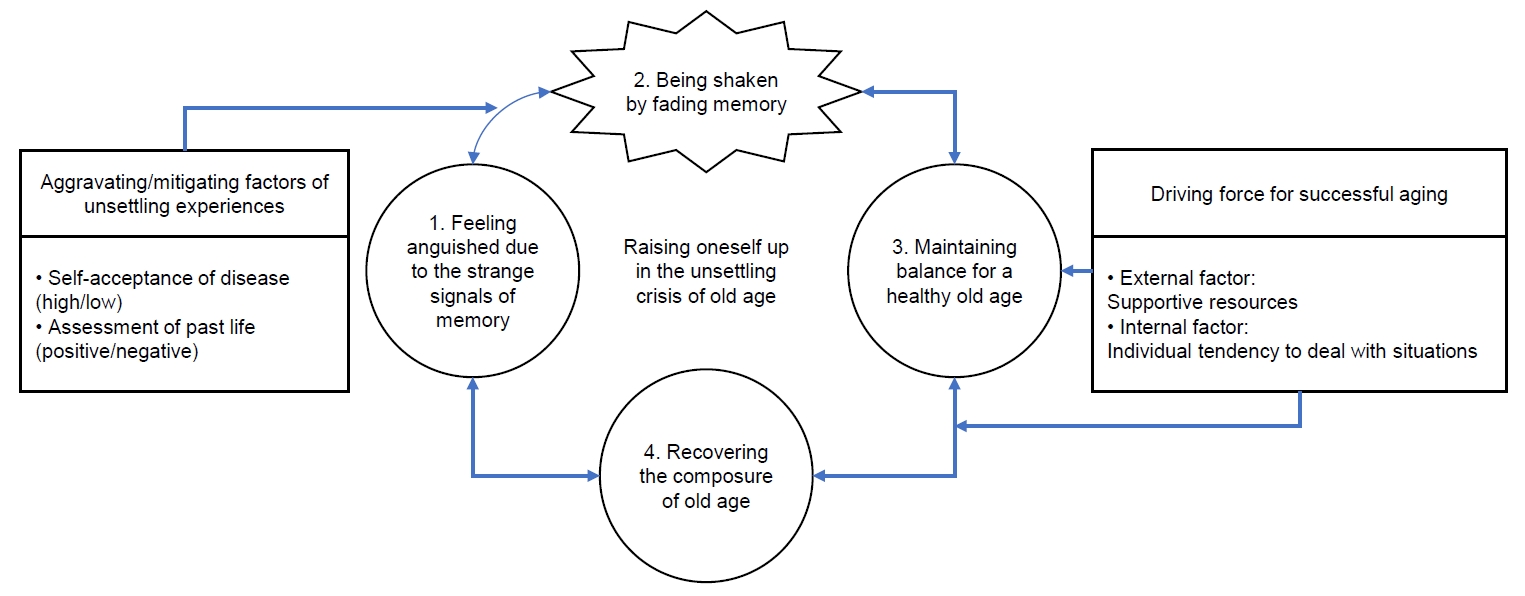
The key category representing experiences of successful aging experience in older adults with mild cognitive impairment was “raising oneself up in the unsettling crisis of old age.” Four stages were derived: “feeling anguished due to the strange signals of memory,” “being shaken by fading memory,” “maintaining balance for a healthy old age,” and “recovering the composure of old age.”
Conclusion
Participants tried to successfully achieve aging while implementing their own plans and strategies in the midst of the challenges of old age, when the mind and body were unsettled by mild cognitive impairment. The results of this study provide a deep understanding of experiences of successful aging in older adults with mild cognitive impairment, potentially contributing to the development and implement of nursing intervention programs to promote the successful pursuit of aging in this population.
- 3,337 View
- 165 Download

- Young Adult Donor’s Experiences of Living Donor Liver Transplantation
- Miseon Bang, Haeyun Shin, Min Ryu, Suhye Kwon
- J Korean Acad Nurs 2021;51(1):105-118. Published online February 28, 2021
- DOI: https://doi.org/10.4040/jkan.20235
-
Abstract
PDF
- Purpose
This study aimed to explore young adult donors’ experiences of living donor liver transplantation.
Methods
A phenomenological research method was used. The participants were two women and six men. Data were collected through individual in-depth interviews from November 25th, 2019 to June 10th, 2020 and analyzed using Colaizzi’s phenomenological method.
Results
Five theme clusters extracted from the young adult donors’ experiences were painful decision of a liver donation, the agony of both mind and body that overpowers youth, the bitter and bare face of reality that a young donor encounters, feeling the power of love that fills up the space of the organ removed, and liver donation becoming priming water for maturity.
Conclusion
The results of this study provide a deeper understanding of the lives of young adult donors who have experienced unexpected difficulties as well as self growth from the donation. It is expected that the results can be of use for developing and applying customized nursing interventions for management before and after liver donation among young adult donors. -
Citations
Citations to this article as recorded by
- Adaptation of living donors after liver transplantation in South Korea: an integrative review
Gyeong-Ju An
Journal of Korean Biological Nursing Science.2026; 28(2): 231. CrossRef - Giving as repaying: towards an embodied ethics of living donor liver transplantation
Ya-Ping Lin, Huei-Ya Chen
Medicine, Health Care and Philosophy.2025; 28(3): 517. CrossRef - Research Trends on Living Donors for Liver Transplantation: A Text Network Analysis and Topic Modeling
Seongmi Choi, Mihui Kim, Won Jin Seo
Journal of Korean Academy of Fundamentals of Nursing.2024; 31(2): 157. CrossRef - Living well or not? Quality of life of parental living liver donors: A cross‐sectional study
Xiaxin Wu, Jing Chen, Yaru Fan, Yuexian Shi, Wei Gao
Journal of Clinical Nursing.2023; 32(15-16): 5113. CrossRef - The Caring Experience of Family Caregivers for Patients of Living Donor Liver Transplantation from the Family Members
Miseon Bang, Suhye Kwon
Journal of Korean Academy of Nursing.2022; 52(4): 435. CrossRef - The life experiences of living liver donors: A qualitative meta‐synthesis
Hye‐Young Jang, Hyei Yeon Im, Hye Jin Nam
Research in Nursing & Health.2022; 45(6): 693. CrossRef
- Adaptation of living donors after liver transplantation in South Korea: an integrative review
- 2,778 View
- 26 Download
- 6 Web of Science
- 6 Crossref
 First
First Prev
Prev


