
 Submit an article

Search
- Page Path
- HOME > Search
Research Paper
- Effect of a continuous glucose monitoring-guided personalized lifestyle coaching intervention on glycemic outcomes and variability in patients with type 2 diabetes mellitus: a randomized controlled trial
- Youngran Yang, Youngmin Park, Heung Yong Jin
- J Korean Acad Nurs 2026;56(3):393-407. Published online August 12, 2026
- DOI: https://doi.org/10.4040/jkan.26036
-
 Abstract
 PDF
PDF ePub
ePub - Purpose
This study examined the effects of continuous glucose monitoring (CGM)-guided personalized lifestyle coaching on glycemic outcomes and glycemic variability in patients with type 2 diabetes mellitus (T2DM).
Methods
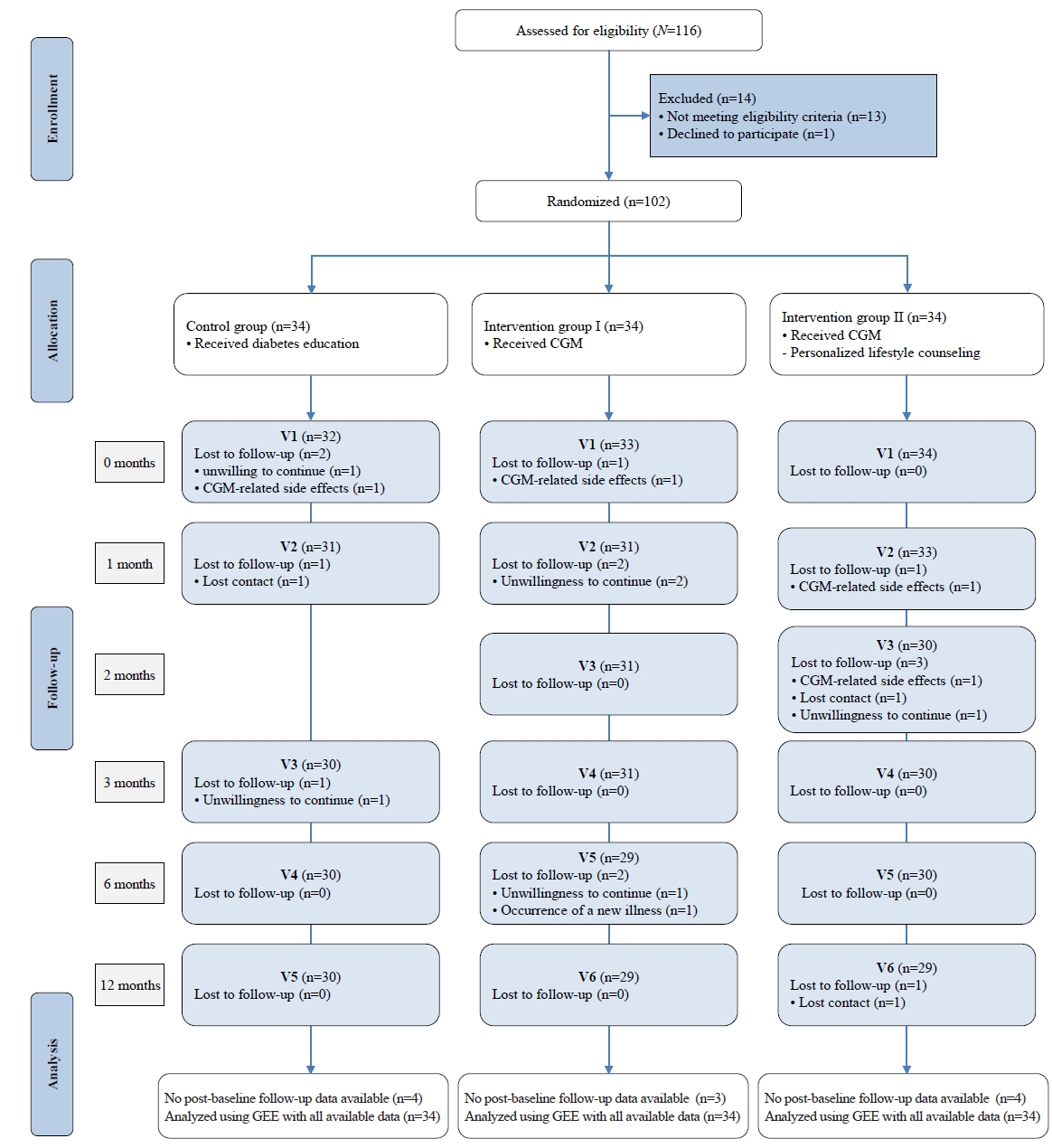
This three-arm randomized controlled trial was conducted in South Korea from June 2023 to November 2024. Participants were assigned to CGM alone (Intervention I, n=34), CGM-guided personalized lifestyle coaching (Intervention II, n=34), or standard diabetes education (control, n=34). The intervention lasted 3 months, with assessments at baseline and at 3, 6, and 12 months. Data were analyzed using generalized estimating equations.
Results
At 3 months, glycated hemoglobin (HbA1c) and fasting plasma glucose (FPG) levels were significantly lower in both intervention groups than in the control group. Compared with the control group, HbA1c was lower by 0.78 percentage points in Intervention I (p=.008) and by 1.12 percentage points in Intervention II (p<.001). At 3 months, FPG was lower than in the control group by 34.05 mg/dL in Intervention I (p=.001) and by 34.77 mg/dL in Intervention II (p<.001). At 6 months, TBR70 (time below range <70 mg/dL) was lower in Intervention I than in Intervention II (adjusted mean difference=–2.18, p=.010), whereas TAR180 (time above range >180 mg/dL) was lower in Intervention II than in the control group and Intervention I by 7.85 and 8.28 percentage points, respectively (both p=.004).
Conclusion
CGM-guided personalized lifestyle coaching improved glycemic control and reduced hyperglycemic exposure in patients with T2DM. Real-time glucose data may support individualized lifestyle counseling and sustained diabetes self-management. This study was retrospectively registered with the Clinical Research Information Service (CRIS) of the Republic of Korea (KCT0008872) on 16 October 2023.
- 1,183 View
- 92 Download

 First
First Prev
Prev


