
 Submit an article

Search
- Page Path
- HOME > Search
Research Paper
- Usefulness of Charlson comorbidity index-adjusted mortality prediction tools and factors influencing mortality in intensive care unit patients: a retrospective medical record review–based study
- Jai Jung Lee, Dong Yeon Kim, Min Ji Lee, Ji Young Kim
- J Korean Acad Nurs 2026;56(1):27-38. Published online February 11, 2026
- DOI: https://doi.org/10.4040/jkan.25094
-
 Abstract
 PDF
PDF ePub
ePub - Purpose
This study aimed to estimate the mortality rate in adult intensive care units (ICUs) using the Charlson comorbidity index (CCI)-adjusted Acute Physiology and Chronic Health Evaluation (APACHE) II and Simplified Acute Physiology Score (SAPS) III models, and to identify factors influencing mortality.
Methods
This retrospective cohort study included adult patients admitted to the ICU at a tertiary hospital between June 1 and August 31, 2022. Among the 1,098 screened patients, those younger than 18 years, those discharged within 48 hours, and those with missing medical records were excluded. In total, 482 patients were analyzed using the chi-square test, independent t-test, and multivariate logistic regression. Model performance was evaluated using the c-statistic and the Hosmer-Lemeshow goodness-of-fit test.
Results
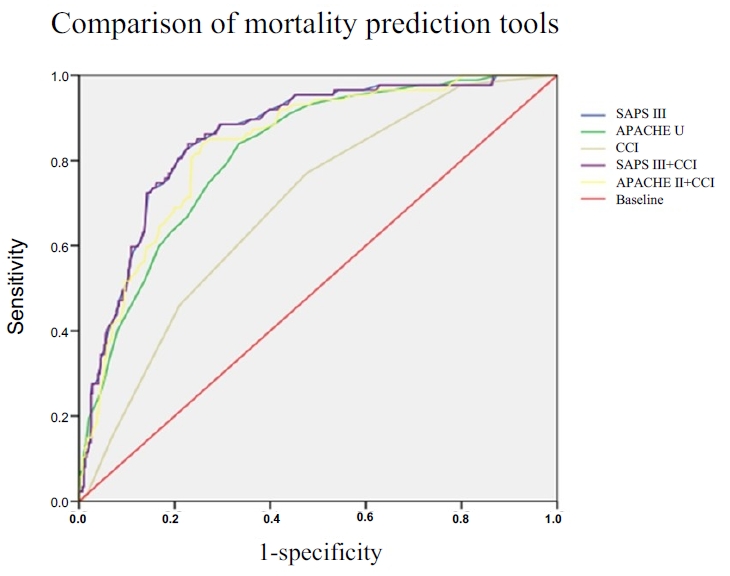
The predictive accuracy of the mortality models was shown by c-statistic values of 0.817 for APACHE II, 0.857 for SAPS III, 0.697 for CCI, and 0.834 for CCI-adjusted APACHE II (0.834). Mechanical ventilation, cardiopulmonary cerebral resuscitation, continuous renal replacement therapy, and the presence of leukemia or lymphoma were significant predictors of mortality in adult ICU patients. Among the evaluated models, SAPS III and CCI-adjusted APACHE II demonstrated the highest predictive power.
Conclusion
The findings indicate that incorporating comorbidity indices such as the CCI with acute physiological parameters improves the accuracy of mortality prediction in ICU patients. Understanding mortality prediction models is essential for nurses to provide individualized, evidence-based, and high-quality care in adult ICUs.
- 3,575 View
- 278 Download

Original Article
- Patient Severity Classification in a Medical ICU using APACHE III and Patient Severity Classification Tool
- Kyeong Ok Lee, Hyeon Ju Shin, Hyeoun Ae Park, Hyeon Myeong Jeong, Mi Hye Lee, Eun Ha Choi, Jeong Mi Lee, Yu Ja Kim, Yun Kyeong Sim, Kyi Ju Park
- Journal of Korean Academy of Nursing 2000;30(5):1243-1253. Published online March 29, 2017
- DOI: https://doi.org/10.4040/jkan.2000.30.5.1243
-
Abstract
PDF
The purpose of this study was to verify the validity of the Patient Severity Classification Tool by examining the correlations between the APACHE III and the Patient Severity Classification Tool and to propose admission criteria to the ICU. The instruments used for this study were the APACHE III developed by Knaus and thePatient Severity Classification Tool developed by Korean Clinical Nurses Association. Data was collected from the 156 Medical ICU patients during their first 24 hours of admission at the Seoul National University Hospital by three trained Medical ICU nurses from April 20 to August 31 1999. Data were analyzed using the frequency, X2, Wilcoxon rank sum test, and Spearman rho. There was statistically significant correlations between the scores of the APACHE III and the Patient Severity Classification Tool. Mortality rate was increased as patients classification of severity in both the APACHE III and the Patient Severity Classification Tool scored higher. The Patient Severity Classification Tool was proved to be a valid and reliable tool, and a useful tool as one of the severity predicting factors, ICU admission criteria, information sharing between ICUs, quality evaluations of ICUs, and ICU nurse staffing. 1) This paper was awarded the first prize at the Seoul National Hospital Nursing Department Research Contest.
-
Citations
Citations to this article as recorded by
- Development of a patient classification system for critical care nursing based on nursing intensity
Yukyung Ko, Bohyun Park, Hanju Lee, Donghwan Kim
International Journal of Nursing Practice.2023;[Epub] CrossRef - Integrative literature review of patient classification tools for nursing intensity evaluation: Focusing on comparison of South Korean and international tools
Yukyung Ko, Bohyun Park
Nursing Open.2021; 8(5): 2105. CrossRef - Critical Patient Severity Classification System predicts outcomes in intensive care unit patients
Mona Choi, Hyeong Suk Lee
Nursing in Critical Care.2016; 21(4): 206. CrossRef - Understanding the Nature of Medication Errors in an ICU with a Computerized Physician Order Entry System
Insook Cho, Hyeok Park, Youn Jeong Choi, Mi Heui Hwang, David W. Bates, Jorge I.F. Salluh
PLoS ONE.2014; 9(12): e114243. CrossRef - Comparison of Related Characteristics between Unplanned and Planned Extubation of Patients in Medical Intensive Unit
Hyo Im Cho, Young Whee Lee, Hwa Soon Kim, Bo-Yun Sim
Korean Journal of Adult Nursing.2012; 24(5): 509. CrossRef - Predictive Effects of Previous Fall History on Accuracy of Fall Risk Assessment Tool in Acute Care Settings
Ihn Sook Park
Journal of Korean Academy of Fundamentals of Nursing.2012; 19(4): 444. CrossRef - Predictive Bayesian Network Model Using Electronic Patient Records for Prevention of Hospital-Acquired Pressure Ulcers
In Sook Cho, Eunja Chung
Journal of Korean Academy of Nursing.2011; 41(3): 423. CrossRef - Braden Scale: evaluation of clinical usefulness in an intensive care unit
InSook Cho, Maengseok Noh
Journal of Advanced Nursing.2010; 66(2): 293. CrossRef
- Development of a patient classification system for critical care nursing based on nursing intensity
- 1,429 View
- 3 Download
- 8 Crossref
 First
First Prev
Prev


