-
Psychological reactance to anti-smoking campaigns in designated smoking areas among female smokers in their 20s and 30s: a quasi-experimental study
-
Hyeonji Mun, Soontae An, Hyekyeong Kim
-
J Korean Acad Nurs 2026;56(3):294-305. Published online August 10, 2026
-
DOI: https://doi.org/10.4040/jkan.25177
-
-
 Abstract Abstract
 PDF PDF ePub ePub
- Purpose
This study aimed to determine whether placing anti-smoking campaign messages in designated smoking areas elicits psychological reactance among female smokers and to assess whether message framing (controlling vs. non-controlling) moderates the association between psychological reactance and intention to quit smoking.
Methods
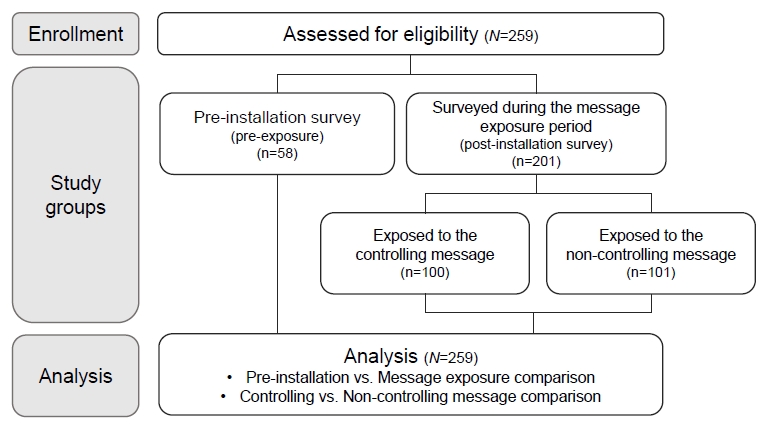
A quasi-experimental survey was conducted with 259 female smokers. Of these, 58 participants completed the survey before exposure to smoking-cessation messages, and 201 completed the survey after exposure. Among the exposed participants, 100 were assigned to the controlling condition and 101 to the non-controlling condition. Measures included psychological reactance, intention to quit smoking, trait reactance, smoking disclosure, and smoking-related covariates. Data were analyzed using analysis of covariance and Hayes’ PROCESS Model 1, with statistical significance set at p<.05.
Results
Smokers exposed to anti-smoking messages within designated smoking areas reported higher psychological reactance (mean±standard deviation: 2.10±0.94) than those not exposed (1.81±0.77), with a significant between-group difference (p=.017). Simple slope analysis revealed that psychological reactance was negatively associated with quit intention under controlling messages (B=–0.20, p=.031), but not under non-controlling messages (B=–0.05, p=.591).
Conclusion
Exposure to anti-smoking messages within designated smoking areas was associated with increased psychological reactance toward smoking cessation. In contrast, autonomy-supportive, non-controlling messages attenuated this effect. These findings suggest that smoking areas may serve as strategic behavioral intervention points when campaigns employ context-sensitive, autonomy-supportive message framing.
This study was registered with the Clinical Research Information Service (CRIS) of the Republic of Korea (KCT0012514) on 27 August 2026.
|

 Submit an article