-
Latent profile analysis of health and fatigue recovery among shift work nurses and differential associations with participation in a shift work improvement pilot project: a descriptive cross-sectional study
-
Eunhee Jung, Eunhye Kim, Suryang Seo, Sunyoung Lee, Sora An, Hyejin Kim, Ye Seul Kim, Youjin Kim, Mijeong Park, Hyoun-Joong Kong, Saram Lee, Yeong Joo Hong, Minho Jung
-
J Korean Acad Nurs 2026;56(3):358-369. Published online July 23, 2026
-
DOI: https://doi.org/10.4040/jkan.26006
-
-
 Abstract Abstract
 PDF PDF ePub ePub
- Purpose
This study aimed to identify latent profiles of shift-work nurses according to perceived health, fatigue, and recovery levels and to examine differences across profiles in work-related outcomes, including sleep quality, work-life balance, job satisfaction, and turnover intention. It also examined whether patterns associated with participation in a shift-work improvement pilot project differed by latent profile.
Methods
This descriptive cross-sectional study included 120 shift-work nurses working in pediatric wards at a tertiary hospital in South Korea. Data were collected from January 14 to 24, 2025. Latent profile analysis was performed using the 36-Item Short Form Health Survey and the Occupational Fatigue Exhaustion Recovery Scale. Differences in outcomes by latent profile membership and pilot-project participation status at the time of data collection were examined using two-way analysis of covariance, with age included as a covariate.
Results
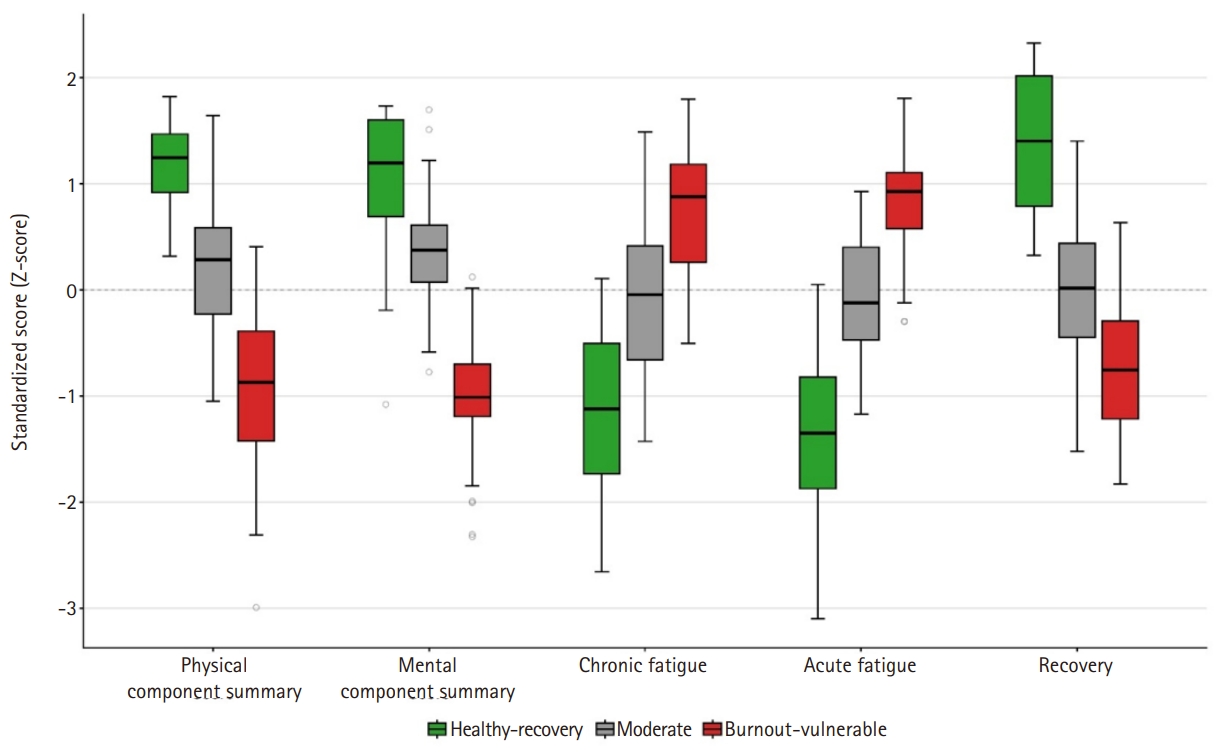
Three latent profiles were identified: Healthy-Recovery (20.8%), Moderate (41.7%), and Burnout-Vulnerable (37.5%). Significant differences among profiles were observed in sleep quality (F=37.37, p<.001), work-life balance (F=50.86, p<.001), job satisfaction (F=12.29, p<.001), and turnover intention (F=12.11, p<.001). A significant interaction between latent profile membership and pilot-project participation was observed for job satisfaction (F=4.77, p=.010, partial η²=.078). Pilot-project participation was associated with significantly higher job satisfaction only in the Healthy-Recovery profile (p=.005).
Conclusion
Associations between pilot-project participation and work-related outcomes differed according to nurses’ health, fatigue, and recovery profiles. These findings indicate that heterogeneity among shift-work nurses should be considered when interpreting work-related outcomes and designing tailored support strategies.
-
An Analysis of Tasks of Nurses Caring for Patients with COVID-19 in a Nationally-Designated Inpatient Treatment Unit
-
Minho Jung, Moon-Sook Kim, Joo-Yeon Lee, Kyung Yi Lee, Yeon-Hwan Park
-
J Korean Acad Nurs 2022;52(4):391-406. Published online August 31, 2022
-
DOI: https://doi.org/10.4040/jkan.22056
-
-
Abstract
PDF
- Purpose
The purpose of this study was to provide foundational knowledge on nursing tasks performed on patients with COVID-19 in a nationally-designated inpatient treatment unit.
Methods
This study employs both quantitative and qualitative approaches. The quantitative method investigated the content and frequency of nursing tasks for 460 patients (age ≥ 18y, 57.4% men) from January 20, 2020, to September 30, 2021, by analyzing hospital information system records. Qualitative data were collected via focus group interviews. The study involved interviews with three focus groups comprising 18 nurses overall to assess their experiences and perspectives on nursing care during the pandemic from February 3, 2022, to February 15, 2022. The data were examined with thematic analysis.
Results
Overall, 49 different areas of nursing tasks (n = 130,687) were identified based on the Korean Patient Classification System for nurses during the study period. Among the performed tasks, monitoring of oxygen saturation and measuring of vital signs were considered high-priority. From the focus group interview, three main themes and eleven sub-themes were generated. The three main themes are “Experiencing eventfulness in isolated settings,” “All-around player,” and “Reflections for solutions.” Conclusion: During the COVID-19 pandemic, it is imperative to ensure adequate staffing levels, compensation, and educational support for nurses. The study further propose improving guidelines for emerging infectious diseases and patient classification systems to improve the overall quality of patient care.
-
Citations
Citations to this article as recorded by  - Exploring Nursing Care for Patients With COVID-19 Using International Classification for Nursing Practice–Based Nursing Records
Sumi Sung, Hyesil Jung, Youlim Kim
CIN: Computers, Informatics, Nursing.2024; 42(2): 127. CrossRef - Burnout among Nurses in COVID-19 Designated Units Compared with Those in General Units Caring for Both COVID-19 and Non-COVID-19 Patients
Kyung Ah Woo, Eun Kyoung Yun, JiSun Choi, Hye Min Byun
Journal of Korean Academy of Nursing Administration.2023; 29(4): 374. CrossRef - A Systematic Review of the Functional Ingredients and Physiological Activities of Taraxacum coreanum Nakai
In-Seo Yoo, Ae-Jung Kim
Asian Journal of Beauty and Cosmetology.2023; 21(4): 719. CrossRef
-
3,242
View
-
37
Download
-
1
Web of Science
-
3
Crossref
-
Influence of Social Capital on Depression of Older Adults Living in Rural Area: A Cross-Sectional Study Using the 2019 Korea Community Health Survey
-
Minho Jung, Jinhyun Kim
-
J Korean Acad Nurs 2022;52(2):144-156. Published online April 30, 2022
-
DOI: https://doi.org/10.4040/jkan.21239
-
-
Abstract
PDF
- Purpose
This study aimed to investigate the influence of social capital on the depression of older adults living in rural areas.
Methods
Data sets were obtained from the 2019 Korea Community Health Survey. The participants were 39,390 older adults over 65 years old living in rural areas. Indicators of social capital included trust, reciprocity, network, and social participation. Depression—the dependent variable—was measured using the Patient Health Questionnaire-9 (PHQ-9). Hierarchical ordinal logistic regression was conducted to identify factors associated with depression after adjusting the data numbers to 102,601 by applying the Synthetic Minority Oversampling Technique (SMOTE).
Results
The independent variables—indicators of social capital—exhibited significant association with the depression of older adults. The odds ratios of depression were higher in groups without social capital variables.
Conclusion
To reduce depression, we recommend increasing social capital. Factors identified in this study need to be considered in older adult depression intervention programs and policies.
-
Citations
Citations to this article as recorded by - The Effects of Perceived Stress on Depression among Middle-aged Adults with Diabetes Mellitus in Korea: Exploring the Mediating Role of Social Capital through a Descriptive Correlational Study
Kyung Ae Kim, Mi Ran Bang
Korean Journal of Adult Nursing.2025; 37(1): 50. CrossRef - An Observational Study on the Association Between Nutritional Intake and Mental Health Among Older Adults in Rural Areas
Kyeongmin Jang
Nursing & Health Sciences.2025;[Epub] CrossRef - Modelo de regresión ordinal para pronóstico de la depresión en el adulto mayor peruano
Lilian Roxana Paredes López
UCV Hacer.2025; 14(2): 32. CrossRef - Moderating effects of social capital on the relationship between fear of falling and depressive symptoms among community-dwelling older adults
Yeong-Mi Seo, Eun Sook Lee
Archives of Public Health.2025;[Epub] CrossRef - Prediction model of weight control experience in men with obesity in their 30 s and 40 s using decision tree analysis
Myeunghee Han
Scientific Reports.2024;[Epub] CrossRef - The relationship between human capital and depression among middle-aged rural adults: The multiple-parallel mediating effects of social capital
Soo Mi Jang, Hyung Mi Ha
Korean Journal of Health Education and Promotion.2023; 40(1): 33. CrossRef
-
3,749
View
-
135
Download
-
4
Web of Science
-
6
Crossref
|

 Submit an article