
Skip Navigation
Skip to contents

J Korean Acad Nurs : Journal of Korean Academy of Nursing


Articles

Page Path
HOME > J Korean Acad Nurs > Ahead-of print articles > Article
Research Paper
Effects of a one-to-one midwife counseling intervention on fear of childbirth, childbirth readiness, and maternal birth outcomes: a nonrandomized study
Uri Bangorcid, Hyun Kyoung Kimorcid

DOI: https://doi.org/10.4040/jkan.26022
Published online: November 13, 2026

Department of Nursing, Nursing and Health College, Kongju National University, Gongju, South Korea

Corresponding author: Hyun Kyoung Kim Department of Nursing, Nursing and Health College, Kongju National University, Kongjudaehak-Ro 56, Gongju 32588, South Korea E-mail: hkk@kongju.ac.kr
• Received: February 12, 2026   • Revised: April 18, 2026   • Accepted: October 21, 2026

© 2026 Korean Society of Nursing Science

This is an Open Access article distributed under the terms of the Creative Commons Attribution NoDerivs License (http://creativecommons.org/licenses/by-nd/4.0) If the original work is properly cited and retained without any modification or reproduction, it can be used and re-distributed in any format and medium.

  • 92 Views
  • 0 Download
  • Purpose
    This study examined the effects of one-to-one midwife-led counseling on fear of childbirth, childbirth readiness, and maternal birth outcomes.
  • Methods
    A quasi-experimental, nonequivalent control-group pretest–posttest design was used to evaluate the intervention. A total of 54 pregnant women were allocated to the two groups, and 52 were included in the final analysis. Between August 2024 and August 2025, 52 pregnant women were recruited from a birth center and a public health center in South Korea. The experimental group (n=25) received four individualized midwife-led counseling sessions, and the control group (n=27) attended routine childbirth education. Outcomes were compared between groups using analysis of covariance (ANCOVA) and the chi-square test.
  • Results
    After adjustment for baseline childbirth readiness, ANCOVA showed a significant group effect on fear of childbirth (F=18.14, p<.001, partial η2=.29). The adjusted posttest mean score on the Wijma Delivery Expectancy/Experience Questionnaire, version A, was significantly lower in the experimental group than in the control group. Childbirth readiness did not differ significantly between groups (F=1.04, p=.314). The experimental group had a significantly lower cesarean section rate (4.0% vs. 48.2%) and less frequent use of epidural analgesia, together with higher rates of rooming-in and breastfeeding (all p<.05).
  • Conclusion
    One-to-one midwife-led counseling is associated with lower fear of childbirth and with selected maternal birth outcomes. These findings suggest that individualized midwife counseling may be considered as part of antenatal care to support positive birth experiences. The study was registered with the Clinical Research Information Service, Republic of Korea (registration number: KCT0007006).
Pregnancy and childbirth are major life events for women and their families; however, many expectant mothers experience fear related to labor and delivery [1]. Severe fear of childbirth, also referred to as tokophobia, can compromise maternal psychological well-being and adversely influence the birth process as well as postpartum adaptation, with negative consequences for the mother, partner, and infant [2]. Globally, the prevalence of fear of childbirth is high and continues to increase. For example, approximately 30% of pregnant women in Australia and Sweden report fear of childbirth, and 5% to 20% of these cases are considered clinically severe [3]. In Iran, one study found that 62.6% of primiparas preferred cesarean section, and nearly half of them reported experiencing severe fear of childbirth [4]. Such fear directly influences preferences regarding delivery mode, with women reporting higher levels of fear being more likely to request cesarean section [5]. Accordingly, fear of childbirth is increasingly recognized as a major contributor to rising rates of non-medically indicated cesarean section. Reducing fear of childbirth has therefore emerged as an important public health priority for lowering unnecessary cesarean section rates and improving maternal and neonatal health outcomes [6].
In South Korea, the cesarean section rate increased sharply in the early 2000s, reaching nearly 40% alongside improvements in socioeconomic and medical conditions [7]. Although a temporary decline was observed thereafter, the rate rose again during the 2010s, reaching 38.7% in 2014 and escalating to 66.9% in 2024 [8]. The American College of Obstetricians and Gynecologists (ACOG) [9] recommends that when a maternal request for cesarean section is primarily driven by fear of childbirth, healthcare providers should first offer adequate information regarding pain relief options and emotional support during labor, and engage in careful discussion of risks and benefits before proceeding with surgery. This guidance underscores that fear of childbirth is not merely an individual emotional response, but a clinically relevant factor that influences decision-making and health outcomes. In addition, negative emotional experiences surrounding childbirth can reduce women’s preparedness and confidence, thereby weakening their coping capacity during labor and adversely affecting postpartum mental health [10]. These findings highlight the need for timely and appropriate interventions. Anxiety and fear have been identified as the most influential psychological factors contributing to low childbirth confidence, and Lee [10] emphasized the importance of developing nursing interventions aimed at alleviating anxiety and strengthening support systems for pregnant women.
In addition to these challenges, Korea is experiencing a persistently low birth rate, accompanied by a decline in the maternity care workforce, including a reduction in the number of practicing midwives. Structural limitations in midwifery education and training systems have further constrained workforce development, raising concerns about the sustainability of maternal care services [11]. Nevertheless, midwives provide differentiated care by offering continuous, woman-centered support tailored to individual needs and preferences throughout pregnancy and childbirth [12]. This individualized and relational approach distinguishes midwifery care from standardized hospital-based models and aligns with the growing emphasis on respectful maternity care. In this context, midwife-led counseling may represent a meaningful strategy for addressing fear of childbirth by providing both emotional support and personalized care [12].
From a theoretical perspective, the Theory of Human Caring by Watson [13] offers a relevant framework for understanding and addressing fear of childbirth. Watson conceptualizes caring as a transpersonal and relational process grounded in humanistic values, empathy, trust, and the promotion of hope through authentic nurse–client relationships. The Caritas Processes emphasize the establishment of trusting caring relationships, the acceptance and validation of both positive and negative emotions, the fostering of faith and hope, and the creation of a healing environment that supports psychological, emotional, and spiritual well-being [13]. When applied to the context of childbirth, this theoretical perspective suggests that fear may be alleviated not only through the provision of information, but also through caring interactions that empower women to regain confidence in the birth process.
One-to-one counseling by midwives has emerged as a promising approach for alleviating fear of childbirth while enhancing maternal self-efficacy and preparedness. Several studies have recommended non-medical interventions, including childbirth education and psychosocial counseling during antenatal visits, as effective strategies for reducing maternal anxiety and promoting positive birth experiences [6,10,14]. A growing body of evidence indicates that midwife-led counseling improves maternal childbirth self-efficacy and reduces postpartum depressive symptoms [14,15]. Furthermore, the impact of midwife-led interventions extends to birth outcomes. Fenwick et al. [14] demonstrated that women who participated in the BELIEF program, a midwife-led intervention designed to reduce childbirth fear, achieved higher rates of spontaneous vaginal delivery and showed improvements in postpartum mental health outcomes, including reduced depression and posttraumatic stress symptoms. Similarly, Andaroon et al. [15] reported that a three-session individual counseling program for primiparas resulted in significantly lower fear of birth in the intervention group, along with substantially higher rates of vaginal birth compared with the control group. Taken together, these findings suggest that midwife counseling not only improves psychological outcomes for pregnant women but also produces measurable effects on delivery patterns.
The limited and declining midwifery workforce in South Korea and the scarcity of midwife-led antenatal programs have restricted the implementation of counseling interventions [11]. Consequently, evidence regarding the effectiveness of one-to-one midwife-led counseling remains insufficient, highlighting the need for further research in the South Korean context. The present study aims to develop a structured midwife counseling intervention and to comprehensively evaluate its effects on fear of childbirth, childbirth readiness, and maternal birth outcomes, guided by the Theory of Human Caring by Watson [13]. By establishing evidence-based midwife-led strategies, this study seeks to promote positive perceptions of childbirth among pregnant women and to contribute to the advancement of maternal health.
1. Study design
This study employed a quasi-experimental design to examine the effects of one-to-one midwife-led counseling on fear of childbirth among pregnant women, using a nonequivalent control-group pretest–posttest design, and was reported in accordance with the TREND checklist for nonrandomized trials [16]. The hypotheses of this study were as follows:
Hypothesis 1. The experimental group that participated in the one-to-one midwife counseling intervention will report lower fear of childbirth than the control group.
Hypothesis 2. The experimental group that participated in the one-to-one midwife counseling intervention will demonstrate higher childbirth readiness than the control group.
Hypothesis 3. The experimental group that participated in the one-to-one midwife counseling intervention will demonstrate more favorable maternal birth outcomes (birth type, oxytocin use, epidural analgesia, gestational age at birth, length of labor, reason for admission, rooming-in, and breastfeeding) than the control group.
2. Participants
Participants were pregnant women recruited between August 1, 2024, and August 31, 2025, from a birth center in Seoul and a public health center in Gongju, South Korea, using convenience sampling. The inclusion criteria were as follows: women enrolled before 28 weeks of gestation; women carrying fetuses without congenital anomalies; women without pregnancy-related complications such as gestational hypertension, threatened abortion, or risk of preterm birth; women without underlying conditions such as diabetes, renal disease, or liver disease; women not currently receiving medical or surgical treatment; and women who understood the purpose of the study and provided informed consent.
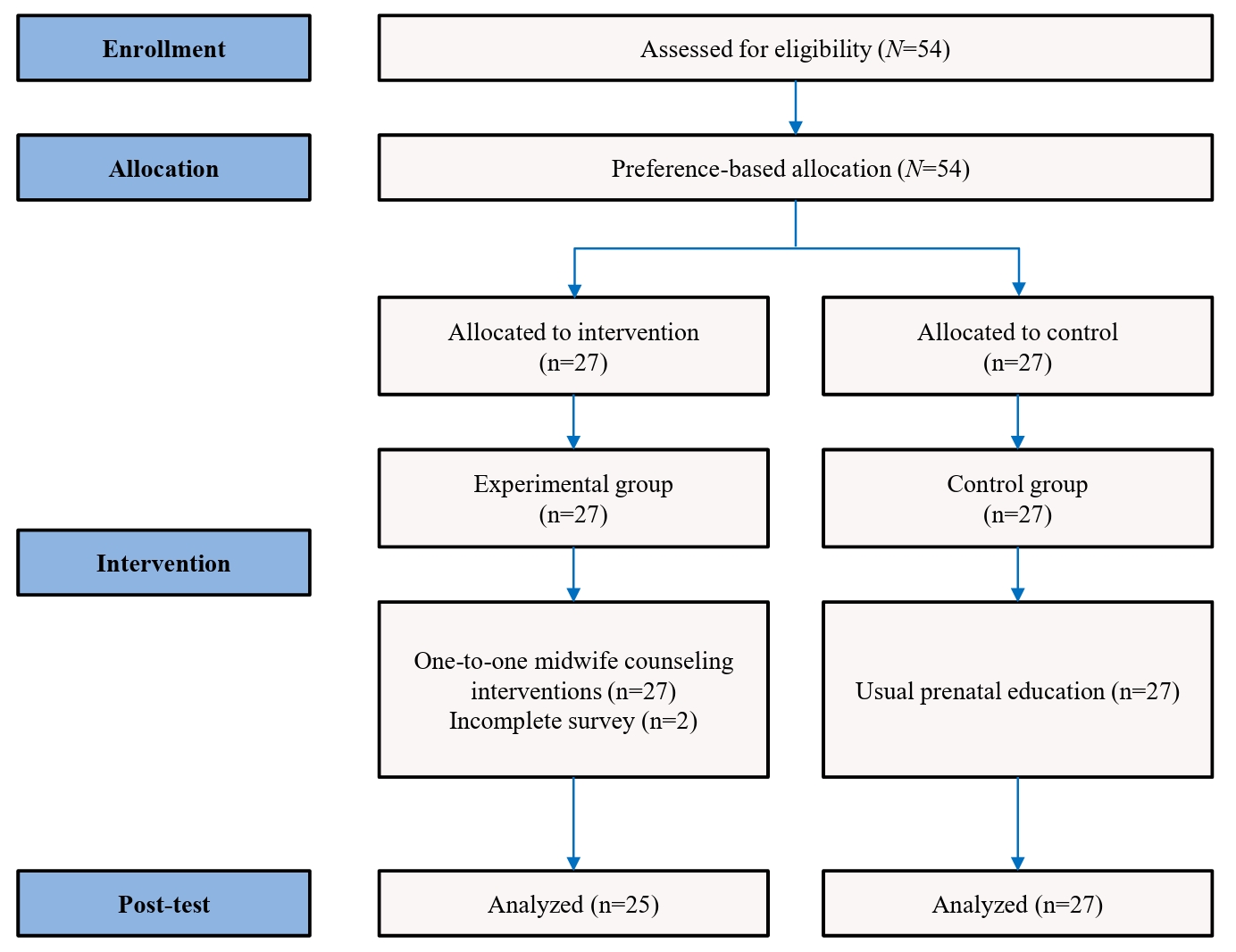
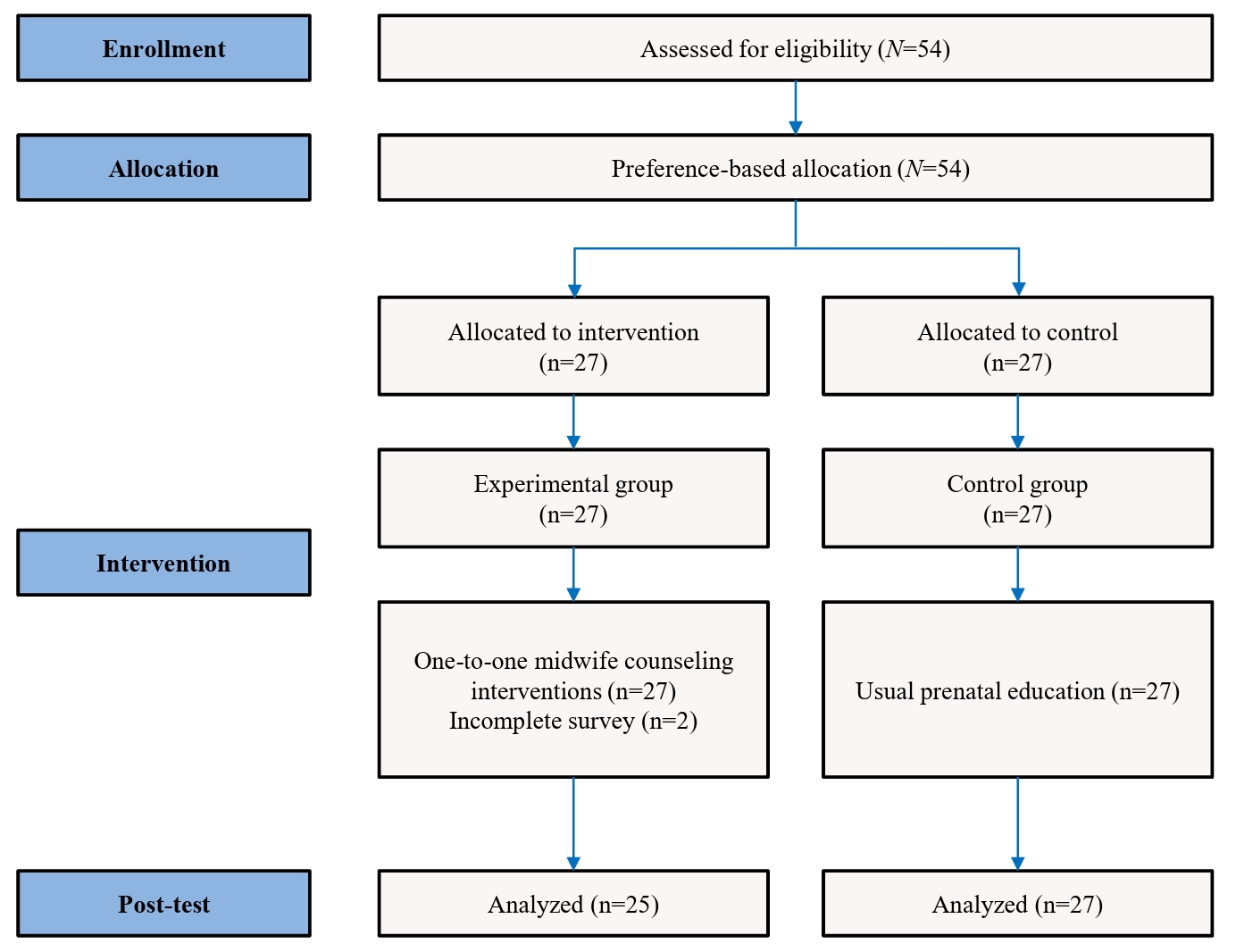
A total of 54 pregnant women were allocated to the two groups, and 52 were included in the final analysis. A total of 52 women participated in the study, with 27 assigned to the experimental group receiving one-to-one midwife-led counseling and 27 assigned to the control group participating in routine childbirth education at the public health center. Sample size estimation was performed using G*Power ver. 3.1 (Heinrich-Heine-Universität Düsseldorf) [17]. Based on a large effect size (Cohen’s d≈1.02) reported in an advanced midwife intervention study [12], an independent two-tailed t-test with an assumed effect size of d=1.02, a significance level of α=.05, and statistical power of 0.90 indicated that a minimum of 22 participants per group was required, yielding a total sample size of 44. Considering an anticipated dropout rate of 20%, 27 participants (rounded up from 26.4) per group were recruited through convenience sampling (Figure 1).
3. Intervention
The intervention was delivered by a certified midwife with expertise in women’s health and antenatal education. Prior to implementation, three women’s health experts (one maternal and child health team leader at a public health center and two professors specializing in women’s health nursing) reviewed the counseling materials to ensure content validity. Counseling themes were derived from a systematic literature review addressing fear of childbirth, and a draft curriculum was subsequently developed. Content validity was assessed using a 5-point Likert scale, and items achieving a content validity index (CVI) of ≥0.78 were retained and further refined based on expert feedback [18].
Participants in the experimental group received individualized one-to-one counseling delivered by the midwife. The program consisted of four sessions totaling 8 hours, including one online session conducted via Zoom (120 minutes) (Zoom Video Communications Inc.) and three face-to-face sessions (each lasting 120 minutes). The framework of the program was Watson’s Caritas 10 Processes [19]. Session 1 addressed the meaning of natural childbirth (Embrace) and the natural birth environment (Inspire). Session 2 focused on prenatal health management (Trust), prenatal education (Nurture), and lifestyle counseling (Forgive). Session 3 included birth rehearsal (Deepen), birth preparation (Balance). Session 4 addressed parental roles (Co-create) and newborn care (Minister). Each session incorporated interactive question-and-answer components, and participants were additionally provided with access to 24-hour telephone consultation (Open) throughout pregnancy (Table 1).
In contrast, the control group attended routine childbirth education provided by the public health center, which represents standard antenatal care in South Korea. This program consisted of four face-to-face group sessions, each lasting 120 minutes for a total of 8 hours, and addressed pregnancy management, breastfeeding, postpartum care, and newborn care. Routine childbirth education was selected as the comparator because it reflects current standard educational practice available to pregnant women in public health centers, thereby allowing evaluation of whether individualized midwife-led counseling provides added benefits. To maintain intervention fidelity, standardized counseling materials were developed and validated in advance. The same midwife delivered all counseling sessions to ensure consistency, and participants were expected to complete all four sessions unless they withdrew from the study.
4. Measurements

1) Fear of childbirth

Fear of childbirth was assessed using the Wijma Delivery Expectancy/Experience Questionnaire, version A (W-DEQ-A) [20]. The instrument consists of 33 items rated on a 6-point Likert scale ranging from 0 (“not at all”) to 5 (“extremely”), with higher scores indicating greater levels of childbirth fear. The original version demonstrated high internal consistency (Cronbach’s α=.89), and the Korean version also showed satisfactory reliability (Cronbach’s α=.89) [21]. In the present study, the internal consistency reliability of the W-DEQ-A was shown by a Cronbach’s α of .87.

2) Childbirth readiness

Childbirth readiness was measured using the Childbirth Readiness Scale (CRS) [22]. The CRS is an 18-item instrument rated on a 5-point Likert scale and comprises four subdomains: self-management (four items), information utilization (six items), childbirth confidence (four items), and childbirth planning (four items). Higher scores indicate greater childbirth readiness. The original scale demonstrated split-half reliability, with Cronbach’s α values of .94 and .88. In the Korean version [23] and in the present study, internal consistency reliability coefficients were Cronbach’s α=.86 and .83, respectively.

3) Maternal birth outcomes

Maternal birth outcomes were collected using postpartum surveys and medical records. Key variables included birth type (vaginal/cesarean), oxytocin use (yes/no), epidural analgesia (yes/no), gestational age at birth (week), length of labor (time from admission to birth), reason for admission (open-ended response), rooming-in (yes/no), and breastfeeding (formula/breastfeeding/mixed). Categorical variables were treated as nominal, and continuous variables were summarized using means and standard deviations (SDs).
5. Data collection
Participants were allocated using a nonrandomized, preference-based method. Pregnant women registered for the childbirth class who expressed interest in the one-to-one midwife counseling program were sequentially assigned to the intervention group, whereas those who declined participation in the counseling program were allocated to the standard childbirth education group. Allocation proceeded sequentially according to program registration order until the target sample size was reached.
An online baseline survey was administered to participants in both groups at or before 28 weeks of gestation. Follow-up data were collected at two time points: the first through an online survey conducted between 37 and 40 weeks of gestation, and the second within 4 weeks postpartum. All surveys were distributed via Google Forms (Google LLC), with an average completion time of approximately 10 to 15 minutes. Prior to survey participation, the researcher provided a detailed explanation of the study purpose and procedures, and written informed consent was obtained from all participants.
The data analyst remained blinded to group allocation throughout the analysis process, as the dataset was de-identified and group assignments were coded to obscure intervention status. To ensure blinding, participants were assigned identification codes at baseline, enabling data collection without personal identifiers. During follow-up, research assistants matched participant responses using these codes within Google Forms, and the analyst conducted outcome analyses while blinded to baseline participant characteristics. These procedures ensured implementation of a single-blind study design.
6. Ethical considerations
This study was approved by the Institutional Review Board of Kongju National University (KNU-IRB-2024-079). All participants received a full explanation of the study procedures and provided written informed consent prior to participation. Personal information was anonymized for analysis, and to ensure ethical equity, the same one-to-one counseling intervention was offered to the control group after study completion.
7. Data analysis
Data were analyzed using IBM SPSS ver. 27.0 (IBM Corp.). Descriptive statistics, including frequencies, percentages, means, and SDs, were used to summarize participants’ general characteristics. Group homogeneity was assessed using the independent t-test, chi-square test, and Fisher’s exact test. Fear of childbirth and childbirth readiness were analyzed using t-test and ANCOVA was additionally performed to adjust for baseline childbirth readiness score. Birth outcome variables were analyzed using the chi-square test and Fisher’s exact test for categorical data. Length of labor was analyzed using the Mann-Whitney U test.
1. Homogeneity between two groups
The mean age of participants was 33.9 years (SD=3.95), and the mean gestational age was 25.94 weeks (SD=1.77). At baseline, the mean score for W-DEQ-A was 63.46 (SD=20.84), and the mean score for CRS was 71.23 (SD=8.60). Homogeneity testing indicated no significant difference in mean age between the control group and the experimental group (p=.538). Baseline W-DEQ-A scores were also comparable between the control group (65.19, SD=18.69) and the experimental group (61.60, SD=23.17; p=.541). In contrast, baseline CRS scores were significantly higher in the control group (74.07, SD=9.24) than in the experimental group (68.16, SD=6.78; t=2.61, p=.012). Accordingly, baseline CRS was included as a covariate in subsequent analyses examining effects on W-DEQ-A and CRS (Table 2).
2. Effect on fear of childbirth
Prior to conducting ANCOVA, the underlying statistical assumptions were examined. The Shapiro-Wilk test confirmed normality of the dependent variables within each group (all p>.05). Levene’s test for equality of variances indicated no significant difference between groups (F=2.86, p=.097), supporting the assumption of homogeneity of variances. Scatterplots and correlation analyses confirmed a linear relationship between the covariate (baseline CRS) and the dependent variable. In addition, the homogeneity of regression slopes assumption was satisfied, as the interaction between group and the covariate was not statistically significant (all p>.05). Based on these findings, ANCOVA was deemed appropriate for further analyses. The ANCOVA for W-DEQ-A, controlling for baseline CRS, demonstrated a significant group effect (F=18.14, p<.001, partial η2=.29). The adjusted posttest mean score in the experimental group (37.49, standard error [SE]=4.03) was significantly lower than that in the control group (62.03, SE=3.87) (Table 3).
3. Effect on childbirth readiness
The ANCOVA for CRS, controlling for baseline CRS scores, revealed no significant group effect (F=1.04, p=.314, partial η2=.03). The adjusted posttest mean score of the experimental group (76.61, SE=2.40) did not differ significantly from that of the control group (71.51, SE=2.30) (Table 3).
4. Effect on maternal birth outcomes
In comparisons of maternal birth outcomes, the cesarean section rate was significantly lower in the experimental group (4.0%) than in the control group (48.2%) (p<.001). Oxytocin use was not significantly different between the experimental group (4.0%) and the control group (25.9%) (p=.051). Epidural analgesia use was significantly higher in the control group (63.0%) than in the experimental group (0.0%) (p<.001). Gestational age at birth was higher in the experimental group than in the control group (p=.016). No significant difference was found in the length of labor between the groups (p=.166). The reason for admissions differed significantly between groups (p<.001). Cesarean section was the most common reason in the control group (48.2%), whereas labor pain predominated in the experimental group (72.0%). Rooming-in was implemented for all participants in the experimental group (100.0%), whereas it was practiced in 59.3% of the control group (p<.001). Breastfeeding also differed significantly between groups (p=.023). Mixed feeding (76.0%) was more common in the experimental group, whereas formula feeding (18.5%) was reported only in the control group (Table 4).
This study suggests that one-to-one counseling led by midwives was associated with lower fear of childbirth and favorable delivery outcomes among pregnant women. These findings indicate that individualized counseling may be related to psychological stability and birth outcomes. From the perspective of Watson’s theory, these effects can be interpreted as arising from caring relationships that foster trust, emotional safety, and women’s confidence in their own childbirth capabilities [24].
The results support prior evidence indicating that fear of childbirth is negatively associated with obstetric outcomes and postpartum mental health. Fear of childbirth has been associated with an increased risk of cesarean section [25] and may also be linked to postpartum posttraumatic stress symptoms and difficulties in maternal role adaptation [2]. In Korea, the cesarean section rate remains among the highest in Organization for Economic Cooperation and Development countries [8,26], with maternal fear of vaginal birth frequently cited as a major contributing factor [7]. In this context, the lower cesarean section rate observed in the experimental group could have potential clinical implications. The Watson’s theory [13] emphasizes the acceptance of negative emotions and the cultivation of hope through authentic midwife–woman relationships, suggesting that addressing fear through caring interactions may translate into more positive clinical decision-making and birth outcomes [27].
The findings are consistent with previous research suggesting that midwife-led psychoeducational interventions are associated with lower fear of childbirth. Fenwick et al. [14] reported that psychosocial interventions delivered by midwives reduced fear of childbirth and improved maternal well-being, while Abadi Marzoni et al. [28] reported that midwife-led psychoeducation significantly reduced fear among primiparas. Firouzan et al. [29] showed that counseling based on the gamble approach enhanced childbirth self-efficacy, and Firouzbakht et al. [5] found that antenatal education effectively alleviated maternal anxiety and pain. In line with these international findings, the present study further suggests that midwife-led counseling is associated not only with psychological improvements but also with clinical indicators, including reduced cesarean section and epidural analgesia use. These results are congruent with Watson’s theory [13], which emphasizes the integration of scientific knowledge with empathy, presence, and individualized care in clinical practice. This study has important implications for improving childbirth experiences among Korean women. Childbirth in Korea is often perceived as highly medicalized and intervention-intensive, and women describe such experiences as traumatic [30]. Compared with women in Australia and Sweden, Korean women report higher levels of fear of childbirth [3,31], which may contribute to avoidance of subsequent pregnancies and negative maternal experiences.
No significant difference in childbirth readiness was observed between the experimental and control groups. Women who voluntarily selected one-to-one midwife-led care may have differed systematically from those in the control group. Such individuals may have been more likely to engage in proactive health behaviors, actively seek information, and acquire childbirth-related knowledge from multiple sources. Furthermore, childbirth readiness is not a unidimensional construct but a multidimensional concept encompassing self-management, information utilization, childbirth confidence, and childbirth planning, and it reflects women’s physical, cognitive, and psychological preparedness for childbirth [22]. Previous studies have shown that women with higher childbirth readiness tend to have greater self-efficacy, higher eHealth literacy, and lower fear of childbirth [32]. Taken together, the absence of a significant improvement in this study may be attributable both to the high baseline readiness of participants and to the inherently complex, multifaceted nature of childbirth readiness.
Significant between-group differences were also observed in birth outcomes. Women in the experimental group had lower cesarean section rates, were less likely to receive epidural analgesia, and had higher rates of rooming-in and breastfeeding. The lower cesarean section rate is particularly meaningful in the context of the persistently high cesarean section rate in South Korea and may be explained by reduced fear of childbirth and greater confidence in vaginal birth following midwife-led counseling. Cesarean section was also performed due to maternal and obstetric conditions such as previous cesarean section, advanced maternal age, myoma, hypertension, hemorrhoids, and prior pelvic surgery, highlighting the need to incorporate these factors into antenatal education to support informed decision-making. These findings are consistent with previous evidence that midwifery-led care is associated with lower cesarean section rates, particularly among low-risk women [33], supporting the view that continuous, woman-centered care promotes physiological birth while reducing unnecessary medical interventions.
The higher rate of rooming-in in the intervention group may be partly attributable to the lower cesarean section rate, as surgical delivery is often associated with postoperative pain, delayed recovery, and limited maternal mobility, all of which can delay early mother–infant contact. In addition, consistent with Watson’s theory [13], midwives play a proactive role in supporting physiological birth through antenatal education and counseling and in encouraging rooming-in and breastfeeding, even among women who undergo cesarean birth. Because rooming-in facilitates maternal–infant bonding and supports breastfeeding initiation, this finding suggests that midwife-led counseling may enhance early postpartum adaptation by improving mother–infant proximity. The higher breastfeeding rate further supports this interpretation and suggests that midwife-led counseling may have provided both practical guidance and emotional support for early postpartum adjustment [12].
These findings are also consistent with international recommendations emphasizing the minimization of unnecessary medical interventions and the promotion of woman-centered care [9,34]. Furthermore, they reflect Watson’s theory [13], which emphasizes the creation of a caring-healing environment and the development of authentic caring relationships. These practices support holistic postpartum recovery by promoting mother–infant bonding and addressing women's physcial and emotional needs [19].
Several limitations of this study should be acknowledged. First, the relatively small sample size limits the generalizability of the findings. Small samples increase the risk of underestimating or overestimating true effects due to limited statistical power [17]. Second, the nonrandomized, preference-based design, along with differences in recruitment sites and childbirth environments, limits causal interpretation of the findings. In addition, participants’ pre-existing delivery preferences and differences in access to epidural analgesia and medical interventions may have influenced the observed outcomes. Many women in the experimental group had a strong preference for vaginal birth and high motivation for counseling, suggesting potential selection bias [6,28]. Furthermore, the intervention was not limited to one-to-one counseling; the experimental group also received continuous 24-hour telephone support, whereas the control group participated in group-based education. These differences should be considered when interpreting the findings. Future research should include more diverse populations to examine whether the observed associations are consistent across different childbirth preferences, motivations, and clinical contexts.
Finally, this study has important policy implications. Korea currently faces the dual challenge of a persistently low birth rate and high cesarean section rates, alongside a declining pool of maternity care professionals [8,11,26]. Hwang [35] emphasized the need to institutionalize maternal health promotion programs, and the present findings provide empirical support for strengthening such system-level efforts. From a policy perspective, these findings suggest two key directions. First, there is a need to expand the availability of trained midwives capable of providing continuous, individualized care. The maternity care system faces structural challenges, and strengthening midwifery education and training has been emphasized [11]. Second, the professional role of midwives should be expanded beyond delivery assistance to include structured antenatal counseling, psychosocial support, and continuity-of-care models. This requires supportive legal and institutional frameworks that allow midwives to practice to their full scope of competencies [11]. This study supports the integration of midwife-led counseling programs into Korea’s public health system and highlights the importance of strengthening both human resource capacity and professional role expansion through education and policy reform to improve maternal and neonatal health outcomes.
This study suggests that one-to-one midwife-led counseling was related to differences in fear of childbirth and selected birth outcomes. Women who received counseling demonstrated lower fear levels and lower rates of cesarean section and epidural analgesia use compared with women in the control group. These findings suggest that midwife-led counseling was associated with differences in both psychological outcomes and clinically relevant aspects of childbirth. Although the study is limited by a small, self-selected sample and participants’ strong motivation for vaginal birth, it provides preliminary evidence of such associations. Larger-scale studies involving more diverse populations are warranted to confirm these findings. Nevertheless, in the context of Korea’s high cesarean section rate and low fertility rate, the findings indicate a relationship between midwife-led counseling, positive childbirth experiences, and selected birth outcomes. Institutional expansion of such programs within the public health system may provide opportunities to further examine their associations with maternal and neonatal health outcomes and childbirth experiences.

Conflicts of Interest

Hyun Kyoung Kim serves as an Editorial Board member of the Journal of Korean Academy of Nursing but has no role in the decision to publish this article. Except for that, no other potential conflict of interest relevant to this article was reported.

Acknowledgements

None.

Funding

This work was supported by a National Research Foundation of Korea grant funded by the Korean government (MSIT) (No. RS-2026-25586663).

Data Sharing Statement

Please contact the corresponding author for data availability.

Author Contributions

Conceptualization: UB, HKK. Methodology: none. Software: none. Validation: none. Formal analysis: UB, HKK. Investigation: none. Resources: none. Data curation: UB, HKK. Visualization: none. Supervision: none. Project administration: none. Funding acquisition: HKK. Writing–original draft: UB, HKK. Writing–review & editing: UB, HKK. Final approval of the manuscript: all authors.

Figure 1.
Flow diagram of participant enrollment, allocation, intervention, and analysis.
jkan-26022f1.jpg
Table 1.
One-to-one midwife counseling intervention
Session (week) Control group content (usual treatment) Experimental group content (individual midwife counseling) Watson’s caritas processes Time (min) Methods
1(1) (Gestational week 28 or earlier) • Orientation to the program purpose, content, and methods • Introduction to the program purpose, content, and methods 1. Embrace: A caring consciousness grounded in the midwife’s loving-kindness 120 Zoom meeting
• Greetings and introductions • The relationship between pregnant women and the midwife 2. Inspire: Cultivation of deep belief and a subjective sense of life in relation to birth
• Sharing pregnancy experiences • Spouse/family involvement during birth
• Health care during pregnancy • The meaning of natural childbirth
• Prenatal health promotion • Childbirth culture in Korea
• Discussion of current lifestyles • Description of the natural childbirth environment
• Questions and answers
2(2) (Gestational weeks 29–32) • Practicing prenatal education (taegyo) • Prenatal health care 3. Trust: Development of spiritual sensitivity at birth 120 Face-to-face
• Meditation as integrative medicine • Prenatal education 4. Nurture: Promotion of trust
• Practicing Lamaze breathing in teams • Nutrition and dietary counseling during pregnancy 5. Forgive: Development of and support for positive and negative feelings and attitudes about birth
• Practicing yoga postures in teams • Lifestyle and posture education during pregnancy
• Exercise during pregnancy
• Prenatal breast care
• Questions and answers
3(3) (Gestational weeks 33–36) • Postnatal health promotion • Birth rehearsal 6. Deepen: Application of innovative problem-solving during birth 120 Face-to-face
• Dietary recommendations during pregnancy • The process and signs of natural childbirth 7. Balance: Development of transpersonal teaching and learning
• Breathing techniques, relaxation methods
• Birth preparation
• Prenatal breast care
• Questions and answers
4(4) (Gestational weeks 37–40) • Sharing concerns about newborn health • The role of parents 8. Co-create: Provision of a healing and supportive environment 120 Face-to-face
• Newborn health care and health promotion • General characteristics of newborns 9. Minister: Assistance with basic needs
• Wrap-up • Newborn care, including emergency measures
• Breastfeeding positions
• No intervention • 24-hour telephone counseling throughout pregnancy 10. Open: Attention and care for the dimensions of life Telephone
5 (Gestational weeks 37–40) • Online survey via a social networking service • Online survey via a social networking service - 15 1st posttest
6 (4 weeks postpartum) • Online survey via a social networking service • Online survey via a social networking service after birth - 15 2nd posttest
Table 2.
Baseline comparability of the groups (N=52)
Characteristic Total Control group (n=27) Experimental group (n=25) t/χ2 p
Age (yr) 33.9±3.95 33.6±4.65 34.2±3.07 –0.62 .538
Gestational age (wk) 25.94±1.77 25.63±2.02 26.28±1.40 –1.34 .187
Employment 0.21 .647
 Yes 19 (70.4) 19 (76.0)
 No 8 (29.6) 6 (24.0)
Educational level .123b)
 High school or below 6 (22.2) 1 (4.0)
 College or university 19 (70.4) 20 (80.0)
 Master’s degree or above 2 (7.4) 4 (16.0)
Current disease .296b)
 Yesa) 7 (25.9) 3 (12.0)
 No 20 (74.1) 22 (88.0)
Fear of childbirth 63.46±20.84 65.19±18.69 61.60±23.17 0.62 .541
Childbirth readiness 71.23±8.60 74.07±9.24 68.16±6.78 2.61 .012

Values are presented as mean±standard deviation or number (%).

a)Gestational diabetes, vaginitis, hypertension, back pain, morning sickness, or cervical insufficiency. b)By Fisher’s exact test.

Table 3.
Effects on fear of childbirth and childbirth readiness compared with the control group (N=52)
Variable Category Pretest Posttest Adjusteda) Partial η2
Mean (SD) Mean (SD) Mean (SE)
Fear of childbirth Control 65.19 (18.69) 59.41 (21.61) 62.03 (3.87)
Experimental 61.60 (23.17) 40.32 (19.65) 37.49 (4.03)
F or t (p) 0.62 (.541) 3.33 (.002) 18.14 (<.001) .29a)
Childbirth readiness Control 74.07 (9.24) 73.41 (15.02) 71.51 (2.30)
Experimental 68.16 (6.78) 74.56 (6.61) 76.61 (2.40)
F or t (p) 2.61 (.012) –0.35 (.725) 1.04 (.314) .03a)

SD, standard deviation; SE, standard error.

a)Analysis of covariance was performed with the baseline childbirth readiness score as a covariate.

Table 4.
Maternal birth outcomes compared with the control group (N=52)
Characteristic Control group (n=27) Experimental group (n=25) t/U/χ2 p
Mode of birth <.001a)
 Vaginal delivery 14 (51.8) 24 (96.0)
 Cesarean sectionb) 13 (48.2) 1 (4.0)
Oxytocin use .051a)
 Yes 7 (25.9) 1 (4.0)
 No 20 (74.1) 24 (96.0)
Epidural analgesia <.001a)
 Yes 17 (63.0) 0 (0.0)
 No 10 (37.0) 25 (100.0)
Gestational age at birth (wk) 39.02±1.03 39.68±0.83 –2.50 .016
Duration of labor (hr) 7.26±5.28 11.38±10.35 262.00c) .166
Reason for admission <.001a)
 Labor pain 6 (22.2) 18 (72.0)
 Rupture of membranes 5 (18.5) 6 (24.0)
 Induction of labor 3 (11.1) 1 (4.0)
 Cesarean section 13 (48.2) 0 (0.0)
Rooming-in <.001a)
 Yes 16 (59.3) 25 (100.0)
 No 11 (40.7) 0 (0.0)
Breastfeeding .023a)
 Exclusive 10 (37.0) 6 (24.0)
 Formula 5 (18.5) 0 (0.0)
 Mixed 12 (44.5) 19 (76.0)

Values are presented as number (%) or mean±standard deviation unless otherwise stated.

a)By Fisher’s exact test. b)History of cesarean section (4), advanced maternal age (1), myoma (1), twin pregnancy (1), breech presentation (1), hypertension (1), hemorrhoid (1), history of pelviscopy (1), or emergency cesarean section (2). c)By the Mann-Whitney U test.

Figure & Data

REFERENCES

    Citations

    Citations to this article as recorded by  

      • ePub LinkePub Link
      • Cite
        CITE
        export Copy Download
        Close
        Download Citation
        Download a citation file in RIS format that can be imported by all major citation management software, including EndNote, ProCite, RefWorks, and Reference Manager.

        Format:
        • RIS — For EndNote, ProCite, RefWorks, and most other reference management software
        • BibTeX — For JabRef, BibDesk, and other BibTeX-specific software
        Include:
        • Citation for the content below
        Effects of a one-to-one midwife counseling intervention on fear of childbirth, childbirth readiness, and maternal birth outcomes: a nonrandomized study
        Close
      • XML DownloadXML Download
      Figure
      • 0
      We recommend
      Effects of a one-to-one midwife counseling intervention on fear of childbirth, childbirth readiness, and maternal birth outcomes: a nonrandomized study
      Image
      Figure 1. Flow diagram of participant enrollment, allocation, intervention, and analysis.
      Effects of a one-to-one midwife counseling intervention on fear of childbirth, childbirth readiness, and maternal birth outcomes: a nonrandomized study
      Session (week) Control group content (usual treatment) Experimental group content (individual midwife counseling) Watson’s caritas processes Time (min) Methods
      1(1) (Gestational week 28 or earlier) • Orientation to the program purpose, content, and methods • Introduction to the program purpose, content, and methods 1. Embrace: A caring consciousness grounded in the midwife’s loving-kindness 120 Zoom meeting
      • Greetings and introductions • The relationship between pregnant women and the midwife 2. Inspire: Cultivation of deep belief and a subjective sense of life in relation to birth
      • Sharing pregnancy experiences • Spouse/family involvement during birth
      • Health care during pregnancy • The meaning of natural childbirth
      • Prenatal health promotion • Childbirth culture in Korea
      • Discussion of current lifestyles • Description of the natural childbirth environment
      • Questions and answers
      2(2) (Gestational weeks 29–32) • Practicing prenatal education (taegyo) • Prenatal health care 3. Trust: Development of spiritual sensitivity at birth 120 Face-to-face
      • Meditation as integrative medicine • Prenatal education 4. Nurture: Promotion of trust
      • Practicing Lamaze breathing in teams • Nutrition and dietary counseling during pregnancy 5. Forgive: Development of and support for positive and negative feelings and attitudes about birth
      • Practicing yoga postures in teams • Lifestyle and posture education during pregnancy
      • Exercise during pregnancy
      • Prenatal breast care
      • Questions and answers
      3(3) (Gestational weeks 33–36) • Postnatal health promotion • Birth rehearsal 6. Deepen: Application of innovative problem-solving during birth 120 Face-to-face
      • Dietary recommendations during pregnancy • The process and signs of natural childbirth 7. Balance: Development of transpersonal teaching and learning
      • Breathing techniques, relaxation methods
      • Birth preparation
      • Prenatal breast care
      • Questions and answers
      4(4) (Gestational weeks 37–40) • Sharing concerns about newborn health • The role of parents 8. Co-create: Provision of a healing and supportive environment 120 Face-to-face
      • Newborn health care and health promotion • General characteristics of newborns 9. Minister: Assistance with basic needs
      • Wrap-up • Newborn care, including emergency measures
      • Breastfeeding positions
      • No intervention • 24-hour telephone counseling throughout pregnancy 10. Open: Attention and care for the dimensions of life Telephone
      5 (Gestational weeks 37–40) • Online survey via a social networking service • Online survey via a social networking service - 15 1st posttest
      6 (4 weeks postpartum) • Online survey via a social networking service • Online survey via a social networking service after birth - 15 2nd posttest
      Characteristic Total Control group (n=27) Experimental group (n=25) t/χ2 p
      Age (yr) 33.9±3.95 33.6±4.65 34.2±3.07 –0.62 .538
      Gestational age (wk) 25.94±1.77 25.63±2.02 26.28±1.40 –1.34 .187
      Employment 0.21 .647
       Yes 19 (70.4) 19 (76.0)
       No 8 (29.6) 6 (24.0)
      Educational level .123b)
       High school or below 6 (22.2) 1 (4.0)
       College or university 19 (70.4) 20 (80.0)
       Master’s degree or above 2 (7.4) 4 (16.0)
      Current disease .296b)
       Yesa) 7 (25.9) 3 (12.0)
       No 20 (74.1) 22 (88.0)
      Fear of childbirth 63.46±20.84 65.19±18.69 61.60±23.17 0.62 .541
      Childbirth readiness 71.23±8.60 74.07±9.24 68.16±6.78 2.61 .012
      Variable Category Pretest Posttest Adjusteda) Partial η2
      Mean (SD) Mean (SD) Mean (SE)
      Fear of childbirth Control 65.19 (18.69) 59.41 (21.61) 62.03 (3.87)
      Experimental 61.60 (23.17) 40.32 (19.65) 37.49 (4.03)
      F or t (p) 0.62 (.541) 3.33 (.002) 18.14 (<.001) .29a)
      Childbirth readiness Control 74.07 (9.24) 73.41 (15.02) 71.51 (2.30)
      Experimental 68.16 (6.78) 74.56 (6.61) 76.61 (2.40)
      F or t (p) 2.61 (.012) –0.35 (.725) 1.04 (.314) .03a)
      Characteristic Control group (n=27) Experimental group (n=25) t/U/χ2 p
      Mode of birth <.001a)
       Vaginal delivery 14 (51.8) 24 (96.0)
       Cesarean sectionb) 13 (48.2) 1 (4.0)
      Oxytocin use .051a)
       Yes 7 (25.9) 1 (4.0)
       No 20 (74.1) 24 (96.0)
      Epidural analgesia <.001a)
       Yes 17 (63.0) 0 (0.0)
       No 10 (37.0) 25 (100.0)
      Gestational age at birth (wk) 39.02±1.03 39.68±0.83 –2.50 .016
      Duration of labor (hr) 7.26±5.28 11.38±10.35 262.00c) .166
      Reason for admission <.001a)
       Labor pain 6 (22.2) 18 (72.0)
       Rupture of membranes 5 (18.5) 6 (24.0)
       Induction of labor 3 (11.1) 1 (4.0)
       Cesarean section 13 (48.2) 0 (0.0)
      Rooming-in <.001a)
       Yes 16 (59.3) 25 (100.0)
       No 11 (40.7) 0 (0.0)
      Breastfeeding .023a)
       Exclusive 10 (37.0) 6 (24.0)
       Formula 5 (18.5) 0 (0.0)
       Mixed 12 (44.5) 19 (76.0)
      Table 1. One-to-one midwife counseling intervention

      Table 2. Baseline comparability of the groups (N=52)

      Values are presented as mean±standard deviation or number (%).

      a)Gestational diabetes, vaginitis, hypertension, back pain, morning sickness, or cervical insufficiency. b)By Fisher’s exact test.

      Table 3. Effects on fear of childbirth and childbirth readiness compared with the control group (N=52)

      SD, standard deviation; SE, standard error.

      a)Analysis of covariance was performed with the baseline childbirth readiness score as a covariate.

      Table 4. Maternal birth outcomes compared with the control group (N=52)

      Values are presented as number (%) or mean±standard deviation unless otherwise stated.

      a)By Fisher’s exact test. b)History of cesarean section (4), advanced maternal age (1), myoma (1), twin pregnancy (1), breech presentation (1), hypertension (1), hemorrhoid (1), history of pelviscopy (1), or emergency cesarean section (2). c)By the Mann-Whitney U test.


      J Korean Acad Nurs : Journal of Korean Academy of Nursing
      Close layer
      TOP