

Skip Navigation
Skip to contents

J Korean Acad Nurs : Journal of Korean Academy of Nursing


Articles

Page Path
HOME > J Korean Acad Nurs > Ahead-of print articles > Article
Review Paper
Clarifying the concepts of self-care and self-management in type 2 diabetes: a BERTopic-based analysis of academic literature
Giyoung Hanorcid, Youngshin Songorcid

DOI: https://doi.org/10.4040/jkan.26076
Published online: November 9, 2026

College of Nursing, Chungnam National University, Daejeon, South Korea

Corresponding author: Youngshin Song College of Nursing, Chungnam National University, 266 Munhwa-ro, Jung-gu, Daejeon 35015, South Korea E-mail: yssong87@cnu.ac.kr
• Received: May 18, 2026   • Revised: July 22, 2026   • Accepted: August 25, 2026

© 2026 Korean Society of Nursing Science

This is an Open Access article distributed under the terms of the Creative Commons Attribution-NonCommercial-NoDerivatives 4.0 International License (https://creativecommons.org/licenses/by-nc-nd/4.0/). If the original work is properly cited and retained without any modification, it can be used and re-distributed non-commercially in any format and medium.

  • 264 Views
  • 7 Download
  • Purpose
    Self-care (SC) and self-management (SM) are often used interchangeably in type 2 diabetes, although they arise from different theoretical roots. This study aimed to clarify their conceptual boundary by examining similarity and differentiation across a large body of academic literature using BERTopic-based multidimensional quantitative analysis.
  • Methods
    A total of 13,300 abstracts on SC and SM in type 2 diabetes published from 1984 to 2025 were retrieved from PubMed, Scopus, and Web of Science. Using BERTopic in Python, we derived topics and conducted time-series cosine similarity analysis, discriminative lexical analysis using term frequency–inverse document frequency, topic-purity analysis based on normalized pointwise mutual information, and log-odds ratio analysis of the largest topic.
  • Results
    Twenty-seven topics were derived, of which 26 were interpreted. Semantic similarity converged above 0.9 after 2003; beneath this convergence, however, the concepts remained lexically differentiated. SC was aligned with everyday practice, quality of life, and psychosocial factors, including activities, adherence, quality, life, and depression, whereas SM was aligned with professional intervention and structured education, including intervention, education, outcomes, and diabetes SM education. SM-oriented topics accounted for 78.6% of the interpreted literature. This differentiation persisted within the largest topic, blood glucose monitoring, whereas “foot” was attributed to SC lexically but to SM at the topic level.
  • Conclusion
    Although SM discourse predominated, SC retained a distinct domain, indicating its independent value in the everyday management of diabetes and the continuing importance of the nursing role in strengthening patients’ SC capacity. The two concepts appear to have a complementary relationship, and this study provides a quantitative reference for judging their use according to the level and context of care.
Diabetes is a chronic disease affecting approximately 11% of the global adult population and imposing a serious disease burden, accounting for about 9.3% of all-cause mortality [1]. If diabetes is not properly managed, various complications such as cardiovascular disease, kidney disease, dementia, retinopathy, and neuropathy can occur [1]. Accordingly, the American Diabetes Association (ADA) strongly recommends that people with diabetes actively participate in Diabetes Self-Management Education and Support (DSMES) programs, and the educational content includes self-care (SC) behaviors [2]. As key factors that lower complications and mortality and improve quality of life [3], SC and self-management (SM) have been addressed as important themes in a large number of diabetes studies. In particular, type 2 diabetes mellitus (T2DM) is a representative chronic disease that requires both autonomous patient behavior (SC) and structured disease management involving collaboration between patients and healthcare providers (SM) [4], which makes it a suitable empirical target for clarifying the patterns of conceptual differentiation between the two concepts.
SC is grounded in the Self-Care Deficit Nursing Theory as described by Orem [5] and refers to the “behavioral practice” that individuals perform to maintain well-being; the role of nursing is to strengthen the patient’s SC agency or, when a SC deficit arises, to compensate for it and thereby strengthen the patient as a SC agent. Thus, SC has been used as a nursing concept closely related to an individual’s SC capacity, everyday health-management behaviors, and psychosocial adaptation, in direct and close connection with nursing practice. By contrast, Wagner et al. [6,7] explain SM on the basis of the Chronic Care Model (CCM), a perspective in which chronic disease management is regarded not as the individual’s responsibility alone but as a process requiring the joint functioning of patients, health professionals, the healthcare system, decision support, clinical information systems, and community resources to improve health outcomes. Accordingly, SM is described as a system-based disease-management process that includes education, counseling, support, follow-up, complication prevention, and collaboration with health professionals. In short, although both concepts relate to patients’ health-management behaviors, SC focuses relatively more on an individual’s care capacity and behavior, whereas SM focuses on disease-management competence supported within the chronic-care system; originating from different scholarly models, the two concepts differ in their scope of use and context of application [5-7].
However, prior studies analyzing the concepts of SC and SM in diabetes have defined them inconsistently: some distinguished SM as patient behavior performed under the guidance of health professionals and SC as behavior patients perform on their own [4], whereas others explained SM as the ability to manage and cope with diabetes on one’s own [8] or as the ability to manage and control oneself through learning [9]. When SM is defined solely as a guided learning process or as the patient’s capacity for control, it fails to adequately encompass the very aspect that SC emphasizes—autonomous practice in everyday life itself. Moreover, although SM has theoretically been subsumed as a subset of the broader concept of SC, the emphasis on patient education and multidisciplinary collaboration in T2DM management has led SC to be subsumed under the term SM, weakening its distinct identity [10,11], and as the concept of SM expanded to encompass psychosocial adaptation and autonomous decision-making, the boundary between the two concepts became even more ambiguous [12]. Furthermore, although both concepts are important core concepts in diabetes management, patient education, health-behavior promotion, and nursing intervention, in the literature and in practice they have often been used as synonyms or addressed through the same interventions and measured with the same outcome variables. This conceptual conflation renders the interpretation of variables and the selection of measurement instruments unclear, thereby reducing the precision of studies [10]; in education and clinical practice, it can obscure intervention goals, evaluation criteria, and expectations of the nurse’s role and boundaries of responsibility [12]; and in health policy, it makes it difficult to set priorities for resource allocation [4]. Empirical research clarifying how the two terms have specifically been used and how their use has changed in the large body of academic literature is therefore urgently needed.
Classical concept-analysis methods enable in-depth understanding and systematic analysis, but the attributes and boundaries they derive depend heavily on the researcher’s subjective interpretation (a problem of method) [13], and they are constrained by selection bias arising from a small body of non-probabilistically selected literature (a problem of data) [14]; consequently, they have been limited in objectively clarifying how the two concepts are actually used across a large body of academic literature [15]. For example, Richard and Shea [10] qualitatively compared SC, SM, and related concepts and reported that the two concepts have more commonalities than differences; however, how such observations manifest over time in a large body of literature, and what microscopic differentiation underlies them, have not been quantitatively verified. Recently, to overcome the limitations of such qualitative analysis, the need for computational text mining using large-scale data has been emphasized in nursing scholarship [16,17]. Conventional text mining can identify the quantitative weight and frequency of occurrence but cannot capture the context behind words, whereas BERTopic derives topics while preserving contextual meaning but merely lists the extracted topics without quantifying the semantic boundaries between and within topics [18]. Accordingly, to clarify the conceptual boundary from multiple angles, this study adopted a multidimensional quantitative analysis design that organically combines four dimensions on the basis of the BERTopic framework [18]: time (the trend of semantic convergence), lexicon (discriminative vocabulary), topic (topic purity and conceptual orientation), and micro-level boundaries within a shared topic. This design is suitable for simultaneously verifying and quantifying the macroscopic proximity of the two terms across the large body of diabetes literature (the state of conflation) and the microscopic distinctiveness that still exists within individual topics (conceptual differentiation).
Therefore, using multidimensional quantitative analytic techniques based on BERTopic modeling [18-20], this study aimed, in a large body of abstracts related to T2DM, to (1) identify the major topic structure of the literature related to SC and SM, (2) clarify the shared semantic domains and the distinct discriminative domains of the two concepts, and (3) derive, on this basis, a quantified conceptual boundary and propose its implications for nursing research, education, and clinical practice.
To clarify the macroscopic proximity (the state of conflation) and the microscopic distinctiveness (conceptual differentiation) between SC and SM, the core concepts in T2DM research, this study conducted a BERTopic-based multidimensional exploratory quantitative analysis. Specifically, the relationship between the two concepts was quantified and analyzed along four dimensions: time (embedding-based similarity time-series analysis), lexicon (term frequency–inverse document frequency [TF-IDF]-based discriminative vocabulary), topic (BERTopic topic extraction and normalized pointwise mutual information [NPMI]-based topic purity and conceptual orientation), and micro-level boundaries within a shared topic (semantic network analysis of Topic 0). In addition, this methodology constitutes inductive, exploratory research in that it traces the actual usage patterns and conceptual boundaries of the two terms embedded in large-scale literature data.
1. Data collection and preprocessing
This study collected literature related to SC and SM in adult patients with T2DM from three databases: Web of Science (WoS), Scopus, and PubMed. From PubMed, 9,980 records were collected via the Entrez API, and from WoS and Scopus, 7,310 and 9,433 records, respectively, were collected by downloading bibliographic information from each database. The search queries were constructed by combining SC/SM-related terms and T2DM-related terms using Medical Subject Headings (MeSH) terms and title/abstract (tiab) field terms. Specifically, the concept axis comprised terms such as “Self Care”[Mesh], “Self-Care”[tiab], “Self-Management”[Mesh], and “Self Management”[tiab], and the disease axis comprised terms such as “Diabetes Mellitus, Type 2”[Mesh], “Type 2 Diabetes”[tiab], “NIDDM”[tiab], and “T2DM”[tiab], combined with Boolean operators (OR, AND). The same search strategy, based on the PubMed query, was adapted to the search syntax of each database. No restriction was placed on the start year, so the search period spanned from the earliest indexed literature in the databases (1984) to December 2025.
From the collected literature, duplicate records across the three databases were removed, and records with missing abstracts or with an unidentifiable publication year were excluded. As a result, 13,300 records were selected for analysis from the 26,723 initially collected.
The selected abstracts were cleaned in the following order: lowercasing, removal of special characters and numbers, tokenization, stopword removal, and removal of words of three or fewer characters. Stopwords were expanded to include, in addition to the standard English stopwords, terms not aligned with the research topic and analytic purpose. Specifically, the following were treated as stopwords: (1) terms related to gestational diabetes (e.g., gestational, pregnancy, gestational diabetes mellitus) and to childhood/adolescent/type 1 diabetes (e.g., children, adolescents, pediatric, type 1), because this study focuses on adult T2DM; (2) vocabulary that appears in all documents and thus reduces topic discriminability (e.g., diabetes, mellitus, T2DM), excluding “self,” “care,” and “management,” which were retained as the core terms for the analyses; and (3) academic boilerplate reflecting the structure of abstracts (e.g., background, purpose, methods, results, conclusion). That is, rather than excluding literature on gestational, childhood, and adolescent diabetes at the document level—because abstracts on adult T2DM frequently mention these terms only briefly, as background or differential context, rather than as their primary focus—the influence of these contexts on topic formation was controlled by removing the relevant terms as stopwords. Finally, to capture multiword academic terms (e.g., blood glucose, foot care), the lexical unit was set to a range of one to two words (unigram–bigram).
2. BERTopic modeling
To explore, with minimal researcher intervention, the semantic structure embedded in the large body of academic literature and the actual usage patterns of the two concepts (SC and SM), the BERTopic algorithm, which combines transformer-based embeddings with class-based TF-IDF (c-TF-IDF), was applied [18]. Analyses were conducted in a Python ver. 3.13.9 environment (Python Software Foundation), and the main libraries used were BERTopic 0.17.3, sentence-transformers 5.1.2 [21], umap-learn 0.5.9 [22], hdbscan 0.8.39 [23], scikit-learn 1.6.1, and gensim 4.4.0.
The analysis pipeline comprised three steps. First, the cleaned abstracts were converted into high-dimensional dense vectors using all-MiniLM-L6-v2 [21], the default embedding model of BERTopic. Second, the dimensionality of the vectors was reduced with UMAP [22], and density-based clustering was performed with HDBSCAN [23]. The main hyperparameters were UMAP [22] (n_neighbors=15, n_components=5, min_dist=0.0, metric=“cosine”, random_state=42) and HDBSCAN [23] (min_cluster_size=40, metric=“Euclidean”, cluster_selection_method=“eom”, prediction_data=True). Setting min_cluster_size=40 was intended to prevent excessive topic fragmentation in a large corpus and to secure an interpretable minimum topic size and fixing the random seed (random_state=42) ensured reproducibility. Third, the representative keywords within each cluster (topic) were derived using c-TF-IDF weights.
The final number of topics was set to be automatically optimized according to the data density distribution rather than arbitrarily specified by the researcher (nr_topics=“auto”); in this process, statistically and semantically similar topics were automatically merged, yielding a final set of 27 topics. The C_v coherence metric quantifies the semantic relatedness among a topic’s top keywords by combining NPMI with cosine similarity, with values ranging from 0 to 1; higher values indicate greater semantic coherence [24]. A C_v score of 0.64 falls within the moderate-to-good range typically considered acceptable for topic interpretability in large text corpora. To ensure the reliability of labeling, two researchers independently reviewed each topic’s c-TF-IDF-based representative keywords and its actual representative source abstracts, and the final labels were confirmed by consensus.
3. Multidimensional conceptual analysis of SC and SM
To measure the macroscopic state of conceptual conflation between SC and SM in the literature on T2DM and, further, to clarify the microscopic linguistic distinctiveness and conceptual orientation of each concept, the following stepwise quantitative analyses were performed. First, a document-embedding-based similarity time-series analysis was conducted to examine the extent to which the two concepts are actually used interchangeably, as if synonymous, across the academic literature. For this purpose, two document sets (corpora) containing the core term “care” and the core term “management,” respectively, were extracted from the entire preprocessed literature (13,300 records) and converted into document embedding vectors using a pretrained language model. The embeddings within each group were averaged to obtain a centroid vector, and the cosine similarity between the two centroid vectors was then calculated for each year to analyze, the semantic convergence of the two concepts and the trend of their conflation over time.
Second, to clarify the differences between them across the entire literature, a TF-IDF-based discriminative lexical analysis was performed. Because the entire corpus had already been retrieved using SC/SM-specific search terms, the terms “care” and “management”—rather than “self-care” and “self-management”—were used to capture the full range of within-corpus expressions, including forms such as “foot care” and “diabetes management.” Any resulting noise was filtered out through the subsequent statistical procedure, which extracted only the top discriminative terms based on the weight difference between the two corpora rather than raw frequency. Of the 13,300 records, those containing “care” or “management” in the abstract were classified into a corpus containing “care” and a corpus containing “management” (case-insensitive; abstracts containing both terms were included in both corpora). This yielded 8,464 abstracts in the “care” corpus and 7,696 abstracts in the “management” corpus, of which 5,270 abstracts contained both terms; the remaining 2,410 abstracts contained neither term and were excluded from this analysis. TF-IDF (minimum document frequency min_df=10, maximum vocabulary of 1,000, English stopwords removed) was applied to each corpus to compute the mean weight of each word by group (Care_Weight, Management_Weight). Words with high weights in both groups, forming a linguistic intersection, were identified as the common clinical keywords shared by the two concepts, and words with a large weight difference between the groups (Care_Weight−Management_Weight) were automatically defined as the distinctive discriminative vocabulary of each concept, from which the top 10 SC-oriented and the top 10 SM-oriented words were derived. Furthermore, only significant relational networks in which the statistical association between the discriminative vocabulary and the core terms had an NPMI of 0.1 or higher were extracted and visualized as a semantic network.
Third, using the derived discriminative vocabulary, the microscopic purity and conceptual orientation of each topic were analyzed. Within each topic, the statistical association between the discriminative vocabulary and the core terms (“care”/“management”) was calculated as NPMI [19,20], and the mean NPMI of the SC discriminative word group and of the SM discriminative word group were defined as the SC purity and the SM purity of that topic, respectively. The difference between the two purities (purity difference) was computed to quantify the conceptual bias of each topic, and a positive sign (+) was classified as SC-oriented and a negative sign (−) as SM-oriented.
Fourth, for blood glucose monitoring (Topic 0), which accounts for the highest proportion of the entire literature and corresponds to the common clinical goal of the two concepts, the log-odds ratio (LOR) and NPMI of each major discriminative word were computed to clarify in detail the microscopic semantic boundary between the two terms within the same topic.
1. Trend of semantic convergence between the two concepts
The 13,300 documents ultimately analyzed were published between 1984 and 2025. The number of abstracts totaled 143 over the approximately 15 years from 1984 to 1999, then increased to 50 in 2000 and 123 in 2003 and rose sharply after the 2000s to 480 in 2012, 884 in 2020, and 1,154 in 2025.
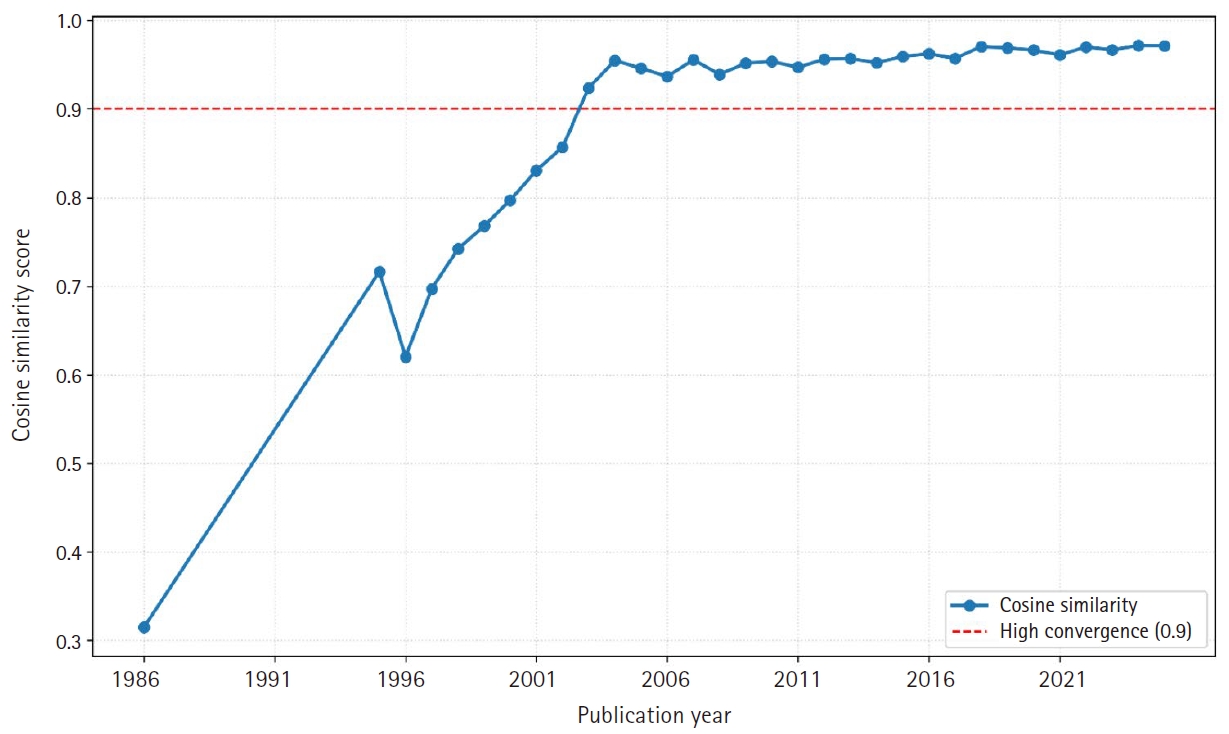
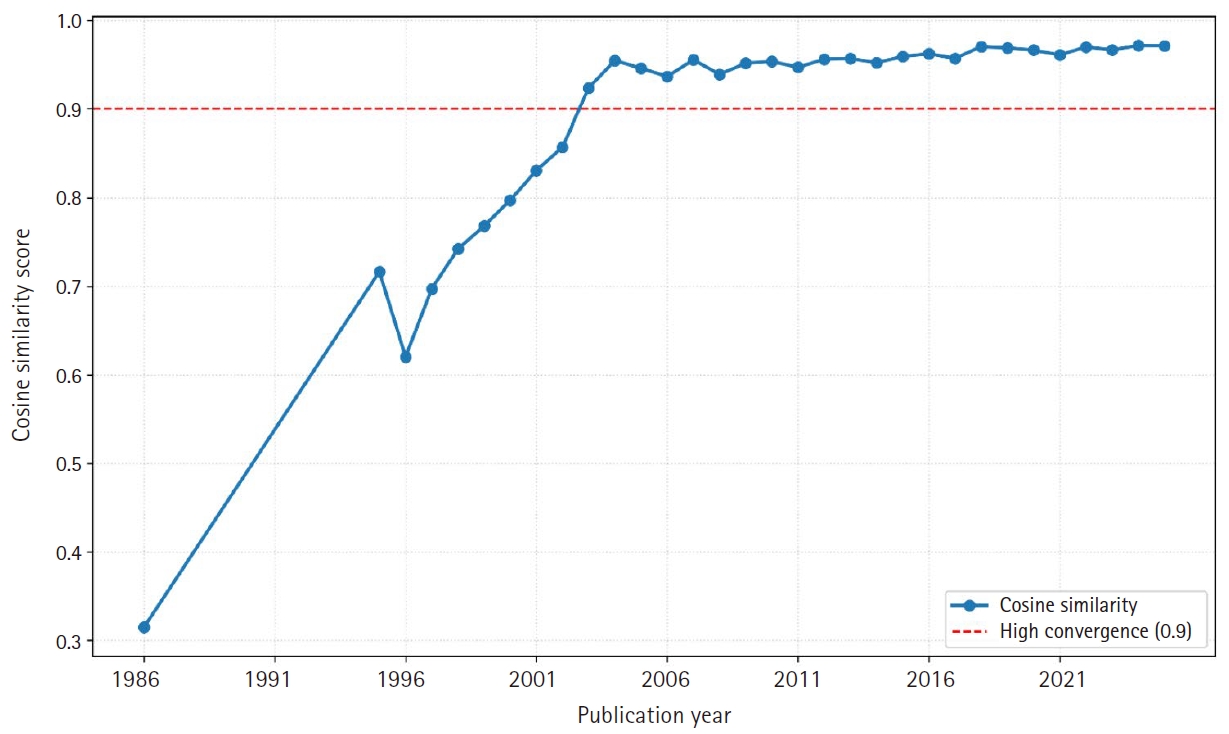
The semantic similarity between the two concepts, measured by the cosine similarity between the document embedding vectors of the “care” corpus and the “management” corpus, was 0.31 in 1986, the year from which both corpora were formed (Figure 1). The similarity rose to 0.72 in 1995, declined temporarily to 0.62 in 1996, and then rose to 0.80 in 2000 and 0.86 in 2002 to exceed 0.9 in 2003 (0.92). From 2004 to 2025, the similarity has remained within the range of 0.94–0.97. The year 2003, when the similarity exceeded 0.9, preceded the 2010s, when the annual number of publications increased sharply (480 in 2012 and 884 in 2020).
2. Common semantic domain and distinctive discriminative vocabulary
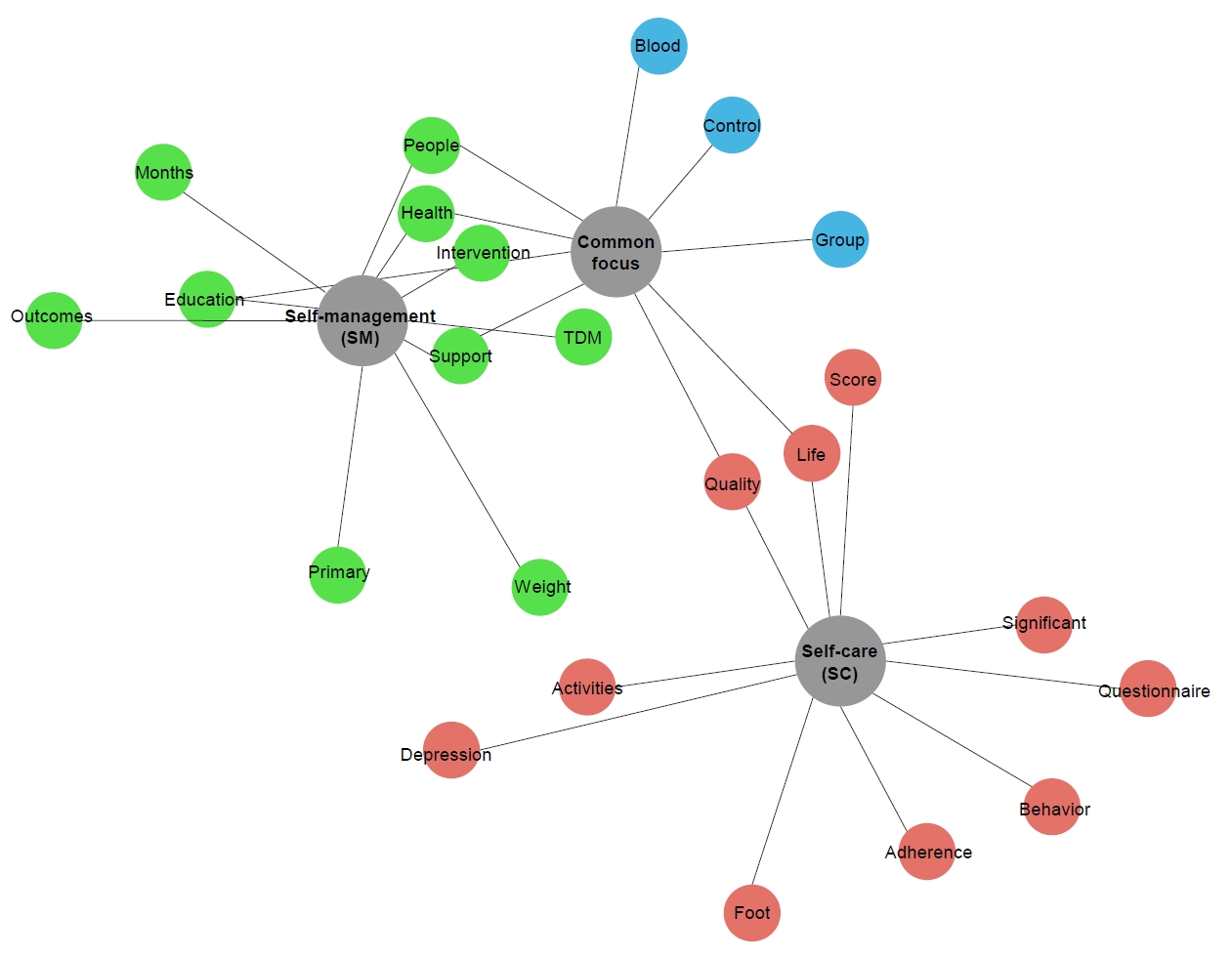
When the entire literature was classified into a “care” corpus and a “management” corpus and their TF-IDF weights were compared, the common keywords showing high weights in both groups were, in order, health (combined weight 0.206), control (0.197), intervention (0.180), group (0.164), education (0.144), blood (0.123), and support (0.105).
The distinctive discriminative vocabulary with large weight differences between the two groups was clearly differentiated. The top 10 SC-distinctive words were activities (weight difference 0.081), adherence (0.059), behavior (0.050), score (0.049), quality (0.046), significant (0.044), life (0.039), foot (0.039), questionnaire (0.038), and depression (0.038); the top 10 SM-distinctive words were intervention (0.110), education (0.078), people (0.076), health (0.059), outcomes (0.050), months (0.047), weight (0.045), primary (0.044), support (0.043), and therapeutic drug monitoring (TDM) (0.033) (Supplementary Table 1).
Extracting only the associations with an NPMI of 0.1 or higher between the discriminative vocabulary and the core terms yielded a network centered on three hubs—Common Focus, SC, and SM (Figure 2). Blood, control, and group were connected to the Common Focus hub; activities, adherence, behavior, depression, foot, questionnaire, and score were connected to the SC hub; education, health, intervention, outcomes, people, primary, support, and weight were connected to the SM hub; and quality and life were connected to both the Common Focus and SC hubs.
3. Major topic structure and conceptual orientation
After BERTopic learned the semantic structure of the abstracts and automatically merged similar topics, 27 topics were derived. Excluding outliers (Topic −1; 5,198 documents, 39.1%), which did not belong to any topic, and a topic formed by records without a usable abstract that clustered around boilerplate such as “abstract available” and “available abstract” (Topic 9; 221 documents), a final set of 26 topics comprising 7,881 documents was confirmed for interpretation. In Topic 9, the discriminative vocabulary did not co-occur with the core terms at all, making purity computation impossible; in the outlier group, the SC purity and SM purity were 0.031 and 0.043, respectively, indicating no extreme bias toward either concept.
The topic with the highest share of the literature was blood glucose monitoring (Topic 0; 2,562 documents, 19.3%), followed by cultural context and community (Topic 1; 670 documents, 5.0%), social and family support (Topic 2; 602 documents, 4.5%), depression and psychological distress (Topic 3; 546 documents, 4.1%), primary care and practice (Topic 4; 483 documents, 3.6%), and digital health and technology (Topic 5; 470 documents, 3.5%) (Table 1).
Hierarchical cluster analysis showed that the non-informative topic (Topic 9) was the first to separate from all the others (distance 1.182), after which the 26 topics divided into two higher-order axes (distance 1.081). The first axis, represented by depression, foot, SC, and symptoms, comprised 12 topics (Topics 3, 8, 11, 13, 15, 16, 18, 20, 22, 24, 25, and 26), and the second axis, represented by glucose, insulin, care, and control, comprised 14 topics (Topics 0, 1, 2, 4, 5, 6, 7, 10, 12, 14, 17, 19, 21, and 23).
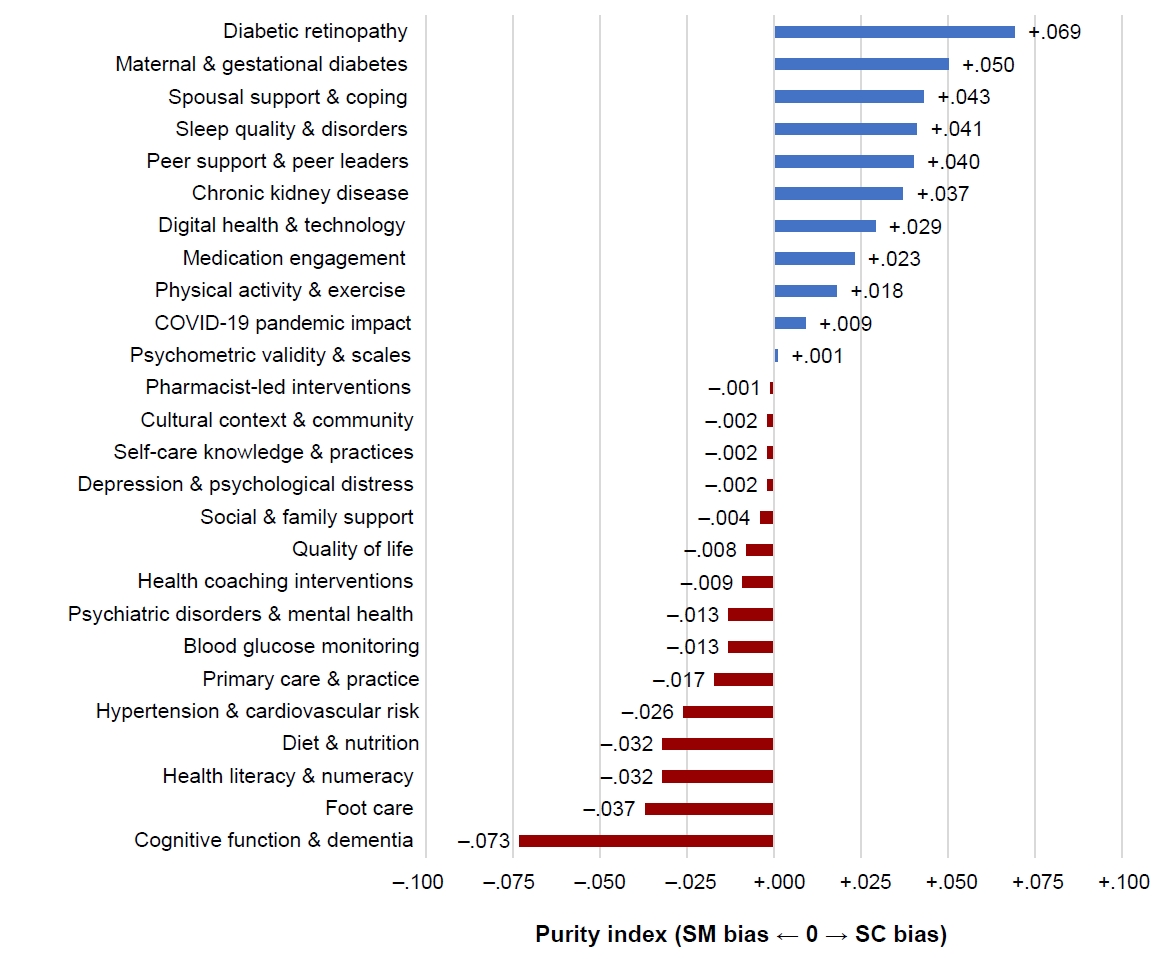
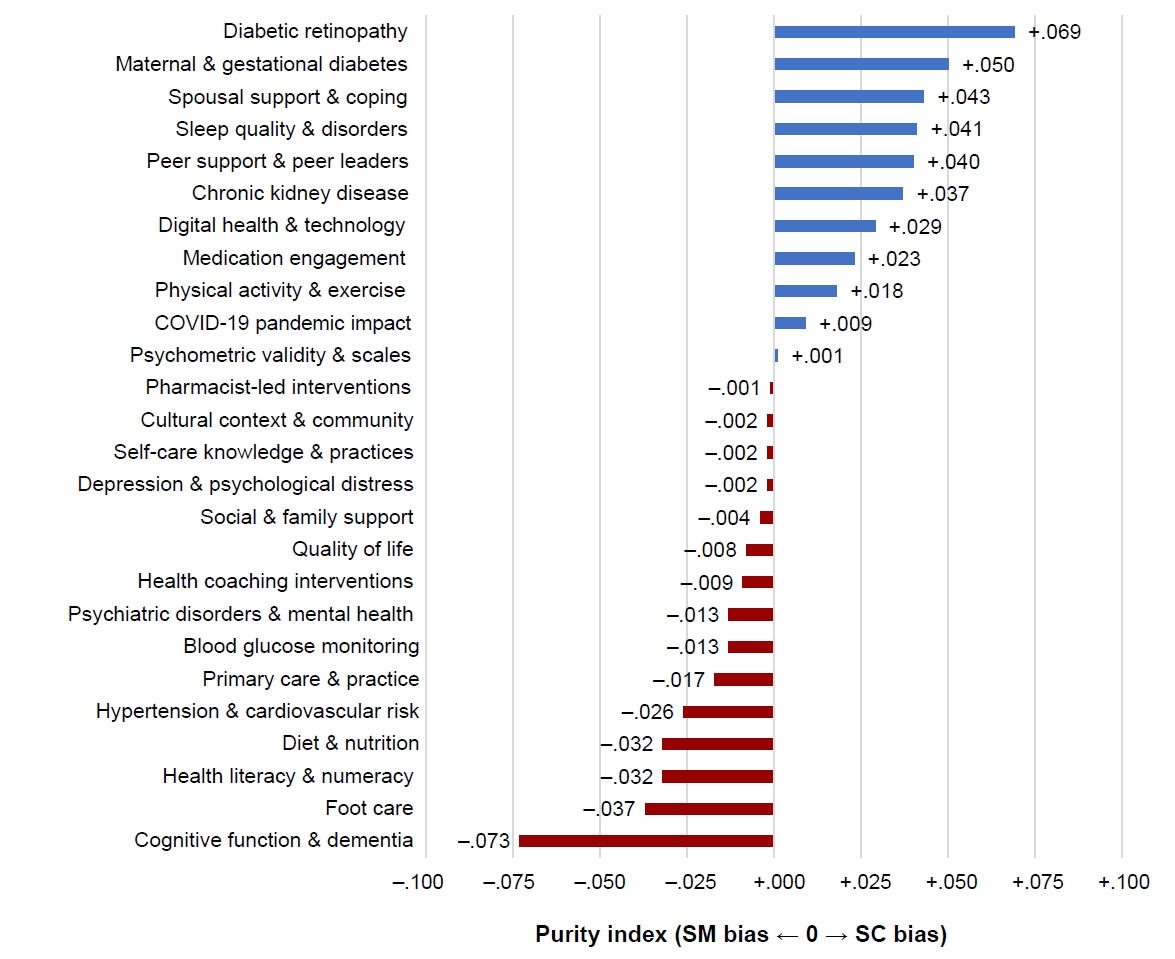
When the conceptual orientation of each topic was computed as the NPMI-based purity difference, 11 of the 26 topics were SC-oriented and 15 were SM-oriented (Figure 3, Table 1). The 15 SM-oriented topics accounted for 6,195 of the 7,881 interpreted documents (78.6%), whereas the 11 SC-oriented topics accounted for the remaining 1,686 documents (21.4%). The topics with a strong SC orientation were, in order, diabetic retinopathy (Topic 26, +.069), spousal support and coping (Topic 25, +.043), sleep quality (Topic 24, +.041), and peer support (Topic 21, +.040). The topics with a strong SM orientation were, in order, cognitive function and dementia (Topic 15, −.073), foot care (Topic 8, −.037), health literacy and numeracy (Topic 13, −.032), diet and nutrition (Topic 7, −.032), and hypertension and cardiovascular risk (Topic 10, −.026).
The purity difference of the largest topic, blood glucose monitoring (Topic 0), was −.013, close to zero, and both its SC purity (.066) and SM purity (.079) were high. In addition, nine topics had an absolute purity difference below .01: pharmacist-led interventions (Topic 17, −.001), cultural context and community (Topic 1, −.002), SC knowledge and practices (Topic 22, −.002), depression and psychological distress (Topic 3, −.002), social and family support (Topic 2, −.004), quality of life (Topic 18, −.008), health coaching (Topic 23, −.009), psychometric validity (Topic 11, +.001), and COVID-19 (coronavirus disease 2019) impact (Topic 16, +.009).
4. Micro-level conceptual boundary within the blood glucose monitoring topic (Topic 0)
Within blood glucose monitoring (Topic 0; 2,562 documents), which accounts for the highest proportion of the literature and corresponds to the common clinical goal of the two concepts, the LOR and purity of the major discriminative words were analyzed (Table 2). The results showed that the conceptual bias of individual words was differentiated even within the same topic.
The words skewed toward SC were primary, healthcare, depression, and activities, with primary showing the strongest bias. Those skewed toward SM were diabetes self-management education (DSME) and foot, with foot showing the highest bias of all words examined (purity 0.914). Interventions, program, and app were contested, with purities near the neutral point. Glucose showed negative values on both sides and was not attributable to either concept (Table 2).
This study found that SC and SM shared semantic domains centered on the clinical outcomes that constitute the common goal of diabetes management—such as blood glucose monitoring, education, and support—consistent with prior conceptual reviews noting that both concepts converge on glycemic control [4,10]. By contrast, their distinct domains were clearly differentiated at the lexical level: SC was coupled with words such as activities, behavior, and depression, reflecting the SC theory as described by Orem [5] of autonomous, psychosocially adaptive action, whereas SM was associated with words such as intervention, outcomes, and education, reflecting the CCM by Wagner et al. [6,7] of system-based disease management. However, at the topic level, the orientation of SC and SM was not as clearly separated as at the lexical level: SC-oriented topics included clinical themes such as diabetic retinopathy alongside psychosocial themes such as spousal support and coping, and SM-oriented topics included themes such as cognitive function and health literacy alongside clinical-management themes such as diet and nutrition and hypertension and cardiovascular risk. This suggests that a topic’s conceptual orientation reflects the discourse within which a subject is discussed, rather than the subject’s inherent clinical or psychosocial nature.
In particular, the finding that SC was associated with depression is in line with prior studies reporting that psychosocial factors such as depression and social support are closely intertwined with SM practice in patients with diabetes [25], supporting the view that SC is a nursing concept encompassing psychosocial adaptation beyond mere behavioral performance. By contrast, although foot was an SC-distinctive word at the lexical level, foot care (Topic 8) was SM-oriented at the topic level, and in the micro-level analysis of the largest topic, foot was also strongly associated with SM. In diabetes in particular, a diabetic foot ulcer can rapidly progress to severe outcomes such as amputation and sepsis if even a minor infection is left untreated; its prevention therefore requires foot-care education, regular examination, and close collaboration with the medical care system, and as part of systematized complication-prevention management [26], it is explained as being closer to a system-based disease process in the CCM by Wagner et al. [6,7]. However, whereas cases in which a wound or infection has occurred require medication, wound treatment, and even perioperative management within the disease-management system, routinely inspecting one’s feet and checking the inside of one’s shoes for preventive purposes is also an item of diabetes SC measurement instruments [27,28] and everyday SC behavior. Therefore, this distinction is better understood as a relative tendency depending on the patient’s context rather than an absolute boundary.
The period after 2003, when the semantic similarity of the two terms exceeded 0.9, coincides with the period in which the chronic disease management paradigm shifted from an individual-centered to a system-centered orientation. As the CCM was adopted with its emphasis on informed decision-makers, collaborative partnership, and management skills [7], and as the ADA’s DSME was designated a required component of “management education and support” in national standards [29,30], the systemic term “management” rose to prominence in chronic-disease discourse. Within this paradigmatic current, such a high convergence of similarity reveals that the distinct scholarly boundary between SC and SM has become blurred within the academic literature and that the two terms are in effect being used interchangeably, as if synonymous. In this study as well, no SC orientation was observed even in the topic labeled “Self-care knowledge & practices” (Topic 22). This suggests that even studies that use the term “self-care” in their titles are, in their actual descriptions, framed within the SM perspective of knowledge transfer and practice education. Using different terms for similar interventions and, conversely, the same term for different interventions can complicate the objective interpretation of research findings, such as in meta-analyses. Indeed, recent conceptual reviews have noted that SM is conceptualized as a subset of SC while, conversely, SC is also subsumed under the concept of SM, so that bidirectional conflation coexists in the literature [31,32]. This mismatch between name and substance can be interpreted as an empirical reproduction, in large-scale data, of the tendency for SC to be subsumed under the concept of SM, and it demonstrates that, without a clear conceptual distinction, the retrieval, classification, and synthesis of the literature itself may be contaminated [10,12]. This is because the more the terms converge on the surface, the greater the risk that different theoretical orientations become mixed and used without distinction.
Nevertheless, the persistence of distinctive discriminative domains amid macroscopic conflation is consistent with the view that SC and SM are complementary rather than substitutable in diabetes management [4].
In conclusion, although the semantic similarity of the concepts of SC and SM was high enough for them to be used almost synonymously in large-scale academic discourse, each concept has its own semantic domain and the two stand in a complementary relationship. In particular, effective and continuous diabetes management requires SM capacity, including following disease-management plans and close collaboration with health professionals within an integrated healthcare system [33]. Separately, it should not be overlooked that even people with diabetes spend more time in ordinary life outside the management of the healthcare system, and that everyday SC capacity, regardless of the presence of disease, ultimately serves as the primary basis and the last line of defense for managing diabetes [4,5]. Clarifying these two concepts is also related to current health-care issues such as person-centered intervention design and community-based care and health-management systems in nursing practice [7,34] and can contribute to setting the goals and scope of nursing in accordance with patients’ needs and to allocating resources appropriately [4]. Meanwhile, unlike in English-speaking contexts, in Korean academic and clinical settings for diabetes, SC and SM are not distinguished and are both translated and used as the single term “Jagi-gwanri”, which tends to further reduce conceptual clarity [35,36]. The persistent divergence in discriminative vocabulary (e.g., activities and depression for SC versus intervention and education for SM) and in topic-level orientation, despite the substantial semantic overlap between the two concepts, provides evidence that the difference between SC and SM is not merely nominal but reflects distinguishable patterns of conceptual use in the literature, suggesting that a more precise distinction and application are needed in non-English-speaking research and clinical environments where the two terms are translated as a single word. This study has several limitations. First, because only abstracts were analyzed, the detailed content and context of interventions could not be captured, so expansion to full-text analysis is needed. Second, because the study centered on academic literature did not sufficiently reflect actual clinical records or patients’ voices, comparative studies with empirical data are needed. Third, because it was based on English-language literature, it did not reflect terminological differences across countries and cultures, so multilingual data analysis is needed to enhance generalizability. Fourth, methodologically, the results of BERTopic are somewhat sensitive to the embedding model, the UMAP/HDBSCAN parameter settings, and randomness, and the researcher’s judgment intervenes in the interpretation of topic labeling. In addition, keyword-based semantic analysis may not fully capture subtle nuances of context. Therefore, the results of this study should be understood not as automatically establishing concept definitions themselves, but as an instrumental basis for exploring the semantic patterns of concept use. In addition, because NPMI-based topic purity is affected by the frequency with which the core terms appear within a topic (e.g., in the foot care topic, “care” appeared in 91.6% of documents and “management” in 25.6%), the conceptual orientation of an individual topic should be interpreted as a relative indicator rather than an absolute attribution. Fifth, because term-level stopword filtering could not fully suppress topical influence from adjacent vocabulary not included in the stopword list (e.g., maternal, neonatal, postpartum), one residual topic related to a maternal/gestational context (Topic 14) remained in the modeling output and was retained in the analysis; therefore, findings related to this topic should be interpreted with caution.
This study quantitatively analyzed four decades of academic literature to clarify the conceptual boundary between SC and SM. First, while the two terms were used almost synonymously in research discourse, literature on SM predominated and the discourse on SC appeared weakened; nevertheless, SC retained its distinct domain of individual practice, quality of life, and psychosocial adaptation, showing that SC holds an independent value in the everyday management of diabetes and that the nursing role of strengthening patients’ SC capacity remains important. Second, as with foot care, the case in which the same term was attributed to either SC or SM depending on whether it concerned routine preventive care or medical care suggests that the use of a concept may vary with the level at which it is operationalized.
The two concepts converged in semantic similarity across the discourse overall, yet each remained statistically differentiated in its discriminative vocabulary, topic-level orientation, and micro-level boundaries; this indicates that they stand in a complementary rather than interchangeable relationship. On this basis, this study provides a quantitative reference by which researchers and practitioners can judge the use of these concepts according to the level and context of care for patients with diabetes. Future studies should extend to full-text and multilingual literature to verify the stability of this boundary.

Conflicts of Interest

Youngshin Song serves as an editor of the Journal of Korean Academy of Nursing but has no role in the decision to publish this article. Except for that, no other potential conflict of interest relevant to this article was reported.

Acknowledgements

None.

Funding

This work was supported by a National Research Foundation of Korea (NRF) grant funded by the Korean government (MSIT) (RS-2026-25476867).

Data Sharing Statement

Please contact the corresponding author for data availability.

Supplementary Data

Supplementary data to this article can be found online at https://doi.org/10.4040/jkan.26076.

Supplementary Table 1.

jkan-26076-Supplementary-Table-1.pdf

Disclosure and declaration of AI use

During the preparation of this manuscript, the authors utilized AI to assist with language proofreading.

Author Contributions

Conceptualization: GH, YS. Methodology: GH. Software: none. Validation: GH, YS. Formal analysis: GH. Investigation: GH. Resources: YS. Data curation: GH, YS. Visualization: GH. Supervision: YS. Project administration: YS. Funding acquisition: YS. Writing–original draft: GH. Writing–review & editing: GH, YS. Final approval of the manuscript: all authors.

Figure 1.
Temporal trend in semantic convergence between the terms “care” and “management” in type 2 diabetes mellitus literature, 1986–2025. Semantic convergence was quantified as the cosine similarity between document embedding vectors of “care” and “management” for publications in each year. The dashed line denotes the high-convergence threshold (cosine similarity=0.90).
jkan-26076f1.jpg
Figure 2.
Semantic network map of shared and concept-specific keywords for self-care (SC) and self-management (SM). Gray nodes indicate the central concept hubs (self-management, self-care, and their common focus). Blue nodes represent the common-focus keywords, linked to the common focus hub; green nodes represent keywords distinctively associated with SM; pink nodes represent keywords distinctively associated with SC. Edges connect each hub to its associated keywords. TDM, therapeutic drug monitoring.
jkan-26076f2.jpg
Figure 3.
Topic-level purity index for self-care (SC) and self-management (SM) oriented topics based on normalized pointwise mutual information (NPMI). The purity index represents the degree to which each topic is discriminatively associated with self-care versus self-management, calculated as the mean NPMI of SC-related discriminative words co-occurring with “care” minus the mean NPMI of SM-related discriminative words co-occurring with “management.” Positive values (blue bars) indicate SC-oriented topics; negative values (red bars) indicate SM-oriented topics.
jkan-26076f3.jpg
Table 1.
Topic distribution and SC/SM orientation in the T2DM literature
Topic no. Topic label Representative keywords Count Share (%) Orientation (Purity_diff)
0 Blood glucose monitoring Glucose, insulin, CGM, SMBG, monitoring, blood, blood glucose, HbA1c, hypoglycemia, glucose monitoring 2,562 19.3 SM (−.013)
1 Cultural context & community Health, culturally, Americans, cultural, community, care, intervention, African, education 670 5.0 SM (−.002)
2 Social & family support Control, support, group, family, intervention, HbA1c, social, blood 602 4.5 SM (−.004)
3 Depression & psychological distress Depression, symptoms, depressive, distress, anxiety, self-care, psychological, control 546 4.1 SM (−.002)
4 Primary care & practice Care, patient, health, support, primary, nurses, practice, primary care, management 483 3.6 SM (−.017)
5 Digital health & technology Mobile, health, App, apps, use, technology, mHealth, applications, data 470 3.5 SC (+.029)
6 Medication engagement Adherence, medication, treatment, self-care, medications, factors, control, health, intervention 367 2.8 SC (+.023)
7 Diet & nutrition Food, dietary, eating, nutrition, diet, insecurity, food insecurity, intake, healthy, education 277 2.1 SM (−.032)
8 Foot care Foot, diabetic foot, foot care, diabetic, foot self-care, ulcers, care, ulcer, foot ulcers 250 1.9 SM (−.037)
10 Hypertension & cardiovascular risk Risk, care, pressure, blood pressure, hypertension, group, CVD, intervention, blood, disease 191 1.4 SM (−.026)
11 Psychometric validity & scales Validity, reliability, version, scale, factor, items, psychometric, internal, consistency 174 1.3 SC (+.001)
12 Physical activity & exercise Activity, physical, physical activity, exercise, weight, intervention, walking, interventions, lifestyle, change 154 1.2 SC (+.018)
13 Health literacy & numeracy Literacy, health literacy, health, self-care, knowledge, self-efficacy, behaviors, functional, self-management level 148 1.1 SM (−.032)
14 Maternal & gestational diabetes Women, glucose, maternal, neonatal, outcomes, postpartum, risk, monitoring, glucose monitoring, care 142 1.1 SC (+.050)
15 Cognitive function & dementia Cognitive, impairment, dementia, function, cognitive function, memory, dysfunction, older 122 0.9 SM (−.073)
16 COVID-19 pandemic impact COVID-19, pandemic, lockdown, people, coronavirus, self-management, self-care, health, infection 99 0.7 SC (+.009)
17 Pharmacist-led interventions Pharmacists, pharmacist, care, medication, pharmacy, intervention, community, patient, adherence, interventions 84 0.6 SM (−.001)
18 Quality of life HRQoL, quality life, life, quality, QOL, EQ-5D, health-related, health-related quality, health, age 82 0.6 SM (−.008)
19 Chronic kidney disease Chronic kidney disease, kidney, kidney disease, chronic kidney, risk, care, renal, chronic 75 0.6 SC (+.037)
20 Psychiatric disorders & mental health Mental, mental illness, SMI, schizophrenia, illness, mental health, people, severe mental, psychiatric, health 62 0.5 SM (−.013)
21 Peer support & peer leaders Peer, peer support, support, peers, peer leaders, leaders, intervention, training, supporters, peer supporters 61 0.5 SC (+.040)
22 Self-care knowledge & practices Knowledge, self-care, practices, practice, diabetic, attitude, education, level 59 0.4 SM (−.002)
23 Health coaching interventions Coaching, health coaching, health, coaches, intervention, program, health coaches, peer, outcomes 57 0.4 SM (−.009)
24 Sleep quality & disorders Sleep, sleep quality, quality, OSA, sleepiness, insomnia, CPAP, daytime, sleep duration 53 0.4 SC (+.041)
25 Spousal support & coping Partners, couples, coping, spouses, partner, communal, communal coping, spousal, illness, relationship 49 0.4 SC (+.043)
26 Diabetic retinopathy Retinopathy, diabetic retinopathy, diabetic, eye, risk, complications, screening, factors, control, care 42 0.3 SC (+.069)

Topics are ordered by topic number. Concept orientation is based on the sign of the topic purity difference (Purity_diff), shown in parentheses (+: SC-oriented, −: SM-oriented). Purity_diff: mean NPMI of the SC discriminative words with “care” minus mean NPMI of the SM discriminative words with “management.” Share (%)=(number of documents in the topic/13,300)×100. Representative keywords are the top c-TF-IDF terms; topic labels were assigned by consensus of two researchers. Topic 9 (a topic formed by records without a usable abstract; 221 documents) and Topic −1 (outliers; 5,198 documents) were excluded from interpretation.

App, application; CGM, continuous glucose monitoring; COVID-19, coronavirus disease 2019; CPAP, continuous positive airway pressure; c-TF-IDF, class-based term frequency–inverse document frequency; CVD, cardiovascular disease; EQ-5D, EuroQol 5-dimension (questionnaire); HbA1c, hemoglobin A1c; HRQoL, health-related quality of life; mHealth, mobile health; NPMI, normalized pointwise mutual information; OSA, obstructive sleep apnea; QOL, quality of life; SMBG, self-monitoring of blood glucose; SC, self-care; SM, self-management; SMI, serious mental illness; T2DM, type 2 diabetes mellitus.

Table 2.
LOR and NPMI-based analysis of core keywords in Topic 0
Keyword NPMI (SC) NPMI (SM) LOR (direction) Purity
Primary .19 .03 –1.90 .87
Healthcare .44 .13 –1.24 .78
Depression .09 .03 –1.11 .75
Activities .14 .07 –0.74 .68
Interventions .10 .11 0.12 .53
Program .10 .11 0.10 .53
App .08 .09 0.19 .55
Glucose –.06a) –.05a) NA NA
DSME .07 .20 1.04 .74
Foot –.01 .10 2.36 .91

NPMI (SC) and NPMI (SM) represent normalized pointwise mutual information, indicating the statistical strength of association between each keyword and the terms “self-care” (SC) and “self-management” (SM). LOR represents the semantic orientation; negative values (e.g., primary: –1.90) indicate a stronger association with SC, while positive values (e.g., foot: 2.36) indicate a stronger association with SM. Purity is a normalized index (0 to 1) indicating how distinctively a keyword belongs to one specific concept over the other.

App, application; DSME, diabetes self-management education; LOR, log odds ratio; NA, not applicable; NPMI, normalized pointwise mutual information; SC, self-care; SM, self-management.

a)NPMI values for ‘glucose’ indicate that this term’s association with SC and SM fell below the threshold (0.1) used to define a distinct association; consequently, LOR and purity are reported as NA for this keyword.

  • 1. International Diabetes Federation. IDF Diabetes Atlas. 11th ed. International Diabetes Federation; 2025.
  • 2. American Diabetes Association Professional Practice Committee. 5. Facilitating positive health behaviors and well-being to improve health outcomes: standards of care in diabetes-2025. Diabetes Care. 2025;48(1 Suppl 1):S86-S127. https://doi.org/10.2337/dc25-S005ArticlePubMedPMC
  • 3. Korean Diabetes Association. Clinical Practice Guidelines for Diabetes. Korean Diabetes Association; 2025.
  • 4. Puzhakkal S, Kavanagh S, Conway B, Kow CS, Hasan SS. Self-care and self-management in diabetes: concepts, theories and practices. Int J Clin Pharm. 2025;47(6):2094-2100. https://doi.org/10.1007/s11096-025-01941-zArticlePubMedPMC
  • 5. Orem DE. Self-care and health promotion: understanding self-care. In: Renpenning KM, Taylor SG, editors. Self-care theory in nursing: selected papers of Dorothea Orem. Springer Publishing Company; 2003. p. 212-222.
  • 6. Wagner EH, Austin BT, Von Korff M. Organizing care for patients with chronic illness. Milbank Q. 1996;74(4):511-544. https://doi.org/10.2307/3350391ArticlePubMed
  • 7. Wagner EH, Austin BT, Davis C, Hindmarsh M, Schaefer J, Bonomi A. Improving chronic illness care: translating evidence into action. Health Aff (Millwood). 2001;20(6):64-78. https://doi.org/10.1377/hlthaff.20.6.64ArticlePubMedPMC
  • 8. Othman MM, Khudadad H, Dughmosh R, Furuya-Kanamori L, Abou-Samra AB, Doi SA. Towards a better understanding of self-management interventions in type 2 diabetes: a concept analysis. Prim Care Diabetes. 2022;16(1):142-149. https://doi.org/10.1016/j.pcd.2021.09.001ArticlePubMed
  • 9. Pranata S, Wulandari H. A concept analysis of Self-management among diabetes mellitus. Int J Nurs Health Serv. 2021;4(3):356-367. https://doi.org/10.35654/ijnhs.v4i3.469Article
  • 10. Richard AA, Shea K. Delineation of self-care and associated concepts. J Nurs Scholarsh. 2011;43(3):255-264. https://doi.org/10.1111/j.1547-5069.2011.01404.xArticlePubMedPMC
  • 11. Wilde MH, Garvin S. A concept analysis of self-monitoring. J Adv Nurs. 2007;57(3):339-350. https://doi.org/10.1111/j.1365-2648.2006.04089.xArticlePubMed
  • 12. Matarese M, Lommi M, De Marinis MG, Riegel B. A systematic review and integration of concept analyses of self-care and related concepts. J Nurs Scholarsh. 2018;50(3):296-305. https://doi.org/10.1111/jnu.12385ArticlePubMed
  • 13. Nashwan AJ, Kunjavara J, Joy G, Sigh K, Rony MKK, M K, et al. Preferred reporting items for concept analysis in nursing: a systematic review. J Res Nurs. 2026;31(5-6):498-511. https://doi.org/10.1177/17449871251410464ArticlePubMedPMC
  • 14. Van de Velde D, De Zutter F, Satink T, Costa U, Janquart S, Senn D, et al. Delineating the concept of self-management in chronic conditions: a concept analysis. BMJ Open. 2019;9(7):e027775. https://doi.org/10.1136/bmjopen-2018-027775ArticlePubMedPMC
  • 15. Walker LO, Avant KC. Strategies for theory construction in nursing. 4th ed. Pearson Prentice Hall; 2005.
  • 16. Oner B, Hakli O, Zengul FD. A text mining and network analysis of topics and trends in major nursing research journals. Nurs Open. 2024;11(1):e2050. https://doi.org/10.1002/nop2.2050ArticlePubMedPMC
  • 17. Nam J, Lee H, Lee S, Park H. Literature review of complementary and alternative therapies: using text mining and analysis of trends in nursing research. BMC Nurs. 2024;23(1):526. https://doi.org/10.1186/s12912-024-02172-9ArticlePubMedPMC
  • 18. Grootendorst M. BERTopic: neural topic modeling with a class-based TF-IDF procedure. arXiv [Preprint]. 2022 Mar 11. https://doi.org/10.48550/arXiv.2203.05794Article
  • 19. Bouma G. Normalized (pointwise) mutual information in collocation extraction. In: Chiarcos C, Eckart de Castilho R, Stede M, editors. From form to meaning: processing texts automatically. Proceedings of the Biennial GSCL Conference; 2009 Sep 30-Oct 2; Potsdam, Germany. Gunter Narr Verlag; 2009. p. 31-40.
  • 20. Church K, Hanks P. Word association norms, mutual information, and lexicography. Comput Linguist. 1990;16(1):22-29. Article
  • 21. Reimers N, Gurevych I. Sentence-BERT: sentence embeddings using Siamese BERT-networks. Proceedings of the 2019 Conference on Empirical Methods in Natural Language Processing and the 9th International Joint Conference on Natural Language Processing (EMNLP-IJCNLP); 2019 Nov 3-7; Hong Kong, China. Association for Computational Linguistics; 2019. p. 3982-3992. https://doi.org/10.18653/v1/D19-1410Article
  • 22. McInnes L, Healy J, Melville J. Umap: uniform manifold approximation and projection for dimension reduction. arXiv [Preprint]. 2018 Feb 9. https://doi.org/10.48550/arXiv.1802.03426Article
  • 23. McInnes L, Healy J, Astels S. hdbscan: hierarchical density based clustering. J Open Source Softw. 2017;2(11):205. https://doi.org/10.21105/joss.00205ArticlePMC
  • 24. Röder M, Both A, Hinneburg A. Exploring the space of topic coherence measures. Proceedings of the 8th ACM International Conference on Web Search and Data Mining; 2015 Feb 2-6; Shanghai, China. Association for Computing Machinery; 2015. p. 399-408. https://doi.org/10.1145/2684822.2685324Article
  • 25. Derese A, Sirgu S, Gebreegziabhere Y, Hanlon C. Mechanisms and pathways linking depression and type 2 diabetes outcomes: a scoping review. J Diabetes Res. 2025;2025:5590413. https://doi.org/10.1155/jdr/5590413ArticlePubMedPMC
  • 26. Schaper NC, van Netten JJ, Apelqvist J, Bus SA, Hinchliffe RJ, Lipsky BA, et al. Practical Guidelines on the prevention and management of diabetic foot disease (IWGDF 2019 update). Diabetes Metab Res Rev. 2020;36 Suppl 1:e3266. https://doi.org/10.1002/dmrr.3266ArticlePubMedPMC
  • 27. Toobert DJ, Hampson SE, Glasgow RE. The summary of diabetes self-care activities measure: results from 7 studies and a revised scale. Diabetes Care. 2000;23(7):943-950. https://doi.org/10.2337/diacare.23.7.943ArticlePubMed
  • 28. Khosravizadeh O, Ahadinezhad B, Maleki A, Yousefy S, Momeni Z. Diabetes self-care activities among patients with type 2 diabetes: a systematic review and meta-analysis. Int J Diabetes Dev Ctries. 2024;44(1):10-19. https://doi.org/10.1007/s13410-023-01214-3Article
  • 29. Mensing C, Boucher J, Cypress M, Weinger K, Mulcahy K, Barta P, et al. National standards for diabetes self-management education. Diabetes Care. 2003;26 Suppl 1:S149-S156. https://doi.org/10.2337/diacare.26.2007.s149ArticlePubMed
  • 30. Mensing C, Boucher J, Cypress M, Weinger K, Mulcahy K, Barta P, et al. National standards for diabetes self-management education. Diabetes Care. 2004;27 Suppl 1:S143-S150. https://doi.org/10.2337/diacare.27.2007.s143ArticlePubMed
  • 31. Kamradt M, Bozorgmehr K, Krisam J, Freund T, Kiel M, Qreini M, et al. Assessing self-management in patients with diabetes mellitus type 2 in Germany: validation of a German version of the Summary of Diabetes Self-Care Activities measure (SDSCA-G). Health Qual Life Outcomes. 2014;12:185. https://doi.org/10.1186/s12955-014-0185-1ArticlePubMedPMC
  • 32. Chipu M, Downing C. Professional nurses’ facilitation of self-care in intensive care units: a concept analysis. Int J Nurs Sci. 2020;7(4):446-452. https://doi.org/10.1016/j.ijnss.2020.08.002ArticlePubMedPMC
  • 33. Corbin JM, Strauss A. A nursing model for chronic illness management based upon the Trajectory Framework. Sch Inq Nurs Pract. 1991;5(3):155-174. ArticlePubMed
  • 34. Dickinson JK, Guzman SJ, Maryniuk MD, O'Brian CA, Kadohiro JK, Jackson RA, et al. The use of language in diabetes care and education. Diabetes Care. 2017;40(12):1790-1799. https://doi.org/10.2337/dci17-0041ArticlePubMedPMC
  • 35. Korean Diabetes Association. Diabetes glossary [Internet]. Korean Diabetes Association; 2020 [cited 2026 Jan 25] Available from: https://www.diabetes.or.kr/pro/glossary/search.php?initial=83
  • 36. Lee J. Research trends in diabetes mellitus self-management intervention: the scoping review. J Muscle Jt Health. 2022;29(2):113-123. https://doi.org/10.5953/JMJH.2022.29.2.113Article

Figure & Data

REFERENCES

    Citations

    Citations to this article as recorded by  

      • ePub LinkePub Link
      • Cite
        CITE
        export Copy Download
        Close
        Download Citation
        Download a citation file in RIS format that can be imported by all major citation management software, including EndNote, ProCite, RefWorks, and Reference Manager.

        Format:
        • RIS — For EndNote, ProCite, RefWorks, and most other reference management software
        • BibTeX — For JabRef, BibDesk, and other BibTeX-specific software
        Include:
        • Citation for the content below
        Clarifying the concepts of self-care and self-management in type 2 diabetes: a BERTopic-based analysis of academic literature
        Close
      • XML DownloadXML Download
      Figure
      • 0
      • 1
      • 2
      We recommend
      Clarifying the concepts of self-care and self-management in type 2 diabetes: a BERTopic-based analysis of academic literature
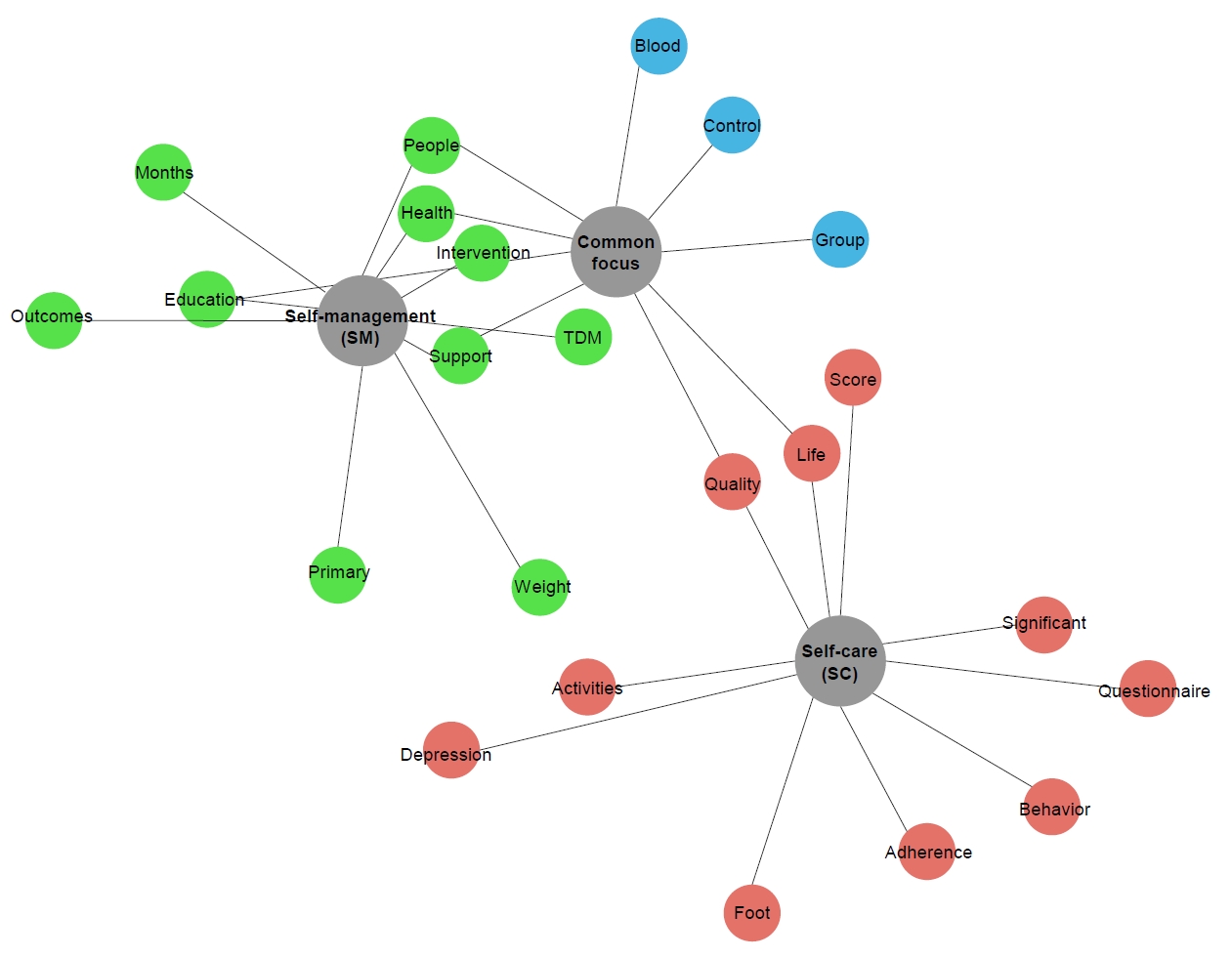
      Image Image Image
      Figure 1. Temporal trend in semantic convergence between the terms “care” and “management” in type 2 diabetes mellitus literature, 1986–2025. Semantic convergence was quantified as the cosine similarity between document embedding vectors of “care” and “management” for publications in each year. The dashed line denotes the high-convergence threshold (cosine similarity=0.90).
      Figure 2. Semantic network map of shared and concept-specific keywords for self-care (SC) and self-management (SM). Gray nodes indicate the central concept hubs (self-management, self-care, and their common focus). Blue nodes represent the common-focus keywords, linked to the common focus hub; green nodes represent keywords distinctively associated with SM; pink nodes represent keywords distinctively associated with SC. Edges connect each hub to its associated keywords. TDM, therapeutic drug monitoring.
      Figure 3. Topic-level purity index for self-care (SC) and self-management (SM) oriented topics based on normalized pointwise mutual information (NPMI). The purity index represents the degree to which each topic is discriminatively associated with self-care versus self-management, calculated as the mean NPMI of SC-related discriminative words co-occurring with “care” minus the mean NPMI of SM-related discriminative words co-occurring with “management.” Positive values (blue bars) indicate SC-oriented topics; negative values (red bars) indicate SM-oriented topics.
      Clarifying the concepts of self-care and self-management in type 2 diabetes: a BERTopic-based analysis of academic literature
      Topic no. Topic label Representative keywords Count Share (%) Orientation (Purity_diff)
      0 Blood glucose monitoring Glucose, insulin, CGM, SMBG, monitoring, blood, blood glucose, HbA1c, hypoglycemia, glucose monitoring 2,562 19.3 SM (−.013)
      1 Cultural context & community Health, culturally, Americans, cultural, community, care, intervention, African, education 670 5.0 SM (−.002)
      2 Social & family support Control, support, group, family, intervention, HbA1c, social, blood 602 4.5 SM (−.004)
      3 Depression & psychological distress Depression, symptoms, depressive, distress, anxiety, self-care, psychological, control 546 4.1 SM (−.002)
      4 Primary care & practice Care, patient, health, support, primary, nurses, practice, primary care, management 483 3.6 SM (−.017)
      5 Digital health & technology Mobile, health, App, apps, use, technology, mHealth, applications, data 470 3.5 SC (+.029)
      6 Medication engagement Adherence, medication, treatment, self-care, medications, factors, control, health, intervention 367 2.8 SC (+.023)
      7 Diet & nutrition Food, dietary, eating, nutrition, diet, insecurity, food insecurity, intake, healthy, education 277 2.1 SM (−.032)
      8 Foot care Foot, diabetic foot, foot care, diabetic, foot self-care, ulcers, care, ulcer, foot ulcers 250 1.9 SM (−.037)
      10 Hypertension & cardiovascular risk Risk, care, pressure, blood pressure, hypertension, group, CVD, intervention, blood, disease 191 1.4 SM (−.026)
      11 Psychometric validity & scales Validity, reliability, version, scale, factor, items, psychometric, internal, consistency 174 1.3 SC (+.001)
      12 Physical activity & exercise Activity, physical, physical activity, exercise, weight, intervention, walking, interventions, lifestyle, change 154 1.2 SC (+.018)
      13 Health literacy & numeracy Literacy, health literacy, health, self-care, knowledge, self-efficacy, behaviors, functional, self-management level 148 1.1 SM (−.032)
      14 Maternal & gestational diabetes Women, glucose, maternal, neonatal, outcomes, postpartum, risk, monitoring, glucose monitoring, care 142 1.1 SC (+.050)
      15 Cognitive function & dementia Cognitive, impairment, dementia, function, cognitive function, memory, dysfunction, older 122 0.9 SM (−.073)
      16 COVID-19 pandemic impact COVID-19, pandemic, lockdown, people, coronavirus, self-management, self-care, health, infection 99 0.7 SC (+.009)
      17 Pharmacist-led interventions Pharmacists, pharmacist, care, medication, pharmacy, intervention, community, patient, adherence, interventions 84 0.6 SM (−.001)
      18 Quality of life HRQoL, quality life, life, quality, QOL, EQ-5D, health-related, health-related quality, health, age 82 0.6 SM (−.008)
      19 Chronic kidney disease Chronic kidney disease, kidney, kidney disease, chronic kidney, risk, care, renal, chronic 75 0.6 SC (+.037)
      20 Psychiatric disorders & mental health Mental, mental illness, SMI, schizophrenia, illness, mental health, people, severe mental, psychiatric, health 62 0.5 SM (−.013)
      21 Peer support & peer leaders Peer, peer support, support, peers, peer leaders, leaders, intervention, training, supporters, peer supporters 61 0.5 SC (+.040)
      22 Self-care knowledge & practices Knowledge, self-care, practices, practice, diabetic, attitude, education, level 59 0.4 SM (−.002)
      23 Health coaching interventions Coaching, health coaching, health, coaches, intervention, program, health coaches, peer, outcomes 57 0.4 SM (−.009)
      24 Sleep quality & disorders Sleep, sleep quality, quality, OSA, sleepiness, insomnia, CPAP, daytime, sleep duration 53 0.4 SC (+.041)
      25 Spousal support & coping Partners, couples, coping, spouses, partner, communal, communal coping, spousal, illness, relationship 49 0.4 SC (+.043)
      26 Diabetic retinopathy Retinopathy, diabetic retinopathy, diabetic, eye, risk, complications, screening, factors, control, care 42 0.3 SC (+.069)
      Keyword NPMI (SC) NPMI (SM) LOR (direction) Purity
      Primary .19 .03 –1.90 .87
      Healthcare .44 .13 –1.24 .78
      Depression .09 .03 –1.11 .75
      Activities .14 .07 –0.74 .68
      Interventions .10 .11 0.12 .53
      Program .10 .11 0.10 .53
      App .08 .09 0.19 .55
      Glucose –.06a) –.05a) NA NA
      DSME .07 .20 1.04 .74
      Foot –.01 .10 2.36 .91
      Table 1. Topic distribution and SC/SM orientation in the T2DM literature

      Topics are ordered by topic number. Concept orientation is based on the sign of the topic purity difference (Purity_diff), shown in parentheses (+: SC-oriented, −: SM-oriented). Purity_diff: mean NPMI of the SC discriminative words with “care” minus mean NPMI of the SM discriminative words with “management.” Share (%)=(number of documents in the topic/13,300)×100. Representative keywords are the top c-TF-IDF terms; topic labels were assigned by consensus of two researchers. Topic 9 (a topic formed by records without a usable abstract; 221 documents) and Topic −1 (outliers; 5,198 documents) were excluded from interpretation.

      App, application; CGM, continuous glucose monitoring; COVID-19, coronavirus disease 2019; CPAP, continuous positive airway pressure; c-TF-IDF, class-based term frequency–inverse document frequency; CVD, cardiovascular disease; EQ-5D, EuroQol 5-dimension (questionnaire); HbA1c, hemoglobin A1c; HRQoL, health-related quality of life; mHealth, mobile health; NPMI, normalized pointwise mutual information; OSA, obstructive sleep apnea; QOL, quality of life; SMBG, self-monitoring of blood glucose; SC, self-care; SM, self-management; SMI, serious mental illness; T2DM, type 2 diabetes mellitus.

      Table 2. LOR and NPMI-based analysis of core keywords in Topic 0

      NPMI (SC) and NPMI (SM) represent normalized pointwise mutual information, indicating the statistical strength of association between each keyword and the terms “self-care” (SC) and “self-management” (SM). LOR represents the semantic orientation; negative values (e.g., primary: –1.90) indicate a stronger association with SC, while positive values (e.g., foot: 2.36) indicate a stronger association with SM. Purity is a normalized index (0 to 1) indicating how distinctively a keyword belongs to one specific concept over the other.

      App, application; DSME, diabetes self-management education; LOR, log odds ratio; NA, not applicable; NPMI, normalized pointwise mutual information; SC, self-care; SM, self-management.

      a)NPMI values for ‘glucose’ indicate that this term’s association with SC and SM fell below the threshold (0.1) used to define a distinct association; consequently, LOR and purity are reported as NA for this keyword.


      J Korean Acad Nurs : Journal of Korean Academy of Nursing
      Close layer
      TOP