
 Submit an article

Articles
- Page Path
- HOME > J Korean Acad Nurs > Volume 56(2); 2026 > Article
-
Editorial
- Toward an end-to-end K-AI nursing ecosystem: digital twins across the care continuum
-
Jeung-Im Kim1
 , Jiyeon Kang2, YeoJin Im3, Sung Reul Kim4, Sun Ju Chang5
 -
Journal of Korean Academy of Nursing 2026;56(2):123-125.
DOI: https://doi.org/10.4040/jkan.25180
Published online: April 17, 2026
1School of Nursing, Soonchunhyang University College of Medicine, Cheonan, South Korea
2College of Nursing, Dong-A University, Busan, South Korea
3College of Nursing Science, Kyung Hee University, Seoul, South Korea
4College of Nursing, Korea University, Seoul, South Korea
5College of Nursing, Seoul National University, Seoul, South Korea
- Corresponding author: Sun Ju Chang College of Nursing, Seoul National University, 103 Daehak-ro, Jongno-gu, Seoul 03080, South Korea E-mail: changsj@snu.ac.kr
• Received: December 28, 2025 • Revised: December 31, 2025 • Accepted: December 31, 2025
© 2026 Korean Society of Nursing Science
This is an Open Access article distributed under the terms of the Creative Commons Attribution NoDerivs License (http://creativecommons.org/licenses/by-nd/4.0) If the original work is properly cited and retained without any modification or reproduction, it can be used and re-distributed in any format and medium.
- 2,728 Views
- 158 Download
- 1 Crossref


High-Risk Pregnancy
Children with Chronic Conditions
Critically Ill Patients
People with Complex Neurological Conditions
Older Adults with Disabilities
A Path Forward
-
Conflicts of Interest
Sun Ju Chang serves as Editorial Board members of the Journal of Korean Academy of Nursing but have no role in the decision to publish this article. Except for that, no potential conflict of interest relevant to this article was reported.
-
Acknowledgements
None.
-
Funding
None.
-
Data Sharing Statement
Please contact the corresponding author for data availability.
-
Author Contributions
Conceptualization: JIK, JK, YJI, SRK, SJC. Formal analysis: JIK, JK, YJI, SRK, SJC. Methodology: JIK, JK, YJI, SRK, SJC. Visualization: SJC. Writing - original draft: JIK, JK, YJI, SRK, SJC. Writing - review & editing: JIK, JK, YJI, SRK, SJC. Validation: JIK, JK, YJI, SRK, SJC.
Article Information
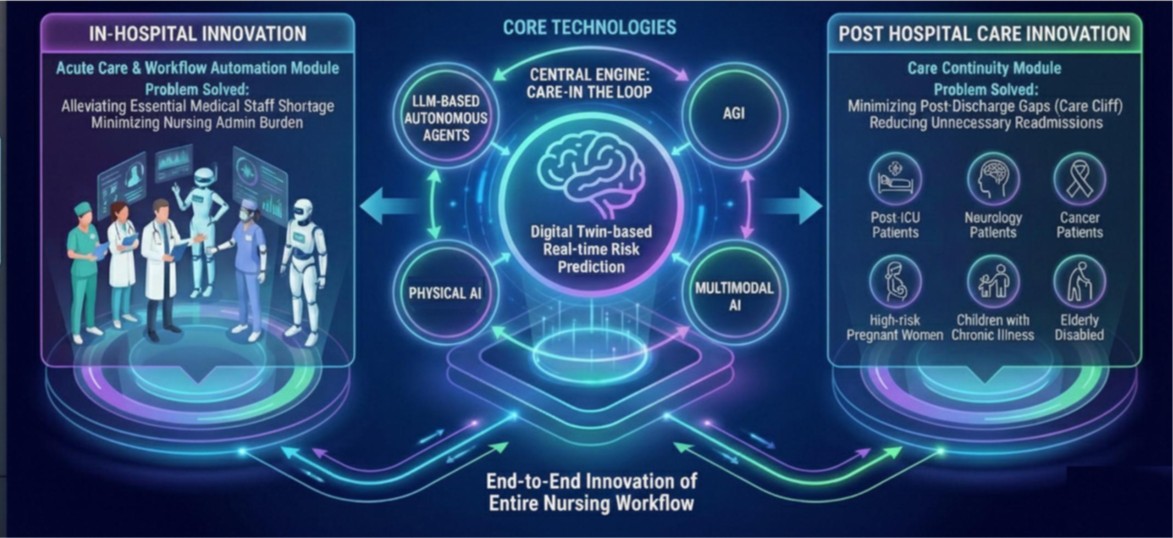
Figure 1.Precision nursing intelligence (PNI) platform: end-to-end nursing workflow innovation architecture (AI-generated image in response to the request "visualization of AI-integrated nursing across the care continuum for diverse patient populations" (Generator: Gemini; Requestor: SJC; Date: 2025-12-15). AGI, artificial general intelligence; ICU, intensive care unit.
- 1. Jaeger KM, Nissen M, Leutheuser H, Danzberger N, Titzmann A, Pontones CA, et al. Adherence to digital pregnancy care: lessons learned from the SMART start feasibility study. NPJ Digit Med. 2025;8(1):561. https://doi.org/10.1038/s41746-025-01966-8ArticlePubMedPMC
- 2. Chow AJ, Saad A, Al-Baldawi Z, Iverson R, Skidmore B, Jordan I, et al. Family-centred care interventions for children with chronic conditions: a scoping review. Health Expect. 2024;27(1):e13897. https://doi.org/10.1111/hex.13897ArticlePubMedPMC
- 3. Green LA, Ailey SH. Increasing childhood asthma care appointments on a mobile asthma van. J Sch Nurs. 2021;37(3):209-219. https://doi.org/10.1177/1059840519857143ArticlePubMed
- 4. Festor P, Nagendran M, Gordon AC, Faisal AA, Komorowski M. Safety of human-AI cooperative decision-making within intensive care: a physical simulation study. PLOS Digit Health. 2025;4(2):e0000726. https://doi.org/10.1371/journal.pdig.0000726ArticlePubMedPMC
- 5. Linden R, Vassilaki M, Henderson EJ, Mohan D. Editorial: Multimorbidity in the context of neurodegenerative disorders. Front Neurosci. 2022;16:1076486. https://doi.org/10.3389/fnins.2022.1076486ArticlePubMedPMC
- 6. Fekonja LS, Schenk R, Schröder E, Tomasello R, Tomšič S, Picht T. The digital twin in neuroscience: from theory to tailored therapy. Front Neurosci. 2024;18:1454856. https://doi.org/10.3389/fnins.2024.1454856ArticlePubMedPMC
- 7. Ministry of Health and Welfare; National Rehabilitation Center. Characteristics of elderly with disability [Internet]. Ministry of Health and Welfare, National Rehabilitation Center; 2018 [cited 2025 Nov 30]. Available from: https://www.nrc.go.kr/portal/html/content.do?depth=de&menu_cd=07_01_02
- 8. Momand Z, Mongkolnam P, Chan JH, Charoenkitkarn N, Pal D. Building digital twins for elderly care: an end-to-end framework from data acquisition to modeling. IEEE Access. 2025;13:169415-169445. https://doi.org/10.1109/ACCESS.2025.3607603Article
- 9. Kilfoy A, Chu C, Krisnagopal A, Mcatee E, Baek S, Zworth M, et al. Nurse-led remote digital support for adults with chronic conditions: a systematic synthesis without meta-analysis. J Clin Nurs. 2025;34(3):715-736. https://doi.org/10.1111/jocn.17226ArticlePubMedPMC
- 10. Choi MJ, Seo MH, Kim J, Kim S, Jeong SH. Research trends in generative artificial intelligence in nursing: a scoping review. J Korean Acad Nurs. 2025;55(3):468-487. https://doi:10.4040/jkan.25006ArticlePubMedPDF
References
Figure & Data
REFERENCES
Citations
Citations to this article as recorded by 
- Workplace-Based Multicomponent Weight Management Interventions for Employees with Overweight or Obesity: A Systematic Review
Yesol Kim, Seonhye Lee, Haeyoung Min, Sohee Jung, A-young Jo, Hyeonji Kang
Journal of The Korean Society of Living Environmental System.2026; 33(4): 454. CrossRef
 ePub Link
 Cite
Cite XML Download
Toward an end-to-end K-AI nursing ecosystem: digital twins across the care continuum
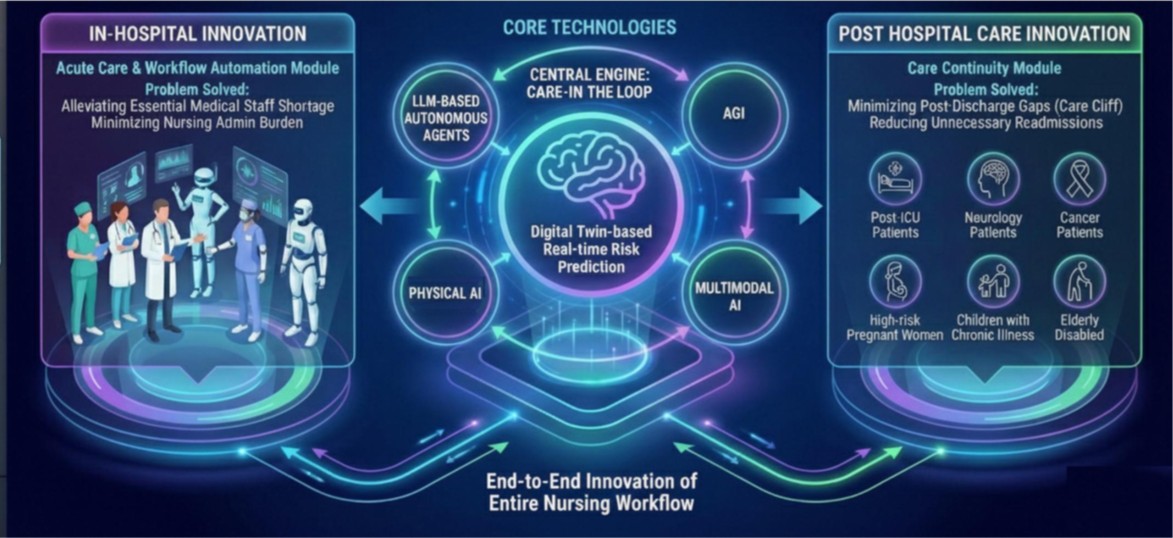
Figure 1. Precision nursing intelligence (PNI) platform: end-to-end nursing workflow innovation architecture (AI-generated image in response to the request "visualization of AI-integrated nursing across the care continuum for diverse patient populations" (Generator: Gemini; Requestor: SJC; Date: 2025-12-15). AGI, artificial general intelligence; ICU, intensive care unit.
Figure 1.
Toward an end-to-end K-AI nursing ecosystem: digital twins across the care continuum


