
 Submit an article

Search
- Page Path
- HOME > Search
Research Paper
- Development of emergency nursing educational materials in Lao People's Democratic Republic: a methodological study
- Jina Oh, Eunsil Won, Seohyun Won, Sunmi Kim, Seryung Oh, Souksavanh Phanpaseuth, Anousone Sisoulath, Lamngeun Silavong
- J Korean Acad Nurs 2026;56(2):247-261. Published online May 21, 2026
- DOI: https://doi.org/10.4040/jkan.25174
-
 Abstract
 PDF
PDF ePub
ePub - Purpose
This study aimed to develop contextualized emergency nursing educational materials tailored to the Lao People’s Democratic Republic (Lao PDR). Emergency nurses in Lao PDR face challenges arising from the lack of standardized, culturally relevant learning resources. Existing materials are often adopted from other countries and do not adequately reflect local needs, contributing to inconsistencies in clinical practice. Developing locally tailored resources, supported by official development assistance, is therefore essential for improving emergency nursing education and practice.
Methods
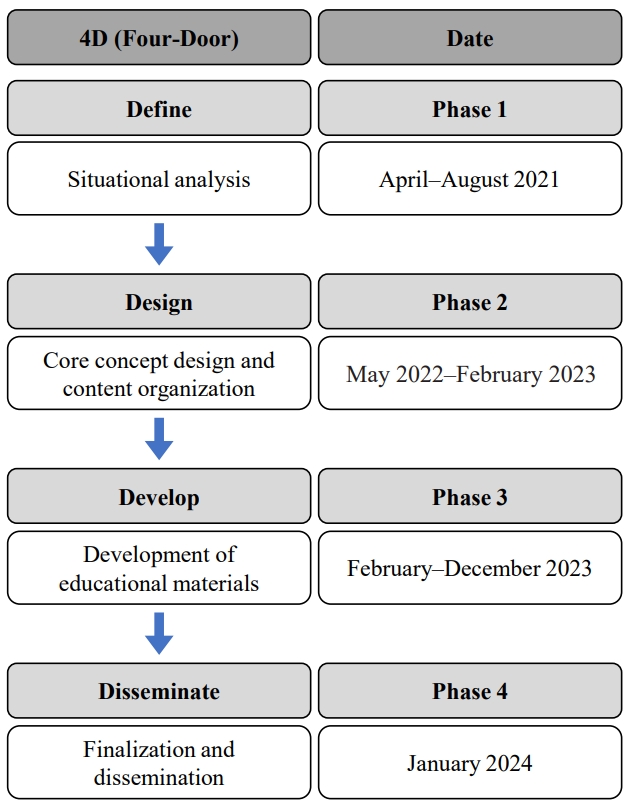
This study used a methodological design based on the Four-Door Model—Define, Design, Develop, and Disseminate—from 2021 to 2024. A situational analysis was conducted using a mixed-methods approach that included a quantitative survey of 70 nursing professionals and qualitative interviews with 52 stakeholders. Content validity and suitability were evaluated by a panel of six local experts using standardized validation forms and the Suitability Assessment of Materials (SAM).
Results
Ten emergency nursing domains were developed to address both universal principles, including triage protocols and life support interventions, and Lao PDR-specific challenges. Validity and suitability were supported by a SAM score of 77.3%, indicating clinical accuracy and cultural appropriateness. The 269-page coursebook was distributed to partner nursing colleges, three central hospitals, and international organizations.
Conclusion
This study developed the first comprehensive emergency nursing educational materials tailored to the Lao PDR context and written in the local language. These materials support continuing professional development and license renewal every 5 years. They also exemplify an international development paradigm that prioritizes recipient-country ownership and sustainable capacity building through collaborative knowledge creation.
- 1,210 View
- 114 Download

Review Paper
- Research trends in generative artificial intelligence in nursing: a scoping review
- Myung Jin Choi, Myoung Hee Seo, Jihun Kim, Sunmi Kim, Seok Hee Jeong
- J Korean Acad Nurs 2025;55(3):468-487. Published online August 5, 2025
- DOI: https://doi.org/10.4040/jkan.25006
-
Abstract
PDFePub
- Purpose
Generative artificial intelligence (AI) has yet to be comprehensively analyzed in the nursing literature. This study aimed to identify research trends in generative AI within the nursing field through a scoping review and propose strategies for its effective utilization in nursing.
Methods
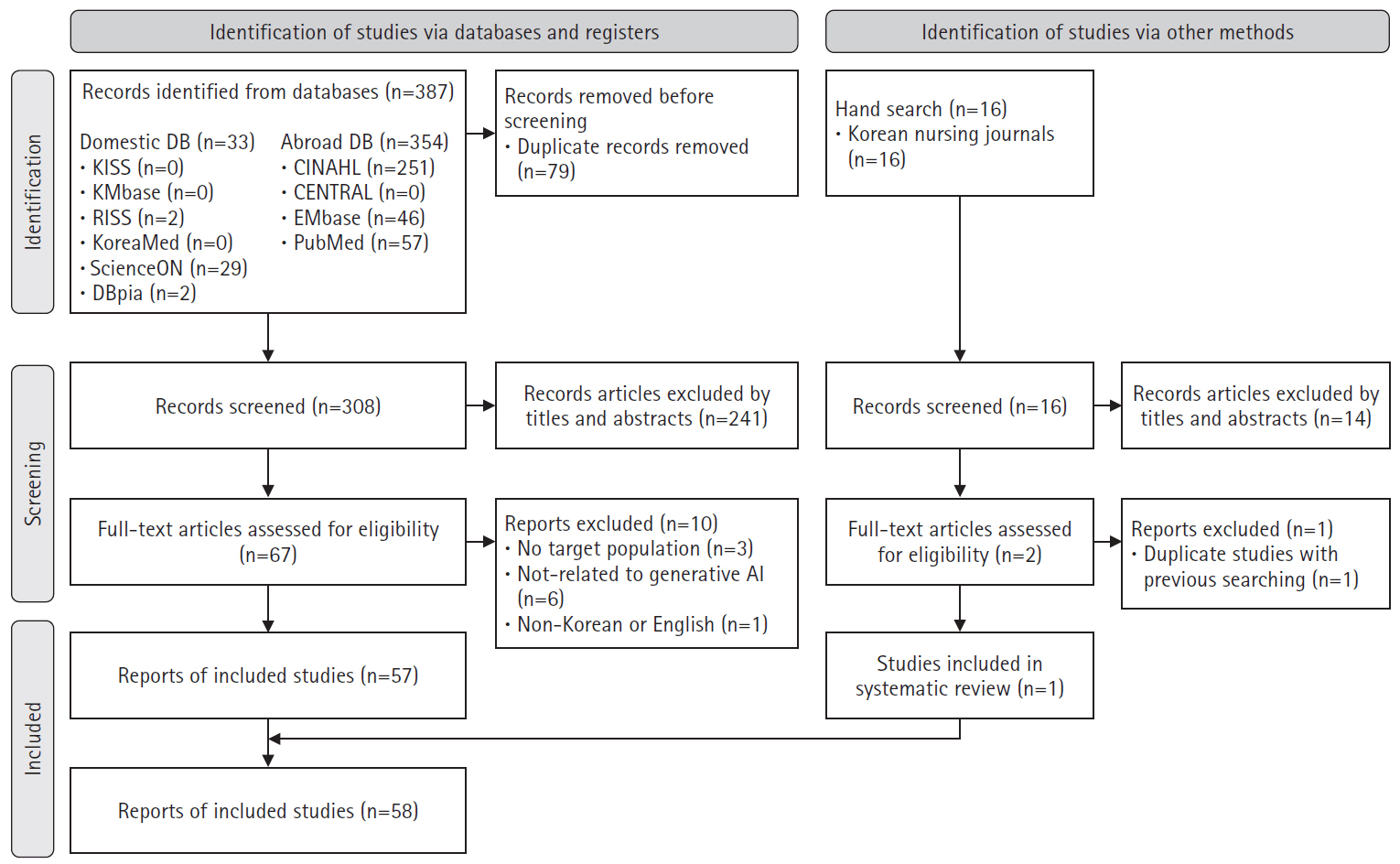
A scoping review was conducted following Arksey and O’Malley’s six-stage framework. The inclusion criteria included: (1) studies conducted in nursing; (2) research related to generative AI; and (3) original research articles, theses, communications, editorials, letters, or commentaries published in academic journals. Database used PubMed, Embase, CENTRAL, CINAHL, KMbase, KoreaMed, KISS, ScienceON, RISS, DBpia, and 27 nursing-specific journals.
Results
In total, 403 studies were initially identified, and 58 were included in the final analysis. In the care domain, strengths included rapid information retrieval and improved nurse-patient communication, while limitations included the irreplaceable human element and low reliability. The administration domain had no relevant studies. In the research domain, generative AI exhibited strengths such as enhanced efficiency in the paper writing process and improved dissemination speed, but its weaknesses included lack of ethical and legal accountability and a risk of inaccurate or biased information. In the education domain, generative AI was effective in saving time in educational design and implementation, as well as supporting content creation, but challenges included algorithmic bias and risks of plagiarism.
Conclusion
This study identified potential benefits and limitations of generative AI across nursing domains. For effective application, it is essential to develop comprehensive guidelines and policies, provide user education and support, and create opportunities for nurses, educators, and students to learn about strengths and risks of generative AI. -
Citations
Citations to this article as recorded by
- Generative AI use in instructor-assigned learning activities among nursing students: A cross-sectional survey of perceptions, ethical awareness, faculty restrictions, and continuance intention
Yun-Ting Huang, Hsiao-Fang Hsiung, Hui-Ling Lin, Li-Chun Chang, Li-Ling Liao
Nurse Education Today.2026; 165: 107162. CrossRef - Toward an end-to-end K-AI nursing ecosystem: digital twins across the care continuum
Jeung-Im Kim, Jiyeon Kang, YeoJin Im, Sung Reul Kim, Sun Ju Chang
Journal of Korean Academy of Nursing.2026; 56(2): 123. CrossRef - A concept analysis of generative artificial intelligence-based learning support in nursing education
Hyo Hoon Ku
The Journal of Korean Academic Society of Nursing Education.2026; 32(3): 393. CrossRef - Leadership Development Needs of Novice and Advanced Beginner Nurses: A Nationwide Cross-sectional Study Using Proportional Quota Sampling
Sunmi Kim, Seok Hee Jeong
Journal of Korean Academy of Nursing Administration.2026; 32(4): 275. CrossRef - Nursing Students' Perspectives on the Use of Artificial Intelligence in Psychiatric Nursing Education: A Qualitative Meta-Synthesis
Sukyung Son, Eunyoung Park
Journal of Korean Academy of psychiatric and Mental Health Nursing.2025; 34(Special Is): 9. CrossRef
- Generative AI use in instructor-assigned learning activities among nursing students: A cross-sectional survey of perceptions, ethical awareness, faculty restrictions, and continuance intention
- 14,204 View
- 1,094 Download
- 2 Web of Science
- 5 Crossref
Research Paper
- Effects of a nursing leadership program on self-leadership, interpersonal relationships, clinical performance, problem-solving abilities, and nursing professionalism among nursing students in South Korea: a quasi-experimental study
- Sunmi Kim, Young Ju Jeong, Hee Sun Kim, Seok Hee Jeong, Eun Jee Lee
- J Korean Acad Nurs 2025;55(1):137-151. Published online February 25, 2025
- DOI: https://doi.org/10.4040/jkan.24110
-
Abstract
PDFePub
- Purpose
This study investigated the effects of a nursing leadership program on self-leadership, interpersonal relationships, clinical performance, problem-solving abilities, and nursing professionalism among nursing students in South Korea.
Methods
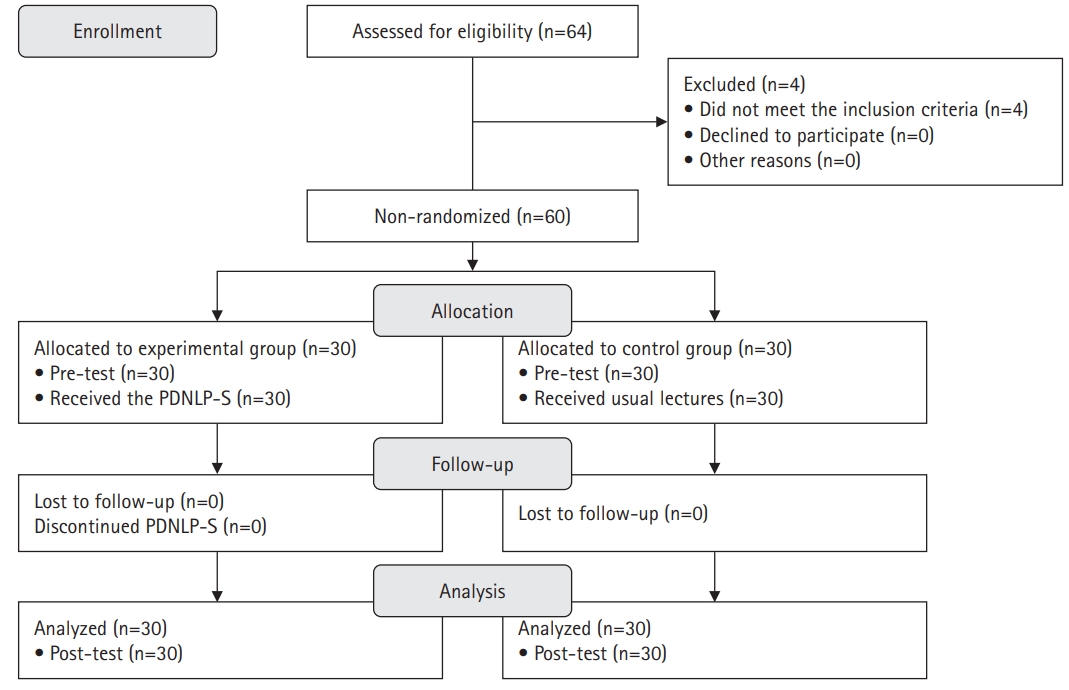
A quasi-experimental study was conducted. The Practice-Driven Nursing Leadership Program for Students (PDNLP-S) was developed based on the ADDIE model (analysis, design, development, implementation, and evaluation). This quasi-experimental study design included 60 nursing students. The experimental group (n=30) participated in the PDNLP-S for 120-minute sessions over 5 weeks, while the control group (n=30) received usual lectures. The PDNLP-S included lectures, discussions, and individual and group activities to cultivate core nursing leadership competencies such as individual growth, collaboration, nursing excellence, creative problem-solving, and influence. Data were analyzed using descriptive statistics, the Mann-Whitney U-test, and the independent t-test with IBM SPSS Windows ver. 26.0.
Results
The experimental group demonstrated significant improvements in self-leadership (t=3.28, p=.001), interpersonal relationships (t=3.07, p=.002), clinical performance (U=268.50, p=.004), and problem-solving abilities (t=2.20, p=.017) compared to the control group. No significant difference was observed in nursing professionalism (t=0.50, p=.311).
Conclusion
This study demonstrates that the PDNLP-S improved nursing students’ self-leadership, interpersonal relationships, clinical performance, and problem-solving abilities. The PDNLP-S can play a significant role in cultivating future nurse leaders by enhancing these nursing leadership competencies among nursing students. -
Citations
Citations to this article as recorded by- Psychosocial Predictors of Developmentally Supportive Care Competency Among NICU Nurses in South Korea: Self-Leadership, Emotional Intelligence, and Nursing Professionalism
So Jin Lee, Haeryun Cho
Advances in Neonatal Care.2026;[Epub] CrossRef - Self‐Leadership and Caring as Foundations of Relational Accountability in Nursing Clinical Judgement: A Conceptual Analysis
Mahmud Ady Yuwanto, Iyus Yosep, Iqbal Pramukti, Ati Surya Mediawati
Nursing Open.2026;[Epub] CrossRef - Efficacy of structured spiritual care education program on nurses’ spiritual well-being and clinical competence: a randomized controlled trial
Mehrvash Hemati, Azita Jaberi, Naval Heydari, Marzieh Momennasab
BMC Nursing.2026;[Epub] CrossRef - Leadership Development Needs of Novice and Advanced Beginner Nurses: A Nationwide Cross-sectional Study Using Proportional Quota Sampling
Sunmi Kim, Seok Hee Jeong
Journal of Korean Academy of Nursing Administration.2026; 32(4): 275. CrossRef - Self-Determination Theory in Return to Work Interventions: A Scoping Review
Kexin Chen, Ling Yang, Jiajia Tu
Journal of Multidisciplinary Healthcare.2025; Volume 18: 7539. CrossRef
- Psychosocial Predictors of Developmentally Supportive Care Competency Among NICU Nurses in South Korea: Self-Leadership, Emotional Intelligence, and Nursing Professionalism
- 11,704 View
- 460 Download
- 4 Web of Science
- 5 Crossref
Review Paper
- A Meta-Analytic Path Analysis on the Outcome Variables of Nursing Unit Managers’ Transformational Leadership: Systemic Review and Meta-Analysis
- Sunmi Kim, Seok Hee Jeong
- J Korean Acad Nurs 2020;50(6):757-777. Published online December 31, 2020
- DOI: https://doi.org/10.4040/jkan.20205
-
Abstract
PDF
- Purpose
The purpose of this study was to identify the outcome variables of nursing unit managers’ transformational leadership and to test a hypothetical model using meta-analytic path analysis.
Methods
A systematic review and meta-analysis were conducted in accordance with PRISMA guidelines. Data analysis, conducted using R version 3.6.2 software, included 49 studies for the meta-analysis and 119 studies for meta-analytic path analysis.
Results
In the meta-analysis, four out of 32 outcome variables were selected. These four variables were empowerment, nursing performance, job satisfaction, and organizational commitment, which showed larger effect sizes than the median and more than five k. The hypothetical model for the meta-analytic path analysis was established by using these four variables and transformational leadership. A total of 22 hypothetical paths including nine direct effects and 13 indirect effects were set and tested. The meta-analytic path analysis showed that transformational leadership had direct effects on the four variables. Finally, eight direct effects, 12 indirect effects, and six mediating effects were statistically significant, and the hypothetical model was verified.
Conclusion
Nursing unit managers can use the transformational leadership to improve empowerment, nursing performance, job satisfaction, and organizational commitment of nurses. This study empirically showed the importance of transformational leadership of nursing managers. This finding will be used as evidence to develop strategies for enhancing transformational leadership, empowerment, nursing performance, job satisfaction, and organizational commitment in nursing science and practice. -
Citations
Citations to this article as recorded by- Strategies Employed by Nursing Managers Within a Transformational Approach: A Qualitative Study
Gholamhossein Mahmoudirad, Ayob Akbari, Suja P. Davis
Nursing Research and Practice.2025;[Epub] CrossRef - Using Behaviour Diagnostics to Identify Enablers and Barriers to Optimise Nurse and Midwife Manager Leadership Time
Julie Considine, Philippa Blencowe, Naida Lumsden, Jordana Schlieff, Judy Currey, Abdulqadir J. Nashwan
Journal of Nursing Management.2025;[Epub] CrossRef - Leadership Development in Undergraduate Nursing Students: A Scoping Review
Patrícia Costa, Joana Pereira Sousa, Tiago Nascimento, Paulo Cruchinho, Elisabete Nunes, Filomena Gaspar, Pedro Lucas
Nursing Reports.2025; 15(5): 160. CrossRef - Effect of Nursing Managers’ Ethical Leadership on Clinical Nurse Empowerment, Performance, and Organizational Commitment
Jihun Kim, Seok Hee Jeong, Hee Sun Kim, Myung Ha Lee
Journal of Nursing Research.2025; 33(4): e400. CrossRef - Transformational Leadership, Psychological Empowerment, and Organizational Citizenship Behaviors among Nursing Workforce: A Single Mediation Analysis
Ibrahim Abdullatif Ibrahim, Ahmed Hashem El-Monshed, Marwan Altheeb, Mohamed Gamal El-Sehrawy, Abdulqadir J. Nashwan
Journal of Nursing Management.2024; 2024: 1. CrossRef - Personal and organisational attributes that support transformational leadership in acute healthcare: scoping review
Julie Considine, Jenny Dempster, Nga Man Wendy Wong, Noelleen Kiprillis, Leanne Boyd
Australian Health Review.2024; 48(3): 274 . CrossRef - Leadership styles and transformational leadership skills among nurse leaders in Qatar, a cross‐sectional study
Amer Al‐Thawabiya, Kalpana Singh, Badriya Abdulla Al‐Lenjawi, Albara Alomari
Nursing Open.2023; 10(6): 3440. CrossRef - Effects of Leadership Styles of Nursing Managers on Turnover Intention of Hospital Nurses: A Systematic Review and Meta-Analysis
Yunjeong Cho, Seok Hee Jeong, Hee Sun Kim, Young Man Kim
Journal of Korean Academy of Nursing.2022; 52(5): 479. CrossRef - Patient Safety Management Activities of Korean Nurses: A Meta-Analytic Path Analysis
Seohee Jeong, Seok Hee Jeong
Journal of Korean Academy of Nursing.2022; 52(4): 363. CrossRef - Nurses' ethical leadership and related outcome variables: Systematic review and meta‐analysis
Sunmi Kim, Seok Hee Jeong, Myoung Hee Seo
Journal of Nursing Management.2022; 30(7): 2308. CrossRef
- Strategies Employed by Nursing Managers Within a Transformational Approach: A Qualitative Study
- 4,492 View
- 217 Download
- 10 Web of Science
- 10 Crossref
 First
First Prev
Prev


