
 Submit an article

Search
- Page Path
- HOME > Search
Review Paper
- Variables associated with compliance with standard precautions among hospital nurses: a systematic review and meta-analysis
- Song Hee Park, Seok Hee Jeong, Chang Seop Lee, Young Man Kim
- J Korean Acad Nurs 2026;56(1):1-26. Published online February 27, 2026
- DOI: https://doi.org/10.4040/jkan.25114
-
 Abstract
 PDF
PDF - Purpose
This study aimed to conduct a systematic review and meta-analysis to identify variables associated with standard precautions compliance among hospital nurses and to comprehensively examine their effect sizes.
Methods
A systematic review and meta-analysis were reported in accordance with the PRISMA and MOOSE guidelines. Studies published in English or Korean were retrieved from KMbase, KoreaMed, KISS, ScienceON, RISS, Nanet, DBpia, PubMed, Embase, CINAHL, and CENTRAL. Data collection was conducted from July 6 to July 16, 2024. To ensure a comprehensive search, no restrictions were placed on the publication period, and studies published up to June 2024 were included in the literature search. Analyses were performed using R ver. 4.4.1.
Results
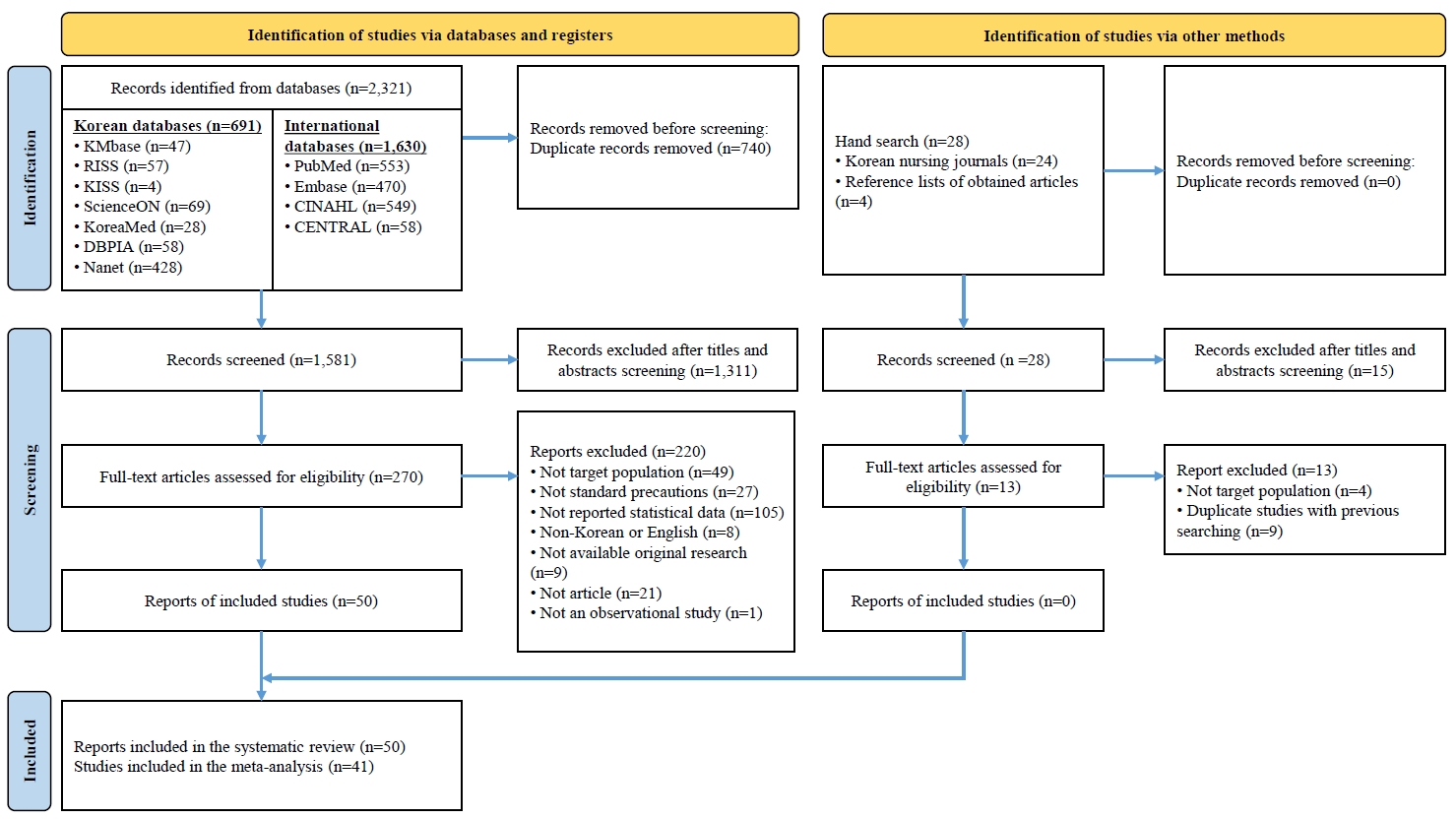
Of the 2,321 studies screened, 50 were included in the systematic review and 41 were included in the meta-analysis. Variables were categorized according to the ecological model. Among individual-level factors, variables with medium correlation effect sizes (ESr ≥.30) included self-efficacy (ESr=.41; 95% confidence interval [CI], 0.24 to 0.56), perceived barriers (ESr=−.35; 95% CI, −0.59 to −0.05), cues to action (ESr=.34; 95% CI, 0.07 to 0.57), and perceived benefits (ESr=.30; 95% CI, 0.13 to 0.46). Among organizational factors, organizational culture for infection control (ESr=.47; 95% CI, 0.39 to 0.54) and patient safety culture (ESr=.44; 95% CI, 0.35 to 0.53) demonstrated medium effect sizes. Other statistically significant variables with small effect sizes were also identified. No variables were identified within the interpersonal, community, or public policy domains.
Conclusion
This study identified self-efficacy and organizational culture for infection control as key determinants of compliance with standard precautions. Strengthening these factors may reduce healthcare-associated infections and promote safer nursing care (PROSPERO registration number: CRD42024566518). -
Citations
Citations to this article as recorded by
- Factors influencing intensive care unit nurses’ performance of standard precautions in South Korea: a descriptive correlational study
Hana Seo, Nahyun Kim
Journal of Korean Biological Nursing Science.2026; 28(2): 300. CrossRef
- Factors influencing intensive care unit nurses’ performance of standard precautions in South Korea: a descriptive correlational study
- 3,432 View
- 391 Download
- 1 Crossref

Research Paper
- Media discourse on physician assistant nurses in South Korea: a text network and topic modeling approach
- Young Gyu Kwon, Daun Jeong, Song Hee Park, Mi Kyung Kim, Chan Woong Kim
- J Korean Acad Nurs 2025;55(3):388-399. Published online July 30, 2025
- DOI: https://doi.org/10.4040/jkan.25038
-
Abstract
PDF
 ePub
ePub - Purpose
This study quantitatively examined the portrayal of physician assistant (PA) nurses in Korean media by integrating text network analysis with latent Dirichlet allocation (LDA) topic modeling.
Methods
A total of 3,564 news articles published by nine major Korean media outlets between 2020 and 2024 were analyzed. Content analysis was conducted using term frequency-inverse document frequency calculations, network centrality analysis, and LDA topic modeling to extract key terms, map discourse structures, and identify latent topics.
Results
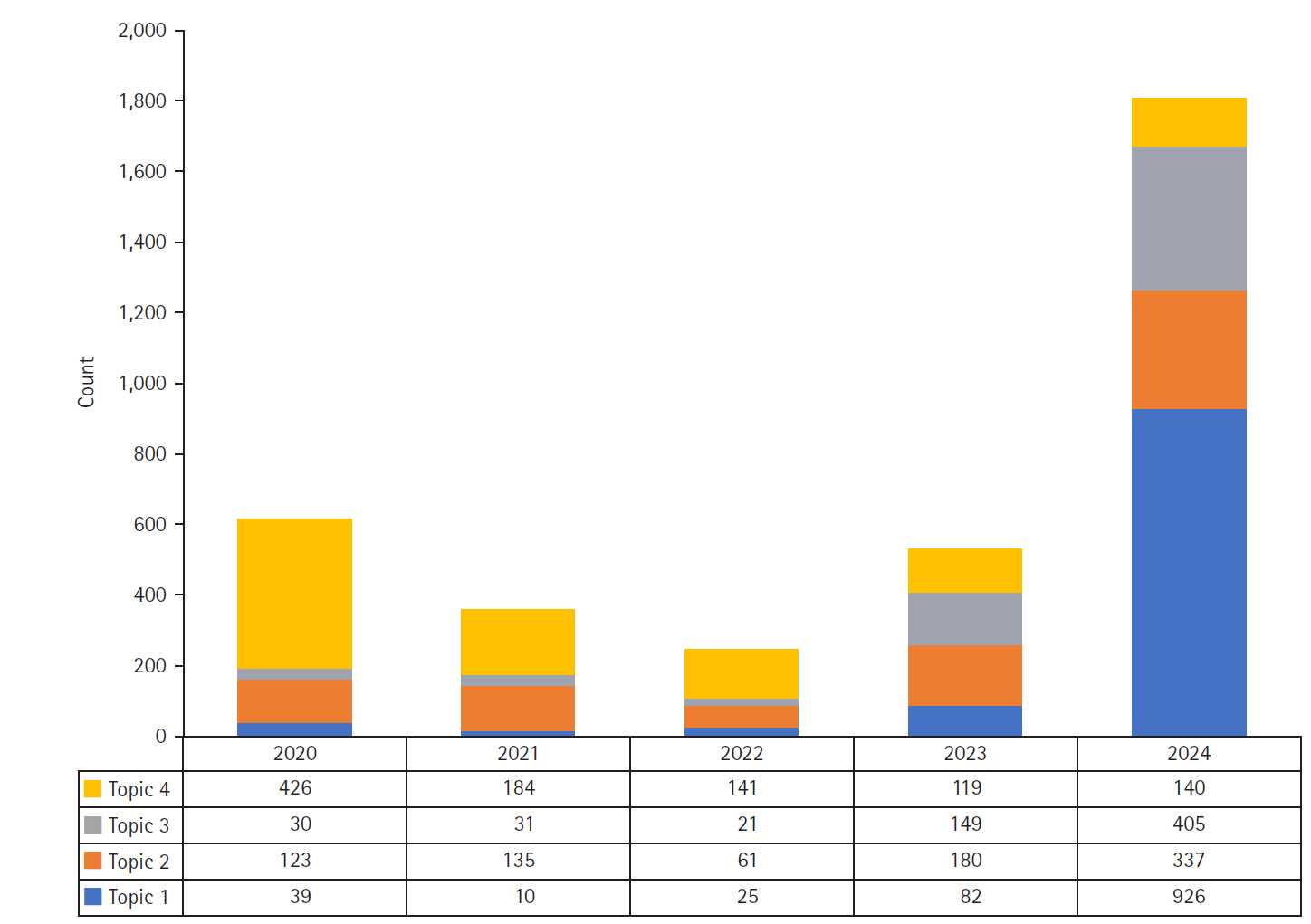
The analysis identified four primary topics in Korean media discourse: “healthcare workforce expansion policies” (30.4%), “hospital clinical practice and operational management” (23.5%), “institutionalization of the PA nursing role” (17.8%), and “COVID-19 response and public health crisis management” (28.3%). High-centrality keywords included “hospital,” “medical,” “patient,” “physician,” “government,” and “nurse,” indicating that the discourse primarily focused on clinical settings. Topic modeling revealed a major shift from pandemic-centered coverage in 2020 to a focus on healthcare workforce policy and PA nurse institutionalization in 2024, coinciding with the passage of the Nursing Act.
Conclusion
This study provides empirical evidence suggesting that the portrayal of PA nurses in Korean media discourse evolved from a peripheral regulatory issue to a central healthcare delivery solution, particularly in the contexts of workforce management, clinical practice, and crisis response. Our findings suggest that PA nurse institutionalization received broader attention when positioned as part of systemic healthcare improvements addressing concrete clinical needs. These results offer valuable insights for policymakers and administrators in framing and implementing workforce policy reforms. -
Citations
Citations to this article as recorded by- Impact of role conflict and job stress on turnover intention among Korean physician assistant nurses: A cross-sectional study
Jin-Won Lee, Eun-Hi Choi, Ji-Sun Back
International Journal of Nursing Sciences.2026; 13(2): 172. CrossRef
- Impact of role conflict and job stress on turnover intention among Korean physician assistant nurses: A cross-sectional study
- 4,645 View
- 155 Download
- 1 Web of Science
- 1 Crossref
 First
First Prev
Prev


