
 Submit an article

Search
- Page Path
- HOME > Search
Review Papers
- Migrant health research in South Korea, 2010–2021: a scoping review
- Soo Jin Kang, Bok-Nam Seo
- J Korean Acad Nurs 2026;56(2):126-147. Published online May 19, 2026
- DOI: https://doi.org/10.4040/jkan.25152
-
 Abstract
 PDF
PDF ePub
ePub - Purpose
This scoping review mapped research trends in migrant health in Korea and evaluated their alignment with global priorities.
Methods
We conducted a scoping review using the Arksey and O’Malley framework. We searched PubMed, CINAHL, Scopus, KoreaMed, ScienceON, RISS, and KISS for articles published between 2010 and 2021, which defined the review period. The inclusion criteria were studies of adult migrants residing in Korea, primary empirical research, and academic journal articles with full text available in Korean or English. Two reviewers performed inductive coding and assigned each study to one primary subject area for frequency counts.
Results
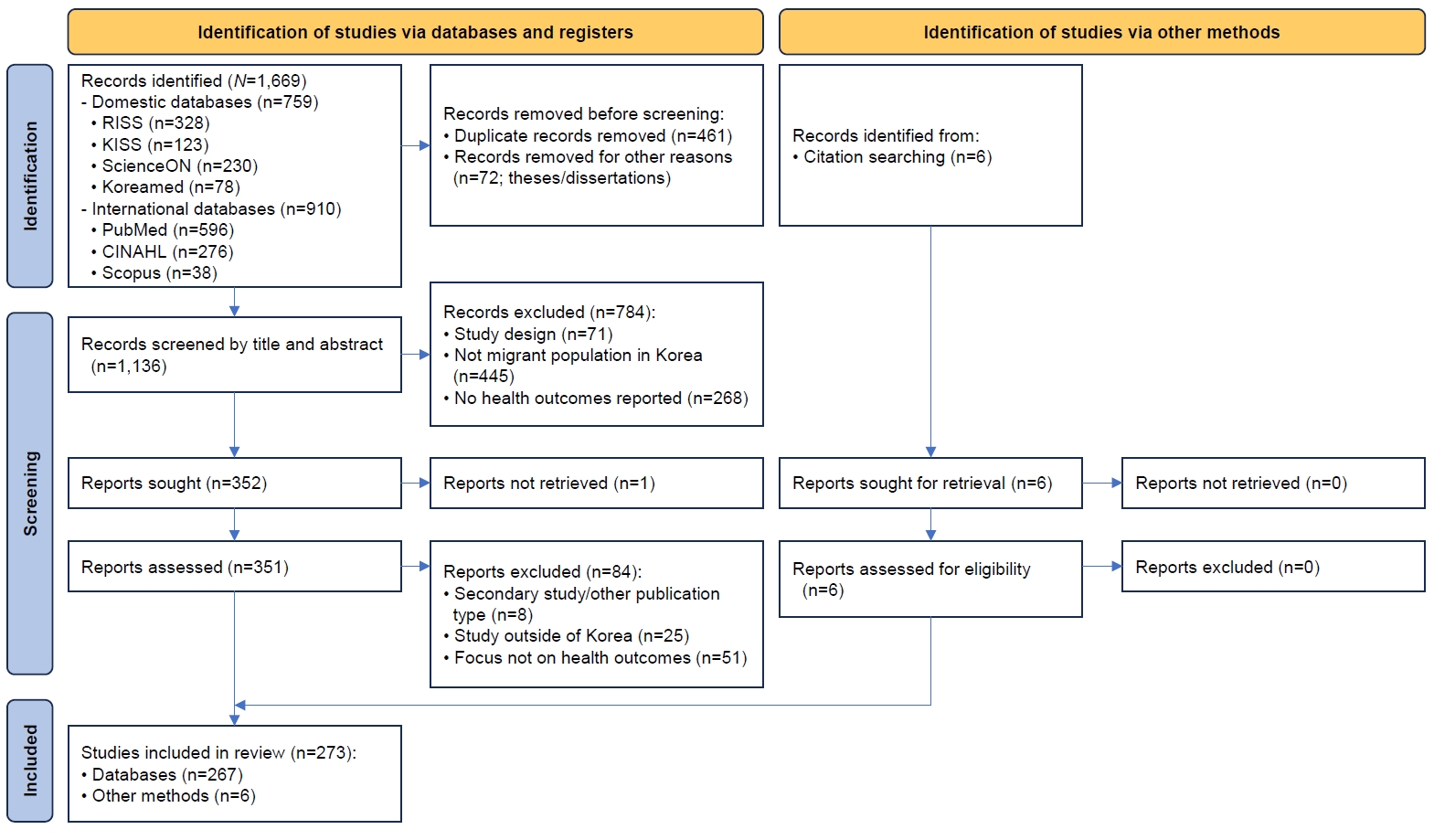
Of 1,669 records, 273 studies met the inclusion criteria. Marriage-migrant women were the most frequently studied group (56.4%), followed by migrant workers (20.5%) and international students (7.0%). Ten subject areas were identified. Mental health (56/273; 20.5%) and health status and quality of life (47/273; 17.2%) were the most common, whereas infection was the least common (6/273; 2.2%). According to World Health Organization priority areas, P4 (tackling the social determinants of health) was the most common (132/273; 48.4%), followed by P1 (promoting health through public health interventions) (73/273; 26.7%). P3 (mainstreaming health policies and fostering partnerships) and P5 (strengthening health monitoring and information systems) were minimally represented (6/273; 2.2% and 11/273; 4.0%, respectively).
Conclusion
Migrant health research in Korea is heavily concentrated on individual-level topics and marriage-migrant populations, with limited evidence on policies, monitoring systems, and underserved groups (e.g., refugees and diverse populations). Future studies should diversify the populations examined, standardize national monitoring and linked data infrastructure, strengthen the P3 and P5 priority areas, and include more longitudinal, interventional, and policy evaluation research.
- 2,128 View
- 216 Download

- Research trends in generative artificial intelligence in nursing: a scoping review
- Myung Jin Choi, Myoung Hee Seo, Jihun Kim, Sunmi Kim, Seok Hee Jeong
- J Korean Acad Nurs 2025;55(3):468-487. Published online August 5, 2025
- DOI: https://doi.org/10.4040/jkan.25006
-
Abstract
PDFePub
- Purpose
Generative artificial intelligence (AI) has yet to be comprehensively analyzed in the nursing literature. This study aimed to identify research trends in generative AI within the nursing field through a scoping review and propose strategies for its effective utilization in nursing.
Methods
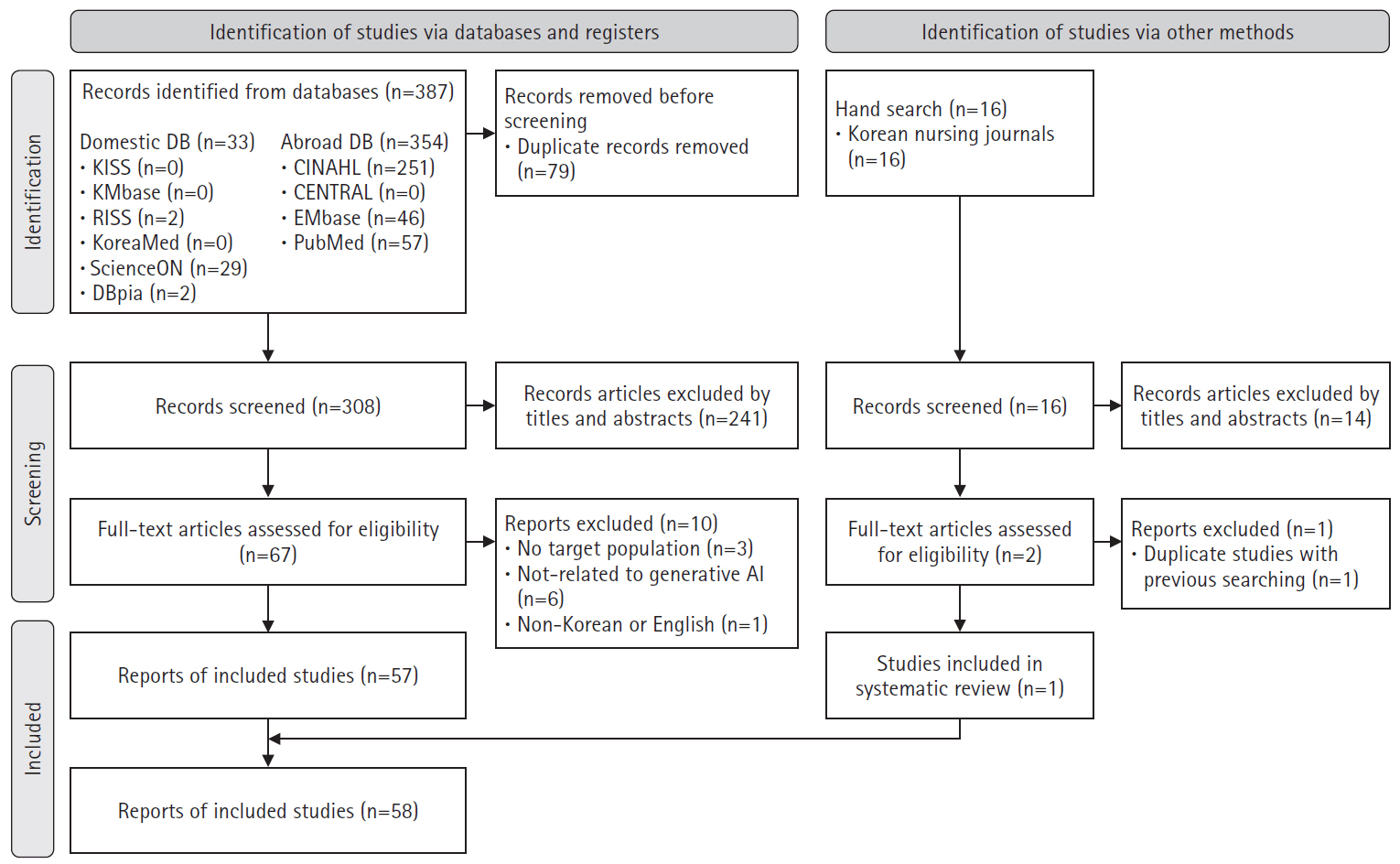
A scoping review was conducted following Arksey and O’Malley’s six-stage framework. The inclusion criteria included: (1) studies conducted in nursing; (2) research related to generative AI; and (3) original research articles, theses, communications, editorials, letters, or commentaries published in academic journals. Database used PubMed, Embase, CENTRAL, CINAHL, KMbase, KoreaMed, KISS, ScienceON, RISS, DBpia, and 27 nursing-specific journals.
Results
In total, 403 studies were initially identified, and 58 were included in the final analysis. In the care domain, strengths included rapid information retrieval and improved nurse-patient communication, while limitations included the irreplaceable human element and low reliability. The administration domain had no relevant studies. In the research domain, generative AI exhibited strengths such as enhanced efficiency in the paper writing process and improved dissemination speed, but its weaknesses included lack of ethical and legal accountability and a risk of inaccurate or biased information. In the education domain, generative AI was effective in saving time in educational design and implementation, as well as supporting content creation, but challenges included algorithmic bias and risks of plagiarism.
Conclusion
This study identified potential benefits and limitations of generative AI across nursing domains. For effective application, it is essential to develop comprehensive guidelines and policies, provide user education and support, and create opportunities for nurses, educators, and students to learn about strengths and risks of generative AI. -
Citations
Citations to this article as recorded by
- Generative AI use in instructor-assigned learning activities among nursing students: A cross-sectional survey of perceptions, ethical awareness, faculty restrictions, and continuance intention
Yun-Ting Huang, Hsiao-Fang Hsiung, Hui-Ling Lin, Li-Chun Chang, Li-Ling Liao
Nurse Education Today.2026; 165: 107162. CrossRef - Toward an end-to-end K-AI nursing ecosystem: digital twins across the care continuum
Jeung-Im Kim, Jiyeon Kang, YeoJin Im, Sung Reul Kim, Sun Ju Chang
Journal of Korean Academy of Nursing.2026; 56(2): 123. CrossRef - A concept analysis of generative artificial intelligence-based learning support in nursing education
Hyo Hoon Ku
The Journal of Korean Academic Society of Nursing Education.2026; 32(3): 393. CrossRef - Nursing Students' Perspectives on the Use of Artificial Intelligence in Psychiatric Nursing Education: A Qualitative Meta-Synthesis
Sukyung Son, Eunyoung Park
Journal of Korean Academy of psychiatric and Mental Health Nursing.2025; 34(Special Is): 9. CrossRef
- Generative AI use in instructor-assigned learning activities among nursing students: A cross-sectional survey of perceptions, ethical awareness, faculty restrictions, and continuance intention
- 13,179 View
- 1,031 Download
- 2 Web of Science
- 4 Crossref
- Factors Related to Emotional Leadership in Nurses Manager: Systematic Review and Meta-Analysis
- Se Young Jang, Chan Mi Park, Eun Hee Yang
- J Korean Acad Nurs 2024;54(2):119-138. Published online May 31, 2024
- DOI: https://doi.org/10.4040/jkan.24026
-
Abstract
PDF
- Purpose
This study aimed to identify research trends related to emotional leadership among nurse managers by conducting a systematic literature review and meta-analysis. This study sought to derive insights that could contribute to improving emotional leadership in nursing practice.
Methods
A systematic review and meta-analysis were conducted according to the Preferred Reporting Items for Systematic Reviews and Meta-Analysis (PRISMA) and Meta-Analysis Of Observational Studies in Epidemiology (MOOSE) guidelines. Databases including PubMed, Cumulative Index to Nursing and Allied Health Literature, Scopus, Web of Science, Research Information Sharing Service, Koreanstudies Information Service System, Korean Medical Database, KoreaMed, ScienceON, and DBpia were searched to obtain papers published in English and Korean. Literature searches and screenings were conducted for the period December 1, 2023 to December 17, 2023. The effect size correlation (ESr) was calculated for each variable and the meta-analysis was performed using the statistical software SPSS 29.0, R 4.3.1.
Results
Twenty-five (four personal, six job, and fifteen organizational) relevant variables were identified through the systematic review. The results of the meta-analysis showed that the total overall effect size was ESr = .33. Job satisfaction (ESr = .40) and leader-member exchange (ESr = .75) had the largest effect size among the job and organizational-related factors.
Conclusion
Emotional leadership helps promote positive changes within organizations, improves organizational effectiveness, and increases member engagement and satisfaction. Therefore, it is considered an important strategic factor in improving organizational performance. -
Citations
Citations to this article as recorded by- Emotional leadership in health care: A dire need illuminated by pivotal resource cuts
Jacqueline Hoare
South African Journal of Science.2025;[Epub] CrossRef
- Emotional leadership in health care: A dire need illuminated by pivotal resource cuts
- 5,398 View
- 259 Download
- 1 Web of Science
- 1 Crossref
- Descriptive Review of Patents in Healthcare and Nursing: Based on Network Analysis
- Misun Jeon, Nayung Youn, Sanghee Kim
- J Korean Acad Nurs 2024;54(1):1-17. Published online February 29, 2024
- DOI: https://doi.org/10.4040/jkan.23064
-
Abstract
PDF
- Purpose
The significance of the healthcare industry has grown exponentially in recent years due to the impact of the fourth industrial revolution and the ongoing pandemic. Accordingly, this study aimed to examine domestic healthcare-related patents comprehensively. Big data analysis was used to present the trend and status of patents filed in nursing.
Methods
The descriptive review was conducted based on Grant and Booth’s descriptive review framework. Patents related to nursing was searched in the Korea Intellectual Property Rights Information Service between January 2016 to December 2020. Data analysis included descriptive statistics, phi-coefficient for correlations, and network analysis using the R program (version 4.2.2).
Results
Among 37,824 patents initially searched, 1,574 were selected based on the inclusion criteria. Nursing-related patents did not specify subjects, and many patents (41.4%) were related to treatment in the healthcare delivery phase. Furthermore, most patents (56.1%) were designed to increase effectiveness. The words frequently used in the titles of nursing-related patents were, in order, “artificial intelligence,” “health management,” and “medical information,” and the main terms with high connection centrality were “artificial intelligence” and “therapeutic system.” Conclusion: The industrialization of nursing is the best solution for developing the healthcare industry and national health promotion. Collaborations in education, research, and policy will help the nursing industry become a healthcare industry of the future. This will prime the enhancement of the national economy and public health.
- 3,860 View
- 113 Download
Invited Paper
- Analysis of Research Topics and Trends in the Journal of Korean Academy of Nursing to Improve Its International Influence
- Soyoung Yu, Jeung-Im Kim, Jin-Hee Park, Sun Joo Jang, Eunyoung E. Suh, Ju-Eun Song, YeoJin Im
- J Korean Acad Nurs 2020;50(4):501-512. Published online August 31, 2020
- DOI: https://doi.org/10.4040/jkan.20167
-
Abstract
PDF
- Purpose
The purpose of this study was to analyze articles published in the Journal of the Korean Academy of Nursing (JKAN) between 2010 and 2019, along with those published in three international nursing journals, to improve JKAN’s international reputation.
Methods
The overall characteristics of JKAN’s published papers and keywords, study participants, types of nursing interventions and dependent variables, citations, and cited journals were analyzed. Additionally, the keywords and study designs, publication-related characteristics, journal impact factors (JIF), and Eigenfactor scores of International Journal of Nursing Studies (IJNS), International Nursing Review (INR), Nursing & Health Sciences (NHS), and JKAN were analyzed and compared.
Results
Among the four journals, JKAN’s score was the lowest in both the journal impact factor and Eigenfactor score. In particular, while the JIF of INR and NHS has been continuously increasing; JKAN’s JIF has remained static for almost 10 years. The journals which had cited JKAN and those which JKAN had cited were mainly published in Korean.
Conclusion
JKAN still has a low IF and a low ranking among Social Citation Index (E) journals during the past 10 years, as compared to that of four international journals. To enhance JKAN’s status as an international journal, it is necessary to consider publishing it in English and to continuously improve the conditions of other publications. -
Citations
Citations to this article as recorded by- Methodological and Thematic Trends in the Korean Journal of Adult Nursing (2015–2024)
Eunok Park, Jungsun Lee, Jeong Hee Kim, JinShil Kim, Haeng-Mi Son, Jeonghyun Cho, Bohyun Park
Korean Journal of Adult Nursing.2026; 38(2): 155. CrossRef - A descriptive and bibliometric trend analysis of biological nursing research in the Journal of Korean Biological Nursing Science (2011–2025)
Hohyun Seong, Sungwon Lim, Jae Sim Jeong, Gyeong Ju An, Youn-Jung Kim
Journal of Korean Biological Nursing Science.2026; 28(2): 217. CrossRef - Ten-year trends in research designs and keywords: a bibliometric comparison of the Journal of Korean Academy of Nursing and leading international nursing journals
Jin-Hee Park, Hyun Kyoung Kim, Gaeun Kim, Sun Hyoung Bae
Journal of Korean Academy of Nursing.2025; 55(4): 557. CrossRef - Commemorating the 50th Anniversary of Korean Society of Nursing Science and Contemplating Direction to Move Forward
Kyung-Sook Cho
Journal of Korean Academy of Nursing.2020; 50(5): 641. CrossRef
- Methodological and Thematic Trends in the Korean Journal of Adult Nursing (2015–2024)
- 3,439 View
- 32 Download
- 2 Web of Science
- 4 Crossref
 First
First Prev
Prev


