-
Nurse retention discourse in YouTube comments: a structural topic modeling analysis
-
Taewha Lee, JooHyun Lee
-
J Korean Acad Nurs 2026;56(2):206-219. Published online May 18, 2026
-
DOI: https://doi.org/10.4040/jkan.25172
-
-
 Abstract Abstract
 PDF PDF ePub ePub
- Purpose
This study analyzed public discourse on nurse retention through YouTube comments posted between 2018 and 2024 to examine how retention issues are collectively framed in online public spheres, thereby extending individual-level retention research to societal-level discourse analysis.
Methods
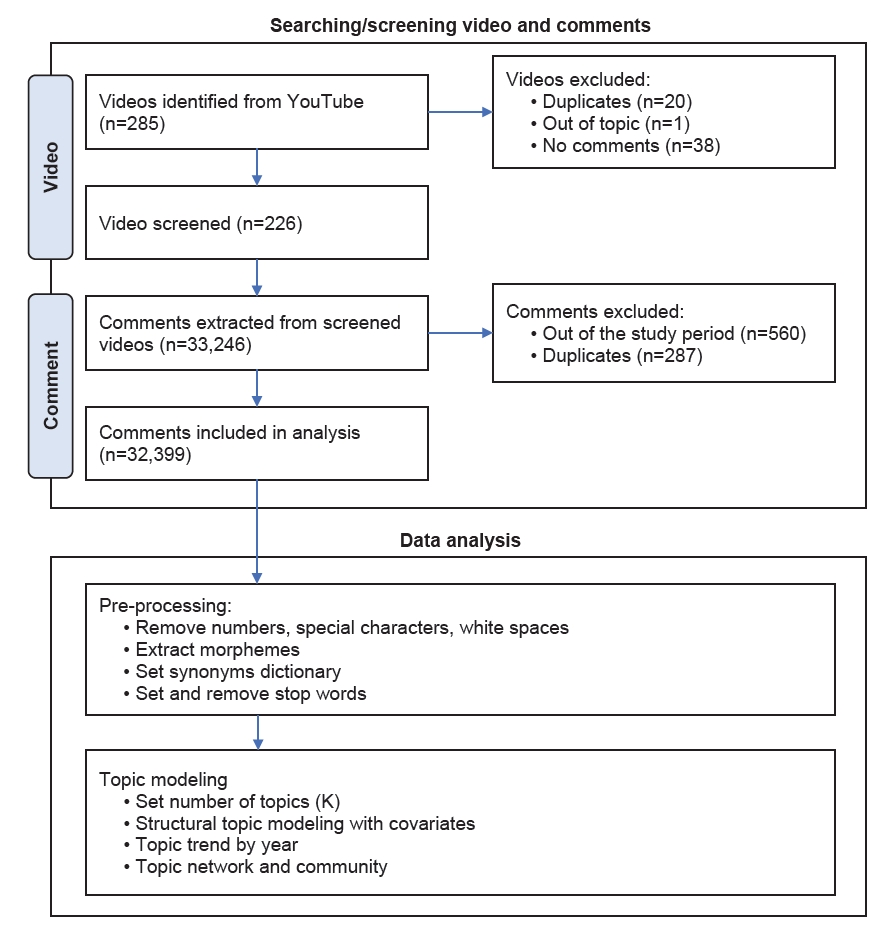
Comments were collected from 226 YouTube videos uploaded between January 2015 and December 2024, identified using search terms that combined “nurse” with retention-related keywords. After duplicates and comments posted outside the study period were removed, 32,399 comments were analyzed using structural topic modeling with year and number of likes as covariates. Topic correlation network analysis with community detection was used to identify discourse coalitions.
Results
Fourteen substantive topics and one noninterpretive topic emerged, spanning individual coping strategies, organizational workplace issues, and systemic policy structures. “International nursing migration and career pathways” (12.8%) and “Disputes regarding the scope of practice among professionals” (11.4%) were the most prevalent topics. Temporal analysis revealed discourse shifts consistent with focusing events theory: COVID-19 (coronavirus disease 2019) activated structural critique frames while suppressing career mobility discourse; the 2022 Nursing Law followed an issue-attention cycle pattern; and the 2024 medical school quota expansion embedded retention discourse within broader healthcare policy debates. Network analysis identified two discourse communities, professional identity and structural exploitation, with international migration serving as a bridging frame across both.
Conclusion
Public discourse framed nurse retention as a systemic and structural issue rather than as an expression of individual professional rejection. These collective framing patterns complement traditional survey-based research and may inform policy design by identifying which frames achieve public resonance and where discourse fragmentation may challenge policy implementation.
-
Health Behaviors between a Health Promotion Demonstration Health Center and a General Health Center
-
Taewha Lee, Chung Yul Lee, Hee Soon Kim, Ok Kyung Ham
-
Journal of Korean Academy of Nursing 2005;35(3):461-468. Published online June 30, 2005
-
DOI: https://doi.org/10.4040/jkan.2005.35.3.461
-
-
Abstract
PDF
-
Purpose
The purpose of the study was to compare community residents' perceptions, participation, satisfaction, and behavioral changes between a health promotion demonstration health center and general health center.
Method
The design of the study was ex-post facto that compared community residents in demonstration health centers and general health centers. The sample included 2,261 community residents who were conveniently selected from demonstration (792 participants) and general health centers (1,496 participants).
Result
The results of the study were as follows: 1) Perception and participation rates of exercise, nutrition, and hypertension management programs were significantly higher in the participants of demonstration health centers than those of general health centers.; 2) Satisfaction rates of all programs except the smoking cessation program were significantly higher in the participants of demonstration health centers than those of general health centers. However, only the exercise rate among risk behaviors of participants was significantly higher in demonstration health centers than general health centers.
Conclusion
Systematic efforts for health promotion were effective not only in improving the community's awareness, participation, and satisfaction of the program, but also in changing health behaviors. This evidence should be used to foster and disseminate health promotion programs toother health centers to improve community residents' health status and quality of life.
-
Citations
Citations to this article as recorded by  - The Influence of Local Residents’ Perception about National Healthcare Projects on the Level of Satisfaction
You Ho Kim
Journal of Health Informatics and Statistics.2019; 44(4): 375. CrossRef - Utilization and Factors Associated in Public Health Centers in Incheon Metropolitan City
Gyeong-Soon Han
Journal of dental hygiene science.2015; 15(6): 728. CrossRef - The Effect of a Health Promotion Program through Multi-level Health Promotion
Gyung-Hee Kim, Hee Sang Yoon
Journal of Korean Academy of Community Health Nursing.2010; 21(1): 92. CrossRef
-
1,396
View
-
0
Download
-
3
Crossref
-
Methodological Issues in Nursing Research on Cost-Effectiveness Analysis
-
Taewha Lee
-
Journal of Korean Academy of Nursing 2001;31(7):1202-1209. Published online March 29, 2017
-
DOI: https://doi.org/10.4040/jkan.2001.31.7.1202
-
-
Abstract
PDF
Cost effectiveness is a recent and newly emerging approach in nursing evaluation studies. Nursing is in a unique position among health care providers to respond to these efforts and is ready to provide evidence of its cost-effectiveness because nurses has long advocated a holistic view of patient care, that means, nurses are unique position to identify the full range of costs and effects. The cumulative evidence showed that nurses provided cost-effective care that substituted for physician services in many situations and new and important services in long-term care and nursing homes. The purpose of this article is to review, critique, and synthesize research on the cost-effectiveness of nursing care from the research methodology perspective. Two major problems are apparent from this review. First, there is no uniform approach to identifying and valuing resources used in producing nursing intervention options. Second, although it is not difficult to find reports of cost savings, the cost to effect ratio was not used to evaluate the relationship between the cost and effects of alternative options. Based on my analysis, the nursing CEA literature seemed to have huge variation in methods, so that it is not easy to compare the CEA methods among studies. There are still such methodological problems as we found in the literature review. Many of the studies reviewed here would have profited from improved designs. Therefore, future cost-effectiveness analyses should include methodological progress in the context of nursing area application such as the definition and quantification of multi-attribute effectiveness measures, employment of sensitivity analysis, a concept of discount. Nurse and nurse researchers should consider cost-effectiveness questions when addressing other research questions. Because these efforts are forcing policy makers to consider the economics of nursing, nurses should demonstrate and document the value of nursing as compared to other uses of society's health care resources.
-
Citations
Citations to this article as recorded by - Economic Evaluation of Enhancing Nurse Educational Level on In-Hospital Mortality: Cost per Prevented Death Analysis
Rasmus Emil Sørensen, Mads Christian Holst
Journal of Medical Sciences and Interdisciplinary Research.2025; 5(1): 108. CrossRef - Cost-effectiveness Analysis of Home Care Services for Patients with Diabetic Foot
Chong Rye Song, Yong Soon Kim, Jin Hyun Kim
Journal of Korean Academy of Nursing Administration.2013; 19(4): 437. CrossRef
-
1,322
View
-
3
Download
-
2
Crossref
|

 Submit an article