-
Effects of a health literacy program on COVID-19 awareness and preventive behaviors among older adults in Bangkok, Thailand: a quasi-experimental study
-
Walaya Tupanich, Sasawan Attaworakun, Suteekarn Chaiyalap, Nattanan Wattanawikan
-
J Korean Acad Nurs 2026;56(3):306-317. Published online July 28, 2026
-
DOI: https://doi.org/10.4040/jkan.25147
-
-
 Abstract Abstract
 PDF PDF ePub ePub
- Purpose
This study examined the effectiveness of a health literacy (HL) enhancement program in improving awareness of and preventive behaviors related to coronavirus disease 2019 (COVID-19) among older adults in an urban community in Bangkok, Thailand.
Methods
This quasi-experimental study included 76 older adults in Dusit District, Bangkok. Eight participants were lost to follow-up; however, all 76 participants (38 per group) were included in the primary analysis using all available observations. The intervention was based on Pengjuntr’s V-shape HL model, which includes six domains: access, understanding, interactive communication, decision-making, behavior change, and advocacy. The program was delivered through group sessions, LINE-based communication, community activities, and home visits. Data were collected at pre-test (baseline), post-test (4 weeks), and follow-up (12 weeks) using questionnaires. Outcomes were analyzed using linear mixed-effects models. This study was retrospectively registered with the Thai Clinical Trials Registry (TCTR20260502013).
Results
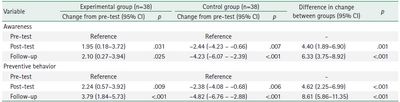
At post-test, the experimental group had significantly higher COVID-19 awareness and preventive behavior scores than the control group (p<.001). Within-group analysis showed significant improvements in both COVID-19 awareness and preventive behavior at post-test and follow-up. Significant between-group differences were also observed at follow-up (p<.001), with higher scores in the experimental group.
Conclusion
The intervention group receiving the HL enhancement program showed significant improvements in both COVID-19 awareness and preventive behaviors, which were sustained through follow-up. These findings support the use of nurse-led, community-based HL interventions with behavioral reinforcement to promote COVID-19 prevention among urban older adults.
|

 Submit an article