-
Migrant health research in South Korea, 2010–2021: a scoping review
-
Soo Jin Kang, Bok-Nam Seo
-
J Korean Acad Nurs 2026;56(2):126-147. Published online May 19, 2026
-
DOI: https://doi.org/10.4040/jkan.25152
-
-
 Abstract Abstract
 PDF PDF ePub ePub
- Purpose
This scoping review mapped research trends in migrant health in Korea and evaluated their alignment with global priorities.
Methods
We conducted a scoping review using the Arksey and O’Malley framework. We searched PubMed, CINAHL, Scopus, KoreaMed, ScienceON, RISS, and KISS for articles published between 2010 and 2021, which defined the review period. The inclusion criteria were studies of adult migrants residing in Korea, primary empirical research, and academic journal articles with full text available in Korean or English. Two reviewers performed inductive coding and assigned each study to one primary subject area for frequency counts.
Results
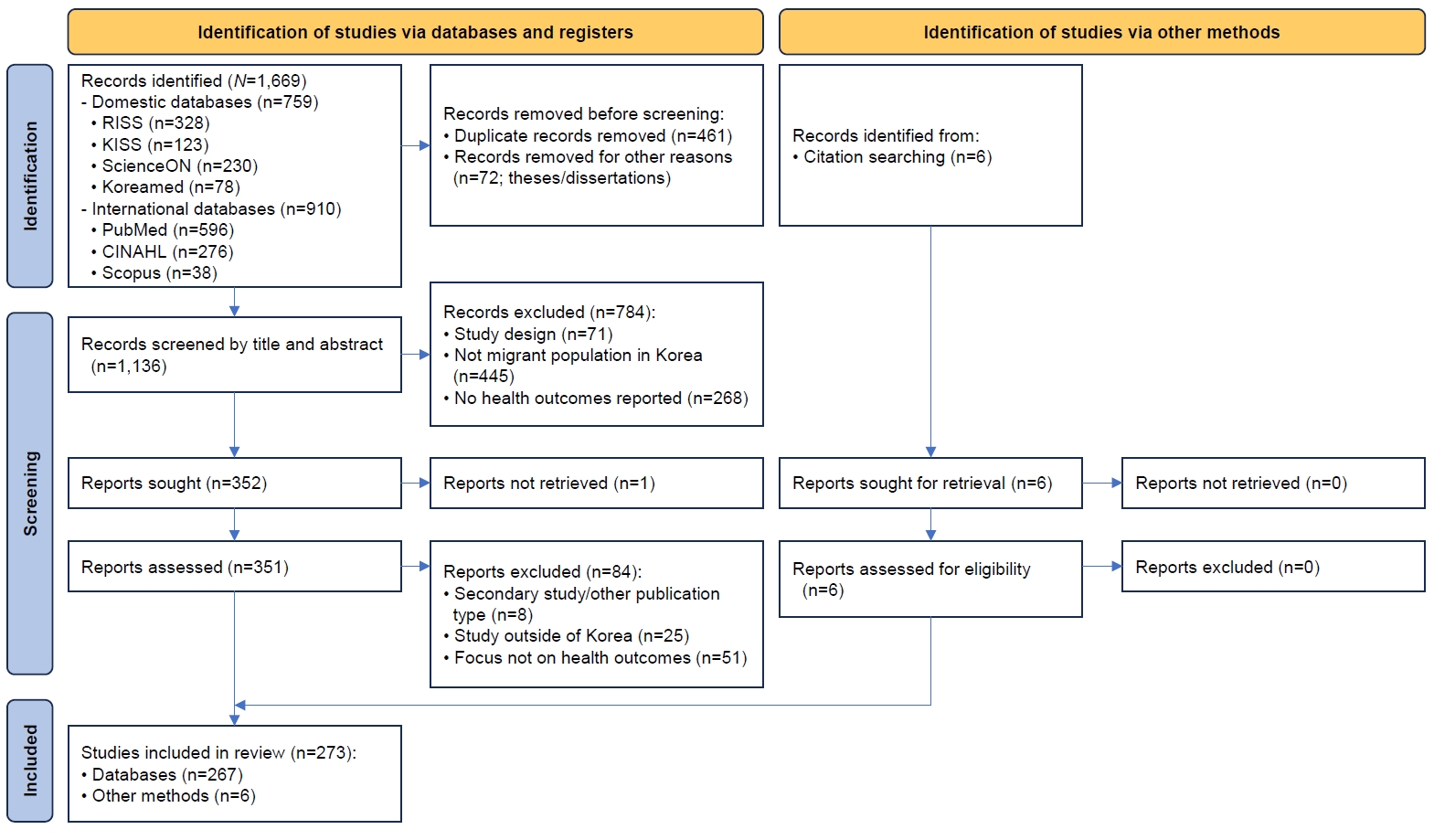
Of 1,669 records, 273 studies met the inclusion criteria. Marriage-migrant women were the most frequently studied group (56.4%), followed by migrant workers (20.5%) and international students (7.0%). Ten subject areas were identified. Mental health (56/273; 20.5%) and health status and quality of life (47/273; 17.2%) were the most common, whereas infection was the least common (6/273; 2.2%). According to World Health Organization priority areas, P4 (tackling the social determinants of health) was the most common (132/273; 48.4%), followed by P1 (promoting health through public health interventions) (73/273; 26.7%). P3 (mainstreaming health policies and fostering partnerships) and P5 (strengthening health monitoring and information systems) were minimally represented (6/273; 2.2% and 11/273; 4.0%, respectively).
Conclusion
Migrant health research in Korea is heavily concentrated on individual-level topics and marriage-migrant populations, with limited evidence on policies, monitoring systems, and underserved groups (e.g., refugees and diverse populations). Future studies should diversify the populations examined, standardize national monitoring and linked data infrastructure, strengthen the P3 and P5 priority areas, and include more longitudinal, interventional, and policy evaluation research.
|

 Submit an article